Controls many body functions - exerts control by releasing special chemical substances into the blood called  hormones - Hormones  affect other endocrine glands or body systems Consists of several glands located in various parts of the body. 1.Pituitary gland
 
The Pituitary Gland is divided into 2 areas Posterior Pituitary: oxytocin  antidiuretic hormone ( ADH ) Anterior Pituitary: thyroid-stimulating hormone ( TSH ) growth hormone ( GH ) adrenocorticotropin ( ACTH ) follicle-stimulating hormone ( FSH ) luteinizing hormone ( LH ) prolactin
2.  Thyroid Gland - lies in the anterior neck just below the larynyx. - Two lobes, located on either side of the trachea, connected by a narrow band of tissue called the  isthmus . - Sacs inside the gland contain  colloid thyroxine ( T4 ) triiodothyronine ( T3 ) “ C” cells within the thyroid produce the hormone  calcitonin .
Calcitonin , when released, lowers the amount of calcium in the blood. hypothyroidism,  or  Myxedema. hyperthyroidism,  commonly called  Graves’ disease.   Long term hyperthyroidism: Exopthalmos bulging of the eyeballs In severe cases - a medical emergency called  t hyrotoxicosis  can result.
3. Parathyroid Glands small, pea-shaped glands, located in the neck near the thyroid usually 4 - number can vary regulate the level of calcium in the body produce  parathyroid hormone -     level of calcium in blood  Hypocalcemia can result if parathyroids are removed or destroyed.
4. Pancreas Islets of Langerhans specialized tissues in which the endocrine functions of the pancreas occurs include 3 types of cells: alpha (   ) beta (  ) delta (  ) each secretes an important hormone .
Alpha (  ) cells  release  glucagon , essential for controlling blood glucose levels. When blood glucose levels fall,     cells    the amount of glucagon in the blood. Beta Cells (  )  release  insulin   (antagonistic to glucagon).  Insulin    the rate at which various body cells take up glucose.  Thus, insulin lowers the blood glucose level.  Delta Cells  (  ) produce  somatostatin , which inhibits both glucagon and insulin.
5. Adrenal Glands 2 small glands that sit atop both kidneys.  Each has 2 divisions, each with different functions. Adrenal Medulla   catecholamine hormones  norepinephrine   epinephrine  Adrenal Cortex  steroid hormones glucocorticoids mineralocorticoids androgenic hormones
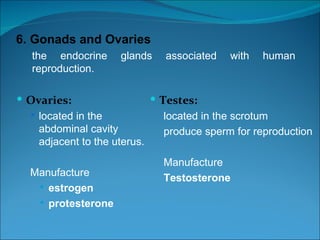
6. Gonads and Ovaries the endocrine glands associated with human reproduction. Ovaries: located in the abdominal cavity adjacent to the uterus.  Manufacture estrogen protesterone Testes: located in the scrotum produce sperm for reproduction Manufacture Testosterone
Hypothalamic Hormones/Factors Corticotropin releasing hormone (CRH)-  ACTH Thyrotropin releasing hormone (TRH)-  TSH Gonadotropin releasing Hormone (GnRH)-   FSH,LH Prolactin release inhibiting hormone (PRIH)-   Prolactin  Prolactin releasing factor (PRF)-   Prolactin
Growth hormone releasing hormone (GHRH)-  GH Growth hormone releasing  inhibiting  Factor (GHRIF)- GH Malinocyte-stimulating hormone releasing factor (MSH-RF)-  α , β  & ᵞ -MSH MSH release inhibiting factor (MSH-RIF)-  α , β  & ᵞ -MSH
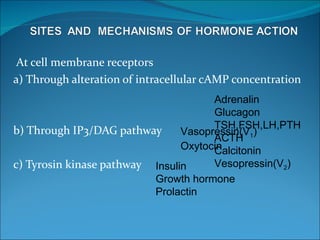
At cell membrane receptors a) Through alteration of intracellular cAMP concentration b) Through IP3/DAG pathway c) Tyrosin kinase pathway Adrenalin Glucagon TSH,FSH,LH,PTH ACTH Calcitonin Vesopressin(V 2 ) Vasopressin(V 1 ) Oxytocin Insulin Growth hormone Prolactin
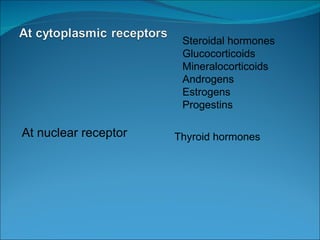
Steroidal hormones Glucocorticoids Mineralocorticoids Androgens Estrogens Progestins At nuclear receptor Thyroid hormones
 
Stimuli which cause growth hormone release Fasting Hypoglycaemia Exercise Stress Gh secretion is ↓ by  ↑  in plasma free fatty acids High dose of glucocorticoids β  adrenergic agonist Gh secretion is ↑ by   5HT agonist α adrenergic agonist
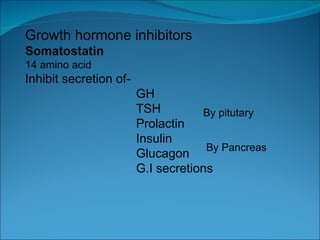
Growth hormone inhibitors Somatostatin 14 amino acid Inhibit secretion of-  GH TSH Prolactin Insulin Glucagon  G.I secretions  By pitutary By Pancreas
Synthetic octapeptide of  somatostatin 40 times more potent Long acting Use Acromegaly Secretory diarrhoeas associated with carcinoids, AIDS, cancer chemotherapy

Endocrine system

  • 1.
  • 2.
    Controls many bodyfunctions - exerts control by releasing special chemical substances into the blood called hormones - Hormones affect other endocrine glands or body systems Consists of several glands located in various parts of the body. 1.Pituitary gland
  • 3.
  • 4.
    The Pituitary Glandis divided into 2 areas Posterior Pituitary: oxytocin antidiuretic hormone ( ADH ) Anterior Pituitary: thyroid-stimulating hormone ( TSH ) growth hormone ( GH ) adrenocorticotropin ( ACTH ) follicle-stimulating hormone ( FSH ) luteinizing hormone ( LH ) prolactin
  • 5.
    2. ThyroidGland - lies in the anterior neck just below the larynyx. - Two lobes, located on either side of the trachea, connected by a narrow band of tissue called the isthmus . - Sacs inside the gland contain colloid thyroxine ( T4 ) triiodothyronine ( T3 ) “ C” cells within the thyroid produce the hormone calcitonin .
  • 6.
    Calcitonin , whenreleased, lowers the amount of calcium in the blood. hypothyroidism, or Myxedema. hyperthyroidism, commonly called Graves’ disease. Long term hyperthyroidism: Exopthalmos bulging of the eyeballs In severe cases - a medical emergency called t hyrotoxicosis can result.
  • 7.
    3. Parathyroid Glandssmall, pea-shaped glands, located in the neck near the thyroid usually 4 - number can vary regulate the level of calcium in the body produce parathyroid hormone -  level of calcium in blood Hypocalcemia can result if parathyroids are removed or destroyed.
  • 8.
    4. Pancreas Isletsof Langerhans specialized tissues in which the endocrine functions of the pancreas occurs include 3 types of cells: alpha (  ) beta (  ) delta (  ) each secretes an important hormone .
  • 9.
    Alpha ( ) cells release glucagon , essential for controlling blood glucose levels. When blood glucose levels fall,  cells  the amount of glucagon in the blood. Beta Cells (  ) release insulin (antagonistic to glucagon). Insulin  the rate at which various body cells take up glucose. Thus, insulin lowers the blood glucose level. Delta Cells (  ) produce somatostatin , which inhibits both glucagon and insulin.
  • 10.
    5. Adrenal Glands2 small glands that sit atop both kidneys. Each has 2 divisions, each with different functions. Adrenal Medulla catecholamine hormones norepinephrine epinephrine Adrenal Cortex steroid hormones glucocorticoids mineralocorticoids androgenic hormones
  • 11.
    6. Gonads andOvaries the endocrine glands associated with human reproduction. Ovaries: located in the abdominal cavity adjacent to the uterus. Manufacture estrogen protesterone Testes: located in the scrotum produce sperm for reproduction Manufacture Testosterone
  • 12.
    Hypothalamic Hormones/Factors Corticotropinreleasing hormone (CRH)- ACTH Thyrotropin releasing hormone (TRH)- TSH Gonadotropin releasing Hormone (GnRH)- FSH,LH Prolactin release inhibiting hormone (PRIH)- Prolactin Prolactin releasing factor (PRF)- Prolactin
  • 13.
    Growth hormone releasinghormone (GHRH)- GH Growth hormone releasing inhibiting Factor (GHRIF)- GH Malinocyte-stimulating hormone releasing factor (MSH-RF)- α , β & ᵞ -MSH MSH release inhibiting factor (MSH-RIF)- α , β & ᵞ -MSH
  • 14.
    At cell membranereceptors a) Through alteration of intracellular cAMP concentration b) Through IP3/DAG pathway c) Tyrosin kinase pathway Adrenalin Glucagon TSH,FSH,LH,PTH ACTH Calcitonin Vesopressin(V 2 ) Vasopressin(V 1 ) Oxytocin Insulin Growth hormone Prolactin
  • 15.
    Steroidal hormones GlucocorticoidsMineralocorticoids Androgens Estrogens Progestins At nuclear receptor Thyroid hormones
  • 16.
  • 17.
    Stimuli which causegrowth hormone release Fasting Hypoglycaemia Exercise Stress Gh secretion is ↓ by ↑ in plasma free fatty acids High dose of glucocorticoids β adrenergic agonist Gh secretion is ↑ by 5HT agonist α adrenergic agonist
  • 18.
    Growth hormone inhibitorsSomatostatin 14 amino acid Inhibit secretion of- GH TSH Prolactin Insulin Glucagon G.I secretions By pitutary By Pancreas
  • 19.
    Synthetic octapeptide of somatostatin 40 times more potent Long acting Use Acromegaly Secretory diarrhoeas associated with carcinoids, AIDS, cancer chemotherapy