PRESENTATION ON- GROWTH HORMONE
FACULTY OF PHARMACY
INTEGRAL UNIVERSITY, LUCKNOW
PRESENTED BY:
Abdullah Ansari
PRESENTED TO:
Dr. Anuradha Mishra
M. Pharm Ist Year
(Pharmacology)
2017
Growth Hormone
Synthesis & Source of Secretion
– Synthesized by chromphill cells of anterior
pituitary.
– Secreted by somatotropes which are the
acidophilic cells of anterior pituitary.
– They are in fact regulated by neuro-hormones
secreted by hypothalamus.
INTRODUCTION
Hormones are secreted by the endocrine or ductless glands.
These are---
1. Pituitary
(a) Anterior growth hormone (GH), prolactin (Prl),
Adrenocorticotropic hormone (ACTH, Corticotropin),
Thyroid stimulating hormone (TSH, Thyrotropin),
Gonadotropins—Follicle stimulating hormone (FSH) and Luteinizing
hormone(LH).
(b) Posterior—Oxytosin,
2. Thyroid
Thyroxine (T4), Triidothyronine (T3), Calcitonin
3. Parathyroid Parathormone (PTH).
4. Pancreas (islets of langerhans) Insulin, Glucagon.
5. Adrenals
(a)Cortex Glucocorticoids (hydrocortisone)
Mineralocorticoids (aldesterone)
Sex steroids (dehydroepiandrosterone)
(b) Medulla Adrenaline, Noradrenaline
6. Gonads Androgens (testosterone)
estrogens (estradiol)
progestins (progesterone)
HGH USES & ABUSES
Some people turn to a substance called human growth hormone
 (HGH) in hopes that it will keep them feeling and looking
youthful. But use of these products can be harmful.
HGH, produced by the pituitary gland, spurs growth in
children and adolescents. It also helps to regulate body
composition, body fluids, muscle and bone growth, sugar and
fat metabolism, and possibly heart function. Produced
synthetically, HGH is the active ingredient in a number
of prescription drugs and in other products available all over the
world.
Synthetic human growth hormone was developed in 1985 and
approved by the FDA for specific uses in children and adults. In
children, HGH injections are approved for treating short stature of
unknown cause as well as poor growth due to a number of
medical causes, including:
•Turner's syndrome:- A genetic disorder that affects a girl's
development
•Prader-Willi syndrome:- An uncommon genetic disorder causing
poor muscle tone, low levels of sex hormones, and a constant
feeling of hunger
•Chronic kidney disease
•HGH deficiency or insufficiency
•Children born small for gestational age.
In adults, approved uses of HGH include:
Short bowel syndrome, a condition in which nutrients are not
properly absorbed due to severe intestinal disease or the surgical
removal of a large portion of the small intestine
HGH deficiency due to rare pituitary tumors or their treatment
Muscle-wasting disease associated with HIV/AIDS
But the most common uses for HGH are not FDA-approved. Some
people use the hormone, along with other performance-
enhancing drugs such as anabolic steroids in an attempt to build
muscle and improve athletic performance. Yet HGH's effect on
athletic performance is unknown.
Because the body's HGH levels naturally decrease with age, some
so-called anti-aging experts have speculated and claimed that
HGH products could reverse age-related bodily deterioration. But
these claims, too, are unproven. The use of HGH for anti-aging is
not FDA-approved.
• Chemistry, Blood Level and Daily Output
– Protein in nature, having a single-chain
polypeptide with 191 amino acids.
– Its molecular weight is 21,500.
– Basal level of GH concentration in blood:
• Normal adult: 300 g/dL
• Children:500 mg/dL
– Its daily output in adults is 0.5 to1.0 mg.
• Normal Growth Hormones Levels in
Body(Random)
1. Men: < 5 ng/mL
2. Women: < 10 ng/mL
3. Children: 0-20 ng/mL
4. Newborns: 5-40 ng/mL
• Half-life and Metabolism
–Half-life of circulating growth hormone is
about 20 minutes.
–It is degraded in liver and kidney
• Transport
–Transported in blood by GH-binding
proteins (GHBPs)
• Mode of Action of GH:
– GH act through somatomedin is a poly-peptide
through which growth hormone acts.
– It is secreted by liver.
– Somatomedins are of two types:
1. Insulin-like growth factor-I (IGF-I), which is also
called somatomedin C, acts on bones and protein
metabolism.
2. Insulin-like growth factor-II, plays an important role
in growth of fetus
– GH is transported in blood by loose binding with
plasma protein.
– It is released from plasma protein rapidly.
– Action also lasts only for a short duration of 20
minutes.
– But, the somatomedin C binds with plasma proteins
very strongly.
– Because of this, the molecules of somatomedin C are
released slowly from the plasma proteins.
– The action of somatomedin C lasts for about 20 hours.
Mode of action of somatomedin C:
– Somatomedin C acts through the second
messenger called cyclic AMP
– GH receptor is called growth hormone
secretagogue
– GH binds with the receptor situated mainly in liver
cells and forms the hormonereceptor complex.
– Hormone-receptor complex induces various
intracellular enzyme pathways, resulting in
somatomedin secretion.
– Somatomedin in turn, executes the actions of
growth hormone.
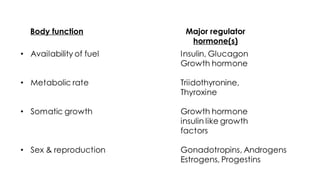
Body function Major regulator
hormone(s)
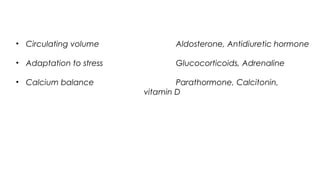
• Circulating volume Aldosterone, Antidiuretic hormone
• Adaptation to stress Glucocorticoids, Adrenaline
• Calcium balance Parathormone, Calcitonin,
vitamin D
• Actions of Growth Hormone
– Responsible for the general growth of the body
– It increases the size and number of cells by mitotic
division.
– Also causes specific differentiation of certain types
of cells like bone cells and muscle cells.
– GH affects
1. Metabolism of carbohydrates, fats & proteins
2. Bones
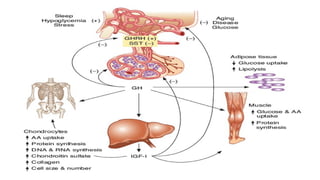
• Metabolism of Proteins:
– GH accelerates the synthesis of proteins
by:
1. Increasing amino acid transport through cell
membrane
2. Increasing transcription of DNA to RNA
3. Increasing ribonucleic acid RNA translation
4. Decreasing catabolism of protein
5. Promoting anabolism of proteins indirectly
• Metabolism of Fats:
• GH mobilizes fats from adipose tissue.
• Increases the concentration of fatty acids which are used
for the production of energy by the cells.
• Proteins are spared.
• During the utilization of fatty acids for energy production,
lot of aceto-acetic acid is produced by liver and is released
into the body fluids, leading to ketosis.
• Sometimes, excess mobilization of fat from the adipose
tissue causes accumulation of fat in liver, resulting in
fatty liver.
• Metabolism of Carbohydrates:
– Effects of GH on carbohydrate
metabolism:
1. Decrease in the peripheral utilization of
glucose for the production of energy
2. Increase in the deposition of glycogen in the
cells
3. Decrease in the uptake of glucose by the cells
4. Diabeto-genic effect of GH
• Effects on Bone:
– In embryonic stage, GH is responsible for
the differentiation and development of
bone cells.
– In later stages, GH increases the growth of
the skeleton.
– It increases both the length as well as the
thickness of the bones.
– In Bones, GH Increases:
1. Synthesis and deposition of proteins by
chondrocytes and osteogenic cells
2. Multiplication of chondrocytes and
osteogenic cells by enhancing the intestinal
calcium absorption
3. Formation of new bones by converting
chondrocytes into osteogenic cells
4. Availability of calcium mineralization of bone
matrix.
– GH increases the length of the bones, until
epiphysis fuses with shaft, which occurs at the
time of puberty.
– After the epiphyseal fusion, it stimulates the
osteoblasts strongly.
– Bone continues to grow in thickness throughout
the life particularly, the membranous bones such
as the jaw bone and the skull bones become
thicker under the influence of GH.
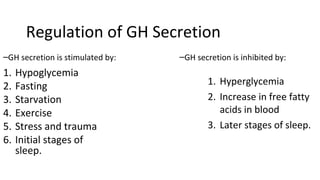
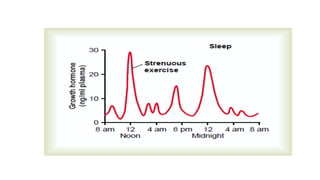
Regulation of GH Secretion
–GH secretion is stimulated by:
1. Hypoglycemia
2. Fasting
3. Starvation
4. Exercise
5. Stress and trauma
6. Initial stages of
sleep.
–GH secretion is inhibited by:
1. Hyperglycemia
2. Increase in free fatty
acids in blood
3. Later stages of sleep.
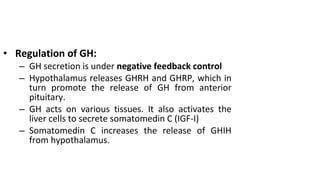
• Regulation of GH:
– GH secretion is under negative feedback control
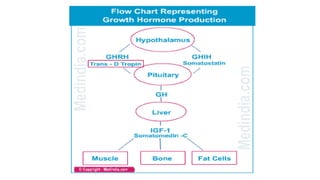
– Hypothalamus releases GHRH and GHRP, which in
turn promote the release of GH from anterior
pituitary.
– GH acts on various tissues. It also activates the
liver cells to secrete somatomedin C (IGF-I)
– Somatomedin C increases the release of GHIH
from hypothalamus.
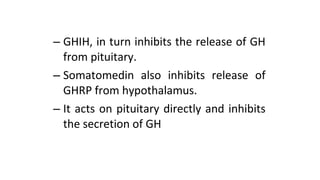
– GHIH, in turn inhibits the release of GH
from pituitary.
– Somatomedin also inhibits release of
GHRP from hypothalamus.
– It acts on pituitary directly and inhibits
the secretion of GH
THANK YOU

Growth hormone uses and abuses

  • 1.
    PRESENTATION ON- GROWTHHORMONE FACULTY OF PHARMACY INTEGRAL UNIVERSITY, LUCKNOW PRESENTED BY: Abdullah Ansari PRESENTED TO: Dr. Anuradha Mishra M. Pharm Ist Year (Pharmacology) 2017
  • 2.
    Growth Hormone Synthesis &Source of Secretion – Synthesized by chromphill cells of anterior pituitary. – Secreted by somatotropes which are the acidophilic cells of anterior pituitary. – They are in fact regulated by neuro-hormones secreted by hypothalamus. INTRODUCTION
  • 4.
    Hormones are secretedby the endocrine or ductless glands. These are--- 1. Pituitary (a) Anterior growth hormone (GH), prolactin (Prl), Adrenocorticotropic hormone (ACTH, Corticotropin), Thyroid stimulating hormone (TSH, Thyrotropin), Gonadotropins—Follicle stimulating hormone (FSH) and Luteinizing hormone(LH). (b) Posterior—Oxytosin, 2. Thyroid Thyroxine (T4), Triidothyronine (T3), Calcitonin
  • 5.
    3. Parathyroid Parathormone(PTH). 4. Pancreas (islets of langerhans) Insulin, Glucagon. 5. Adrenals (a)Cortex Glucocorticoids (hydrocortisone) Mineralocorticoids (aldesterone) Sex steroids (dehydroepiandrosterone) (b) Medulla Adrenaline, Noradrenaline 6. Gonads Androgens (testosterone) estrogens (estradiol) progestins (progesterone)
  • 6.
    HGH USES &ABUSES Some people turn to a substance called human growth hormone  (HGH) in hopes that it will keep them feeling and looking youthful. But use of these products can be harmful. HGH, produced by the pituitary gland, spurs growth in children and adolescents. It also helps to regulate body composition, body fluids, muscle and bone growth, sugar and fat metabolism, and possibly heart function. Produced synthetically, HGH is the active ingredient in a number of prescription drugs and in other products available all over the world.
  • 7.
    Synthetic human growthhormone was developed in 1985 and approved by the FDA for specific uses in children and adults. In children, HGH injections are approved for treating short stature of unknown cause as well as poor growth due to a number of medical causes, including: •Turner's syndrome:- A genetic disorder that affects a girl's development •Prader-Willi syndrome:- An uncommon genetic disorder causing poor muscle tone, low levels of sex hormones, and a constant feeling of hunger •Chronic kidney disease •HGH deficiency or insufficiency •Children born small for gestational age.
  • 8.
    In adults, approveduses of HGH include: Short bowel syndrome, a condition in which nutrients are not properly absorbed due to severe intestinal disease or the surgical removal of a large portion of the small intestine HGH deficiency due to rare pituitary tumors or their treatment Muscle-wasting disease associated with HIV/AIDS But the most common uses for HGH are not FDA-approved. Some people use the hormone, along with other performance- enhancing drugs such as anabolic steroids in an attempt to build muscle and improve athletic performance. Yet HGH's effect on athletic performance is unknown. Because the body's HGH levels naturally decrease with age, some so-called anti-aging experts have speculated and claimed that HGH products could reverse age-related bodily deterioration. But these claims, too, are unproven. The use of HGH for anti-aging is not FDA-approved.
  • 9.
    • Chemistry, BloodLevel and Daily Output – Protein in nature, having a single-chain polypeptide with 191 amino acids. – Its molecular weight is 21,500. – Basal level of GH concentration in blood: • Normal adult: 300 g/dL • Children:500 mg/dL – Its daily output in adults is 0.5 to1.0 mg.
  • 10.
    • Normal GrowthHormones Levels in Body(Random) 1. Men: < 5 ng/mL 2. Women: < 10 ng/mL 3. Children: 0-20 ng/mL 4. Newborns: 5-40 ng/mL
  • 11.
    • Half-life andMetabolism –Half-life of circulating growth hormone is about 20 minutes. –It is degraded in liver and kidney • Transport –Transported in blood by GH-binding proteins (GHBPs)
  • 12.
    • Mode ofAction of GH: – GH act through somatomedin is a poly-peptide through which growth hormone acts. – It is secreted by liver. – Somatomedins are of two types: 1. Insulin-like growth factor-I (IGF-I), which is also called somatomedin C, acts on bones and protein metabolism. 2. Insulin-like growth factor-II, plays an important role in growth of fetus
  • 13.
    – GH istransported in blood by loose binding with plasma protein. – It is released from plasma protein rapidly. – Action also lasts only for a short duration of 20 minutes. – But, the somatomedin C binds with plasma proteins very strongly. – Because of this, the molecules of somatomedin C are released slowly from the plasma proteins. – The action of somatomedin C lasts for about 20 hours.
  • 14.
    Mode of actionof somatomedin C: – Somatomedin C acts through the second messenger called cyclic AMP – GH receptor is called growth hormone secretagogue – GH binds with the receptor situated mainly in liver cells and forms the hormonereceptor complex. – Hormone-receptor complex induces various intracellular enzyme pathways, resulting in somatomedin secretion. – Somatomedin in turn, executes the actions of growth hormone.
  • 15.
    Body function Majorregulator hormone(s)
  • 16.
    • Circulating volumeAldosterone, Antidiuretic hormone • Adaptation to stress Glucocorticoids, Adrenaline • Calcium balance Parathormone, Calcitonin, vitamin D
  • 17.
    • Actions ofGrowth Hormone – Responsible for the general growth of the body – It increases the size and number of cells by mitotic division. – Also causes specific differentiation of certain types of cells like bone cells and muscle cells. – GH affects 1. Metabolism of carbohydrates, fats & proteins 2. Bones
  • 18.
    • Metabolism ofProteins: – GH accelerates the synthesis of proteins by: 1. Increasing amino acid transport through cell membrane 2. Increasing transcription of DNA to RNA 3. Increasing ribonucleic acid RNA translation 4. Decreasing catabolism of protein 5. Promoting anabolism of proteins indirectly
  • 19.
    • Metabolism ofFats: • GH mobilizes fats from adipose tissue. • Increases the concentration of fatty acids which are used for the production of energy by the cells. • Proteins are spared. • During the utilization of fatty acids for energy production, lot of aceto-acetic acid is produced by liver and is released into the body fluids, leading to ketosis. • Sometimes, excess mobilization of fat from the adipose tissue causes accumulation of fat in liver, resulting in fatty liver.
  • 20.
    • Metabolism ofCarbohydrates: – Effects of GH on carbohydrate metabolism: 1. Decrease in the peripheral utilization of glucose for the production of energy 2. Increase in the deposition of glycogen in the cells 3. Decrease in the uptake of glucose by the cells 4. Diabeto-genic effect of GH
  • 21.
    • Effects onBone: – In embryonic stage, GH is responsible for the differentiation and development of bone cells. – In later stages, GH increases the growth of the skeleton. – It increases both the length as well as the thickness of the bones.
  • 22.
    – In Bones,GH Increases: 1. Synthesis and deposition of proteins by chondrocytes and osteogenic cells 2. Multiplication of chondrocytes and osteogenic cells by enhancing the intestinal calcium absorption 3. Formation of new bones by converting chondrocytes into osteogenic cells 4. Availability of calcium mineralization of bone matrix.
  • 23.
    – GH increasesthe length of the bones, until epiphysis fuses with shaft, which occurs at the time of puberty. – After the epiphyseal fusion, it stimulates the osteoblasts strongly. – Bone continues to grow in thickness throughout the life particularly, the membranous bones such as the jaw bone and the skull bones become thicker under the influence of GH.
  • 25.
    Regulation of GHSecretion –GH secretion is stimulated by: 1. Hypoglycemia 2. Fasting 3. Starvation 4. Exercise 5. Stress and trauma 6. Initial stages of sleep. –GH secretion is inhibited by: 1. Hyperglycemia 2. Increase in free fatty acids in blood 3. Later stages of sleep.
  • 27.
    • Regulation ofGH: – GH secretion is under negative feedback control – Hypothalamus releases GHRH and GHRP, which in turn promote the release of GH from anterior pituitary. – GH acts on various tissues. It also activates the liver cells to secrete somatomedin C (IGF-I) – Somatomedin C increases the release of GHIH from hypothalamus.
  • 28.
    – GHIH, inturn inhibits the release of GH from pituitary. – Somatomedin also inhibits release of GHRP from hypothalamus. – It acts on pituitary directly and inhibits the secretion of GH
  • 29.