1
Multiple Regression Analysis
y = 0 + 1x1 + 2x2 + . . . kxk + u
6. Heteroskedasticity
2
What is Heteroskedasticity
Recall the assumption of homoskedasticity
implied that conditional on the explanatory
variables, the variance of the unobserved error, u,
was constant
If this is not true, that is if the variance of u is
different for different values of the x’s, then the
errors are heteroskedastic
Example: estimating returns to education and
ability is unobservable, and think the variance in
ability differs by educational attainment
3
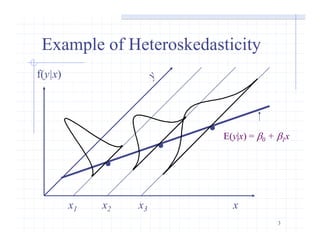
.
xx1 x2
f(y|x)
Example of Heteroskedasticity
x3
.
. E(y|x) = 0 + 1x
4
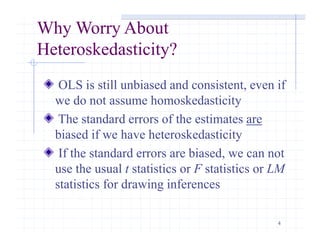
Why Worry About
Heteroskedasticity?
OLS is still unbiased and consistent, even if
we do not assume homoskedasticity
The standard errors of the estimates are
biased if we have heteroskedasticity
If the standard errors are biased, we can not
use the usual t statistics or F statistics or LM
statistics for drawing inferences
5
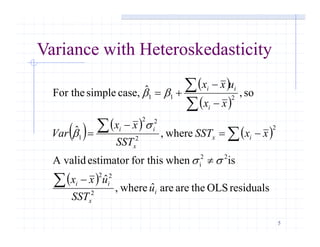
Variance with Heteroskedasticity
 
 
   
 
 
residualsOLStheareareˆwhere,
ˆ
iswhenfor thisestimatorA valid
where,ˆ
so,ˆcase,simpleFor the
2
22
22
i
2
2
22
1
211
i
x
ii
ix
x
ii
i
ii
u
SST
uxx
xxSST
SST
xx
Var
xx
uxx












ss
s


6
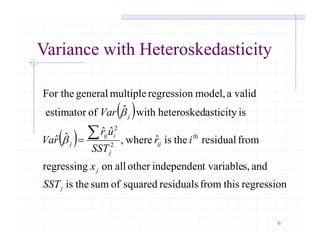
Variance with Heteroskedasticity
 
 
regressionthisfromresidualssquaredofsumtheis
ands,t variableindependenotherallonregressing
fromresidualtheisˆwhere,
ˆˆ
ˆˆ
isasticityheteroskedwithˆofestimator
validamodel,regressionmultiplegeneralFor the
th
2
2
j
j
ij
j
iij
j
j
SST
x
ir
SST
ur
rVa
Var


7
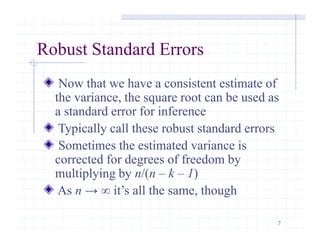
Robust Standard Errors
Now that we have a consistent estimate of
the variance, the square root can be used as
a standard error for inference
Typically call these robust standard errors
Sometimes the estimated variance is
corrected for degrees of freedom by
multiplying by n/(n – k – 1)
As n → ∞ it’s all the same, though
8
Robust Standard Errors (cont)
Important to remember that these robust
standard errors only have asymptotic
justification – with small sample sizes t
statistics formed with robust standard errors
will not have a distribution close to the t,
and inferences will not be correct
In Stata, robust standard errors are easily
obtained using the robust option of reg
9
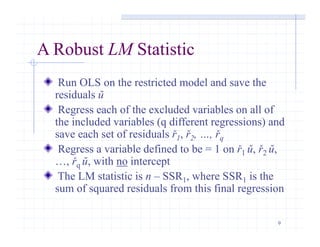
A Robust LM Statistic
Run OLS on the restricted model and save the
residuals ŭ
Regress each of the excluded variables on all of
the included variables (q different regressions) and
save each set of residuals ř1, ř2, …, řq
Regress a variable defined to be = 1 on ř1 ŭ, ř2 ŭ,
…, řq ŭ, with no intercept
The LM statistic is n – SSR1, where SSR1 is the
sum of squared residuals from this final regression
10
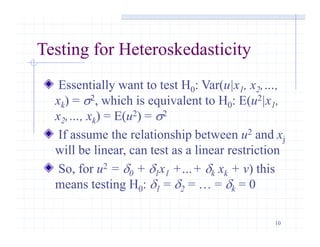
Testing for Heteroskedasticity
Essentially want to test H0: Var(u|x1, x2,…,
xk) = s2, which is equivalent to H0: E(u2|x1,
x2,…, xk) = E(u2) = s2
If assume the relationship between u2 and xj
will be linear, can test as a linear restriction
So, for u2 = d0 + d1x1 +…+ dk xk + v) this
means testing H0: d1 = d2 = … = dk = 0
11
The Breusch-Pagan Test
Don’t observe the error, but can estimate it with
the residuals from the OLS regression
After regressing the residuals squared on all of the
x’s, can use the R2 to form an F or LM test
The F statistic is just the reported F statistic for
overall significance of the regression, F =
[R2/k]/[(1 – R2)/(n – k – 1)], which is distributed
Fk, n – k - 1
The LM statistic is LM = nR2, which is distributed
c2
k
12
The White Test
The Breusch-Pagan test will detect any
linear forms of heteroskedasticity
The White test allows for nonlinearities by
using squares and crossproducts of all the x’s
Still just using an F or LM to test whether
all the xj, xj
2, and xjxh are jointly significant
This can get to be unwieldy pretty quickly
13
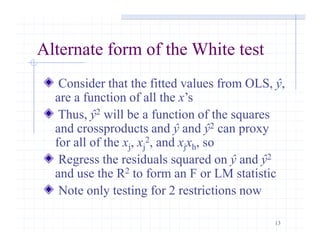
Alternate form of the White test
Consider that the fitted values from OLS, ŷ,
are a function of all the x’s
Thus, ŷ2 will be a function of the squares
and crossproducts and ŷ and ŷ2 can proxy
for all of the xj, xj
2, and xjxh, so
Regress the residuals squared on ŷ and ŷ2
and use the R2 to form an F or LM statistic
Note only testing for 2 restrictions now
14
Weighted Least Squares
While it’s always possible to estimate
robust standard errors for OLS estimates, if
we know something about the specific form
of the heteroskedasticity, we can obtain
more efficient estimates than OLS
The basic idea is going to be to transform
the model into one that has homoskedastic
errors – called weighted least squares
15
Case of form being known up to
a multiplicative constant
Suppose the heteroskedasticity can be
modeled as Var(u|x) = s2h(x), where the
trick is to figure out what h(x) ≡ hi looks like
E(ui/√hi|x) = 0, because hi is only a function
of x, and Var(ui/√hi|x) = s2, because we
know Var(u|x) = s2hi
So, if we divided our whole equation by √hi
we would have a model where the error is
homoskedastic
16
Generalized Least Squares
Estimating the transformed equation by
OLS is an example of generalized least
squares (GLS)
GLS will be BLUE in this case
GLS is a weighted least squares (WLS)
procedure where each squared residual is
weighted by the inverse of Var(ui|xi)
17
Weighted Least Squares
While it is intuitive to see why performing
OLS on a transformed equation is
appropriate, it can be tedious to do the
transformation
Weighted least squares is a way of getting
the same thing, without the transformation
Idea is to minimize the weighted sum of
squares (weighted by 1/hi)
18
More on WLS
WLS is great if we know what Var(ui|xi)
looks like
In most cases, won’t know form of
heteroskedasticity
Example where do is if data is aggregated,
but model is individual level
Want to weight each aggregate observation
by the inverse of the number of individuals
19
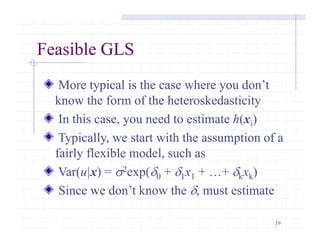
Feasible GLS
More typical is the case where you don’t
know the form of the heteroskedasticity
In this case, you need to estimate h(xi)
Typically, we start with the assumption of a
fairly flexible model, such as
Var(u|x) = s2exp(d0 + d1x1 + …+ dkxk)
Since we don’t know the d, must estimate
20
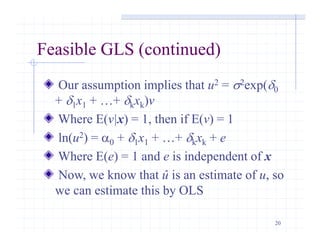
Feasible GLS (continued)
Our assumption implies that u2 = s2exp(d0
+ d1x1 + …+ dkxk)v
Where E(v|x) = 1, then if E(v) = 1
ln(u2) = a0 + d1x1 + …+ dkxk + e
Where E(e) = 1 and e is independent of x
Now, we know that û is an estimate of u, so
we can estimate this by OLS
21
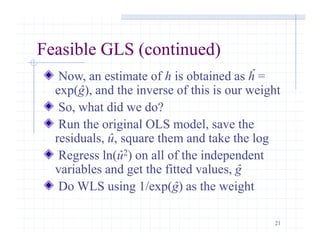
Feasible GLS (continued)
Now, an estimate of h is obtained as ĥ =
exp(ĝ), and the inverse of this is our weight
So, what did we do?
Run the original OLS model, save the
residuals, û, square them and take the log
Regress ln(û2) on all of the independent
variables and get the fitted values, ĝ
Do WLS using 1/exp(ĝ) as the weight
22
WLS Wrapup
When doing F tests with WLS, form the weights
from the unrestricted model and use those weights to
do WLS on the restricted model as well as the
unrestricted model
Remember we are using WLS just for efficiency –
OLS is still unbiased & consistent
Estimates will still be different due to sampling
error, but if they are very different then it’s likely that
some other Gauss-Markov assumption is false

Chapter8

  • 1.
    1 Multiple Regression Analysis y= 0 + 1x1 + 2x2 + . . . kxk + u 6. Heteroskedasticity
  • 2.
    2 What is Heteroskedasticity Recallthe assumption of homoskedasticity implied that conditional on the explanatory variables, the variance of the unobserved error, u, was constant If this is not true, that is if the variance of u is different for different values of the x’s, then the errors are heteroskedastic Example: estimating returns to education and ability is unobservable, and think the variance in ability differs by educational attainment
  • 3.
    3 . xx1 x2 f(y|x) Example ofHeteroskedasticity x3 . . E(y|x) = 0 + 1x
  • 4.
    4 Why Worry About Heteroskedasticity? OLSis still unbiased and consistent, even if we do not assume homoskedasticity The standard errors of the estimates are biased if we have heteroskedasticity If the standard errors are biased, we can not use the usual t statistics or F statistics or LM statistics for drawing inferences
  • 5.
    5 Variance with Heteroskedasticity            residualsOLStheareareˆwhere, ˆ iswhenfor thisestimatorA valid where,ˆ so,ˆcase,simpleFor the 2 22 22 i 2 2 22 1 211 i x ii ix x ii i ii u SST uxx xxSST SST xx Var xx uxx             ss s  
  • 6.
    6 Variance with Heteroskedasticity    regressionthisfromresidualssquaredofsumtheis ands,t variableindependenotherallonregressing fromresidualtheisˆwhere, ˆˆ ˆˆ isasticityheteroskedwithˆofestimator validamodel,regressionmultiplegeneralFor the th 2 2 j j ij j iij j j SST x ir SST ur rVa Var  
  • 7.
    7 Robust Standard Errors Nowthat we have a consistent estimate of the variance, the square root can be used as a standard error for inference Typically call these robust standard errors Sometimes the estimated variance is corrected for degrees of freedom by multiplying by n/(n – k – 1) As n → ∞ it’s all the same, though
  • 8.
    8 Robust Standard Errors(cont) Important to remember that these robust standard errors only have asymptotic justification – with small sample sizes t statistics formed with robust standard errors will not have a distribution close to the t, and inferences will not be correct In Stata, robust standard errors are easily obtained using the robust option of reg
  • 9.
    9 A Robust LMStatistic Run OLS on the restricted model and save the residuals ŭ Regress each of the excluded variables on all of the included variables (q different regressions) and save each set of residuals ř1, ř2, …, řq Regress a variable defined to be = 1 on ř1 ŭ, ř2 ŭ, …, řq ŭ, with no intercept The LM statistic is n – SSR1, where SSR1 is the sum of squared residuals from this final regression
  • 10.
    10 Testing for Heteroskedasticity Essentiallywant to test H0: Var(u|x1, x2,…, xk) = s2, which is equivalent to H0: E(u2|x1, x2,…, xk) = E(u2) = s2 If assume the relationship between u2 and xj will be linear, can test as a linear restriction So, for u2 = d0 + d1x1 +…+ dk xk + v) this means testing H0: d1 = d2 = … = dk = 0
  • 11.
    11 The Breusch-Pagan Test Don’tobserve the error, but can estimate it with the residuals from the OLS regression After regressing the residuals squared on all of the x’s, can use the R2 to form an F or LM test The F statistic is just the reported F statistic for overall significance of the regression, F = [R2/k]/[(1 – R2)/(n – k – 1)], which is distributed Fk, n – k - 1 The LM statistic is LM = nR2, which is distributed c2 k
  • 12.
    12 The White Test TheBreusch-Pagan test will detect any linear forms of heteroskedasticity The White test allows for nonlinearities by using squares and crossproducts of all the x’s Still just using an F or LM to test whether all the xj, xj 2, and xjxh are jointly significant This can get to be unwieldy pretty quickly
  • 13.
    13 Alternate form ofthe White test Consider that the fitted values from OLS, ŷ, are a function of all the x’s Thus, ŷ2 will be a function of the squares and crossproducts and ŷ and ŷ2 can proxy for all of the xj, xj 2, and xjxh, so Regress the residuals squared on ŷ and ŷ2 and use the R2 to form an F or LM statistic Note only testing for 2 restrictions now
  • 14.
    14 Weighted Least Squares Whileit’s always possible to estimate robust standard errors for OLS estimates, if we know something about the specific form of the heteroskedasticity, we can obtain more efficient estimates than OLS The basic idea is going to be to transform the model into one that has homoskedastic errors – called weighted least squares
  • 15.
    15 Case of formbeing known up to a multiplicative constant Suppose the heteroskedasticity can be modeled as Var(u|x) = s2h(x), where the trick is to figure out what h(x) ≡ hi looks like E(ui/√hi|x) = 0, because hi is only a function of x, and Var(ui/√hi|x) = s2, because we know Var(u|x) = s2hi So, if we divided our whole equation by √hi we would have a model where the error is homoskedastic
  • 16.
    16 Generalized Least Squares Estimatingthe transformed equation by OLS is an example of generalized least squares (GLS) GLS will be BLUE in this case GLS is a weighted least squares (WLS) procedure where each squared residual is weighted by the inverse of Var(ui|xi)
  • 17.
    17 Weighted Least Squares Whileit is intuitive to see why performing OLS on a transformed equation is appropriate, it can be tedious to do the transformation Weighted least squares is a way of getting the same thing, without the transformation Idea is to minimize the weighted sum of squares (weighted by 1/hi)
  • 18.
    18 More on WLS WLSis great if we know what Var(ui|xi) looks like In most cases, won’t know form of heteroskedasticity Example where do is if data is aggregated, but model is individual level Want to weight each aggregate observation by the inverse of the number of individuals
  • 19.
    19 Feasible GLS More typicalis the case where you don’t know the form of the heteroskedasticity In this case, you need to estimate h(xi) Typically, we start with the assumption of a fairly flexible model, such as Var(u|x) = s2exp(d0 + d1x1 + …+ dkxk) Since we don’t know the d, must estimate
  • 20.
    20 Feasible GLS (continued) Ourassumption implies that u2 = s2exp(d0 + d1x1 + …+ dkxk)v Where E(v|x) = 1, then if E(v) = 1 ln(u2) = a0 + d1x1 + …+ dkxk + e Where E(e) = 1 and e is independent of x Now, we know that û is an estimate of u, so we can estimate this by OLS
  • 21.
    21 Feasible GLS (continued) Now,an estimate of h is obtained as ĥ = exp(ĝ), and the inverse of this is our weight So, what did we do? Run the original OLS model, save the residuals, û, square them and take the log Regress ln(û2) on all of the independent variables and get the fitted values, ĝ Do WLS using 1/exp(ĝ) as the weight
  • 22.
    22 WLS Wrapup When doingF tests with WLS, form the weights from the unrestricted model and use those weights to do WLS on the restricted model as well as the unrestricted model Remember we are using WLS just for efficiency – OLS is still unbiased & consistent Estimates will still be different due to sampling error, but if they are very different then it’s likely that some other Gauss-Markov assumption is false