
International trade allows countries to specialize in producing goods where they have a comparative advantage and trade for goods they do not produce domestically. When trade is unrestricted, buyers and sellers have the option to purchase goods from either their domestic or international markets, choosing whichever market provides higher or lower prices. Countries engage in trade to benefit from differences in resources and technology between nations as well as to achieve scale economies in production.
INTERNATIONAL TRADE: Theeconomic interaction
among different nations involving the exchange of
goods and services, that is, exports and imports.
The guiding principle of international trade is
comparative advantage, which indicates that every
country, no matter their level of development, can
find something that it can produce cheaper than
another country.
INTRODUCTION
3.
International trade isthe sale and purchase of
goods across national boundaries.
Unrestricted International Trade – If international
trade is not restricted, buyers & sellers in one
country may purchase goods (& services) from
any other country.
Hence – each buyer and seller has the option
to make a transaction either in the domestic
market or abroad.
The choice depends on where you can get the
higher (lower) price if you are selling (buying)
4.
• Countries engagein international
trade for two basic reasons:
–Countries trade because they differ either in
their resources or in technology.
–Countries trade in order to achieve scale
economies or increasing returns in production.
5.
Advantages to consider:
Enhanceyour domestic competitiveness
Increase sales and profits
Gain your global market share
Reduce dependence on existing markets
Exploit international trade technology
Extend sales potential of existing products
Stabilize seasonal market fluctuations
Enhance potential for expansion of your
business
Sell excess production capacity
Maintain cost competitiveness in your domestic
market
6.
Advantages
Meeting our Needs
•Allows Countries to have access to many goods
that we are unable to produce ourselves
(equipments, motor vehicles….)
• Trading Partners get something they need by
trading something that they do not need
7.
Advantages
Job Creation
• Foreignbusinesses buy Countries products
and services, which leads to more jobs
Attracting Investment
• Investment follows trade
• Many foreign companies, when demand is
proven through trade, will invest in an office,
factory or distribution warehouse in the country
to simplify their trade and reduce costs
• This investment creates other jobs in
construction, sales and office management
8.
New Technology andMaterial
Development of new technology promotes
competitiveness and profitability
Newly developed technology sold through patents
to foreign companies – collecting annual fees,
royalty percentage or a one-time payment,
outlined very specifically in a contract
9.
Diverse Products andServices
Foreign trade opens up the world as a market,
delivering a wide range of foods, high fashions, and
new inventions to the domestic market
Foreign travel, banking, consultation and other
services are also available to the domestic
consumers.
Businesses must consider that their competition for
similar products and services is no longer just in the
same city but anywhere in the world.
10.
Disadvantages to keepin mind:
• You may need to wait for long-term gains
• Hire staff to launch international trading
• Modify your product or packaging
• Develop new promotional material
• Incur added administrative costs
• Dedicate personnel for traveling
• Wait long for payments
• Apply for additional financing
• Deal with special licenses and regulations
Monopolistic competition isa market structure in
which there are many competing producers, each
producing a differentiated product, and there is
free entry and exit in the long run.
Product differentiation takes three main forms: by
style or type, by location, or by quality
MONOPOLİSTİC COMPETİTİON
13.
PRODUCT DIFFERENTIATION
Product differentiationplays an even more
crucial role in monopolistically competitive
industries.
Why?
Tacit collusion is virtually impossible when
there are many producers. Hence, product
differentiation is the only way
monopolistically competitive firms can
acquire some market power.
14.
• Product differentiationis crucial to
monopolistic competition
• People value variety, even if it is not
material (real)
• Product differentiation takes place in
buyer’s mind
• Variety is valued but costly – we pay for it
CONTINUED….
15.
• Product differentiationdoes not
necessarily mean there are any physical
differences among products
– They might all be the same, but how they are
sold may make all the difference
• There are, of course, some very real
physical product differences.
– Buyers often differentiate based on real
physical differences, but differentiation is still
taking place in the buyers mind, and it may or
may not be based on real physical differences
CONTINUED…
16.
Advertising
• In monopolisticallycompetitive industries,
product differentiation and markup pricing
lead naturally to the use of advertising.
• In general, the more differentiated the products,
the more advertising firms buy.
• Economists disagree about the social value of
advertising.
17.
A monopolistically competitivefirm will always prefer to
make an additional sale at the going price, so it will engage
in advertising to increase demand for its product and
enhance its market power.
Advertising and brand names that provide useful information
to consumers are economically valuable. But they are
economically wasteful when their only purpose is to create
market power.
18.
BRAND NAME
• Abrand name is valuable to a firm; it makes the
demand less elastic and can enable the firm to earn
higher profits.
• Once a consumer has had a positive experience with
a good, the price elasticity of demand for that good
typically decreases—the consumer becomes loyal to
the product.
19.
COMPETITION WITH
DIFFERENTIATED PRODUCTS
•The Monopolistically Competitive Firm in
the Short Run
–Short-run economic profits encourage new
firms to enter the market. This:
• Increases the number of products offered.
• Reduces demand faced by firms already in the
market.
• Incumbent firms’ demand curves shift to the
left.
• Demand for the incumbent firms’ products fall,
and their profits decline.
20.
PRICE DISCRIMINATION
Question– Does price discrimination raise or
lower profit?
Price discrimination – selling the same good or
service at a number of different prices.
Answer – Price discrimination is a marketing
means to increase economic profit
21.
• Methods ofprice discrimination
Discriminate among groups of buyers
works when different buying groups are willing
to pay different prices (on the average) for the
same good or service
Example: Airline travel – prices target business
travelers vs. leisure time travelers
discriminator is advance notice, shorter the
notice, the higher the price
22.
Some Examples ofPrice Discrimination
– Doctors often charge rich patients more than
poor patients
• They may have one price for those with insurance
and another price for those without insurance
– Movies in the evening cost more than those in
the early afternoon
– Senior citizen, youth, and student discounts
– New and used cars
– Youth fairs on airlines.
23.
Motives for PriceDiscrimination
• In most cases, price discrimination is basically a
mechanism for rationing goods and services
• The main motivation for price discrimination is
to raise profits
– The greater the price discrimination, the greater the
profits because buyers lose some of their “consumer
surplus”
– If price discrimination were carried to its logical
conclusion, we would have perfect price
discrimination
• The buyers would lose all of their “consumer surplus”
24.
MANY SELLERS
When thereare many sellers, they do not take into
account rivals’ reactions.
The existence of many sellers makes collusion
difficult.
Monopolistically competitive firms act
independently.
There are many firms competing for the same group of customers.
Product examples include books, CDs, movies, computer
games, restaurants, piano lessons, cookies, furniture, etc.
25.
Easy Entry ofNew Firms in the Long Run
There are no significant barriers to entry.
Barriers to entry prevent competitive
pressures.
Ease of entry limits long-run profit.
26.
• The monopolisticcompetition model
can be used to show how trade leads to:
–A lower average price due to scale
economies
–The availability of a greater variety of
goods due to product differentiation
–Imports and exports within each industry
(intra-industry trade)
Monopolistic Competition
and Trade
27.
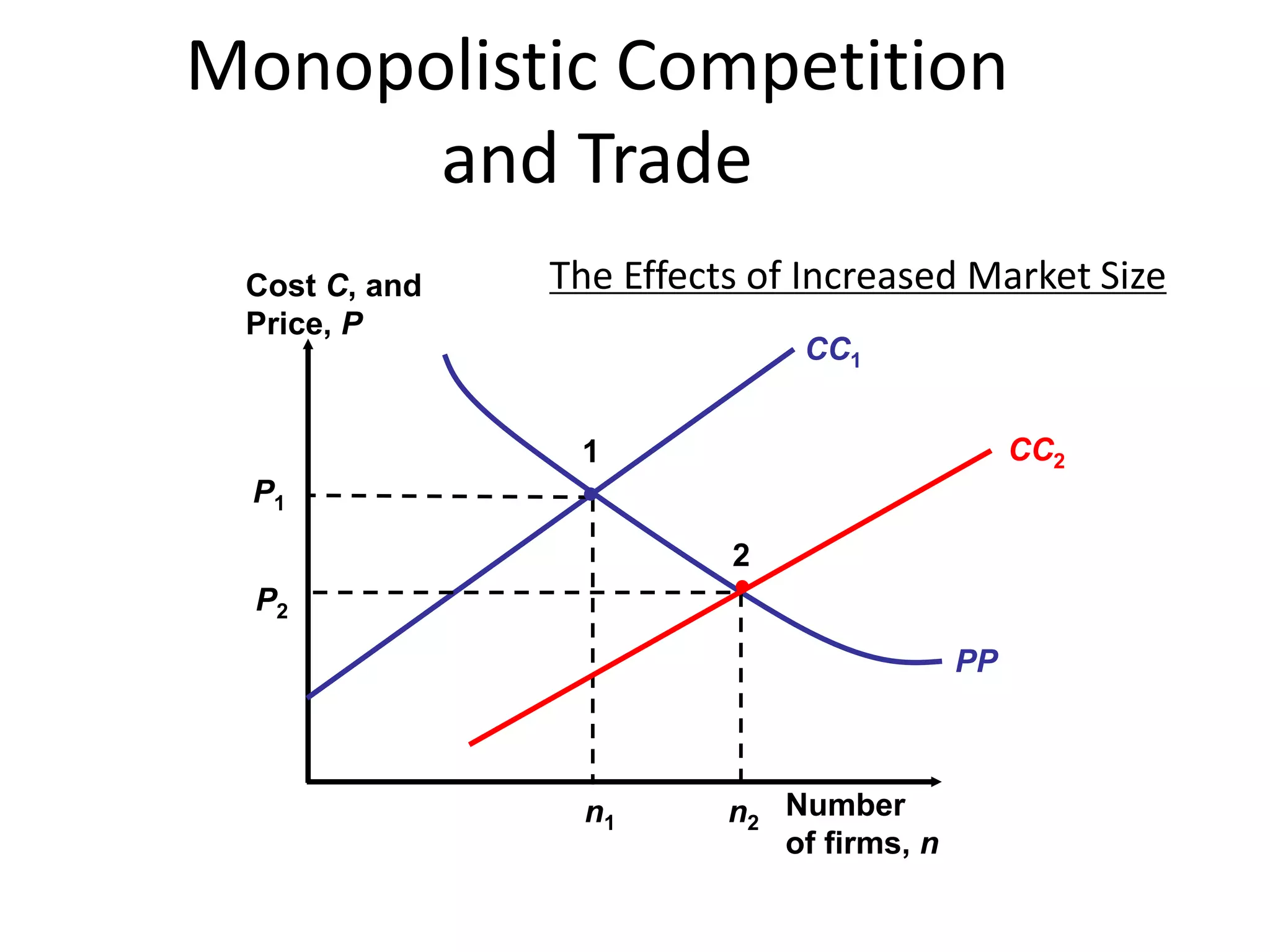
• The Effectsof Increased Market Size
–The number of firms in a monopolistically
competitive industry and the prices they
charge are affected by the size of the market.
Monopolistic Competition
and Trade
28.
Cost C, and
Price,P
Number
of firms, n
CC1
n1
P1
1
PP
n2
P2
2
CC2
Monopolistic Competition
and Trade
The Effects of Increased Market Size
29.
• Gains froman Integrated Market:
• International trade allows creation of an
integrated market that is larger than each
country’s market.
• It thus becomes possible to offer
consumers a greater variety of products
and lower prices.
Monopolistic Competition
and Trade
30.
• Assumptions:
– Thereare two countries: Home (the capital-
abundant country) and Foreign.
– There are two industries: manufactures (the
capital-intensive industry) and food.
– Neither country is able to produce the full
range of manufactured products by itself due
to economies of scale.
Economies of Scale and
Comparative Advantage
–If manufactures isa monopolistically
competitive sector, world trade consists of two
parts:
• Intraindustry trade
– The exchange of manufactures for manufactures
• Interindustry trade
– The exchange of manufactures for food
Monopolistic Competition
and Trade
Main differences betweeninterindustry
and intraindustry trade:
• Interindustry trade reflects comparative
advantage, whereas intraindustry trade does not.
• The pattern of intraindustry trade itself is
unpredictable, whereas that of interindustry
trade is determined by underlying differences
between countries.
• The relative importance of intraindustry and
interindustry trade depends on how similar
countries are.
• About one-fourthof world trade consists of
intra-industry trade.
• Intra-industry trade plays a particularly
large role in the trade in manufactured
goods among advanced industrial nations,
which accounts for most of world trade.
Significance of
Intraindustry trade
38.
• Intra industrytrade allows countries to benefit
from larger markets.
• Gains from intra industry trade will be large
when economies of scale are strong and
products are highly differentiated.
– For example, sophisticated manufactured goods.
39.
.
Continued…
–Consumers gain morevariety at a lower prices
than those that would prevail without trade.
–Production is more efficient. (Larger market
allows full exploitation of economies of scale.)
–When similar countries trade, the resulting
change in the income distribution (capital v.
labor) will be small
–Thus, everyone may gain from trade.
40.
DUMPING
• Dumping isthe practice of charging a lower price for
exported goods than for goods sold domestically.
• Dumping is an example of price discrimination:
the practice of charging different customers
different prices.
• Price discrimination and dumping may occur only if
– imperfect competition exists: firms are able to influence market
prices.
– markets are segmented so that goods are not easily bought in one
market and resold in another.
41.
• Dumping maybe a profit maximizing strategy because
of differences in foreign and domestic markets.
• One difference is that domestic firms usually have a
larger share of the domestic market than they do of
foreign markets.
– Because of less market dominance and more competition in
foreign markets, foreign sales are usually more responsive to
price changes than domestic sales.
– Domestic firms may be able to charge a high price in the
domestic market but must charge a low price on exports if
foreign consumers are more responsive to price changes.
Continued…
42.
• Two kindsof behavior arise in the general oligopoly
setting that are excluded by assumption from the
monopolistic competition model:
– Collusive behavior:
• Can raise the profits of all firms at the expense of consumers
• May be managed through explicit agreements or through tacit
coordination strategies
– Strategic behavior:
• Is adopted by firms to affect the behavior of competitors in a
desirable way
• Deters potential rivals from entering an industry
Limitations of Monopolistic
Competition
43.
CONCLUSION
Although the leveland the rate of economic
development depend primarily on internal conditions
in developing nations, international trade can
contribute significantly to the development process.
Some economists believed that international trade
and the functioning of the present international
economic system benefited developed nations at the
expense of developing nations
44.
A monopolistically competitivemarket is
characterized by three attributes: many firms,
differentiated products, and free entry.
Monopolistic competition allows for gains
from trade through lower costs and prices,
as well as through wider consumer choice.
45.
In general, trademay be divided into two kinds:
Two-way trade in differentiated products within an
industry (intraindustry trade).
Trade in which the products of one industry are
exchanged for products of another (interindustry
trade).
Dumping may be a profitable strategy when a firm faces
little competition in its domestic market and faces
heavy competition in foreign markets.
46.
Monopolistic competition havea significant influence on
international trade. The existence of large number of
sellers expand the market size and supply of
differentiated products.
The competition of firms through differentiated price
may cause losses, therefore they prefer non price
competition like advertisements, guarantees and
warranties.
Under monopolistic competition a country can achieve
variety of goods at low price and help to expand market
and integration of market