Autocorrelation -
Remedies
Shilpa Chaudhary
JDMC
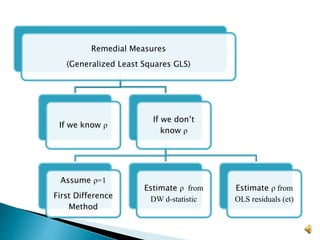
Remedial Measures
(Generalized Least Squares GLS)
If we know ρ
If we don’t
know ρ
Assume ρ=1
First Difference
Method
Estimate ρ from
DW d-statistic
Estimate ρ from
OLS residuals (et)
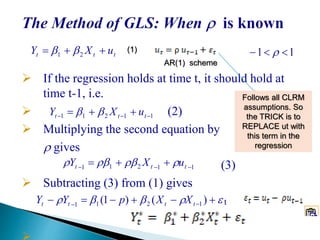
 If the regression holds at time t, it should hold at
time t-1, i.e.
 (2)
 Multiplying the second equation by
 gives
(3)
 Subtracting (3) from (1) gives
t
11211   ttt uXY 
11211 
 ttt uXY 
  
)()1( 1211 tttt XXpYY
ttt uXY  21  11  
AR(1) scheme
Follows all CLRM
assumptions. So
the TRICK is to
REPLACE ut with
this term in the
regression
(1)
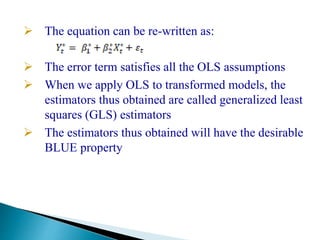
 The equation can be re-written as:
 The error term satisfies all the OLS assumptions
 When we apply OLS to transformed models, the
estimators thus obtained are called generalized least
squares (GLS) estimators
 The estimators thus obtained will have the desirable
BLUE property
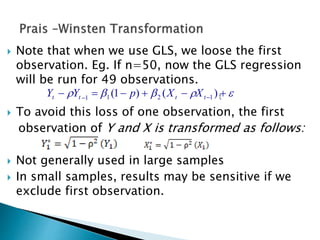
 Note that when we use GLS, we loose the first
observation. Eg. If n=50, now the GLS regression
will be run for 49 observations.
t
 To avoid this loss of one observation, the first
observation of Y and X is transformed as follows:
 Not generally used in large samples
 In small samples, results may be sensitive if we
exclude first observation.
  
)()1( 1211 tttt XXpYY
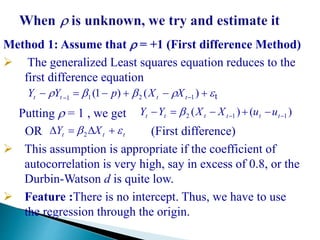
Method 1: Assume that  = +1 (First difference Method)
 The generalized Least squares equation reduces to the
first difference equation
t
Putting  = 1 , we get
OR (First difference)
 This assumption is appropriate if the coefficient of
autocorrelation is very high, say in excess of 0.8, or the
Durbin-Watson d is quite low.
 Feature :There is no intercept. Thus, we have to use
the regression through the origin.
)()( 112   tttttt uuXXYY 
ttt XY   2
  
)()1( 1211 tttt XXpYY
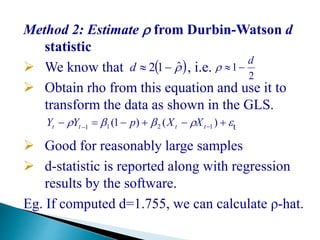
Method 2: Estimate  from Durbin-Watson d
statistic
 We know that , i.e.
 Obtain rho from this equation and use it to
transform the data as shown in the GLS.
t
 Good for reasonably large samples
 d-statistic is reported along with regression
results by the software.
Eg. If computed d=1.755, we can calculate ρ-hat.
2
1
d
 ˆ12 d
  
)()1( 1211 tttt XXpYY
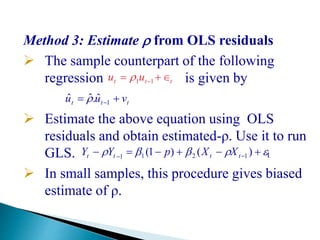
Method 3: Estimate  from OLS residuals
 The sample counterpart of the following
regression is given by
 Estimate the above equation using OLS
residuals and obtain estimated-ρ. Use it to run
GLS. t
 In small samples, this procedure gives biased
estimate of ρ.
ttt uu  11
ttt vuu  1
ˆ.ˆˆ 
  
)()1( 1211 tttt XXpYY
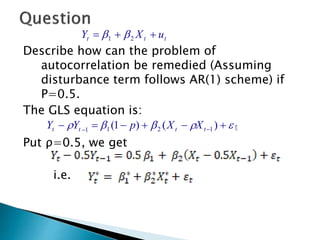
Describe how can the problem of
autocorrelation be remedied (Assuming
disturbance term follows AR(1) scheme) if
P=0.5.
The GLS equation is:
t
Put ρ=0.5, we get
i.e.
ttt uXY  21 
  
)()1( 1211 tttt XXpYY
Thank you

Autocorrelation- Remedial Measures

  • 1.
  • 2.
    Remedial Measures (Generalized LeastSquares GLS) If we know ρ If we don’t know ρ Assume ρ=1 First Difference Method Estimate ρ from DW d-statistic Estimate ρ from OLS residuals (et)
  • 3.
     If theregression holds at time t, it should hold at time t-1, i.e.  (2)  Multiplying the second equation by  gives (3)  Subtracting (3) from (1) gives t 11211   ttt uXY  11211   ttt uXY     )()1( 1211 tttt XXpYY ttt uXY  21  11   AR(1) scheme Follows all CLRM assumptions. So the TRICK is to REPLACE ut with this term in the regression (1)
  • 4.
     The equationcan be re-written as:  The error term satisfies all the OLS assumptions  When we apply OLS to transformed models, the estimators thus obtained are called generalized least squares (GLS) estimators  The estimators thus obtained will have the desirable BLUE property
  • 5.
     Note thatwhen we use GLS, we loose the first observation. Eg. If n=50, now the GLS regression will be run for 49 observations. t  To avoid this loss of one observation, the first observation of Y and X is transformed as follows:  Not generally used in large samples  In small samples, results may be sensitive if we exclude first observation.    )()1( 1211 tttt XXpYY
  • 6.
    Method 1: Assumethat  = +1 (First difference Method)  The generalized Least squares equation reduces to the first difference equation t Putting  = 1 , we get OR (First difference)  This assumption is appropriate if the coefficient of autocorrelation is very high, say in excess of 0.8, or the Durbin-Watson d is quite low.  Feature :There is no intercept. Thus, we have to use the regression through the origin. )()( 112   tttttt uuXXYY  ttt XY   2    )()1( 1211 tttt XXpYY
  • 7.
    Method 2: Estimate from Durbin-Watson d statistic  We know that , i.e.  Obtain rho from this equation and use it to transform the data as shown in the GLS. t  Good for reasonably large samples  d-statistic is reported along with regression results by the software. Eg. If computed d=1.755, we can calculate ρ-hat. 2 1 d  ˆ12 d    )()1( 1211 tttt XXpYY
  • 8.
    Method 3: Estimate from OLS residuals  The sample counterpart of the following regression is given by  Estimate the above equation using OLS residuals and obtain estimated-ρ. Use it to run GLS. t  In small samples, this procedure gives biased estimate of ρ. ttt uu  11 ttt vuu  1 ˆ.ˆˆ     )()1( 1211 tttt XXpYY
  • 9.
    Describe how canthe problem of autocorrelation be remedied (Assuming disturbance term follows AR(1) scheme) if P=0.5. The GLS equation is: t Put ρ=0.5, we get i.e. ttt uXY  21     )()1( 1211 tttt XXpYY
  • 10.