Atropisomerism in Biphenyl compounds
Stereochemistry
Biphenyl compounds
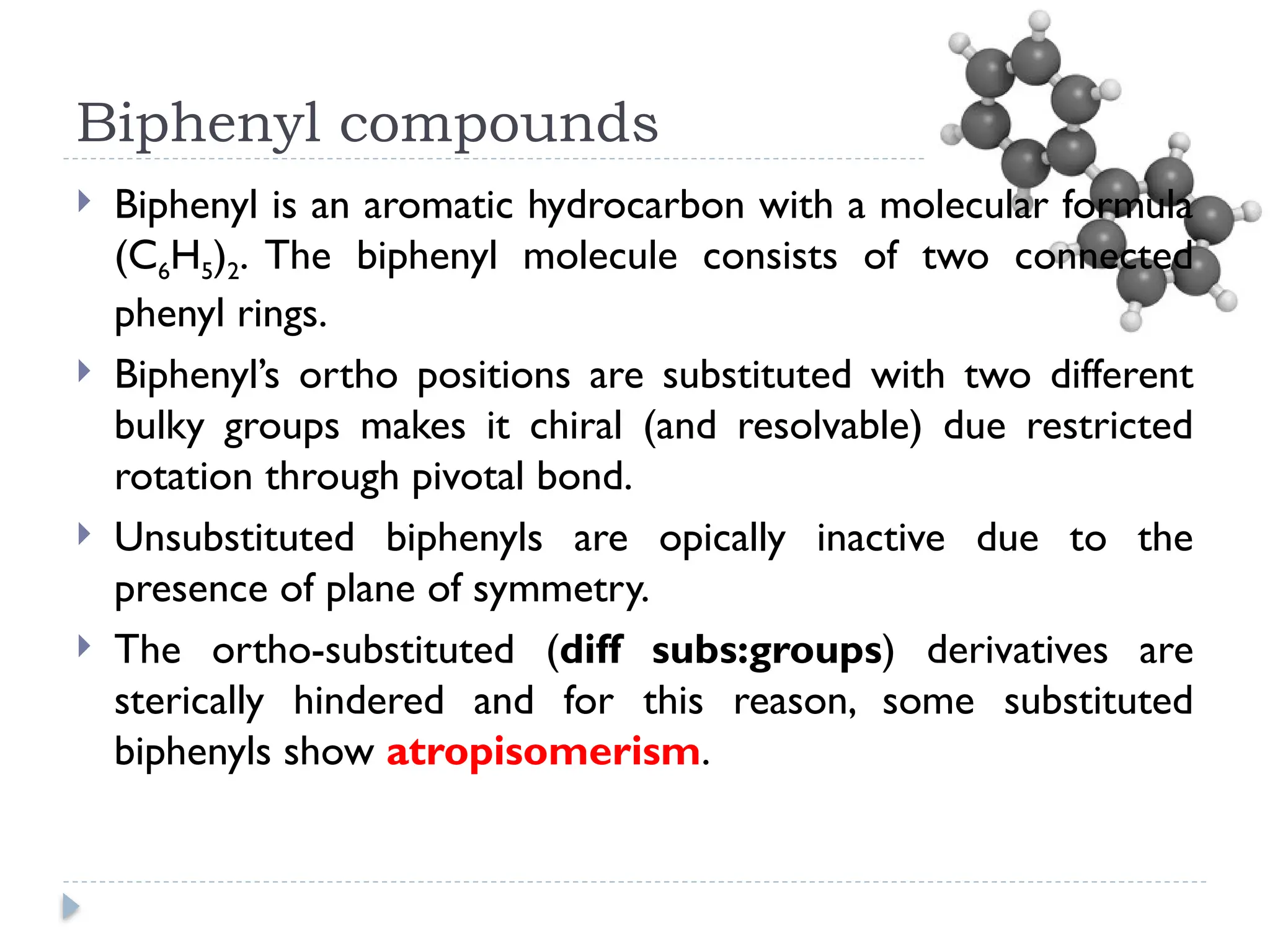
 Biphenyl is an aromatic hydrocarbon with a molecular formula
(C6H5)2. The biphenyl molecule consists of two connected
phenyl rings.
 Biphenyl’s ortho positions are substituted with two different
bulky groups makes it chiral (and resolvable) due restricted
rotation through pivotal bond.
 Unsubstituted biphenyls are opically inactive due to the
presence of plane of symmetry.
 The ortho-substituted (diff subs:groups) derivatives are
sterically hindered and for this reason, some substituted
biphenyls show atropisomerism.
Atropisomerism
 Atropisomers can be defined as isomers that can be
isolated due to prevention or restriction of rotation
about a given single bond, usually between two planar
moieties.
Atropisomerism is also called axial chirality.
Case of unsubstituted biphenyl:-
 The equilibrium torsional/dihedral angle is 44.4°.
 Then torsional barriers are quite small,
 6.0 kJ/mol at 0°
 6.5 kJ/mol at 90°.
 On adding ortho substituents greatly increases the
barrier:
 In the case of the 2, 2'-dimethyl derivative, the barrier is 17.4
kcal/mol (72.8 kJ/mol).
Case of substituted biphenyl:-
 Biphenyls substituted on ortho- position (which contains a
chiral axis along the biphenyl linkage) the biphenyl rings
need to be perpendicular to each other in order to
minimize steric clashes between the four ortho-
substituents.
 It means that rotation about the biphenyl bond through pivotal
bond is restricted.
 The interconversion between the two isomers (θ=0-90°) is
restricted (slow) therefore two isomers are separate entities,
and can resolved to its separate enantiomers.
Conditions for biphenyls to be
enantiomeric/resolvable:
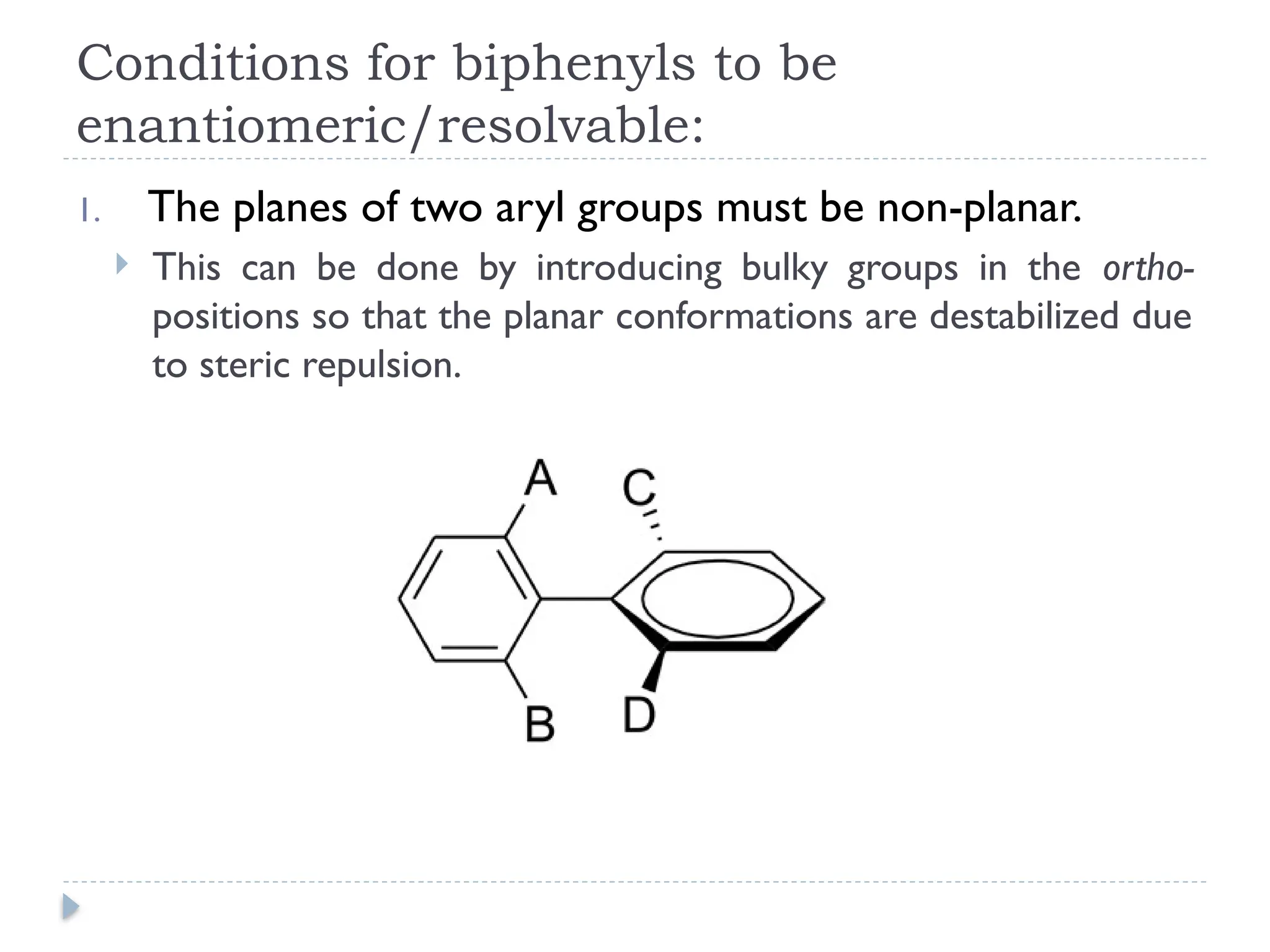
1. The planes of two aryl groups must be non-planar.
 This can be done by introducing bulky groups in the ortho-
positions so that the planar conformations are destabilized due
to steric repulsion.
Conditions for biphenyls to be
enantiomeric/resolvable:
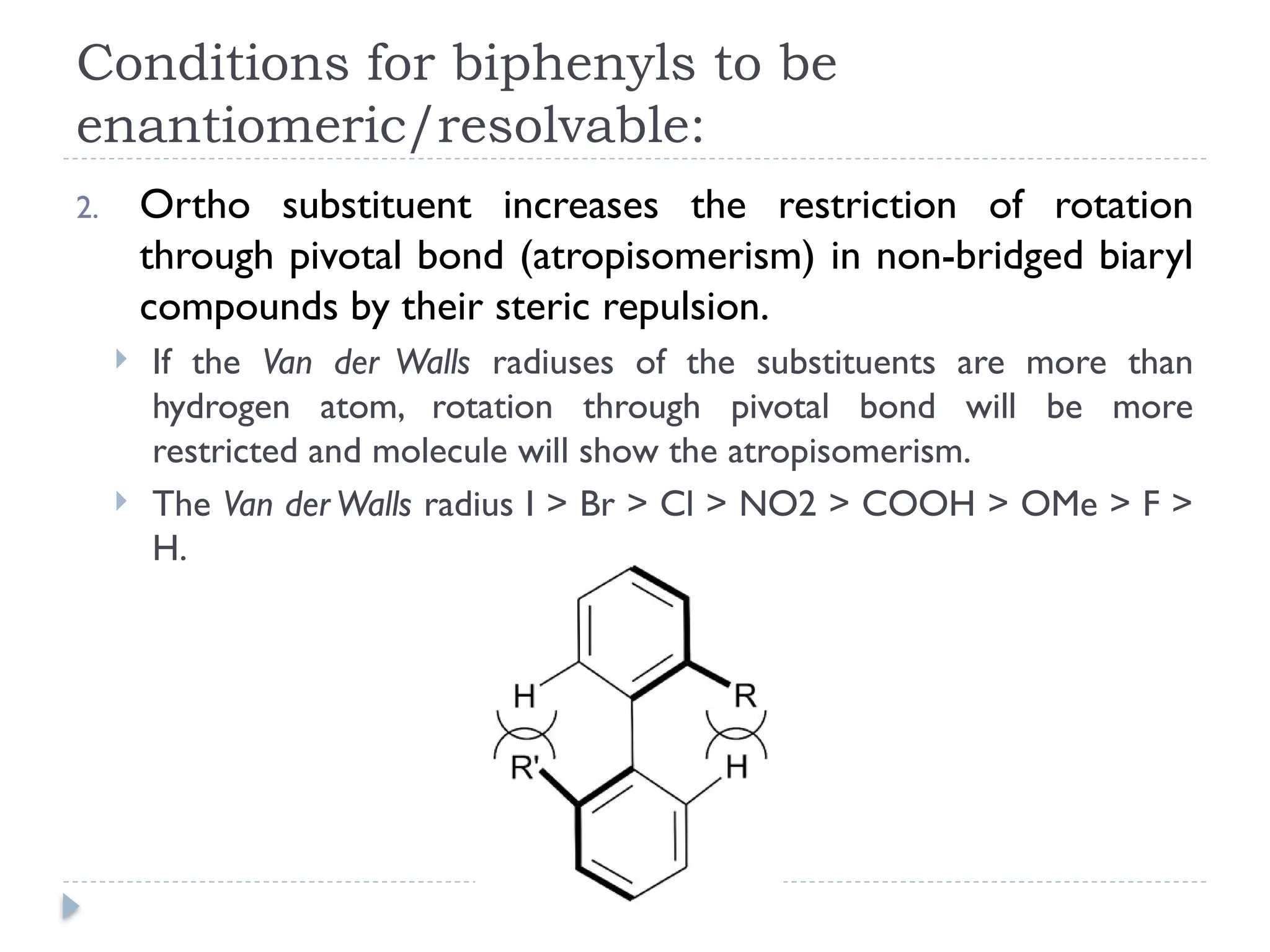
2. Ortho substituent increases the restriction of rotation
through pivotal bond (atropisomerism) in non-bridged biaryl
compounds by their steric repulsion.
 If the Van der Walls radiuses of the substituents are more than
hydrogen atom, rotation through pivotal bond will be more
restricted and molecule will show the atropisomerism.
 The Van der Walls radius I > Br > Cl > NO2 > COOH > OMe > F >
H.
Conditions for biphenyls to be
enantiomeric/resolvable:
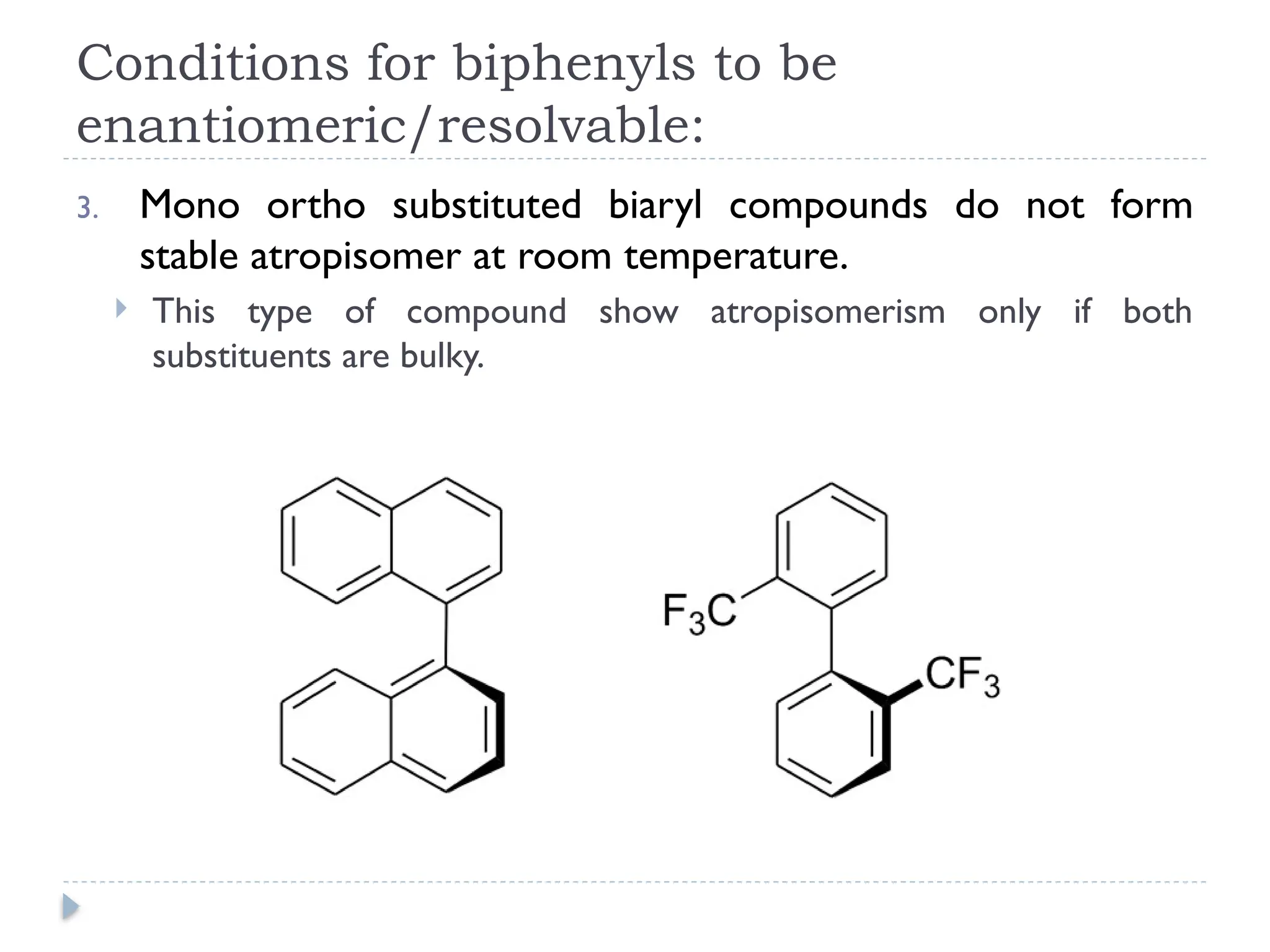
3. Mono ortho substituted biaryl compounds do not form
stable atropisomer at room temperature.
 This type of compound show atropisomerism only if both
substituents are bulky.
Conditions for biphenyls to be
enantiomeric/resolvable:
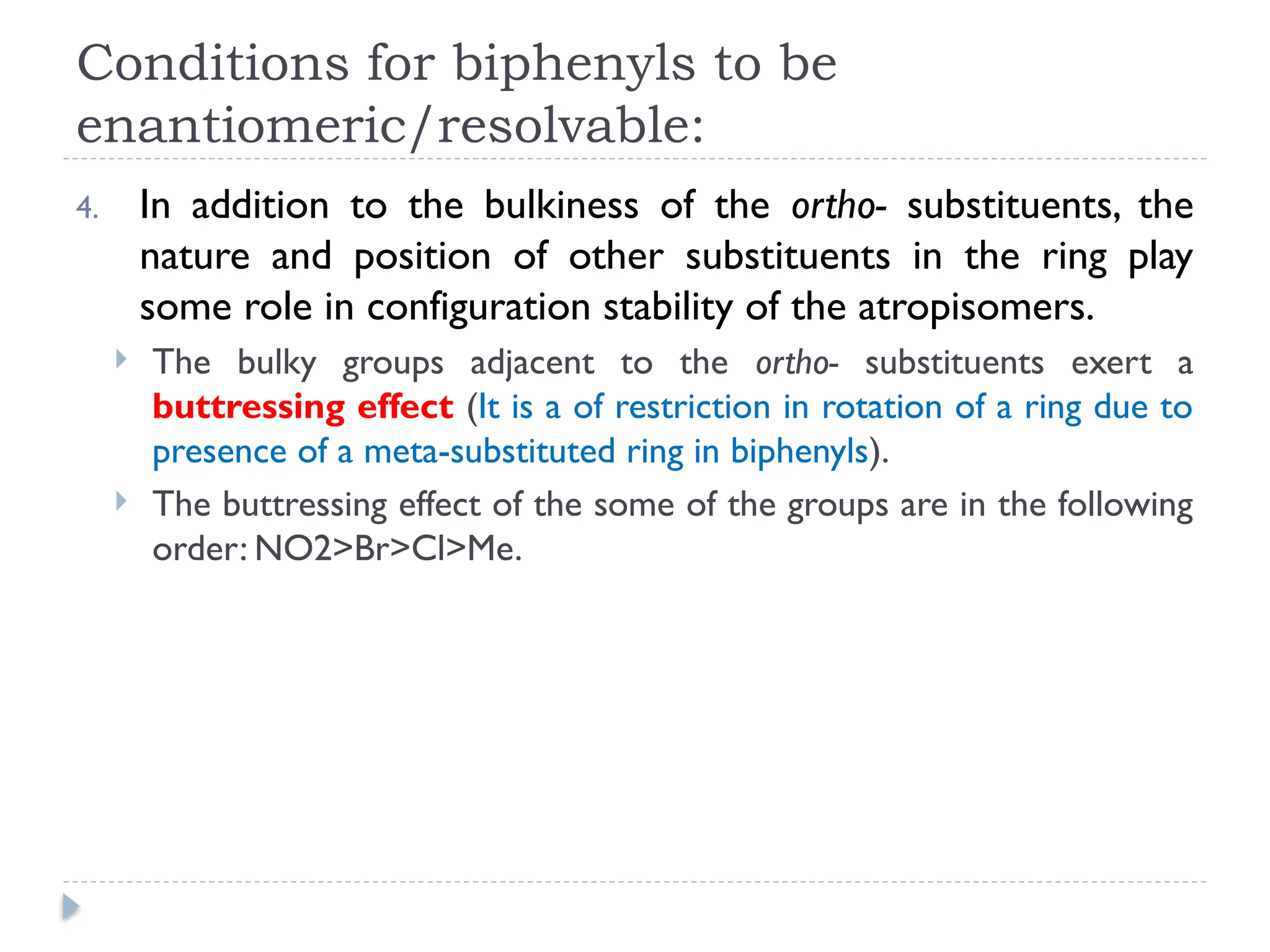
4. In addition to the bulkiness of the ortho- substituents, the
nature and position of other substituents in the ring play
some role in configuration stability of the atropisomers.
 The bulky groups adjacent to the ortho- substituents exert a
buttressing effect (It is a of restriction in rotation of a ring due to
presence of a meta-substituted ring in biphenyls).
 The buttressing effect of the some of the groups are in the following
order: NO2>Br>Cl>Me.
Conditions for biphenyls to be
enantiomeric/resolvable:
 The rate of racemization (conversion to other enantiomer through
rotation) is much lower in compound (I) than the compound (II).
 In compound (I) the bulkier group (NO2) is adjacent to methoxy but
in case of compound (II) the bulkier group is adjacent to hydrogen.
 Compound (I) is having more buttressing effect and racemization is
slow compared to the compound (II)
Conditions for biphenyls to be
enantiomeric/resolvable:
5. If two substituents on ortho position are similar but on meta
position substituents are different then these type of
molecules are chiral and are less common.
R = D, NH2, Br, I
Conditions for biphenyls to be
enantiomeric/resolvable:
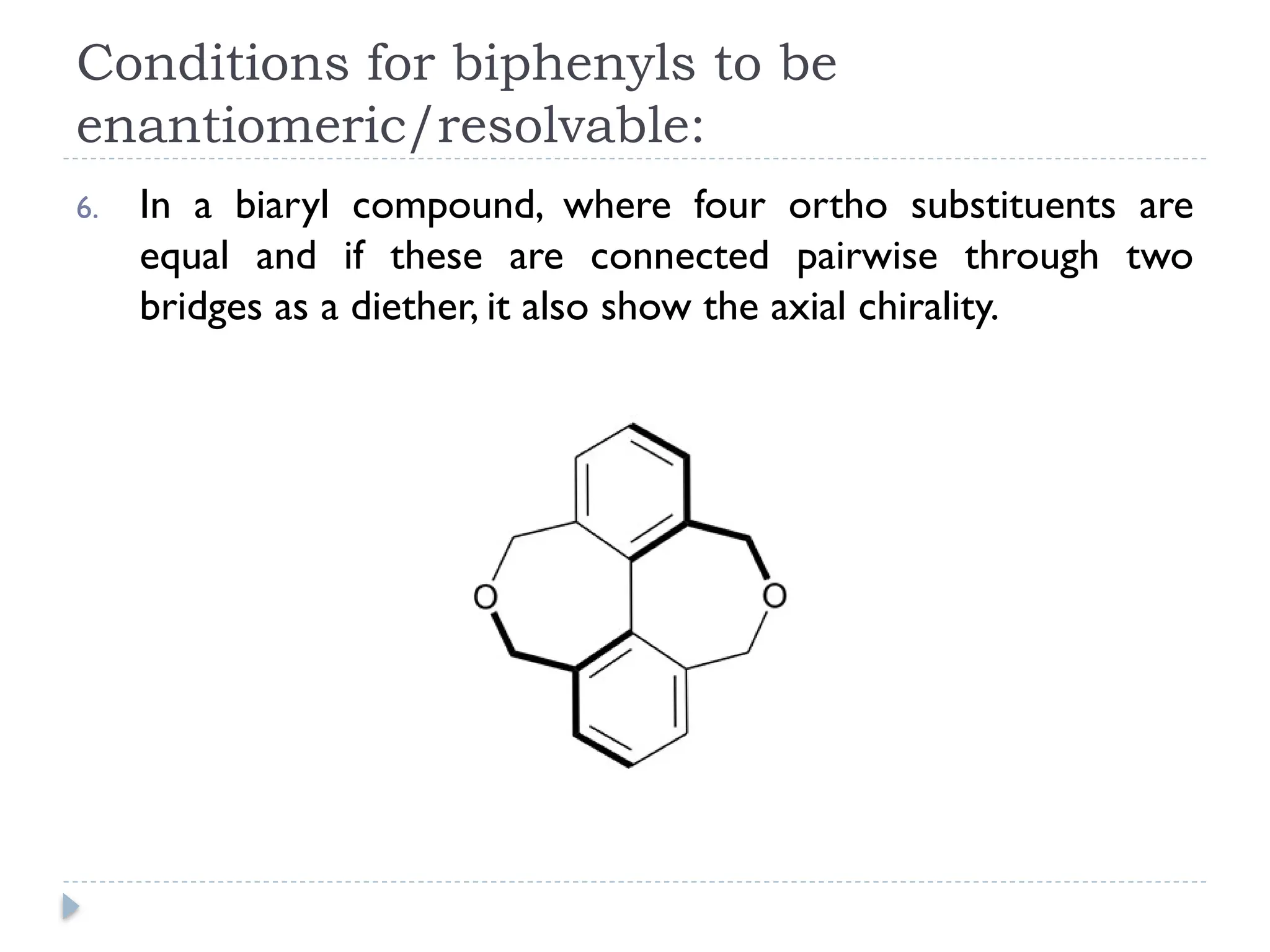
6. In a biaryl compound, where four ortho substituents are
equal and if these are connected pairwise through two
bridges as a diether, it also show the axial chirality.
Conditions for biphenyls to be
enantiomeric:
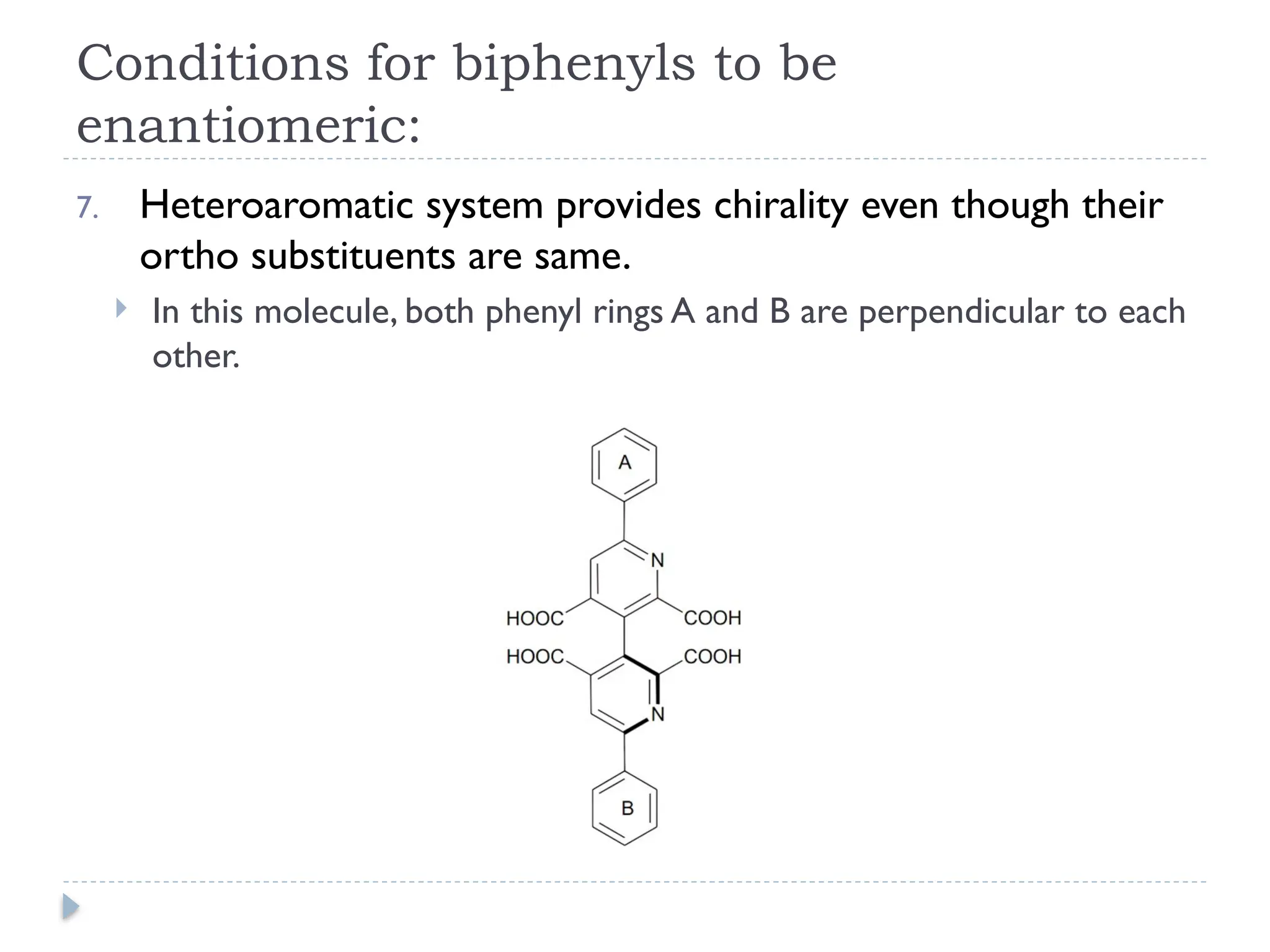
7. Heteroaromatic system provides chirality even though their
ortho substituents are same.
 In this molecule, both phenyl rings A and B are perpendicular to each
other.
NEXT SESSION
 Stereospecific & Stereoselective reactions.

Atropisomerism 123456789101112131415161718

  • 1.
    Atropisomerism in Biphenylcompounds Stereochemistry
  • 2.
    Biphenyl compounds  Biphenylis an aromatic hydrocarbon with a molecular formula (C6H5)2. The biphenyl molecule consists of two connected phenyl rings.  Biphenyl’s ortho positions are substituted with two different bulky groups makes it chiral (and resolvable) due restricted rotation through pivotal bond.  Unsubstituted biphenyls are opically inactive due to the presence of plane of symmetry.  The ortho-substituted (diff subs:groups) derivatives are sterically hindered and for this reason, some substituted biphenyls show atropisomerism.
  • 3.
    Atropisomerism  Atropisomers canbe defined as isomers that can be isolated due to prevention or restriction of rotation about a given single bond, usually between two planar moieties. Atropisomerism is also called axial chirality.
  • 4.
    Case of unsubstitutedbiphenyl:-  The equilibrium torsional/dihedral angle is 44.4°.  Then torsional barriers are quite small,  6.0 kJ/mol at 0°  6.5 kJ/mol at 90°.  On adding ortho substituents greatly increases the barrier:  In the case of the 2, 2'-dimethyl derivative, the barrier is 17.4 kcal/mol (72.8 kJ/mol).
  • 5.
    Case of substitutedbiphenyl:-  Biphenyls substituted on ortho- position (which contains a chiral axis along the biphenyl linkage) the biphenyl rings need to be perpendicular to each other in order to minimize steric clashes between the four ortho- substituents.  It means that rotation about the biphenyl bond through pivotal bond is restricted.  The interconversion between the two isomers (θ=0-90°) is restricted (slow) therefore two isomers are separate entities, and can resolved to its separate enantiomers.
  • 6.
    Conditions for biphenylsto be enantiomeric/resolvable: 1. The planes of two aryl groups must be non-planar.  This can be done by introducing bulky groups in the ortho- positions so that the planar conformations are destabilized due to steric repulsion.
  • 7.
    Conditions for biphenylsto be enantiomeric/resolvable: 2. Ortho substituent increases the restriction of rotation through pivotal bond (atropisomerism) in non-bridged biaryl compounds by their steric repulsion.  If the Van der Walls radiuses of the substituents are more than hydrogen atom, rotation through pivotal bond will be more restricted and molecule will show the atropisomerism.  The Van der Walls radius I > Br > Cl > NO2 > COOH > OMe > F > H.
  • 8.
    Conditions for biphenylsto be enantiomeric/resolvable: 3. Mono ortho substituted biaryl compounds do not form stable atropisomer at room temperature.  This type of compound show atropisomerism only if both substituents are bulky.
  • 9.
    Conditions for biphenylsto be enantiomeric/resolvable: 4. In addition to the bulkiness of the ortho- substituents, the nature and position of other substituents in the ring play some role in configuration stability of the atropisomers.  The bulky groups adjacent to the ortho- substituents exert a buttressing effect (It is a of restriction in rotation of a ring due to presence of a meta-substituted ring in biphenyls).  The buttressing effect of the some of the groups are in the following order: NO2>Br>Cl>Me.
  • 10.
    Conditions for biphenylsto be enantiomeric/resolvable:  The rate of racemization (conversion to other enantiomer through rotation) is much lower in compound (I) than the compound (II).  In compound (I) the bulkier group (NO2) is adjacent to methoxy but in case of compound (II) the bulkier group is adjacent to hydrogen.  Compound (I) is having more buttressing effect and racemization is slow compared to the compound (II)
  • 11.
    Conditions for biphenylsto be enantiomeric/resolvable: 5. If two substituents on ortho position are similar but on meta position substituents are different then these type of molecules are chiral and are less common. R = D, NH2, Br, I
  • 12.
    Conditions for biphenylsto be enantiomeric/resolvable: 6. In a biaryl compound, where four ortho substituents are equal and if these are connected pairwise through two bridges as a diether, it also show the axial chirality.
  • 13.
    Conditions for biphenylsto be enantiomeric: 7. Heteroaromatic system provides chirality even though their ortho substituents are same.  In this molecule, both phenyl rings A and B are perpendicular to each other.
  • 14.
    NEXT SESSION  Stereospecific& Stereoselective reactions.