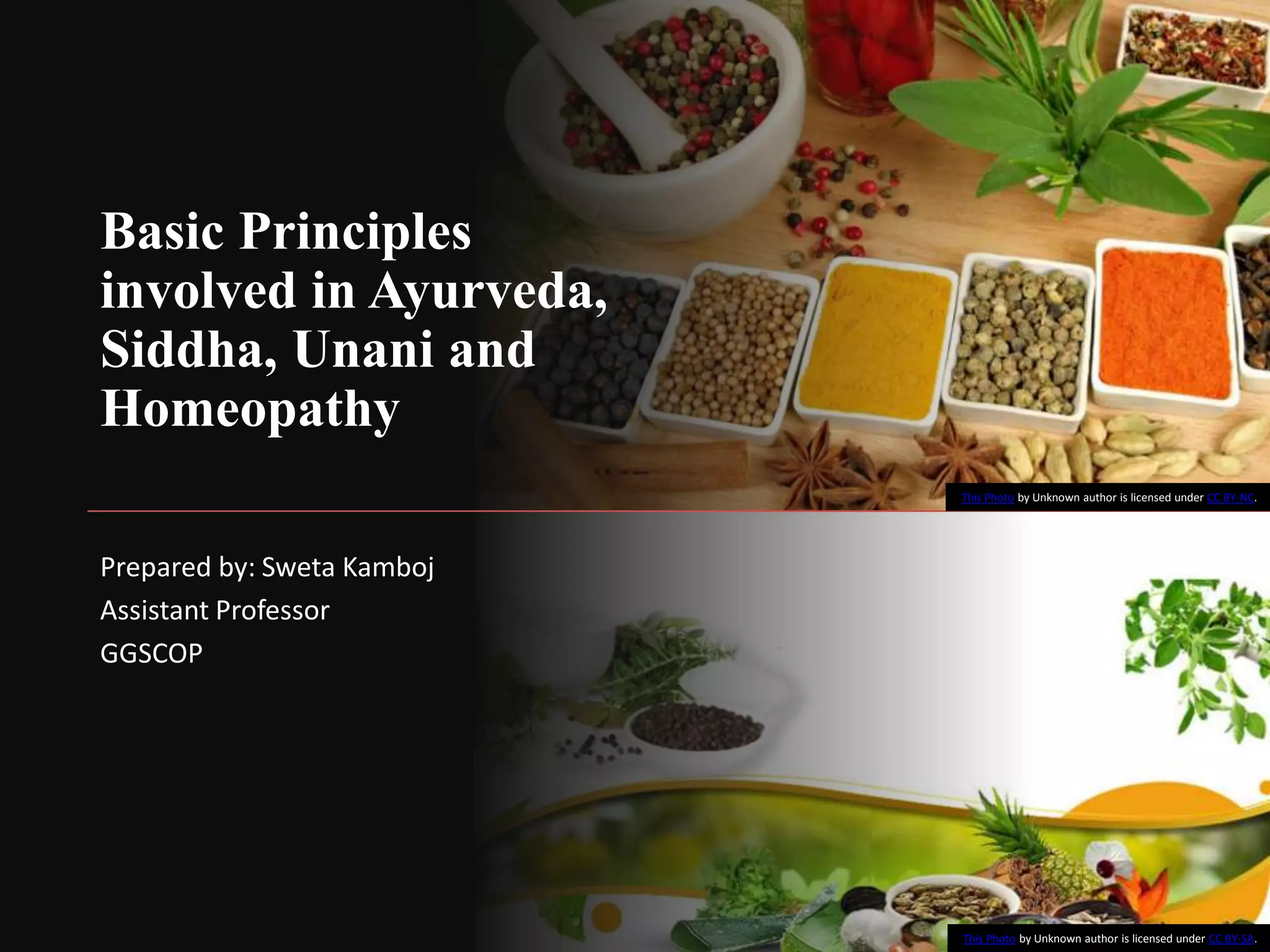
Basic Principles
involved in Ayurveda,
Siddha, Unani and
Homeopathy
Prepared by: Sweta Kamboj
Assistant Professor
GGSCOP
This Photo by Unknown author is licensed under CC BY-NC.
This Photo by Unknown author is licensed under CC BY-SA.
Ayurveda
System(Art
of Total
Health
Care)
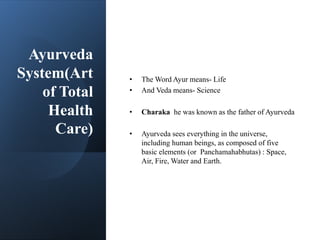
• The Word Ayur means- Life
• And Veda means- Science
• Charaka he was known as the father of Ayurveda
• Ayurveda sees everything in the universe,
including human beings, as composed of five
basic elements (or Panchamahabhutas) : Space,
Air, Fire, Water and Earth.
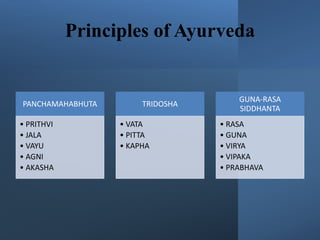
Principles of Ayurveda
PANCHAMAHABHUTA
• PRITHVI
• JALA
• VAYU
• AGNI
• AKASHA
TRIDOSHA
• VATA
• PITTA
• KAPHA
GUNA-RASA
SIDDHANTA
• RASA
• GUNA
• VIRYA
• VIPAKA
• PRABHAVA
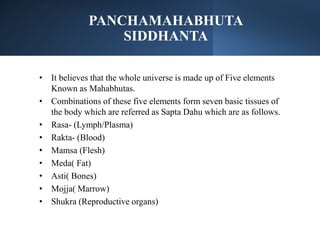
PANCHAMAHABHUTA
SIDDHANTA
• It believes that the whole universe is made up of Five elements
Known as Mahabhutas.
• Combinations of these five elements form seven basic tissues of
the body which are referred as Sapta Dahu which are as follows.
• Rasa- (Lymph/Plasma)
• Rakta- (Blood)
• Mamsa (Flesh)
• Meda( Fat)
• Asti( Bones)
• Mojja( Marrow)
• Shukra (Reproductive organs)
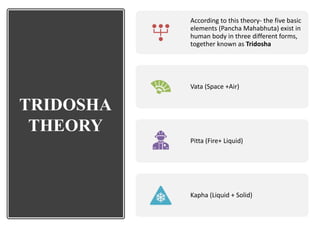
TRIDOSHA
THEORY
According to this theory- the five basic
elements (Pancha Mahabhuta) exist in
human body in three different forms,
together known as Tridosha
Vata (Space +Air)
Pitta (Fire+ Liquid)
Kapha (Liquid + Solid)
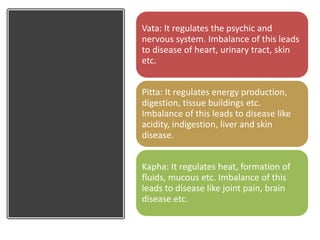
Vata: It regulates the psychic and
nervous system. Imbalance of this leads
to disease of heart, urinary tract, skin
etc.
Pitta: It regulates energy production,
digestion, tissue buildings etc.
Imbalance of this leads to disease like
acidity, indigestion, liver and skin
disease.
Kapha: It regulates heat, formation of
fluids, mucous etc. Imbalance of this
leads to disease like joint pain, brain
disease etc.
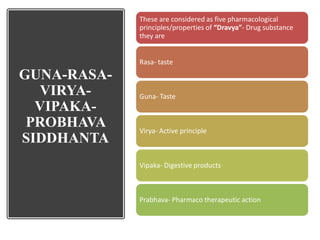
GUNA-RASA-
VIRYA-
VIPAKA-
PROBHAVA
SIDDHANTA
These are considered as five pharmacological
principles/properties of “Dravya”- Drug substance
they are
Rasa- taste
Guna- Taste
Virya- Active principle
Vipaka- Digestive products
Prabhava- Pharmaco therapeutic action
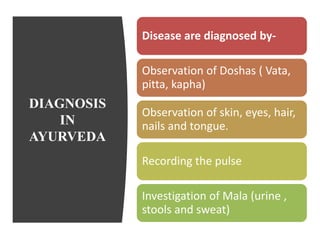
DIAGNOSIS
IN
AYURVEDA
Disease are diagnosed by-
Observation of Doshas ( Vata,
pitta, kapha)
Observation of skin, eyes, hair,
nails and tongue.
Recording the pulse
Investigation of Mala (urine ,
stools and sweat)
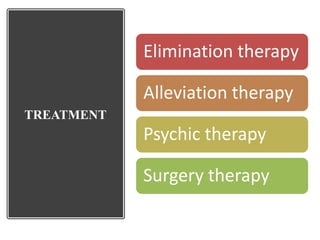
TREATMENT
Elimination therapy
Alleviation therapy
Psychic therapy
Surgery therapy
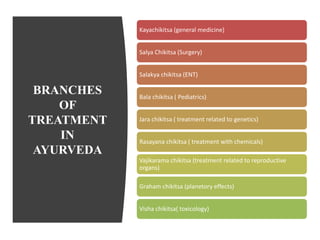
BRANCHES
OF
TREATMENT
IN
AYURVEDA
Kayachikitsa (general medicine)
Salya Chikitsa (Surgery)
Salakya chikitsa (ENT)
Bala chikitsa ( Pediatrics)
Jara chikitsa ( treatment related to genetics)
Rasayana chikitsa ( treatment with chemicals)
Vajikarama chikitsa (treatment related to reproductive
organs)
Graham chikitsa (planetory effects)
Visha chikitsa( toxicology)
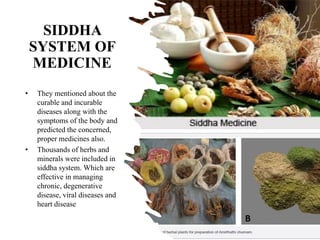
SIDDHA
SYSTEM OF
MEDICINE
• They mentioned about the
curable and incurable
diseases along with the
symptoms of the body and
predicted the concerned,
proper medicines also.
• Thousands of herbs and
minerals were included in
siddha system. Which are
effective in managing
chronic, degenerative
disease, viral diseases and
heart disease
Theory and
basic
Principles
According to this system the human body is
the replica of the universe and so are the
food and drugs irrespective of their origin.
The Five major concept of
Panchmahabhutas, are named as Nilam,
Neer, Neruppu, Kattru and Veli, which are
respectively in hands known as : Space, Air,
Fire, Water and Earth.
Imbalanced ration of panchamahabhutas
may cause disease.
Basic
Principles
of Siddha
System
TRIGUNA
VATA
PITTA
KAPHA
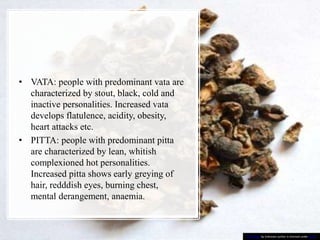
• VATA: people with predominant vata are
characterized by stout, black, cold and
inactive personalities. Increased vata
develops flatulence, acidity, obesity,
heart attacks etc.
• PITTA: people with predominant pitta
are characterized by lean, whitish
complexioned hot personalities.
Increased pitta shows early greying of
hair, redddish eyes, burning chest,
mental derangement, anaemia.
This Photo by Unknown author is licensed under CC BY.
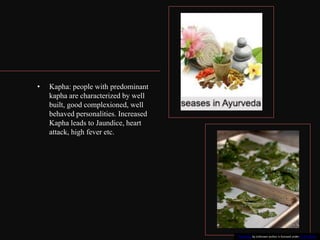
• Kapha: people with predominant
kapha are characterized by well
built, good complexioned, well
behaved personalities. Increased
Kapha leads to Jaundice, heart
attack, high fever etc.
This Photo by Unknown author is licensed under CC BY-SA-NC.
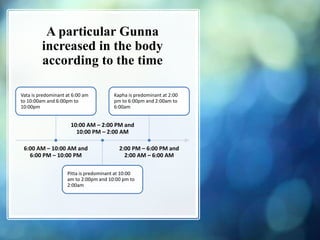
A particular Gunna
increased in the body
according to the time
6:00 AM – 10:00 AM and
6:00 PM – 10:00 PM
Vata is predominant at 6:00 am
to 10:00am and 6:00pm to
10:00pm
10:00 AM – 2:00 PM and
10:00 PM – 2:00 AM
Pitta is predominant at 10:00
am to 2:00pm and 10:00 pm to
2:00am
2:00 PM – 6:00 PM and
2:00 AM – 6:00 AM
Kapha is predominant at 2:00
pm to 6:00pm and 2:00am to
6:00am
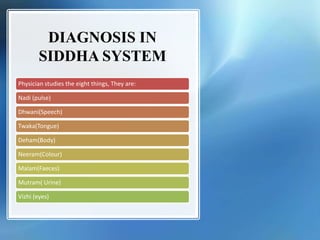
DIAGNOSIS IN
SIDDHA SYSTEM
Physician studies the eight things, They are:
Nadi (pulse)
Dhwani(Speech)
Twaka(Tongue)
Deham(Body)
Neeram(Colour)
Malam(Faeces)
Mutram( Urine)
Vizhi (eyes)
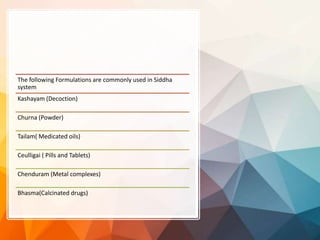
The following Formulations are commonly used in Siddha
system
Kashayam (Decoction)
Churna (Powder)
Tailam( Medicated oils)
Ceulligai ( Pills and Tablets)
Chenduram (Metal complexes)
Bhasma(Calcinated drugs)
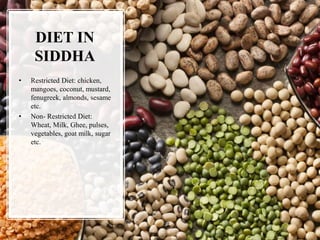
DIET IN
SIDDHA
• Restricted Diet: chicken,
mangoes, coconut, mustard,
fenugreek, almonds, sesame
etc.
• Non- Restricted Diet:
Wheat, Milk, Ghee, pulses,
vegetables, goat milk, sugar
etc.
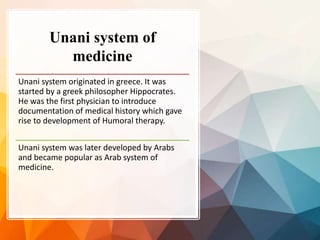
Unani system of
medicine
Unani system originated in greece. It was
started by a greek philosopher Hippocrates.
He was the first physician to introduce
documentation of medical history which gave
rise to development of Humoral therapy.
Unani system was later developed by Arabs
and became popular as Arab system of
medicine.
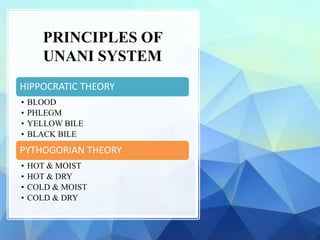
PRINCIPLES OF
UNANI SYSTEM
HIPPOCRATIC THEORY
• BLOOD
• PHLEGM
• YELLOW BILE
• BLACK BILE
PYTHOGORIAN THEORY
• HOT & MOIST
• HOT & DRY
• COLD & MOIST
• COLD & DRY
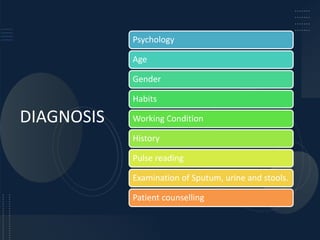
DIAGNOSIS
Psychology
Age
Gender
Habits
Working Condition
History
Pulse reading
Examination of Sputum, urine and stools.
Patient counselling
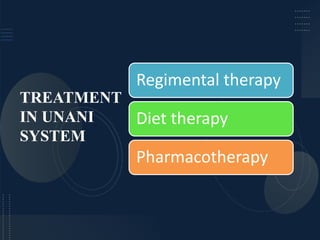
TREATMENT
IN UNANI
SYSTEM
Regimental therapy
Diet therapy
Pharmacotherapy
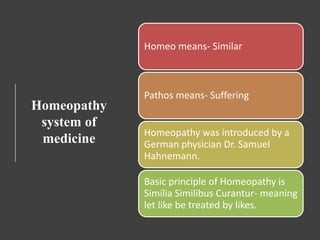
Homeopathy
system of
medicine
Homeo means- Similar
Pathos means- Suffering
Homeopathy was introduced by a
German physician Dr. Samuel
Hahnemann.
Basic principle of Homeopathy is
Similia Similibus Curantur- meaning
let like be treated by likes.
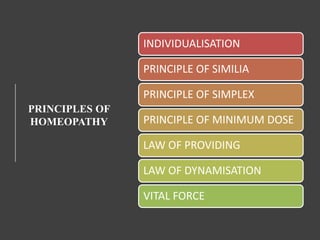
PRINCIPLES OF
HOMEOPATHY
INDIVIDUALISATION
PRINCIPLE OF SIMILIA
PRINCIPLE OF SIMPLEX
PRINCIPLE OF MINIMUM DOSE
LAW OF PROVIDING
LAW OF DYNAMISATION
VITAL FORCE
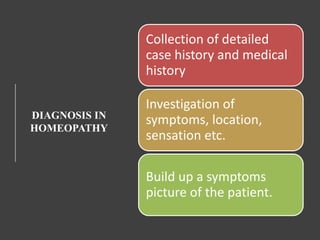
DIAGNOSIS IN
HOMEOPATHY
Collection of detailed
case history and medical
history
Investigation of
symptoms, location,
sensation etc.
Build up a symptoms
picture of the patient.
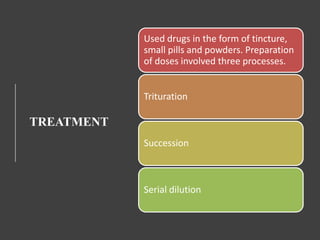
TREATMENT
Used drugs in the form of tincture,
small pills and powders. Preparation
of doses involved three processes.
Trituration
Succession
Serial dilution
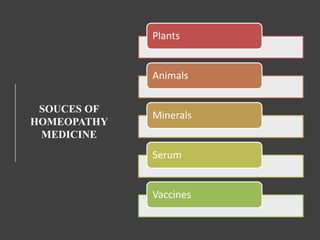
SOUCES OF
HOMEOPATHY
MEDICINE
Plants
Animals
Minerals
Serum
Vaccines
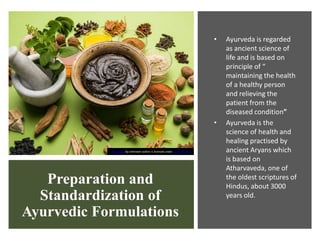
Preparation and
Standardization of
Ayurvedic Formulations
• Ayurveda is regarded
as ancient science of
life and is based on
principle of “
maintaining the health
of a healthy person
and relieving the
patient from the
diseased condition”
• Ayurveda is the
science of health and
healing practised by
ancient Aryans which
is based on
Atharvaveda, one of
the oldest scriptures of
Hindus, about 3000
years old.
This Photo by Unknown author is licensed under CC BY-NC-ND.
• The object of Ayurveda is to
counteract the imbalance of
three essential elements,
Vata, Pitta and Kapha,
which constitute the Tridosh
from which the body
originates. It is Tridosh
which regularises the
normal working of the
human body.
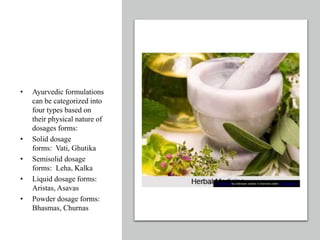
• Ayurvedic formulations
can be categorized into
four types based on
their physical nature of
dosages forms:
• Solid dosage
forms: Vati, Ghutika
• Semisolid dosage
forms: Leha, Kalka
• Liquid dosage forms:
Aristas, Asavas
• Powder dosage forms:
Bhasmas, Churnas
This Photo by Unknown author is licensed under CC BY-NC-ND.
ARISTAS
AND
ASAVAS
• It is also known as Alcoholic
preparations. They are generally
processed by soaking the drugs in the
powdered form or in decoction form,
in a solution of sugar or jaggery.
During soaking it undergoes
fermentation generating alcohol and in
process facilitating extraction of active
constituents contained in the drugs.
• Example- Madhukasava, Kumariasava,
Arvindasava, ashokarista, kutarista etc.
VATI AND
GHUTIKA
• These are the medicines in the
form of tablets (Vati ) and
Pills (Ghutika). These are
made by using single or
combinations of vegetables,
minerals or animal drugs.
They can be used upto 2
years.
• Method of preparation:
• The drugs are dried and finely
powdered, mineral drugs are
converted into calcinated
products(bhasmas) or any
other form as specified.
• The drugs and other
ingredients are mixed
together and made into a
soft paste with specified
liquids. It is then
properly ground and
made into Vati(tablets)
or ghutikas(pills).
Example: Vati: Gandhaka
vati, Sankha vati.
Ghutika: Pranda ghutika,
Lasunadi ghutika
CHURNA
• They contain single or
combination of drugs along
with other ingredients in a
powdered form
• Method of Preparation:
• Drugs and other ingredients
mentioned in the formula are
separately dried, finely
powdered and sieved to get
uniform size particles, they
are mixed to get a uniform
powder.
LEHA/AVLEHA
These are semisolid preparations made by
boiling the powdered drug/extract with a
solution of sugar or Jaggery.
Method of preparation:
sugar or Jaggery is dissolved in a liquid, it is
boiled and filtered. The powdered drugs
extract along with other ingredients are
added with continuous stirring to form a
homogenous semisolid mass.
STANDARDIZATION
PARAMETERS FOR
LEHA
It should neither become hard nor
liquify
There should be no growth of fungus
over it.
It should not change its colour, odour
and taste.
They can be used up to one year if
properly stored.
E.g.- Draksavaleha, Vasavaleha,
Bilvadileha
BHASMA
• These are the powdered forms
of drugs prepared by calcination
of metals, minerals or animal
products by a special process in
closed crucibles or in pits
covered with cow dung.
• Method of preparation:
• Stage-1 Sodhana:
• It is a process of purification of
metals, minerals by heating
them and immersing in a
specific liquid. This is done to
remove its toxicity.
STAGE-2
MARANA
• This is the second stage of preparing
bhasmas, in which the purified drugs
obtained from sodhana process are
ground and mixed with plants/
extracts as specified. After specified
time, small cakes are made and dried
in sunlight. The dried cakes are kept
in earthen vessels, sealed with clay
smeared cloth and kept in a pit
covered with cow dung and fire is
put on all the sides. After heating for
a specified period, the contents are
removed and ground into a fine
powder and stored.
• E.g.- Suvarna Bhasma, Shankha
Bhasma, Taura Bhasma.
This Photo by Unknown author is licensed under CC BY-NC.

Basic principle of ayurvedic system unit II

  • 1.
    Basic Principles involved inAyurveda, Siddha, Unani and Homeopathy Prepared by: Sweta Kamboj Assistant Professor GGSCOP This Photo by Unknown author is licensed under CC BY-NC. This Photo by Unknown author is licensed under CC BY-SA.
  • 2.
    Ayurveda System(Art of Total Health Care) • TheWord Ayur means- Life • And Veda means- Science • Charaka he was known as the father of Ayurveda • Ayurveda sees everything in the universe, including human beings, as composed of five basic elements (or Panchamahabhutas) : Space, Air, Fire, Water and Earth.
  • 3.
    Principles of Ayurveda PANCHAMAHABHUTA •PRITHVI • JALA • VAYU • AGNI • AKASHA TRIDOSHA • VATA • PITTA • KAPHA GUNA-RASA SIDDHANTA • RASA • GUNA • VIRYA • VIPAKA • PRABHAVA
  • 4.
    PANCHAMAHABHUTA SIDDHANTA • It believesthat the whole universe is made up of Five elements Known as Mahabhutas. • Combinations of these five elements form seven basic tissues of the body which are referred as Sapta Dahu which are as follows. • Rasa- (Lymph/Plasma) • Rakta- (Blood) • Mamsa (Flesh) • Meda( Fat) • Asti( Bones) • Mojja( Marrow) • Shukra (Reproductive organs)
  • 5.
    TRIDOSHA THEORY According to thistheory- the five basic elements (Pancha Mahabhuta) exist in human body in three different forms, together known as Tridosha Vata (Space +Air) Pitta (Fire+ Liquid) Kapha (Liquid + Solid)
  • 6.
    Vata: It regulatesthe psychic and nervous system. Imbalance of this leads to disease of heart, urinary tract, skin etc. Pitta: It regulates energy production, digestion, tissue buildings etc. Imbalance of this leads to disease like acidity, indigestion, liver and skin disease. Kapha: It regulates heat, formation of fluids, mucous etc. Imbalance of this leads to disease like joint pain, brain disease etc.
  • 7.
    GUNA-RASA- VIRYA- VIPAKA- PROBHAVA SIDDHANTA These are consideredas five pharmacological principles/properties of “Dravya”- Drug substance they are Rasa- taste Guna- Taste Virya- Active principle Vipaka- Digestive products Prabhava- Pharmaco therapeutic action
  • 8.
    DIAGNOSIS IN AYURVEDA Disease are diagnosedby- Observation of Doshas ( Vata, pitta, kapha) Observation of skin, eyes, hair, nails and tongue. Recording the pulse Investigation of Mala (urine , stools and sweat)
  • 9.
  • 10.
    BRANCHES OF TREATMENT IN AYURVEDA Kayachikitsa (general medicine) SalyaChikitsa (Surgery) Salakya chikitsa (ENT) Bala chikitsa ( Pediatrics) Jara chikitsa ( treatment related to genetics) Rasayana chikitsa ( treatment with chemicals) Vajikarama chikitsa (treatment related to reproductive organs) Graham chikitsa (planetory effects) Visha chikitsa( toxicology)
  • 11.
    SIDDHA SYSTEM OF MEDICINE • Theymentioned about the curable and incurable diseases along with the symptoms of the body and predicted the concerned, proper medicines also. • Thousands of herbs and minerals were included in siddha system. Which are effective in managing chronic, degenerative disease, viral diseases and heart disease
  • 12.
    Theory and basic Principles According tothis system the human body is the replica of the universe and so are the food and drugs irrespective of their origin. The Five major concept of Panchmahabhutas, are named as Nilam, Neer, Neruppu, Kattru and Veli, which are respectively in hands known as : Space, Air, Fire, Water and Earth. Imbalanced ration of panchamahabhutas may cause disease.
  • 13.
  • 14.
    • VATA: peoplewith predominant vata are characterized by stout, black, cold and inactive personalities. Increased vata develops flatulence, acidity, obesity, heart attacks etc. • PITTA: people with predominant pitta are characterized by lean, whitish complexioned hot personalities. Increased pitta shows early greying of hair, redddish eyes, burning chest, mental derangement, anaemia. This Photo by Unknown author is licensed under CC BY.
  • 15.
    • Kapha: peoplewith predominant kapha are characterized by well built, good complexioned, well behaved personalities. Increased Kapha leads to Jaundice, heart attack, high fever etc. This Photo by Unknown author is licensed under CC BY-SA-NC.
  • 16.
    A particular Gunna increasedin the body according to the time 6:00 AM – 10:00 AM and 6:00 PM – 10:00 PM Vata is predominant at 6:00 am to 10:00am and 6:00pm to 10:00pm 10:00 AM – 2:00 PM and 10:00 PM – 2:00 AM Pitta is predominant at 10:00 am to 2:00pm and 10:00 pm to 2:00am 2:00 PM – 6:00 PM and 2:00 AM – 6:00 AM Kapha is predominant at 2:00 pm to 6:00pm and 2:00am to 6:00am
  • 17.
    DIAGNOSIS IN SIDDHA SYSTEM Physicianstudies the eight things, They are: Nadi (pulse) Dhwani(Speech) Twaka(Tongue) Deham(Body) Neeram(Colour) Malam(Faeces) Mutram( Urine) Vizhi (eyes)
  • 18.
    The following Formulationsare commonly used in Siddha system Kashayam (Decoction) Churna (Powder) Tailam( Medicated oils) Ceulligai ( Pills and Tablets) Chenduram (Metal complexes) Bhasma(Calcinated drugs)
  • 19.
    DIET IN SIDDHA • RestrictedDiet: chicken, mangoes, coconut, mustard, fenugreek, almonds, sesame etc. • Non- Restricted Diet: Wheat, Milk, Ghee, pulses, vegetables, goat milk, sugar etc.
  • 20.
    Unani system of medicine Unanisystem originated in greece. It was started by a greek philosopher Hippocrates. He was the first physician to introduce documentation of medical history which gave rise to development of Humoral therapy. Unani system was later developed by Arabs and became popular as Arab system of medicine.
  • 21.
    PRINCIPLES OF UNANI SYSTEM HIPPOCRATICTHEORY • BLOOD • PHLEGM • YELLOW BILE • BLACK BILE PYTHOGORIAN THEORY • HOT & MOIST • HOT & DRY • COLD & MOIST • COLD & DRY
  • 22.
  • 23.
  • 24.
    Homeopathy system of medicine Homeo means-Similar Pathos means- Suffering Homeopathy was introduced by a German physician Dr. Samuel Hahnemann. Basic principle of Homeopathy is Similia Similibus Curantur- meaning let like be treated by likes.
  • 25.
    PRINCIPLES OF HOMEOPATHY INDIVIDUALISATION PRINCIPLE OFSIMILIA PRINCIPLE OF SIMPLEX PRINCIPLE OF MINIMUM DOSE LAW OF PROVIDING LAW OF DYNAMISATION VITAL FORCE
  • 26.
    DIAGNOSIS IN HOMEOPATHY Collection ofdetailed case history and medical history Investigation of symptoms, location, sensation etc. Build up a symptoms picture of the patient.
  • 27.
    TREATMENT Used drugs inthe form of tincture, small pills and powders. Preparation of doses involved three processes. Trituration Succession Serial dilution
  • 28.
  • 29.
    Preparation and Standardization of AyurvedicFormulations • Ayurveda is regarded as ancient science of life and is based on principle of “ maintaining the health of a healthy person and relieving the patient from the diseased condition” • Ayurveda is the science of health and healing practised by ancient Aryans which is based on Atharvaveda, one of the oldest scriptures of Hindus, about 3000 years old. This Photo by Unknown author is licensed under CC BY-NC-ND.
  • 30.
    • The objectof Ayurveda is to counteract the imbalance of three essential elements, Vata, Pitta and Kapha, which constitute the Tridosh from which the body originates. It is Tridosh which regularises the normal working of the human body.
  • 31.
    • Ayurvedic formulations canbe categorized into four types based on their physical nature of dosages forms: • Solid dosage forms: Vati, Ghutika • Semisolid dosage forms: Leha, Kalka • Liquid dosage forms: Aristas, Asavas • Powder dosage forms: Bhasmas, Churnas This Photo by Unknown author is licensed under CC BY-NC-ND.
  • 32.
    ARISTAS AND ASAVAS • It isalso known as Alcoholic preparations. They are generally processed by soaking the drugs in the powdered form or in decoction form, in a solution of sugar or jaggery. During soaking it undergoes fermentation generating alcohol and in process facilitating extraction of active constituents contained in the drugs. • Example- Madhukasava, Kumariasava, Arvindasava, ashokarista, kutarista etc.
  • 33.
    VATI AND GHUTIKA • Theseare the medicines in the form of tablets (Vati ) and Pills (Ghutika). These are made by using single or combinations of vegetables, minerals or animal drugs. They can be used upto 2 years. • Method of preparation: • The drugs are dried and finely powdered, mineral drugs are converted into calcinated products(bhasmas) or any other form as specified.
  • 34.
    • The drugsand other ingredients are mixed together and made into a soft paste with specified liquids. It is then properly ground and made into Vati(tablets) or ghutikas(pills). Example: Vati: Gandhaka vati, Sankha vati. Ghutika: Pranda ghutika, Lasunadi ghutika
  • 35.
    CHURNA • They containsingle or combination of drugs along with other ingredients in a powdered form • Method of Preparation: • Drugs and other ingredients mentioned in the formula are separately dried, finely powdered and sieved to get uniform size particles, they are mixed to get a uniform powder.
  • 36.
    LEHA/AVLEHA These are semisolidpreparations made by boiling the powdered drug/extract with a solution of sugar or Jaggery. Method of preparation: sugar or Jaggery is dissolved in a liquid, it is boiled and filtered. The powdered drugs extract along with other ingredients are added with continuous stirring to form a homogenous semisolid mass.
  • 37.
    STANDARDIZATION PARAMETERS FOR LEHA It shouldneither become hard nor liquify There should be no growth of fungus over it. It should not change its colour, odour and taste. They can be used up to one year if properly stored. E.g.- Draksavaleha, Vasavaleha, Bilvadileha
  • 38.
    BHASMA • These arethe powdered forms of drugs prepared by calcination of metals, minerals or animal products by a special process in closed crucibles or in pits covered with cow dung. • Method of preparation: • Stage-1 Sodhana: • It is a process of purification of metals, minerals by heating them and immersing in a specific liquid. This is done to remove its toxicity.
  • 39.
    STAGE-2 MARANA • This isthe second stage of preparing bhasmas, in which the purified drugs obtained from sodhana process are ground and mixed with plants/ extracts as specified. After specified time, small cakes are made and dried in sunlight. The dried cakes are kept in earthen vessels, sealed with clay smeared cloth and kept in a pit covered with cow dung and fire is put on all the sides. After heating for a specified period, the contents are removed and ground into a fine powder and stored. • E.g.- Suvarna Bhasma, Shankha Bhasma, Taura Bhasma.
  • 40.
    This Photo byUnknown author is licensed under CC BY-NC.