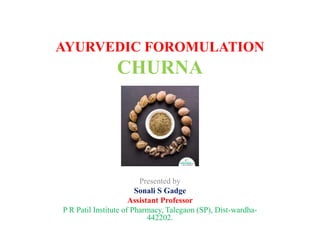
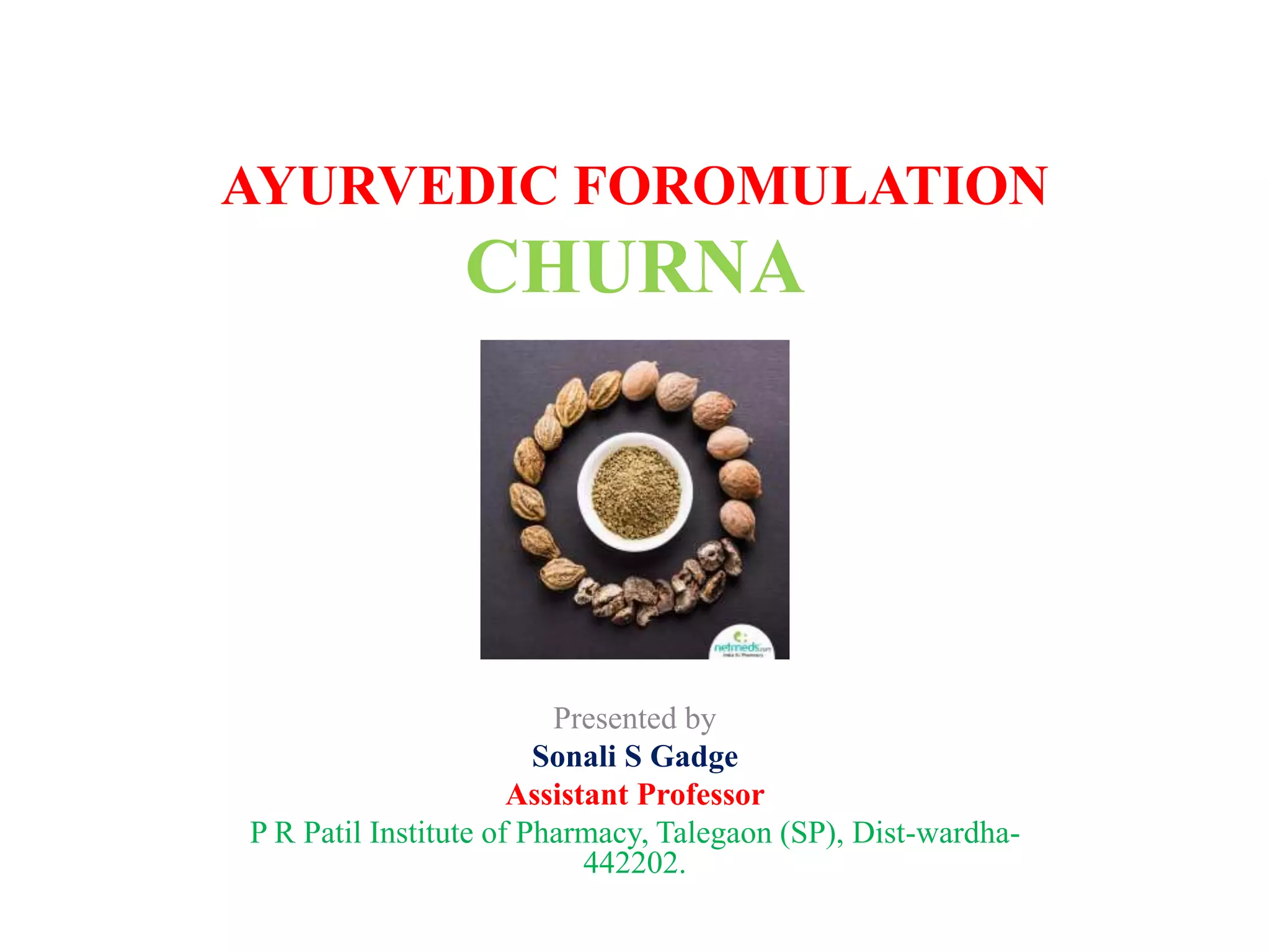
AYURVEDIC FOROMULATION
CHURNA
Presented by
Sonali S Gadge
Assistant Professor
P R Patil Institute of Pharmacy, Talegaon (SP), Dist-wardha-
442202.
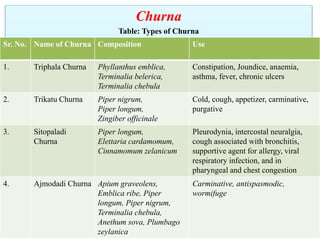
Churna
Table: Types of Churna
Sr. No. Name of Churna Composition Use
1. Triphala Churna Phyllanthus emblica,
Terminalia belerica,
Terminalia chebula
Constipation, Joundice, anaemia,
asthma, fever, chronic ulcers
2. Trikatu Churna Piper nigrum,
Piper longum,
Zingiber officinale
Cold, cough, appetizer, carminative,
purgative
3. Sitopaladi
Churna
Piper longum,
Elettaria cardamomum,
Cinnamomum zelanicum
Pleurodynia, intercostal neuralgia,
cough associated with bronchitis,
supportive agent for allergy, viral
respiratory infection, and in
pharyngeal and chest congestion
4. Ajmodadi Churna Apium graveolens,
Emblica ribe, Piper
longum, Piper nigrum,
Terminalia chebula,
Anethum sova, Plumbago
zeylanica
Carminative, antispasmodic,
wormifuge
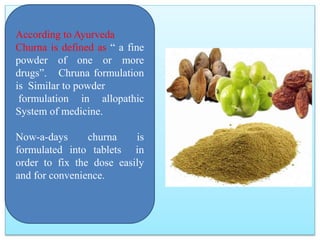
According to Ayurveda
Churna is defined as “ a fine
powder of one or more
drugs”. Chruna formulation
is Similar to powder
formulation in allopathic
System of medicine.
Now-a-days churna is
formulated into tablets in
order to fix the dose easily
and for convenience.
• These forms of medicaments are prescribed
generally because of their particle size.
• Smaller the particle size of churna, better is the
effect on the body.
• Churna should be given with other vehicle like
honey, milk or churna.
• This make administration of churna easy and
increased palatability also enhances therapeutic
effect, such vehicles are called as Anupan in
Ayurveda.
Preparation
• Plant material is collected and cleaned.
• Plant material is dried in shade or sun according
to specific requirements.
• Dried material is pulverized and then sieved
through mesh 60 or 80 according to the drug.
• Finally, it is stored in well closed container on
proper place.
Standardization
Traditional method:
• The ideal churna should be free flowing and
without lumps or big particles.
• It should retain its potency for one year, if
preserved in airtight container.
• It should not change its colour, odour.
Modern Method:
Particle size, angle of repose, flow properties of
churna can be studied by using different modern
analytical instruements.
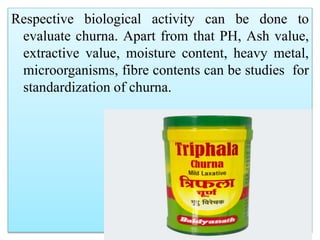
Respective biological activity can be done to
evaluate churna. Apart from that PH, Ash value,
extractive value, moisture content, heavy metal,
microorganisms, fibre contents can be studies for
standardization of churna.
Churna.pptx

Churna.pptx

  • 1.
    AYURVEDIC FOROMULATION CHURNA Presented by SonaliS Gadge Assistant Professor P R Patil Institute of Pharmacy, Talegaon (SP), Dist-wardha- 442202.
  • 2.
    Churna Table: Types ofChurna Sr. No. Name of Churna Composition Use 1. Triphala Churna Phyllanthus emblica, Terminalia belerica, Terminalia chebula Constipation, Joundice, anaemia, asthma, fever, chronic ulcers 2. Trikatu Churna Piper nigrum, Piper longum, Zingiber officinale Cold, cough, appetizer, carminative, purgative 3. Sitopaladi Churna Piper longum, Elettaria cardamomum, Cinnamomum zelanicum Pleurodynia, intercostal neuralgia, cough associated with bronchitis, supportive agent for allergy, viral respiratory infection, and in pharyngeal and chest congestion 4. Ajmodadi Churna Apium graveolens, Emblica ribe, Piper longum, Piper nigrum, Terminalia chebula, Anethum sova, Plumbago zeylanica Carminative, antispasmodic, wormifuge
  • 3.
    According to Ayurveda Churnais defined as “ a fine powder of one or more drugs”. Chruna formulation is Similar to powder formulation in allopathic System of medicine. Now-a-days churna is formulated into tablets in order to fix the dose easily and for convenience.
  • 4.
    • These formsof medicaments are prescribed generally because of their particle size. • Smaller the particle size of churna, better is the effect on the body. • Churna should be given with other vehicle like honey, milk or churna. • This make administration of churna easy and increased palatability also enhances therapeutic effect, such vehicles are called as Anupan in Ayurveda.
  • 5.
    Preparation • Plant materialis collected and cleaned. • Plant material is dried in shade or sun according to specific requirements. • Dried material is pulverized and then sieved through mesh 60 or 80 according to the drug. • Finally, it is stored in well closed container on proper place.
  • 6.
    Standardization Traditional method: • Theideal churna should be free flowing and without lumps or big particles. • It should retain its potency for one year, if preserved in airtight container. • It should not change its colour, odour. Modern Method: Particle size, angle of repose, flow properties of churna can be studied by using different modern analytical instruements.
  • 7.
    Respective biological activitycan be done to evaluate churna. Apart from that PH, Ash value, extractive value, moisture content, heavy metal, microorganisms, fibre contents can be studies for standardization of churna.