A K M A S U D A I
HEPATIC ENCEPHALOPATHY
Definition
 It is a state of disordered CNS function, resulting
from failure of liver to detoxify toxic agents because
of hepatic insufficiency and Porto-systemic shunt.
 It represents a reversible decrease in neurologic
function.
 It occurs most often in patients with cirrhosis but
also occur in acute hepatic failure.
PATHOGENESIS
 Ammonia formed by protein breakdown in GIT
 Liver dysfunction (abnormal) NH3 Passes BBB
Hepatic encephalopathy.
 Other factors:
 Increase sensitivity to glutamine & GABA
(inhibitory neurotransmitter)
 Increase circulating levels of endogenous
benzodiazepines.
PATHOGENESIS – ACUTE AND CHRONIC
 The basic cause is same in both forms but the mechanism is
somewhat different
Diminished detoxification of toxic intestinal nitrogenous
compounds
Increased in blood NH3 etc
Toxic effect on brain
Appearance of abnormal
amines in systemic circulation
Interference with
neurotransmission
PATHOGENESIS
ENDOTOXINS
 Ammonia
 Mercaptans (degradation of methionine in the gut)
 Phenols.
 Free fatty acids.
 Gamma amino butyric acid(GABA)
 Octopamine.
CAUSES
Chronic parenchymal liver disease:
• Chronic hepatitis.
• Cirrhosis.
Fulminating hepatic failure:
• Acute viral hepatitis.
• Drugs.
• Toxins e.g. Wilson’s Disease, CCL4.
 Surgical Portal-systemic anastomoses, - portacaval
shunts, or Transjugular intrahepatic portal-systemic
shunting [TIPS]).
PRECIPITATING AGENTS
(A) Increase Nitrogen Load
 (a) Constipation.
 (b) Gastro intestinal bleeding.
 (c) Excess dietary intake of protein & fatty acids.
 (d) Azotemia.
PRECIPITATING FACTORS
(B) Infections & Trauma (Surgery)
(C) Electrolyte & Metabolic imbalance
 Hypokalemia.
 Alkalosis.
 Hypoxia.
 Hyponatremic.
(D) Drugs
• Diuretics, Narcotics, Tranquilizers, Sedatives
CLINICAL FEATURES
A. Disturbance in consciousness
• Disturbances in sleep rhythm.
• Impaired memory/ apraxia.
• Mental confusion.
• Apathy.
• Drowsiness / Somnolence.
• Coma.
CLINICAL FEATURES
B. Changes Personality
• Childish behaviour.
• May be aggressive out burst.
• Euphoric.
• Foetor hepaticus – Foul–smelling breath associated
with liver disease due to mercaptans.
CLINICAL FEATURES
C. Neurological signs:
• Flapping tremor / Asterixis (in pre coma).
• Exaggerated tendon reflex.
• Extensor plantar reflex.
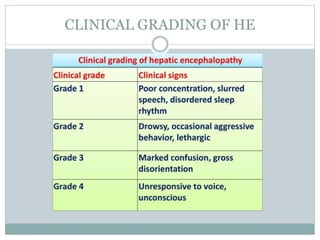
CLINICAL GRADING OF HE
WEST HAVEN CRITERIA
INVESTIGATION
 Diagnosis is usually made clinically
 Routine Investigations - CBC, LFTS, Electrolytes,
Urea, Creatinine, Prothrombin time, Albumin , A/G
ratio.
 Elevation of blood ammonia.
 EEG (Electroencephalogram)
 CSF & CT Scan – Normal
DIFFERENTIAL DIAGNOSIS
 Subdural Haematoma.
 Drug or Alcohol intoxication.
 Wernicke’s encephalopathy.
 Hypoglycaemia
MANAGEMENT
Supportive Treatment.
 Specific Treatment aims at:
 Decreasing ammonia production in colon
 Elimination or treatment of precipitating factors
TREATMENT
 Hospitalize the patient.
 Maintain ABC.
 Identify and remove the precipitating factors.
 Iv fluid dextrose ,saline. Stop Diuretic Therapy.
 Correct any electrolyte imbalance.
 Ryle tube feeding & bladder catheterization.
 Reduce the ammonia (NH3) Load.
 Diet – Restriction of protein diet. High glucose diet.
 Treat Constipation by Laxatives.
LACTULOSE
 Lactulose 15-30ml X 3 – 4 times a day- result aims
at 2-4 stools/day.
 Rectal use is indicated when patient is unable to take
orally.
 300ml of lactulose in 700ml of saline or sorbitol as a
retention enema for 30 – 60 min.
 May be repeated 4 – 6 hours.
MECHANISM OF ACTION OF LACTULOSE
 A non-absorbable disaccharide.
 It produces osmosis of water- Diarrhoea.
 It reduces pH of colonic content & thereby prevents
absorption of NH3.
 It converts NH3- NH4 that can be excreted.
TREAT THE GIT INFECTIONS
 Antibiotics:
 Rifaximin
 Broad spectrum antibiotic, recently approved in
humans for HE.
 Negligible systemic absorption.
 Shown to decrease hospitalizations and length of
stay as compared to lactulose in humans.
 DOSE: 550 mg orally B.I.D
 Metronidazole : 250mg orally T.D.S
 Neomycin : 0.5 – 1 g orally 6 or 12 hours for 7 days.
 Side effects: Ototoxicity, nephrotoxicity.
 Vancomycin : 1 g orally B.I.D
DIET
 With held dietary protein during acute episode if
patient cannot eat.
 Oral intake should be 60 – 80 g/day as tolerated.
 Vegetable protein is better tolerated than meat
protein.
 G.I.T bleeding should be controlled
 120ml of magnesium citrate by mouth or NG tube
every 3 – 4 hours until stool free of blood.
Stimulation of metabolic ammonia metabolism
 Sodium benzoate • 5 g orally twice a day.
 L-ornithine-L-aspartate • 9 g orally thrice a day.
 L-acyl-carnitine aspartate • 4 g orally daily.
 Zinc sulphate • 600mg/day in divided doses.
CORRECT AMINO ACID METABOLIC
IMBALANCE
 Correct amino acid metabolic imbalance
 Infusion or oral administration of BCAA (branched-
chain amino acid)
 Its use is unnecessary except in patient who are
intolerant of standard protein supplements.
GABA/BZ complex antagonist:
 Flumazenil ( particularly if patient has been given
benzodiazepines )
 Opiods & sedatives should be avoided.
Acarbose
 α – glucosidase inhibitor.
 Under study.
Other Therapies:
 Prebiotics & probiotics.
 Extracorporeal albumin dialysis ( MARS)
 Liver transplant.
PROGNOSIS
 Acute hepatic encephalopathy may be treatable.
 Chronic forms of the disorder often keep getting
worse or continue to come back.
 Both forms may result in irreversible coma and
death.
 Approximately 80% (8 out of 10 patients) die if they
go into a coma.
 Recovery & the risk of the condition returning vary
from patient to patient
REFERENCES
 Davidson’s Principles & Practice of Medicine- 21st
edition.
 Harrison’s Principles of internal Medicine-10th &
17th edition.
 THANK YOU

Hepatic encephalopathy [HE]

  • 1.
    A K MA S U D A I HEPATIC ENCEPHALOPATHY
  • 2.
    Definition  It isa state of disordered CNS function, resulting from failure of liver to detoxify toxic agents because of hepatic insufficiency and Porto-systemic shunt.  It represents a reversible decrease in neurologic function.  It occurs most often in patients with cirrhosis but also occur in acute hepatic failure.
  • 3.
    PATHOGENESIS  Ammonia formedby protein breakdown in GIT  Liver dysfunction (abnormal) NH3 Passes BBB Hepatic encephalopathy.  Other factors:  Increase sensitivity to glutamine & GABA (inhibitory neurotransmitter)  Increase circulating levels of endogenous benzodiazepines.
  • 4.
    PATHOGENESIS – ACUTEAND CHRONIC  The basic cause is same in both forms but the mechanism is somewhat different Diminished detoxification of toxic intestinal nitrogenous compounds Increased in blood NH3 etc Toxic effect on brain Appearance of abnormal amines in systemic circulation Interference with neurotransmission
  • 5.
  • 6.
    ENDOTOXINS  Ammonia  Mercaptans(degradation of methionine in the gut)  Phenols.  Free fatty acids.  Gamma amino butyric acid(GABA)  Octopamine.
  • 7.
    CAUSES Chronic parenchymal liverdisease: • Chronic hepatitis. • Cirrhosis. Fulminating hepatic failure: • Acute viral hepatitis. • Drugs. • Toxins e.g. Wilson’s Disease, CCL4.  Surgical Portal-systemic anastomoses, - portacaval shunts, or Transjugular intrahepatic portal-systemic shunting [TIPS]).
  • 8.
    PRECIPITATING AGENTS (A) IncreaseNitrogen Load  (a) Constipation.  (b) Gastro intestinal bleeding.  (c) Excess dietary intake of protein & fatty acids.  (d) Azotemia.
  • 9.
    PRECIPITATING FACTORS (B) Infections& Trauma (Surgery) (C) Electrolyte & Metabolic imbalance  Hypokalemia.  Alkalosis.  Hypoxia.  Hyponatremic. (D) Drugs • Diuretics, Narcotics, Tranquilizers, Sedatives
  • 10.
    CLINICAL FEATURES A. Disturbancein consciousness • Disturbances in sleep rhythm. • Impaired memory/ apraxia. • Mental confusion. • Apathy. • Drowsiness / Somnolence. • Coma.
  • 11.
    CLINICAL FEATURES B. ChangesPersonality • Childish behaviour. • May be aggressive out burst. • Euphoric. • Foetor hepaticus – Foul–smelling breath associated with liver disease due to mercaptans.
  • 12.
    CLINICAL FEATURES C. Neurologicalsigns: • Flapping tremor / Asterixis (in pre coma). • Exaggerated tendon reflex. • Extensor plantar reflex.
  • 13.
  • 14.
  • 15.
    INVESTIGATION  Diagnosis isusually made clinically  Routine Investigations - CBC, LFTS, Electrolytes, Urea, Creatinine, Prothrombin time, Albumin , A/G ratio.  Elevation of blood ammonia.  EEG (Electroencephalogram)  CSF & CT Scan – Normal
  • 16.
    DIFFERENTIAL DIAGNOSIS  SubduralHaematoma.  Drug or Alcohol intoxication.  Wernicke’s encephalopathy.  Hypoglycaemia
  • 17.
    MANAGEMENT Supportive Treatment.  SpecificTreatment aims at:  Decreasing ammonia production in colon  Elimination or treatment of precipitating factors
  • 18.
    TREATMENT  Hospitalize thepatient.  Maintain ABC.  Identify and remove the precipitating factors.  Iv fluid dextrose ,saline. Stop Diuretic Therapy.  Correct any electrolyte imbalance.  Ryle tube feeding & bladder catheterization.  Reduce the ammonia (NH3) Load.  Diet – Restriction of protein diet. High glucose diet.  Treat Constipation by Laxatives.
  • 19.
    LACTULOSE  Lactulose 15-30mlX 3 – 4 times a day- result aims at 2-4 stools/day.  Rectal use is indicated when patient is unable to take orally.  300ml of lactulose in 700ml of saline or sorbitol as a retention enema for 30 – 60 min.  May be repeated 4 – 6 hours.
  • 21.
    MECHANISM OF ACTIONOF LACTULOSE  A non-absorbable disaccharide.  It produces osmosis of water- Diarrhoea.  It reduces pH of colonic content & thereby prevents absorption of NH3.  It converts NH3- NH4 that can be excreted.
  • 22.
    TREAT THE GITINFECTIONS  Antibiotics:  Rifaximin  Broad spectrum antibiotic, recently approved in humans for HE.  Negligible systemic absorption.  Shown to decrease hospitalizations and length of stay as compared to lactulose in humans.  DOSE: 550 mg orally B.I.D
  • 23.
     Metronidazole :250mg orally T.D.S  Neomycin : 0.5 – 1 g orally 6 or 12 hours for 7 days.  Side effects: Ototoxicity, nephrotoxicity.  Vancomycin : 1 g orally B.I.D
  • 24.
    DIET  With helddietary protein during acute episode if patient cannot eat.  Oral intake should be 60 – 80 g/day as tolerated.  Vegetable protein is better tolerated than meat protein.  G.I.T bleeding should be controlled  120ml of magnesium citrate by mouth or NG tube every 3 – 4 hours until stool free of blood.
  • 25.
    Stimulation of metabolicammonia metabolism  Sodium benzoate • 5 g orally twice a day.  L-ornithine-L-aspartate • 9 g orally thrice a day.  L-acyl-carnitine aspartate • 4 g orally daily.  Zinc sulphate • 600mg/day in divided doses.
  • 26.
    CORRECT AMINO ACIDMETABOLIC IMBALANCE  Correct amino acid metabolic imbalance  Infusion or oral administration of BCAA (branched- chain amino acid)  Its use is unnecessary except in patient who are intolerant of standard protein supplements.
  • 27.
    GABA/BZ complex antagonist: Flumazenil ( particularly if patient has been given benzodiazepines )  Opiods & sedatives should be avoided.
  • 28.
    Acarbose  α –glucosidase inhibitor.  Under study. Other Therapies:  Prebiotics & probiotics.  Extracorporeal albumin dialysis ( MARS)  Liver transplant.
  • 29.
    PROGNOSIS  Acute hepaticencephalopathy may be treatable.  Chronic forms of the disorder often keep getting worse or continue to come back.  Both forms may result in irreversible coma and death.  Approximately 80% (8 out of 10 patients) die if they go into a coma.  Recovery & the risk of the condition returning vary from patient to patient
  • 30.
    REFERENCES  Davidson’s Principles& Practice of Medicine- 21st edition.  Harrison’s Principles of internal Medicine-10th & 17th edition.
  • 31.