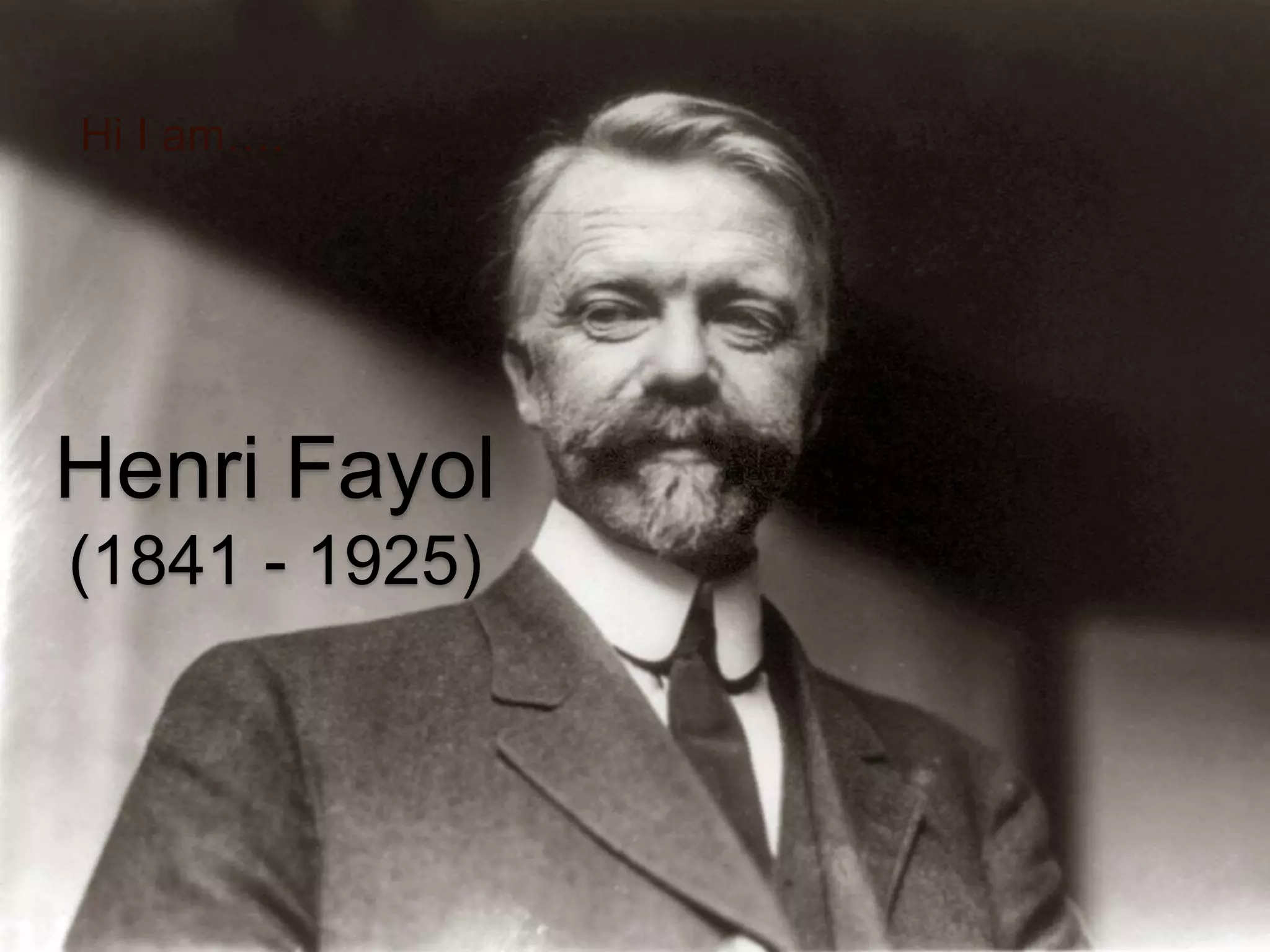
Henri Fayol
(1841 - 1925)
Hi I am….
Henri Fayol’s Background
 Graduated from the National School of
Mines in Saint Etrenne in 1860
 After graduation he went to work and spent
his entire career at Commentry-
Fourchamboult-Decazeville.
 In 1888 he became managing director,
when the mine company employed over
10,000 people
MAJOR ACHIVMENTS
 He is credited with saving the company
from bankruptcy
 During his career he lectured at Ecole
Superievre de la Guerre
 In his retirement he established the Center
of Administrative Studies
How do we manage an
Organization…?
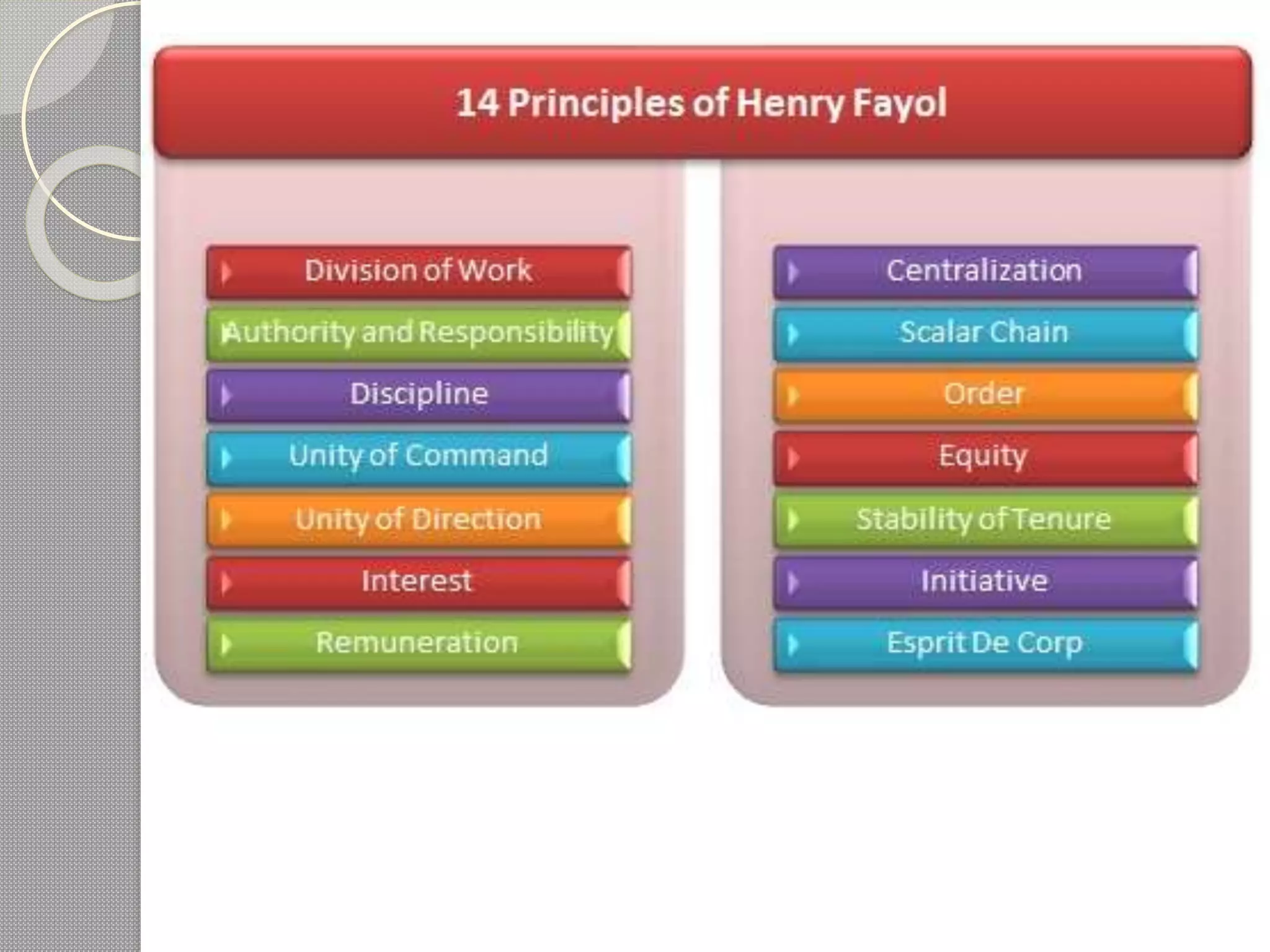
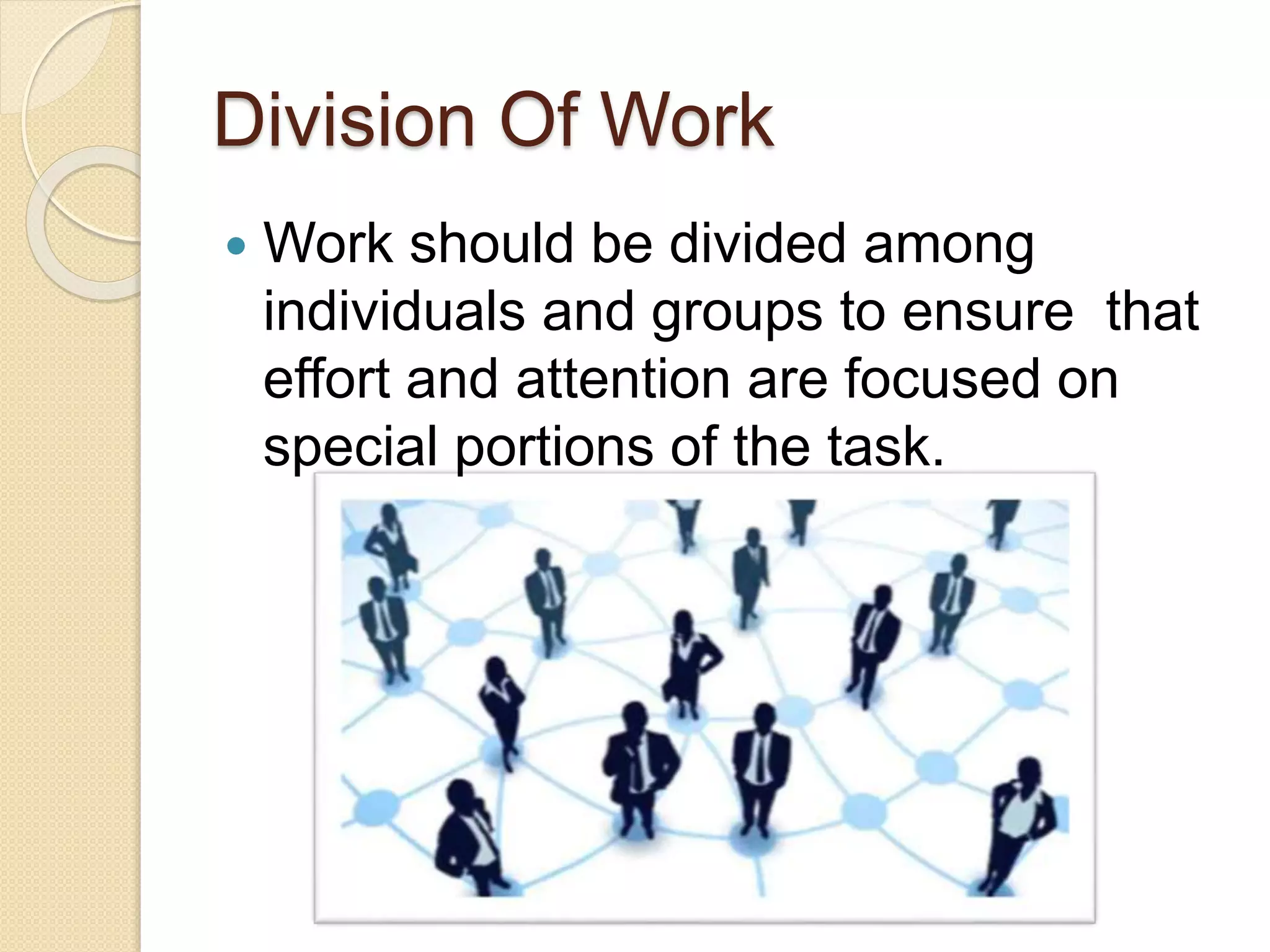
Division Of Work
 Work should be divided among
individuals and groups to ensure that
effort and attention are focused on
special portions of the task.
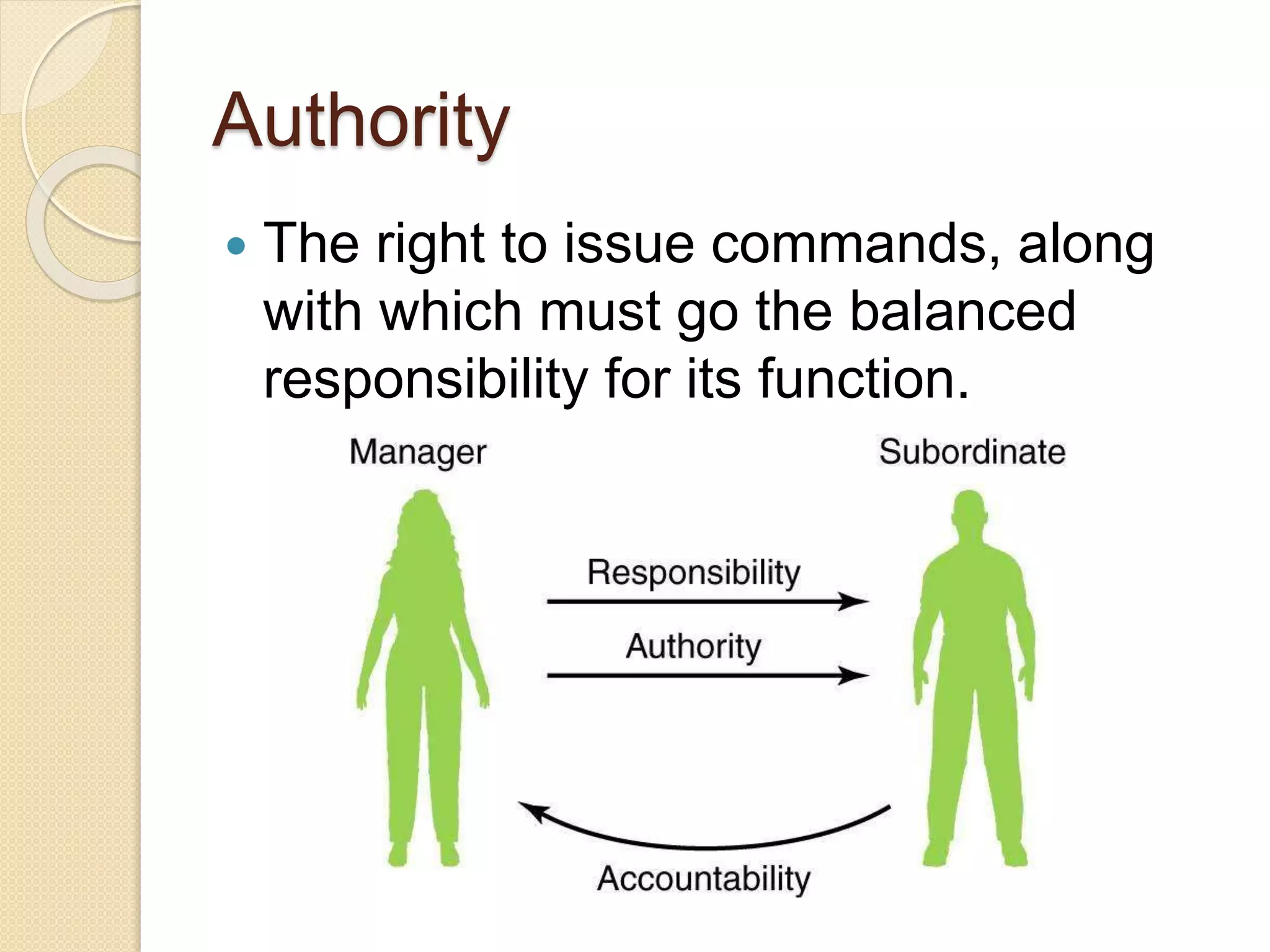
Authority
 The right to issue commands, along
with which must go the balanced
responsibility for its function.
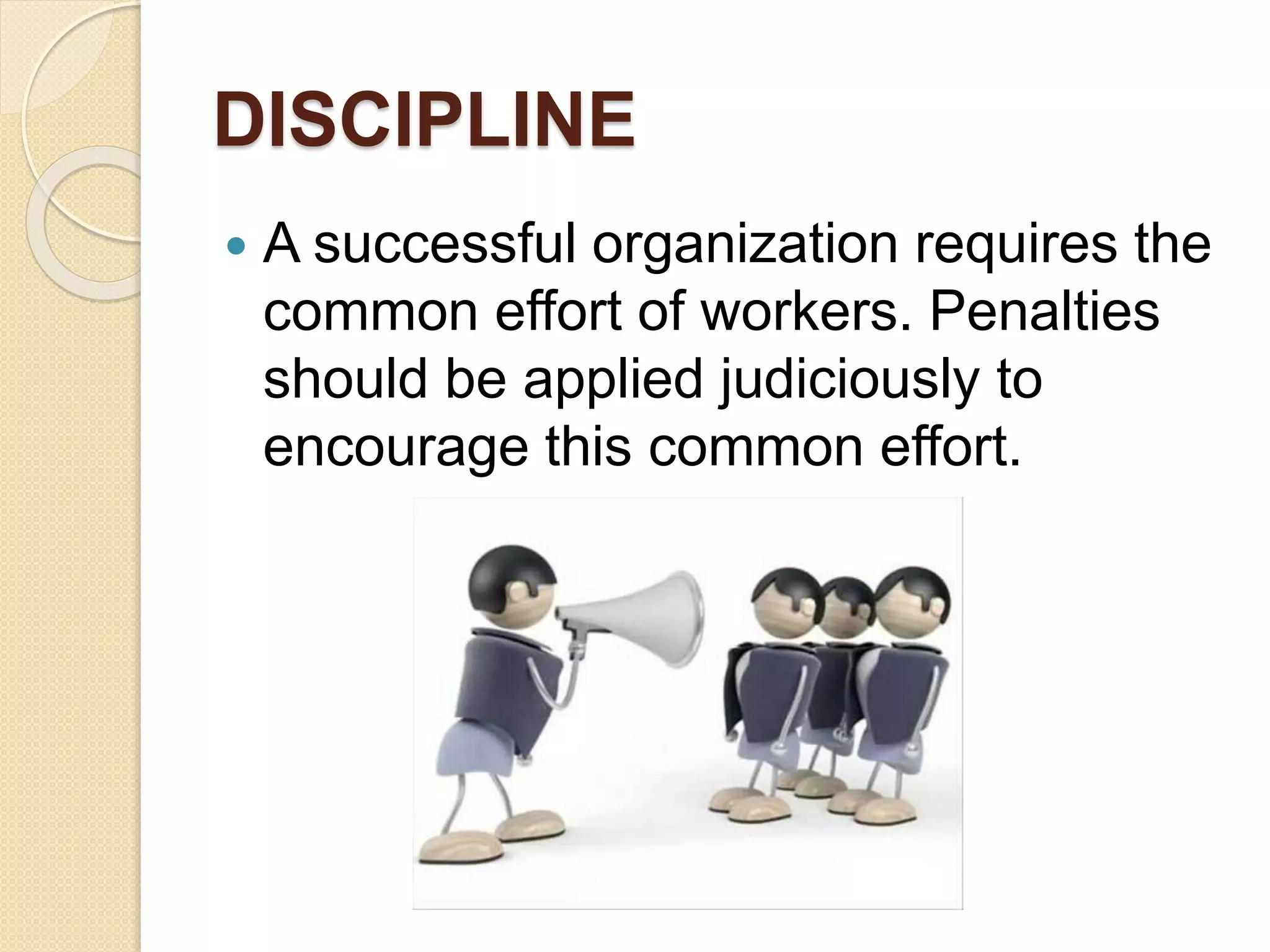
DISCIPLINE
 A successful organization requires the
common effort of workers. Penalties
should be applied judiciously to
encourage this common effort.
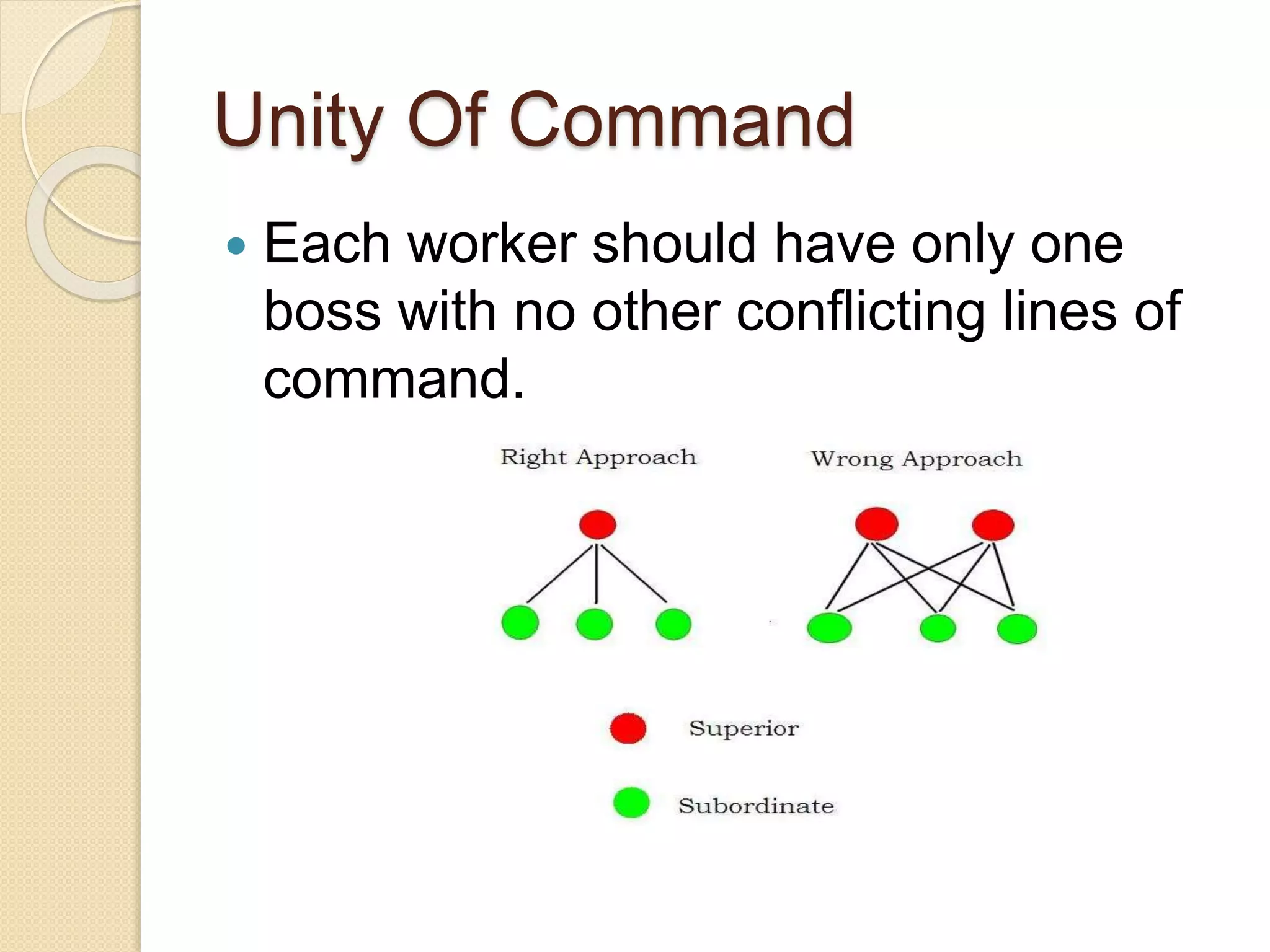
Unity Of Command
 Each worker should have only one
boss with no other conflicting lines of
command.
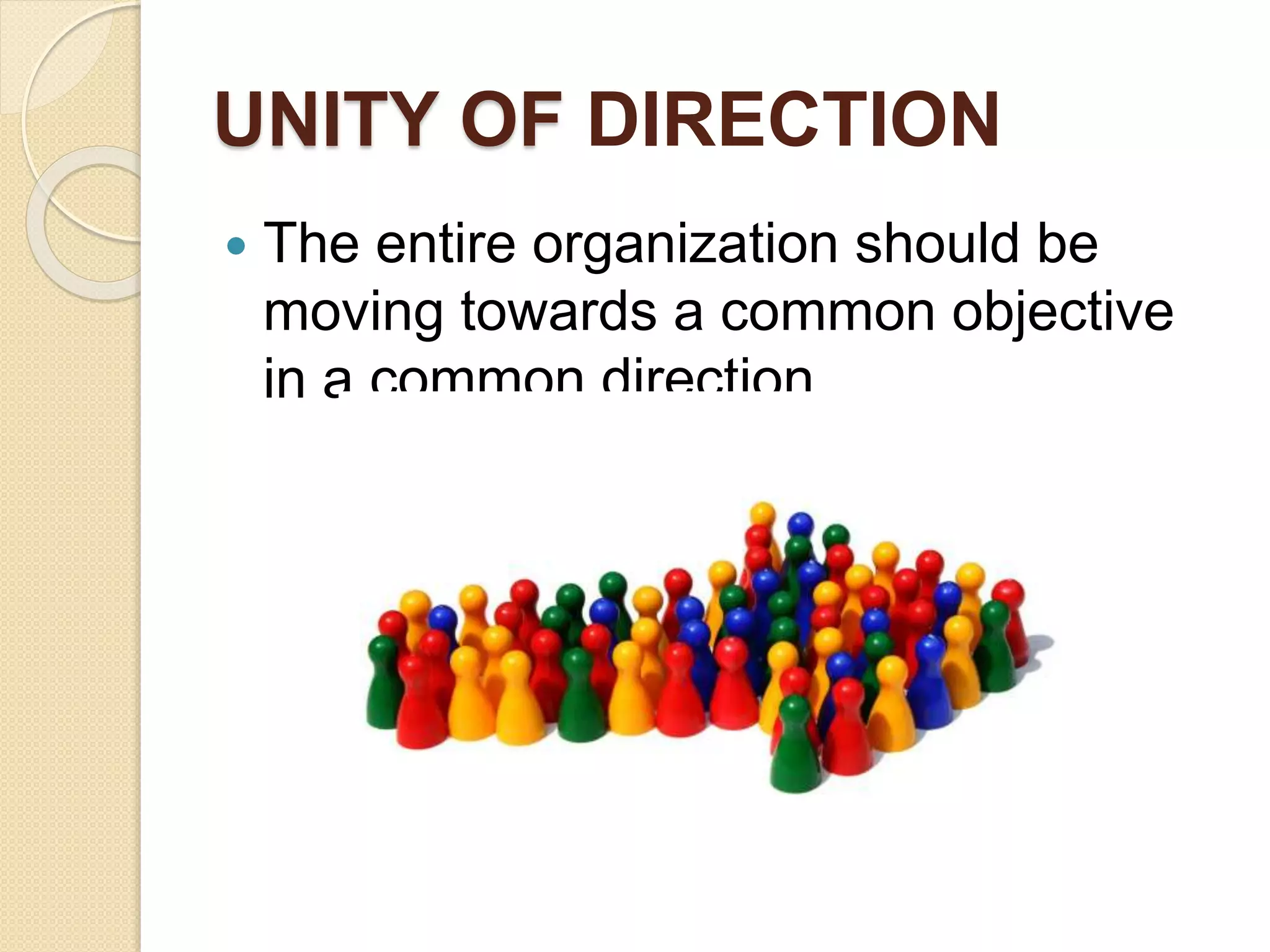
UNITY OF DIRECTION
 The entire organization should be
moving towards a common objective
in a common direction.
Subordination of individual
interest
 Management must see that the goals
of the firms are always paramount.
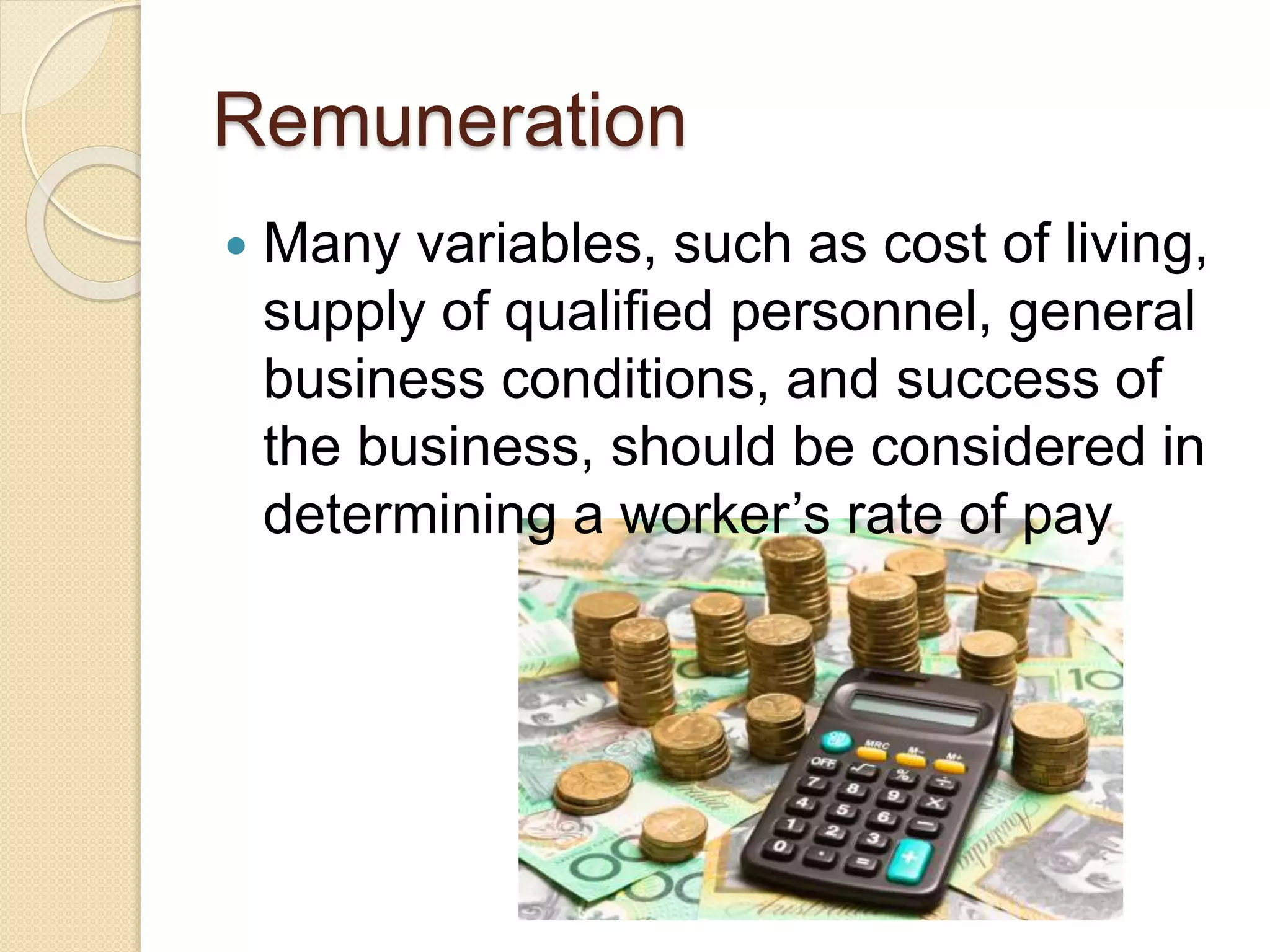
Remuneration
 Many variables, such as cost of living,
supply of qualified personnel, general
business conditions, and success of
the business, should be considered in
determining a worker’s rate of pay
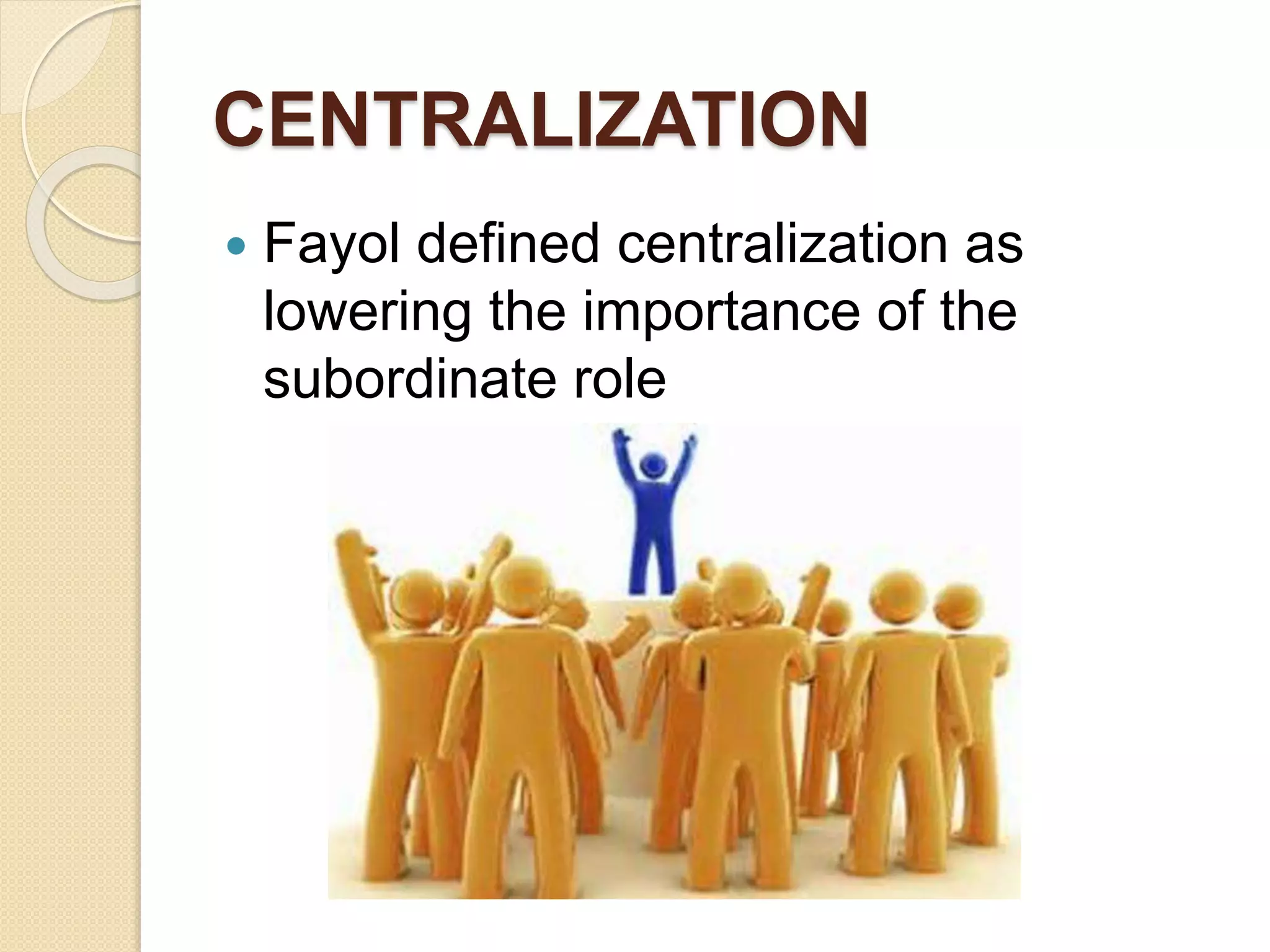
CENTRALIZATION
 Fayol defined centralization as
lowering the importance of the
subordinate role
SCALAR CHAIN
 Scalar chain refers to the number of
levels in the hierarchy from the
ultimate authority to the lowest level in
the organization. It should not be over-
stretched and consist of too-many
levels
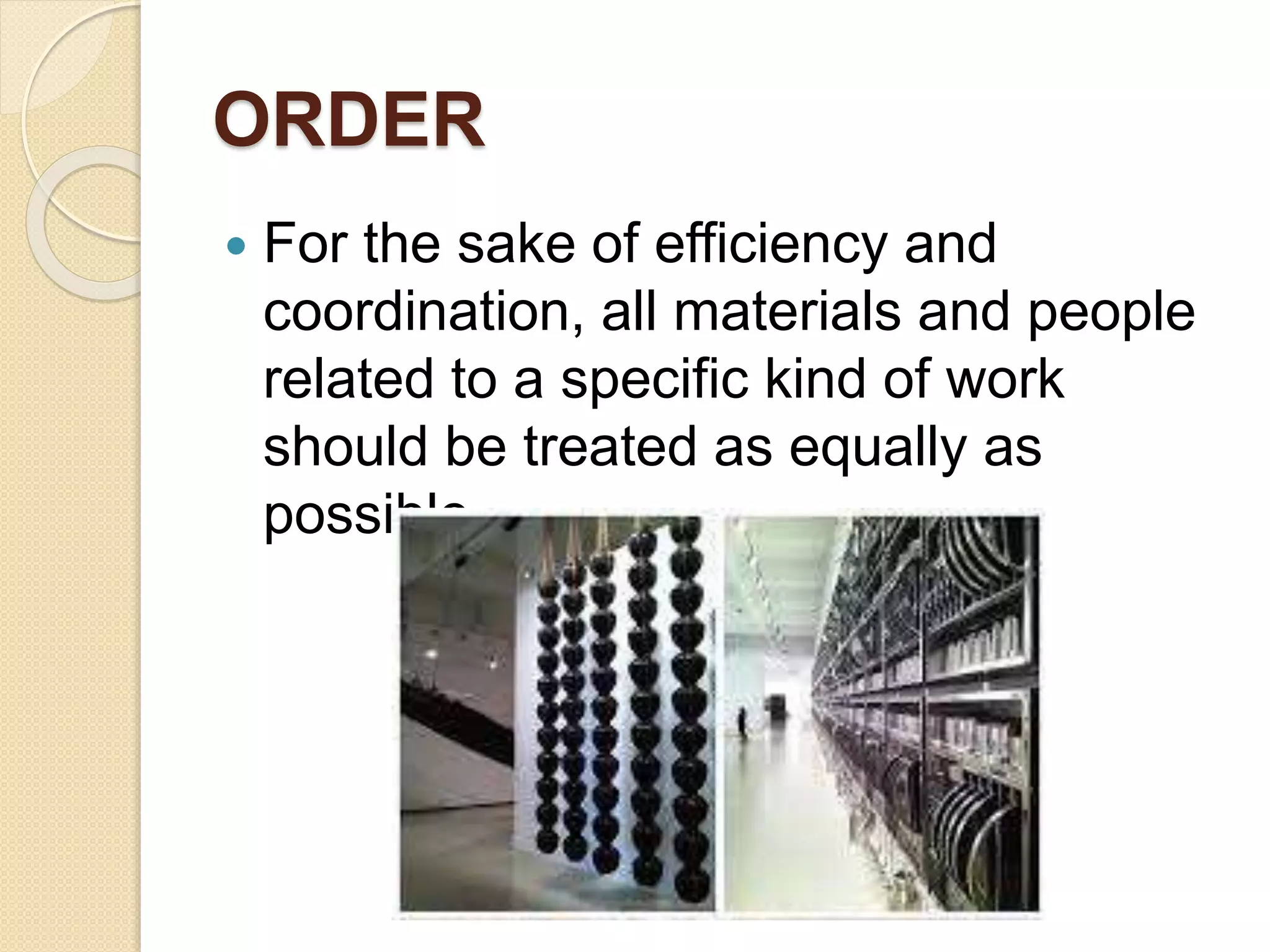
ORDER
 For the sake of efficiency and
coordination, all materials and people
related to a specific kind of work
should be treated as equally as
possible.
EQUITY
 In running a business a ‘combination
of kindliness and justice’ is needed.
Treating employees well is important
to achieve equity
STABILITY OF TENURE OF
PERSONNEL
 Retaining productive employees
should always be a high priority of
management
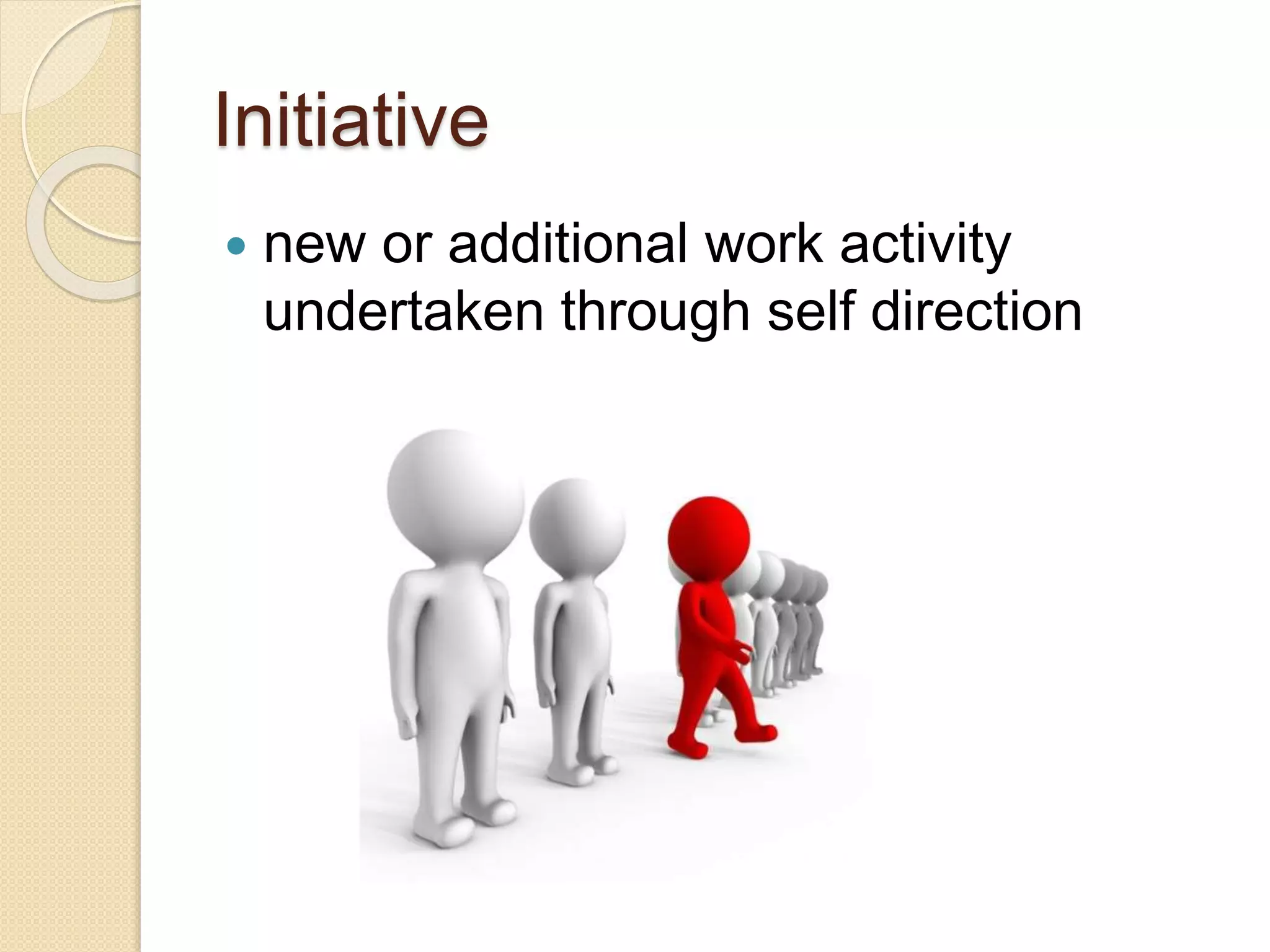
Initiative
 new or additional work activity
undertaken through self direction
Esprit de Corps
 Management should encourage
harmony and general good feelings
among employees.
Functions of these
management
 To forecast and plan
 To organize
 To command or direct
 To coordinate
 To control
Common criticisms of Henri Fayol
Management is not always universal:
Fayol was criticized because he only had
experience in a coal mine. Many have said just
because you can manage a coal mine does not
necessarily mean you can manage a hospital.
His writing is lessons learned in his career:
Everything that Fayol wrote about was something
from his career as the managing director of a
mining company. The criticism is that his
background was not all that diverse.
Fayol’s Big Contributions to
Management
 1) Universality of management: The
same skills are needed to manage a coal
mine that are needed to manage a
hospital, post office, university, etc..
 2) Management is a field in and of itself:
There were no schools of management
prior to Henri Fayol!!!
SINTO K K
MAHRM-2014

Henri fayol's 14 principle

  • 1.
    Henri Fayol (1841 -1925) Hi I am….
  • 2.
    Henri Fayol’s Background Graduated from the National School of Mines in Saint Etrenne in 1860  After graduation he went to work and spent his entire career at Commentry- Fourchamboult-Decazeville.  In 1888 he became managing director, when the mine company employed over 10,000 people
  • 3.
    MAJOR ACHIVMENTS  Heis credited with saving the company from bankruptcy  During his career he lectured at Ecole Superievre de la Guerre  In his retirement he established the Center of Administrative Studies
  • 4.
    How do wemanage an Organization…?
  • 6.
    Division Of Work Work should be divided among individuals and groups to ensure that effort and attention are focused on special portions of the task.
  • 7.
    Authority  The rightto issue commands, along with which must go the balanced responsibility for its function.
  • 8.
    DISCIPLINE  A successfulorganization requires the common effort of workers. Penalties should be applied judiciously to encourage this common effort.
  • 9.
    Unity Of Command Each worker should have only one boss with no other conflicting lines of command.
  • 10.
    UNITY OF DIRECTION The entire organization should be moving towards a common objective in a common direction.
  • 11.
    Subordination of individual interest Management must see that the goals of the firms are always paramount.
  • 12.
    Remuneration  Many variables,such as cost of living, supply of qualified personnel, general business conditions, and success of the business, should be considered in determining a worker’s rate of pay
  • 13.
    CENTRALIZATION  Fayol definedcentralization as lowering the importance of the subordinate role
  • 14.
    SCALAR CHAIN  Scalarchain refers to the number of levels in the hierarchy from the ultimate authority to the lowest level in the organization. It should not be over- stretched and consist of too-many levels
  • 15.
    ORDER  For thesake of efficiency and coordination, all materials and people related to a specific kind of work should be treated as equally as possible.
  • 16.
    EQUITY  In runninga business a ‘combination of kindliness and justice’ is needed. Treating employees well is important to achieve equity
  • 17.
    STABILITY OF TENUREOF PERSONNEL  Retaining productive employees should always be a high priority of management
  • 18.
    Initiative  new oradditional work activity undertaken through self direction
  • 19.
    Esprit de Corps Management should encourage harmony and general good feelings among employees.
  • 20.
    Functions of these management To forecast and plan  To organize  To command or direct  To coordinate  To control
  • 21.
    Common criticisms ofHenri Fayol Management is not always universal: Fayol was criticized because he only had experience in a coal mine. Many have said just because you can manage a coal mine does not necessarily mean you can manage a hospital. His writing is lessons learned in his career: Everything that Fayol wrote about was something from his career as the managing director of a mining company. The criticism is that his background was not all that diverse.
  • 22.
    Fayol’s Big Contributionsto Management  1) Universality of management: The same skills are needed to manage a coal mine that are needed to manage a hospital, post office, university, etc..  2) Management is a field in and of itself: There were no schools of management prior to Henri Fayol!!!
  • 23.