TAYLOR PRINCIPLES OF SCIENTIFIC
MANAGEMENT
Prepared by
Nivesh tv class XII
A principle refers to a fundamental truth.
It establishes cause and effect relationship between
two or more variables under given situation.
They serve as a guide to thought & actions.
These principles are derived: -
•On the basis of experimentation
INTRODUCTION
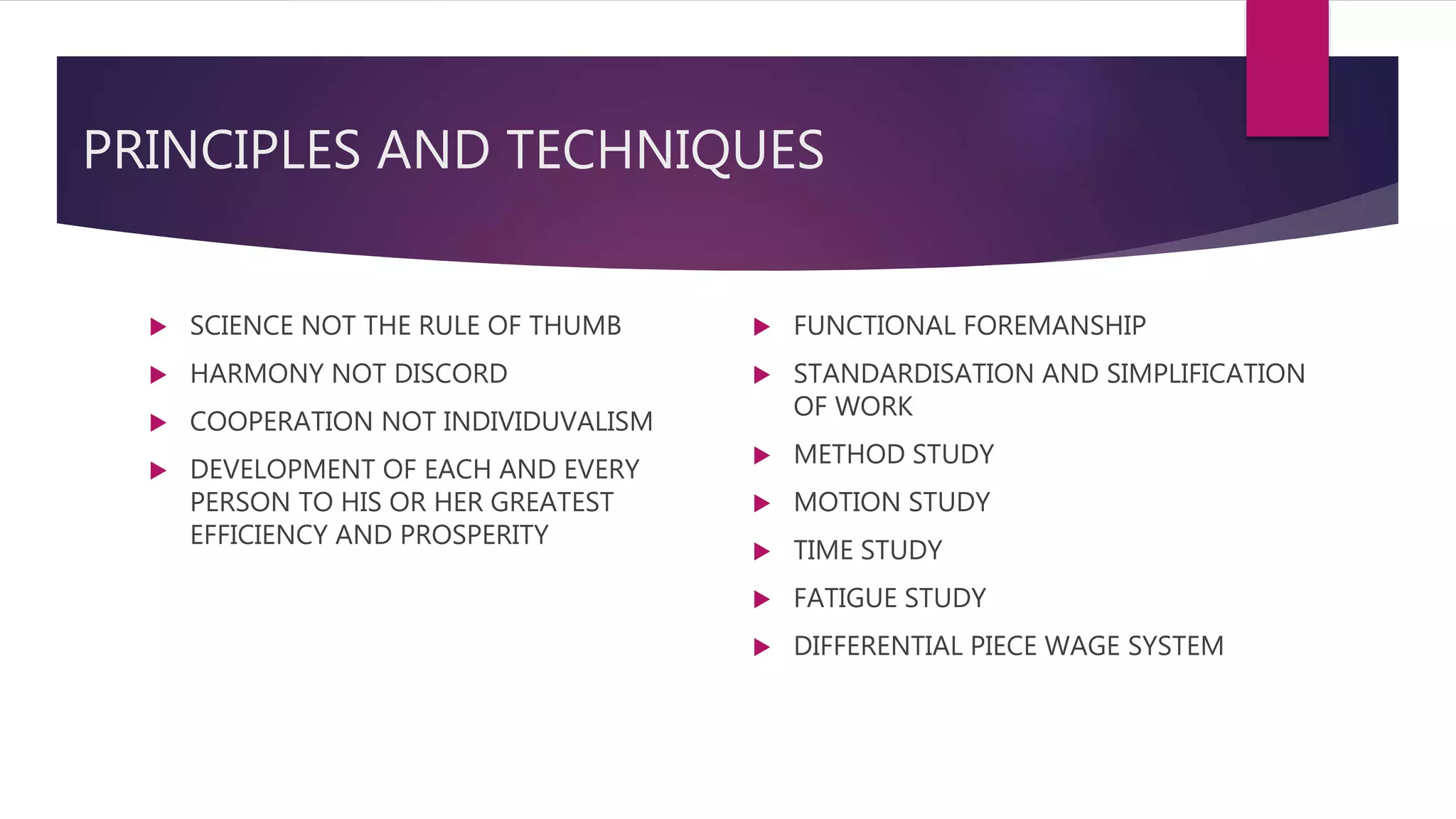
PRINCIPLES AND TECHNIQUES
 SCIENCE NOT THE RULE OF THUMB
 HARMONY NOT DISCORD
 COOPERATION NOT INDIVIDUVALISM
 DEVELOPMENT OF EACH AND EVERY
PERSON TO HIS OR HER GREATEST
EFFICIENCY AND PROSPERITY
 FUNCTIONAL FOREMANSHIP
 STANDARDISATION AND SIMPLIFICATION
OF WORK
 METHOD STUDY
 MOTION STUDY
 TIME STUDY
 FATIGUE STUDY
 DIFFERENTIAL PIECE WAGE SYSTEM
PRINCIPLES
SCIENCE NOT THE RULE OF THUMB
 Taylor pioneered the introduction of the method of scientific inquiry into
management practice.
 He suggested that by following the rules of thumb, all would not be equally
effective.
 He believed that there was only one best method to maximise efficiency.
 Even a small production work loading pigs of iron into box cars can be
scientifically planned and managed.
HARMONY, NOT DISCORD
 Managers served as a link between the owners and the workers.
 There should be complete harmony between the management and workers. Both
should realise that both are important.
 He had called for complete mental revolution on the part of both management
and workers. It means management and workers should transform their thinking.
 In such a situation even trade unions will not thinking of going strike etc..
COOPERATION, NOT INDIVIDUVALISM
 This principle is the extension of second principle.
 Competition must be replaced by cooperation. Both should realise that they need
each other.
 Workers should be rewarded for their suggestions.
 According to him there should be an almost equal division of work and
responsibility between workers and management.
DEVELOPMENT OF EACH AND EVERY PERSON
TO HIS OR HER GREATEST EFFICIENCY AND
PROSPERITY
 Industrial efficiency depends on individual competencies.
 Worker training was essential also to develop workers.
 Taylor was of the view that the concern of efficiency could be built in right in the
process of employee selection.
TECHNIQUES
FUNCTIONAL FOREMANSHIP
 Taylor advocated separation of planning and execution function. This concept was
extended to the lowest level of shop floor.
 Under factory manager there was a planning incharge and production incharge.
 Under planning incharge there are instruction card clerk, route clerk, time and cost
clerk, disciplinarian.
 Under production incharge there are speedboss, gangboss, repairsboss, inspector.
 Foreman should have qualities of intelligence, honesty, good health etc.. As these
all qualities cannot be seen in one person they were given posts depending upon
his/her capabilities.
STANDARDISATION AND
SIMPLIFICATION OF WORK
 Taylor was an ardent supporter of standardisation. According to him scientific
method should be used to analyse methods of production prevalent under the
rule of thumb.
 Standardisation refers to the process of setting standards for every business
activity it can be raw material, product, time etc…
 Simplification aims unnecessary diversification of products which results in saving
of costs.
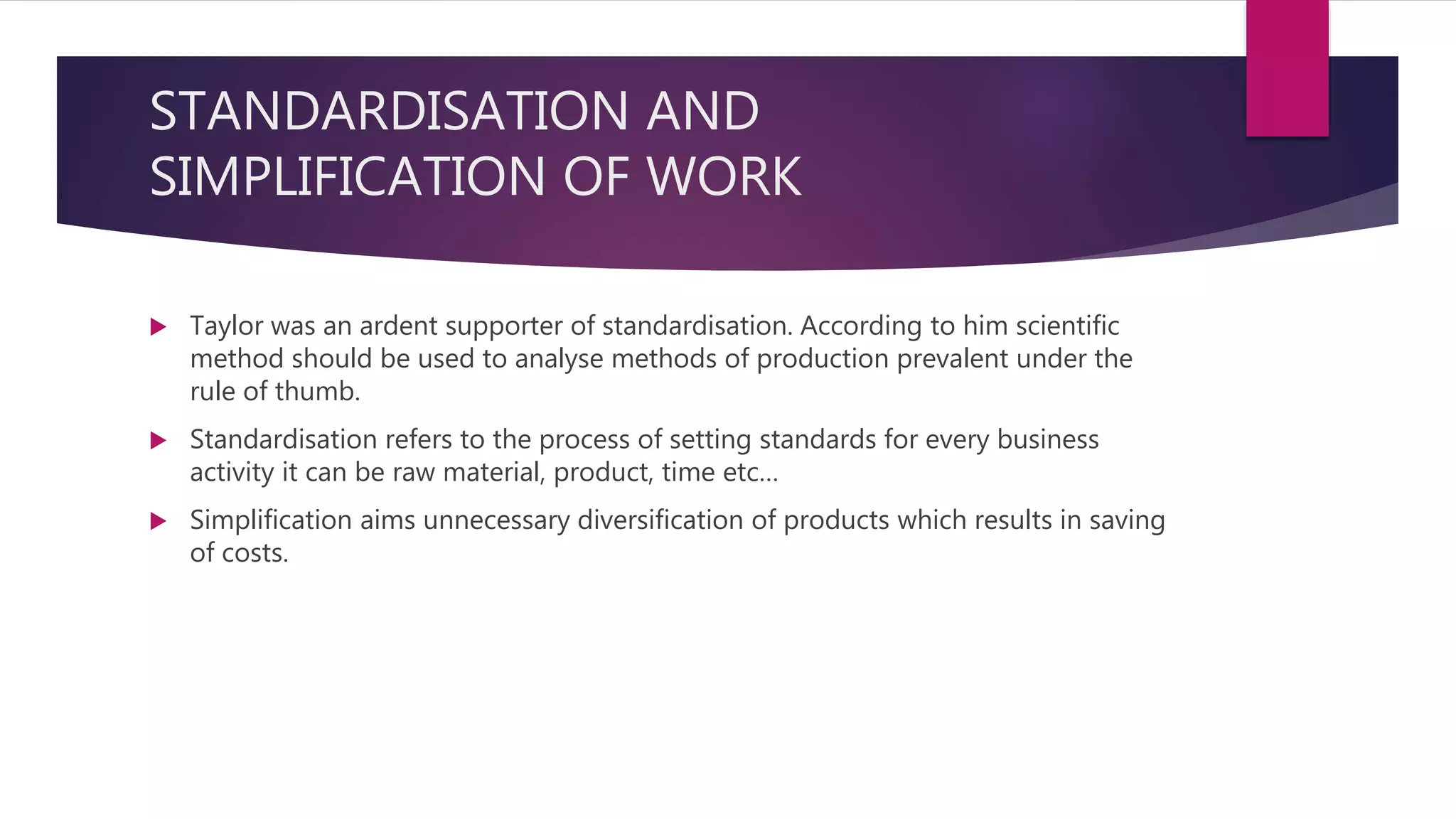
METHOD STUDY
 The objective of method study is to find out the best way to do the job.
 Right from procurement of raw materials till the final product is delivered all the
activities come under method study.
 The objective of whole exercise is to minimise the cost of production and
maximise the quality and satisfaction of the customer.
MOTION STUDY
 It refers to the study of movements like lifting, putting objects, which are
undertaken while doing a typical job. Unnecessary movements are sought to be
eliminated so that it takes less time to complete the job efficiently.
 On close examination it is possible to find out motions which are productive,
incidental and unproductive.
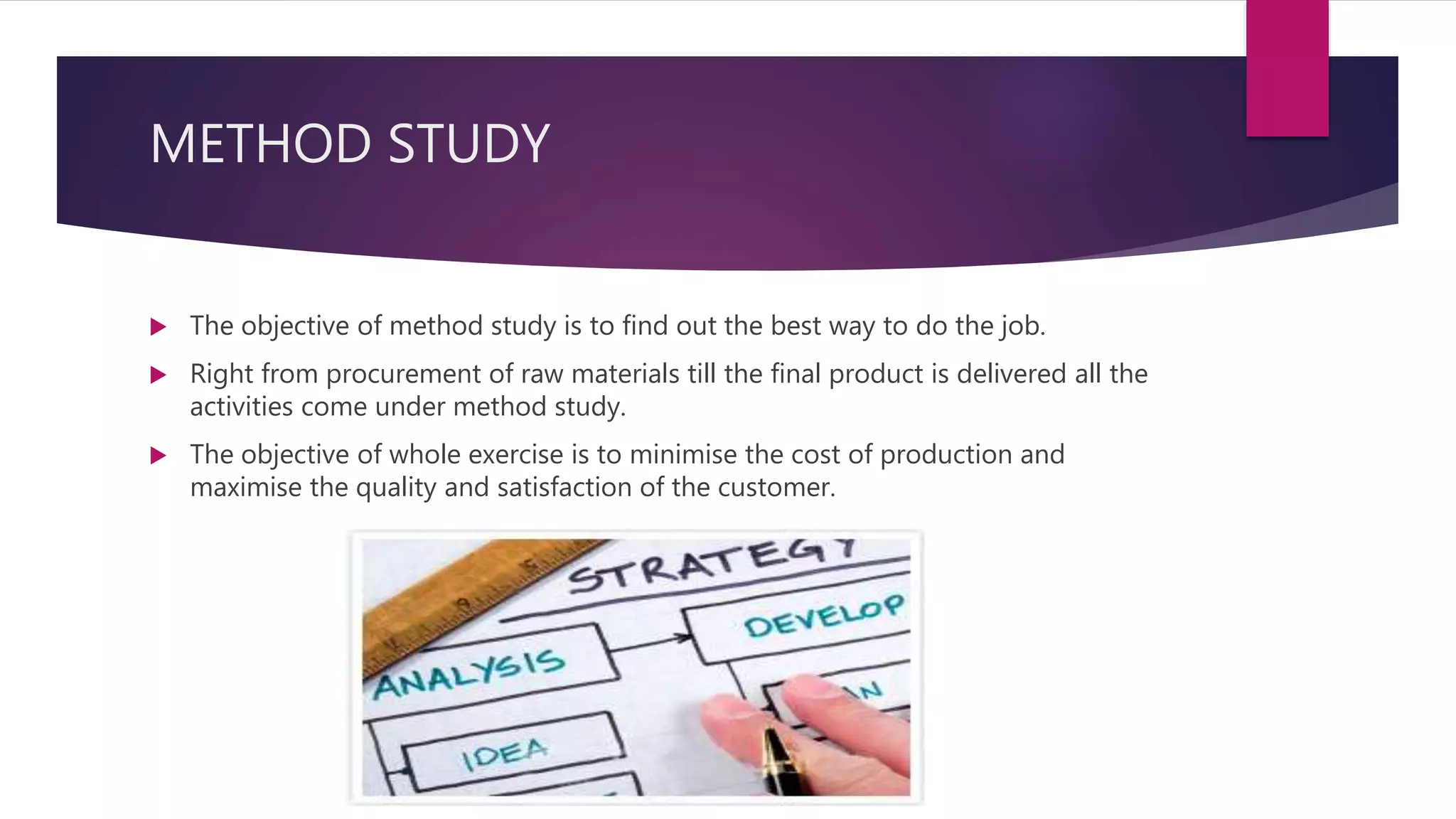
 He used stop watches and time measuring devices for this purpose.
TIME STUDY
 It determines the standard time taken to perform a well-defined job.
 The objective of time study is to determine the number of workers to be
employed and to determine labour costs.
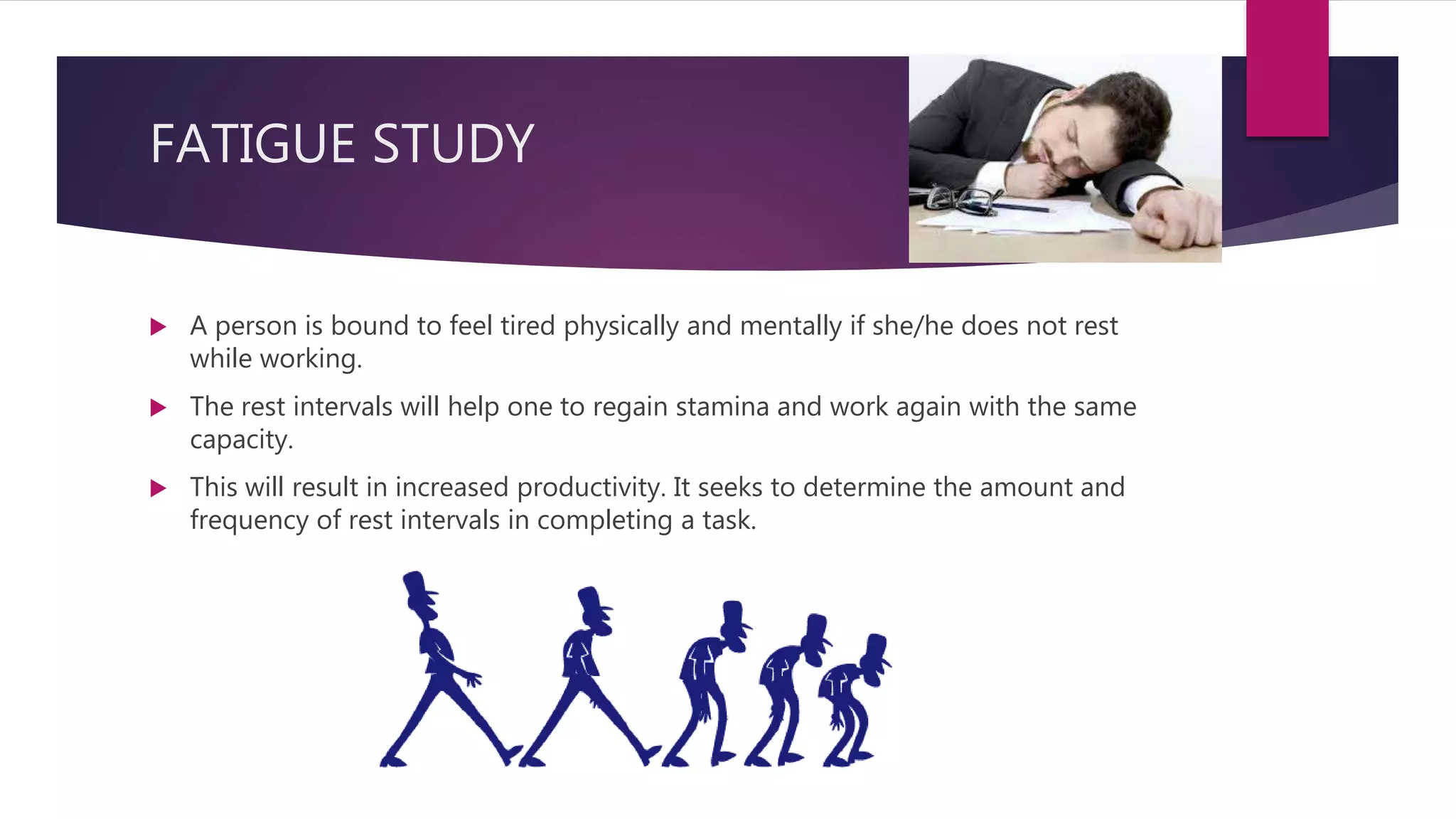
 A person is bound to feel tired physically and mentally if she/he does not rest
while working.
 The rest intervals will help one to regain stamina and work again with the same
capacity.
 This will result in increased productivity. It seeks to determine the amount and
frequency of rest intervals in completing a task.
FATIGUE STUDY
DIFFERENTIAL PIECE WAGE SYSTEM
 Taylor was a strong advocate of piece wage system. He wanted to differentiate
between efficient and inefficient workers.
 So he introduced wage payment for those who performed above standard and for
those who performed below standard.
 There must be a compensation system that differentiates those who are able to
accomplish the fair day’s work.
THANK YOU

Taylor principles of scientific management

  • 1.
    TAYLOR PRINCIPLES OFSCIENTIFIC MANAGEMENT Prepared by Nivesh tv class XII
  • 3.
    A principle refersto a fundamental truth. It establishes cause and effect relationship between two or more variables under given situation. They serve as a guide to thought & actions. These principles are derived: - •On the basis of experimentation INTRODUCTION
  • 4.
    PRINCIPLES AND TECHNIQUES SCIENCE NOT THE RULE OF THUMB  HARMONY NOT DISCORD  COOPERATION NOT INDIVIDUVALISM  DEVELOPMENT OF EACH AND EVERY PERSON TO HIS OR HER GREATEST EFFICIENCY AND PROSPERITY  FUNCTIONAL FOREMANSHIP  STANDARDISATION AND SIMPLIFICATION OF WORK  METHOD STUDY  MOTION STUDY  TIME STUDY  FATIGUE STUDY  DIFFERENTIAL PIECE WAGE SYSTEM
  • 5.
  • 6.
    SCIENCE NOT THERULE OF THUMB  Taylor pioneered the introduction of the method of scientific inquiry into management practice.  He suggested that by following the rules of thumb, all would not be equally effective.  He believed that there was only one best method to maximise efficiency.  Even a small production work loading pigs of iron into box cars can be scientifically planned and managed.
  • 7.
    HARMONY, NOT DISCORD Managers served as a link between the owners and the workers.  There should be complete harmony between the management and workers. Both should realise that both are important.  He had called for complete mental revolution on the part of both management and workers. It means management and workers should transform their thinking.  In such a situation even trade unions will not thinking of going strike etc..
  • 9.
    COOPERATION, NOT INDIVIDUVALISM This principle is the extension of second principle.  Competition must be replaced by cooperation. Both should realise that they need each other.  Workers should be rewarded for their suggestions.  According to him there should be an almost equal division of work and responsibility between workers and management.
  • 11.
    DEVELOPMENT OF EACHAND EVERY PERSON TO HIS OR HER GREATEST EFFICIENCY AND PROSPERITY  Industrial efficiency depends on individual competencies.  Worker training was essential also to develop workers.  Taylor was of the view that the concern of efficiency could be built in right in the process of employee selection.
  • 12.
  • 13.
    FUNCTIONAL FOREMANSHIP  Tayloradvocated separation of planning and execution function. This concept was extended to the lowest level of shop floor.  Under factory manager there was a planning incharge and production incharge.  Under planning incharge there are instruction card clerk, route clerk, time and cost clerk, disciplinarian.  Under production incharge there are speedboss, gangboss, repairsboss, inspector.  Foreman should have qualities of intelligence, honesty, good health etc.. As these all qualities cannot be seen in one person they were given posts depending upon his/her capabilities.
  • 15.
    STANDARDISATION AND SIMPLIFICATION OFWORK  Taylor was an ardent supporter of standardisation. According to him scientific method should be used to analyse methods of production prevalent under the rule of thumb.  Standardisation refers to the process of setting standards for every business activity it can be raw material, product, time etc…  Simplification aims unnecessary diversification of products which results in saving of costs.
  • 16.
    METHOD STUDY  Theobjective of method study is to find out the best way to do the job.  Right from procurement of raw materials till the final product is delivered all the activities come under method study.  The objective of whole exercise is to minimise the cost of production and maximise the quality and satisfaction of the customer.
  • 17.
    MOTION STUDY  Itrefers to the study of movements like lifting, putting objects, which are undertaken while doing a typical job. Unnecessary movements are sought to be eliminated so that it takes less time to complete the job efficiently.  On close examination it is possible to find out motions which are productive, incidental and unproductive.  He used stop watches and time measuring devices for this purpose.
  • 18.
    TIME STUDY  Itdetermines the standard time taken to perform a well-defined job.  The objective of time study is to determine the number of workers to be employed and to determine labour costs.
  • 19.
     A personis bound to feel tired physically and mentally if she/he does not rest while working.  The rest intervals will help one to regain stamina and work again with the same capacity.  This will result in increased productivity. It seeks to determine the amount and frequency of rest intervals in completing a task. FATIGUE STUDY
  • 20.
    DIFFERENTIAL PIECE WAGESYSTEM  Taylor was a strong advocate of piece wage system. He wanted to differentiate between efficient and inefficient workers.  So he introduced wage payment for those who performed above standard and for those who performed below standard.  There must be a compensation system that differentiates those who are able to accomplish the fair day’s work.
  • 22.

Editor's Notes