Hemorrhagic disorders
Micheal Mohab Nady Mikael
Hemorrhagic disorders
Hemostatic system
Hemostasis is the dynamic process of coagulation .It stop
bleeding in the areas of vascular injury .This process
involves the interaction of
-cellular component:
- Platelets
- Vascular wall
- Protein component :
- Procoagulants( Coagulation factors )
-Fibrinolytics ( for lysis)
-Anticoagulants (regulation)
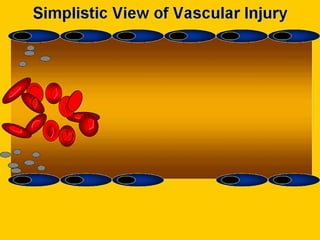
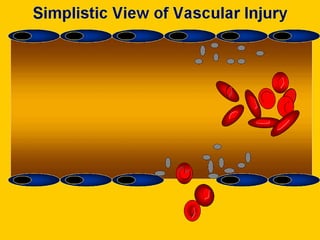
Blood vessel injury →vasoconstriction &
exposed endothelium & sub endothelial
collagen →stimulation of von Willebrond
factor→ platelets activation & adhesion
→activated platelets induce platelets
aggregation .At the same time tissue factor
+ collagen &other proteins in the tissue
activate the coagulation cascade
→formation of thrombin which has
multiple effects on coagulation mechanism :
-feedback activation of factors 5&8
-conversion of fibrinogen to fibrin
-activation of factor 2thus a platelet
plug is formed &bleeding stop .If
failed then thrombin activate
-factor 13 which links fibrin to form
a stable thrombus. Then contractile
elements within platelets cause clot
retraction
• Thrombin also activate the anticoagulant
system leading to limitation of clot size
.Thrombin activate
• the fibrinolytic system to cause lyses of the
thrombus resulting in recanalysation of the
blood vessel.
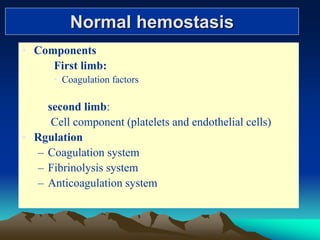
Normal hemostasis
• Components
First limb:
• Coagulation factors
second limb:
Cell component (platelets and endothelial cells)
• Rgulation
– Coagulation system
– Fibrinolysis system
– Anticoagulation system
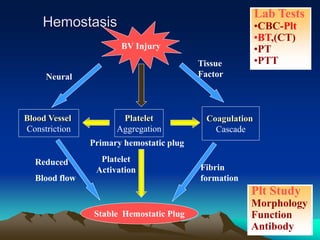
Hemostasis
BV Injury
Platelet
Aggregation
Platelet
Activation
Blood Vessel
Constriction
Coagulation
Cascade
Stable Hemostatic Plug
Fibrin
formation
Reduced
Blood flow
Tissue
Factor
Primary hemostatic plug
Neural
Lab Tests
•CBC-Plt
•BT,(CT)
•PT
•PTT
Plt Study
Morphology
Function
Antibody
Kinins HMW Kininogen
Kallikrein Contact Activation
XII Prekallikrein
XIIa
XIa XI
IXa Ca++ IX
VIIIa VIII
Ca++
Phospholipid
Intrinsic Pathway
Xa X
Va V
Ca++
Phospholipid XIII
II IIa
XIIa
Fibrinogen Fibrin XIII
Common Pathway
VII VIIa
Ca++
Tissue Factor
Coagulation cascade
Extrinsic Pathway
Platelet structure:
Platelets are non-nucleated cellular
fragments produced by megakaryocytes of
bone marrow. Their life span is 7-10 days.
Normal platelet count is 150 - 400 x 109/ L.
(150.000-400.000/mm3).
Functions of platelets
a- They stimulate vasoconstriction of the injured vessels.
b- They form a primary hemostatic plug to seal small
vascular tears. This plug is formed by platelet adhesion
(sticking of the platelets to the subendothelial structures)
followed by aggregation (sticking of the platelets to each
other).
c- They play an essential role in fibrin clot formation by
the production of platelet factor 3 needed in blood clot
formation.
d- They induce fibrin clot retraction.
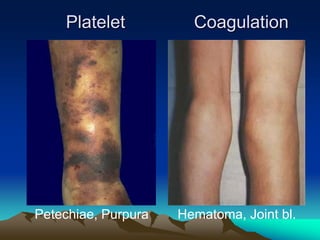
Platelet Coagulation
Petechiae, Purpura Hematoma, Joint bl.
Hemostatic Disorders
1-bleeding disorders
a-platelets defects
b-vascular defects
2-Hemohrragic disorders
1-bleeding disorders
Vascular defect -  fragility
Petechiae, purpura, ecchymoses
 senile purpura
 vitamin C deficiency (scurvy)
 connective tissue disorders
Vascular defect - cont.
 Infectious and hypersensitivity
vasculitides
- Rickettsial and meningococcal
infections
- Henoch-Schonlein purpura
(immune)
Platelet disorders:
  platelets (thrombocytopenia)
petechiae
spontaneous bleeding after trauma
CNS bleeding (severe  plt)
 Platelet dysfunction -
mucocutaneous bleeding
2-Hemohrragic disorders
• Coagulation factors defect
• Vitamin K deficiency
• Anticoagulant therapy: heparin
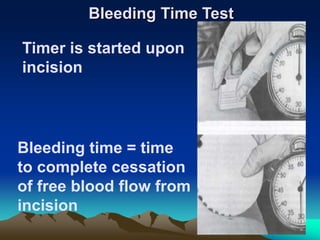
Bleeding Time Test
Timer is started upon
incision
Bleeding time = time
to complete cessation
of free blood flow from
incision
Tests for coagulation factors
• Clotting time
• Thrombin time
• Prothrombin time
• Partial thromboplastin time
purpura
Classification of purpuras
A- Purpura associated with normal numbers of
platelets (non thrombocytopenic purpuras)
1- Vascular purpura
a- Henoch-Schonlein purpura (anaphylactoid
purpura).
b- Meningococcemia or septicemia.
c- Toxic vasculitis: may produce hemorrhagic rash
as a reaction to drugs such as iodides.
d- Viral or rickettsial infections.
e- Scurvy (vitamin C deficiency).
2- Platelet function disorders
a- Congenital platelet function defects
(thrombasthenias).
b- Acquired platelet function disorders: e.g.
uremia.
c- Drug-induced abnormalities of platelet
aggregation (salicylates therapy).
B- Purpura associated with decreased number of
platelet (thrombocytopenic purpuras)
1- Idiopathic thrombocytopenic purpura (ITP).
2- Aplastic anemia.
3- Bone marrow infiltration e.g. leukemia.
4- hypersplenism.
5- Other thrombocytopenic purpura.
a- Drug induced thrombocytopenia e.g
carbamazepine.
b- Congenital thrombocytopenic syndromes (e.g.
Wiskott Aldrich syndrome).
c- Thrombocytopenia with cavernous hemangioma.
6- Neonatal thrombocytopenia.
Idiopathic Thrombocytopenic
Purpura (ITP)
 Acute - children (post infection)
- autoimmune disorder
- antiplatelet antibodies (IgG
against platelet
glycoproteins)
- IgG coated platelets removed by
spleen ( platelet survival)
 Usually  megakaryocytes in BM
Clinical Picture
 The classic presentation of ITP is at age 1-
4 years.
 Sudden onset of generalized petechial
purpura in a previously healthy child.
 Intracranial hemorrhage
 no organomegally
 70-80% spontaneous recovery.
 About 10-20% develop chronic ITP
persisting more than 6 months.
Laboratory investigations:
 Platelet count is reduced below 150x109
/L, bleeding occurs with platelet count<40
x109/L.
 Bleeding time and clot retraction test yield
abnormal results.
 Anemia is not present unless significant
blood loss has occurred.
 White blood cell count is normal.
 Bone marrow aspiration reveals
normal granulocytic and erythrocytic
series, normal or increased numbers of
megakaryocytes, some of
megakaryocytes are immature, platelet
budding may be scanty but there is no
diagnostic megakaryocyte morphology.
D.D:
Non thrompocytopenic purpura:
Other thrompocytopenic purpura:
 Aplastic anemia
 Bone marrow infiltration
 hypersplenism
Treatment
• Fresh blood
• PLT transfusion
• IV immunoglobulin
• Steroid therapy
• IV antiD therapy
• splenectomy
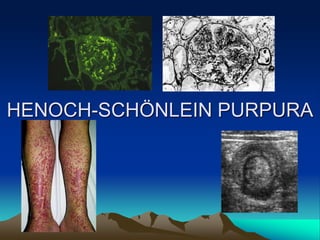
HENOCH-SCHÖNLEIN PURPURA
DEFINITION
• Also called “anaphylactoid purpura”
• HSP is a systemic vasculitic syndrome
with:
– Palpable purpura
– Arthralgias or arthritis
– GIT involvement
– Glomerulonephritis
EPIDEMIOLOGY
• 90% of cases reported in children
– Peak in children aged 4-7
• Male:Female (1.5:1)
• 50% follow a URI
• Renal disease is more severe in adults
CLINICAL FEATURES
• Tetrad of symptoms
– Abdominal pain
– Renal disease
– Palpable purpura
– Arthritis/arthralgias – more common in adults
and most common in knees and ankles.
Generally self-limiting
MANAGEMENT
• Usually self-limiting (1-6 weeks)
• Steroids:
– may decrease tissue edema, may aid in
arthralgias and some abdominal pain
– Has not been shown to be beneficial in kidney
disease or dermal manifestations
– Does not lessen chance of recurrence
– Does not shorten duration of disease
Coagulation disorders
Heridetary:
- hemophilia A
- hemophilia B
- hemophilia C
Acquired:
• Hepatic dysfunction
• Vit K defeciency
• DIC
Hemophilia
Hemophilia
• Caused by an absence or decreased
amount of a procoagulant –
• VIII -Hemophilia A affects ~ 1:5000
males
• XI -Hemophilia B affects ~ 1:30000
males
• XI –Hemophilia C – Rare /Ethnicity
Epidemiology
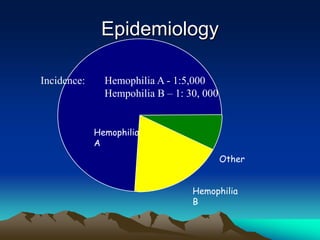
Hemophilia
A
Other
Hemophilia
B
Incidence: Hemophilia A - 1:5,000
Hempohilia B – 1: 30, 000
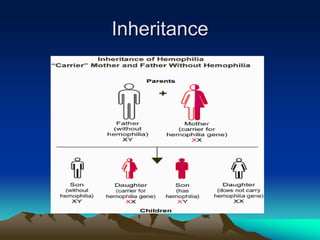
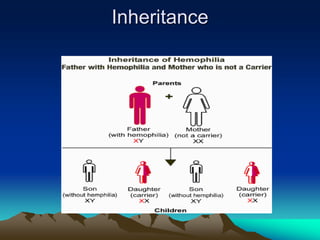
Inheritance
Inheritance
Woman can have hemophilia
• Lyonization of the normal X
chromosome
• Turner syndrome ( XO)
• Father with hemophilia/ mom as a
carrier
• vW type 2 N ( Normandy)
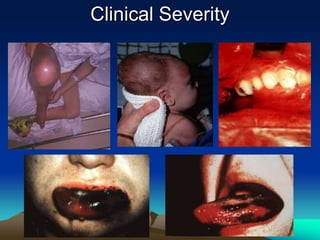
Clinical Severity
Laboratory findings:
• Rolonged PTT
• Normal PT and thrombin time
• Decreased level of factor VIII
Complications :
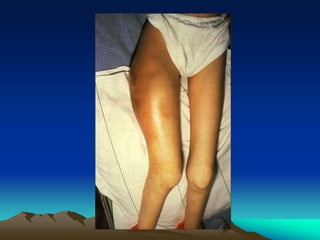
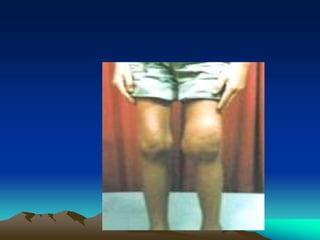
• Joint derormities
• Inhibitors to factor VIII
• Hepatitis
• AIDS
management
• General: dental hygiene, avoid
injury,avoid aspirin,replacement therapy
with surgery
• Replacement therapy:
1. Fresh frozen plasma
2. Factor VIII concentrates
3. Intranasal form of desmopressin acetate
prophylaxis
• Factor VIII concentrates (20-40IU/Kg)
every 3 days with severe form
Thank you

Hemorrhagic disorders march 2020

  • 1.
  • 2.
    Hemorrhagic disorders Hemostatic system Hemostasisis the dynamic process of coagulation .It stop bleeding in the areas of vascular injury .This process involves the interaction of -cellular component: - Platelets - Vascular wall - Protein component : - Procoagulants( Coagulation factors ) -Fibrinolytics ( for lysis) -Anticoagulants (regulation)
  • 3.
    Blood vessel injury→vasoconstriction & exposed endothelium & sub endothelial collagen →stimulation of von Willebrond factor→ platelets activation & adhesion →activated platelets induce platelets aggregation .At the same time tissue factor + collagen &other proteins in the tissue activate the coagulation cascade →formation of thrombin which has multiple effects on coagulation mechanism :
  • 4.
    -feedback activation offactors 5&8 -conversion of fibrinogen to fibrin -activation of factor 2thus a platelet plug is formed &bleeding stop .If failed then thrombin activate -factor 13 which links fibrin to form a stable thrombus. Then contractile elements within platelets cause clot retraction
  • 5.
    • Thrombin alsoactivate the anticoagulant system leading to limitation of clot size .Thrombin activate • the fibrinolytic system to cause lyses of the thrombus resulting in recanalysation of the blood vessel.
  • 6.
    Normal hemostasis • Components Firstlimb: • Coagulation factors second limb: Cell component (platelets and endothelial cells) • Rgulation – Coagulation system – Fibrinolysis system – Anticoagulation system
  • 7.
    Hemostasis BV Injury Platelet Aggregation Platelet Activation Blood Vessel Constriction Coagulation Cascade StableHemostatic Plug Fibrin formation Reduced Blood flow Tissue Factor Primary hemostatic plug Neural Lab Tests •CBC-Plt •BT,(CT) •PT •PTT Plt Study Morphology Function Antibody
  • 8.
    Kinins HMW Kininogen KallikreinContact Activation XII Prekallikrein XIIa XIa XI IXa Ca++ IX VIIIa VIII Ca++ Phospholipid Intrinsic Pathway Xa X Va V Ca++ Phospholipid XIII II IIa XIIa Fibrinogen Fibrin XIII Common Pathway VII VIIa Ca++ Tissue Factor Coagulation cascade Extrinsic Pathway
  • 12.
    Platelet structure: Platelets arenon-nucleated cellular fragments produced by megakaryocytes of bone marrow. Their life span is 7-10 days. Normal platelet count is 150 - 400 x 109/ L. (150.000-400.000/mm3).
  • 13.
    Functions of platelets a-They stimulate vasoconstriction of the injured vessels. b- They form a primary hemostatic plug to seal small vascular tears. This plug is formed by platelet adhesion (sticking of the platelets to the subendothelial structures) followed by aggregation (sticking of the platelets to each other). c- They play an essential role in fibrin clot formation by the production of platelet factor 3 needed in blood clot formation. d- They induce fibrin clot retraction.
  • 14.
  • 15.
    Hemostatic Disorders 1-bleeding disorders a-plateletsdefects b-vascular defects 2-Hemohrragic disorders
  • 16.
    1-bleeding disorders Vascular defect-  fragility Petechiae, purpura, ecchymoses  senile purpura  vitamin C deficiency (scurvy)  connective tissue disorders
  • 17.
    Vascular defect -cont.  Infectious and hypersensitivity vasculitides - Rickettsial and meningococcal infections - Henoch-Schonlein purpura (immune)
  • 18.
    Platelet disorders:  platelets (thrombocytopenia) petechiae spontaneous bleeding after trauma CNS bleeding (severe  plt)  Platelet dysfunction - mucocutaneous bleeding
  • 19.
    2-Hemohrragic disorders • Coagulationfactors defect • Vitamin K deficiency • Anticoagulant therapy: heparin
  • 20.
    Bleeding Time Test Timeris started upon incision Bleeding time = time to complete cessation of free blood flow from incision
  • 21.
    Tests for coagulationfactors • Clotting time • Thrombin time • Prothrombin time • Partial thromboplastin time
  • 22.
    purpura Classification of purpuras A-Purpura associated with normal numbers of platelets (non thrombocytopenic purpuras) 1- Vascular purpura a- Henoch-Schonlein purpura (anaphylactoid purpura). b- Meningococcemia or septicemia. c- Toxic vasculitis: may produce hemorrhagic rash as a reaction to drugs such as iodides. d- Viral or rickettsial infections. e- Scurvy (vitamin C deficiency).
  • 23.
    2- Platelet functiondisorders a- Congenital platelet function defects (thrombasthenias). b- Acquired platelet function disorders: e.g. uremia. c- Drug-induced abnormalities of platelet aggregation (salicylates therapy).
  • 24.
    B- Purpura associatedwith decreased number of platelet (thrombocytopenic purpuras) 1- Idiopathic thrombocytopenic purpura (ITP). 2- Aplastic anemia. 3- Bone marrow infiltration e.g. leukemia. 4- hypersplenism. 5- Other thrombocytopenic purpura. a- Drug induced thrombocytopenia e.g carbamazepine. b- Congenital thrombocytopenic syndromes (e.g. Wiskott Aldrich syndrome). c- Thrombocytopenia with cavernous hemangioma. 6- Neonatal thrombocytopenia.
  • 25.
    Idiopathic Thrombocytopenic Purpura (ITP) Acute - children (post infection) - autoimmune disorder - antiplatelet antibodies (IgG against platelet glycoproteins) - IgG coated platelets removed by spleen ( platelet survival)  Usually  megakaryocytes in BM
  • 26.
    Clinical Picture  Theclassic presentation of ITP is at age 1- 4 years.  Sudden onset of generalized petechial purpura in a previously healthy child.  Intracranial hemorrhage  no organomegally  70-80% spontaneous recovery.  About 10-20% develop chronic ITP persisting more than 6 months.
  • 27.
    Laboratory investigations:  Plateletcount is reduced below 150x109 /L, bleeding occurs with platelet count<40 x109/L.  Bleeding time and clot retraction test yield abnormal results.  Anemia is not present unless significant blood loss has occurred.  White blood cell count is normal.
  • 28.
     Bone marrowaspiration reveals normal granulocytic and erythrocytic series, normal or increased numbers of megakaryocytes, some of megakaryocytes are immature, platelet budding may be scanty but there is no diagnostic megakaryocyte morphology.
  • 29.
    D.D: Non thrompocytopenic purpura: Otherthrompocytopenic purpura:  Aplastic anemia  Bone marrow infiltration  hypersplenism
  • 30.
    Treatment • Fresh blood •PLT transfusion • IV immunoglobulin • Steroid therapy • IV antiD therapy • splenectomy
  • 31.
  • 32.
    DEFINITION • Also called“anaphylactoid purpura” • HSP is a systemic vasculitic syndrome with: – Palpable purpura – Arthralgias or arthritis – GIT involvement – Glomerulonephritis
  • 33.
    EPIDEMIOLOGY • 90% ofcases reported in children – Peak in children aged 4-7 • Male:Female (1.5:1) • 50% follow a URI • Renal disease is more severe in adults
  • 34.
    CLINICAL FEATURES • Tetradof symptoms – Abdominal pain – Renal disease – Palpable purpura – Arthritis/arthralgias – more common in adults and most common in knees and ankles. Generally self-limiting
  • 35.
    MANAGEMENT • Usually self-limiting(1-6 weeks) • Steroids: – may decrease tissue edema, may aid in arthralgias and some abdominal pain – Has not been shown to be beneficial in kidney disease or dermal manifestations – Does not lessen chance of recurrence – Does not shorten duration of disease
  • 36.
    Coagulation disorders Heridetary: - hemophiliaA - hemophilia B - hemophilia C Acquired: • Hepatic dysfunction • Vit K defeciency • DIC
  • 37.
  • 38.
    Hemophilia • Caused byan absence or decreased amount of a procoagulant – • VIII -Hemophilia A affects ~ 1:5000 males • XI -Hemophilia B affects ~ 1:30000 males • XI –Hemophilia C – Rare /Ethnicity
  • 39.
  • 40.
  • 41.
  • 42.
    Woman can havehemophilia • Lyonization of the normal X chromosome • Turner syndrome ( XO) • Father with hemophilia/ mom as a carrier • vW type 2 N ( Normandy)
  • 43.
  • 46.
    Laboratory findings: • RolongedPTT • Normal PT and thrombin time • Decreased level of factor VIII
  • 47.
    Complications : • Jointderormities • Inhibitors to factor VIII • Hepatitis • AIDS
  • 48.
    management • General: dentalhygiene, avoid injury,avoid aspirin,replacement therapy with surgery • Replacement therapy: 1. Fresh frozen plasma 2. Factor VIII concentrates 3. Intranasal form of desmopressin acetate
  • 49.
    prophylaxis • Factor VIIIconcentrates (20-40IU/Kg) every 3 days with severe form
  • 50.