Haemostasis
Anticoagulants
& Bleeding
Disorders
Hemophilia & purpura)
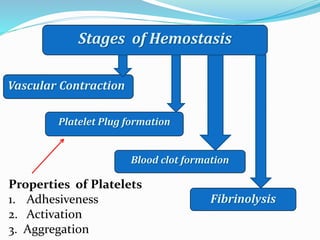
Stages of Hemostasis
Vascular Contraction
Platelet Plug formation
Blood clot formation
Fibrinolysis
Properties of Platelets
1. Adhesiveness
2. Activation
3. Aggregation
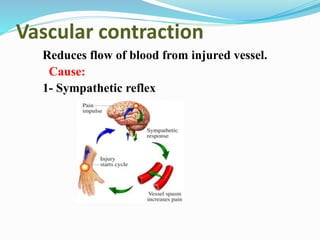
Vascular contraction
Reduces flow of blood from injured vessel.
Cause:
1- Sympathetic reflex
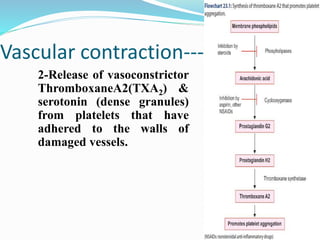
Vascular contraction-----
2-Release of vasoconstrictor
ThromboxaneA2(TXA2) &
serotonin (dense granules)
from platelets that have
adhered to the walls of
damaged vessels.
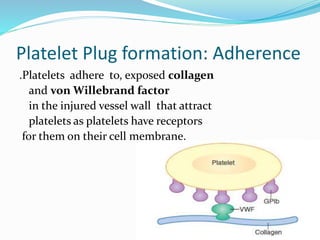
Platelet Plug formation: Adherence
.Platelets adhere to, exposed collagen
and von Willebrand factor
in the injured vessel wall that attract
platelets as platelets have receptors
for them on their cell membrane.
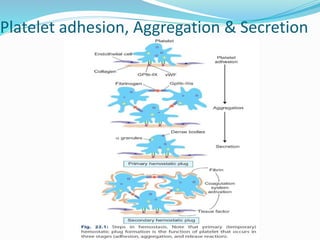
Platelet adhesion, Aggregation & Secretion
Factor I Fibrinogen
Factor II Prothrombin
Factor III Thromboplastin
Factor IV Calcium
Factor V Labile factor, or proaccelerin
Factor VI Non – existent
Factor VII Stable factor or proconvertin
Factor VIII Antihaemophilic factor / globulin A
Factor IX Christmas factor or Antihaemophilic factor B
Factor X Stuart – Prower factor
Factor XI Plasma thromboplastin antecedent or
Antihaemophilic factor C
Factor XII Hageman factor or Contact factor
Factor XIII Fibrin stabilizing factor or Laki – Lorand factor
CLOTING
FACTOR
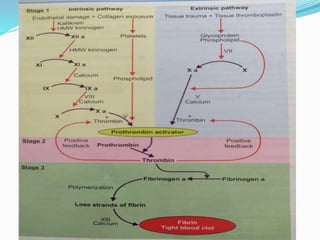
CLOT FORMATION
 The clotting mechanism involves a cascade of
reactions in which clotting factors are activated.
 Most of them are plasma proteins synthesized by
the liver (vitamin K is needed for the synthesis of
factor II, VII, IX and X).
 They are always present in the plasma in an inactive
form.
 When activated they act as proteolytic enzymes
which activate other inactive enzymes.
 Several of these steps require Ca++ and platelet
phospholipid.
Anti - Clotting Mechanism (in vivo)
Some factors do not allow the clot enlarge beyond the
injured vessel wall one factor such is Heparin
Heparin when combined with antithrombin-III,
the effectiveness of antithrombin III to remove
thrombin increases by 100 to 1000-fold. This does not
allow the clot to extends to long .
Prevents coagulation for approximately 24 hours by
neutralizing thrombin. It facilitates action of
antithrombin III. Thus, it prevents formation of
fibrin from fibrinogen
Fibrinolysis (in vivo)
 The process of removing unwanted
insoluble deposit formed as a result of
coagulation is called fibrinolysis.
 It is a physiological process in which fibrin
clot is broken down by enzyme into soluble
fragment.
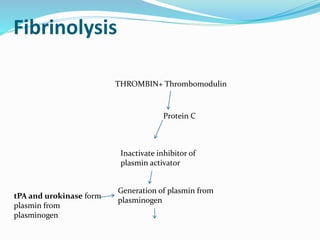
Fibrinolysis
THROMBIN+ Thrombomodulin
Protein C
Inactivate inhibitor of
plasmin activator
Generation of plasmin from
plasminogen
tPA and urokinase form
plasmin from
plasminogen
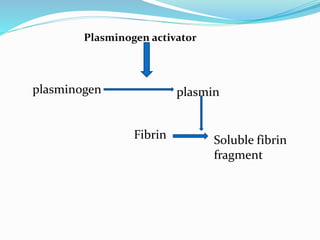
Plasminogen activator
plasminogen plasmin
Fibrin Soluble fibrin
fragment
BLEEDING DISORDERS
 Bleeding disorders are the conditions characterized by
prolonged bleeding time or clotting time.
 Bleeding disorders are of three types:
1. Hemophilia.
2. Purpura.
3. von Willebrand disease.
1.Hemophilia
 Hemophilia is a group of sex-linked inherited blood
disorders, characterized by prolonged clotting time.
 However, the bleeding time is normal.
 Usually, it affects the males, with the females being the
carriers.
 Easy bruising and hemorrhage in muscles and joints
are also common in this disease
Causes of hemophilia
 Hemophilia occurs due to lack of formation of
prothrombin activator.
 That is why the coagulation time is prolonged.
 The formation of prothrombin activator is affected due
to the deficiency of factor VIII, IX or XI.
Types of hemophilia
 Depending upon the deficiency of the factor
involved,hemophilia is classified into three types:
 i. Hemophilia A (VIII)or classic hemophilia: 85%
 ii. Hemophilia B(IX) or Christmas disease: 15%
 iii. Hemophilia C or factor XI deficiency: Rare
Symptoms of hemophilia
i. Spontaneous bleeding.
ii. Prolonged bleeding due to cuts, tooth extraction and
surgery.
iii. Hemorrhage in gastrointestinal and urinary tracts.
iv. Bleeding in joints followed by swelling an pain
v. Appearance of blood in urine
2. Purpura
 Purpura is a disorder characterized by prolonged
bleeding time.
 However, the clotting time is normal.
 Characteristic feature of this disease is spontaneous
bleeding under the skin from ruptured capillaries.
 It causes small tiny hemorrhagic spots in many
areas of the body.
 The hemorrhagic spots under the skin are called
purpuric spots (purple colored patch like
appearance).
Types and causes of purpura
1.Thrombocytopenic purpura
 Thrombocytopenic purpura is due to the deficiency of
platelets (thrombocytopenia).
 In bone marrow disease, platelet production is affected
leading to the deficiency of platelets.
2. Idiopathic thrombocytopenic purpura
 Purpura due to some unknown cause is called
idiopathic thrombocytopenic purpura.
 It is believed that platelet count decreases due to the
development of antibodies against platelets, which
occurs after blood transfusion
3.Thrombasthenic purpura
 Thrombasthenic purpura is due to structural or
functional abnormality of platelets
 However, the platelet count is normal.
 It is characterized by normal clotting time, normal or
prolonged bleeding time but defective clot retraction
3. von Willebrand Disease
 von Willebrand disease is a bleeding disorder,
 characterized by excess bleeding even with a mild
injury.
 It is due to deficiency of von Willebrand factor, which
is a protein secreted by endothelium of damaged
blood vessels and platelets.
 This protein is responsible for adherence of platelets to
endothelium of blood vessels during hemostasis after
an injury.
Haemostasis, anticoagulant, bleeding disorders.

Haemostasis, anticoagulant, bleeding disorders.

  • 1.
  • 2.
    Stages of Hemostasis VascularContraction Platelet Plug formation Blood clot formation Fibrinolysis Properties of Platelets 1. Adhesiveness 2. Activation 3. Aggregation
  • 3.
    Vascular contraction Reduces flowof blood from injured vessel. Cause: 1- Sympathetic reflex
  • 4.
    Vascular contraction----- 2-Release ofvasoconstrictor ThromboxaneA2(TXA2) & serotonin (dense granules) from platelets that have adhered to the walls of damaged vessels.
  • 5.
    Platelet Plug formation:Adherence .Platelets adhere to, exposed collagen and von Willebrand factor in the injured vessel wall that attract platelets as platelets have receptors for them on their cell membrane.
  • 6.
  • 7.
    Factor I Fibrinogen FactorII Prothrombin Factor III Thromboplastin Factor IV Calcium Factor V Labile factor, or proaccelerin Factor VI Non – existent Factor VII Stable factor or proconvertin Factor VIII Antihaemophilic factor / globulin A Factor IX Christmas factor or Antihaemophilic factor B Factor X Stuart – Prower factor Factor XI Plasma thromboplastin antecedent or Antihaemophilic factor C Factor XII Hageman factor or Contact factor Factor XIII Fibrin stabilizing factor or Laki – Lorand factor CLOTING FACTOR
  • 8.
    CLOT FORMATION  Theclotting mechanism involves a cascade of reactions in which clotting factors are activated.  Most of them are plasma proteins synthesized by the liver (vitamin K is needed for the synthesis of factor II, VII, IX and X).  They are always present in the plasma in an inactive form.  When activated they act as proteolytic enzymes which activate other inactive enzymes.  Several of these steps require Ca++ and platelet phospholipid.
  • 10.
    Anti - ClottingMechanism (in vivo) Some factors do not allow the clot enlarge beyond the injured vessel wall one factor such is Heparin Heparin when combined with antithrombin-III, the effectiveness of antithrombin III to remove thrombin increases by 100 to 1000-fold. This does not allow the clot to extends to long . Prevents coagulation for approximately 24 hours by neutralizing thrombin. It facilitates action of antithrombin III. Thus, it prevents formation of fibrin from fibrinogen
  • 11.
    Fibrinolysis (in vivo) The process of removing unwanted insoluble deposit formed as a result of coagulation is called fibrinolysis.  It is a physiological process in which fibrin clot is broken down by enzyme into soluble fragment.
  • 12.
    Fibrinolysis THROMBIN+ Thrombomodulin Protein C Inactivateinhibitor of plasmin activator Generation of plasmin from plasminogen tPA and urokinase form plasmin from plasminogen
  • 13.
  • 14.
    BLEEDING DISORDERS  Bleedingdisorders are the conditions characterized by prolonged bleeding time or clotting time.  Bleeding disorders are of three types: 1. Hemophilia. 2. Purpura. 3. von Willebrand disease.
  • 15.
    1.Hemophilia  Hemophilia isa group of sex-linked inherited blood disorders, characterized by prolonged clotting time.  However, the bleeding time is normal.  Usually, it affects the males, with the females being the carriers.  Easy bruising and hemorrhage in muscles and joints are also common in this disease
  • 16.
    Causes of hemophilia Hemophilia occurs due to lack of formation of prothrombin activator.  That is why the coagulation time is prolonged.  The formation of prothrombin activator is affected due to the deficiency of factor VIII, IX or XI.
  • 17.
    Types of hemophilia Depending upon the deficiency of the factor involved,hemophilia is classified into three types:  i. Hemophilia A (VIII)or classic hemophilia: 85%  ii. Hemophilia B(IX) or Christmas disease: 15%  iii. Hemophilia C or factor XI deficiency: Rare
  • 18.
    Symptoms of hemophilia i.Spontaneous bleeding. ii. Prolonged bleeding due to cuts, tooth extraction and surgery. iii. Hemorrhage in gastrointestinal and urinary tracts. iv. Bleeding in joints followed by swelling an pain v. Appearance of blood in urine
  • 19.
    2. Purpura  Purpurais a disorder characterized by prolonged bleeding time.  However, the clotting time is normal.  Characteristic feature of this disease is spontaneous bleeding under the skin from ruptured capillaries.  It causes small tiny hemorrhagic spots in many areas of the body.  The hemorrhagic spots under the skin are called purpuric spots (purple colored patch like appearance).
  • 20.
    Types and causesof purpura 1.Thrombocytopenic purpura  Thrombocytopenic purpura is due to the deficiency of platelets (thrombocytopenia).  In bone marrow disease, platelet production is affected leading to the deficiency of platelets.
  • 21.
    2. Idiopathic thrombocytopenicpurpura  Purpura due to some unknown cause is called idiopathic thrombocytopenic purpura.  It is believed that platelet count decreases due to the development of antibodies against platelets, which occurs after blood transfusion
  • 22.
    3.Thrombasthenic purpura  Thrombasthenicpurpura is due to structural or functional abnormality of platelets  However, the platelet count is normal.  It is characterized by normal clotting time, normal or prolonged bleeding time but defective clot retraction
  • 23.
    3. von WillebrandDisease  von Willebrand disease is a bleeding disorder,  characterized by excess bleeding even with a mild injury.  It is due to deficiency of von Willebrand factor, which is a protein secreted by endothelium of damaged blood vessels and platelets.  This protein is responsible for adherence of platelets to endothelium of blood vessels during hemostasis after an injury.