1
SHOCK
Presented by:
Dr. Satyaki Verma
JR 1
CONTENTS
3
• INTRODUCTION
• CLINICAL FEATURES
• CLASSIFICATION
• TYPES OF SHOCK
• PATHOGENESIS AND
PATHOPHYSIOLOGY
• STAGES OF SHOCK
• COMPLICATIONS OF SHOCK
• CLINICAL EMERGENCIES AND
TREATMENT
• REFERENCES
INTRODUCTION
SHOCK is characterised by systemic hypoperfusion of tissues, it can be caused
by diminished cardiac output or by reduced effective circulating blood volume.
---ROBBINS BASIC PATHOLOGY 9TH ED.
4
CLINICAL FEATURES
Rapid Shallow
Respiration.
Hypotension with a
systolic blood pressure <
100 mm/hg
Tachycardia ( >100/min).
Cold and clammy skin.
5
Oligouria(urine output
<0.5mL/Hr./Kg.).
Pale face.
Sunken eyes.
Weakness.
CLASSIFICATION
6
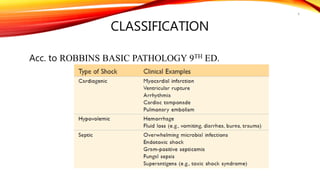
Acc. to ROBBINS BASIC PATHOLOGY 9TH ED.
• Acc. To DAVIDSONS’S ESSENTIALS OF MEDICINE 2ND ED.
• Based on Low Stroke:-
• Hypovolemic Shock.
• Cardiogenic Shock.
• Obstructive Shock.
• Based On Vasodialation:-
• Sepsis.
• Anaphylactic.
• Neurogenic.
7
• Acc to SCHWARTZ’S PRINCIPLES OF SURGERY 10TH ED.
8
ETIOLOGY AND CLASSIFICATION
• The most common forms of shock can be grouped into three pathogenic categories:
• HYPOVOLAEMIC SHOCK
• SEPTIC SHOCK
• CARDIOGENIC SHOCK
9
HYPOVOLEMIC SHOCK
• Reduction in blood volume or loss of circulating blood volume induces
hypovolemic shock.
• Causes:
1) Loss of whole blood due to hemorrhage eg. In trauma and surger
2) Excessive amount of fluid loss example in severe burn.
3) Persistant vomiting and severe diarrhea causing dehydration
10
SEPTIC SHOCK
It results from arterial vasodialation and venous blood pooling that results from
systemic immune response to microbial infection.
The predominant cause are as follows:
1) Gram negative septicemia( endotoxic shock)
2) Gram positive septicemia ( exotoxic shock)
11
CARDIOGENIC SHOCK
Acute circulatory failure with sudden fall in cardiac output from acute diseases
of heart without actual reduction of blood volume result in cardiogenic shock.
The cause include the following
1) Deficient emptying eg.
a) Myocardial infarction
b) Rupture of heart
c) Cardiac arrythemia
12
2) Deficient filling eg.
a) Cardiac tamponade
3) Obstruction to the outflow
a) Pulmonary embolism
b) Ball valve thrombus
13
TYPES
Shock may be of 2 types
• Primary (initial) shock
• Secondary (true) shock
14
15
PRIMARY (INTIAL) SHOCK
It is a transient and usually benign
vasovagal attack resulting from sudden
reduction of venous return to the heart
caused by the vasodilatation and
consequent peripheral pooling of blood.
SECONDARY (TRUE) SHOCK
This form of shock which occur due
to haemodynamic derangement
with hypo perfusion of cells. This
type of shock is a true shock which
is commonly reffered to as ‘shock’
PATHOGENESIS OF SHOCK
16
There are three basic features in pathogenesis of shock:
1) Reduced effective circulating blood volume
2) Reduced supply of oxygen to the cells and tissue with resultant anoxia
3) Inflammatory mediators and toxins released from shock induced cellular
injury.
17
DECREASED
EFFECTIVE
CIRCULATING
BLOOD VOLUME
DECREASED
VENOUS RETURN
TO HEART
DECREASED
CARDIAC OUTPUT
DECREASED BLOOD
FLOW
DECREASED SUPPLY
OF OXYGEN
ANOXIA
INFLAMTORY
MEDIATORS
SHOCK
18
Shock Hypoperfusion Hypoxic cell injury
Activation of Innate
Immunity
Stimulation Of
Macrophages
Release of
Inflammatory
Mediators
19
STAGES OF SHOCK
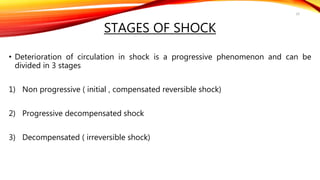
• Deterioration of circulation in shock is a progressive phenomenon and can be
divided in 3 stages
1) Non progressive ( initial , compensated reversible shock)
2) Progressive decompensated shock
3) Decompensated ( irreversible shock)
20
NON PROGRESSIVE SHOCK
• In early stage an attempt is made to maintain adequate cerebral and
coronary blood supply by redistribution of blood so that vital organ are
adequately perfused and oxygenated
• This is achieved by various neurohormonal mechanism causing
1) Widespread vasoconstriction
2) By fluid conservation by kidney
• So if the condition that causes shock is adequately treated , compensatory
mechanism may bring about recovery to normal condition. This is called
compensated or reversible shock.
21
• WIDESPREAD VASOCONSTRICTION
• in response to reduced blood flow and tissue anoxia, the neural and
hormonal factors (like baroreceptors, chemoreceptors, catecholamines,
renins) are activated
22
reduced blood flow tissue anoxia
activation of
neurohormonal
factors
cause increased
peripheral resistance
increased heart rateincreased BP
SHOCK IS
COMPENSATED
23
2) FLUID CONSERVATION BY KIDNEY
In order to compensate the actual loss of blood volume in hypovolaemic shock ,
these are the factors which restore the blood volume
• Release of ALDOSTERONE from hypoxic kidney and ADH due to decrease
effective circulating blood volume
• Reduce GFR due to arteriolar constriction
• Shifting of tissue fluid into plasma due to hypotension
24
25
PROGRESSIVE DECOMPENSATED
SHOCK
• This is a stage when the patient suffers from some other stress or risk factor (eg.
preexisting cardiovascular disease and lung disease)
• The effect of tissue hypoperfusion leads to:
1) Pulmonary hypoperfusion leading to ARDS & Tachypnoea.
2) Tissue anoxia leading to vasodialation.
Clinically this stage the patient develops confusion and worsening of renal
function.
26
DECOMPENSATED ( IRREVERSIBLE ) SHOCK
• When the shock is so severe that inspite of compensatory mechanism and
therapy and control of etiologic agent which causes the shock no recovery take
place it is called DECOMPENSATED SHOCK.
• Clinically the patient at this stage has features of coma, worsened heart function,
and progressive renal failure due to acute tubular necrosis.
27
Widespread Cellular
Injury leads to:
• Progressive Vasodialation
• Increased Vascular Permiability
• Myocardial depressant factor
• Worsening pulmonary hypoperfusion
• Anoxic damage to heart, kidney and brain
28
COMPLICATIONS OF SHOCK
• Shock leads to multi system failure. The major organs affected are the brain,
heart, lungs, and kidney.
The common complications are:
1) Hypoxic encephalopathy
2) Heart in shock
3) Shock lung
4) Shock kidney
5) Adrenal in shock
6) Liver in shock
29
HYPOXIC ENCEPPHALOPATHY
• If the blood pressure falls below
50mm/hg as occur in systemic
hypotension in prolonged shock and
cardiac arrest , patient suffers from the
serious ischemic damage with loss of
cortical function and leads to coma.
HEART IN SHOCK
• Heart is affected in cardiogenic shock
as well as in other form of shock
• There are 2 types of changes in heart in
all types of shock
• Haemorrahage and necrosis
• Zonal lesions - these are the opaque
transverse contraction band in
myocytes near intercalated disc
30
SHOCK LUNG
• Lungs due to dual blood supply
are generally not affected by
hypovolemic shock, but in septic
shock the morphologic changes
in lungs are quite prominent
known as ‘SHOCK LUNG’.
SHOCK KIDNEY
• The one of important
complication of shock is
irreversible renal injury . The end
result is generally anuria and
death
31
ADRENAL IN SHOCK
• The adrenal shows stress response in
shock. This include release of
aldosterone in response to hypoxic
kidney, release of glucocorticoid
from adrenal cortex and
catecholamines like adrenaline from
adrenal medulla . In sever shock
adrenal haemorrahage may occur
LIVER IN SHOCK
• Due to hypoxia on liver, VDM is
released from liver which causes
vasodilatation. Besides focal necrosis
may be seen fatty changes may
occur and liver function may
impaired.
32
• Some life threatening complications of Shock include:
1. Acute respiratory distress syndrome.
2. Disseminated intravascular coagulation.
3. Acute renal failure.
4. Multiple organ dysfunction syndrome.
33
CLINICAL EMERGENCIES
• Anaphylactic Shock- Is defined as an acute potentially life threatening
hypersensitivity reaction involving the release of mediators from Mast
Cell.
• It is life threatening systemic allergic reaction caused by IgE mediated
release of histamine and other vasoactive mediators.
• Clinical features include
• Wheeze
• Stridor
• Angioedema
• Utricaria
34
• Most Common Potential Allergens Include:
1. Food( Peanut, shellfish, eggs)
2. Latex
3. Insect Venom( bee and wasp)
4. Drugs (penicillin, Anesthetic Agents)
35
• Prevention of further allergen exposure
• Ensuring airway patency
• Prompt administration of adrenalin (0.32-0.5 ML 1: 1000 IM
repeated if necessary)
• Anti histamines (Chlorphenamine 10mg IM)
• Corticosteroid to prevent late phase symptoms (ex
Hydrocortisone 200mg IV)
• Oxygen
• Nebulised Beta 2 agonist for Wheeze.
Management
of
Anaphylactic
shock:
36
• Syncope
a sudden, transient loss of consciousness without prodromal symptoms
that is followed within seconds to minutes (<30 minutes) by resumption
of consciousness, usually with the premorbid status intact.
37
MANAGEMENT OF SYNCOPE:
38
TREATMENT OF SHOCK
• Hypovolemic/Hemorrahagic Shock
• The preclinical and clinical treatment of hypovolemic shock consists of
immediate intravascular volume replacement and Fluid resuscitation with
balanced crystalloids and in a hemorrhaging patient is rapid bleeding control.
39
SEPTIC SHOCK
• Treatment of septic shock requires:
• Infusion of balanced crystalloid solution.
• Administration of Vasopressors( norepinephrine, Vasopressin).
• As soon as impulse have been obtained from microbiological study
broad spectrum antibiotic therapy and source control should be done.
40
CARDIOGENIC SHOCK
The primary goal of treatment is removing the cardiac causes of shock. This
includes interventional treatment of mechanical causes and structural heart
diseases and surgical or interventional ablation.
In addition to this symptomatic treatment is undertaken with aim of improving
end organ perfusion, microcirculation and cellular oxygen utilisation.
41
SUMMARY
• Shock is a complex multi-organ system response to perfusion inadequancy
caused by any number of pathological states. Although etiologies are many
, as shock progresses the patterns of physiological change become quite
similar .The diagnosis must be made from clinical observation until reliable
laboratory tests can be devised. Treatment is aimed at restoring adequate
tissue perfusion while simultaneously treating the underlying cause.
42
REFERENCES
• Principles and practice of medicine – Davidson, 19th Ed.
• Basic Pathology – Robbins – 7th Ed.
• Short Practice of Surgery – Bailey & Love, 23rd ED.
• ESSENTIAL PATHOLOGY – HARSH MOHAN.
• SCHWARTZ’S PRINCIPLES OF SURGERY 10TH ED..
• Medical Emergencies in Dental Office- Stanley F Malamed 7th Ed.
43
• da Silva RM. Syncope: epidemiology, etiology, and prognosis. Frontiers in
physiology. 2014 Dec 8;5:471.
• Standl T, Annecke T, Cascorbi I, Heller AR, Sabashnikov A, Teske W. The
nomenclature, definition and distinction of types of shock. Deutsches
Ärzteblatt International. 2018 Nov;115(45):757.
44
45

Shock

  • 1.
  • 2.
  • 3.
    CONTENTS 3 • INTRODUCTION • CLINICALFEATURES • CLASSIFICATION • TYPES OF SHOCK • PATHOGENESIS AND PATHOPHYSIOLOGY • STAGES OF SHOCK • COMPLICATIONS OF SHOCK • CLINICAL EMERGENCIES AND TREATMENT • REFERENCES
  • 4.
    INTRODUCTION SHOCK is characterisedby systemic hypoperfusion of tissues, it can be caused by diminished cardiac output or by reduced effective circulating blood volume. ---ROBBINS BASIC PATHOLOGY 9TH ED. 4
  • 5.
    CLINICAL FEATURES Rapid Shallow Respiration. Hypotensionwith a systolic blood pressure < 100 mm/hg Tachycardia ( >100/min). Cold and clammy skin. 5 Oligouria(urine output <0.5mL/Hr./Kg.). Pale face. Sunken eyes. Weakness.
  • 6.
    CLASSIFICATION 6 Acc. to ROBBINSBASIC PATHOLOGY 9TH ED.
  • 7.
    • Acc. ToDAVIDSONS’S ESSENTIALS OF MEDICINE 2ND ED. • Based on Low Stroke:- • Hypovolemic Shock. • Cardiogenic Shock. • Obstructive Shock. • Based On Vasodialation:- • Sepsis. • Anaphylactic. • Neurogenic. 7
  • 8.
    • Acc toSCHWARTZ’S PRINCIPLES OF SURGERY 10TH ED. 8
  • 9.
    ETIOLOGY AND CLASSIFICATION •The most common forms of shock can be grouped into three pathogenic categories: • HYPOVOLAEMIC SHOCK • SEPTIC SHOCK • CARDIOGENIC SHOCK 9
  • 10.
    HYPOVOLEMIC SHOCK • Reductionin blood volume or loss of circulating blood volume induces hypovolemic shock. • Causes: 1) Loss of whole blood due to hemorrhage eg. In trauma and surger 2) Excessive amount of fluid loss example in severe burn. 3) Persistant vomiting and severe diarrhea causing dehydration 10
  • 11.
    SEPTIC SHOCK It resultsfrom arterial vasodialation and venous blood pooling that results from systemic immune response to microbial infection. The predominant cause are as follows: 1) Gram negative septicemia( endotoxic shock) 2) Gram positive septicemia ( exotoxic shock) 11
  • 12.
    CARDIOGENIC SHOCK Acute circulatoryfailure with sudden fall in cardiac output from acute diseases of heart without actual reduction of blood volume result in cardiogenic shock. The cause include the following 1) Deficient emptying eg. a) Myocardial infarction b) Rupture of heart c) Cardiac arrythemia 12
  • 13.
    2) Deficient fillingeg. a) Cardiac tamponade 3) Obstruction to the outflow a) Pulmonary embolism b) Ball valve thrombus 13
  • 14.
    TYPES Shock may beof 2 types • Primary (initial) shock • Secondary (true) shock 14
  • 15.
    15 PRIMARY (INTIAL) SHOCK Itis a transient and usually benign vasovagal attack resulting from sudden reduction of venous return to the heart caused by the vasodilatation and consequent peripheral pooling of blood. SECONDARY (TRUE) SHOCK This form of shock which occur due to haemodynamic derangement with hypo perfusion of cells. This type of shock is a true shock which is commonly reffered to as ‘shock’
  • 16.
  • 17.
    There are threebasic features in pathogenesis of shock: 1) Reduced effective circulating blood volume 2) Reduced supply of oxygen to the cells and tissue with resultant anoxia 3) Inflammatory mediators and toxins released from shock induced cellular injury. 17
  • 18.
    DECREASED EFFECTIVE CIRCULATING BLOOD VOLUME DECREASED VENOUS RETURN TOHEART DECREASED CARDIAC OUTPUT DECREASED BLOOD FLOW DECREASED SUPPLY OF OXYGEN ANOXIA INFLAMTORY MEDIATORS SHOCK 18
  • 19.
    Shock Hypoperfusion Hypoxiccell injury Activation of Innate Immunity Stimulation Of Macrophages Release of Inflammatory Mediators 19
  • 20.
    STAGES OF SHOCK •Deterioration of circulation in shock is a progressive phenomenon and can be divided in 3 stages 1) Non progressive ( initial , compensated reversible shock) 2) Progressive decompensated shock 3) Decompensated ( irreversible shock) 20
  • 21.
    NON PROGRESSIVE SHOCK •In early stage an attempt is made to maintain adequate cerebral and coronary blood supply by redistribution of blood so that vital organ are adequately perfused and oxygenated • This is achieved by various neurohormonal mechanism causing 1) Widespread vasoconstriction 2) By fluid conservation by kidney • So if the condition that causes shock is adequately treated , compensatory mechanism may bring about recovery to normal condition. This is called compensated or reversible shock. 21
  • 22.
    • WIDESPREAD VASOCONSTRICTION •in response to reduced blood flow and tissue anoxia, the neural and hormonal factors (like baroreceptors, chemoreceptors, catecholamines, renins) are activated 22
  • 23.
    reduced blood flowtissue anoxia activation of neurohormonal factors cause increased peripheral resistance increased heart rateincreased BP SHOCK IS COMPENSATED 23
  • 24.
    2) FLUID CONSERVATIONBY KIDNEY In order to compensate the actual loss of blood volume in hypovolaemic shock , these are the factors which restore the blood volume • Release of ALDOSTERONE from hypoxic kidney and ADH due to decrease effective circulating blood volume • Reduce GFR due to arteriolar constriction • Shifting of tissue fluid into plasma due to hypotension 24
  • 25.
  • 26.
    PROGRESSIVE DECOMPENSATED SHOCK • Thisis a stage when the patient suffers from some other stress or risk factor (eg. preexisting cardiovascular disease and lung disease) • The effect of tissue hypoperfusion leads to: 1) Pulmonary hypoperfusion leading to ARDS & Tachypnoea. 2) Tissue anoxia leading to vasodialation. Clinically this stage the patient develops confusion and worsening of renal function. 26
  • 27.
    DECOMPENSATED ( IRREVERSIBLE) SHOCK • When the shock is so severe that inspite of compensatory mechanism and therapy and control of etiologic agent which causes the shock no recovery take place it is called DECOMPENSATED SHOCK. • Clinically the patient at this stage has features of coma, worsened heart function, and progressive renal failure due to acute tubular necrosis. 27
  • 28.
    Widespread Cellular Injury leadsto: • Progressive Vasodialation • Increased Vascular Permiability • Myocardial depressant factor • Worsening pulmonary hypoperfusion • Anoxic damage to heart, kidney and brain 28
  • 29.
    COMPLICATIONS OF SHOCK •Shock leads to multi system failure. The major organs affected are the brain, heart, lungs, and kidney. The common complications are: 1) Hypoxic encephalopathy 2) Heart in shock 3) Shock lung 4) Shock kidney 5) Adrenal in shock 6) Liver in shock 29
  • 30.
    HYPOXIC ENCEPPHALOPATHY • Ifthe blood pressure falls below 50mm/hg as occur in systemic hypotension in prolonged shock and cardiac arrest , patient suffers from the serious ischemic damage with loss of cortical function and leads to coma. HEART IN SHOCK • Heart is affected in cardiogenic shock as well as in other form of shock • There are 2 types of changes in heart in all types of shock • Haemorrahage and necrosis • Zonal lesions - these are the opaque transverse contraction band in myocytes near intercalated disc 30
  • 31.
    SHOCK LUNG • Lungsdue to dual blood supply are generally not affected by hypovolemic shock, but in septic shock the morphologic changes in lungs are quite prominent known as ‘SHOCK LUNG’. SHOCK KIDNEY • The one of important complication of shock is irreversible renal injury . The end result is generally anuria and death 31
  • 32.
    ADRENAL IN SHOCK •The adrenal shows stress response in shock. This include release of aldosterone in response to hypoxic kidney, release of glucocorticoid from adrenal cortex and catecholamines like adrenaline from adrenal medulla . In sever shock adrenal haemorrahage may occur LIVER IN SHOCK • Due to hypoxia on liver, VDM is released from liver which causes vasodilatation. Besides focal necrosis may be seen fatty changes may occur and liver function may impaired. 32
  • 33.
    • Some lifethreatening complications of Shock include: 1. Acute respiratory distress syndrome. 2. Disseminated intravascular coagulation. 3. Acute renal failure. 4. Multiple organ dysfunction syndrome. 33
  • 34.
    CLINICAL EMERGENCIES • AnaphylacticShock- Is defined as an acute potentially life threatening hypersensitivity reaction involving the release of mediators from Mast Cell. • It is life threatening systemic allergic reaction caused by IgE mediated release of histamine and other vasoactive mediators. • Clinical features include • Wheeze • Stridor • Angioedema • Utricaria 34
  • 35.
    • Most CommonPotential Allergens Include: 1. Food( Peanut, shellfish, eggs) 2. Latex 3. Insect Venom( bee and wasp) 4. Drugs (penicillin, Anesthetic Agents) 35
  • 36.
    • Prevention offurther allergen exposure • Ensuring airway patency • Prompt administration of adrenalin (0.32-0.5 ML 1: 1000 IM repeated if necessary) • Anti histamines (Chlorphenamine 10mg IM) • Corticosteroid to prevent late phase symptoms (ex Hydrocortisone 200mg IV) • Oxygen • Nebulised Beta 2 agonist for Wheeze. Management of Anaphylactic shock: 36
  • 37.
    • Syncope a sudden,transient loss of consciousness without prodromal symptoms that is followed within seconds to minutes (<30 minutes) by resumption of consciousness, usually with the premorbid status intact. 37
  • 38.
  • 39.
    TREATMENT OF SHOCK •Hypovolemic/Hemorrahagic Shock • The preclinical and clinical treatment of hypovolemic shock consists of immediate intravascular volume replacement and Fluid resuscitation with balanced crystalloids and in a hemorrhaging patient is rapid bleeding control. 39
  • 40.
    SEPTIC SHOCK • Treatmentof septic shock requires: • Infusion of balanced crystalloid solution. • Administration of Vasopressors( norepinephrine, Vasopressin). • As soon as impulse have been obtained from microbiological study broad spectrum antibiotic therapy and source control should be done. 40
  • 41.
    CARDIOGENIC SHOCK The primarygoal of treatment is removing the cardiac causes of shock. This includes interventional treatment of mechanical causes and structural heart diseases and surgical or interventional ablation. In addition to this symptomatic treatment is undertaken with aim of improving end organ perfusion, microcirculation and cellular oxygen utilisation. 41
  • 42.
    SUMMARY • Shock isa complex multi-organ system response to perfusion inadequancy caused by any number of pathological states. Although etiologies are many , as shock progresses the patterns of physiological change become quite similar .The diagnosis must be made from clinical observation until reliable laboratory tests can be devised. Treatment is aimed at restoring adequate tissue perfusion while simultaneously treating the underlying cause. 42
  • 43.
    REFERENCES • Principles andpractice of medicine – Davidson, 19th Ed. • Basic Pathology – Robbins – 7th Ed. • Short Practice of Surgery – Bailey & Love, 23rd ED. • ESSENTIAL PATHOLOGY – HARSH MOHAN. • SCHWARTZ’S PRINCIPLES OF SURGERY 10TH ED.. • Medical Emergencies in Dental Office- Stanley F Malamed 7th Ed. 43
  • 44.
    • da SilvaRM. Syncope: epidemiology, etiology, and prognosis. Frontiers in physiology. 2014 Dec 8;5:471. • Standl T, Annecke T, Cascorbi I, Heller AR, Sabashnikov A, Teske W. The nomenclature, definition and distinction of types of shock. Deutsches Ärzteblatt International. 2018 Nov;115(45):757. 44
  • 45.