An Introduction to Haemophilia
and related bleeding disorders
M QARI, MD, FRCPA
CONTENTS
Normal blood clotting
Abnormal blood clotting
Bleeding in people with haemophilia
History of haemophilia
Treatment/surgery
Inheritance of haemophilia
Other bleeding disorders
NORMAL CLOTTING
Response to vessle injury
1. Vasoconstriction to reduce blood flow
2. Platelet plug formation (von willebrand factor
binds damaged vessle and platelets)
3. Activation of clotting cascade with generation of
fibrin clot formation
4. Fibrinlysis (clot breakdown)
Normally the ingredients, called factors, act like a
row of dominoes toppling against each other to
create a chain reaction.
If one of the factors is missing this chain reaction
cannot proceed.
CLOTTING CASCADE
CLOTTING CASCADE
CLOTTING CASCADE – simplified version
Tissue factor:FVIIa
FX FXa
FII (prothrombin) FIIa (thrombin)
FVa is cofactor
Fibrinogen Fibrin
Crosslinked fibrin
FXIIIa
FIX FIXa
FVIIIa is cofactor
WHAT IS HAEMOPHILIA ?
Haemophilia : group of inherited blood disorders in
which there is a life-long defect in clotting. A
HAEMOPHILIA
A shortage of clotting factor VIII (Haemophilia A)
or factor IX (Haemophilia B) halts the chain
reaction with the consequence that a clot does not
form.
Haemophilia A and B
1 in 10,000 of the population has the condition called
haemophilia A. Clotting factor VIII lacks activity.
Another of the clotting ingredients is called factor IX.
The activity of this factor is deficient in haemophilia
B, also known as Christmas disease.
Haemophilia A is approximately five times more
common than haemophilia B.
Haemophilia A and B
Both types haemophilia share the
same symptoms and inheritance
pattern - only blood tests can
differentiate between the two.
Important to know which factor is
defective so that the correct
treatment can be given.
Except in very rare cases both
haemophilia A and haemophilia B
affect only males.
320 158
DISEASE SEVERITY
50-200% 5-50% 2-5% <1%
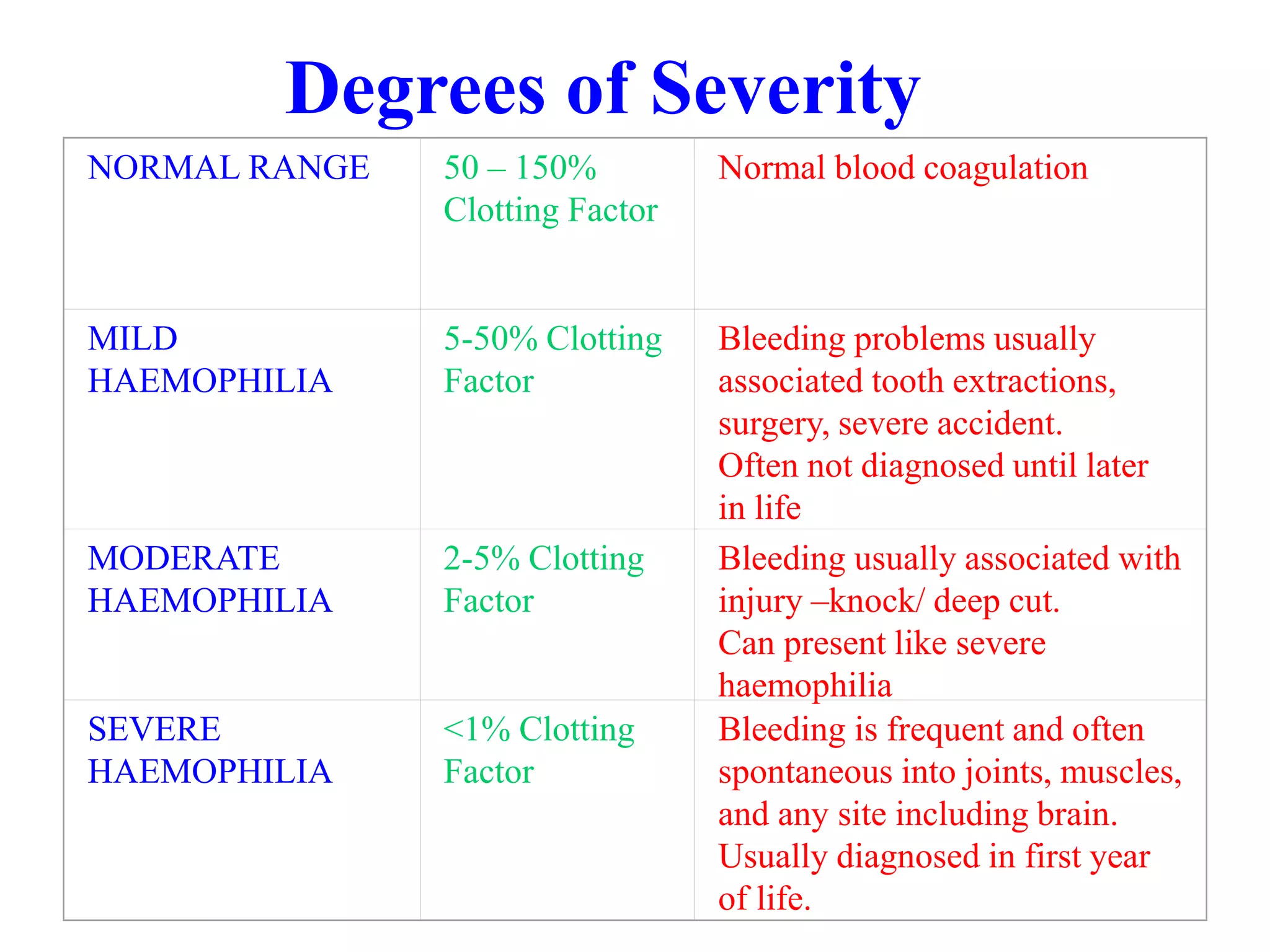
Degrees of Severity
NORMAL RANGE 50 – 150%
Clotting Factor
Normal blood coagulation
MILD
HAEMOPHILIA
5-50% Clotting
Factor
Bleeding problems usually
associated tooth extractions,
surgery, severe accident.
Often not diagnosed until later
in life
MODERATE
HAEMOPHILIA
2-5% Clotting
Factor
Bleeding usually associated with
injury –knock/ deep cut.
Can present like severe
haemophilia
SEVERE
HAEMOPHILIA
<1% Clotting
Factor
Bleeding is frequent and often
spontaneous into joints, muscles,
and any site including brain.
Usually diagnosed in first year
of life.
Haemarthrosis in severe
haemophilia
Thigh muscle bleed
HISTORY OF
HAEMOPHILIA
TREATMENT
1950’s – no treatment for haemophilia, life expectancy
15 yrs
1960’s/70’s – fresh frozen plasma, cryoprecipitate
1970’s – cryoprecipitate/ factor/ home treatment
1980’s – plasma derived factor allowed home
treatment, prophylaxis but viral contamination
1990’s – recombinant factor introduced, still residual
risk of infection
SURGERY AND HAEMOPHILIA
Factor replacement should be given pre surgery and
during post op period
Factor pre physio, suture removal, drain removal
Factor levels should be taken to confirm expected rise in
levels
Continuous infusion should never be switched off as
levels will fall rapidly post op
No IM injections
No asprin or NSAID
Treatment of bleeds
Treatment given IV through vein or port
Treatment should be prompt to cease bleeding
Use of correct factor concentrate
Bed rest, ice
Analgesia
Haemophilia Inheritance
FVIII and FIX only
•Two
chromosomes
determine the sex
of an individual, X
and Y.
•Female XX
•Male XY
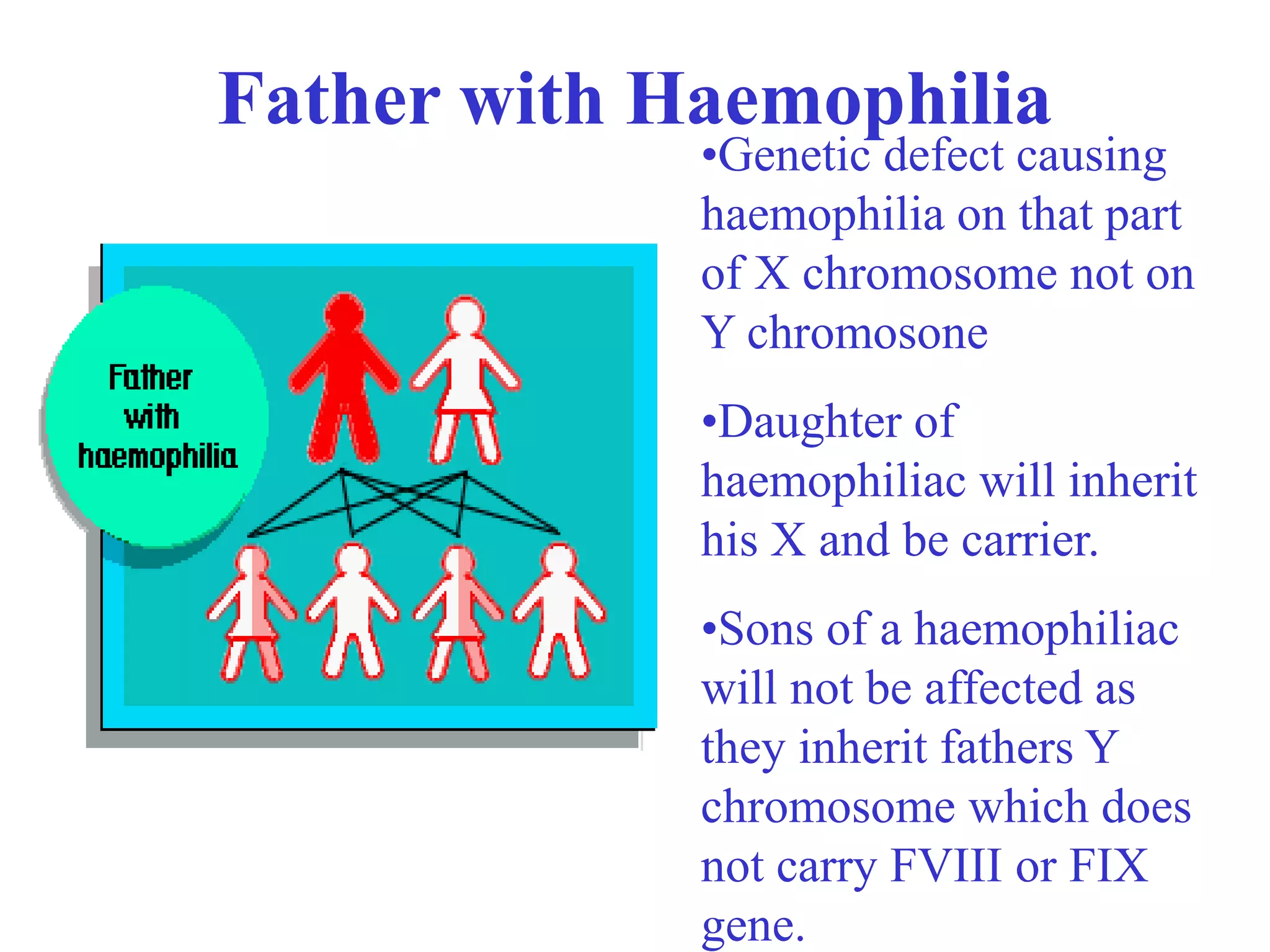
Father with Haemophilia
•Genetic defect causing
haemophilia on that part
of X chromosome not on
Y chromosone
•Daughter of
haemophiliac will inherit
his X and be carrier.
•Sons of a haemophiliac
will not be affected as
they inherit fathers Y
chromosome which does
not carry FVIII or FIX
gene.
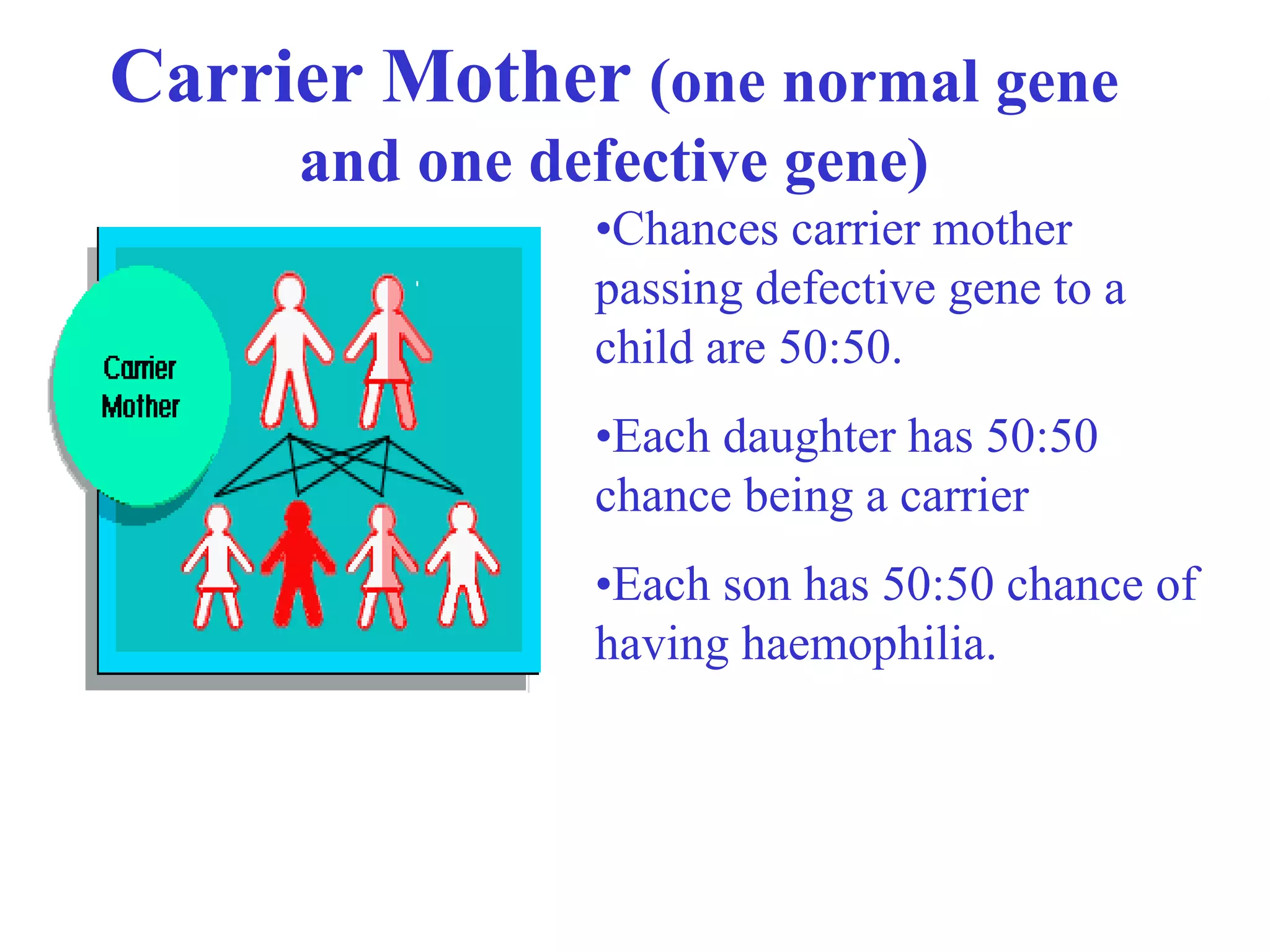
Carrier Mother (one normal gene
and one defective gene)
•Chances carrier mother
passing defective gene to a
child are 50:50.
•Each daughter has 50:50
chance being a carrier
•Each son has 50:50 chance of
having haemophilia.
Spontaneous Mutation
In some 30%
cases of
haemophilia
there is no
known
family
history
Haemophilia
is probably
the result of
spontaneous
genetic
mutation in
these families.
INHIBITORS
30% of people with haemophilia develop an antibody to
the clotting factor they are receiving for treatment. These
antibodies are known as inhibitors.
These patients are treated with high does of FVIIa for
bleeds or surgery. This overrides defect in FVIII or FIX
deficiency.
Longterm management involves attempting to eradicate
inhibitors by administering high dose FVIII (or FIX) in a
process called immune tolerance
Von Willebrand's Disease
Von Willebrand's disease is usually much milder than
haemophilia.
Muscle or joint bleeds are rare.
Affected boys and girls may bruise easily, suffer nose
bleeds, or suffer from (menorrhagia) heavy periods.
Treatment of choice is DDAVP if responsive
otherwise replace with von Willebrand concentrate
Platelet function defects
• Wide range of sites of defect
• Bleeding usually mild outside of surgery or
dental extractions
• Diagnosis: Assess platelet function
• Treatment options : Platelets, DDAVP and
tranexamic acid (antifibrinolytic)
CONCLUSION
Rare bleeding disorders
Prompt treatment of bleeds reduces joint/muscle/tissue
damage
Regular prophylaxis prevents bleeding
Viral/ prion contamination still a theoretical risk
Assessment of bleeding disorder
Bleeding history
-Spontaneous bleeding: easy bruising (spontaneous v post
trauma) epistaxis, menorrhagia, GI, joint, muscle, CNS,
atypical sites
-Pregnancy related bleeding: Post partum
-Surgical bleeding: return to theatre or requiring transfusion
-Dental extraction: duration, requiring return to dentist,
requiring packing or transfusion
Assessment
Laboratory investigations
FBC
PT/APTT (factors I, II, V, VII, VIII, IX, X, IX and XII)
Note factor III, IV and VI don’t exist
Von Willebrand activity
Platelet function
FXIII
An Introduction to Haemophilia
and related bleeding disorders
National Centre for Hereditary
Coagulation Disorders
St James’s Hospital, Dublin 8

bleeding disorders4th 1.ppt

  • 1.
    An Introduction toHaemophilia and related bleeding disorders M QARI, MD, FRCPA
  • 2.
    CONTENTS Normal blood clotting Abnormalblood clotting Bleeding in people with haemophilia History of haemophilia Treatment/surgery Inheritance of haemophilia Other bleeding disorders
  • 3.
    NORMAL CLOTTING Response tovessle injury 1. Vasoconstriction to reduce blood flow 2. Platelet plug formation (von willebrand factor binds damaged vessle and platelets) 3. Activation of clotting cascade with generation of fibrin clot formation 4. Fibrinlysis (clot breakdown)
  • 4.
    Normally the ingredients,called factors, act like a row of dominoes toppling against each other to create a chain reaction. If one of the factors is missing this chain reaction cannot proceed. CLOTTING CASCADE
  • 5.
  • 6.
    CLOTTING CASCADE –simplified version Tissue factor:FVIIa FX FXa FII (prothrombin) FIIa (thrombin) FVa is cofactor Fibrinogen Fibrin Crosslinked fibrin FXIIIa FIX FIXa FVIIIa is cofactor
  • 8.
    WHAT IS HAEMOPHILIA? Haemophilia : group of inherited blood disorders in which there is a life-long defect in clotting. A
  • 9.
    HAEMOPHILIA A shortage ofclotting factor VIII (Haemophilia A) or factor IX (Haemophilia B) halts the chain reaction with the consequence that a clot does not form.
  • 10.
    Haemophilia A andB 1 in 10,000 of the population has the condition called haemophilia A. Clotting factor VIII lacks activity. Another of the clotting ingredients is called factor IX. The activity of this factor is deficient in haemophilia B, also known as Christmas disease. Haemophilia A is approximately five times more common than haemophilia B.
  • 11.
    Haemophilia A andB Both types haemophilia share the same symptoms and inheritance pattern - only blood tests can differentiate between the two. Important to know which factor is defective so that the correct treatment can be given. Except in very rare cases both haemophilia A and haemophilia B affect only males. 320 158
  • 12.
  • 13.
    Degrees of Severity NORMALRANGE 50 – 150% Clotting Factor Normal blood coagulation MILD HAEMOPHILIA 5-50% Clotting Factor Bleeding problems usually associated tooth extractions, surgery, severe accident. Often not diagnosed until later in life MODERATE HAEMOPHILIA 2-5% Clotting Factor Bleeding usually associated with injury –knock/ deep cut. Can present like severe haemophilia SEVERE HAEMOPHILIA <1% Clotting Factor Bleeding is frequent and often spontaneous into joints, muscles, and any site including brain. Usually diagnosed in first year of life.
  • 14.
  • 15.
  • 16.
    HISTORY OF HAEMOPHILIA TREATMENT 1950’s –no treatment for haemophilia, life expectancy 15 yrs 1960’s/70’s – fresh frozen plasma, cryoprecipitate 1970’s – cryoprecipitate/ factor/ home treatment 1980’s – plasma derived factor allowed home treatment, prophylaxis but viral contamination 1990’s – recombinant factor introduced, still residual risk of infection
  • 17.
    SURGERY AND HAEMOPHILIA Factorreplacement should be given pre surgery and during post op period Factor pre physio, suture removal, drain removal Factor levels should be taken to confirm expected rise in levels Continuous infusion should never be switched off as levels will fall rapidly post op No IM injections No asprin or NSAID
  • 18.
    Treatment of bleeds Treatmentgiven IV through vein or port Treatment should be prompt to cease bleeding Use of correct factor concentrate Bed rest, ice Analgesia
  • 19.
    Haemophilia Inheritance FVIII andFIX only •Two chromosomes determine the sex of an individual, X and Y. •Female XX •Male XY
  • 20.
    Father with Haemophilia •Geneticdefect causing haemophilia on that part of X chromosome not on Y chromosone •Daughter of haemophiliac will inherit his X and be carrier. •Sons of a haemophiliac will not be affected as they inherit fathers Y chromosome which does not carry FVIII or FIX gene.
  • 21.
    Carrier Mother (onenormal gene and one defective gene) •Chances carrier mother passing defective gene to a child are 50:50. •Each daughter has 50:50 chance being a carrier •Each son has 50:50 chance of having haemophilia.
  • 22.
    Spontaneous Mutation In some30% cases of haemophilia there is no known family history Haemophilia is probably the result of spontaneous genetic mutation in these families.
  • 23.
    INHIBITORS 30% of peoplewith haemophilia develop an antibody to the clotting factor they are receiving for treatment. These antibodies are known as inhibitors. These patients are treated with high does of FVIIa for bleeds or surgery. This overrides defect in FVIII or FIX deficiency. Longterm management involves attempting to eradicate inhibitors by administering high dose FVIII (or FIX) in a process called immune tolerance
  • 24.
    Von Willebrand's Disease VonWillebrand's disease is usually much milder than haemophilia. Muscle or joint bleeds are rare. Affected boys and girls may bruise easily, suffer nose bleeds, or suffer from (menorrhagia) heavy periods. Treatment of choice is DDAVP if responsive otherwise replace with von Willebrand concentrate
  • 25.
    Platelet function defects •Wide range of sites of defect • Bleeding usually mild outside of surgery or dental extractions • Diagnosis: Assess platelet function • Treatment options : Platelets, DDAVP and tranexamic acid (antifibrinolytic)
  • 26.
    CONCLUSION Rare bleeding disorders Prompttreatment of bleeds reduces joint/muscle/tissue damage Regular prophylaxis prevents bleeding Viral/ prion contamination still a theoretical risk
  • 27.
    Assessment of bleedingdisorder Bleeding history -Spontaneous bleeding: easy bruising (spontaneous v post trauma) epistaxis, menorrhagia, GI, joint, muscle, CNS, atypical sites -Pregnancy related bleeding: Post partum -Surgical bleeding: return to theatre or requiring transfusion -Dental extraction: duration, requiring return to dentist, requiring packing or transfusion
  • 28.
    Assessment Laboratory investigations FBC PT/APTT (factorsI, II, V, VII, VIII, IX, X, IX and XII) Note factor III, IV and VI don’t exist Von Willebrand activity Platelet function FXIII
  • 30.
    An Introduction toHaemophilia and related bleeding disorders National Centre for Hereditary Coagulation Disorders St James’s Hospital, Dublin 8