“Unique among textbooks, Dunn puts problematization and
problem structuring center stage as the
major driver in each field of the policy-analytic domain. As
usual, Dunn skillfully blends (social) scien-
tific insight, epistemological sophistication, methodological
finesse and practical savvy.”
Robert Hoppe, University of Twente, The Netherlands
“This new edition continues the tradition of excellence
established by previous editions and updates the
text, references and examples to ensure its continuing relevance
to the contemporary world of policy
analysis in governments, the NGO and private sectors. ”
Michael Howlett, Simon-Fraser University, Canada
“William Dunn effectively illustrates methodology and methods
of policy analysis with real-world case
materials and examples at the local, national and international
levels. It remains the best guide for both
undergraduate and graduate courses out there.”
Keun Namkoong, Former President of Seoul Tech and of
Korean Association for Public Administration, South Korea
“Very impressive book and will continue to use this as a must
read book for my students aspiring to
become respectable policy analysts.”
Sofian Effendi, Gadjah Mada University, Indonesia
http://taylorandfrancis.com
Public Policy Analysis, the most widely cited book on the
subject, provides students with a comprehensive
methodology of policy analysis. It starts from the premise that
policy analysis is an applied social science
discipline designed for solving practical problems facing public
and nonprofit organizations. This thor-
oughly revised sixth edition contains a number of important
updates:
-new “big ideas” case study in
policy analysis to stimulate student
interest in timely and important problems.
-based policy and the role
of field experiments has been
thoroughly rewritten and expanded.
been added, including using scientific
evidence in public policymaking, systematic reviews, meta-
analyses, and “big data.”
as IBM SPSS 23.0 files and are
convertible to Excel, Stata, and R statistical software programs
to suit a variety of course needs and
teaching styles.
-new PowerPoint slides are included to make instructor
preparation easier than ever before.
Designed to prepare students from a variety of academic
backgrounds to conduct policy analysis on
their own, without requiring a background in microeconomics,
Public Policy Analysis, Sixth Edition helps
students develop the practical skills needed to communicate
findings through memos, position papers,
and other forms of structured analytical writing. The text
engages students by challenging them to criti-
cally analyze the arguments of policy practitioners as well as
political scientists, economists, and political
philosophers.
William N. Dunn is Professor in the Graduate School of Public
and International Affairs at the Univer-
sity of Pittsburgh, USA.
Public Policy Analysis
http://taylorandfrancis.com
Public Policy Analysis
An Integrated Approach
Sixth Edition
WILLIAM N. DUNN
Sixth edition published 2018
by Routledge
711 Third Avenue, New York, NY 10017
and by Routledge
2 Park Square, Milton Park, Abingdon, Oxon OX14 4RN
Routledge is an imprint of the Taylor & Francis Group, an
informa business
© 2018 Taylor & Francis
The right of William N. Dunn to be identified as author of this
work has been asserted by
him in accordance with sections 77 and 78 of the Copyright,
Designs and Patents
Act 1988.
All rights reserved. No part of this book may be reprinted or
reproduced or utilised in
any form or by any electronic, mechanical, or other means, now
known or hereafter
invented, including photocopying and recording, or in any
information storage or
retrieval system, without permission in writing from the
publishers.
Trademark notice: Product or corporate names may be
trademarks or registered trademarks,
and are used only for identification and explanation without
intent to infringe.
First edition published by Pearson Education, Inc. 1994
Fifth edition published by Routledge 2016
Library of Congress Cataloging-in-Publication Data
Names: Dunn, William N., author.
Title: Public policy analysis : an integrated approach / by
William N. Dunn.
Description: Sixth Edition. | New York : Routledge, 2017. |
Revised edition of the author's
Public policy analysis, c2012. | Includes bibliographical
references and index.
Identifiers: LCCN 2017008665 | ISBN 9781138743830
(hardback : alk. paper) |
ISBN 9781138743847 (pbk. : alk. paper) | ISBN 9781315181226
(ebook)
Subjects: LCSH: Policy sciences. | Political planning—
Evaluation.
Classification: LCC H61 .D882 2017 | DDC 320.6—dc23
LC record available at https://lccn.loc.gov/2017008665
ISBN: 978-1-138-74383-0 (hbk)
ISBN: 978-1-138-74384-7 (pbk)
ISBN: 978-1-315-18122-6 (ebk)
Typeset in Minion Pro, Bell Gothic
by Apex CoVantage, LLC
Visit the eResources: www.routledge.com/9781138743847
In memory of Donald T. Campbell
http://taylorandfrancis.com
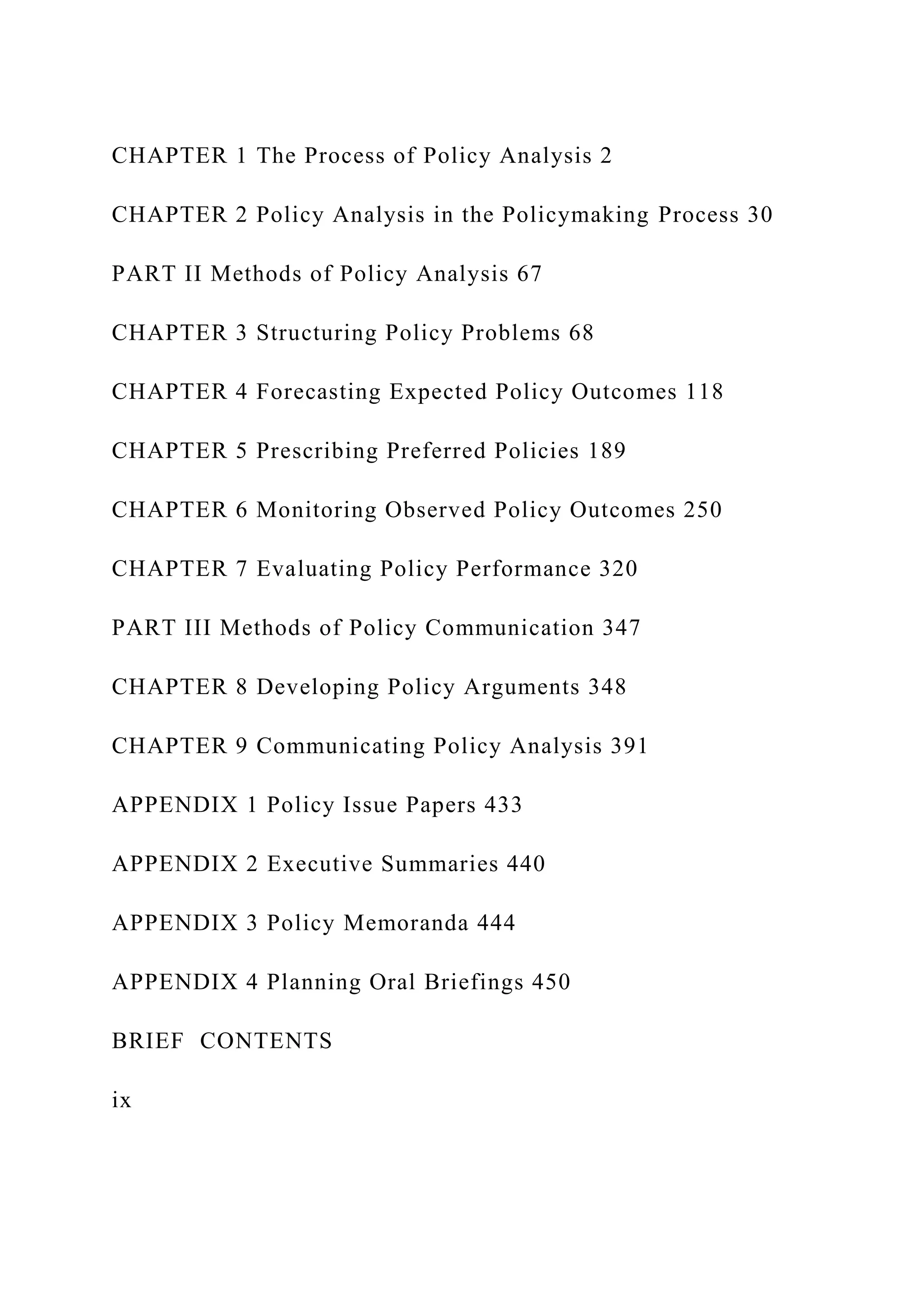
PART I Methodology of Policy Analysis 1
CHAPTER 1 The Process of Policy Analysis 2
CHAPTER 2 Policy Analysis in the Policymaking Process 30
PART II Methods of Policy Analysis 67
CHAPTER 3 Structuring Policy Problems 68
CHAPTER 4 Forecasting Expected Policy Outcomes 118
CHAPTER 5 Prescribing Preferred Policies 189
CHAPTER 6 Monitoring Observed Policy Outcomes 250
CHAPTER 7 Evaluating Policy Performance 320
PART III Methods of Policy Communication 347
CHAPTER 8 Developing Policy Arguments 348
CHAPTER 9 Communicating Policy Analysis 391
APPENDIX 1 Policy Issue Papers 433
APPENDIX 2 Executive Summaries 440
APPENDIX 3 Policy Memoranda 444
APPENDIX 4 Planning Oral Briefings 450
BRIEF CONTENTS
ix
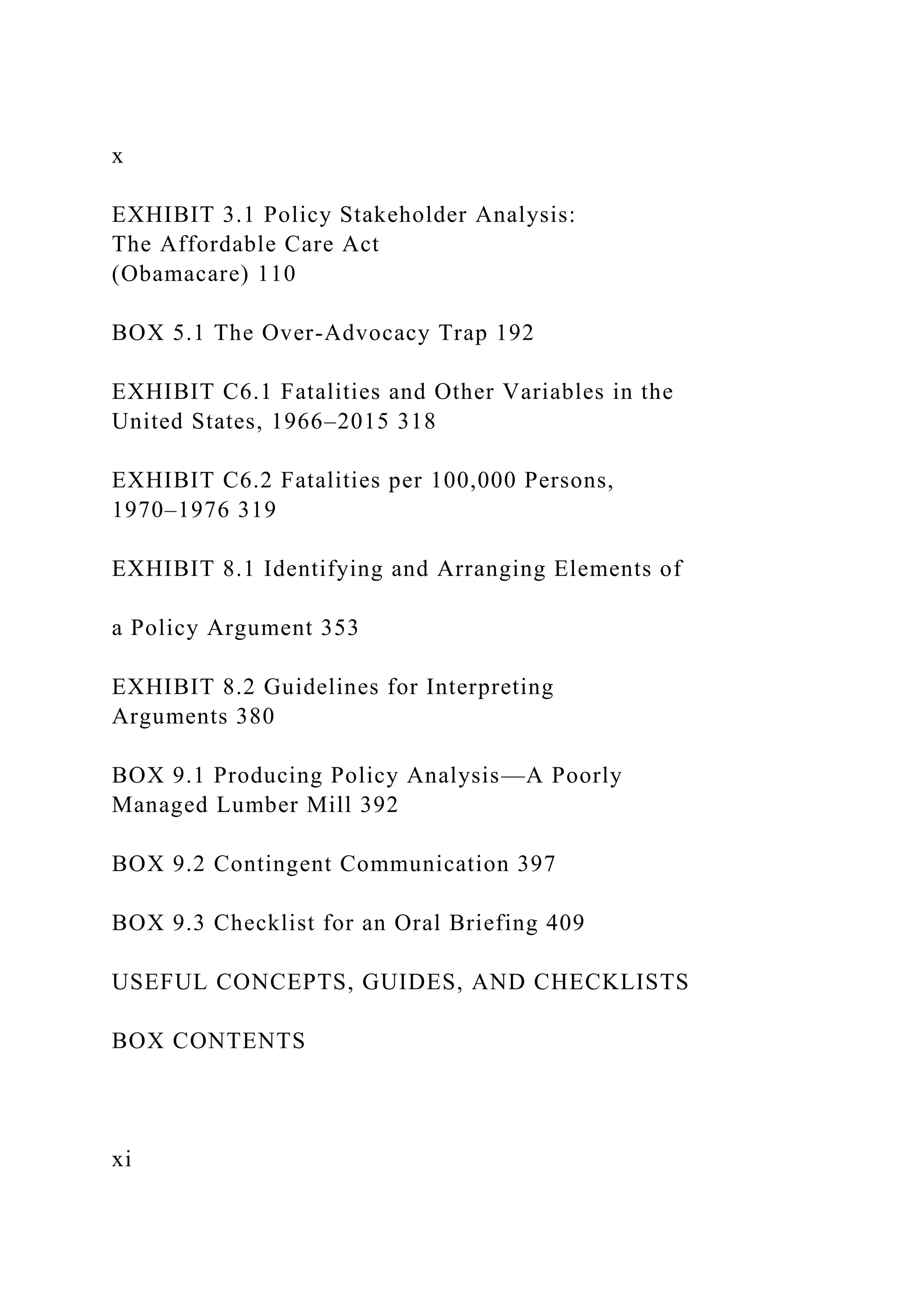
x
EXHIBIT 3.1 Policy Stakeholder Analysis:
The Affordable Care Act
(Obamacare) 110
BOX 5.1 The Over-Advocacy Trap 192
EXHIBIT C6.1 Fatalities and Other Variables in the
United States, 1966–2015 318
EXHIBIT C6.2 Fatalities per 100,000 Persons,
1970–1976 319
EXHIBIT 8.1 Identifying and Arranging Elements of
a Policy Argument 353
EXHIBIT 8.2 Guidelines for Interpreting
Arguments 380
BOX 9.1 Producing Policy Analysis—A Poorly
Managed Lumber Mill 392
BOX 9.2 Contingent Communication 397
BOX 9.3 Checklist for an Oral Briefing 409
USEFUL CONCEPTS, GUIDES, AND CHECKLISTS
BOX CONTENTS
xi
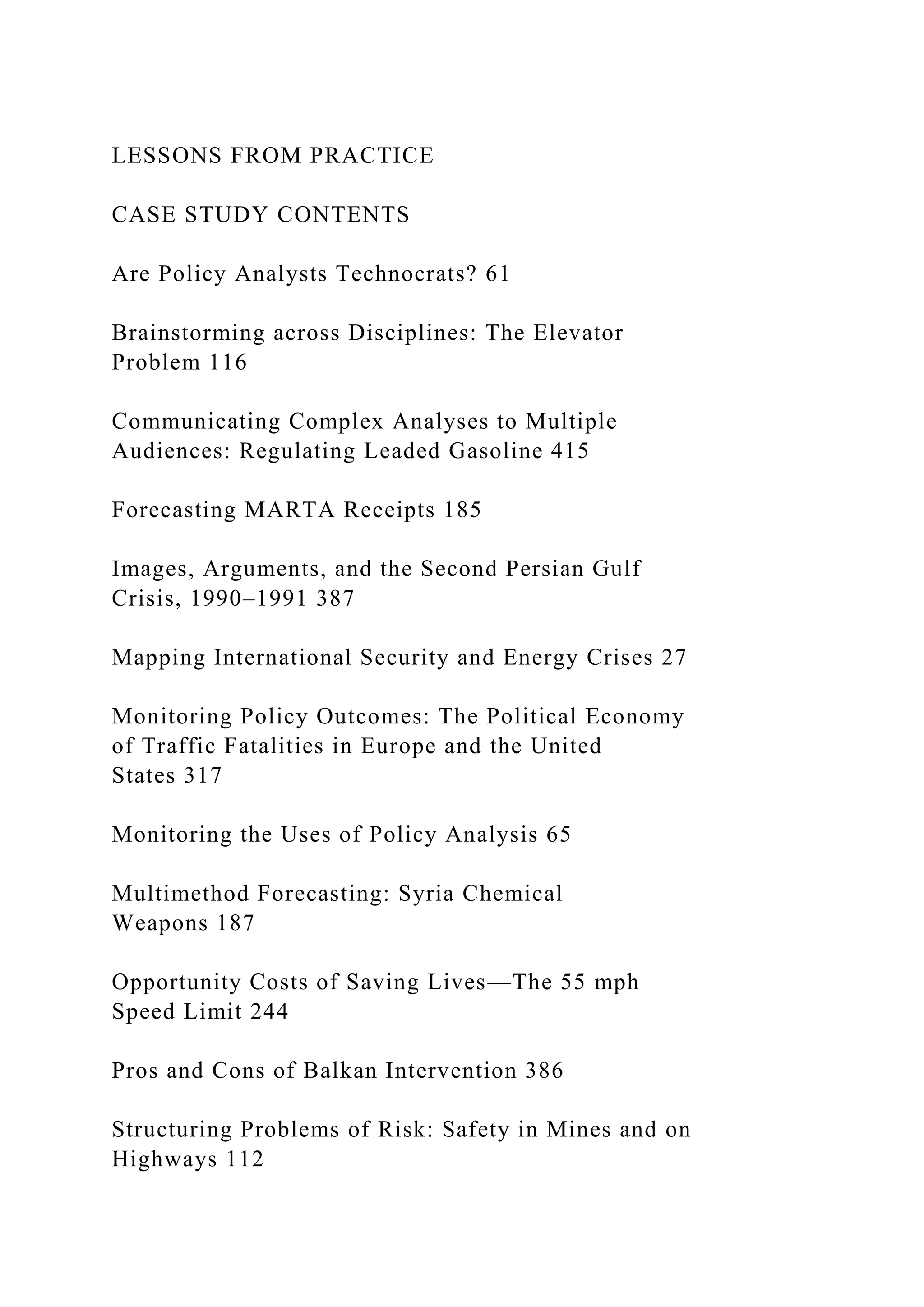
LESSONS FROM PRACTICE
CASE STUDY CONTENTS
Are Policy Analysts Technocrats? 61
Brainstorming across Disciplines: The Elevator
Problem 116
Communicating Complex Analyses to Multiple
Audiences: Regulating Leaded Gasoline 415
Forecasting MARTA Receipts 185
Images, Arguments, and the Second Persian Gulf
Crisis, 1990–1991 387
Mapping International Security and Energy Crises 27
Monitoring Policy Outcomes: The Political Economy
of Traffic Fatalities in Europe and the United
States 317
Monitoring the Uses of Policy Analysis 65
Multimethod Forecasting: Syria Chemical
Weapons 187
Opportunity Costs of Saving Lives—The 55 mph
Speed Limit 244
Pros and Cons of Balkan Intervention 386
Structuring Problems of Risk: Safety in Mines and on
Highways 112
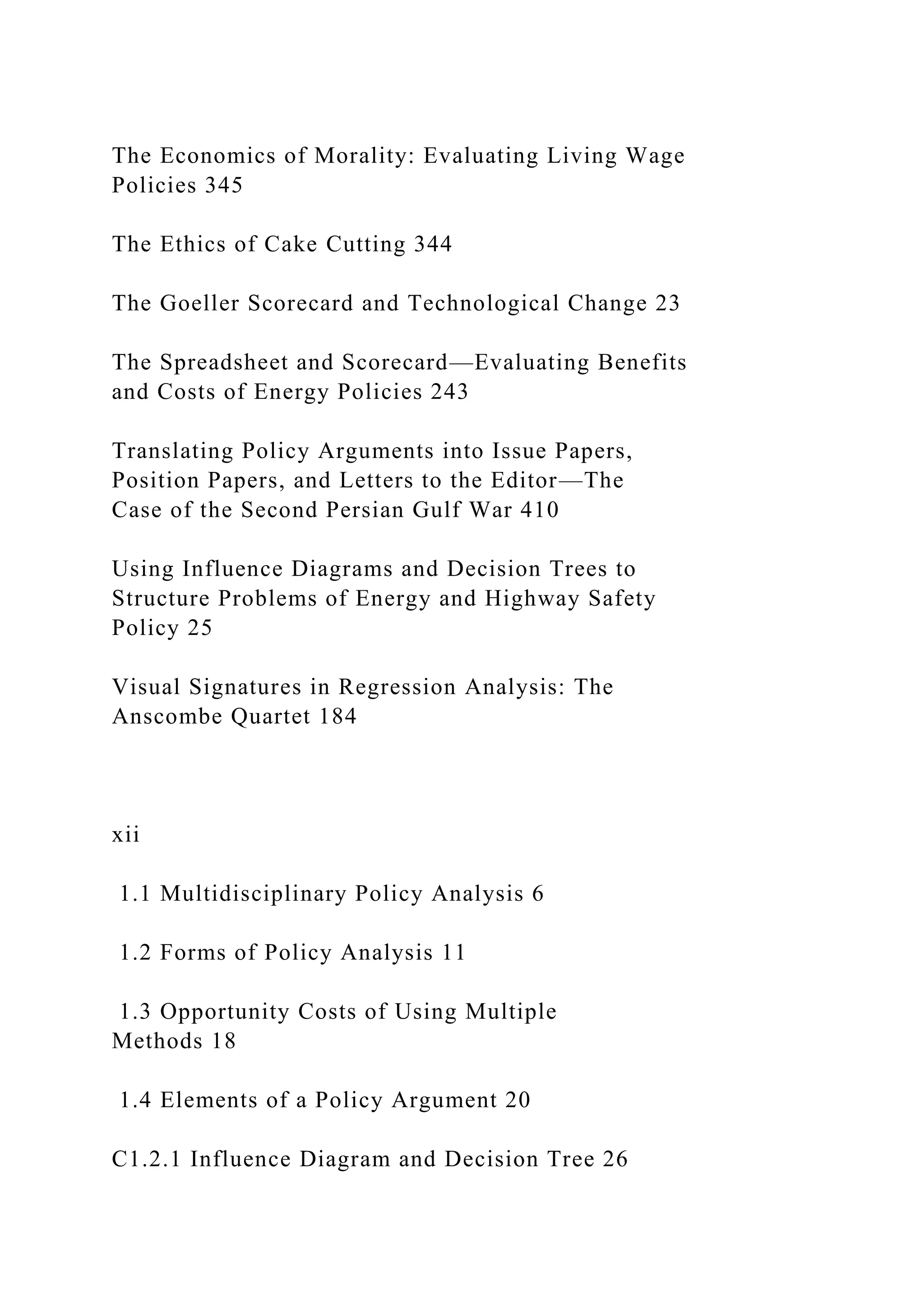
The Economics of Morality: Evaluating Living Wage
Policies 345
The Ethics of Cake Cutting 344
The Goeller Scorecard and Technological Change 23
The Spreadsheet and Scorecard—Evaluating Benefits
and Costs of Energy Policies 243
Translating Policy Arguments into Issue Papers,
Position Papers, and Letters to the Editor—The
Case of the Second Persian Gulf War 410
Using Influence Diagrams and Decision Trees to
Structure Problems of Energy and Highway Safety
Policy 25
Visual Signatures in Regression Analysis: The
Anscombe Quartet 184
xii
1.1 Multidisciplinary Policy Analysis 6
1.2 Forms of Policy Analysis 11
1.3 Opportunity Costs of Using Multiple
Methods 18
1.4 Elements of a Policy Argument 20
C1.2.1 Influence Diagram and Decision Tree 26
C1.3.1 Simple Argument Maps Are Static and
Uncontested 28
C1.3.2 Complex Argument Maps Are Dynamic and
Contested 29
2.1 Complexity, Feedback, and Short Circuiting
in the Policymaking Process 46
2.2 Policy-Relevant Knowledge and Associated
Methods 55
3.1 The Process of Problem Structuring 71
3.2 Hierarchy of Types of Policy Issues 74
3.3 Phases of Problem Structuring 79
3.4 A Symbolic Model 85
3.5 Simulation or Procedural Model 85
3.6 Assumed Effects of X on Y from One
Perspective 87
3.7 Map of Transportation Points in Central
Region 88
3.8
Solution
for Nine-Dot Problem 88
3.9 Pareto Chart—Estimated Boundary of
Problem 92
3.10 Set Union 95
3.11 Set Intersection 96
3.12 Classification Scheme 96
3.13 Cross break 96
3.14 Hierarchy Analysis of the Causes of Fires 98
3.15 The Process of Assumptional Analysis 105
3.16 Plausibility and Importance of Warrant
about Opportunity Costs of Driving at Lower
Speeds 107
C3.1 Pareto Chart—Cumulative Frequency of
Rival Causes 114
C3.2 Pareto Chart—Cumulative Frequency of
Criteria for Evaluating Research on Risk 116
4.1 Processes of Intuition (System I) and
Reasoning (System II) 120
4.2 Three Types of Societal Futures: Potential,
Plausible, and Normative 124
4.3 The Logic of Trend Extrapolation: Inductive
Reasoning 126
4.4 The Logic of Theoretical Prediction:
Deductive Reasoning 127
4.5 The Logic of Possible Futures: Abductive
Reasoning 127
4.6 Demonstration of a Secular Trend: Total
Arrests per 1,000 Persons in Chicago,
1940–1970 130
4.7 Demonstration of Cyclical Fluctuations:
Total Arrests per 1,000 Persons in Chicago,
1868–1970 131
4.8 Two Properties of Linear Regression 132
4.9 Five Classes of Nonlinear Time Series 138
4.10 Growth of Federal Government Organizations
in the United States by Presidential Term,
1789–1973 139
4.11 Linear versus Growth Trends 141
4.12 Four Types of Causal Arguments 149
4.13 Arrow Diagram Illustrating the Causal
Structure of an Argument 152
FIGURES FOR ORGANIZING THINKING
VISUAL DISPLAY CONTENTS
Visual Display Contents xiii
4.14 Path Diagram Illustrating a Model of Public
Choice Theory 154
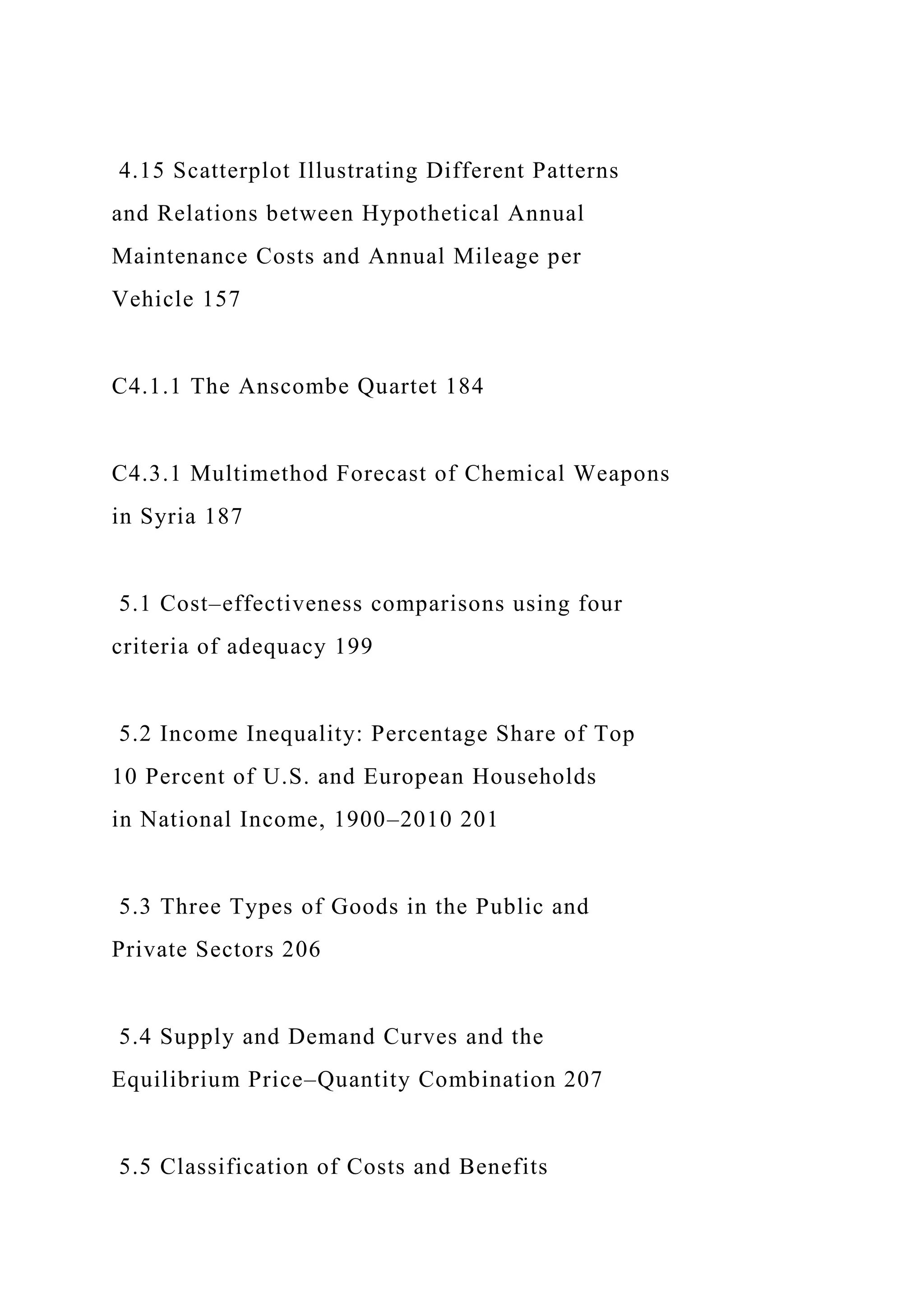
4.15 Scatterplot Illustrating Different Patterns
and Relations between Hypothetical Annual
Maintenance Costs and Annual Mileage per
Vehicle 157
C4.1.1 The Anscombe Quartet 184
C4.3.1 Multimethod Forecast of Chemical Weapons
in Syria 187
5.1 Cost–effectiveness comparisons using four
criteria of adequacy 199
5.2 Income Inequality: Percentage Share of Top
10 Percent of U.S. and European Households
in National Income, 1900–2010 201
5.3 Three Types of Goods in the Public and
Private Sectors 206
5.4 Supply and Demand Curves and the
Equilibrium Price–Quantity Combination 207
5.5 Classification of Costs and Benefits
According to Four Types of Questions 212
5.6 Objectives Tree for National Energy
Policy 221
5.7 Value-Critical Discourse 224
5.8 Simplified Partial Cost Model for Total
Initial Investment 227
5.9 Constraints Map for National Energy
Policy 230
5.10 Comparison of Discounted and Undiscounted
Costs Cumulated for Two Programs with
Equal Effectiveness 232
5.11 Threats to the Plausibility of Claims
about the Benefits of the 55 mph Speed
Limit 237
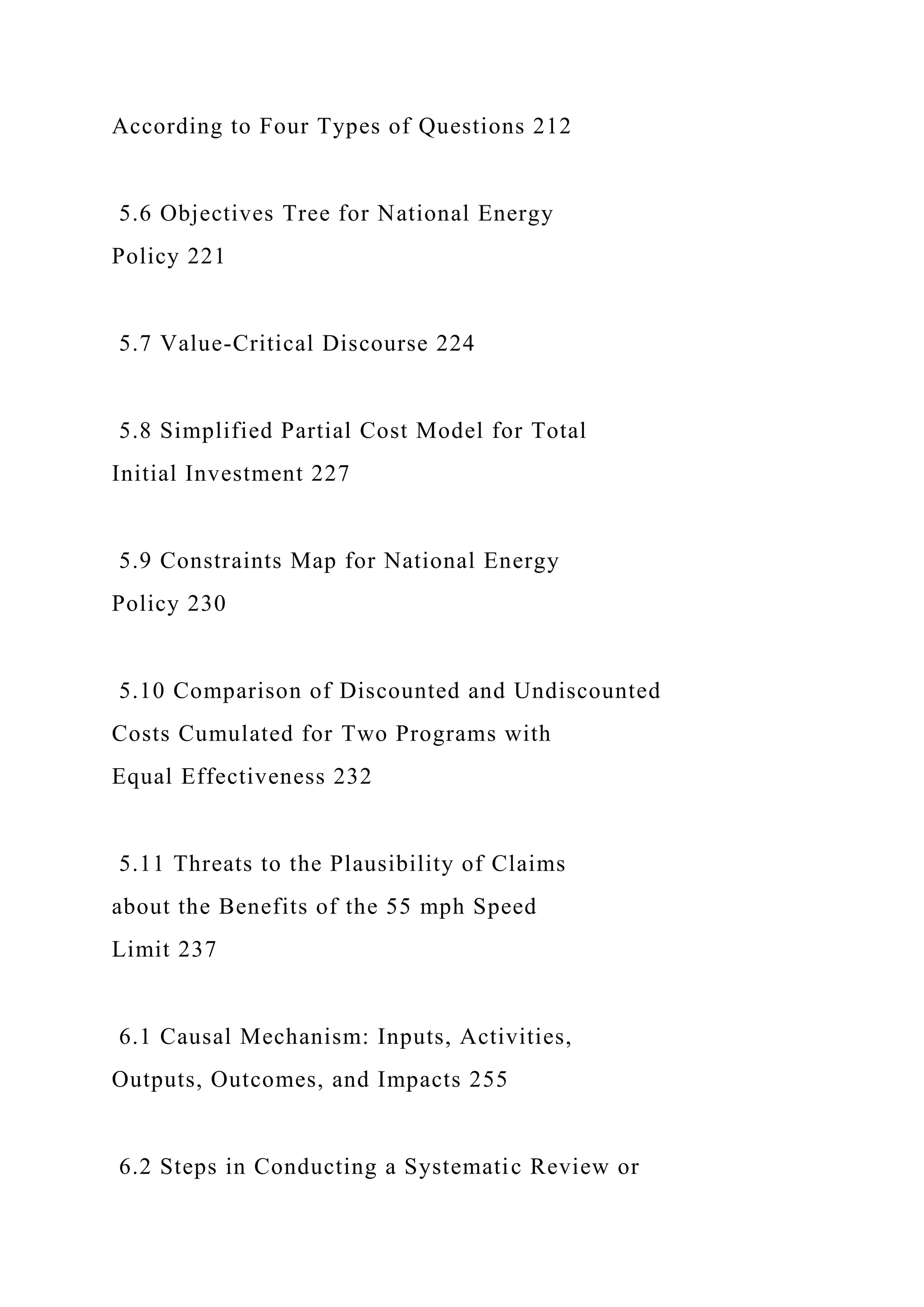
6.1 Causal Mechanism: Inputs, Activities,
Outputs, Outcomes, and Impacts 255
6.2 Steps in Conducting a Systematic Review or
Meta-Analysis 275
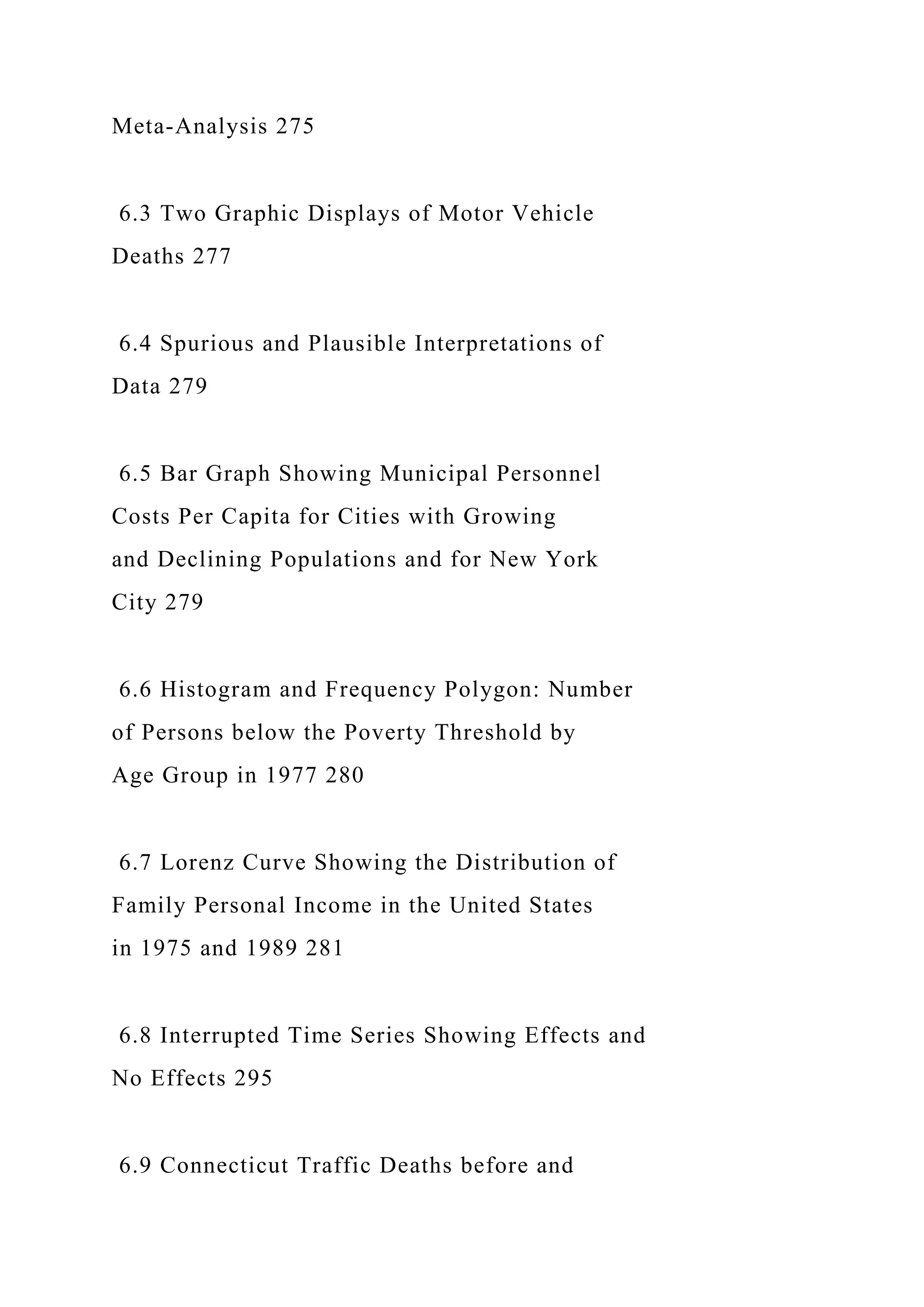
6.3 Two Graphic Displays of Motor Vehicle
Deaths 277
6.4 Spurious and Plausible Interpretations of
Data 279
6.5 Bar Graph Showing Municipal Personnel
Costs Per Capita for Cities with Growing
and Declining Populations and for New York
City 279
6.6 Histogram and Frequency Polygon: Number
of Persons below the Poverty Threshold by
Age Group in 1977 280
6.7 Lorenz Curve Showing the Distribution of
Family Personal Income in the United States
in 1975 and 1989 281
6.8 Interrupted Time Series Showing Effects and
No Effects 295
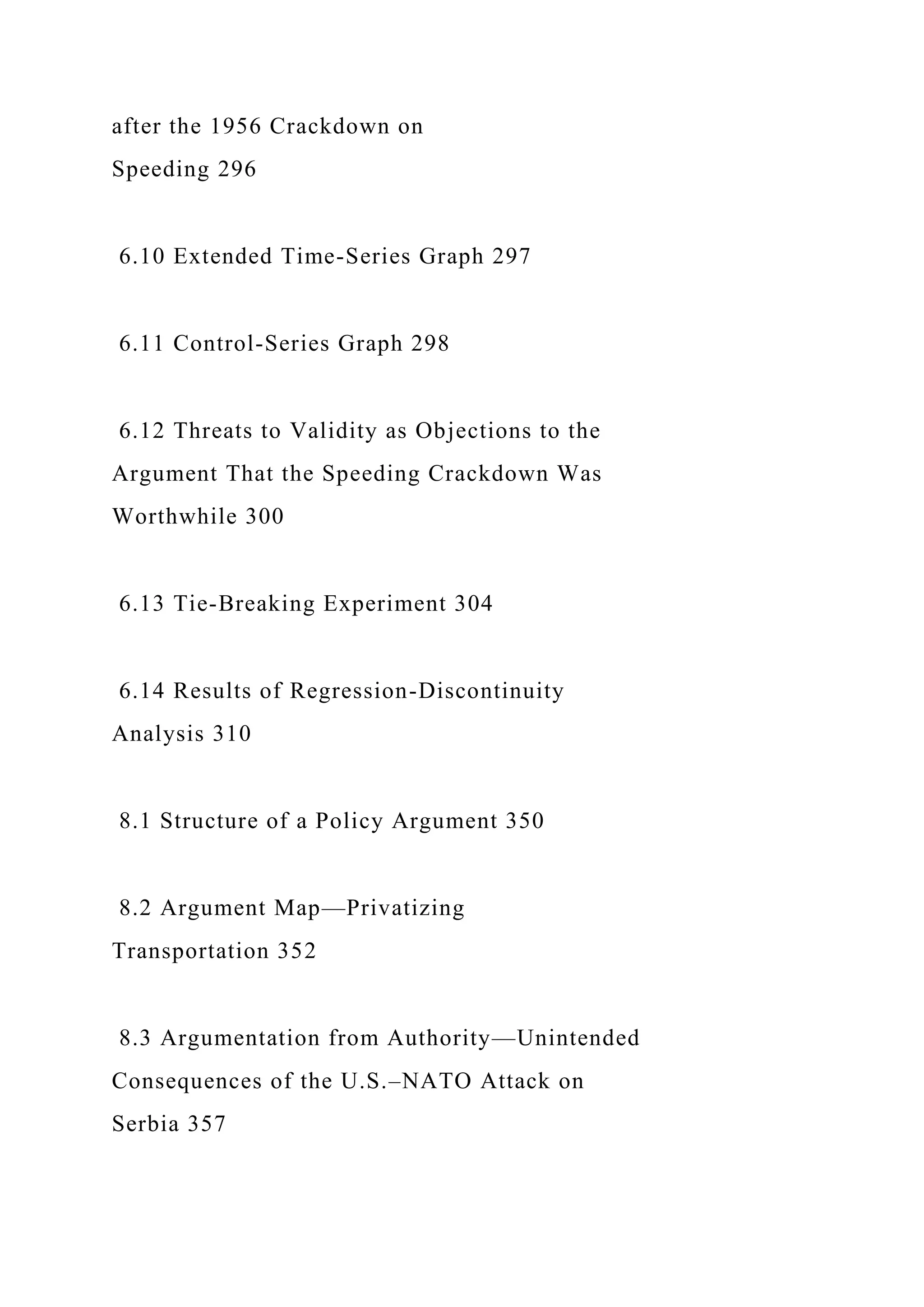
6.9 Connecticut Traffic Deaths before and
after the 1956 Crackdown on
Speeding 296
6.10 Extended Time-Series Graph 297
6.11 Control-Series Graph 298
6.12 Threats to Validity as Objections to the
Argument That the Speeding Crackdown Was
Worthwhile 300
6.13 Tie-Breaking Experiment 304
6.14 Results of Regression-Discontinuity
Analysis 310
8.1 Structure of a Policy Argument 350
8.2 Argument Map—Privatizing
Transportation 352
8.3 Argumentation from Authority—Unintended
Consequences of the U.S.–NATO Attack on
Serbia 357
8.4 Argumentation from Method—
Intransitivity of Preferences for Nuclear
Power 358
8.5 Argumentation from Generalization—A
“False Positive” About the Success of
Community Nutrition 361
8.6 Argumentation from Classification—
Challenging Claims about Authoritarian Rule
and Terrorism 363
8.7 Argumentation from Theoretical Cause—
Competing Deductive-Nomological
Explanations of the Cuban Missile
Crisis 365
Visual Display Contentsxiv
8.8 Argumentation from Practical Cause—Rival
Explanations of the Effects of the Connecticut
Crackdown on Speeding 368
8.9 Argumentation from Sign—Quantitative
Indicators Such as Correlation
Coefficients and P-Values Do Not “Prove”
Causation 370
8.10 Argumentation from Motivation—Support
for the Equal Rights Amendment 372
8.11 Argumentation from Intuition—A Counter-
intuitive

Unique among textbooks, Dunn puts problematization and pr.docx

  • 1.
    “Unique among textbooks,Dunn puts problematization and problem structuring center stage as the major driver in each field of the policy-analytic domain. As usual, Dunn skillfully blends (social) scien- tific insight, epistemological sophistication, methodological finesse and practical savvy.” Robert Hoppe, University of Twente, The Netherlands “This new edition continues the tradition of excellence established by previous editions and updates the text, references and examples to ensure its continuing relevance to the contemporary world of policy analysis in governments, the NGO and private sectors. ” Michael Howlett, Simon-Fraser University, Canada “William Dunn effectively illustrates methodology and methods of policy analysis with real-world case materials and examples at the local, national and international levels. It remains the best guide for both undergraduate and graduate courses out there.” Keun Namkoong, Former President of Seoul Tech and of Korean Association for Public Administration, South Korea “Very impressive book and will continue to use this as a must read book for my students aspiring to become respectable policy analysts.”
  • 2.
    Sofian Effendi, GadjahMada University, Indonesia http://taylorandfrancis.com Public Policy Analysis, the most widely cited book on the subject, provides students with a comprehensive methodology of policy analysis. It starts from the premise that policy analysis is an applied social science discipline designed for solving practical problems facing public and nonprofit organizations. This thor- oughly revised sixth edition contains a number of important updates: -new “big ideas” case study in policy analysis to stimulate student interest in timely and important problems. -based policy and the role of field experiments has been thoroughly rewritten and expanded. been added, including using scientific evidence in public policymaking, systematic reviews, meta- analyses, and “big data.” as IBM SPSS 23.0 files and are convertible to Excel, Stata, and R statistical software programs to suit a variety of course needs and teaching styles. -new PowerPoint slides are included to make instructor
  • 3.
    preparation easier thanever before. Designed to prepare students from a variety of academic backgrounds to conduct policy analysis on their own, without requiring a background in microeconomics, Public Policy Analysis, Sixth Edition helps students develop the practical skills needed to communicate findings through memos, position papers, and other forms of structured analytical writing. The text engages students by challenging them to criti- cally analyze the arguments of policy practitioners as well as political scientists, economists, and political philosophers. William N. Dunn is Professor in the Graduate School of Public and International Affairs at the Univer- sity of Pittsburgh, USA. Public Policy Analysis http://taylorandfrancis.com Public Policy Analysis An Integrated Approach Sixth Edition WILLIAM N. DUNN Sixth edition published 2018
  • 4.
    by Routledge 711 ThirdAvenue, New York, NY 10017 and by Routledge 2 Park Square, Milton Park, Abingdon, Oxon OX14 4RN Routledge is an imprint of the Taylor & Francis Group, an informa business © 2018 Taylor & Francis The right of William N. Dunn to be identified as author of this work has been asserted by him in accordance with sections 77 and 78 of the Copyright, Designs and Patents Act 1988. All rights reserved. No part of this book may be reprinted or reproduced or utilised in any form or by any electronic, mechanical, or other means, now known or hereafter invented, including photocopying and recording, or in any information storage or retrieval system, without permission in writing from the publishers. Trademark notice: Product or corporate names may be trademarks or registered trademarks, and are used only for identification and explanation without intent to infringe. First edition published by Pearson Education, Inc. 1994 Fifth edition published by Routledge 2016 Library of Congress Cataloging-in-Publication Data Names: Dunn, William N., author.
  • 5.
    Title: Public policyanalysis : an integrated approach / by William N. Dunn. Description: Sixth Edition. | New York : Routledge, 2017. | Revised edition of the author's Public policy analysis, c2012. | Includes bibliographical references and index. Identifiers: LCCN 2017008665 | ISBN 9781138743830 (hardback : alk. paper) | ISBN 9781138743847 (pbk. : alk. paper) | ISBN 9781315181226 (ebook) Subjects: LCSH: Policy sciences. | Political planning— Evaluation. Classification: LCC H61 .D882 2017 | DDC 320.6—dc23 LC record available at https://lccn.loc.gov/2017008665 ISBN: 978-1-138-74383-0 (hbk) ISBN: 978-1-138-74384-7 (pbk) ISBN: 978-1-315-18122-6 (ebk) Typeset in Minion Pro, Bell Gothic by Apex CoVantage, LLC Visit the eResources: www.routledge.com/9781138743847 In memory of Donald T. Campbell http://taylorandfrancis.com PART I Methodology of Policy Analysis 1
  • 6.
    CHAPTER 1 TheProcess of Policy Analysis 2 CHAPTER 2 Policy Analysis in the Policymaking Process 30 PART II Methods of Policy Analysis 67 CHAPTER 3 Structuring Policy Problems 68 CHAPTER 4 Forecasting Expected Policy Outcomes 118 CHAPTER 5 Prescribing Preferred Policies 189 CHAPTER 6 Monitoring Observed Policy Outcomes 250 CHAPTER 7 Evaluating Policy Performance 320 PART III Methods of Policy Communication 347 CHAPTER 8 Developing Policy Arguments 348 CHAPTER 9 Communicating Policy Analysis 391 APPENDIX 1 Policy Issue Papers 433 APPENDIX 2 Executive Summaries 440 APPENDIX 3 Policy Memoranda 444 APPENDIX 4 Planning Oral Briefings 450 BRIEF CONTENTS ix
  • 7.
    x EXHIBIT 3.1 PolicyStakeholder Analysis: The Affordable Care Act (Obamacare) 110 BOX 5.1 The Over-Advocacy Trap 192 EXHIBIT C6.1 Fatalities and Other Variables in the United States, 1966–2015 318 EXHIBIT C6.2 Fatalities per 100,000 Persons, 1970–1976 319 EXHIBIT 8.1 Identifying and Arranging Elements of a Policy Argument 353 EXHIBIT 8.2 Guidelines for Interpreting Arguments 380 BOX 9.1 Producing Policy Analysis—A Poorly Managed Lumber Mill 392 BOX 9.2 Contingent Communication 397 BOX 9.3 Checklist for an Oral Briefing 409 USEFUL CONCEPTS, GUIDES, AND CHECKLISTS BOX CONTENTS xi
  • 8.
    LESSONS FROM PRACTICE CASESTUDY CONTENTS Are Policy Analysts Technocrats? 61 Brainstorming across Disciplines: The Elevator Problem 116 Communicating Complex Analyses to Multiple Audiences: Regulating Leaded Gasoline 415 Forecasting MARTA Receipts 185 Images, Arguments, and the Second Persian Gulf Crisis, 1990–1991 387 Mapping International Security and Energy Crises 27 Monitoring Policy Outcomes: The Political Economy of Traffic Fatalities in Europe and the United States 317 Monitoring the Uses of Policy Analysis 65 Multimethod Forecasting: Syria Chemical Weapons 187 Opportunity Costs of Saving Lives—The 55 mph Speed Limit 244 Pros and Cons of Balkan Intervention 386 Structuring Problems of Risk: Safety in Mines and on Highways 112
  • 9.
    The Economics ofMorality: Evaluating Living Wage Policies 345 The Ethics of Cake Cutting 344 The Goeller Scorecard and Technological Change 23 The Spreadsheet and Scorecard—Evaluating Benefits and Costs of Energy Policies 243 Translating Policy Arguments into Issue Papers, Position Papers, and Letters to the Editor—The Case of the Second Persian Gulf War 410 Using Influence Diagrams and Decision Trees to Structure Problems of Energy and Highway Safety Policy 25 Visual Signatures in Regression Analysis: The Anscombe Quartet 184 xii 1.1 Multidisciplinary Policy Analysis 6 1.2 Forms of Policy Analysis 11 1.3 Opportunity Costs of Using Multiple Methods 18 1.4 Elements of a Policy Argument 20 C1.2.1 Influence Diagram and Decision Tree 26
  • 10.
    C1.3.1 Simple ArgumentMaps Are Static and Uncontested 28 C1.3.2 Complex Argument Maps Are Dynamic and Contested 29 2.1 Complexity, Feedback, and Short Circuiting in the Policymaking Process 46 2.2 Policy-Relevant Knowledge and Associated Methods 55 3.1 The Process of Problem Structuring 71 3.2 Hierarchy of Types of Policy Issues 74 3.3 Phases of Problem Structuring 79 3.4 A Symbolic Model 85 3.5 Simulation or Procedural Model 85 3.6 Assumed Effects of X on Y from One Perspective 87 3.7 Map of Transportation Points in Central Region 88 3.8 Solution
  • 11.
    for Nine-Dot Problem88 3.9 Pareto Chart—Estimated Boundary of Problem 92 3.10 Set Union 95 3.11 Set Intersection 96 3.12 Classification Scheme 96 3.13 Cross break 96 3.14 Hierarchy Analysis of the Causes of Fires 98 3.15 The Process of Assumptional Analysis 105 3.16 Plausibility and Importance of Warrant about Opportunity Costs of Driving at Lower Speeds 107 C3.1 Pareto Chart—Cumulative Frequency of Rival Causes 114 C3.2 Pareto Chart—Cumulative Frequency of
  • 12.
    Criteria for EvaluatingResearch on Risk 116 4.1 Processes of Intuition (System I) and Reasoning (System II) 120 4.2 Three Types of Societal Futures: Potential, Plausible, and Normative 124 4.3 The Logic of Trend Extrapolation: Inductive Reasoning 126 4.4 The Logic of Theoretical Prediction: Deductive Reasoning 127 4.5 The Logic of Possible Futures: Abductive Reasoning 127 4.6 Demonstration of a Secular Trend: Total Arrests per 1,000 Persons in Chicago, 1940–1970 130 4.7 Demonstration of Cyclical Fluctuations: Total Arrests per 1,000 Persons in Chicago, 1868–1970 131
  • 13.
    4.8 Two Propertiesof Linear Regression 132 4.9 Five Classes of Nonlinear Time Series 138 4.10 Growth of Federal Government Organizations in the United States by Presidential Term, 1789–1973 139 4.11 Linear versus Growth Trends 141 4.12 Four Types of Causal Arguments 149 4.13 Arrow Diagram Illustrating the Causal Structure of an Argument 152 FIGURES FOR ORGANIZING THINKING VISUAL DISPLAY CONTENTS Visual Display Contents xiii 4.14 Path Diagram Illustrating a Model of Public Choice Theory 154
  • 14.
    4.15 Scatterplot IllustratingDifferent Patterns and Relations between Hypothetical Annual Maintenance Costs and Annual Mileage per Vehicle 157 C4.1.1 The Anscombe Quartet 184 C4.3.1 Multimethod Forecast of Chemical Weapons in Syria 187 5.1 Cost–effectiveness comparisons using four criteria of adequacy 199 5.2 Income Inequality: Percentage Share of Top 10 Percent of U.S. and European Households in National Income, 1900–2010 201 5.3 Three Types of Goods in the Public and Private Sectors 206 5.4 Supply and Demand Curves and the Equilibrium Price–Quantity Combination 207 5.5 Classification of Costs and Benefits
  • 15.
    According to FourTypes of Questions 212 5.6 Objectives Tree for National Energy Policy 221 5.7 Value-Critical Discourse 224 5.8 Simplified Partial Cost Model for Total Initial Investment 227 5.9 Constraints Map for National Energy Policy 230 5.10 Comparison of Discounted and Undiscounted Costs Cumulated for Two Programs with Equal Effectiveness 232 5.11 Threats to the Plausibility of Claims about the Benefits of the 55 mph Speed Limit 237 6.1 Causal Mechanism: Inputs, Activities, Outputs, Outcomes, and Impacts 255 6.2 Steps in Conducting a Systematic Review or
  • 16.
    Meta-Analysis 275 6.3 TwoGraphic Displays of Motor Vehicle Deaths 277 6.4 Spurious and Plausible Interpretations of Data 279 6.5 Bar Graph Showing Municipal Personnel Costs Per Capita for Cities with Growing and Declining Populations and for New York City 279 6.6 Histogram and Frequency Polygon: Number of Persons below the Poverty Threshold by Age Group in 1977 280 6.7 Lorenz Curve Showing the Distribution of Family Personal Income in the United States in 1975 and 1989 281 6.8 Interrupted Time Series Showing Effects and No Effects 295 6.9 Connecticut Traffic Deaths before and
  • 17.
    after the 1956Crackdown on Speeding 296 6.10 Extended Time-Series Graph 297 6.11 Control-Series Graph 298 6.12 Threats to Validity as Objections to the Argument That the Speeding Crackdown Was Worthwhile 300 6.13 Tie-Breaking Experiment 304 6.14 Results of Regression-Discontinuity Analysis 310 8.1 Structure of a Policy Argument 350 8.2 Argument Map—Privatizing Transportation 352 8.3 Argumentation from Authority—Unintended Consequences of the U.S.–NATO Attack on Serbia 357
  • 18.
    8.4 Argumentation fromMethod— Intransitivity of Preferences for Nuclear Power 358 8.5 Argumentation from Generalization—A “False Positive” About the Success of Community Nutrition 361 8.6 Argumentation from Classification— Challenging Claims about Authoritarian Rule and Terrorism 363 8.7 Argumentation from Theoretical Cause— Competing Deductive-Nomological Explanations of the Cuban Missile Crisis 365 Visual Display Contentsxiv 8.8 Argumentation from Practical Cause—Rival Explanations of the Effects of the Connecticut Crackdown on Speeding 368
  • 19.
    8.9 Argumentation fromSign—Quantitative Indicators Such as Correlation Coefficients and P-Values Do Not “Prove” Causation 370 8.10 Argumentation from Motivation—Support for the Equal Rights Amendment 372 8.11 Argumentation from Intuition—A Counter- intuitive