Policy Analysis For Practice Applying Social Policy Paul Spicker
Policy Analysis For Practice Applying Social Policy Paul Spicker
Policy Analysis For Practice Applying Social Policy Paul Spicker
Policy Analysis For Practice Applying Social Policy Paul Spicker
Policy Analysis For Practice Applying Social Policy Paul Spicker
1.
Policy Analysis ForPractice Applying Social
Policy Paul Spicker download
https://ebookbell.com/product/policy-analysis-for-practice-
applying-social-policy-paul-spicker-51809174
Explore and download more ebooks at ebookbell.com
2.
Here are somerecommended products that we believe you will be
interested in. You can click the link to download.
Integrating Landscape Approaches And Multiresource Analysis Into
Natural Resource Management Summary Of A Workshop 1st Edition And
Medicine Engineering National Academies Of Sciences Policy And Global
Affairs Science And Technology For Sustainability Program Committee On
The Practice Of Sustainability Science Dominic A Brose
https://ebookbell.com/product/integrating-landscape-approaches-and-
multiresource-analysis-into-natural-resource-management-summary-of-a-
workshop-1st-edition-and-medicine-engineering-national-academies-of-
sciences-policy-and-global-affairs-science-and-technology-for-
sustainability-program-committee-on-the-practice-of-sustainability-
science-dominic-a-brose-51984092
Practical Guide For Policy Analysis The Eightfold Path To More
Effective Problem Solving 5th Eugene Bardach
https://ebookbell.com/product/practical-guide-for-policy-analysis-the-
eightfold-path-to-more-effective-problem-solving-5th-eugene-
bardach-6861212
A Practical Guide For Policy Analysis The Eightfold Path To More
Effective Problem Solving 4th Edition Eugene Bardach
https://ebookbell.com/product/a-practical-guide-for-policy-analysis-
the-eightfold-path-to-more-effective-problem-solving-4th-edition-
eugene-bardach-4734602
Using R For Trade Policy Analysis R Codes For The Unctad And Wto
Practical Guide 2nd Edition Massimiliano Porto
https://ebookbell.com/product/using-r-for-trade-policy-analysis-r-
codes-for-the-unctad-and-wto-practical-guide-2nd-edition-massimiliano-
porto-52221030
3.
Using R ForTrade Policy Analysis R Codes For The Unctad And Wto
Practical Guide 1st Ed Massimiliano Porto
https://ebookbell.com/product/using-r-for-trade-policy-analysis-r-
codes-for-the-unctad-and-wto-practical-guide-1st-ed-massimiliano-
porto-11857714
Policy Analysis For Educational Leaders A Stepbystep Approach
Hardcover Nicola A Alexander
https://ebookbell.com/product/policy-analysis-for-educational-leaders-
a-stepbystep-approach-hardcover-nicola-a-alexander-10008890
Environmental Policy Analysis For Decision Making 1st Edition John
Loomis
https://ebookbell.com/product/environmental-policy-analysis-for-
decision-making-1st-edition-john-loomis-4490672
The Policybased Profession An Introduction To Social Welfare Policy
Analysis For Social Workers 7th Edition Philip R Popple
https://ebookbell.com/product/the-policybased-profession-an-
introduction-to-social-welfare-policy-analysis-for-social-workers-7th-
edition-philip-r-popple-36682432
The Policybased Profession An Introduction To Social Welfare Policy
Analysis For Social Workers 7th Edition Philip R Popple
https://ebookbell.com/product/the-policybased-profession-an-
introduction-to-social-welfare-policy-analysis-for-social-workers-7th-
edition-philip-r-popple-36873244
5.
POLICY ANALYSIS
FOR PRACTICE
PaulSpicker
Applying social policy
POLICY
ANALYSIS
FOR
PRACTICE
Paul
Spicker
“This book offers an interesting and unique approach that will appeal to
many working in the field.Written in a clear and accessible style, it will be
a valuable text not only for those involved in policy and practice, but also
for students and practitioners in health and social care.” Susan Balloch,
Professor of Health and Social Care, Health and Social Policy Research Centre,
University of Brighton, UK
People who work in planning, management and service delivery in the public
sector need to know how policy is translated into practice, what is happening,
and whether a policy works. Policy analysis for practice introduces students
and practitioners to the concepts, methods and techniques required to
undertake the analysis and review of policy and its implementation. Focusing
on developing understanding and skills for a growing area of practice, it
combines material from public and social administration with examples and
application to social policy and the social services.
The book looks at ways to understand and analyse the main stages of the
policy process: developing strategies, identifying aims, examining the
situation, choosing methods, implementation and service delivery, and
evaluating outcomes. It stresses throughout the role of policy analysis as a
political, and not just a technical, activity.
Policy analysis for practice is an original, thought-provoking text with a strong
applied focus. It offers:
• systematic, accessible coverage of wide-ranging literature;
• application to practical circumstances and the needs of people in the field;
• a direct relationship to vocational work in the management and
administration of social services.
It will be invaluable for students and practitioners in public policy, social
policy and public sector management, in fields including central and local
government, health and social care and the voluntary sector.
Paul Spicker holds the Grampian Chair of Public Policy at the Robert Gordon
University, Aberdeen and is the Director of the Centre for Public Policy and
Management.
www.policypress.org.uk
SOCIAL POLICY
Policy analysis for practice [POD].qxd 14/11/08 14:42 Page 1
www.policypress.co.uk
PolicyPress @policypress
iii
Contents
Preface v
Notes onthe author viii
one The nature of policy analysis 1
Policy analysis 1
The work of the policy analyst 1
Policy analysis and social science 3
Skills for policy analysis 6
The role of the policy analyst 11
two The policy process 15
Policy making 16
Setting policy 24
The policy cycle 29
three Strategic policy making 33
The structure of a policy analysis 33
Strategic planning 36
four Aims, values and goals 49
The mission 50
Values 54
Aims 57
Goals 61
five Assessing the environment 1: qualitative interpretation 67
Checking existing sources 69
Stakeholders 70
Key actors 72
Research methods: obtaining information 75
Consultation 78
Interpreting and processing qualitative data 82
9.
iv
Policy analysis forpractice
six Assessing the environment 2: quantitative 87
interpretation
Indicators 87
Enumerations and censuses 93
Need assessment 94
Forecasting 96
seven Methods, constraints and resources 105
Government action 105
Constraints 113
Resources 117
Decisions about methods 120
eight Selecting methods: value for money 129
Effectiveness, efficiency and value for money 129
Distributive issues 138
nine Analysing implementation 145
Understanding implementation 147
Administration 149
Process evaluation 156
The art of the possible 163
ten The evaluation of policy 167
Summative and formative evaluation 167
Criteria for evaluation 168
Evaluation research 171
User perspectives 175
Approaches to evaluation 178
Policy analysis: developing a checklist 181
References 185
Index 201
10.
v
Preface
This book isintended to introduce students and practitioners to the
concepts, methods and skills required for policy analysis in practice.
‘Policy analysis’can understood in two main senses. Policy analysis in
the UK usually refers to the analysis of policy – understanding the
structures and processes which relate to policy making. Policy analysis
in the US is more usually treated as analysis for policy – helping to
make decisions about what course to follow,and reviewing what effects
different measures might have. That,by contrast with the first approach,
is the main sense in which‘policy analysis’is used in this book. Readers
who are familiar with some of the standard approaches in the UK,like
books by Parsons or Hudson and Lowe,1
may be surprised how little
direct relationship there is between their concerns and the agenda of
this book. This is not a criticism of the value of understanding structures
and processes,but this book is trying to do something quite different.
There is a particular shortage of this kind of material in the UK, but
practitioners here need to understand analysis for policy as much as
their American counterparts do.
The book mixes approaches from two overlapping fields of study.
The first is Public Administration. Most British books on Public
Administration are concerned with the process by which policy is
made and implemented. The structure of the book is based on the
‘rational-comprehensive’ model of planning, which reviews:
• the environment in which policy takes place;
• the aims of policy;
• the selection of methods;
• the process of implementation; and
• evaluation.
Obviously, it is important to have some understanding of structures
and processes in order to be able to work effectively in practice, but
this is not the main focus. Rather, it is on the skills and methods
which can be used to deal with problems in practice.
The second field of study is Social Policy. By contrast with Public
Administration, Social Policy is focused less on process than on the
substantive content of policies. The principal areas relate to policy
and administrative practice in health administration, social security,
education, employment services, community care and housing
management; social problems, including criminology, disability,
11.
vi
Policy analysis forpractice
unemployment, mental health and old age; issues relating to social
disadvantage, including ‘race’, gender and poverty; and the range of
collective social responses to these conditions. The study of the subject
is concerned with:
• the general application of social science disciplines to these issues,
such as sociology, economics and political science;
• specific methods and approaches relevant to the areas of study of
these subject areas, including policy analysis, social planning
methods, the evaluation of organisational processes and service
delivery, and the management of social services; and
• the development of skills for application in these contexts,
including, for example, welfare rights, social research methods
and social planning.
Social Policy was conceived as an applied subject. The field was
developed to meet the needs of public and voluntary sector
administrators who needed to know about the problems and processes
they would be dealing with. In the course of the last 20 years or so,
however, teaching of the subject in British universities has become
progressively more divorced from its practical and vocational roots.
Although the practical issues the subject used to be mainly focused
on are not treated as central in the field of Social Policy nowadays,
they have not gone away. On the contrary, they have developed very
substantially,and there is a rich and varied literature about them. Issues
like strategic planning, partnership working and user participation
have become part of the language of everyday practice in central and
local government. There is a new administrative language, covering
topics like performance indicators,targets and audit. Beyond that,we
have seen the growth of a range of relatively new concepts – issues
like empowerment, voice and quasi-markets. There are a range of
new techniques, obviously including changes in information and
communication technology, but including focus groups, interactive
approaches to consultation and participative research. At a time when
most people working in Social Policy had lost interest in social
administration, the field has been growing, developing and changing.
This book is concerned with a particular aspect of the applied focus
of Social Policy, which is its application to policy making and review.
(This is only part of the agenda for an applied course in Social Policy
– the other parts are professional skills and public sector management.)
The areas which this book covers include many which are closely
related to employment in social administration and public service.
12.
vii
Preface
The kinds ofwork that students in Social Policy are most likely to do
call for the sort of skills and techniques discussed in this book.
Policy analysis for practice has developed from teaching on a Master’s
in Public Administration (MPA) at the Robert Gordon University. I
owe thanks to Geraldine Wooley and Coryn Barclay for comments,
and to my colleague Kirsteen Davidson,who co-wrote the case study
on gender mainstreaming.
Paul Spicker,
May 2006
13.
viii
Policy analysis forpractice
Notes on the author
Paul Spicker holds the Grampian Chair of Public Policy at the Robert
Gordon University, Aberdeen,and is Director of the Centre for Public
Policy and Management. His research includes studies of poverty,
need,disadvantage and service delivery;he has worked as a consultant
for a range of agencies in social welfare provision. His books include:
Stigma and social welfare (Croom Helm, 1984)
Principles of social welfare (Routledge, 1988)
Social housing and the social services (Longman, 1989)
Poverty and social security: concepts and principles (Routledge, 1993)
Social policy: themes and approaches (Prentice Hall, 1995)
Planning for the needs of people with dementia (with D S Gordon,
Avebury, 1997)
Social protection: a bilingual glossary (co-edited with J-P Révauger,
Mission-Recherche, 1998)
Social policy in a changing society (with Maurice Mullard,Routledge,
1998)
The international glossary on poverty (co-editor with David Gordon,
Zed, 1999)
The welfare state: a general theory (Sage Publications, 2000).
14.
1
ONE
The nature ofpolicy analysis
Policy analysis
There are three main areas of applied policy work: policy formation,
public sector management, and policy analysis and review.
• Policy formation. The formation and development of policy
depends on knowledge of the specific subject area and ideas
about options and approaches. Studies in this field focus on
what policies are, what they do, and how else they might be
done. Because this is often done in an attempt to bring about
change in policy, or to defend particular approaches, it is
sometimes referred to as ‘policy advocacy’.2
• Public sector management is mainly concerned with the process of
administering policy, implementation and managing
organisations. The skills required include project management,
resource management and working with people.
• Policy analysis and review. This is about examining policy – finding
out and assessing what is happening;monitoring implementation;
and evaluation,or finding out whether policies do what they are
supposed to do.
Although there are references in this book to all these activities,Policy
analysis for practice is mainly concerned with the third area, policy
analysis and review. Policy analysis works by trying to establish the
criteria by which policies can be judged,to find out how they operate,
and to see whether they produce the effects they are supposed to
produce. This book introduces the concepts,approaches and techniques
which are used to examine policy in practice. It has a direct application
to an expanding set of job opportunities, concerned with social
administration, service planning and delivery, and strategic public
service management.
The work of the policy analyst
There is no agreement about what a ‘policy analyst’ is or does. An
advertisement in June 2002 for‘policy analysts’in the Scottish Executive
15.
Policy analysis forpractice
2
generated widespread confusion in the press, with the suspicion that
what the Executive was looking for were political advisors. Policy
analysis is more pedestrian:the Executive was looking for people with
the skills to say what kinds of approach might be possible and whether
the policies worked or not. This is, broadly, what many civil servants,
administrators and local government officers do. There are many people
who work as policy analysts, but in the UK they are not often called
that.
I started to write this book on a Wednesday morning, and the jobs
advertised in the morning’s newspaper included posts like these:
• Operations Manager, Housing Association offering housing and
support for people with either a learning disability or a mental
health problem. You will be able to demonstrate:
◗ understanding of issues and the environment of community
care, including relevant legislation;
◗ knowledge of the role and function of housing associations;
◗ experience of service funding negotiations;
◗ experience of obtaining and managing new service
developments;
◗ knowledge of drafting and advising on policy.
• Planning and Development Officers,Children and Family Services.
You will need to have a thorough understanding of current issues,
and the ability to think strategically and critically. Both
postholders will hold key positions in Departmental and inter-
agency service development, and will be involved in the
preparation of statutory plans in consultation with colleagues,
service users and other organisations.
• Research and Information Officer, Social Work. The Research and
Information section provides research, service evaluation and
management information support to Departmental managers and
planners; produces statutory and Departmental performance
information and statistical returns to government;supports‘Best
Value’ service reviews, including consumer research; undertakes
work on resource allocation,and develops population models of
need and demand for planning purposes.
There are pages upon pages of these adverts. Many of them are looking
for people with specific experience of a client group, particular
knowledge of agency structures and managerial experience; but they
are also looking for a range of skills. They want people who can
negotiate with others involved in the field, develop plans and
programmes, deliver reports, and work out whether or not policy is
16.
3
being effective. Theseare the skills of policy analysis. They are generally
wanted in local government, voluntary sector organisations and
specialist agencies. There are few areas of public service in which
they are not at least relevant.
There are also people who work exclusively as policy analysts,even
if they are not often called that. Consultancy and research work often
requires a similar range of skills and methods,and some of the examples
in this text are drawn from my own work in this field. For the purposes
of this book, the kinds of problems which are being considered are
the kinds of problems consultants are asked to deal with. Unlike
managers or practitioners, who generally have to find room for work
related to policy or strategy in competition with the rest of their
work, consultants are left free to look at every aspect of a problem or
issue. The classic model of the consultant is ‘Star Trek’: Captain Kirk
beams down into an alien environment with no preparation or
knowledge of the situation,and little more than his wits and principles
of engagement to work by, and has to find a solution for everyone’s
problems before the end of the episode.
This is not so far from reality as it might appear at first. The advantage
of starting here is that the situation lends itself to comprehensive analysis,
and in particular it can reflect the position of the student who is
analysing, commenting and reporting on policies from outside the
agency. At the same time, it can be remote from the experience of
people who undertake policy analysis within an organisation. People
who are working in a particular setting do not start cold. They will
have a series of relationships,good and bad,which will help or hinder
the work they are trying to do. They have a status in the organisation,
which conveys a sense of expectation: it can be difficult for people
with junior status to mobilise support for projects from others who
are senior to them. Some of the same considerations apply to external
consultants – they are often taken to‘belong’to the person who hired
them, or brought them in to the organisation. (It is also possible, of
course, that agencies bring in outsiders because they do not have any
particular commitment to the policy, and can drop it afterwards; but
that is the kind of problem policy analysts have to cope with.) These
kinds of issues can still be considered in the context of a comprehensive
model.
Policy analysis and social science
Policy analysis is an exercise in applied social science. It begins with
a set of issues or problems and tries to apply insights from different
The nature of policy analysis
17.
Policy analysis forpractice
4
sources to the problems in hand. There are many different types of
academic course which are based on a wide range of approaches from
different social sciences:examples are general courses on social policy
or public sector management, and specific professional courses for
social workers, housing managers and health administrators. These
courses usually draw on material from a range of social sciences.
Economics and sociology are particularly important, although other
material can be drawn from philosophy, psychology, history and law.
Academic studies provide both tools and techniques for the task,
and specific knowledge. The knowledge base which is most relevant
to this field is part of what used to be called ‘social administration’,
although in most places the term has been replaced by the more general
term of‘social policy’. Social administration is concerned specifically
with the operation and delivery of social services. It is often castigated
in the literature as being far too much concerned with description,
and too little with analysis. If this was ever true, it had largely ceased
to be true by the late 1960s,when academic discussions of the subject
started to flourish. The literature of social administration covers issues
like service organisation,delivery,management,needs and relationships
with users. Many of the most interesting developments in social policy
since 1990 have been issues in social administration: examples are
community care, needs assessments, quasi-markets, care management
and user empowerment. Many of the practical issues which matter in
the field are issues in social administration; examples are corporate
planning, service rationing, joint working and the analysis of
institutional racism. This is a specialist literature,mainly now contained
in social policy and professional courses preparing people to work in
the social services. Social administration is related to public policy
mainly because general issues and principles,some of which are covered
in this book, apply across and between services. It is different from
public policy because social administration is focused on content and
results,rather than process. Social administration is strongly concerned
with practical policies to improve welfare – meeting need, dealing
with disadvantage and promoting social justice.
Sociology contributes a basic understanding of many concepts which
are fundamental to policy, including social problems, inequality and
social exclusion, and analyses of key topics, including, for example,
health, education, the family,‘race’ and gender. It provides some of
the staple tools of policy analysis, including the construction of social
indicators, identification of social processes, the use of social research
methods and some of the literature on evaluation.
Economics is important for two reasons. The first is that economic
18.
5
approaches and informationare a basic part of policy work. Concepts
like marginal cost,cost-benefit analysis and efficiency are part of policy
analysis, and analysts need to be familiar with them. Second, analysts
have to know enough to deal with the economic arguments. I went
once to an international social security conference on targeting and
incentives to work, where a group of American economists were
revealing the Truth to the lesser orders in the rest of the world. I
discussed this with a delegate from a country in West Africa, where
most people lived in poverty, nearly a fifth of all children died before
they were five and whose social security system barely covered a tenth
of the population. What, I asked him, has this stuff on incentives to
work got to do with you? His answer was,I thought,a very good one.
He explained that although the problems theAmericans were discussing
were quite irrelevant,he had to deal with international organisations,
like the World Bank and the United Nations, which talked the same
language. He had to get to grips with this sort of thing if he wanted
to deal with them.
Among the other areas which might be useful,law deserves a special
mention. Legal studies are often seen, and far too often taught to
practitioners, as a long list of ‘dos’ and ‘don’ts’. Even at that level, the
law is potentially useful: human rights, data protection or negligence
are commonly part of the background noise of policy decisions, but
just occasionally there might be some reason to put them in the
foreground. It is certainly true that, even if some legal principles
change and develop, others (like natural justice, which I refer to later)
are long established as part of the everyday meat of administrative
decisions, and analysts ought to be familiar with them. But beyond
this,there are also advantages to understanding legal reasoning. Many
laws are devised, not to establish the limits of right and wrong, but to
draw a line between those rules that might work in practice,and those
that won’t;it is a line of reasoning that policy makers may also need to
follow.
Because policy analysis is practically oriented,many of the problems
will be concerned with the specifics of the area where they are applied,
and they will mainly be considered by practitioners. Some of the
issues can only be addressed by practitioners,and the role of the policy
analyst will be to clarify problems – to ask questions and organise
material, so that the practitioners themselves can come to a view. It
often happens, in this process, that the best answers an analyst can
provide are answers which the practitioners knew anyway. (The time
to invoice people for payment,one consultancy book suggests,is before
the customers realise they could have done it themselves.)At the same
The nature of policy analysis
19.
Policy analysis forpractice
6
time, some of the skills of social policy analysts will be alien to
practitioners. Some areas of policy have been colonised by particular
professions,but that does not mean that the skills of that profession are
needed to do the job. Doctors learn how to take an appendix out on
the kitchen table,which they are unlikely nowadays to do in practice,
but relatively few know what the options are for organising an
appointments system, even if that might be rather more relevant to
the way they actually work. Social workers are responsible, in the
UK, for community care, but most social workers’ training is geared
to understand needs and identifying individual responses, rather than
the service planning and administration that go along with that.
Many of the administrative tasks undertaken by practitioners are
treated as a matter of ‘common sense’. Many agencies have a firmly
held understanding of what ‘common sense’ means, and take a dim
view of outsiders whose common sense is different. Many people
who work within organisations, particularly at the lower levels, are
expected to learn on the job. They learn from others who are working
in the same setting,and they often come to hold similar views. Social
services have their own‘ideologies’– interrelated sets of values,opinions
and beliefs which relate to the practical issues of the work setting.3
Often, these ideologies reflect common pressures and expectations
from people outside. Police forces emphasise public order,not because
public order offences are the most serious crimes, but because they
will be subject to criticism if public order breaks down in a way that
they will not be if crime rates increase generally. Social workers
emphasise risk,because ultimately they are likely to be judged if things
go wrong. Housing officers tend to emphasise equity, because there
will be protests if some people are seen to be treated differently from
others. These differences are reinforced by professional training, but
they make sense in their own right: they reflect the demands of the
job.
Skills for policy analysis
Anyone can set up shop as a policy analyst. Many of the people who
work in the field have drifted into it, because they were in a job
which required them to start doing it in practice. There may be no
agreement about the job specification, but there is a task to perform,
and the task calls for certain skills.
We can dispose of one myth immediately: analysts do not have to
be able to do the job themselves to make relevant comments about a
service. It is important for a policy analyst to gain some working
20.
7
knowledge of thearea which is being investigated. There is a jargon
to be learned; professionals in the field will want to communicate
their concerns;users will need to be able to explain their experiences.
The skills which are needed to do this, however, are not necessarily
the skills of the relevant profession. It does not take a doctor to ask a
patient about their treatment – in some circumstances,being associated
with the medical profession may be an obstacle. It does not take a
social worker to talk to the users of social work services. (Despite the
impression one may gain from the specialist literature, these are not
just ‘service users’. They are people.) It is important, however, to be
sensitive to the situation that people are in, and to know how to ask
them the questions which will produce the answers. These are the
basic skills of a researcher, and there are many fields in which people
learn those skills.
Research
Much of the work which is involved in analysis is described in academic
settings as ‘research’, although it is not necessarily research in the
conventional sense: the main purpose is not to find things out, but to
do what is necessary for practice. People who want to influence
policy have to do many of the same things that researchers do. They
need to understand the context in which the policy is being applied;
they have to be able to identify the likely effects of policies, and to
assess and evaluate the policy after it has been undertaken. This means
that many of the skills and methods of researchers are important for
policy analysts; they have to review sources of data, gather evidence
and make judgments about the weight to give to different findings.
Newcomers to ‘research’ often assume that it involves particular
approaches and techniques – like random samples,clipboards and boxes
to tick. This is a mistake. There is no single way of doing things.
Research can include any method of finding something out. This
includes, among other methods:
• scholarship – finding things out by looking at books and archives;
• exploration – finding things out by searching, observation and
enquiry;
• practice – finding things out through testing, experimenting,
developing and implementing methods; and
• systematic investigation – finding things out by surveys,controlled
experiments and other forms of scientific empirical examination.
The nature of policy analysis
21.
Policy analysis forpractice
8
There is no ‘right’ way to do research. Because methods can shape
results unintentionally, however, the best approaches tend to be those
which combine different approaches – in the jargon,‘triangulating’ –
in order to confirm issues from a range of perspectives.
The process of undertaking research can be broken down into four
main tasks:
• selection and interpretation of the research problem;
• choosing methods;
• obtaining data; and
• processing and interpreting the data.
Selection and interpretation. In applied research, the selection of the
research problem is often given; it is not usually open to a policy
analyst,asked to look at the problems of poor families,to say‘let’s look
at the structure of capitalism instead’. There is still scope for
interpretation – what, after all, is a poor family, and who should be
excluded or included from the definition? This kind of selection is
informed partly by theoretical considerations, but also by what it is
feasible and practical for people to do.
Choosing methods. Research methods are almost infinitely flexible.
Some things will be done as standard: a review of what other people
have done and a collation of existing material. Beyond that,there is a
very wide range of different research approaches and techniques,rooted
in a range of academic disciplines. There is scope,then,for considerable
imagination in what kinds of methods can be used and how they are
applied. It tends to be true, of course, that imagination is not always
appreciated;there is no research programme which cannot be subjected
to methodological criticism,but programmes which follow well-worn
paths are less vulnerable to scepticism than innovative ones.
Obtaining data. Research depends on getting hold of the people and
sources from which information can be drawn. This is usually referred
to in research primers as‘sampling’,although the practical experience
of many policy analysts is that the sample is often set before they
appear, and something has to be done within those constraints which
makes some kind of sense. The popular image of research tends to
assume that it is ‘representative’. Representative samples are drawn
from a whole population, usually either on a random basis or by
selection for a quota. Representative samples are intended to reflect
the views of the whole population; this is useful in surveys of public
22.
9
opinion or consumersatisfaction. Ideally, a representative sample is
taken by reproducing their characteristics – gender,age,ethnicity,and
so forth – in miniature. This is the basic stuff of market research, and
indeed of many social and psychological surveys. But it is not widely
done in policy analysis, partly because it assumes in advance that the
analyst knows what questions to ask, and partly because it calls for a
lot of resources, but mainly because general public opinion is not
necessarily the best way for the development or impact of policy to
be examined. Samples in policy analysis are much more likely to be
purposive, or deliberately selected. Examples include key groups (people
selected because they perform a particular role in a process),structural
samples (people who occupy defined positions and so have a distinct
perspective to offer),and stakeholder research (work with people who
are directly affected by a policy or engaged with it). Commonly used
methods of obtaining data from a purposive sample are correspondence,
personal interviews and group discussions. The issues in identifying
and consulting with key actors and stakeholders are considered in
Chapter five.
Processing and interpreting the data. Books on research methods devote
considerable time and space to the issue of how research material
should be analysed. The issues are considered further in Chapters
Five and Six, which are concerned with intensive and extensive
techniques for policy analysis. But this is not a book about research,
and there is no attempt here to cover issues like grounded theory or
parametric statistics. These are very useful techniques – given the
wide range of problems that has to be dealt with, there is often a way
to apply them – but they are not central. Policy analysis gathers material
for a purpose, and the processing and presentation of data depend
strictly on that purpose. This book focuses less on the analysis of
research material than on organising the material into the structure
required for policy analysis.
Communication
The other main set of skills required in policy analysis relates to
communication. Four kinds of communication, apart from those
required in research, are particularly important. The first is work in
committees. The consultant is not expected to engage in argument,
because outsiders do not make decisions;contributions in a committee
have to be to the point. In academic seminars,students are encouraged
to talk, to interact, to work out what they have to say. In a policy
The nature of policy analysis
23.
Policy analysis forpractice
10
committee, the opposite is true. You can often assume that no-one
really wants to hear what you have to say if you are not going to agree
with them, and even if they do they may have something more
interesting to do with their life afterwards. You have to make it brief,
and make it count.
The second is presentation. Policy analysts have to be able to present
material directly and effectively,in a way which is tailored to a specific
audience. Often the audience is non-specialised – a community group,
a public meeting or elected members. Presentations work best if they
use more than one medium – people take in information in different
ways, and some will relate better to a slide show or a handout than to
the spoken word. Visual materials have to be highly selective for
effect; try not to put more than five lines on a slide. Presentations
have to be well organised and tightly disciplined. The time allocation
allowed is typically somewhere between five and 15 minutes. No-
one is going to be more persuaded or more impressed because you
went 15 minutes past your allocated time. Learn to deliver your
presentations to the minute.
The third is reporting. Reports are usually presented in writing.
They demand the same skills as academic writing – the selection,
ordering and evaluation of material – but the presentation is different:
• Reports need to be concise; all the padding has to go.
• There has to be an executive summary.
• Material has to be sectionalised and numbered,so that committees
can refer to specific points.
Reports are not only presented in writing, however. There is often
also a verbal component – a formal presentation of results or comments.
This calls for a basis of presentational skills, which in most cases now
calls for some command at least of computer-generated slides and
often of multimedia techniques.
The tests of report writing are simple enough: appropriateness to
the audience and fitness for purpose. Clarity is usually (but not always)
preferred;academic references should be used very sparingly. Because
the report will be the subject of detailed discussion, there should be a
means of referring clearly and unambiguously to the main points,
such as numbered paragraphs. Reports conventionally should have
an executive summary and a clear statement of recommendations. In
my teaching, I find that the summary causes students more problems
than anything else. They have been trained to write‘introductions’to
essays, saying what they are going to do. An executive summary is
quite different. It is not a guide to what is coming next. It is a
24.
11
summary: it hasto say exactly what is in the report. In principle, it
should cover everything that matters. It is there for executive use.
The executive summary is there to get decision makers up to speed,
and to focus the discussion. One also has to say that it is a rare
committee where everyone will have read all the papers before the
meeting. (Ideally, a summary should be contained on one side of
paper. I was instructed very early on in my career never to base a
committee presentation on the expectation that people will turn over
the first page. I have found that to be good advice.)
From the point of view of the consultant,the final report may seem
crucial. It is the only evidence people will have of the work that has
been done. It is how people will judge the work, and it is what the
consultant is being paid for. From the point of view of policy,however,
the final report is rather less important. It is usually an intermediate
stage in the policy process. An excellent report can be left to fester on
the shelves,while an inadequate report can still be used as the basis for
policy.
These three categories are all aspects of formal communication.
The informal aspects of communication are also important. It helps if
analysts are able to build a rapport with the people they are dealing
with. It both improves the flow of information which will be used in
the analysis,and it is likely to make the messages that an analyst has to
communicate more acceptable.
The role of the policy analyst
Policy analysis is,to some extent at least,a technical activity. It involves
the application of social science techniques to practice in order to
make judgments about policy. Policy analysts are commissioned or
requested by policy makers to collate essential information and to
provide the basic material for judgments. The analyst is seen as an
expert who uses a set of techniques – particularly economics,statistics
or other forms of social science – to make an impartial, scientifically
valid judgment. The technicalities mean that at times policy analysis
is sometimes represented as a technocratic activity. Reading Stokey
and Zeckhauser’s A primer for policy analysis,4 which introduces policy
analysts to simulations, linear programming and decision analysis as
part of the ‘nuts and bolts’ of the subject, it is easy to form the same
impression. Some of those techniques are potentially useful: the
discussion of queuing in that book should be force-fed to managers
of public reception areas everywhere. But, as Wildavsky comments,
‘the technical base of policy analysis is weak’.5 There are too many
The nature of policy analysis
25.
Policy analysis forpractice
12
factors to consider, and too many normative issues, to treat policy
analysis as a dispassionate, scientific activity.
Policy analysis is also a political activity. Wildavsky goes on:‘unlike
social science, policy analysis must be prescriptive; arguments about
correct policy ... cannot help but be willful and therefore political’.6
At the simplest level, policy analysis is political because its subject
matter is political: the issues requiring analysis are often contentious
and sensitive. This book is less concerned with the technical issues in
analysis than with interpretative skills. But policy analysis is also political
in a broader sense: the work of policy analysts typically depends on
networking, negotiation and diplomacy. In a traditional hierarchy,
roles and functions are determined by rules,commands and instructions.
Because policy analysis is usually done by someone who is not working
in the same team, policy analysts have to negotiate their relationship
to policy makers and practitioners. A good general rule, Majchrzak
suggests,is that communication with policy makers should start at the
beginning of a project and should be maintained all the way through
it.7 Maintaining good relationships is basic to the cooperation needed
to do the job. Rhodes commends the diplomatic virtues of‘truthfulness,
precision,calm,good temper,patience,modesty and loyalty’.8 Loyalty
is not really relevant for people working from outside the agency, but
we might substitute ‘trustworthiness’.
Beyond this,policy analysis is an ethical activity. Public policy matters,
in general, because it makes a difference to people; if it does not, it is
using resources which ought to be making a difference somewhere else.
Policy analysis is important partly because of its effect on public policy,
but also because the actions affect the staff, institutions and users of
public services. There are many ethical principles at play – they include
issues like democracy,accountability and due process – and many policy
analysts will be guided by other values,including commitments to social
justice, diversity, liberty or equality. The primary ethical principles
which have to be considered by a policy analyst include:
• the moral legitimacy of the policy in relation to the wider society.
There are many principles, but the central one is beneficence –
that policy is supposed to do some good, and not to do harm;
• the responsibilities of the analyst towards the agency – rules like
confidentiality, reliability and trust; and
• the individual responsibilities of the analyst – duties to co-workers,
and responsibilities not to abuse power or influence (for example,
through corrupt practice).
26.
13
The American Societyfor PublicAdministration code of ethics offers
guidance intended generally for officials in the public sector;the central
principles are to:
• serve the public interest;
• respect the law;
• demonstrate personal integrity;
• promote ethical organisations; and
• strive for professional excellence.9
The journal Policy Evaluation is more prescriptive:it suggests that policy
analysts have a moral responsibility to take account of the side-effects
of what they do, to be aware that their recommendations are subject
to uncertainty, and to examine the risks they are exposing people
to.10 An activity which is profoundly political and ethical in its character
can hardly be constructed in a dispassionate,technical,non-normative
framework. There is hardly any activity in public policy which has no
ethical dimensions.
The policy analyst is heavily constrained in practice. Policy formation
begins from a wide range of sources – ideas, networks, coalitions of
interests, agencies, and so forth. Policy analysis, by contrast, begins
with a policy that has already been decided and set,usually by someone
else. Policy analysts have only a limited scope, and limited power, to
make changes in policy. The main way that changes can be brought
about is by working through the formal process – pointing to undesired
implications for policy,giving advice which favours better policy,and
providing a focus for stakeholders who share the analyst’s concerns to
exercise their influence. In circumstances where the policy analyst
actively disagrees with the policy, the options are very limited. In
serious cases, such as breaches of ethical codes, this may imply
withdrawal from engagement with the policy (which generally means
leaving it to someone else who does not have the same reservations),
possibly including resignation. This, however, is a counsel of despair,
reflecting the inability to change the policy internally, and it removes
the prospect of affecting other aspects of policies in the future.
Academics sometimes refer to engagement with practice as ‘getting
your hands dirty’. There is more than one way to read that metaphor.
If you really want to avoid political and moral conflicts, you should
consider taking up a different line of work.
The nature of policy analysis
27.
Policy analysis forpractice
14
Exercise
You will find it helpful to familiarise yourself with the kind of work done by
policy analysts. Beginning with the site at www.policyhub.gov.uk, go to the
bulletin (www.policyhub.gov.uk/bulletins) and review a document given as
an example of ‘Better Policy Making’.
28.
15
TWO
The policy process
Policyis a very ambiguous term. In its simplest sense, a policy is a
decision about a course of action, but it is also supposed to represent
a set of decisions, interrelated and consistent with others. Hogwood
and Gunn identify 10 meanings of the term:
• a label for a field of government activity and involvement;
• an expression of the desired state of affairs or general purpose;
• specific proposals;
• the decisions of government;
• formal authorisation;
• a programme of activity – that is, a defined sphere of activity,
involving particular measures;
• the output of an agency (what is done);
• outcomes;
• a theory or model – assuming certain results from actions; and
• a process of decision making.11
Much of the literature in political science in this field is concerned
with the understanding of how policy is made. It addresses questions
like,‘who makes the policy?’,‘who is the policy for?’and‘who benefits?’.
There are several schools of thought for the analysis of policy. Stone
argues that policy formation is a process of negotiation or bargaining
within the‘polis’or political community. This is essentially an irrational
process: negotiation and bargaining depend on the reconciliation of
conflicting interests, and people are influenced by many irrational
factors, such as concealment, bluff, bargaining, log rolling (trading to
get the results one wants),influence,loyalty and so forth.12The leading
views currently are:
• Policy networks. Policy is made through a process of interaction
between people in networks, where people negotiate,exchange
and share positions. Examples of networks include professional
groups, inter-governmental groups and economic producers.
• Policy streams. This is a complex view,which holds that policy is
influenced by debate in three different areas: the identification
of problems, policy debates and the political forum. In each,
there is constant debate about policy, and received views about
29.
Policy analysis forpractice
16
the agenda and options for development emerge through a process
of interaction.
• Advocacy coalitions. Policy is seen as the product of a negotiation
between different factions, arguing for views and approaches
within different policy domains.
• Rational choice. This works on the view that policy can be
explained through an analysis of rational self-interest.
• Punctuated equilibrium. This idea is borrowed from biology. There
are long periods of ‘equilibrium’, when nothing happens,
punctuated by sudden and rapid change as the paradigms shift.
Within these competing explanations, Peter John identifies five main
types of interpretation:
• institutional – based in the structures and organisations which
make policy;
• groups or policy networks – looking at coalitions of interest;
• socio-economic – looking at the predisposing social conditions;
• rational choice – looking for explanations in the self-interest of
the parties; and
• ideas-based.13
When we analyse policy, we are trying in part to work out what is
going on. Policy analysis in political science is mainly concerned
with process – why and how decisions are made. That is important
both as in intellectual background, and as a way of deciphering what
is happening in practice. There are other useful guides to this process,
which readers may want to refer to.14 The main focus of this book,
however, is very different. It is concerned less with the formation of
policy than with its content – what the policies aim to do, how they
are dealt with in practice, and what effect they have. There are times
when the aims and effects of policy are unclear, and we are driven
back to examining the motives of policy makers. Much more
commonly,however,the policy is set,and the task of the policy analyst
is not to question why it was ever done, but to see how it operates,
and to test whether or not it works.
Policy making
Because so much of the literature about policy analysis derives from
the US, the pattern of decision making which is discussed tends to
reflect procedures and settings which are very different from the UK.
In much of the literature,the typical pattern of policy analysis is based
30.
17
on assessing a‘programme’,astand-alone agency intended to provide
a defined service to a target population.15 Although something of the
kind happens in the UK in specific contexts – there has been a blizzard
of programmatic development in fields like education,social inclusion
and criminal justice – it is not really typical of the policy process in
this country. Decisions are generally made within an established
structure of authority, and even if policies do not fall directly within
the structures of established organisations, such as government
departments,local authorities or health boards,there will still be some
kind of process or network, like sub-contracting or partnership
arrangements, that ties them in to such structures.
The structure of authority
‘Authority’means that people have the right to make decisions affecting
others. Within organisations, authority is usually invested in a formal
body,like a board or council,rather than in individuals. That authority
can be delegated to people in specific roles, but it derives from the
formal body.
For decisions to be made from the top down, there has to be a
hierarchical structure. Within the public sector,this is strongly identified
with the idea of a‘bureaucracy’. Decisions in a bureaucracy are made
at the highest level,and the task of people at lower levels is to implement
the rules. Civil servants in the UK make decisions in the name of
their minister; they are anonymous functionaries. In a traditionally
run local authority, junior officers have no authorisation to make
decisions. Letters are signed in the name of the head of department;
in order to trace where the letter actually comes from, the reference
code will usually note the initials of the letter’s author,and the head of
department’s signature will be initialled by the person who actually
writes the name.
Decisions are not all made from the top down, however; authority
in most public sector organisations is delegated or diffused throughout
the structure, and policy is made at a range of levels. Professional
decision making is very different in structure to bureaucratic
approaches. Doctors, the paradigmatic example, are treated as
independent professionals, principally accountable to other members
of their profession for the standards they maintain. In principle,if not
always in practice, no-one tells a medical practitioner what to do; the
decision on how to treat a patient is the responsibility or ‘clinical
judgment’ of the doctor. Some policy decisions within the National
Health Service (NHS) are made at central level, and some at the level
The policy process
31.
Policy analysis forpractice
18
of health authorities,but most have to be negotiated with the medical
profession: policy decisions which have originated at the level of the
professionals have included centralisation of specialities in large hospitals,
the shift against home births, or general practitioner (GP)
commissioning (which was initiated by a range of group practices
before it became nationally accepted). A number of other professions
– social workers, nurses, and teachers – have sought similar status, but
operate in practice within the confines of bureaucratic organisations:
these are usually referred to as ‘semi-professions’.
The third model is the ‘manager’. This was imposed in a range of
services, most notably in health and education, as part of the ‘new
public management’ of the 1980s and 1990s. Managers have
responsibility for the performance of their units,and relative autonomy
in the way the units achieve their goals. The role of the manager
within the unit is often characterised in terms of ‘leadership’, a
perniciously vague idea which seems to justify any kind of arbitrary
authority. In fact, managers are accountable through a set of external
constraints. In the private sector,goals are supposed to be understood
in terms of profit, which is relatively easy to quantify and measure; in
the public sector, goals tend to include a wide range of measures
based both on outcomes and on following specified procedures, like
‘best value’. This idea of ‘management’ is strongly linked with
government by objectives and targets and the use of performance-
linked pay as a reward for successful leadership.16
The fourth model is an ‘agency’ model, based on the distinction
between principal and agent. Policy is made by a decision maker (the
‘principal’), but the implementation of policy is based on a contract
between the policy-making body and someone who carries it out
(the agent). Common and Flynn identify four main types of contract.
These are:
• Service contracts. These are detailed specifications describing the
process that will be undertaken.
• Partnership contracts. Purchasers and providers collaborate to design
a mutual agreement.
• Service agreements. Providers are contracted to provide a service,
rather than to conduct a specific process. This is commonly
used with in-service units and long-standing voluntary
organisations.
• Informal agreements. Arrangements are made between local
managers for ad hoc provision.17
32.
19
In one sense,this model is a hybrid: the ways that different agencies
work can include any combination of the other three methods.
However,the nature of the contract tends to be strongly geared to the
achievement of explicit goals, usually understood in terms of service
output – the number of patients treated,the number of clients advised,
and so forth. The guidance given to health authorities, for example,
allows for three main types of contract:
• block contracts (for provision of a service);
• cost per case (for services to individuals); or
• a combination of cost and volume.18
Contracts in the UK generally seem to be made on block contracts
with the voluntary sector, but cost per case in the private sector (for
example, residential care for elderly people).
This pattern of policy making is a long way from the idea of policy
as a system of commands:if policy making has to pass through a series
of stages, and it alters at each stage, what comes out may look very
different from what happened at the start.19 Ashworth et al identify
five main problems in agency arrangements:
• resistance, where the contracted agencies seek to follow their
own agenda;
• ritualistic compliance, where the agenda is distorted by slavish
compliance to specified targets;
• performance ambiguity, where because aims are vague, it is not
clear what is being done;
• gaps in data, where reporting is made impossible by lack of
information; and
• capture,where the principal begins to comply with the agent.20
Table 2.1 summarises the main points of the four principal models.
The policy process
Table 2.1: Systems of authority
Bureaucrats Professionals Managers Agents
Role Functionally Specialised Leadership Performance
differentiated competence of specified
administrative functions
tasks
Motivation Public service Professional Incentives Reward as
commitment per contract
Accoun- Responsibility Professional Performance Contract
tability to superiors standards criteria compliance
Decision Rule based Discretion Quasi- Autonomous
making autonomous
33.
Policy analysis forpractice
20
There is a fifth model,but it is less important for practice. There are
alternative forms of organisation, based on collectivist or cooperative
approaches. Some groups reject formal structures. Decisions are made
by teams,not by individuals. This model has been influential in feminist
groups, like Women’s Aid, and it has filtered from there to voluntary
groups and some social work teams. These alternatives do not often
work well: formal mechanisms make it possible for people to work
together despite their differences, and removing the formality often
removes essential protections. Charles Handy argues that so much
time can be spent negotiating functions and boundaries that the agency
can be disabled:
Dreams without systems (and hard decisions) can become
nightmares as the transaction costs of a group exceed its
output.21
Case study: Social security – the bureaucratic model
The UK social security system is an extreme example of‘top-down’ decision
making – a bureaucratic system operating on centrally determined rules.
In the days of the Poor Law, financial assistance was provided at a local
level, and subject to the discretion of the Guardians of the Poor. The
system which replaced it was intended to be as different from the Poor
Law as possible. Benefits were to be given as of right, and the officials
administering the system were not to be given any latitude about the
decisions they made.
The system which resulted was consequently as centralised as it possibly
could be. In the immediate post-war period,there were two main branches:
National Insurance, administered by the Ministry of Pensions and National
Insurance,and NationalAssistance,administered by the NationalAssistance
Board. They were combined into the Department of Social Security in
1966, and the Department of Health and Social Security (DHSS) in 1968.
The local offices of the DHSS were administered in accordance with national
instructions. Every officer of the DHSS was a civil servant, and subject to
the rules of the civil service. All decisions were taken not by individuals,
but in the name of the minister. All the actions of the DHSS were governed
by the 1911 Official Secrets Act. Civil servants were entitled to be
anonymous. The organisation of the offices, and the pattern of service
delivery, including forms, filing systems, even the design of office counters,
was determined nationally in London. Wherever there were problems
34.
21
which could notbe clearly interpreted locally,those problems were referred
upwards for decisions. Over time,the combination of decisions,precedents
and the need to issue guidance and clarification became progressively more
elaborate and complex. This was the most centralised bureaucratic system
in the UK; arguably, it was the most centralised system inWestern Europe.
The system has undergone successive reforms since,including conversion
to delivery by agencies, computerisation, and repeated attempts to change
the culture. Claimants are now defined as‘customers’,benefit administration
has been combined with employment services or shifted away from local
agencies. The process of administration, however, remains bureaucratic in
form. The task of benefit officers is to operate a huge, complex system as
efficiently as possible. Most of the work is done by people working at
clerical and executive grades. Claims are not generally dealt with by
individual officers, but by a conveyor-belt system known as the ‘stream’.
Cases are passed to officers with distinct roles – from ‘callers’ (reception)
to relevant benefit sections, with detours for special functions like the
Benefit Fraud Inspectorate or the repayments section. The computerisation
of most claims means that there are fewer functional divisions within the
offices than used to be the case, but there will still be more than one
person working on each case, and depending on what needs to be done
about the case it will be passed to different parts of the office for processing.
The diffusion of responsibilities and functional division of labour reduces
the scope for judgment by individuals, and consequently helps to ensure
conformity with centrally determined rules.
The bureaucratic approach tends to receive publicity only when it goes
wrong – for example, during the Department for Work and Pensions’
(DWP) notorious computer crashes. It receives very little attention at all
when it does things right. The UK social security system has been
destabilised by successive reforms,but at its peak it was remarkably effective.
The average office dealt with thousands of claimants every week. Most
benefits were processed within a very short period, generally a target of
14 days. This ought to be contrasted with other regimes: in France, the
calculation of pensions begins two and a half years before retirement, and
is still not paid within the six months after retirement for many claimants.
When responsibilities have been transferred from social security offices
to other administrations, the other administrations have hardly been able
to cope. The transfer of responsibility for Housing Benefits to local
authorities,in 1982/83,was described in its day as‘the greatest administrative
fiasco in the history of the welfare state’; 22 the local authorities were
overwhelmed by the sheer volume of the work. Something similar happened
in the development of ChildTax Credit under the aegis of the Inland Revenue:
The policy process
35.
Policy analysis forpractice
22
it took the best part of a year before the Revenue was able to process
many routine claims. What the social security system lost in responsiveness
to individual circumstances, it gained in effective service delivery.
Working in partnership
Many policy decisions in modern government are not made by a
single policy-making body, but by various bodies working together
in partnership. The academic literature has developed the idea of
‘policy networks’, policy making which depends in principle on the
links between distinct organisations. Policy networks depend on
relationships of reciprocity and interdependence; issues are resolved
through negotiation and diplomacy rather than through the exercise
of authority.23 ‘Partnerships’ are formal systems for bringing together
a range of agencies. They take a variety of forms – some are little
more than forums for discussion, while others have a legal status and
substantial budgets in their own right. The principle of partnership is
that various bodies which have a role or interest in relation to an issue
– the ‘stakeholders’ – work together to achieve their objectives.
Much of the literature on partnerships, and many initiatives, are
concerned with joint working at the level of implementation. But
because the issues depend on policy, irresistibly they have also to be
considered at the level of policy formation. The kinds of joint policy
body that have been made have included:
• attempts at ‘joined-up’ government, like the Central Policy
Review Staff of the 1970s or the Social Exclusion Unit in the
1990s;
• service mergers, like the unification of social work and welfare
services in the 1960s, or current attempts to merge health and
social care, or child protection and education; and
• joint priority formation and planning, such as the development
of community planning partnerships.
The model of partnership dominant in the UK was pioneered in the
1970s. Provision for learning disability (referred to at the time as
‘mental handicap’) was considered a ‘Cinderella’ service. It benefited
from two important initiatives: joint planning, undertaken between
health and personal social services, and joint finance, money which
could only be unlocked by services working together on projects.
The subsequent development of services, and the experience that
36.
23
collaboration is routinelyundertaken at every level of the service,
owes much to those initiatives.
The experience of the UK has been very different from that of
other European countries. In the UK, public services are strongly
centred on government, and the relationships which have been most
prominent are the relationships between different public services –
for example, between health and social work, or social security and
employment. In other countries, there has tended to be much more
emphasis on the role of different social partners – typically,employers
and trades unions,but also commonly including voluntary organisations
and mutual funds. That approach is sometimes referred to as
‘corporatism’. It ties different organisations together,with the role of
the state being, not so much to provide services, as to establish the
framework and plan to fill the gaps. Similar approaches are being
developed in much of the developing world, as developing countries
are required by the International Monetary Fund andWorld Bank to
plan for governance on the basis of collaborative work with social
partners.
The difference between the UK and Europe is much less striking
than it used to be. Partly this is because of the UK’s exposure to
European ways of working, but it is also because of the independent
recognition of a ‘mixed economy’ of welfare – that services were not
only provided by the state. In the 1980s and early 1990s, the UK
government attempted to make the provision of services much more
like a private market. The private sector does not need to be
‘coordinated’; market economies develop signals through the price
mechanism. Several reforms were introduced to make the
administration of social services operate more like the management of
private enterprise. This approach led to a number of administrative
reforms, including:
• in the NHS, the creation of self-governing trusts bidding for
patients and resources, and the creation of GP fundholders as
‘purchasers’;24
• in community care,the role of social services departments as the
purchaser rather than the provider of care, from multiple
providers;25 and
• in housing, the development of housing associations as a way of
breaking up the local authority monopoly of social housing,
and the introduction of compulsory competitive tendering for
management services.26
The policy process
37.
Policy analysis forpractice
24
In principle, these reforms should have made issues of coordination,
planning and joint working redundant. In practice, they did the
opposite. The market reforms reduced the administration of
community care,in particular,to a shambles.27 Many people working
in the field looked to see what they could do, and to do it they drew
on the models which they knew to work – often the models of
partnership and joint working which people had experienced in the
1970s. The subsequent development of community care was gradually
rebuilt, not on market signals, but on partnership, multidisciplinary
teamwork, management by objectives, inspection and regulation.
Setting policy
Wherever there are rules, there have to be meta-rules – rules about
the rules, which determine how decisions are made, how they are
changed, and how they are decided on and enforced. The main
conventions governing policy making in Britain are based on
government by committee. Decisions which are taken by managers
and officials are subject to scrutiny and ratification by a formal system
of authority. The conventions include formal constitution of bodies,
the recording of decisions (usually through minutes, more rarely
through policy books) and the establishment of lines of accountability
and reporting back.
Decisions by committees
Decision making by committees has not been examined very closely
or systematically. There are various nostrums in the management
literature. An example is Parkinson’s Law,which suggests that because
most people on committees understand small amounts of money better
than they understand large ones,the proportion of time spent discussing
an issue is likely to be inversely proportional to its importance.28
Another interesting hypothesis generated by social psychologists
concerns the ‘shift to risk’: that groups have the potential to take
decisions which are more risky than any of the members would accept
as individuals.29 (Work on this issue began in the 1960s after the US’s
bizarre decision to invade Cuba in the Bay of Pigs fiasco.)
Before a decision can be made by a committee, the issue has to
reach it. Even if the committee formally makes the rules, there may
be an ‘executive’ – a government, or a civil service – which makes
them in practice. Executives often control both agenda and
implementation. After a decision, some executives may fail to
38.
25
implement the policyat all:there may effectively be a‘pocket veto’in
which policies fall without any overt opposition.
Committee decisions are also strongly influenced by officials.
Officials are often accused of pursuing their own agendas: it has been
argued that bureaucracies are self-interested.30 Some are determined
to build an empire; some to have an easy life (and some want both at
the same time, which is a contradiction in terms). Box 2.1 is not
wholly serious,but it has a serious point:officials have a huge potential
to shape the agenda. Officials often put forward arguments intended
to persuade committees to fund a new project, or to avoid cutting an
old one. Anthony andYoung list the most common ploys31. Most of
the titles are self-explanatory:those which are not have a small comment
attached.
Box 2.1: How to milk committees for money
Ploys for new programmes Ploys for maintaining or
Foot in the door increasing existing programmes
Hidden ball (hide one programme Show of strength
in another) Razzle-dazzle
Divide and conquer Delayed buck (let them see
Distraction the bill afterwards)
Shell game (hide the key statistics Reverence for the past
under other ones) Sprinkling (add extras to budget
It’s free estimates to anticipate cuts)
Implied top-level support
You’re to blame Ploys to resist cuts
Nothing too good for our people Make a study
Keeping up with the Joneses Gold watch (pick the cuts
We must be up to date which antagonise most people
If we don’t someone else will – like no gold watch on )
Call it a rose retirement
Outside experts Arouse client antagonism
Witches and goblins (scare them)
Ploys mainly for managers We are the experts
Keep them lean and hungry End run (go outside normal
Productivity cuts channels)
Arbitrary cuts
‘I only work here’
The policy process
Source: R Anthony, DYoung, 1984, cited in C Clark, I Lapsley, 1996, Planning
and costing community care, London: Jessica Kingsley Publishers.
39.
Policy analysis forpractice
26
Decisions by officials
The decision of a committee is not the end of the process; it is only a
stage on the way. The lines of policy formation are not always clear:
some agencies distinguish policy from ‘management practice’, which
effectively are rules devolved by management. Wherever there are
rules, officials have to use their judgment to determine whether or
not a case fits the rules: judgment is inevitable. Where there are no
rules or policy, officials have to use discretion. Discretion is not the
same thing as judgment.32 Judgments have to be made because someone
has to apply the rules, and every decision about rules is a judgment.
Discretion happens where there are no pre-existing rules; it is about
the decisions which fill in the gaps. Discretion is not inevitable,but it
is difficult for a policy-making body to legislate for every contingency,
and this makes discretion difficult to avoid. The same principle applies
throughout the public service. There are the rules that are made by
policy makers,the rules that are made for people working in practice,
and, in many cases, the rules that the officers at the coalface make for
themselves. Lipsky refers to the formation of policy by officers in
contact with the public as ‘street level bureaucracy’.33
But there are many other reasons why officials might want, or even
need to make rules. Some of the rules relate to simple, practical
problems, like the management of dates: benefits offices use the first
letter of a person’s surname to divide the workload between sections.
Some reflect practical constraints. I used to work in the allocation of
council housing,where there was a huge difference between the formal
rules and ‘management practice’. Because there are different sizes of
household, and because most people prefer some areas over others,
most housing providers run multiple lists,classified by size and type of
property and location. This is often not stated in the formal policy,
but, for any provider managing a diversified housing stock, it would
be extraordinary if it did not happen. And there are‘service ideologies’
– linked sets of values,beliefs and approaches,which emerge in different
services.34 Policy is not only about the issues that are formally decided
on and set down.
Beyond the issues of practice, there are several examples of policy
being made from the ‘bottom up’. Officials try to work out practical
ways of responding to issues; their practice is imitated by others; the
approach is taken up by decision makers at local or national level; the
practice becomes general policy. Examples include:
40.
27
The policy process
•the introduction of deterrent workhouses, pioneered in
Nottinghamshire in the 1820s – George Nicholls, the overseer
at the workhouse in Southwell, became a Poor Law
Commissioner on the strength of his work;
• the development of ‘breakfast clubs’ in schools, which became
national policy after several years of local initiatives;
• the use of short-term loans to help families in need, developed
under powers made available to social workers in 196335 and
later incorporated into the Social Fund; and
• the development of GP commissioning within the NHS,which
grew from voluntary cooperation between practices for the
purchasing of services.36
Case study: Policy for homeless people
Decision making is not necessarily ‘top down’ or ‘bottom up’; it depends
on a mix of different influences. Policy is often seen as stemming from
legislation, particularly the 1977 Housing (Homeless Persons) Act, but this
is only half right. Homelessness is an area where many of the rules come
from official practice rather than national policy.
Homeless people were dealt with under the Poor Law until 1948. The
1948 NationalAssistanceAct,which abolished the Poor Law,required local
authorities to develop schemes to provide for people in the event of
homelessness. Ministers were given extensive powers to impose schemes,
but these were never used. Some authorities ignored the legislation
altogether; some developed their own practices, giving some homeless
people priority while denying access to others. In some cases, families
were separated, or children were taken into care. Cathy come home, a BBC
play based on the situation, raised national concern, and prompted the
foundation of Shelter, the national campaign for homeless people.
In 1971, a Shelter report made the case, persuasively, that the law was
being flouted.37 The response of the Conservative government,in order to
remove any doubt,was to abolish the law: the 1972 Local Government Act
converted the duty to rehouse homeless people into a power to rehouse.
The Labour government, elected in 1974, pledged to restore the duty, but
it did not do so. Instead, it issued a circular, or formal advice, to local
authorities to rehouse homeless people. It confined the scope of that
circular to priority groups – mainly families with children and vulnerable
people. (This approach was based in the practice which had developed in
some London boroughs.38 Single people and childless couples were excluded
partly because it was considered that the private rented sector could
41.
Policy analysis forpractice
28
provide for their needs, and partly because accommodation was defined
as being for families.) When the Housing (Homeless Persons) Act was
passed in 1977, it also confined the principal obligations to those priority
groups.
The legislation on homeless people represented an uneasy compromise
between the general principle of rehousing homeless people,pressure from
local authorities, and the practice of the time. In recognition of strong
political opposition,the 1977Act introduced a test of‘intentionality’:people
in priority groups who were intentionally homeless would be entitled only
to temporary, not to permanent, accommodation. The Act offered fewer
rights to homeless people, then, than the previous legislation. But the
rights were in a more enforceable form. A long series of legal cases went
to court, not because of uncertainty about the law – the Act, as these
things go, was remarkably clearly written – but because of determined
resistance from some local authorities. The courts usually decided, more
or less, that the Act really meant what it said. Current reforms mean that
the distinctions between priority groups and judgments about intentionality
are, at last, being removed.
The core problem here is not the practice or attitude of housing
providers; it is scarcity. There have been declining numbers of affordable
houses and reduced social housing stocks. The contemporary situation, by
comparison with the 1970s, is less pressured for families, but worse for
single people. Another trend over time has been the opening out of large
differences in local conditions, largely reflecting a maldistribution of social
housing nationally. There are some places where affordable housing is
virtually unobtainable, while others have substantial surpluses of ‘difficult
to let’ housing. Currently, there are over 192,000 people on housing lists
in Scotland, and only 40,000 properties a year are available for letting;39 at
that rate, the mean waiting time is five years, although the mismatch of
applications and the available stock means, more realistically, that some
people will never be housed. The pressure on local authority housing was,
and is, unmanageable.
The tension between national policy and local practice reflects, then,
some genuine problems. In some areas, local authorities were resistant to
rehousing people on the basis of need. The legislation was not a major
social advance, but at least it helped to redress the balance. This leaves,
however, the question of what happens in the places where the law cannot
be complied with.
Rules that cannot be obeyed tend to be bent or broken. Typical
administrative responses to unmanageable pressures are:
42.
29
• deterrence –making it difficult for people to gain access to services.
This is a common administrative refuge. Most officials seem to
disapprove of deterrence, but when push comes to shove, and they
are denied either resources or legitimate rationing systems, they do
it.
• delay. Many local authorities have used temporary accommodation,
particularly accommodation in bed and breakfast accommodation,
as a staging post before permanent rehousing. This practice is
generally disapproved of – it is unsatisfactory for families, and
massively expensive.
• taking restrictive interpretations of rules. One common restrictive
interpretation is to say that homeless families should receive one
offer of accommodation,with no choice,because at the point where
they have accommodation they cease to be homeless.
• ignoring inconvenient rules. The law does not say that people who are
intentionally homeless should not be helped. On the contrary, they
are entitled to advice, assistance and temporary accommodation.
This provision has been more honoured in the breach than the
observance.
• inventing new rules. There is nothing in the law which says that people
will only be accepted as homeless if there is a court order for their
eviction,that people under 18 cannot have a tenancy,or that students
are not eligible for rehousing. These are all invented rules, used
either to deter people or to limit the demand.
It can be difficult to distinguish policy from administration, or to work
out the difference between interpreting rules and breaking them. In
principle, it should be true that legislation determines policy, and policy
determines administration. In practice, the reverse may also be true.
The policy cycle
If policy can be made at different levels, and a range of actors play a
part in developing policies, the result is unlikely to take the form of a
neat, ordered structure. Policy is difficult to read, in more than one
sense of that term. It is often difficult to find out what a policy is,who
has made decisions, and where a policy has come from. By the same
token, it can be difficult to reform policy, or to manage change.
There have been many schemes intended to impose some order on
the process. Some agencies work to strict timetables for policy review.
Figure 2.1 is from a work intended to recommend a structure of
The policy process
43.
Policy analysis forpractice
30
decision making for Australian policy makers. It identifies eight main
stages in the policy process.40
The idea of the policy cycle is based on a sequence of ordered
stages. This offers policy makers a useful checklist, but in real life
policy is not likely to be as well ordered as this suggests. Policy
instruments are likely to be refined and developed as time goes on;
consultation may not go to schedule; coordination and partnership
work is likely to be continuous; policy analysis can be undertaken at
any stage of the process.
The purpose of outlining a policy cycle is that many of these stages
come ‘lexically’ before others – that is, it makes sense to do one thing
before another. It is often appropriate to ask,‘shouldn’t we be doing
this first?’, where ‘this’ might be policy analysis before identifying
Identify
issues
Policy
analysis
Policy
instruments
Consultation
Coordination
Decision
Implementation
Evaluation
Figure 2.1: The policy cycle
Source: P Bridgman and G Davis, 1998, Australian policy handbook,Sydney:
Allen and Unwin.
44.
31
The policy process
methods,consultation before a decision, implementation before
evaluation, or evaluation before new policy.
Exercise
Review some recent minutes of the deliberations of a local authority (you
can quickly find a set by a search using Google on ‘minutes gov.uk’). What
further information would be needed to translate decisions as recorded
into a comprehensible account of the policy which has been authorised?
46.
33
THREE
Strategic policy making
Thestructure of a policy analysis
The idea of the policy cycle is based on a ‘rational’ model of policy
making,sometimes called the‘rational-comprehensive’model. Rational
decision making follows a process which allows the examination of
each stage in a policy, and feedback from results into further decision
making. The basic stages look something like this:
1. Assessment of the environment. Decisions have to be taken in the
light of existing situations.
2. The identification of aims and objectives. Aims and values have to be
identified and established as criteria by which decisions can
subsequently be evaluated.
3. Consideration of the alternative methods which are available. Different
ways of achieving the aims and objectives are identified. This is
a question of what is possible.
4. Selection of methods. The possible consequences of all the possible
methods are judged against the aims and objectives in order to
decide their likely effectiveness. The selection of particular
methods of working is then guided by consideration of efficiency
and practical constraints.
5. Implementation. The policy is put into practice.
6. Evaluation. The consequences of policy are monitored, and fed
back into a re-assessment of the environment – at which point
the process begins again.41
The rational model is stated differently in different places: some
presentations cover as few as four stages (aims,methods,implementation
and outcomes),while others have ten or more (context,aims,objectives,
goals,methods,predictions of consequences,selection,implementation,
monitoring, evaluation and feedback). The version given in the
Treasury’s Green Book, which it calls the ROAMEF cycle, covers:
1. a rationale for policy;
2. identification of objectives;
3. appraisal of options;
47.
Policy analysis forpractice
34
4. implementation and monitoring;
5. evaluation; and
6. feedback.42
This is expressed differently,but at its root it is much the same thing as
the rational model: it involves an ordered progression from aims, to
methods, to implementation, and to evaluation. The main difference
from the first list given is the substitution of ‘rationale’ for ‘evaluation
of the environment’. Reference to a‘rationale’lumps together several
issues which ought to be distinct – the justification for a policy,general
aims and values,the evaluation of the environment,and the reason for
selecting different methods and approaches. In the chapters which
follow, these are dealt with sequentially.
The advantage of the rational model is that it makes it possible to
discuss policy in a way that is systematic and explicit. But the model
has been heavily criticised. The first problem is that it demands more
of policy makers than may be practical or feasible;the examination of
alternative approaches and their consequences is time-consuming,
expensive and often speculative. Second, it fails to address issues of
conflict. Conflicts in values and intentions, and conflicts relating to
administrative method,have to be negotiated and compromises arrived
at. Whether or not it is intended to do so,the rational model tends to
give the impression that there is a smooth progression from one stage
of policy making to the next. Third, it ignores the realities of policy
making. Policy makers learn as they go along,and even if they do not
learn,the things they do are likely to be changed by the experience of
doing them. The process of implementation itself changes (or deflects)
the impact of policy.
The main alternative to the rational model has been‘incrementalism’.
Lindblom argues that decision makers have to ‘muddle through’; it is
easier in practice to agree methods than it is to agree aims, and in
practice ends and means are chosen simultaneously.43 In Lindblom’s
view, decisions are primarily an outcome of power relationships, and
only a limited range of options will be considered, but the process is
one of constant refinement and compromise. He refers to the process
of mediation as‘partisan mutual adjustment’.44 Outcomes are examined,
then, by a very different process from the ‘rational’ model; the process
is one of experimentation, review of the consequences that are
perceived as important,adjustment and compromise,and coping with
problems rather than solving them.
Although incrementalism is often a realistic description of the process
of policy making, it suffers from a central problem: an incremental
48.
35
strategy, proceeding bynegotiation and compromise, tends to reflect
the structure of power and to close off certain options for change.
Leach defends the rational model on the basis that it can be seen as a
set of prescriptions for policy, rather than a description of what really
happens;it does not have to be done perfectly,and – far from concealing
conflicts – it can be used to make assumptions and values explicit.45
The reason for beginning with the rational model is not that it
works as a description of policy: it doesn’t. Nor is it a prescription; it
is missing several important issues, like legitimacy, accountability and
democracy. There is a strong argument for having public and user
participation at every level,and the rational model does not apply that
as a test. It is not necessarily the best way to tackle a problem – that
might well be to do something,rather than to talk about it – although
it may help avoid some of the most obvious mistakes. What the rational
model does do is to lay out a framework for the structured analysis of
policy. The stages proposed in the rational model differ in different
formulations. If you work as a policy analyst,you will need to appraise
policy in a systematic way. To do that,you will need to consider most
of these stages – at the very least, context, aims, methods and
implementation – and as a broad proposition you will need to do it in
something like that order. The model works,then,as a checklist. The
longer versions of the checklist add a few extra stages to the core – for
example,goal setting,constraints,monitoring procedures and evaluation
– but it is not a bad idea to keep those in mind.
The rational model was developed mainly with policy formation in
mind, rather than policy analysis, and there are some significant
differences between them. Policy analysis begins with an established
policy, not with a blank sheet. The purpose of the exercise is usually
to determine whether the policy is working. That means that the first
step in a policy analysis is usually some consideration of the aims of
policy; those aims set the terms, and determine the scope, of the
assessment. The order the rest of the book follows, then, is not quite
the order of either version of the rational model. The stages are:
• identifying aims, values and goals;
• assessing the environment;
• identifying methods;
• selecting methods;
• analysing implementation; and
• evaluation.
These stages can be difficult to separate in practice. Working out
what the aims are,what the criteria should be,and whether the problem
Strategic policy making
49.
Policy analysis forpractice
36
being analysed is really the problem stated, all tend to come together
at the start of the process.46 Analysing the environment,and engaging
with stakeholders, is difficult to do without considering the issues of
implementation or the effects of policy. Reviewing the issues in stages
is artificial,but it makes it possible to distinguish some of the elements
of policy.
Strategic planning
The rational model lies at the root of a range of planning methods
used in public sector agencies. The basis of planning usually depends
on four main stages:
• the establishment of aims – often a mission,or general statement
of aims, backed up by other subordinate aims;
• the establishment of outcomes – goals or targets by which the
success or failure of the methods can be established;
• the identification of the methods; and
• the precision of a plan of work by which the methods will be
implemented.
Suppose,for example,that the plan to be developed is a plan to respond
to a particular issue,like domestic violence. The Home Office guidance
on strategy in this area47 suggests three main aims:
• prevention and early intervention;
• protection and justice;
• support for victims.
Within each category, it suggests some illustrative methods and
approaches, including for example:
• prevention
◗ changing public attitudes
◗ working with young people
◗ giving information to potential victims
• protection
◗ improving collaboration between agencies
◗ access to justice
• support for victims
◗ developing advocacy services
◗ building on existing support networks.
This structure may seem restrictive,but these are guidelines,not rules.
There is scope within it for considerable flexibility and imagination.
50.
37
The examples givenin the report include work not just with the
obvious groups,like solicitors and women’s refuges,but with taxi drivers
and locksmiths. This kind of structure has two main purposes. First,
it identifies the contribution of each measure to the whole. Second,it
helps to point to the gaps – the areas where too little is being done.
The principles of strategic planning are now widely accepted and
applied. They have become the norm in central and local government
in Britain. In the process of ‘community planning’, local authorities
and their partners are invited to lay out a general approach,or‘vision’;
to identify key themes for action; and to devise an action plan,including
the key actors engaged in realising the policy and suggesting target
outcomes. Community planning is more, however, than the
development of strategies for action;it involves a partnership approach.
The scope of a community plan is not confined to local government;
it implies a commitment to work with others,usually including other
government agencies, and sometimes (if more rarely) extending into
cooperation with independent groups, voluntary agencies and
representative organisations.
The same principles apply in other parts of the world. The European
Union has required strategic plans from each of its member states on
issues like social inclusion and employment. Developing countries
have been required by international organisations, including the
International Monetary Fund and the World Bank, to create Poverty
Reduction Strategy Papers, or PRSPs. The papers are based on five
main principles:
• the plans would be country driven, rather than set by the
international organisations;
• they would be results-oriented, setting targets;
• they would take a long-term perspective;
• they would be comprehensive, dealing with poverty as a multi-
dimensional problem; and
• they would be based in partnerships,with extensive participation
from civil society.48
It is very difficult to say whether this will deal with the issues of
poverty more effectively,or lead to a better response,than other methods
might. Despite the name,PRSPs do not have much to do with poverty.
What the method does do is to change the way that governments
work. Countries are being encouraged to develop systematic planning,
monitoring and evaluation of their actions. The main emphasis in
most PRSPs falls on planning, partnership and participation.
Governments are expected to plan their methods of governance
Strategic policy making
51.
Policy analysis forpractice
38
explicitly,they have to consult with a range of partners,and they have
to review and monitor outcomes. These are the same approaches as
those expected of governments in developed economies.
Case study: Developing an anti-poverty strategy
Many local authorities in Britain have developed anti-poverty strategies,
but the range of policies included in such strategies tends to be limited: it
reflects a general perception of the limitations of local authority services,
and the restricted scope for innovation. Donnison identifies six main
categories:
1. reduced charges or costs for poor people;
2. improved access to services, including welfare rights;
3. developing opportunities for participation;
4. creating opportunities for employment;
5. policies on safety and crime; and
6. urban regeneration.49
There is scope, however, for a different, more wide-ranging view of an
anti-poverty strategy: a strategy concerned more generally with the role
of a local authority in relation to its population.
In 1999 I was seconded by my university to work asAnti-Poverty Strategy
Coordinator commissioned for Dundee Council. Despite the wonderfully
elaborate job title,the role was hemmed in with limitations. As an outsider,
working on a short fixed-term contract,I could not impose a policy, or see
it through. A large part of the work consisted,not of writing a strategy,but
of a process of negotiation:discussing with officials and community activists
what they hoped to see included, giving them ownership of aspects of
policy, committing them to the process. The approach to developing an
anti-poverty strategy was conservative: much of the stress fell, not on
developing new policies, but on identifying and incorporating existing
contributions. Any new proposals had to be incremental and marginal if
they were to stand a chance of being implemented.
The process of developing strategic aims began, in one sense, from a
theoretical position: that poverty is multi-faceted, and that its dimensions
include needs, economic and social. That implied three basic categories:
• meeting needs;
• improving economic position;
• social inclusion.
Within each category, there are several subordinate categories. The plan
is detailed in Table 3.1.
52.
39
Strategic policy making
continued
Table3.1:Anti-poverty strategy
1. Meeting needs
1.1 Delivering services which meet needs
1.1a Providing services for older people
1.1b Providing services for children and families
1.1bi Providing services for single parents
1.1c Providing services for people who are chronically sick or
disabled
1.1d Providing services for unemployed people
1.1e Providing services for homeless people
1.2 Targeting resources
1.2a Redistributing resources to those who are poorest
1.2b Providing general services for groups of people who are
particularly likely to suffer from poverty
1.2c Ensuring that general services are available to those who
are poorest
1.2d Providing services specifically for people in poverty
1.3 Indirect provision: directing people towards resources and services
available from other services
1.3a Enabling people to meet their own needs
1.3b Information and advice
1.3c Helping people to obtain resources through representation,
aid and advocacy
2. Improving economic position
2.1 Economic development
2.1a Economic development in general
2.1b Economic development of poorer areas
2.2 Employment
2.2a Providing employment
2.2b Developing employment prospects
2.2c Protecting people who are marginally employed
2.3 Mobilising resources
2.3a Obtaining external funding or grant aid
2.3b Maximising personal income
2.3c Securing resources in kind
53.
Policy analysis forpractice
40
Table 3.1:Anti-poverty strategy contd.../
3. Social inclusion
3.1 Developing participation in society
3.1a Developing personal capacity, interests and opportunities
3.1b Integrating the person in a supportive social environment
3.1c Involving people in social and cultural activities
3.1d Preventing factors which make people vulnerable to
poverty
3.1e Ensuring safety and security
3.2 Empowerment
3.2a Participation in decision making
3.2b Collective action with others
3.2c Engagement in the political process, and representation of
interests
3.3 Developing the communities on which inclusion depends
3.3a Developing and extending social networks within
communities
3.3b Developing skills and competences within communities
3.3c Developing and regenerating the infrastructure on which
communities depend
The categories which were used in most cases reflected the pattern of
existing policies. Services for children and families might have been dealt
with in other ways, but had to be included as a category because of the
city’s flagship programme for children and families. Ensuring safety and
security, one of Donnison’s categories of anti-poverty policy,50 might have
been identified as a category in advance, but in fact it was identified as a
heading three weeks before the finalisation of the report, because only
then had returns from officers identified enough areas of activity for it to
be included.
The hierarchical structure serves two main purposes. First, it makes it
possible to see the relationships between specific actions and the overall
strategy. Second, the categorisation identifies both objectives where there
was a great deal of activity (such as employment training) and others where
there were gaps (such as provision for single parents or people who were
unable to work).
Source: Dundee City Council, 1999, Anti-poverty strategy, Dundee: Dundee
City Council,www.dundeecity.gov.uk/publications/antipov.pdf,Reproduced
with permission.
54.
41
Understanding the relationshipbetween plans
The plans related to specific issues are only part of a larger picture.
Planning in these terms has become so widely accepted, and so
generally practised, that public sector agencies are not dealing with a
single, rational plan. Many local authorities in the UK have some 30
to 50 inter-related plans,developed over a number of years;some have
more. In Scotland,for example,NorthAyrshire Council lists 35 related
strategies and plans in its community plan; Falkirk Council lists 59.
The relationship between these plans depends on the identification of
a structure which links and unites them. Typically there will be at
least three levels of planning:
1. strategy, identifying overarching aims and objectives, a range of
issues and fields of operation;
2. planning for fields of operation,identifying for each area of work
how services will operate and policies will function; and
3. policy, where specific policies are devised.
These methods are now widely used in local government, and have
accelerated with the introduction of‘community planning’,undertaken
by partnerships of local authorities, public sector agencies and some
independent organisations.
Strategic plans. Strategic plans provide a framework for other plans and
policies. The term implies that there is a hierarchy of policies. The
Strategic policy making
There were three types of recommendation in the strategy document.
First, there were proposals developed from particular constituencies –
policies which stakeholders wished to see emphasised or developed. Second,
there were proposals arising from gaps identified in the process of
developing the strategy. These included provisions for single parents,
unemployed people, and a review of the distributive implications of some
of the council’s policies. Third, there were proposals to make the strategy
work in the future. These were:
• a review of the council’s information on poverty;
• procedures for the monitoring and reporting of progress on the
anti-poverty strategy; and
• the introduction of a system for monitoring the implications of policy
developments for poverty.
Much of this did not happen, and consequently the impact of the policy
was greatly limited.
nous sont offertespar la nature comme la base sûre de la
reconstitution des vignobles détruits par le phylloxera.
»Nous voudrions qu'il fut donné aux vignerons, aux bons paysans
de certaines régions viticoles où règne le phylloxera, régions où l'on
impose le sulfure comme remède, tout en interdisant l'entrée des
cépages américains, de voir, dans l'Hérault, dans les Bouches-du-
Rhône, dans le Var et autres départements voisins, des vignobles
splendides reconstitués avec les vignes américaines. Nous croyons
bien que protecteurs des insecticides et prohibiteurs des cépages
américains auraient fort à faire à se justifier ensuite auprès de ces
paysans.
»Dans les départements dont nous parlons, l'insuffisance, nous
dirons presque l'innocuité des insecticides n'est plus contestée par
personne; la résistance, la luxuriante végétation de beaucoup de
cépages américains, la belle production directe de quelques-uns sont
prouvées, depuis plusieurs années, par d'importantes plantations en
pleines régions phylloxerées. Des viticulteurs des plus autorisés,
membres honorables de nos Parlements, remplissent un patriotique
devoir en présentant au gouvernement les cépages américains
comme le moyen à la fois unique et sûr de reconstituer nos
vignobles. Espérons que leur voix qui est celle de la vérité ne tardera
plus à être entendue. Espérons aussi que la Compagnie P. L. M. qui,
croyant jadis à la puissance insecticide du sulfure de carbone, s'est
dévouée à en propager l'emploi, voudra bien, aujourd'hui que
l'inefficacité du sulfure est prouvée, accorder aide à la propagation
des cépages américains. De la largeur et de l'activité de cette
propagation dans les départements méridionaux partout phylloxerés
dépend la prompte et indispensable reconstitution d'une triple
source de richesse pour la France, pour ces départements, et pour
les entreprises de transport. Il faut que les plants de Jacquez et de
quelques autres variétés américaines bien connues de cépages à vin,
dits à production directe, et que ceux d'autres variétés également
américaines, précieux porte-greffes pour nos vignes françaises,
57.
puissent non-seulement êtrerépandues partout où besoin est, mais
aussi que leur prix d'achat soit mis à la portée de toutes les bourses.
»Au gouvernement, aux assemblées départementales, aux
associations diverses, et aux compagnies de transport intéressées
incombe la mission de poursuivre la propagation et l'abaissement
des prix des cépages américains.
»A l'île du Levant, que nous quittons, nous recommandons
particulièrement de planter des cépages américains porte-greffes,
tels que Taylor, riparia et quelques autres également rustiques sur
lesquels il faudra greffer le chasselas de Fontainebleau et le Lignan
blanc ou Joanenc charnu pour la production du raisin de primeur à
exporter. Sur les terrains de l'île, sous son climat et à ses expositions
si favorisées, ces vignes de raisins de table donneront un revenu
exceptionnellement rémunérateur.»
Plus récemment, l'Illustration horticole publiait la notice suivante
de notre célèbre botaniste J. Linden.
NOTICE SUR L'ILE DU TITAN OU DU LEVANT.
L'île du Titan est la plus orientale et la plus grande des îles
d'Hyères, les Stœchades des anciens. Pline raconte qu'on y faisait
depuis la plus haute antiquité la pêche du corail, dont les Gaulois
ornaient leurs épées et leurs boucliers. Diosdoride les appelait
Stichades insulae du nom d'une herbe aromatique très abondante
dans ces îles, le Sticha, qu'il indique comme étant une espèce de
Thym; probablement le Lavandula υπο Stœchas. A la renaissance,
les trois îles principales de Porquerolles, Port-Cros et Titan étaient
connues sous le nom poétique d'îles d'or, sans doute à cause de
58.
l'éclat que jettentleurs rochers de mica-schiste. Quelques auteurs
modernes leur ont maintenu cette dénomination.
Avant l'ère chrétienne, ces îles étaient visitées par les Phéniciens
et les Phocéens, qui y formèrent des établissements. Les Romains
s'y installèrent à leur tour. Pendant les premiers siècles du
christianisme, les pieux cénobites de Lérins cherchèrent un refuge à
l'île du Titan.
Les Maures vinrent ensuite s'installer dans cette île, d'où ils
ravagèrent toute la côte provençale. Ils en furent définitivement
chassés sous le règne de François I. En 1549, Henri II érigea l'île du
Titan en marquisat, en faveur de Christophe, comte de Roquendorf,
baron de Molemburg. Napoléon y fit construire le fort des Arbousiers
aujourd'hui déclassé. Depuis, l'île a appartenu à divers propriétaires
dont un des derniers, le comte de Pourtalès y fit exécuter de grands
travaux et y établit un pénitencier et des plantations de vignes d'une
grande étendue. Un seul clos entouré de murs a une contenance de
cent hectares. L'île appartient depuis quelques années à M. Édouard
Otlet, gendre de l'auteur de cette notice.
L'île du Titan a une superficie d'environ 1,400 hectares, son sol est
montagneux, très élevé dans les parties septentrionales et
s'étendant en pente vers le midi. Dans la partie orientale, on
rencontre, sur les hauteurs, des dépressions de terrain qui se
transforment plus bas en vallons parfaitement abrités et couverts
d'une épaisse végétation, tels sont les vallons du Serpent, du Javieu,
du Cagnet et du Titan. À l'abri du mistral et du vent d'est, qui
sévissent avec violence sur les crêtes de l'île, ces localités jouissent
d'une température semi-tropicale, particulièrement propice à la
culture des Palmiers et autres plantes des régions chaudes du globe.
Ce sont ces vallons, où jamais le thermomètre n'est descendu à
zéro, qui ont été choisis pour y établir les grandes cultures que la
Compagnie Continentale d'Horticulture se propose de créer dans le
midi. Au fur et à mesure que les terrains seront défrichés et
défoncés à une certaine profondeur, ils seront livrés à la culture et
de grandes plantations de Palmiers appartenant aux genres Areca,
59.
Brahea, Chamaerops, Cocos,Kentia, Livistona, Phoenix, etc., y
remplaceront la végétation primitive. Quelques parties
particulièrement chaudes seront réservées pour l'acclimatation de
certains arbres fruitiers exotiques et dans les dépressions des
hauteurs s'établiront les grandes cultures de Rosiers, de Gardenia et
autres plantes à fleurs destinées à alimenter le nord pendant les
périodes d'hiver. Les fleurs n'y seront pas exposées, comme à
Cannes et à Nice, aux gelées qui font manquer si fréquemment leur
récolte.
L'île du Levant est aussi remarquable par sa flore que par sa
constitution géologique. Il y a cinq ou six ans, l'île était encore
couverte de forêts de Pins d'Alep (Pinus halepensis) et de Pins
pignons (Pinus pinea), dérodées en grande partie. Sous la forêt
comme dans les parties découvertes, le sol est couvert de maquis
épais, composés d'Arbousiers gigantesques (Arbutus Unedo) ayant
parfois des troncs de 50 centimètres de circonférence et mesurant
jusqu'à 8 mètres de hauteur, de Bruyères arborescentes, Erica
arborea, de 3 mètres de hauteur avec des troncs de 25 centimètres
de circonférence, de Myrtes (Myrtus communis), de Lentisques
(Pistacia lentiscus), de Daphne, de plusieurs espèces de Cistes, etc.
Ces maquis forment des fourrés impénétrables sous lesquels les
lapins, très abondants dans l'île, peuvent circuler à l'aise sans avoir à
redouter l'œil perçant du chasseur. Dans les parties jachères, les
Cistes apparaissent en grand nombre, tandis que dans les endroits
découverts et incultes on rencontre l'Euphorbia dendroides, les
Teucrium marum et massiliense, le Lavandula Stœchas, le Coronilla
juncea, les Genista linifolia, candicans et spinosa, le Jasminum
humile, l'Euphrasia linifolia, le Vitex agnus castus, le Thrincia
tuberosa, etc. Dans le sable, sur le bord de la mer, croissent le
Pancratium maritimum, l'Absinthium maritimum, et sous les rochers
les Juniperus phœnicea et Sabina, le Statice minuta, l'Echinophora
spinosa, quelques espèces d'Euphorbes, etc.
Nous devons à la complaisance de M. le docteur Bernard, de
Porquerolles, les renseignements minéralogiques et géologiques
60.
suivants:
A l'île duLevant se trouve un véritable lit de roches granatifères.
Dans la partie E. et S., vers le NO. au centre de l'île, partout le
schiste micacé, en se délitant et s'effeuillant aux impressions
atmosphériques, jonche la terre de ses grenats. On peut, d'après M.
Denis, reconnaître leur cristallisation dodécaèdre ou trapéziforme; ils
sont en général d'un rouge-brun tirant sur le noir, quelquefois
rouges, violacés et d'apparence terreuse, d'autres fois légèrement
vitreux dans certains endroits. Vers l'E., sur le bord de la mer, ils se
trouvent mêlés aux grenats prismatiques. Le mica-schiste, dans
lequel cette substance est empâtée, est contourné ou anguleux et
les cristaux prismatiques du disthine, élargis comme d'habitude sur
deux faces opposées, s'allongent d'une manière remarquable, se
recourbent, se redressent, et suivent exactement les mouvements
de la roche sur laquelle ils sont appliqués.
Il existe aussi un gisement d'asbeste ou amianthe, à un endroit
appelé la mine, où l'on ne peut arriver qu'au moyen d'une barque.
L'asbeste se trouve dans les fissures d'une roche magnésienne. Elle
affecte plusieurs formes et plusieurs couleurs, ses fibres sont le plus
souvent d'un blanc d'argent, assez soyeuses, mais dures et
compactes.
Un peu au-dessus du gisement d'asbeste, on trouve une actinote
de couleur vert tendre, légèrement nacrée et châtoyante. Cet
amphibole calcaréo-ferrugineux est basillaire, mais non pas à fibres
droites; il s'offre, en outre, sous forme de petites lames assez
étroites, irrégulièrement superposées ou divergentes. C'est, sans
contredit, une des substances les plus remarquables de l'île, après
toutefois les cristallisations des tixanoyides et des titaniates; le
titaniate de fer se trouve dans le mica-schiste, il est solide, noir,
métalloïde et cristallisé en octaèdre.
Les grosses roches, qui font saillie dans les parties centrales de
l'île, sont formés de quartz hyalin, parfois d'une blancheur
éblouissante.
61.
J. Linden.
Enfin nousterminerons ce chapitre par quelques notes
historiques:
Mela désigne toutes les îles du littoral de Provence sous les noms
de Stœchades, qui signifie en grec rangées. Strabon en compte cinq.
«Au devant de la côte, dit-il, en partant de Marseille, on trouve les
îles Stœcades. Il y en a trois grandes et deux petites. Elles sont
habitées par des cultivateurs marseillais; plus anciennement elles
avaient même une garnison pour les garantir des descentes des
pirates, car elles ne manquent pas de ports.» Et le géographe grec
place à la suite les îles de Lérins, sous les noms de Leron (Sainte-
Marguerite) et de Planasia (Saint-Honorat).
Agathémère place les deux petites Stœcades près de Marseille.
Pline est plus précis: «Les trois Stœcades, dit-il, sont ainsi
nommées par les marseillais qui en sont voisins à cause de l'ordre
dans lequel elles sont rangées. Les noms de chacune d'elle sont:
Prote, Mese aussi appelée Pomponiana; la troisième est Hypœa; à
partir de ces îles sont Sturmin, Phœmie et Philœ.» Il mentionne
ensuite les îles Lero et Lerina, qui sont évidemment les îles de
Lérins.
Etienne de Bysance en compte aussi trois, les place résolûment
dans la rade de la ville phocéenne et ajoute qu'elles s'appelaient
Ligustides, ce qui n'apprend pas grand chose, puisqu'elles étaient en
face de la côte Ligurienne.
Les géographes du moyen âge furent encore plus obscurs et
contradictoires: les uns placent les Stœcades un peu partout sur la
côte de Provence, d'autres à l'estuaire du Rhône où ils la confondent
même avec l'île de la Camargue.
Encore, d'après Pline, les îles de Marseille s'appelaient «petites
Stœcades», tandis que celles d'Hyères étaient nommés «grandes
Stœcades» et portaient des noms qui rappelaient leur position
62.
relative. La première,Porquerolles, en marchant de l'Ouest à l'Est,
s'appelait Prote (προτη, première); la seconde, Port-Cros, était celle
du milieu et s'appelait par suite Mese (μηση, milieu); la troisième,
l'île du Levant ou du Titan, placée après et comme au-dessous des
deux autres, portait le nom d'Hypœa (υπο sous,—île inférieure).
Ce sont des fragments détachés de la chaîne des Maures.
Le nom des Îles d'or qu'on leur donne est tout à fait moderne; on
ne le trouve dans aucun auteur ancien. A défaut de meilleure
explication, on a pensé quelque fois que cette désignation avait été
donnée aux îles d'Hyères à cause de l'éclat métallurgique et doré
que jettent au soleil couchant leurs rochers granitiques à facettes et
leur sable pailleté de mica. Les ruines qu'on y rencontre permettent
cependant de supposer qu'elles étaient peuplées dans les temps
anciens. On y a trouvé en effet un nombre assez recommandable de
monnaies romaines et massaliotes à l'effigie des empereurs Néron,
Vespasien, Titus, Nerva et Trajan; les monnaies grecques sont aux
types de Marseille et des substructions qui paraissent indiquer un
établissement d'une certaine importance.
L'empereur Claude, assailli par une violente tempête, lors de son
voyage dans la Grande-Bretagne, vint y chercher un excellent
refuge; elles furent aussi le théâtre de l'arrestation de Valens, le plus
ambitieux des généraux de Vitellius, qui fut transporté delà à
Urbinum, où Paulin le fît mettre à mort.
Aux premiers siècles du christianisme, les moines de Lérins
établirent une succursale dans les trois îles qui prit un très grand
développement.
Pendant près de cinq siècles ces moines vécurent sur ces trois
rochers, repoussant les invasions des barbares et sauvant à plusieurs
reprises les trésors des sciences et des lettres dont ils s'étaient
constitués les gardiens.
Mais la lutte était inégale, et à la fin du XIIe
siècle, les
Barbaresques, victorieux et maîtres de l'Archipel, rasèrent leurs
63.
couvents, détruisent leurséglises, brûlèrent et jetèrent au vent les
livres et les manuscrits qu'ils avaient pieusement recueillis. A dater
de cette époque les Sarrasins paraissent avoir occupé les trois îles
sans avoir été inquiétés. C'est delà qu'ils envoyaient leurs
expéditions sur le littoral. C'était en quelque sorte les avant-postes
de leur petit royaume de la chaîne des Maures, et ils réussirent à s'y
maintenir encore longtemps après qu'ils avaient été chassés du
continent.
64.
CHAPITRE II.
Une grandepartie de l'île est en culture ou propre à en faire. Un
grand plateau, ayant environ 100 hectares de superficie, est entouré
de murs pour se défendre des ravages nocturnes des lapins.
Une soixantaine d'hectares de vignes y a été plantée par M. le
comte de Pourtalès.
Mais, comme nous l'avons déjà dit, le phylloxera les a envahies, et
la plus grande partie du vignoble est perdue, en dépit du sulfure de
carbone administré à grandes doses.
Cette année on a songé a reconstituer le vignoble en plantant de
la vigne américaine à racines résistant au phylloxera, et en greffant
les anciens plants ayant encore assez de vigueur pour émettre de
nouvelles pousses. Une vingtaine d'hectares ont pu être achevés
cette année.
Voici les procédés employés pour la plantation de cette vigne.
Après avoir arraché les vieilles souches, une grosse charrue tirée
par quatre forts bœufs, défonce la terre à une profondeur de 50
centimètres. Un plant de 60 centimètres y est planté à un
écartement de 1 mètre 50, et les raies à une distance de 2 mètres
de largeur. Ces nouveaux plants ne produiront que dans trois ans.
On a également planté cette année quelques hectares de chênes
lièges dans les vallons abrités du mistral. Des divers arbres cultivés
dans un but industriel, un des plus utiles, bien certainement, est le
chêne-liège, dont le bois sert au chauffage et au bâtiment, les fruits
aux engrais domestiques et l'écorce à l'industrie. Le chêne-liège au
point de vue de la production de son écorce, connue sous le nom de
liège, a été, jusqu'à présent, laissé dans des conditions défavorables,
65.
se traduisant aumoment de la récolte en non-valeurs très-
préjudiciables et en diverses manipulations onéreuses qui, pesant
sur le commerce de ce produit, éloignent les propriétaires de cette
culture et menacent cette production, devenue véritablement
indispensable depuis que le liège a reçu de si nombreuses
applications chez tous les peuples civilisés. L'arbre est lent à donner
une écorce utilisable. Le chêne-liège ne subit qu'à 18 ou 19 ans le
demasclage (l'enlèvement de l'écorce mâle), qui doit le préparer à
produire une écorce utilisable. La récolte n'a une valeur marchande
que 2 ou 3 ans après. En résumé, il faut au chêne-liège 20 ans avant
de produire une écorce commerciale; mais dès lors, chaque arbre
rapporte un produit moyen de 3 francs par an. Le chêne-liège est un
des arbres qui demande le moins de soin, et la moins bonne terre. Il
pousse partout où on l'a planté et se contente d'un ou deux binages
dans les trois premières années.
Ce qu'il y a de mieux à faire à l'île du Levant, ce sont les vignes.
Le peu qu'il en reste encore des anciennes plantations atteste
combien elles ont dû être vigoureuses et leur rapport magnifique. On
peut y faire aisément 200 hectares de vignes.
Les vins du midi, on le sait, ont acquis une grande renommée chez
les marchands de vin, car, étant très forts et très noirs, ils les
coupent avec d'autres vins moins forts et le mélange donne un vin
ordinaire apprécié.
Il n'a jamais gelé ni neigé de mémoire d'homme à l'île du Levant.
On y a une température tempérée l'hiver et assez chaude l'été. La
seule chose à craindre est le vent d'est et le mistral. Il y aurait donc
avantage à faire dans les vallons abrités la culture de plantes
exotiques. Ces plantes, en pleine terre, à l'abri du vent, viendraient
beaucoup mieux et grandiraient beaucoup plus vite qu'en serre.
Quelle économie de charbon et de bâtiments n'y aurait-il pas à faire
là!
Le vallon du Javieu est magnifiquement exposé pour cette culture.
On pourrait y établir dans le haut un barrage qui recevrait toutes les
66.
eaux de pluiequi descendent de la colline. Ce barrage aidé de norias
que l'on pourrait faire et des sources qui existent fournirait assez
d'eau pour irriguer les cultures.
Au point de vue des moyens de communications, il y a lieu de
signaler qu'il est question depuis quelque temps de construire un
tronçon de chemin de fer qui relierait les Salins d'Hyères à Fréjus en
passant entre Bormes et le Lavandon et en cotoyant le littoral. Les
plans sont faits et la plupart des communes ont déjà voté des
subsides.
Ce chemin de fer promet un grand avenir à l'île du Levant et au
Lavandon où l'on pourrait créer une station hivernale. On viendrait
alors de Paris à l'île du Levant en moins de vingt heures sans fatigue
aucune.
Le chemin de fer passant au Lavandon, on organiserait un service
de bateaux à vapeur qui relierait deux fois par jour l'île au continent.
La traversée ne serait que de trois quarts d'heure.
Dès lors des villas se construiraient à l'île du Levant et leur nombre
s'accroissant, on ferait un casino. Cette île deviendrait la station
hivernale la plus fréquentée du littoral, car MM. les Anglais
quitteraient volontiers les stations du continent pour venir s'adonner
dans l'île du Levant à tous les plaisirs des yachtmen dont ils sont si
amateurs.
Qui vivra verra.
FOOTNOTES:
(Notes de l'auteur).
[1] Les îles d'Hyères dépendent de la ville du même nom.
[2] L'île de Bagaud que l'on ne cite pas ici a cependant 59
hectares de superficie et possède un fort.
67.
[3] Cette fabriquen'existe plus à l'heure qu'il est. L'île est
défendue par 3 forts.
[4] Cette fabrique est également supprimée. Il n'en reste plus que
d'immenses ruines.
[5] C'est une erreur, de pointe à pointe il n'y a qu'une distance de
800 mètres.
[6] Des Salins d'Hyerès, cette distance n'est que de 23 kilomètres.
Le point le plus proche du continent est le Lavandon, à 14
kilomètres de l'île du Levant.
Note de transcription:
Les erreurs clairement introduites par le
typographe ont été corrigées.
Page 6: “culininant” changé à “culminant.”
“prédesseurs” → “prédécesseurs.”
“titaniate” → “titanate.” “filamentateuse” →
“filamenteuse.”
Page 7: “inculpait” → “inculquait.”
Page 10: “engence” → “engeance.”
“affimer” → “affirmer.”
Page 11: “suivent” → “suivant.” “arivée” →
“arrivée.”
Page 12: “apès → “après.” “frîmes” →
“fîmes.” “longoustes” → “langoustes.”
“oppât” → “appât.” “l'avoner” → “l’avouer.”
Page 26: “automme” → “automne.”
Page 30: “pénitentier” → “pénitencier.”
Page 31: “septentrisnales” →
“septentrionales.” “sodt> → “sont.”
Page 34: “Hypoea” → “Hypaea.”
*** END OFTHE PROJECT GUTENBERG EBOOK L'ÎLE DU LEVANT
***
Updated editions will replace the previous one—the old editions
will be renamed.
Creating the works from print editions not protected by U.S.
copyright law means that no one owns a United States
copyright in these works, so the Foundation (and you!) can copy
and distribute it in the United States without permission and
without paying copyright royalties. Special rules, set forth in the
General Terms of Use part of this license, apply to copying and
distributing Project Gutenberg™ electronic works to protect the
PROJECT GUTENBERG™ concept and trademark. Project
Gutenberg is a registered trademark, and may not be used if
you charge for an eBook, except by following the terms of the
trademark license, including paying royalties for use of the
Project Gutenberg trademark. If you do not charge anything for
copies of this eBook, complying with the trademark license is
very easy. You may use this eBook for nearly any purpose such
as creation of derivative works, reports, performances and
research. Project Gutenberg eBooks may be modified and
printed and given away—you may do practically ANYTHING in
the United States with eBooks not protected by U.S. copyright
law. Redistribution is subject to the trademark license, especially
commercial redistribution.
START: FULL LICENSE
PLEASE READ THISBEFORE YOU DISTRIBUTE OR USE THIS WORK
To protect the Project Gutenberg™ mission of promoting the
free distribution of electronic works, by using or distributing this
work (or any other work associated in any way with the phrase
“Project Gutenberg”), you agree to comply with all the terms of
the Full Project Gutenberg™ License available with this file or
online at www.gutenberg.org/license.
Section 1. General Terms of Use and
Redistributing Project Gutenberg™
electronic works
1.A. By reading or using any part of this Project Gutenberg™
electronic work, you indicate that you have read, understand,
agree to and accept all the terms of this license and intellectual
property (trademark/copyright) agreement. If you do not agree
to abide by all the terms of this agreement, you must cease
using and return or destroy all copies of Project Gutenberg™
electronic works in your possession. If you paid a fee for
obtaining a copy of or access to a Project Gutenberg™
electronic work and you do not agree to be bound by the terms
of this agreement, you may obtain a refund from the person or
entity to whom you paid the fee as set forth in paragraph 1.E.8.
1.B. “Project Gutenberg” is a registered trademark. It may only
be used on or associated in any way with an electronic work by
people who agree to be bound by the terms of this agreement.
There are a few things that you can do with most Project
Gutenberg™ electronic works even without complying with the
full terms of this agreement. See paragraph 1.C below. There
are a lot of things you can do with Project Gutenberg™
electronic works if you follow the terms of this agreement and
help preserve free future access to Project Gutenberg™
electronic works. See paragraph 1.E below.
72.
1.C. The ProjectGutenberg Literary Archive Foundation (“the
Foundation” or PGLAF), owns a compilation copyright in the
collection of Project Gutenberg™ electronic works. Nearly all the
individual works in the collection are in the public domain in the
United States. If an individual work is unprotected by copyright
law in the United States and you are located in the United
States, we do not claim a right to prevent you from copying,
distributing, performing, displaying or creating derivative works
based on the work as long as all references to Project
Gutenberg are removed. Of course, we hope that you will
support the Project Gutenberg™ mission of promoting free
access to electronic works by freely sharing Project Gutenberg™
works in compliance with the terms of this agreement for
keeping the Project Gutenberg™ name associated with the
work. You can easily comply with the terms of this agreement
by keeping this work in the same format with its attached full
Project Gutenberg™ License when you share it without charge
with others.
1.D. The copyright laws of the place where you are located also
govern what you can do with this work. Copyright laws in most
countries are in a constant state of change. If you are outside
the United States, check the laws of your country in addition to
the terms of this agreement before downloading, copying,
displaying, performing, distributing or creating derivative works
based on this work or any other Project Gutenberg™ work. The
Foundation makes no representations concerning the copyright
status of any work in any country other than the United States.
1.E. Unless you have removed all references to Project
Gutenberg:
1.E.1. The following sentence, with active links to, or other
immediate access to, the full Project Gutenberg™ License must
appear prominently whenever any copy of a Project
Gutenberg™ work (any work on which the phrase “Project
73.
Gutenberg” appears, orwith which the phrase “Project
Gutenberg” is associated) is accessed, displayed, performed,
viewed, copied or distributed:
This eBook is for the use of anyone anywhere in the United
States and most other parts of the world at no cost and
with almost no restrictions whatsoever. You may copy it,
give it away or re-use it under the terms of the Project
Gutenberg License included with this eBook or online at
www.gutenberg.org. If you are not located in the United
States, you will have to check the laws of the country
where you are located before using this eBook.
1.E.2. If an individual Project Gutenberg™ electronic work is
derived from texts not protected by U.S. copyright law (does not
contain a notice indicating that it is posted with permission of
the copyright holder), the work can be copied and distributed to
anyone in the United States without paying any fees or charges.
If you are redistributing or providing access to a work with the
phrase “Project Gutenberg” associated with or appearing on the
work, you must comply either with the requirements of
paragraphs 1.E.1 through 1.E.7 or obtain permission for the use
of the work and the Project Gutenberg™ trademark as set forth
in paragraphs 1.E.8 or 1.E.9.
1.E.3. If an individual Project Gutenberg™ electronic work is
posted with the permission of the copyright holder, your use and
distribution must comply with both paragraphs 1.E.1 through
1.E.7 and any additional terms imposed by the copyright holder.
Additional terms will be linked to the Project Gutenberg™
License for all works posted with the permission of the copyright
holder found at the beginning of this work.
1.E.4. Do not unlink or detach or remove the full Project
Gutenberg™ License terms from this work, or any files
74.
containing a partof this work or any other work associated with
Project Gutenberg™.
1.E.5. Do not copy, display, perform, distribute or redistribute
this electronic work, or any part of this electronic work, without
prominently displaying the sentence set forth in paragraph 1.E.1
with active links or immediate access to the full terms of the
Project Gutenberg™ License.
1.E.6. You may convert to and distribute this work in any binary,
compressed, marked up, nonproprietary or proprietary form,
including any word processing or hypertext form. However, if
you provide access to or distribute copies of a Project
Gutenberg™ work in a format other than “Plain Vanilla ASCII” or
other format used in the official version posted on the official
Project Gutenberg™ website (www.gutenberg.org), you must,
at no additional cost, fee or expense to the user, provide a copy,
a means of exporting a copy, or a means of obtaining a copy
upon request, of the work in its original “Plain Vanilla ASCII” or
other form. Any alternate format must include the full Project
Gutenberg™ License as specified in paragraph 1.E.1.
1.E.7. Do not charge a fee for access to, viewing, displaying,
performing, copying or distributing any Project Gutenberg™
works unless you comply with paragraph 1.E.8 or 1.E.9.
1.E.8. You may charge a reasonable fee for copies of or
providing access to or distributing Project Gutenberg™
electronic works provided that:
• You pay a royalty fee of 20% of the gross profits you derive
from the use of Project Gutenberg™ works calculated using the
method you already use to calculate your applicable taxes. The
fee is owed to the owner of the Project Gutenberg™ trademark,
but he has agreed to donate royalties under this paragraph to
the Project Gutenberg Literary Archive Foundation. Royalty
75.
payments must bepaid within 60 days following each date on
which you prepare (or are legally required to prepare) your
periodic tax returns. Royalty payments should be clearly marked
as such and sent to the Project Gutenberg Literary Archive
Foundation at the address specified in Section 4, “Information
about donations to the Project Gutenberg Literary Archive
Foundation.”
• You provide a full refund of any money paid by a user who
notifies you in writing (or by e-mail) within 30 days of receipt
that s/he does not agree to the terms of the full Project
Gutenberg™ License. You must require such a user to return or
destroy all copies of the works possessed in a physical medium
and discontinue all use of and all access to other copies of
Project Gutenberg™ works.
• You provide, in accordance with paragraph 1.F.3, a full refund of
any money paid for a work or a replacement copy, if a defect in
the electronic work is discovered and reported to you within 90
days of receipt of the work.
• You comply with all other terms of this agreement for free
distribution of Project Gutenberg™ works.
1.E.9. If you wish to charge a fee or distribute a Project
Gutenberg™ electronic work or group of works on different
terms than are set forth in this agreement, you must obtain
permission in writing from the Project Gutenberg Literary
Archive Foundation, the manager of the Project Gutenberg™
trademark. Contact the Foundation as set forth in Section 3
below.
1.F.
1.F.1. Project Gutenberg volunteers and employees expend
considerable effort to identify, do copyright research on,
transcribe and proofread works not protected by U.S. copyright
76.
law in creatingthe Project Gutenberg™ collection. Despite these
efforts, Project Gutenberg™ electronic works, and the medium
on which they may be stored, may contain “Defects,” such as,
but not limited to, incomplete, inaccurate or corrupt data,
transcription errors, a copyright or other intellectual property
infringement, a defective or damaged disk or other medium, a
computer virus, or computer codes that damage or cannot be
read by your equipment.
1.F.2. LIMITED WARRANTY, DISCLAIMER OF DAMAGES - Except
for the “Right of Replacement or Refund” described in
paragraph 1.F.3, the Project Gutenberg Literary Archive
Foundation, the owner of the Project Gutenberg™ trademark,
and any other party distributing a Project Gutenberg™ electronic
work under this agreement, disclaim all liability to you for
damages, costs and expenses, including legal fees. YOU AGREE
THAT YOU HAVE NO REMEDIES FOR NEGLIGENCE, STRICT
LIABILITY, BREACH OF WARRANTY OR BREACH OF CONTRACT
EXCEPT THOSE PROVIDED IN PARAGRAPH 1.F.3. YOU AGREE
THAT THE FOUNDATION, THE TRADEMARK OWNER, AND ANY
DISTRIBUTOR UNDER THIS AGREEMENT WILL NOT BE LIABLE
TO YOU FOR ACTUAL, DIRECT, INDIRECT, CONSEQUENTIAL,
PUNITIVE OR INCIDENTAL DAMAGES EVEN IF YOU GIVE
NOTICE OF THE POSSIBILITY OF SUCH DAMAGE.
1.F.3. LIMITED RIGHT OF REPLACEMENT OR REFUND - If you
discover a defect in this electronic work within 90 days of
receiving it, you can receive a refund of the money (if any) you
paid for it by sending a written explanation to the person you
received the work from. If you received the work on a physical
medium, you must return the medium with your written
explanation. The person or entity that provided you with the
defective work may elect to provide a replacement copy in lieu
of a refund. If you received the work electronically, the person
or entity providing it to you may choose to give you a second
opportunity to receive the work electronically in lieu of a refund.
77.
If the secondcopy is also defective, you may demand a refund
in writing without further opportunities to fix the problem.
1.F.4. Except for the limited right of replacement or refund set
forth in paragraph 1.F.3, this work is provided to you ‘AS-IS’,
WITH NO OTHER WARRANTIES OF ANY KIND, EXPRESS OR
IMPLIED, INCLUDING BUT NOT LIMITED TO WARRANTIES OF
MERCHANTABILITY OR FITNESS FOR ANY PURPOSE.
1.F.5. Some states do not allow disclaimers of certain implied
warranties or the exclusion or limitation of certain types of
damages. If any disclaimer or limitation set forth in this
agreement violates the law of the state applicable to this
agreement, the agreement shall be interpreted to make the
maximum disclaimer or limitation permitted by the applicable
state law. The invalidity or unenforceability of any provision of
this agreement shall not void the remaining provisions.
1.F.6. INDEMNITY - You agree to indemnify and hold the
Foundation, the trademark owner, any agent or employee of the
Foundation, anyone providing copies of Project Gutenberg™
electronic works in accordance with this agreement, and any
volunteers associated with the production, promotion and
distribution of Project Gutenberg™ electronic works, harmless
from all liability, costs and expenses, including legal fees, that
arise directly or indirectly from any of the following which you
do or cause to occur: (a) distribution of this or any Project
Gutenberg™ work, (b) alteration, modification, or additions or
deletions to any Project Gutenberg™ work, and (c) any Defect
you cause.
Section 2. Information about the Mission
of Project Gutenberg™
78.
Project Gutenberg™ issynonymous with the free distribution of
electronic works in formats readable by the widest variety of
computers including obsolete, old, middle-aged and new
computers. It exists because of the efforts of hundreds of
volunteers and donations from people in all walks of life.
Volunteers and financial support to provide volunteers with the
assistance they need are critical to reaching Project
Gutenberg™’s goals and ensuring that the Project Gutenberg™
collection will remain freely available for generations to come. In
2001, the Project Gutenberg Literary Archive Foundation was
created to provide a secure and permanent future for Project
Gutenberg™ and future generations. To learn more about the
Project Gutenberg Literary Archive Foundation and how your
efforts and donations can help, see Sections 3 and 4 and the
Foundation information page at www.gutenberg.org.
Section 3. Information about the Project
Gutenberg Literary Archive Foundation
The Project Gutenberg Literary Archive Foundation is a non-
profit 501(c)(3) educational corporation organized under the
laws of the state of Mississippi and granted tax exempt status
by the Internal Revenue Service. The Foundation’s EIN or
federal tax identification number is 64-6221541. Contributions
to the Project Gutenberg Literary Archive Foundation are tax
deductible to the full extent permitted by U.S. federal laws and
your state’s laws.
The Foundation’s business office is located at 809 North 1500
West, Salt Lake City, UT 84116, (801) 596-1887. Email contact
links and up to date contact information can be found at the
Foundation’s website and official page at
www.gutenberg.org/contact
79.
Section 4. Informationabout Donations to
the Project Gutenberg Literary Archive
Foundation
Project Gutenberg™ depends upon and cannot survive without
widespread public support and donations to carry out its mission
of increasing the number of public domain and licensed works
that can be freely distributed in machine-readable form
accessible by the widest array of equipment including outdated
equipment. Many small donations ($1 to $5,000) are particularly
important to maintaining tax exempt status with the IRS.
The Foundation is committed to complying with the laws
regulating charities and charitable donations in all 50 states of
the United States. Compliance requirements are not uniform
and it takes a considerable effort, much paperwork and many
fees to meet and keep up with these requirements. We do not
solicit donations in locations where we have not received written
confirmation of compliance. To SEND DONATIONS or determine
the status of compliance for any particular state visit
www.gutenberg.org/donate.
While we cannot and do not solicit contributions from states
where we have not met the solicitation requirements, we know
of no prohibition against accepting unsolicited donations from
donors in such states who approach us with offers to donate.
International donations are gratefully accepted, but we cannot
make any statements concerning tax treatment of donations
received from outside the United States. U.S. laws alone swamp
our small staff.
Please check the Project Gutenberg web pages for current
donation methods and addresses. Donations are accepted in a
number of other ways including checks, online payments and
80.
credit card donations.To donate, please visit:
www.gutenberg.org/donate.
Section 5. General Information About
Project Gutenberg™ electronic works
Professor Michael S. Hart was the originator of the Project
Gutenberg™ concept of a library of electronic works that could
be freely shared with anyone. For forty years, he produced and
distributed Project Gutenberg™ eBooks with only a loose
network of volunteer support.
Project Gutenberg™ eBooks are often created from several
printed editions, all of which are confirmed as not protected by
copyright in the U.S. unless a copyright notice is included. Thus,
we do not necessarily keep eBooks in compliance with any
particular paper edition.
Most people start at our website which has the main PG search
facility: www.gutenberg.org.
This website includes information about Project Gutenberg™,
including how to make donations to the Project Gutenberg
Literary Archive Foundation, how to help produce our new
eBooks, and how to subscribe to our email newsletter to hear
about new eBooks.
81.
Welcome to ourwebsite – the perfect destination for book lovers and
knowledge seekers. We believe that every book holds a new world,
offering opportunities for learning, discovery, and personal growth.
That’s why we are dedicated to bringing you a diverse collection of
books, ranging from classic literature and specialized publications to
self-development guides and children's books.
More than just a book-buying platform, we strive to be a bridge
connecting you with timeless cultural and intellectual values. With an
elegant, user-friendly interface and a smart search system, you can
quickly find the books that best suit your interests. Additionally,
our special promotions and home delivery services help you save time
and fully enjoy the joy of reading.
Join us on a journey of knowledge exploration, passion nurturing, and
personal growth every day!
ebookbell.com

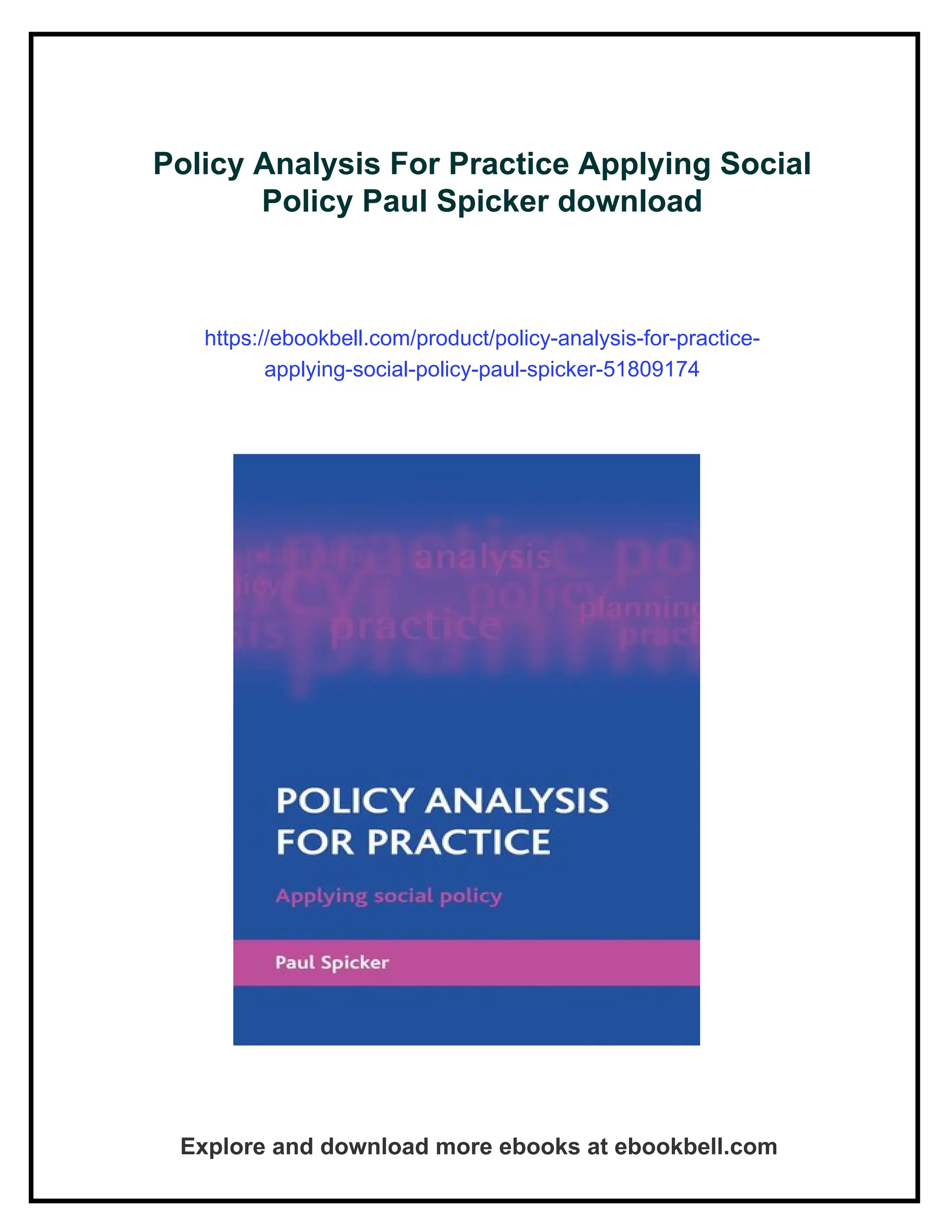

![POLICY ANALYSIS
FOR PRACTICE
Paul Spicker
Applying social policy
POLICY
ANALYSIS
FOR
PRACTICE
Paul
Spicker
“This book offers an interesting and unique approach that will appeal to
many working in the field.Written in a clear and accessible style, it will be
a valuable text not only for those involved in policy and practice, but also
for students and practitioners in health and social care.” Susan Balloch,
Professor of Health and Social Care, Health and Social Policy Research Centre,
University of Brighton, UK
People who work in planning, management and service delivery in the public
sector need to know how policy is translated into practice, what is happening,
and whether a policy works. Policy analysis for practice introduces students
and practitioners to the concepts, methods and techniques required to
undertake the analysis and review of policy and its implementation. Focusing
on developing understanding and skills for a growing area of practice, it
combines material from public and social administration with examples and
application to social policy and the social services.
The book looks at ways to understand and analyse the main stages of the
policy process: developing strategies, identifying aims, examining the
situation, choosing methods, implementation and service delivery, and
evaluating outcomes. It stresses throughout the role of policy analysis as a
political, and not just a technical, activity.
Policy analysis for practice is an original, thought-provoking text with a strong
applied focus. It offers:
• systematic, accessible coverage of wide-ranging literature;
• application to practical circumstances and the needs of people in the field;
• a direct relationship to vocational work in the management and
administration of social services.
It will be invaluable for students and practitioners in public policy, social
policy and public sector management, in fields including central and local
government, health and social care and the voluntary sector.
Paul Spicker holds the Grampian Chair of Public Policy at the Robert Gordon
University, Aberdeen and is the Director of the Centre for Public Policy and
Management.
www.policypress.org.uk
SOCIAL POLICY
Policy analysis for practice [POD].qxd 14/11/08 14:42 Page 1
www.policypress.co.uk
PolicyPress @policypress](https://image.slidesharecdn.com/25904587-250516150413-727550da/85/Policy-Analysis-For-Practice-Applying-Social-Policy-Paul-Spicker-5-320.jpg)
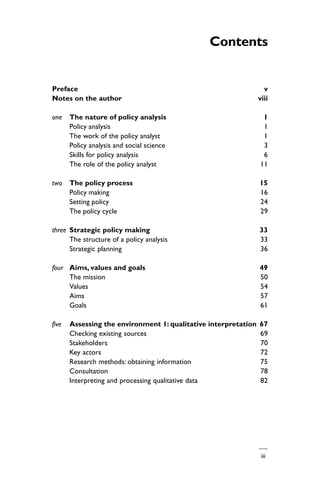
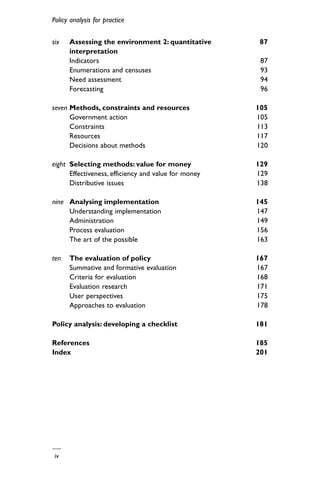
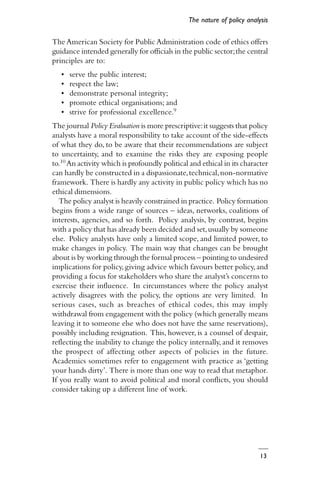

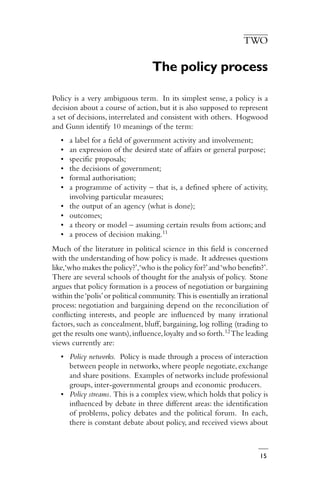
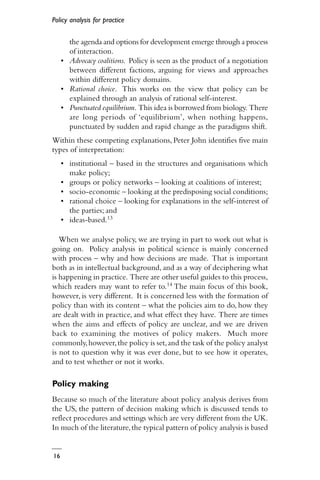
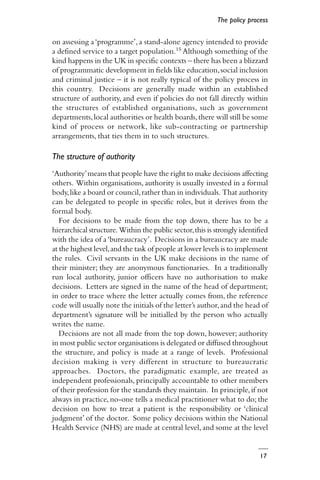
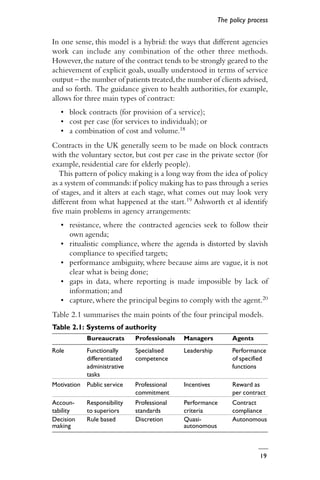
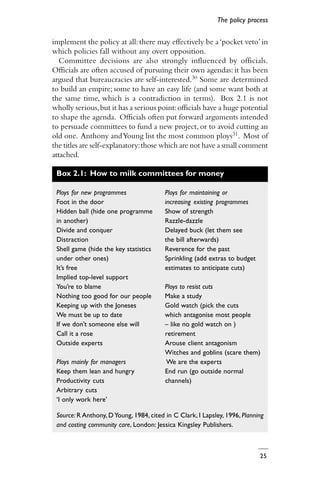
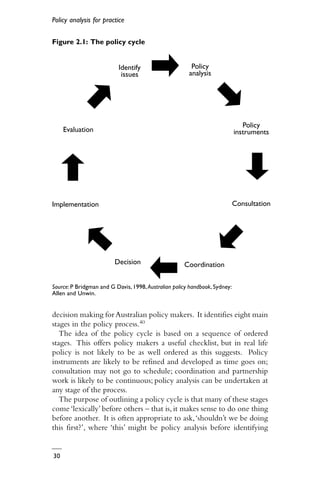

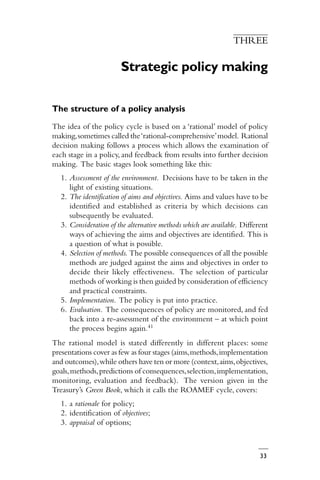
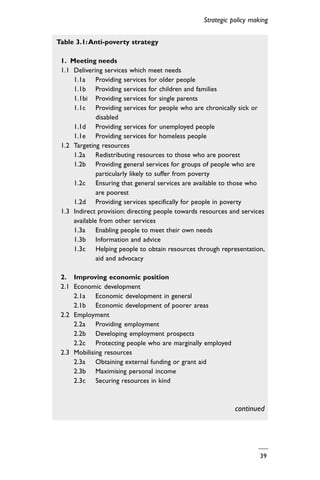
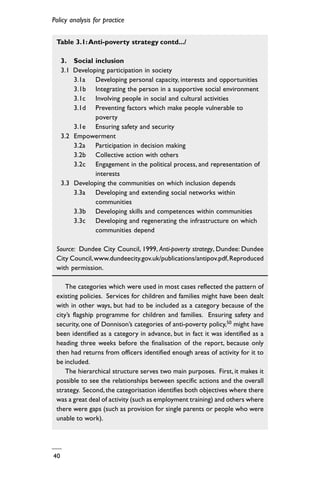
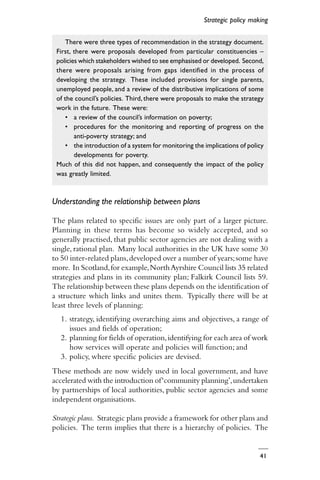









![eaux de pluie qui descendent de la colline. Ce barrage aidé de norias
que l'on pourrait faire et des sources qui existent fournirait assez
d'eau pour irriguer les cultures.
Au point de vue des moyens de communications, il y a lieu de
signaler qu'il est question depuis quelque temps de construire un
tronçon de chemin de fer qui relierait les Salins d'Hyères à Fréjus en
passant entre Bormes et le Lavandon et en cotoyant le littoral. Les
plans sont faits et la plupart des communes ont déjà voté des
subsides.
Ce chemin de fer promet un grand avenir à l'île du Levant et au
Lavandon où l'on pourrait créer une station hivernale. On viendrait
alors de Paris à l'île du Levant en moins de vingt heures sans fatigue
aucune.
Le chemin de fer passant au Lavandon, on organiserait un service
de bateaux à vapeur qui relierait deux fois par jour l'île au continent.
La traversée ne serait que de trois quarts d'heure.
Dès lors des villas se construiraient à l'île du Levant et leur nombre
s'accroissant, on ferait un casino. Cette île deviendrait la station
hivernale la plus fréquentée du littoral, car MM. les Anglais
quitteraient volontiers les stations du continent pour venir s'adonner
dans l'île du Levant à tous les plaisirs des yachtmen dont ils sont si
amateurs.
Qui vivra verra.
FOOTNOTES:
(Notes de l'auteur).
[1] Les îles d'Hyères dépendent de la ville du même nom.
[2] L'île de Bagaud que l'on ne cite pas ici a cependant 59
hectares de superficie et possède un fort.](https://image.slidesharecdn.com/25904587-250516150413-727550da/85/Policy-Analysis-For-Practice-Applying-Social-Policy-Paul-Spicker-66-320.jpg)
![[3] Cette fabrique n'existe plus à l'heure qu'il est. L'île est
défendue par 3 forts.
[4] Cette fabrique est également supprimée. Il n'en reste plus que
d'immenses ruines.
[5] C'est une erreur, de pointe à pointe il n'y a qu'une distance de
800 mètres.
[6] Des Salins d'Hyerès, cette distance n'est que de 23 kilomètres.
Le point le plus proche du continent est le Lavandon, à 14
kilomètres de l'île du Levant.
Note de transcription:
Les erreurs clairement introduites par le
typographe ont été corrigées.
Page 6: “culininant” changé à “culminant.”
“prédesseurs” → “prédécesseurs.”
“titaniate” → “titanate.” “filamentateuse” →
“filamenteuse.”
Page 7: “inculpait” → “inculquait.”
Page 10: “engence” → “engeance.”
“affimer” → “affirmer.”
Page 11: “suivent” → “suivant.” “arivée” →
“arrivée.”
Page 12: “apès → “après.” “frîmes” →
“fîmes.” “longoustes” → “langoustes.”
“oppât” → “appât.” “l'avoner” → “l’avouer.”
Page 26: “automme” → “automne.”
Page 30: “pénitentier” → “pénitencier.”
Page 31: “septentrisnales” →
“septentrionales.” “sodt> → “sont.”
Page 34: “Hypoea” → “Hypaea.”](https://image.slidesharecdn.com/25904587-250516150413-727550da/85/Policy-Analysis-For-Practice-Applying-Social-Policy-Paul-Spicker-67-320.jpg)