PRESENTED BY: MUSARRAT SHAHEEN
MARRI
ASSIGNED BY:DR.AMJAD ALI ARAIN
 INTERNATIONALISATIONVERSUS
GLOBALISATION
 ASSUMPTIONS
 DEFINITION OF INTERNATIONALIZATION
 HOW NEW IS IT?
 WORLD’S RANKING
 RATIONALES DRIVING
INTERNATIONALISATION
 INTERNATIONALISATION AND STATE OF
PAKISTAN
 INTERNATIONALISATIONTRENDS IN
PAKISATN
 RISK FACTORS IN
INTERNATIONALIZATION
 CHALLENGES IN PAKISTAN
 ACCORDINGTO GLOBAL POLICY FORUM:
Internationalization refers to the increasing importance
of international trade, international relations, treaties,
alliances, etc. International, of course, means between
or among nations. The basic unit remains the nation,
even as relations among nations become increasingly
necessary and important. Globalization refers to global
economic integration of many formerly national
economies into one global economy, mainly by free
trade and free capital mobility, but also by easy or
uncontrolled migration. It is the effective erasure of
national boundaries for economic purposes.
 The major aims of higher education institutions
(HEIs) are:
 achieving excellence in teaching, research, and
community service.
 providing solutions for national, regional, and global
most important problems.
 contributing to the development of the national capital.
 nurturing intellectual properties and patents.
 contributing to the economic and social development of
humanity including public health, improvement of
crops production, and cross-cultural and religious
understanding.
 The 21st century job market requires a technology
literate and competent workforce with the ability
to create, innovate, solve problems, and work in
teams.
 Investment in higher education is most important
and valuable as HEIs provide the world's leaders,
scientists, businessmen, physicians, thinkers, and
visionaries who chart society's cultural, scientific,
and technological future.
 "Internationalization of Higher Education
is the process of integrating an
international and intercultural dimension
into the teaching, research and service
functions of the institution“.
"(knight and DeWit, 1997).
1. 1492 - Spain and Portugal colonise S America
etc. World (oceanic) trade established
2. Late 17th Cent – 2nd European colonisation,
slave trade, trade gives over to conquest
3. Late 19th Cent – huge increase in trade, mass
migration to Americas. Last colonies fought
for. Ends with 1930s depression
4. Post WW2 – trade liberalisation, intensifies
1967 – 1980s
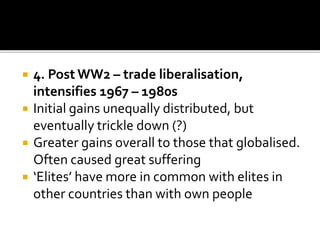
 4. Post WW2 – trade liberalisation,
intensifies 1967 – 1980s
 Initial gains unequally distributed, but
eventually trickle down (?)
 Greater gains overall to those that globalised.
Often caused great suffering
 ‘Elites’ have more in common with elites in
other countries than with own people
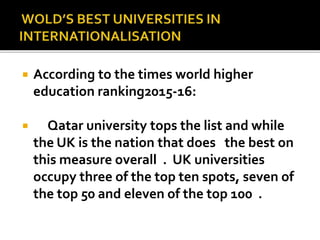
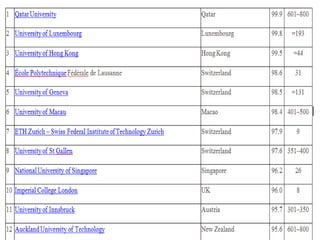
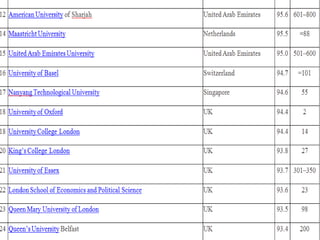
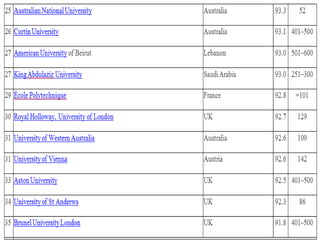
 According to the times world higher
education ranking2015-16:
 Qatar university tops the list and while
the UK is the nation that does the best on
this measure overall . UK universities
occupy three of the top ten spots, seven of
the top 50 and eleven of the top 100 .
 There are different rationales to add
internationalization dimension to
universities.
 Knight proposed: political, economic,
academic and cultural rationales for
internationalization of universities.
 POLITICAL RATIONALE : national security &
foreign policy, mutual understanding and
national identity and some other factors.
 ECONOMIC RATIONALE : in terms of long term
economic benefits in terms of exchange of
skilled human resources (economic growth,
labor market, trade etc.) or short term financial
benefits in the form of revenue generation from
international students.
 ACADEMIC RATIONALE : Academic rationale most
importantly covers the core academic activities of
teaching and research to achieve the international
standards and competitive rankings in parallel. Moreover
it covers institution building, enhancement of quality etc.
 CULTURAL RATIONALE: Cultural rationale highlights
more on cultural and language dimensions of
internationalization so students are offered scholarships
to visit other countries for education and exchange of
cultural norms in parallel. It also focuses on cross-cultural
understanding, social development, citizenship and
community development.
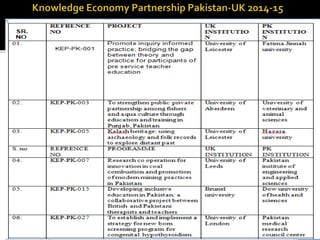
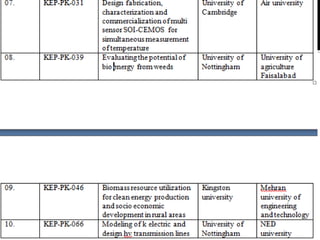
 More than 76 UK universities have formal
partnerships or long-term agreements with
Pakistani higher education institutions. 98
percent of all Pakistani vice-chancellors and
rectors have received leadership training in
the UK since 2010, which has allowed them
to form relationships with the UK.
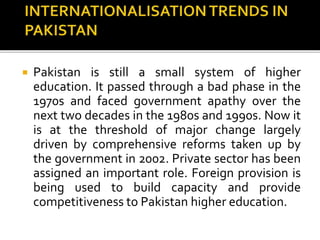
 Pakistan is still a small system of higher
education. It passed through a bad phase in the
1970s and faced government apathy over the
next two decades in the 1980s and 1990s. Now it
is at the threshold of major change largely
driven by comprehensive reforms taken up by
the government in 2002. Private sector has been
assigned an important role. Foreign provision is
being used to build capacity and provide
competitiveness to Pakistan higher education.
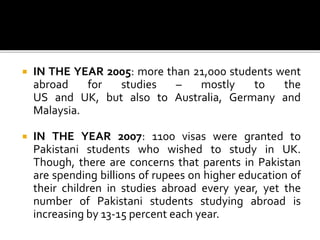
 IN THE YEAR 2005: more than 21,000 students went
abroad for studies – mostly to the
US and UK, but also to Australia, Germany and
Malaysia.
 IN THE YEAR 2007: 1100 visas were granted to
Pakistani students who wished to study in UK.
Though, there are concerns that parents in Pakistan
are spending billions of rupees on higher education of
their children in studies abroad every year, yet the
number of Pakistani students studying abroad is
increasing by 13-15 percent each year.
 IN THE YEAR 2008: Under the Foreign Faculty Hiring
Program, 270 foreign teachers with 140 of them for a long-
term from one to five years were hired for universities in
Pakistan (Rahman,2008). with these highly qualified
people, who worked for most of their lives in
Technologically advanced countries returning to join
universities in Pakistan, "brain drain" has been
transformed into a "brain gain" for Pakistan.
 There is a large variety of collaborative programes for
higher education in Pakistan. Not all of them have explicit
approvals. Currently only 8 foreign universities /
Institutions have been approved to run collaborative
degree programs in Pakistan. This does not include
programes run by ‘top-ranked’ universities.
Several of the collaborative programes are in the area
of business studies.
 The International School of Management Sciences,
which is affiliated with Newport University in the USA,
has three campuses in Pakistan one each in Karachi,
Lahore and Rawalpindi and offer bachelors and
masters level programes in business studies
 The City College of Higher Education in Karachi also
offers undergraduate programs with one year of study
in Karachi and the subsequent two years in Britain.
The College claims an affiliation with twelve British
Universities.
 Institute of Business Administration and Technology which
claims an affiliation with Adamson University, offers MBA
program in marketing management, finance a human resource
management, production management and its degree is
awarded by Adamson University in Manila.
 International University of America which claimed to be a local
campus of the same University based in Canada, School of
Business and Commerce which is affiliated with Preston
University. Preston University is more than 14 years old in the
country and operates two campuses in the city at present
beside other campuses in Islamabad, Rawalpindi, Lahore,
Peshawar and Hyderabad.
 commercialization and co
modification
 Low quality of degrees.
 Brain drain
 Acculturation
 Worst situation of law and order
 Low learning outcome
 Weak foreign relations
 Corruption
 Lack of good governance
 www.saneinetwork.net/Files/08_07.pdf
 www.philadelphia.edu.jo/.../Internationalisation_of_Higher_Edu
cation.ppt
 https://www.britishcouncil.pk/programmes/education/higher-
educationN
 https://www.timeshighereducation.com/.../200-most-
international-universities -world-2016.
 www.ncl.ac.uk/.../NUTLseminarfinal_SueRobson_AlinaSchartner.
pptx
 . http://universityoutlook.com/topics/international/defining-
internationalization-vs-globalization-within-higher-education
 www.qurtuba.edu.pk/.../Dialogue_October_December2015_37
8-389.pdf
Higher Education and Internationalization

Higher Education and Internationalization

  • 1.
    PRESENTED BY: MUSARRATSHAHEEN MARRI ASSIGNED BY:DR.AMJAD ALI ARAIN
  • 2.
     INTERNATIONALISATIONVERSUS GLOBALISATION  ASSUMPTIONS DEFINITION OF INTERNATIONALIZATION  HOW NEW IS IT?  WORLD’S RANKING
  • 3.
     RATIONALES DRIVING INTERNATIONALISATION INTERNATIONALISATION AND STATE OF PAKISTAN  INTERNATIONALISATIONTRENDS IN PAKISATN  RISK FACTORS IN INTERNATIONALIZATION  CHALLENGES IN PAKISTAN
  • 4.
     ACCORDINGTO GLOBALPOLICY FORUM: Internationalization refers to the increasing importance of international trade, international relations, treaties, alliances, etc. International, of course, means between or among nations. The basic unit remains the nation, even as relations among nations become increasingly necessary and important. Globalization refers to global economic integration of many formerly national economies into one global economy, mainly by free trade and free capital mobility, but also by easy or uncontrolled migration. It is the effective erasure of national boundaries for economic purposes.
  • 5.
     The majoraims of higher education institutions (HEIs) are:  achieving excellence in teaching, research, and community service.  providing solutions for national, regional, and global most important problems.  contributing to the development of the national capital.  nurturing intellectual properties and patents.  contributing to the economic and social development of humanity including public health, improvement of crops production, and cross-cultural and religious understanding.
  • 6.
     The 21stcentury job market requires a technology literate and competent workforce with the ability to create, innovate, solve problems, and work in teams.  Investment in higher education is most important and valuable as HEIs provide the world's leaders, scientists, businessmen, physicians, thinkers, and visionaries who chart society's cultural, scientific, and technological future.
  • 7.
     "Internationalization ofHigher Education is the process of integrating an international and intercultural dimension into the teaching, research and service functions of the institution“. "(knight and DeWit, 1997).
  • 9.
    1. 1492 -Spain and Portugal colonise S America etc. World (oceanic) trade established 2. Late 17th Cent – 2nd European colonisation, slave trade, trade gives over to conquest 3. Late 19th Cent – huge increase in trade, mass migration to Americas. Last colonies fought for. Ends with 1930s depression 4. Post WW2 – trade liberalisation, intensifies 1967 – 1980s
  • 10.
     4. PostWW2 – trade liberalisation, intensifies 1967 – 1980s  Initial gains unequally distributed, but eventually trickle down (?)  Greater gains overall to those that globalised. Often caused great suffering  ‘Elites’ have more in common with elites in other countries than with own people
  • 11.
     According tothe times world higher education ranking2015-16:  Qatar university tops the list and while the UK is the nation that does the best on this measure overall . UK universities occupy three of the top ten spots, seven of the top 50 and eleven of the top 100 .
  • 15.
     There aredifferent rationales to add internationalization dimension to universities.  Knight proposed: political, economic, academic and cultural rationales for internationalization of universities.
  • 16.
     POLITICAL RATIONALE: national security & foreign policy, mutual understanding and national identity and some other factors.  ECONOMIC RATIONALE : in terms of long term economic benefits in terms of exchange of skilled human resources (economic growth, labor market, trade etc.) or short term financial benefits in the form of revenue generation from international students.
  • 17.
     ACADEMIC RATIONALE: Academic rationale most importantly covers the core academic activities of teaching and research to achieve the international standards and competitive rankings in parallel. Moreover it covers institution building, enhancement of quality etc.  CULTURAL RATIONALE: Cultural rationale highlights more on cultural and language dimensions of internationalization so students are offered scholarships to visit other countries for education and exchange of cultural norms in parallel. It also focuses on cross-cultural understanding, social development, citizenship and community development.
  • 18.
     More than76 UK universities have formal partnerships or long-term agreements with Pakistani higher education institutions. 98 percent of all Pakistani vice-chancellors and rectors have received leadership training in the UK since 2010, which has allowed them to form relationships with the UK.
  • 21.
     Pakistan isstill a small system of higher education. It passed through a bad phase in the 1970s and faced government apathy over the next two decades in the 1980s and 1990s. Now it is at the threshold of major change largely driven by comprehensive reforms taken up by the government in 2002. Private sector has been assigned an important role. Foreign provision is being used to build capacity and provide competitiveness to Pakistan higher education.
  • 22.
     IN THEYEAR 2005: more than 21,000 students went abroad for studies – mostly to the US and UK, but also to Australia, Germany and Malaysia.  IN THE YEAR 2007: 1100 visas were granted to Pakistani students who wished to study in UK. Though, there are concerns that parents in Pakistan are spending billions of rupees on higher education of their children in studies abroad every year, yet the number of Pakistani students studying abroad is increasing by 13-15 percent each year.
  • 23.
     IN THEYEAR 2008: Under the Foreign Faculty Hiring Program, 270 foreign teachers with 140 of them for a long- term from one to five years were hired for universities in Pakistan (Rahman,2008). with these highly qualified people, who worked for most of their lives in Technologically advanced countries returning to join universities in Pakistan, "brain drain" has been transformed into a "brain gain" for Pakistan.  There is a large variety of collaborative programes for higher education in Pakistan. Not all of them have explicit approvals. Currently only 8 foreign universities / Institutions have been approved to run collaborative degree programs in Pakistan. This does not include programes run by ‘top-ranked’ universities.
  • 24.
    Several of thecollaborative programes are in the area of business studies.  The International School of Management Sciences, which is affiliated with Newport University in the USA, has three campuses in Pakistan one each in Karachi, Lahore and Rawalpindi and offer bachelors and masters level programes in business studies  The City College of Higher Education in Karachi also offers undergraduate programs with one year of study in Karachi and the subsequent two years in Britain. The College claims an affiliation with twelve British Universities.
  • 25.
     Institute ofBusiness Administration and Technology which claims an affiliation with Adamson University, offers MBA program in marketing management, finance a human resource management, production management and its degree is awarded by Adamson University in Manila.  International University of America which claimed to be a local campus of the same University based in Canada, School of Business and Commerce which is affiliated with Preston University. Preston University is more than 14 years old in the country and operates two campuses in the city at present beside other campuses in Islamabad, Rawalpindi, Lahore, Peshawar and Hyderabad.
  • 26.
     commercialization andco modification  Low quality of degrees.  Brain drain  Acculturation
  • 27.
     Worst situationof law and order  Low learning outcome  Weak foreign relations  Corruption  Lack of good governance
  • 28.
     www.saneinetwork.net/Files/08_07.pdf  www.philadelphia.edu.jo/.../Internationalisation_of_Higher_Edu cation.ppt https://www.britishcouncil.pk/programmes/education/higher- educationN  https://www.timeshighereducation.com/.../200-most- international-universities -world-2016.  www.ncl.ac.uk/.../NUTLseminarfinal_SueRobson_AlinaSchartner. pptx  . http://universityoutlook.com/topics/international/defining- internationalization-vs-globalization-within-higher-education  www.qurtuba.edu.pk/.../Dialogue_October_December2015_37 8-389.pdf