UNIT OPERATIONS &
UNIT PROCESS
INTRODUCTION
• NAME:
• EDUCTION:
• HOMETOWN:
• HOBBIES IF ANY:
CONTENTS
• MAKING SENSE OF PROCESS TECHNOLOGY
• UNIT OPERATIONS IN CHEMICAL INDUSTRY
• UNIT PROCESSES IN CHEMICAL INDUSTRY
Learning Objectives
• Difference between unit processes & unit operations.
• Unit operations in chemical industry
• Unit processes in chemical industry.
Making Sense Of Process
Technology
Making Sense of Process Technology
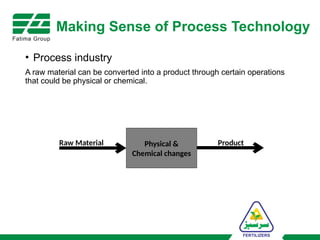
• Process industry
A raw material can be converted into a product through certain operations
that could be physical or chemical.
Physical &
Chemical changes
Raw Material Product
Making Sense of Process Technology
• Differentiating physical & chemical changes
• Combustion of Wood
• Combustion of Natural Gas
• Rusting of Iron
• Drying
• Heating
• Cooling
• Crushing of stones
• Separation
• Distillation
Making Sense of Process Technology
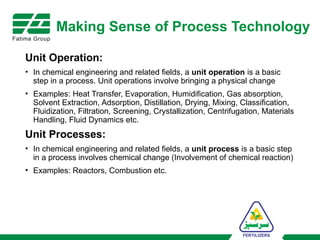
Unit Operation:
• In chemical engineering and related fields, a unit operation is a basic
step in a process. Unit operations involve bringing a physical change
• Examples: Heat Transfer, Evaporation, Humidification, Gas absorption,
Solvent Extraction, Adsorption, Distillation, Drying, Mixing, Classification,
Fluidization, Filtration, Screening, Crystallization, Centrifugation, Materials
Handling, Fluid Dynamics etc.
Unit Processes:
• In chemical engineering and related fields, a unit process is a basic step
in a process involves chemical change (Involvement of chemical reaction)
• Examples: Reactors, Combustion etc.
Making Sense of Process Technology
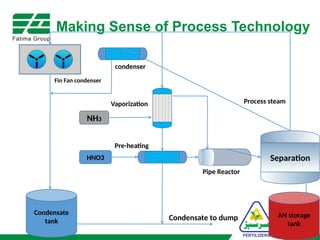
HNO3
NH3
Pre-heating
Vaporization
Separation
AN storage
tank
condenser
Condensate
tank
Pipe Reactor
Fin Fan condenser
Condensate to dump
Process steam
Making Sense of Process Technology
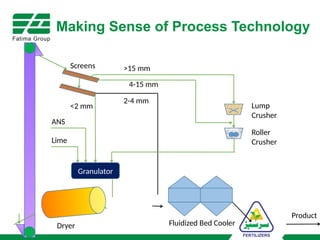
Granulator
Dryer Fluidized Bed Cooler
Screens
Lime
ANS
Lump
Crusher
Roller
Crusher
>15 mm
4-15 mm
2-4 mm
Product
<2 mm
Unit Operations
Unit Operations
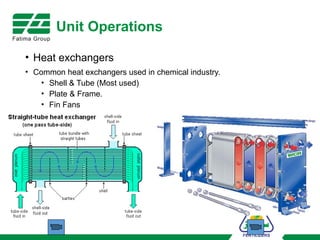
• Heat exchangers
• A heat exchanger is a system used to transfer heat between two or
more fluids. Heat exchangers are used in both cooling and heating
processes.
• Why there is need to heat or cool reactants and/or products.
• control of process conditions (reactor jacketing's)
• recovery of process heat
• to effect phase change (Evaporation)
• Modes of heat transfer
• Conduction
• Convection
• Radiation
Unit Operations
• Heat exchangers
• Common heat exchangers used in chemical industry.
• Shell & Tube (Most used)
• Plate & Frame.
• Fin Fans
Unit Operations
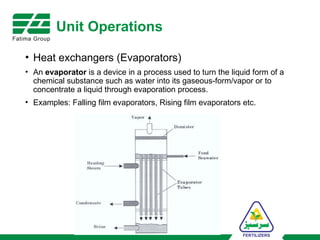
• Heat exchangers (Evaporators)
• An evaporator is a device in a process used to turn the liquid form of a
chemical substance such as water into its gaseous-form/vapor or to
concentrate a liquid through evaporation process.
• Examples: Falling film evaporators, Rising film evaporators etc.
Unit Operations
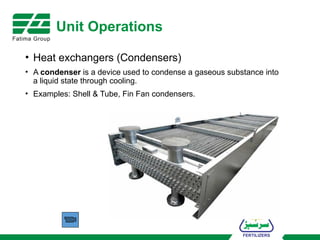
• Heat exchangers (Condensers)
• A condenser is a device used to condense a gaseous substance into
a liquid state through cooling.
• Examples: Shell & Tube, Fin Fan condensers.
Unit Operations
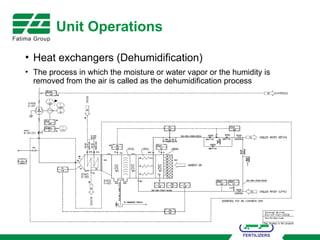
• Heat exchangers (Dehumidification)
• The process in which the moisture or water vapor or the humidity is
removed from the air is called as the dehumidification process
Unit Operations
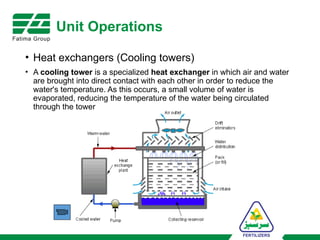
• Heat exchangers (Cooling towers)
• A cooling tower is a specialized heat exchanger in which air and water
are brought into direct contact with each other in order to reduce the
water's temperature. As this occurs, a small volume of water is
evaporated, reducing the temperature of the water being circulated
through the tower
Unit Operations
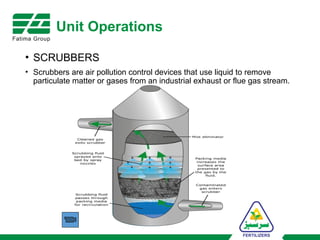
• SCRUBBERS
• Scrubbers are air pollution control devices that use liquid to remove
particulate matter or gases from an industrial exhaust or flue gas stream.
Unit Operations
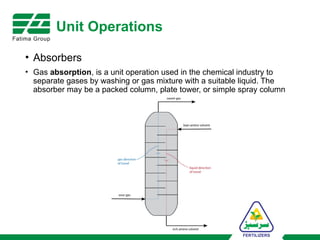
• Absorbers
• Gas absorption, is a unit operation used in the chemical industry to
separate gases by washing or gas mixture with a suitable liquid. The
absorber may be a packed column, plate tower, or simple spray column
Unit Operations
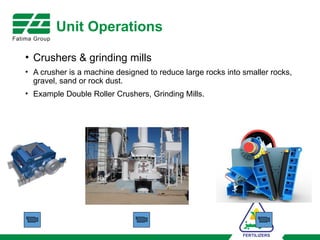
• Crushers & grinding mills
• A crusher is a machine designed to reduce large rocks into smaller rocks,
gravel, sand or rock dust.
• Example Double Roller Crushers, Grinding Mills.
Unit Operations
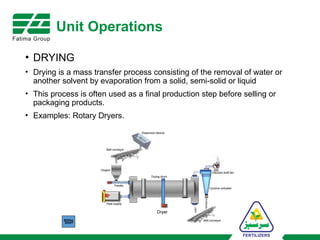
• DRYING
• Drying is a mass transfer process consisting of the removal of water or
another solvent by evaporation from a solid, semi-solid or liquid
• This process is often used as a final production step before selling or
packaging products.
• Examples: Rotary Dryers.
Unit Operations
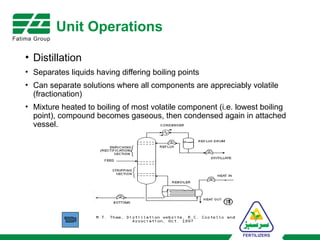
• Distillation
• Separates liquids having differing boiling points
• Can separate solutions where all components are appreciably volatile
(fractionation)
• Mixture heated to boiling of most volatile component (i.e. lowest boiling
point), compound becomes gaseous, then condensed again in attached
vessel.
Unit Operations
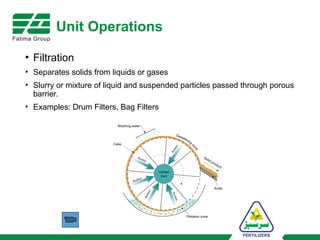
• Filtration
• Separates solids from liquids or gases
• Slurry or mixture of liquid and suspended particles passed through porous
barrier.
• Examples: Drum Filters, Bag Filters
Unit Operations
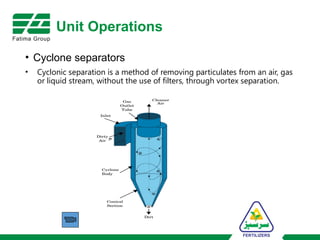
• Cyclone separators
• Cyclonic separation is a method of removing particulates from an air, gas
or liquid stream, without the use of filters, through vortex separation.
Unit Operations
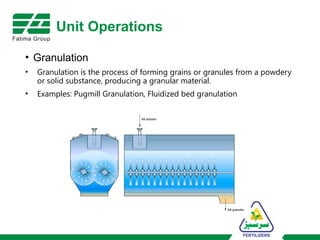
• Granulation
• Granulation is the process of forming grains or granules from a powdery
or solid substance, producing a granular material.
• Examples: Pugmill Granulation, Fluidized bed granulation
Unit Operations
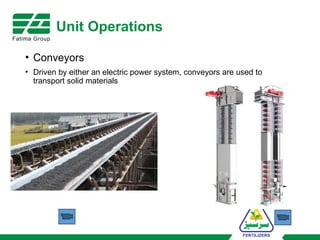
• Conveyors
• Driven by either an electric power system, conveyors are used to
transport solid materials
Unit Operations
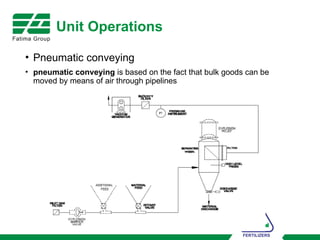
• Pneumatic conveying
• pneumatic conveying is based on the fact that bulk goods can be
moved by means of air through pipelines
Unit Process
Unit Processes
• Introduction to reactors
• Reactor is the heart of Chemical Process.
• A vessel designed to contain chemical reactions is called a reactor
• An industrial reactor is a complex chemical device in which heat transfer,
mass transfer, diffusion and friction may occur along with chemical with
the provisions of safety and controls
Unit Processes
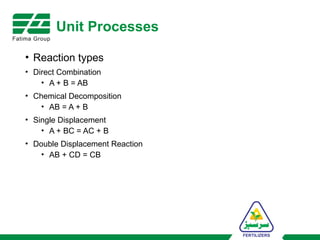
• Reaction types
• Direct Combination
• A + B = AB
• Chemical Decomposition
• AB = A + B
• Single Displacement
• A + BC = AC + B
• Double Displacement Reaction
• AB + CD = CB
Unit Processes
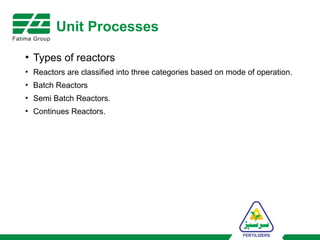
• Types of reactors
• Reactors are classified into three categories based on mode of operation.
• Batch Reactors
• Semi Batch Reactors.
• Continues Reactors.
Unit Processes
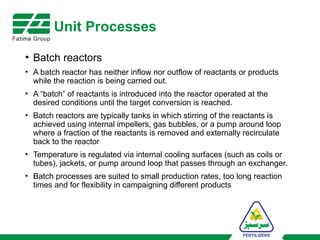
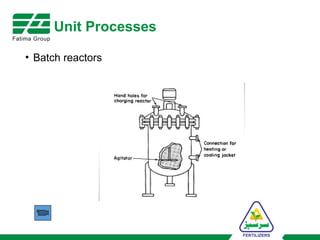
• Batch reactors
• A batch reactor has neither inflow nor outflow of reactants or products
while the reaction is being carried out.
• A “batch” of reactants is introduced into the reactor operated at the
desired conditions until the target conversion is reached.
• Batch reactors are typically tanks in which stirring of the reactants is
achieved using internal impellers, gas bubbles, or a pump around loop
where a fraction of the reactants is removed and externally recirculate
back to the reactor
• Temperature is regulated via internal cooling surfaces (such as coils or
tubes), jackets, or pump around loop that passes through an exchanger.
• Batch processes are suited to small production rates, too long reaction
times and for flexibility in campaigning different products
Unit Processes
• Batch reactors
Unit Processes
• Continues reactors
• Reactants are added and products removed continuously at a constant
mass flow rate. Large daily production rates are mostly conducted in
continuous equipment.
• Types of continues reactors
• CSTR
• Plug Flow Reactor (Pipe Reactors)
Unit Processes
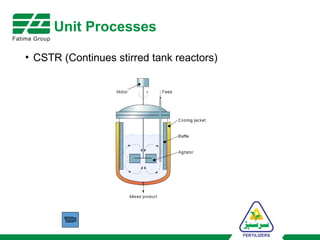
• CSTR (Continues stirred tank reactors)
• A continuous stirred tank reactor (CSTR) is a vessel to which reactants
are added and products removed while the contents within the vessel are
vigorously stirred using internal agitation or by internally (or externally)
recycling the contents.
• Residence time – average amount of time a discrete quantity of reagents
spend inside the tank
• Residence time = Volumetric flow rate/Volume of Tank
• At steady state, the flow rate in must be equal the mass flow rate out.
• Continuous stirred-tank reactors are most commonly used in industrial
processing, primarily in homogeneous liquid-phase flow reactions, where
constant agitation is required. They may be used by themselves, in
series, or in a battery.
Unit Processes
• CSTR (Continues stirred tank reactors)
Unit Processes
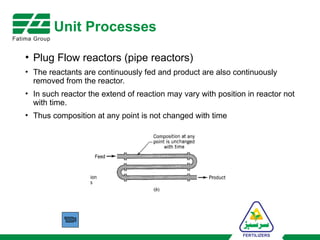
• Plug Flow reactors (pipe reactors)
• The reactants are continuously fed and product are also continuously
removed from the reactor.
• In such reactor the extend of reaction may vary with position in reactor not
with time.
• Thus composition at any point is not changed with time
Unit Processes
• Semi batch reactors
• Some of the reactants are loaded into the reactor, and the rest of the
reactants are fed gradually. Alternatively, one reactant is loaded into the
reactor, and the other reactant is fed continuously.
• Once the reactor is full, it may be operated in a batch mode to complete
the reaction. Semi-batch reactors are especially favored when there are
large heat effects and heat-transfer capability is limited. Exothermic
reactions may be slowed down and endothermic reaction controlled by
limiting reactant concentration.
Unit Processes
Unit Processes

Unit Operations & Unit Process for process plant

  • 1.
  • 2.
    INTRODUCTION • NAME: • EDUCTION: •HOMETOWN: • HOBBIES IF ANY:
  • 3.
    CONTENTS • MAKING SENSEOF PROCESS TECHNOLOGY • UNIT OPERATIONS IN CHEMICAL INDUSTRY • UNIT PROCESSES IN CHEMICAL INDUSTRY
  • 4.
    Learning Objectives • Differencebetween unit processes & unit operations. • Unit operations in chemical industry • Unit processes in chemical industry.
  • 5.
    Making Sense OfProcess Technology
  • 6.
    Making Sense ofProcess Technology • Process industry A raw material can be converted into a product through certain operations that could be physical or chemical. Physical & Chemical changes Raw Material Product
  • 7.
    Making Sense ofProcess Technology • Differentiating physical & chemical changes • Combustion of Wood • Combustion of Natural Gas • Rusting of Iron • Drying • Heating • Cooling • Crushing of stones • Separation • Distillation
  • 8.
    Making Sense ofProcess Technology Unit Operation: • In chemical engineering and related fields, a unit operation is a basic step in a process. Unit operations involve bringing a physical change • Examples: Heat Transfer, Evaporation, Humidification, Gas absorption, Solvent Extraction, Adsorption, Distillation, Drying, Mixing, Classification, Fluidization, Filtration, Screening, Crystallization, Centrifugation, Materials Handling, Fluid Dynamics etc. Unit Processes: • In chemical engineering and related fields, a unit process is a basic step in a process involves chemical change (Involvement of chemical reaction) • Examples: Reactors, Combustion etc.
  • 9.
    Making Sense ofProcess Technology HNO3 NH3 Pre-heating Vaporization Separation AN storage tank condenser Condensate tank Pipe Reactor Fin Fan condenser Condensate to dump Process steam
  • 10.
    Making Sense ofProcess Technology Granulator Dryer Fluidized Bed Cooler Screens Lime ANS Lump Crusher Roller Crusher >15 mm 4-15 mm 2-4 mm Product <2 mm
  • 11.
  • 12.
    Unit Operations • Heatexchangers • A heat exchanger is a system used to transfer heat between two or more fluids. Heat exchangers are used in both cooling and heating processes. • Why there is need to heat or cool reactants and/or products. • control of process conditions (reactor jacketing's) • recovery of process heat • to effect phase change (Evaporation) • Modes of heat transfer • Conduction • Convection • Radiation
  • 13.
    Unit Operations • Heatexchangers • Common heat exchangers used in chemical industry. • Shell & Tube (Most used) • Plate & Frame. • Fin Fans
  • 14.
    Unit Operations • Heatexchangers (Evaporators) • An evaporator is a device in a process used to turn the liquid form of a chemical substance such as water into its gaseous-form/vapor or to concentrate a liquid through evaporation process. • Examples: Falling film evaporators, Rising film evaporators etc.
  • 15.
    Unit Operations • Heatexchangers (Condensers) • A condenser is a device used to condense a gaseous substance into a liquid state through cooling. • Examples: Shell & Tube, Fin Fan condensers.
  • 16.
    Unit Operations • Heatexchangers (Dehumidification) • The process in which the moisture or water vapor or the humidity is removed from the air is called as the dehumidification process
  • 17.
    Unit Operations • Heatexchangers (Cooling towers) • A cooling tower is a specialized heat exchanger in which air and water are brought into direct contact with each other in order to reduce the water's temperature. As this occurs, a small volume of water is evaporated, reducing the temperature of the water being circulated through the tower
  • 18.
    Unit Operations • SCRUBBERS •Scrubbers are air pollution control devices that use liquid to remove particulate matter or gases from an industrial exhaust or flue gas stream.
  • 19.
    Unit Operations • Absorbers •Gas absorption, is a unit operation used in the chemical industry to separate gases by washing or gas mixture with a suitable liquid. The absorber may be a packed column, plate tower, or simple spray column
  • 20.
    Unit Operations • Crushers& grinding mills • A crusher is a machine designed to reduce large rocks into smaller rocks, gravel, sand or rock dust. • Example Double Roller Crushers, Grinding Mills.
  • 21.
    Unit Operations • DRYING •Drying is a mass transfer process consisting of the removal of water or another solvent by evaporation from a solid, semi-solid or liquid • This process is often used as a final production step before selling or packaging products. • Examples: Rotary Dryers.
  • 22.
    Unit Operations • Distillation •Separates liquids having differing boiling points • Can separate solutions where all components are appreciably volatile (fractionation) • Mixture heated to boiling of most volatile component (i.e. lowest boiling point), compound becomes gaseous, then condensed again in attached vessel.
  • 23.
    Unit Operations • Filtration •Separates solids from liquids or gases • Slurry or mixture of liquid and suspended particles passed through porous barrier. • Examples: Drum Filters, Bag Filters
  • 24.
    Unit Operations • Cycloneseparators • Cyclonic separation is a method of removing particulates from an air, gas or liquid stream, without the use of filters, through vortex separation.
  • 25.
    Unit Operations • Granulation •Granulation is the process of forming grains or granules from a powdery or solid substance, producing a granular material. • Examples: Pugmill Granulation, Fluidized bed granulation
  • 26.
    Unit Operations • Conveyors •Driven by either an electric power system, conveyors are used to transport solid materials
  • 27.
    Unit Operations • Pneumaticconveying • pneumatic conveying is based on the fact that bulk goods can be moved by means of air through pipelines
  • 28.
  • 29.
    Unit Processes • Introductionto reactors • Reactor is the heart of Chemical Process. • A vessel designed to contain chemical reactions is called a reactor • An industrial reactor is a complex chemical device in which heat transfer, mass transfer, diffusion and friction may occur along with chemical with the provisions of safety and controls
  • 30.
    Unit Processes • Reactiontypes • Direct Combination • A + B = AB • Chemical Decomposition • AB = A + B • Single Displacement • A + BC = AC + B • Double Displacement Reaction • AB + CD = CB
  • 31.
    Unit Processes • Typesof reactors • Reactors are classified into three categories based on mode of operation. • Batch Reactors • Semi Batch Reactors. • Continues Reactors.
  • 32.
    Unit Processes • Batchreactors • A batch reactor has neither inflow nor outflow of reactants or products while the reaction is being carried out. • A “batch” of reactants is introduced into the reactor operated at the desired conditions until the target conversion is reached. • Batch reactors are typically tanks in which stirring of the reactants is achieved using internal impellers, gas bubbles, or a pump around loop where a fraction of the reactants is removed and externally recirculate back to the reactor • Temperature is regulated via internal cooling surfaces (such as coils or tubes), jackets, or pump around loop that passes through an exchanger. • Batch processes are suited to small production rates, too long reaction times and for flexibility in campaigning different products
  • 33.
  • 34.
    Unit Processes • Continuesreactors • Reactants are added and products removed continuously at a constant mass flow rate. Large daily production rates are mostly conducted in continuous equipment. • Types of continues reactors • CSTR • Plug Flow Reactor (Pipe Reactors)
  • 35.
    Unit Processes • CSTR(Continues stirred tank reactors) • A continuous stirred tank reactor (CSTR) is a vessel to which reactants are added and products removed while the contents within the vessel are vigorously stirred using internal agitation or by internally (or externally) recycling the contents. • Residence time – average amount of time a discrete quantity of reagents spend inside the tank • Residence time = Volumetric flow rate/Volume of Tank • At steady state, the flow rate in must be equal the mass flow rate out. • Continuous stirred-tank reactors are most commonly used in industrial processing, primarily in homogeneous liquid-phase flow reactions, where constant agitation is required. They may be used by themselves, in series, or in a battery.
  • 36.
    Unit Processes • CSTR(Continues stirred tank reactors)
  • 37.
    Unit Processes • PlugFlow reactors (pipe reactors) • The reactants are continuously fed and product are also continuously removed from the reactor. • In such reactor the extend of reaction may vary with position in reactor not with time. • Thus composition at any point is not changed with time
  • 38.
    Unit Processes • Semibatch reactors • Some of the reactants are loaded into the reactor, and the rest of the reactants are fed gradually. Alternatively, one reactant is loaded into the reactor, and the other reactant is fed continuously. • Once the reactor is full, it may be operated in a batch mode to complete the reaction. Semi-batch reactors are especially favored when there are large heat effects and heat-transfer capability is limited. Exothermic reactions may be slowed down and endothermic reaction controlled by limiting reactant concentration.
  • 39.
  • 40.