A STUDY ON COVECTION
    HEAT TRANSFER
  Prepared for:
  Dr. Mohammad Abu Taher
  Department of mathematics
  Dhaka University of Engineering and Technology, (DUET)
  Gajipur, Dhaka.
  E-mail: tahermath@yahoo.com, tahermath@duet.ac.bd


  Prepared by:
  Khairuzzaman Mamun
  ID No :112701P
  Contact no : 01761808592
  Email : kpmmamun@gmail.com


  Presentation Date: 05-09-2012
LETTER OF TRANSMITTAL

September 05, 2012

Dr. Mohammad Abu Taher
Department of mathematics
Dhaka University of Engineering and Technology, (DUET)
Gajipur, Dhaka.

Dear sir
Here is the report that you asked us to conduct on August 30, 2012 on A Study on Convection Heat
Transfer.
This study focused on different types of discussion and result about the Convection Heat Transfer
I will be pleased if you have any further query for this you can call me at your convenient time and
place.
Sincerely yours,

Khairuzzaman Mamun
ID No : 112701P
Contact no : 01761808592
Email : kpmmamun@gmail.com
OBJECTIVES


Energy can exist in numerical forms such as thermal, mechanical, kinetic, potential, electrical, magnetic, chemical, and
nuclear their sum constitutes the total energy E (or e on a unit mass basis) of a system. The forms of energy related to
the molecular structure of a system and the degree of the molecular activity are referred to as the microscopic energy.
The sum of all microscopic form of energy is called the internal energy of a system, and is denoted by U.
Thermal energy is the sensible and latent forms of internal energy, and it is referred to as heat in daily life. The basic
mechanism of heat transfer are the heat conduction, heat convection, heat radiation.


This study aimed to analyze the Convection Heat Transfer and to discuss about heat transfer, classification of heat
transfer, definition and mathematical explanation convection heat transfer, causes of convection heat transfer in the
point of mathematical views. At the end, some example of convection process are described.
SEQUENCE OF CONTENTS


    Introduction
    Classification
    Definition & mathematical explanation of convection heat transfer
    Causes of convection heat transfer in the mathematical point of views
    Some Example of Convection Process
    Conclusion
          INTRODUCTION


The transfer of heat is normally from a high temperature object to a lower temperature object. Heat transfer changes
the internal energy of both systems involved according to the First Law of Thermodynamics. The mechanism of heat
transfer are conduction, convection, and radiation.
Conduction is the transfer of energy from the more energetic particles of a substance to the adjacent less energetic ones
as a result of interactions between the particles.

Convection is the mode of energy transfer between a solid surface and the adjacent liquid or gas which is in motion,
and it involves combined effects of conduction and fluid motion.

Radiation is energy emitted by matter in the form of electromagnetic waves as a result of the changes in the electronic
configurations of the atoms or molecules.
   CLASSIFICATION

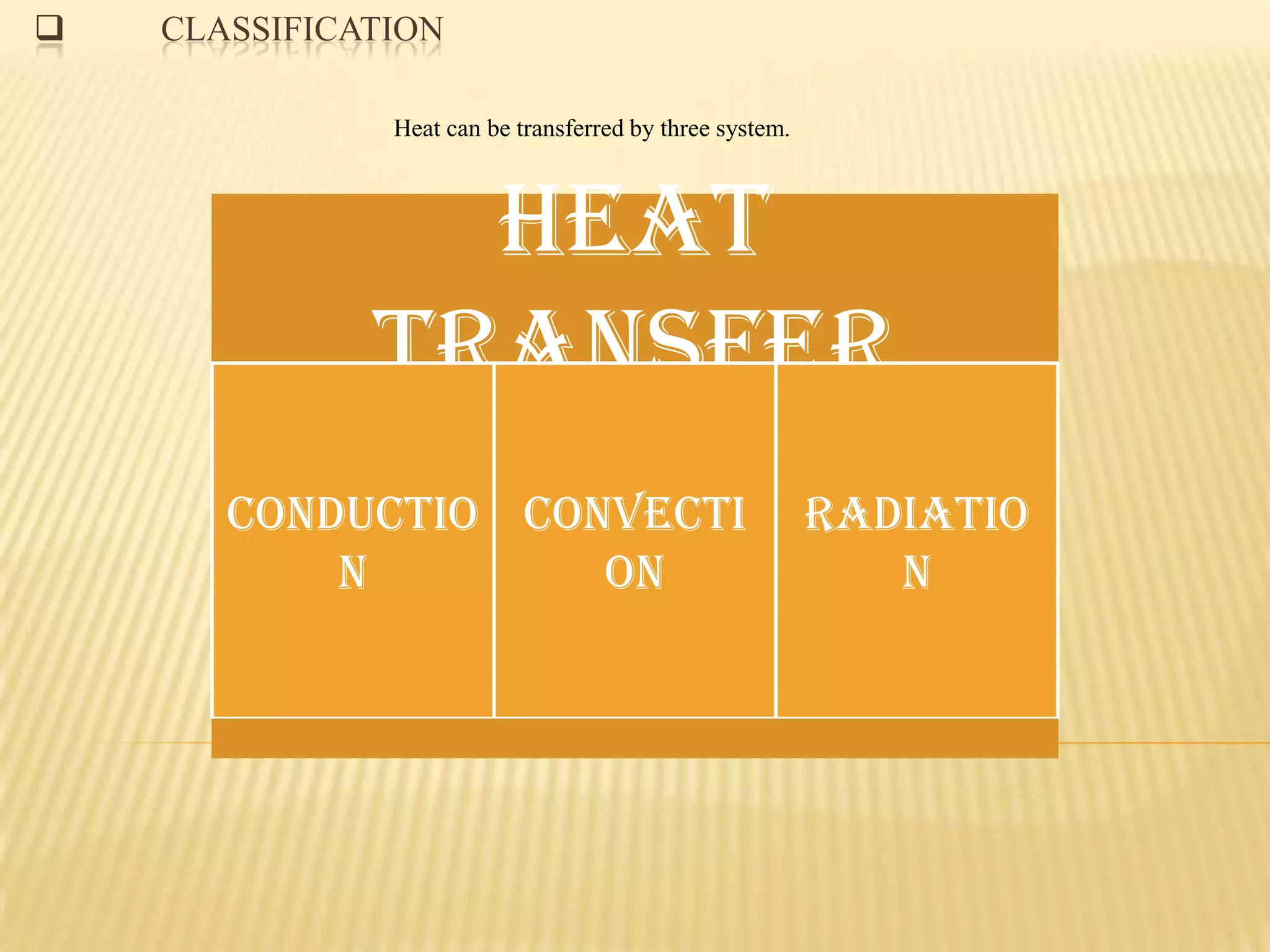
               Heat can be transferred by three system.


                Heat
              Transfer
       Conductio Convecti                                 Radiatio
           n        on                                       n
 DEFINITION & MATHEMATICAL EXPLANATION OF CONVECTION HEAT
TRANSFER
Convection is the mode of energy transfer between a solid surface and the adjacent liquid or gas that is in
motion, and it involves the combined effects of conduction and fluid motion, the greater the convection heat
transfer. In the absence of any bulk fluid motion, heat transfer between a solid surface and the adjacent fluid
is by pure conduction. The presence of bulk motion of the fluid enhances the heat transfer between the solid
surface and the fluid, but it also complicates the determination of heat transfer rates.

Consider the cooling of a hot block by the blowing cool air over its top surface. Heat is transferred to the air
layer adjacent to the block by conduction. This heat is then carried away from the surface by convection, that
is, by the combined effects of conduction within the air that is due to random motion of air molecules and the
bulk or macroscopic motion of the air that removes the heated air near the surface and replaces it by the
cooler air.
Convection is called forced convection if the fluid is forced to flow over the surface by external means such
as a fan, pump, or the wind. In contrast, convection is called natural or free convection if the fluid motion is
caused by buoyancy forces that are included by density differences due to the variation of temperature in the
fluid.

Heat transfer processes that involve change of phase of a fluid are also considered to the convection because
of the fluid motion induced during the process, such as the rise of the vapor bubbles during boiling or the fall
of the liquid droplets during condensation.
Despite the complexity of convection, the rate of heat transfer is observed to be proportional to the
temperature difference, and is conveniently expressed by Newton’s law of cooling as


Where h is the convection heat transfer coefficient in
        is the surface area through which convection heat transfer takes place
        is the surface temperature and
        is the temperature of the fluid sufficiently far from the surface.
Note that at the surface, the fluid temperature equals the surface temperature of the solid.
The convection heat transfer coefficient h is not a property of the fluid. It is an experimentally determined
parameter whose value depends on all the variables influencing convection such as the surface geometry, the
nature of fluid motion, the properties of the fluid, and the bulk fluid velocity.

Some people do not considerate convection to be a fundamental mechanism of heat transfer since it is
essentially heat conduction in the presence of fluid motion. But we still need to give this combined
phenomenon a name, unless we are willing to keep referring to it as “conduction with motion”. Thus, it is
practical to recognize convection as a separate heat transfer mechanism despite the valid arguments to the
contrary.
 CAUSES OF CONVECTION HEAT TRANSFER IN THE MATHEMATICAL POINT
OF VIEWS

Convection is heat transfer by mass motion of a fluid such as air or water when the heated fluid is caused to move away from
the source of heat, carrying energy with it. Convection above a hot surface occurs because hot air expands, becomes less
dense, and rises (see Ideal Gas Law). Hot water is likewise less dense than cold water and rises, causing convection currents
which transport energy.
   SOME EXAMPLE OF CONVECTION PROCESS


                        Convection can also lead to circulation in a liquid, as in the
                        heating of a pot of water over a flame. Heated water expands and
                        becomes more buoyant. Cooler, more dense water near the
                        surface descends and patterns of circulation can be formed,
                        though they will not be as regular as suggested in the drawing.
Convection cells are visible in the heated cooking oil in the
                                                         pot at left. Heating the oil produces changes in the index of
                                                         refraction of the oil, making the cell boundaries visible.
                                                         Circulation patterns form, and presumably the wall-like
                                                         structures visible are the boundaries between the circulation
                                                         patterns.


Convection is thought to play a major role in transporting
energy from the center of the Sun to the surface, and in
movements of the hot magma beneath the surface of the earth.
The visible surface of the Sun (the photosphere) has a granular
appearance with a typical dimension of a granule being 1000
kilometers. The image at right is from the NASA Solar Physics
website and is credited to G. Scharmer and the Swedish
Vacuum Solar Telescope. The granules are described as
convection cells which transport heat from the interior of the
Sun to the surface.
         CONCLUSION

Based on this study it can be said that among all processes of heat transfer, heat convection is a complex
process as it involves combined effect of heat conduction and fluid motion.


         APPENDIX
          a. Wikipedia
          b. Book of heat and mass transfer
                       Writer- Yunus A. Cengel
                                    University of Nevada, Reno.


                                                  THANK YOU
                                                                  KHAIRUZZAMAN MAMUN
                                                                                ID No:112701P

A study on covection heat transfer

  • 1.
    A STUDY ONCOVECTION HEAT TRANSFER Prepared for: Dr. Mohammad Abu Taher Department of mathematics Dhaka University of Engineering and Technology, (DUET) Gajipur, Dhaka. E-mail: tahermath@yahoo.com, tahermath@duet.ac.bd Prepared by: Khairuzzaman Mamun ID No :112701P Contact no : 01761808592 Email : kpmmamun@gmail.com Presentation Date: 05-09-2012
  • 2.
    LETTER OF TRANSMITTAL September05, 2012 Dr. Mohammad Abu Taher Department of mathematics Dhaka University of Engineering and Technology, (DUET) Gajipur, Dhaka. Dear sir Here is the report that you asked us to conduct on August 30, 2012 on A Study on Convection Heat Transfer. This study focused on different types of discussion and result about the Convection Heat Transfer I will be pleased if you have any further query for this you can call me at your convenient time and place. Sincerely yours, Khairuzzaman Mamun ID No : 112701P Contact no : 01761808592 Email : kpmmamun@gmail.com
  • 3.
    OBJECTIVES Energy can existin numerical forms such as thermal, mechanical, kinetic, potential, electrical, magnetic, chemical, and nuclear their sum constitutes the total energy E (or e on a unit mass basis) of a system. The forms of energy related to the molecular structure of a system and the degree of the molecular activity are referred to as the microscopic energy. The sum of all microscopic form of energy is called the internal energy of a system, and is denoted by U. Thermal energy is the sensible and latent forms of internal energy, and it is referred to as heat in daily life. The basic mechanism of heat transfer are the heat conduction, heat convection, heat radiation. This study aimed to analyze the Convection Heat Transfer and to discuss about heat transfer, classification of heat transfer, definition and mathematical explanation convection heat transfer, causes of convection heat transfer in the point of mathematical views. At the end, some example of convection process are described.
  • 4.
    SEQUENCE OF CONTENTS  Introduction  Classification  Definition & mathematical explanation of convection heat transfer  Causes of convection heat transfer in the mathematical point of views  Some Example of Convection Process  Conclusion
  • 5.
    INTRODUCTION The transfer of heat is normally from a high temperature object to a lower temperature object. Heat transfer changes the internal energy of both systems involved according to the First Law of Thermodynamics. The mechanism of heat transfer are conduction, convection, and radiation. Conduction is the transfer of energy from the more energetic particles of a substance to the adjacent less energetic ones as a result of interactions between the particles. Convection is the mode of energy transfer between a solid surface and the adjacent liquid or gas which is in motion, and it involves combined effects of conduction and fluid motion. Radiation is energy emitted by matter in the form of electromagnetic waves as a result of the changes in the electronic configurations of the atoms or molecules.
  • 6.
    CLASSIFICATION Heat can be transferred by three system. Heat Transfer Conductio Convecti Radiatio n on n
  • 7.
     DEFINITION &MATHEMATICAL EXPLANATION OF CONVECTION HEAT TRANSFER Convection is the mode of energy transfer between a solid surface and the adjacent liquid or gas that is in motion, and it involves the combined effects of conduction and fluid motion, the greater the convection heat transfer. In the absence of any bulk fluid motion, heat transfer between a solid surface and the adjacent fluid is by pure conduction. The presence of bulk motion of the fluid enhances the heat transfer between the solid surface and the fluid, but it also complicates the determination of heat transfer rates. Consider the cooling of a hot block by the blowing cool air over its top surface. Heat is transferred to the air layer adjacent to the block by conduction. This heat is then carried away from the surface by convection, that is, by the combined effects of conduction within the air that is due to random motion of air molecules and the bulk or macroscopic motion of the air that removes the heated air near the surface and replaces it by the cooler air. Convection is called forced convection if the fluid is forced to flow over the surface by external means such as a fan, pump, or the wind. In contrast, convection is called natural or free convection if the fluid motion is caused by buoyancy forces that are included by density differences due to the variation of temperature in the fluid. Heat transfer processes that involve change of phase of a fluid are also considered to the convection because of the fluid motion induced during the process, such as the rise of the vapor bubbles during boiling or the fall of the liquid droplets during condensation.
  • 8.
    Despite the complexityof convection, the rate of heat transfer is observed to be proportional to the temperature difference, and is conveniently expressed by Newton’s law of cooling as Where h is the convection heat transfer coefficient in is the surface area through which convection heat transfer takes place is the surface temperature and is the temperature of the fluid sufficiently far from the surface. Note that at the surface, the fluid temperature equals the surface temperature of the solid. The convection heat transfer coefficient h is not a property of the fluid. It is an experimentally determined parameter whose value depends on all the variables influencing convection such as the surface geometry, the nature of fluid motion, the properties of the fluid, and the bulk fluid velocity. Some people do not considerate convection to be a fundamental mechanism of heat transfer since it is essentially heat conduction in the presence of fluid motion. But we still need to give this combined phenomenon a name, unless we are willing to keep referring to it as “conduction with motion”. Thus, it is practical to recognize convection as a separate heat transfer mechanism despite the valid arguments to the contrary.
  • 9.
     CAUSES OFCONVECTION HEAT TRANSFER IN THE MATHEMATICAL POINT OF VIEWS Convection is heat transfer by mass motion of a fluid such as air or water when the heated fluid is caused to move away from the source of heat, carrying energy with it. Convection above a hot surface occurs because hot air expands, becomes less dense, and rises (see Ideal Gas Law). Hot water is likewise less dense than cold water and rises, causing convection currents which transport energy.
  • 10.
    SOME EXAMPLE OF CONVECTION PROCESS Convection can also lead to circulation in a liquid, as in the heating of a pot of water over a flame. Heated water expands and becomes more buoyant. Cooler, more dense water near the surface descends and patterns of circulation can be formed, though they will not be as regular as suggested in the drawing.
  • 11.
    Convection cells arevisible in the heated cooking oil in the pot at left. Heating the oil produces changes in the index of refraction of the oil, making the cell boundaries visible. Circulation patterns form, and presumably the wall-like structures visible are the boundaries between the circulation patterns. Convection is thought to play a major role in transporting energy from the center of the Sun to the surface, and in movements of the hot magma beneath the surface of the earth. The visible surface of the Sun (the photosphere) has a granular appearance with a typical dimension of a granule being 1000 kilometers. The image at right is from the NASA Solar Physics website and is credited to G. Scharmer and the Swedish Vacuum Solar Telescope. The granules are described as convection cells which transport heat from the interior of the Sun to the surface.
  • 12.
    CONCLUSION Based on this study it can be said that among all processes of heat transfer, heat convection is a complex process as it involves combined effect of heat conduction and fluid motion.  APPENDIX a. Wikipedia b. Book of heat and mass transfer Writer- Yunus A. Cengel University of Nevada, Reno. THANK YOU KHAIRUZZAMAN MAMUN ID No:112701P