1
FERMENTATION OF
CARBOHYDRATES
Presented by: Shalini Saini
M.Sc-Ist-year 2nd
sem
Roll no.-1810
2
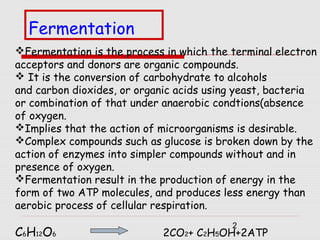
Fermentation
Fermentation is the process in which the terminal electron
acceptors and donors are organic compounds.
 It is the conversion of carbohydrate to alcohols
and carbon dioxides, or organic acids using yeast, bacteria
or combination of that under anaerobic condtions(absence
of oxygen.
Implies that the action of microorganisms is desirable.
Complex compounds such as glucose is broken down by the
action of enzymes into simpler compounds without and in
presence of oxygen.
Fermentation result in the production of energy in the
form of two ATP molecules, and produces less energy than
aerobic process of cellular respiration.
C6H12O6 2CO2+ C2H5OH+2ATP
3
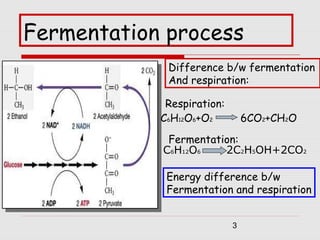
Fermentation process
Difference b/w fermentation
And respiration:
Respiration:
C6H12O6+O2 6CO2+CH2O
Fermentation:
C6H12O6 2C2H5OH+2CO2
Energy difference b/w
Fermentation and respiration
4
The chemistry of fermentation were first investigated
by Louis Pasteur in 1860
He called the process la vie sans air, or life without air
In 1897, Hans and Eduard Beuchner discovered that
fermentation could occur in a cell-free extract of yeast
This work led to the elucidation of the enzymes involved
HISTORYHISTORY
MICROORGANISMS INVOLVED IN FERMENTATION OF
CARBOHYDRATES
Saccharomyces uvarum but in some cases Saccharomyces
Cerevisiae lead to the fermentation of carbohydrates.
5
 It is useful to classify worts carbohydrates as fermentable
or non-fermentable on the basis of wether they can be
metabolised by brewer s̓ yeast.
 WORTS-The class of compound present in greater abun-
-dance is carbohydrates. There many less abundant compou-
-nds viz., nitrogenous, inorganic ions, vitamines, polyphenols,
hops compounds, lipids and oxygen.
 Worts is raw materialfrom which beer is made by the
metabolic action of brewer̓s yeast.
 The more important fermentable carbohydrates are;
maltose, maltotriose, glucose, sucrose and fructose.
 Fructose and sucrose come directly from malt; glucose,
maltose, and malitriose are formed during the mashing oper-
-ations and may also added as component of liquid adjunct
(syrup).
6
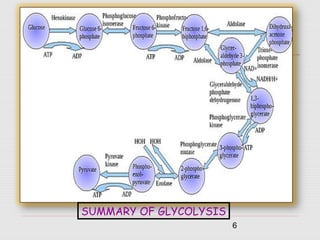
SUMMARY OF GLYCOLYSIS
7
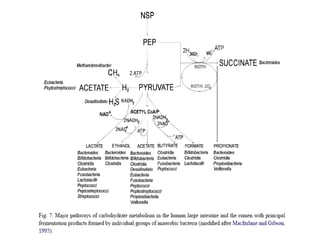
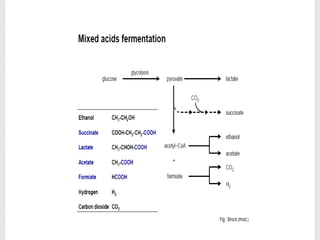
PATHWAYS INVOLVED IN FERMNTATION
OF CARBOHYDRATES
 The EMP or glycolytic pathway is one of the more important
And primitive pathway for metabolizing carbohydrates. It
Occurs not only in a large in a large array of aerobic, anaerobic
, and facultative microorganisms but also in mammalian and
other muscle.
The EMP is the principle route by which carbohydrates are
utilized during brewery fermentation.
The 2ATP is required for phosphorylating glucose and
susequently 2ATPs are recovered between glyceraldehyde-3-
Phosphate are readily interconvertible this pathway can
produce a total 4ATPS from each glucose-with a net gain of
2ATPs-and is the main source of cellular energy during
alcoholic fermentations.
8
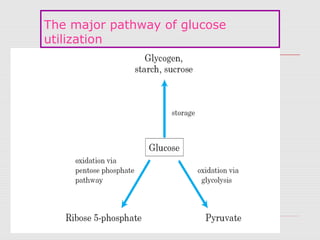
The major pathway of glucose
utilization
9
 Other carbohydrates, such as a galactose, maltose, and
Maltotriose enter this pathway after being converted to
glucose.
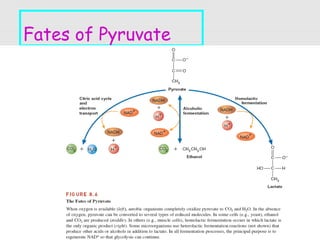
Brewer s̓ yeast does not excrete pyruvate but decarboxyl-
-ates it to yield acetaldehyde which is then reduced to
ethanol.
Oxidation-reduction is thereby balanced the NADH
produced during the oxidation glyceraldehyde-3-phosphate to
1,3-diphosphoglyceric acid is utilized in the reduction of
acetaldehyde to ethanol;the NAD+ regenerated in this way is
available for further oxidation of glyceraldehyde-3-
phosphate. Consequently, CO2 and ethanol are the principle by-
Product of this metabolic pathway.
10
11
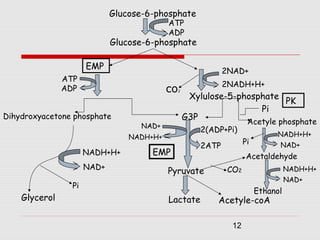
ALCOHOLIC FERMENTATION
OF CARBOHYDRATES
12
Glucose-6-phosphate
ATP
ADP
Glucose-6-phosphate
EMP
Xylulose-5-phosphate
co2
G3P
Pi
ATP
ADP
Dihydroxyacetone phosphate
Acetyle phosphate
PK
Acetaldehyde
Ethanol
NADH+H+
NAD+
NADH+H+
NAD+
NAD+
NADH+H+
EMP
2(ADP+Pi)
2ATP
Pyruvate CO2
Lactate
2NAD+
2NADH+H+
Glycerol
NADH+H+
NAD+
Pi
Pi
Acetyle-coA
13
14
15
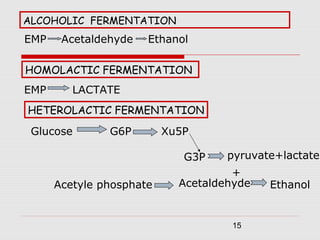
ALCOHOLIC FERMENTATION
EMP Acetaldehyde Ethanol
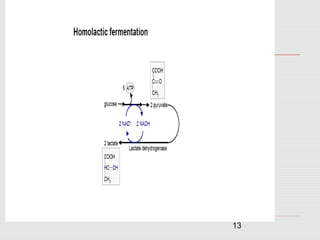
HOMOLACTIC FERMENTATION
EMP LACTATE
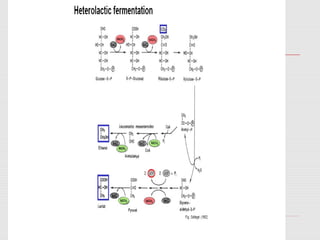
HETEROLACTIC FERMENTATION
Glucose G6P Xu5P
G3P pyruvate+lactate
+
Acetyle phosphate Acetaldehyde Ethanol
16
17
18
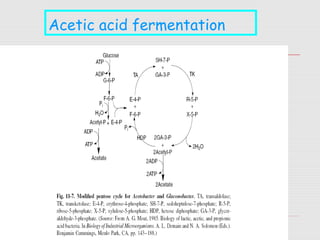
Acetic acid fermentation
19
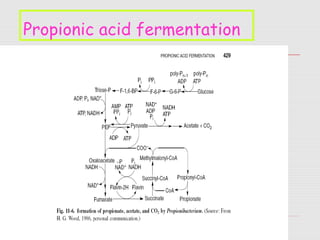
Propionic acid fermentation
20
Fates of Pyruvate
21
22
23
24
25

Fermentation of carbohydrates

  • 1.
    1 FERMENTATION OF CARBOHYDRATES Presented by:Shalini Saini M.Sc-Ist-year 2nd sem Roll no.-1810
  • 2.
    2 Fermentation Fermentation is theprocess in which the terminal electron acceptors and donors are organic compounds.  It is the conversion of carbohydrate to alcohols and carbon dioxides, or organic acids using yeast, bacteria or combination of that under anaerobic condtions(absence of oxygen. Implies that the action of microorganisms is desirable. Complex compounds such as glucose is broken down by the action of enzymes into simpler compounds without and in presence of oxygen. Fermentation result in the production of energy in the form of two ATP molecules, and produces less energy than aerobic process of cellular respiration. C6H12O6 2CO2+ C2H5OH+2ATP
  • 3.
    3 Fermentation process Difference b/wfermentation And respiration: Respiration: C6H12O6+O2 6CO2+CH2O Fermentation: C6H12O6 2C2H5OH+2CO2 Energy difference b/w Fermentation and respiration
  • 4.
    4 The chemistry of fermentation werefirst investigated by Louis Pasteur in 1860 He called the process la vie sans air, or life without air In 1897, Hans and Eduard Beuchner discovered that fermentation could occur in a cell-free extract of yeast This work led to the elucidation of the enzymes involved HISTORYHISTORY MICROORGANISMS INVOLVED IN FERMENTATION OF CARBOHYDRATES Saccharomyces uvarum but in some cases Saccharomyces Cerevisiae lead to the fermentation of carbohydrates.
  • 5.
    5  It isuseful to classify worts carbohydrates as fermentable or non-fermentable on the basis of wether they can be metabolised by brewer s̓ yeast.  WORTS-The class of compound present in greater abun- -dance is carbohydrates. There many less abundant compou- -nds viz., nitrogenous, inorganic ions, vitamines, polyphenols, hops compounds, lipids and oxygen.  Worts is raw materialfrom which beer is made by the metabolic action of brewer̓s yeast.  The more important fermentable carbohydrates are; maltose, maltotriose, glucose, sucrose and fructose.  Fructose and sucrose come directly from malt; glucose, maltose, and malitriose are formed during the mashing oper- -ations and may also added as component of liquid adjunct (syrup).
  • 6.
  • 7.
    7 PATHWAYS INVOLVED INFERMNTATION OF CARBOHYDRATES  The EMP or glycolytic pathway is one of the more important And primitive pathway for metabolizing carbohydrates. It Occurs not only in a large in a large array of aerobic, anaerobic , and facultative microorganisms but also in mammalian and other muscle. The EMP is the principle route by which carbohydrates are utilized during brewery fermentation. The 2ATP is required for phosphorylating glucose and susequently 2ATPs are recovered between glyceraldehyde-3- Phosphate are readily interconvertible this pathway can produce a total 4ATPS from each glucose-with a net gain of 2ATPs-and is the main source of cellular energy during alcoholic fermentations.
  • 8.
    8 The major pathwayof glucose utilization
  • 9.
    9  Other carbohydrates,such as a galactose, maltose, and Maltotriose enter this pathway after being converted to glucose. Brewer s̓ yeast does not excrete pyruvate but decarboxyl- -ates it to yield acetaldehyde which is then reduced to ethanol. Oxidation-reduction is thereby balanced the NADH produced during the oxidation glyceraldehyde-3-phosphate to 1,3-diphosphoglyceric acid is utilized in the reduction of acetaldehyde to ethanol;the NAD+ regenerated in this way is available for further oxidation of glyceraldehyde-3- phosphate. Consequently, CO2 and ethanol are the principle by- Product of this metabolic pathway.
  • 10.
  • 11.
  • 12.
  • 13.
  • 14.
  • 15.
    15 ALCOHOLIC FERMENTATION EMP AcetaldehydeEthanol HOMOLACTIC FERMENTATION EMP LACTATE HETEROLACTIC FERMENTATION Glucose G6P Xu5P G3P pyruvate+lactate + Acetyle phosphate Acetaldehyde Ethanol
  • 16.
  • 17.
  • 18.
  • 19.
  • 20.
  • 21.
  • 22.
  • 23.
  • 24.
  • 25.