PHYSICS NOTES GRADE 10
CHAPTER 6 AND 7 3RD TERM
2016/2017
Properties of waves, light and sound
• General waves properties
• Light
• Electromagnetic spectrum
• sound
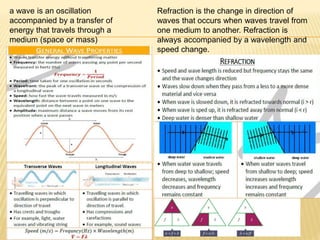
a wave is an oscillation
accompanied by a transfer of
energy that travels through a
medium (space or mass)
Refraction is the change in direction of
waves that occurs when waves travel from
one medium to another. Refraction is
always accompanied by a wavelength and
speed change.
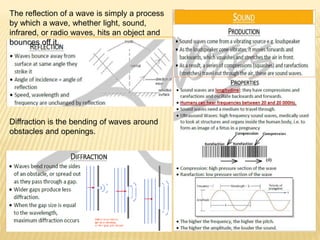
The reflection of a wave is simply a process
by which a wave, whether light, sound,
infrared, or radio waves, hits an object and
bounces off it.
Diffraction is the bending of waves around
obstacles and openings.
The most basic characteristics of a sound
wave are pitch [the quality of a sound governed by the
rate of vibrations producing it; the degree of highness or
lowness of a tone.] , loudness and tone [sound that can
be recognized by its regularity of vibration. A simple tone
has only one frequency, A complex tone consists of two or
more simple tones, called overtones.]. A sound wave's
frequency is experienced as the wave's pitch. The
amplitude determines loudness or volume. The tone of a
sound wave can be recognized by the regularity of its
vibration. Sound quality is typically an assessment of the
accuracy, enjoyability, or intelligibility of audio output from
an electronic device.
The speed of sound is the distance
travelled per unit time by a sound wave as
it propagates through an elastic medium.
speed = distance/time
Humans can hear sounds at frequencies
from about 20 Hz to 20,000 Hz, though we hear
sounds best from 1,000 Hz to 5,000 Hz, where human
speech is centered. Hearing loss may reduce the range of
frequencies a person can hear. It is common for people to
lose their ability to hear higher frequencies as they get
older.
Several animal species are able to hear
frequencies well beyond the human hearing
range. Some dolphins and bats, for example, can
hear frequencies up to 100 kHz. Elephants can
hear sounds at 14–16 Hz, while some whales can
hear infrasonic sounds as low as 7 Hz (in water).
Like any wave, a sound wave doesn't just
stop when it reaches the end of the
medium or when it encounters an obstacle
in its path. Rather, a sound wave will
undergo certain behaviors when it
encounters the end of the medium or an
obstacle. Possible behaviors include
reflection off the obstacle, diffraction
around the obstacle, and transmission
(accompanied by refraction) into the
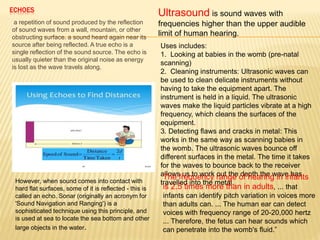
ECHOES
a repetition of sound produced by the reflection
of sound waves from a wall, mountain, or other
obstructing surface. a sound heard again near its
source after being reflected. A true echo is a
single reflection of the sound source. The echo is
usually quieter than the original noise as energy
is lost as the wave travels along.
However, when sound comes into contact with
hard flat surfaces, some of it is reflected - this is
called an echo. Sonar (originally an acronym for
'Sound Navigation and Ranging') is a
sophisticated technique using this principle, and
is used at sea to locate the sea bottom and other
large objects in the water.
Ultrasound is sound waves with
frequencies higher than the upper audible
limit of human hearing.
Uses includes:
1. Looking at babies in the womb (pre-natal
scanning)
2. Cleaning instruments: Ultrasonic waves can
be used to clean delicate instruments without
having to take the equipment apart. The
instrument is held in a liquid. The ultrasonic
waves make the liquid particles vibrate at a high
frequency, which cleans the surfaces of the
equipment.
3. Detecting flaws and cracks in metal: This
works in the same way as scanning babies in
the womb. The ultrasonic waves bounce off
different surfaces in the metal. The time it takes
for the waves to bounce back to the receiver
allows us to work out the depth the wave has
travelled into the metal.
The frequency range of hearing in infants
is 2.5 times more than in adults, ... that
infants can identify pitch variation in voices more
than adults can. ... The human ear can detect
voices with frequency range of 20-20,000 hertz
... Therefore, the fetus can hear sounds which
can penetrate into the womb's fluid.”
LIGHT RAYS AND WAVES
Terms associated with light ray:
1. Luminous objects: give out their own light. E.g sun,
lamps, tv screens etc.
2. Non-luminous objects: don not have their own
light, they only reflect lights that falls on them e.g
bright pages of a paper, wall, etc.
3. Reflection: light rays can be reflected by surfaces.
Light reflects from a smooth surface at the same
angle as it hits the surface. For a smooth surface,
reflected light rays travel in the same direction.
This is called regular reflection. ... Diffuse
reflection is when light hits an object of uneven
surface and reflects in lots of different directions.
4. Transmission of light is the moving of
electromagnetic waves (whether visible light, radio
waves, ultraviolet, etc.) through a transparent
material. E;g glass and water.
Features of Light:
1. Light is a form of radiation
2. Light travels in a straight line
3. Light transfers energy
4. Light travels as waves
5. Light travels through vacuum
6. Light is the fastest moving thing at the speed of
exactly 299,792,458 m/s, 300,000 km/s or 3.0 x
108 m/s
Wavelength and colour:
1. Light is made up of wavelengths of light, and each
wavelength is a particular colour. The colour we
see is a result of which wavelengths are reflected
back to our eyes.
Visible light
1. Visible light is the small part within the
electromagnetic spectrum that human eyes are
sensitive to and can detect.
2. Visible light waves consist of different
wavelengths. The colour of visible light depends
on its wavelength. These wavelengths range from
700 nm at the red end of the spectrum to 400 nm
at the violet end.
3. White light is actually made of all of the colours of
the rainbow because it contains all wavelengths,
and it is described as polychromatic light. Light
from a torch or the Sun is a good example of this.
4. Light from a laser is monochromatic, which means
it only produces one colour. (Lasers are extremely
dangerous and can cause permanent eye
damage. Extreme care must be taken to ensure
that light from a laser never enters someone’s
eyes.)
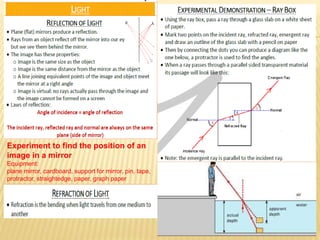
Experiment to find the position of an
image in a mirror
Equipment:
plane mirror, cardboard, support for mirror, pin, tape,
protractor, straightedge, paper, graph paper
Light refracts whenever it travels at an angle into
a substance with a different refractive index (optical
density). This change of direction is caused by a
change in speed. For example, when light travels from
air into water, it slows down, causing it to continue to
travel at a different angle or direction.
refractive index
the ratio of the velocity of light in a vacuum to its
velocity in a specified medium.
Refraction by a prism: A prism is An object made
up of a transparent material like glass or plastic that has
at least two flat surfaces that form an acute angle (less
than 90 degrees). White light is comprised of all the
colours of the rainbow. When white light is passed
through a prism, the colours of the rainbow
[ROYGBIV] emerge from the prism
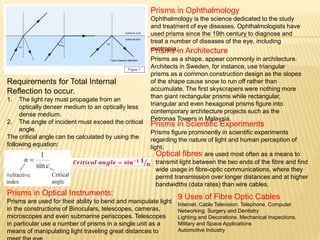
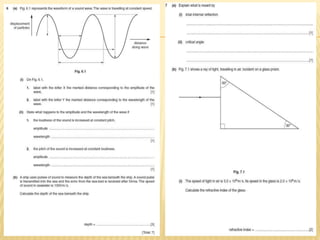
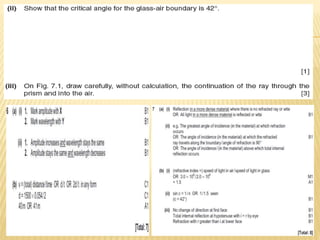
Critical angle and total internal reflection:
When the angle of refraction is equal to 90°, the angle
of incidence is called the critical angle, At any angle of
incidence greater than the critical angle, the light cannot
pass through the surface - it is all reflected. This is
called total internal reflection.
Requirements for Total Internal
Reflection to occur.
1. The light ray must propagate from an
optically denser medium to an optically less
dense medium.
2. The angle of incident must exceed the critical
angle.
The critical angle can be calculated by using the
following equation:
Prisms in Optical Instruments:
Prisms are used for their ability to bend and manipulate light
in the constructions of Binoculars, telescopes, cameras,
microscopes and even submarine periscopes. Telescopes
in particular use a number of prisms in a single unit as a
means of manipulating light traveling great distances to
Prisms in Ophthalmology
Ophthalmology is the science dedicated to the study
and treatment of eye diseases. Ophthalmologists have
used prisms since the 19th century to diagnose and
treat a number of diseases of the eye, including
exotropia,Prisms in Architecture
Prisms as a shape, appear commonly in architecture.
Architects in Sweden, for instance, use triangular
prisms as a common construction design as the slopes
of the shape cause snow to run off rather than
accumulate. The first skyscrapers were nothing more
than giant rectangular prisms while rectangular,
triangular and even hexagonal prisms figure into
contemporary architecture projects such as the
Petronas Towers in Malaysia.
Prisms in Scientific Experiments
Prisms figure prominently in scientific experiments
regarding the nature of light and human perception of
light.
Optical fibres are used most often as a means to
transmit light between the two ends of the fibre and find
wide usage in fibre-optic communications, where they
permit transmission over longer distances and at higher
bandwidths (data rates) than wire cables.
9 Uses of Fibre Optic Cables
Internet. Cable Television. Telephone. Computer
Networking. Surgery and Dentistry
Lighting and Decorations. Mechanical Inspections.
Military and Space Applications
Automotive Industry
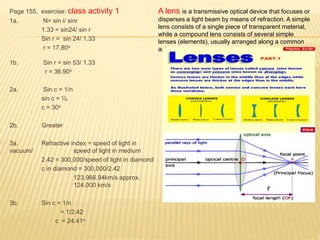
Page 155, exercise: class activity 1
1a. N= sin i/ sinr
1.33 = sin24/ sin r
Sin r = sin 24/ 1.33
r = 17.80o
1b. Sin r = sin 53/ 1.33
r = 36.90o
2a. Sin c = 1/n
sin c = ½.
c = 30o
2b. Greater
3a. Refractive index = speed of light in
vacuum/ speed of light in medium
2.42 = 300,000/speed of light in diamond
c in diamond = 300,000/2.42
123,966.94km/s approx.
124,000 km/s
3b. Sin c = 1/n
= 1/2.42
c = 24.41o
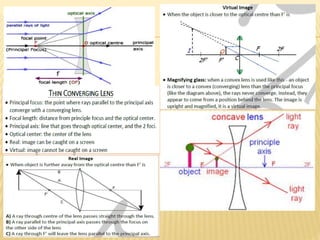
A lens is a transmissive optical device that focuses or
disperses a light beam by means of refraction. A simple
lens consists of a single piece of transparent material,
while a compound lens consists of several simple
lenses (elements), usually arranged along a common
axis.
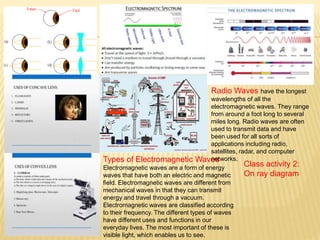
Types of Electromagnetic Waves
Electromagnetic waves are a form of energy
waves that have both an electric and magnetic
field. Electromagnetic waves are different from
mechanical waves in that they can transmit
energy and travel through a vacuum.
Electromagnetic waves are classified according
to their frequency. The different types of waves
have different uses and functions in our
everyday lives. The most important of these is
visible light, which enables us to see.
Radio Waves have the longest
wavelengths of all the
electromagnetic waves. They range
from around a foot long to several
miles long. Radio waves are often
used to transmit data and have
been used for all sorts of
applications including radio,
satellites, radar, and computer
networks.
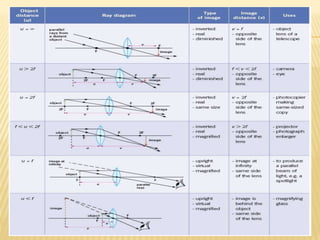
Class activity 2:
On ray diagram
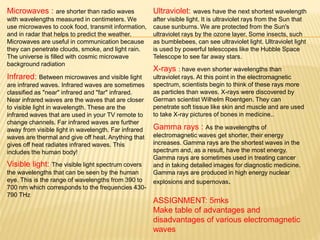
Microwaves : are shorter than radio waves
with wavelengths measured in centimeters. We
use microwaves to cook food, transmit information,
and in radar that helps to predict the weather.
Microwaves are useful in communication because
they can penetrate clouds, smoke, and light rain.
The universe is filled with cosmic microwave
background radiation
Infrared: Between microwaves and visible light
are infrared waves. Infrared waves are sometimes
classified as "near" infrared and "far" infrared.
Near infrared waves are the waves that are closer
to visible light in wavelength. These are the
infrared waves that are used in your TV remote to
change channels. Far infrared waves are further
away from visible light in wavelength. Far infrared
waves are thermal and give off heat. Anything that
gives off heat radiates infrared waves. This
includes the human body!
Visible light: The visible light spectrum covers
the wavelengths that can be seen by the human
eye. This is the range of wavelengths from 390 to
700 nm which corresponds to the frequencies 430-
790 THz
Ultraviolet: waves have the next shortest wavelength
after visible light. It is ultraviolet rays from the Sun that
cause sunburns. We are protected from the Sun's
ultraviolet rays by the ozone layer. Some insects, such
as bumblebees, can see ultraviolet light. Ultraviolet light
is used by powerful telescopes like the Hubble Space
Telescope to see far away stars.
X-rays : have even shorter wavelengths than
ultraviolet rays. At this point in the electromagnetic
spectrum, scientists begin to think of these rays more
as particles than waves. X-rays were discovered by
German scientist Wilhelm Roentgen. They can
penetrate soft tissue like skin and muscle and are used
to take X-ray pictures of bones in medicine..
Gamma rays : As the wavelengths of
electromagnetic waves get shorter, their energy
increases. Gamma rays are the shortest waves in the
spectrum and, as a result, have the most energy.
Gamma rays are sometimes used in treating cancer
and in taking detailed images for diagnostic medicine.
Gamma rays are produced in high energy nuclear
explosions and supernovas.
ASSIGNMENT: 5mks
Make table of advantages and
disadvantages of various electromagnetic
waves
Test Quiz. [10mks]
1) What can electromagnetic waves travel through
that mechanical waves can not travel through?
a. Air b. Wood c. Water d. Vacuum e. All of the
above
2) Electromagnetic waves are classified using what
measurement?
a. Amplitude b. Frequency c. Power d. Energy
e. Type of photons
3) What type of electromagnetic waves cause
sunburns?
a. Radio waves b. Microwaves c. Infrared rays
d. Visible light e. Ultraviolet
4) What type of electromagnetic waves are used to
cook food, predict the weather, and for
communications?
a. Radio waves b. Microwaves c. Infrared rays d.
Visible light e. Ultraviolet
5) What type of waves are used on a TV remote
control?
a. Radio waves b. Microwaves c. Infrared rays d.
Visible light e. Ultraviolet
6) Which electromagnetic waves have the longest
wavelengths?
a. Radio waves b. Microwaves c. Infrared rays
d. Visible light e. Ultraviolet
7) Which electromagnetic waves enable humans to
see?
a. Radio waves b. Microwaves c. Infrared rays
d. Visible light e. Ultraviolet
8) What type of electromagnetic waves have the
shortest wavelengths?
a. Radio waves b. X-Rays c. Infrared rays d.
Gamma rays e. Ultraviolet
9) What type of electromagnetic waves are used to
take pictures of bones in medicine?
a. Radio waves b. X-Rays c. Infrared rays d.
Gamma rays e. Ultraviolet
10) What type of electromagnetic waves have the
most energy?
a. Radio waves b. X-Rays c. Infrared rays d.
Gamma rays e. Ultraviolet
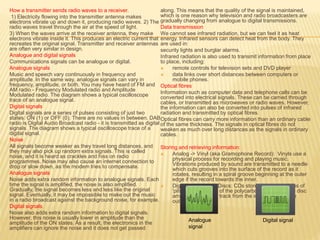
How a transmitter sends radio waves to a receiver.
1) Electricity flowing into the transmitter antenna makes
electrons vibrate up and down it, producing radio waves. 2) The
radio waves travel through the air at the speed of light.
3) When the waves arrive at the receiver antenna, they make
electrons vibrate inside it. This produces an electric current that
recreates the original signal. Transmitter and receiver antennas
are often very similar in design.
Analogue and digital signals
Communications signals can be analogue or digital.
Analogue signals
Music and speech vary continuously in frequency and
amplitude. In the same way, analogue signals can vary in
frequency, amplitude, or both. You may have heard of FM and
AM radio - Frequency Modulated radio and Amplitude
Modulated radio. The diagram shows a typical oscilloscope
trace of an analogue signal.
Digital signals
Digital signals are a series of pulses consisting of just two
states: ON (1) or OFF (0). There are no values in between. DAB
radio is Digital Audio Broadcast radio - it is transmitted as digital
signals. The diagram shows a typical oscilloscope trace of a
digital signal.
Noise
All signals become weaker as they travel long distances, and
they may also pick up random extra signals. This is called
noise, and it is heard as crackles and hiss on radio
programmes. Noise may also cause an internet connection to
drop or slow down, as the modem tries to compensate.
Analogue signals
Noise adds extra random information to analogue signals. Each
time the signal is amplified, the noise is also amplified.
Gradually, the signal becomes less and less like the original
signal. Eventually, it may be impossible to make out the music
in a radio broadcast against the background noise, for example.
Digital signals
Noise also adds extra random information to digital signals.
However, this noise is usually lower in amplitude than the
amplitude of the ON states. As a result, the electronics in the
amplifiers can ignore the noise and it does not get passed
along. This means that the quality of the signal is maintained,
which is one reason why television and radio broadcasters are
gradually changing from analogue to digital transmissions.
Data transmission
We cannot see infrared radiation, but we can feel it as heat
energy. Infrared sensors can detect heat from the body. They
are used in:
security lights and burglar alarms.
Infrared radiation is also used to transmit information from place
to place, including:
 remote controls for television sets and DVD player
 data links over short distances between computers or
mobile phones.
Optical fibres
Information such as computer data and telephone calls can be
converted into electrical signals. These can be carried through
cables, or transmitted as microwaves or radio waves. However,
the information can also be converted into pulses of infrared
radiation and transmitted by optical fibres.
Optical fibres can carry more information than an ordinary cable
of the same thickness. The signals in optical fibres do not
weaken as much over long distances as the signals in ordinary
cables.
Storing and retrieving information:
 Analog -> Vinyl (aka Gramophone Record): Vinyls use a
physical process for recording and playing music.
Vibrations produced by sound are transmitted to a needle
which cuts grooves into the surface of the record as it
rotates, resulting in a spiral groove beginning at the outer
edge if the record towards the inner.
 Digital -> Compact Discs: CDs store data in the forms of
'pits' on the surface of the polycarbonate layer of the disc
arranged in a spiral track from the inside towards the
outside.
Analogue
signal
Digital signal
Waves and sound grade 10

Waves and sound grade 10

  • 1.
    PHYSICS NOTES GRADE10 CHAPTER 6 AND 7 3RD TERM 2016/2017 Properties of waves, light and sound • General waves properties • Light • Electromagnetic spectrum • sound
  • 2.
    a wave isan oscillation accompanied by a transfer of energy that travels through a medium (space or mass) Refraction is the change in direction of waves that occurs when waves travel from one medium to another. Refraction is always accompanied by a wavelength and speed change.
  • 3.
    The reflection ofa wave is simply a process by which a wave, whether light, sound, infrared, or radio waves, hits an object and bounces off it. Diffraction is the bending of waves around obstacles and openings.
  • 4.
    The most basiccharacteristics of a sound wave are pitch [the quality of a sound governed by the rate of vibrations producing it; the degree of highness or lowness of a tone.] , loudness and tone [sound that can be recognized by its regularity of vibration. A simple tone has only one frequency, A complex tone consists of two or more simple tones, called overtones.]. A sound wave's frequency is experienced as the wave's pitch. The amplitude determines loudness or volume. The tone of a sound wave can be recognized by the regularity of its vibration. Sound quality is typically an assessment of the accuracy, enjoyability, or intelligibility of audio output from an electronic device. The speed of sound is the distance travelled per unit time by a sound wave as it propagates through an elastic medium. speed = distance/time Humans can hear sounds at frequencies from about 20 Hz to 20,000 Hz, though we hear sounds best from 1,000 Hz to 5,000 Hz, where human speech is centered. Hearing loss may reduce the range of frequencies a person can hear. It is common for people to lose their ability to hear higher frequencies as they get older. Several animal species are able to hear frequencies well beyond the human hearing range. Some dolphins and bats, for example, can hear frequencies up to 100 kHz. Elephants can hear sounds at 14–16 Hz, while some whales can hear infrasonic sounds as low as 7 Hz (in water). Like any wave, a sound wave doesn't just stop when it reaches the end of the medium or when it encounters an obstacle in its path. Rather, a sound wave will undergo certain behaviors when it encounters the end of the medium or an obstacle. Possible behaviors include reflection off the obstacle, diffraction around the obstacle, and transmission (accompanied by refraction) into the
  • 5.
    ECHOES a repetition ofsound produced by the reflection of sound waves from a wall, mountain, or other obstructing surface. a sound heard again near its source after being reflected. A true echo is a single reflection of the sound source. The echo is usually quieter than the original noise as energy is lost as the wave travels along. However, when sound comes into contact with hard flat surfaces, some of it is reflected - this is called an echo. Sonar (originally an acronym for 'Sound Navigation and Ranging') is a sophisticated technique using this principle, and is used at sea to locate the sea bottom and other large objects in the water. Ultrasound is sound waves with frequencies higher than the upper audible limit of human hearing. Uses includes: 1. Looking at babies in the womb (pre-natal scanning) 2. Cleaning instruments: Ultrasonic waves can be used to clean delicate instruments without having to take the equipment apart. The instrument is held in a liquid. The ultrasonic waves make the liquid particles vibrate at a high frequency, which cleans the surfaces of the equipment. 3. Detecting flaws and cracks in metal: This works in the same way as scanning babies in the womb. The ultrasonic waves bounce off different surfaces in the metal. The time it takes for the waves to bounce back to the receiver allows us to work out the depth the wave has travelled into the metal. The frequency range of hearing in infants is 2.5 times more than in adults, ... that infants can identify pitch variation in voices more than adults can. ... The human ear can detect voices with frequency range of 20-20,000 hertz ... Therefore, the fetus can hear sounds which can penetrate into the womb's fluid.”
  • 6.
    LIGHT RAYS ANDWAVES Terms associated with light ray: 1. Luminous objects: give out their own light. E.g sun, lamps, tv screens etc. 2. Non-luminous objects: don not have their own light, they only reflect lights that falls on them e.g bright pages of a paper, wall, etc. 3. Reflection: light rays can be reflected by surfaces. Light reflects from a smooth surface at the same angle as it hits the surface. For a smooth surface, reflected light rays travel in the same direction. This is called regular reflection. ... Diffuse reflection is when light hits an object of uneven surface and reflects in lots of different directions. 4. Transmission of light is the moving of electromagnetic waves (whether visible light, radio waves, ultraviolet, etc.) through a transparent material. E;g glass and water. Features of Light: 1. Light is a form of radiation 2. Light travels in a straight line 3. Light transfers energy 4. Light travels as waves 5. Light travels through vacuum 6. Light is the fastest moving thing at the speed of exactly 299,792,458 m/s, 300,000 km/s or 3.0 x 10⁸ m/s Wavelength and colour: 1. Light is made up of wavelengths of light, and each wavelength is a particular colour. The colour we see is a result of which wavelengths are reflected back to our eyes. Visible light 1. Visible light is the small part within the electromagnetic spectrum that human eyes are sensitive to and can detect. 2. Visible light waves consist of different wavelengths. The colour of visible light depends on its wavelength. These wavelengths range from 700 nm at the red end of the spectrum to 400 nm at the violet end. 3. White light is actually made of all of the colours of the rainbow because it contains all wavelengths, and it is described as polychromatic light. Light from a torch or the Sun is a good example of this. 4. Light from a laser is monochromatic, which means it only produces one colour. (Lasers are extremely dangerous and can cause permanent eye damage. Extreme care must be taken to ensure that light from a laser never enters someone’s eyes.)
  • 7.
    Experiment to findthe position of an image in a mirror Equipment: plane mirror, cardboard, support for mirror, pin, tape, protractor, straightedge, paper, graph paper
  • 8.
    Light refracts wheneverit travels at an angle into a substance with a different refractive index (optical density). This change of direction is caused by a change in speed. For example, when light travels from air into water, it slows down, causing it to continue to travel at a different angle or direction. refractive index the ratio of the velocity of light in a vacuum to its velocity in a specified medium. Refraction by a prism: A prism is An object made up of a transparent material like glass or plastic that has at least two flat surfaces that form an acute angle (less than 90 degrees). White light is comprised of all the colours of the rainbow. When white light is passed through a prism, the colours of the rainbow [ROYGBIV] emerge from the prism Critical angle and total internal reflection: When the angle of refraction is equal to 90°, the angle of incidence is called the critical angle, At any angle of incidence greater than the critical angle, the light cannot pass through the surface - it is all reflected. This is called total internal reflection.
  • 9.
    Requirements for TotalInternal Reflection to occur. 1. The light ray must propagate from an optically denser medium to an optically less dense medium. 2. The angle of incident must exceed the critical angle. The critical angle can be calculated by using the following equation: Prisms in Optical Instruments: Prisms are used for their ability to bend and manipulate light in the constructions of Binoculars, telescopes, cameras, microscopes and even submarine periscopes. Telescopes in particular use a number of prisms in a single unit as a means of manipulating light traveling great distances to Prisms in Ophthalmology Ophthalmology is the science dedicated to the study and treatment of eye diseases. Ophthalmologists have used prisms since the 19th century to diagnose and treat a number of diseases of the eye, including exotropia,Prisms in Architecture Prisms as a shape, appear commonly in architecture. Architects in Sweden, for instance, use triangular prisms as a common construction design as the slopes of the shape cause snow to run off rather than accumulate. The first skyscrapers were nothing more than giant rectangular prisms while rectangular, triangular and even hexagonal prisms figure into contemporary architecture projects such as the Petronas Towers in Malaysia. Prisms in Scientific Experiments Prisms figure prominently in scientific experiments regarding the nature of light and human perception of light. Optical fibres are used most often as a means to transmit light between the two ends of the fibre and find wide usage in fibre-optic communications, where they permit transmission over longer distances and at higher bandwidths (data rates) than wire cables. 9 Uses of Fibre Optic Cables Internet. Cable Television. Telephone. Computer Networking. Surgery and Dentistry Lighting and Decorations. Mechanical Inspections. Military and Space Applications Automotive Industry
  • 10.
    Page 155, exercise:class activity 1 1a. N= sin i/ sinr 1.33 = sin24/ sin r Sin r = sin 24/ 1.33 r = 17.80o 1b. Sin r = sin 53/ 1.33 r = 36.90o 2a. Sin c = 1/n sin c = ½. c = 30o 2b. Greater 3a. Refractive index = speed of light in vacuum/ speed of light in medium 2.42 = 300,000/speed of light in diamond c in diamond = 300,000/2.42 123,966.94km/s approx. 124,000 km/s 3b. Sin c = 1/n = 1/2.42 c = 24.41o A lens is a transmissive optical device that focuses or disperses a light beam by means of refraction. A simple lens consists of a single piece of transparent material, while a compound lens consists of several simple lenses (elements), usually arranged along a common axis.
  • 13.
    Types of ElectromagneticWaves Electromagnetic waves are a form of energy waves that have both an electric and magnetic field. Electromagnetic waves are different from mechanical waves in that they can transmit energy and travel through a vacuum. Electromagnetic waves are classified according to their frequency. The different types of waves have different uses and functions in our everyday lives. The most important of these is visible light, which enables us to see. Radio Waves have the longest wavelengths of all the electromagnetic waves. They range from around a foot long to several miles long. Radio waves are often used to transmit data and have been used for all sorts of applications including radio, satellites, radar, and computer networks. Class activity 2: On ray diagram
  • 14.
    Microwaves : areshorter than radio waves with wavelengths measured in centimeters. We use microwaves to cook food, transmit information, and in radar that helps to predict the weather. Microwaves are useful in communication because they can penetrate clouds, smoke, and light rain. The universe is filled with cosmic microwave background radiation Infrared: Between microwaves and visible light are infrared waves. Infrared waves are sometimes classified as "near" infrared and "far" infrared. Near infrared waves are the waves that are closer to visible light in wavelength. These are the infrared waves that are used in your TV remote to change channels. Far infrared waves are further away from visible light in wavelength. Far infrared waves are thermal and give off heat. Anything that gives off heat radiates infrared waves. This includes the human body! Visible light: The visible light spectrum covers the wavelengths that can be seen by the human eye. This is the range of wavelengths from 390 to 700 nm which corresponds to the frequencies 430- 790 THz Ultraviolet: waves have the next shortest wavelength after visible light. It is ultraviolet rays from the Sun that cause sunburns. We are protected from the Sun's ultraviolet rays by the ozone layer. Some insects, such as bumblebees, can see ultraviolet light. Ultraviolet light is used by powerful telescopes like the Hubble Space Telescope to see far away stars. X-rays : have even shorter wavelengths than ultraviolet rays. At this point in the electromagnetic spectrum, scientists begin to think of these rays more as particles than waves. X-rays were discovered by German scientist Wilhelm Roentgen. They can penetrate soft tissue like skin and muscle and are used to take X-ray pictures of bones in medicine.. Gamma rays : As the wavelengths of electromagnetic waves get shorter, their energy increases. Gamma rays are the shortest waves in the spectrum and, as a result, have the most energy. Gamma rays are sometimes used in treating cancer and in taking detailed images for diagnostic medicine. Gamma rays are produced in high energy nuclear explosions and supernovas. ASSIGNMENT: 5mks Make table of advantages and disadvantages of various electromagnetic waves
  • 15.
    Test Quiz. [10mks] 1)What can electromagnetic waves travel through that mechanical waves can not travel through? a. Air b. Wood c. Water d. Vacuum e. All of the above 2) Electromagnetic waves are classified using what measurement? a. Amplitude b. Frequency c. Power d. Energy e. Type of photons 3) What type of electromagnetic waves cause sunburns? a. Radio waves b. Microwaves c. Infrared rays d. Visible light e. Ultraviolet 4) What type of electromagnetic waves are used to cook food, predict the weather, and for communications? a. Radio waves b. Microwaves c. Infrared rays d. Visible light e. Ultraviolet 5) What type of waves are used on a TV remote control? a. Radio waves b. Microwaves c. Infrared rays d. Visible light e. Ultraviolet 6) Which electromagnetic waves have the longest wavelengths? a. Radio waves b. Microwaves c. Infrared rays d. Visible light e. Ultraviolet 7) Which electromagnetic waves enable humans to see? a. Radio waves b. Microwaves c. Infrared rays d. Visible light e. Ultraviolet 8) What type of electromagnetic waves have the shortest wavelengths? a. Radio waves b. X-Rays c. Infrared rays d. Gamma rays e. Ultraviolet 9) What type of electromagnetic waves are used to take pictures of bones in medicine? a. Radio waves b. X-Rays c. Infrared rays d. Gamma rays e. Ultraviolet 10) What type of electromagnetic waves have the most energy? a. Radio waves b. X-Rays c. Infrared rays d. Gamma rays e. Ultraviolet
  • 16.
    How a transmittersends radio waves to a receiver. 1) Electricity flowing into the transmitter antenna makes electrons vibrate up and down it, producing radio waves. 2) The radio waves travel through the air at the speed of light. 3) When the waves arrive at the receiver antenna, they make electrons vibrate inside it. This produces an electric current that recreates the original signal. Transmitter and receiver antennas are often very similar in design. Analogue and digital signals Communications signals can be analogue or digital. Analogue signals Music and speech vary continuously in frequency and amplitude. In the same way, analogue signals can vary in frequency, amplitude, or both. You may have heard of FM and AM radio - Frequency Modulated radio and Amplitude Modulated radio. The diagram shows a typical oscilloscope trace of an analogue signal. Digital signals Digital signals are a series of pulses consisting of just two states: ON (1) or OFF (0). There are no values in between. DAB radio is Digital Audio Broadcast radio - it is transmitted as digital signals. The diagram shows a typical oscilloscope trace of a digital signal. Noise All signals become weaker as they travel long distances, and they may also pick up random extra signals. This is called noise, and it is heard as crackles and hiss on radio programmes. Noise may also cause an internet connection to drop or slow down, as the modem tries to compensate. Analogue signals Noise adds extra random information to analogue signals. Each time the signal is amplified, the noise is also amplified. Gradually, the signal becomes less and less like the original signal. Eventually, it may be impossible to make out the music in a radio broadcast against the background noise, for example. Digital signals Noise also adds extra random information to digital signals. However, this noise is usually lower in amplitude than the amplitude of the ON states. As a result, the electronics in the amplifiers can ignore the noise and it does not get passed along. This means that the quality of the signal is maintained, which is one reason why television and radio broadcasters are gradually changing from analogue to digital transmissions. Data transmission We cannot see infrared radiation, but we can feel it as heat energy. Infrared sensors can detect heat from the body. They are used in: security lights and burglar alarms. Infrared radiation is also used to transmit information from place to place, including:  remote controls for television sets and DVD player  data links over short distances between computers or mobile phones. Optical fibres Information such as computer data and telephone calls can be converted into electrical signals. These can be carried through cables, or transmitted as microwaves or radio waves. However, the information can also be converted into pulses of infrared radiation and transmitted by optical fibres. Optical fibres can carry more information than an ordinary cable of the same thickness. The signals in optical fibres do not weaken as much over long distances as the signals in ordinary cables. Storing and retrieving information:  Analog -> Vinyl (aka Gramophone Record): Vinyls use a physical process for recording and playing music. Vibrations produced by sound are transmitted to a needle which cuts grooves into the surface of the record as it rotates, resulting in a spiral groove beginning at the outer edge if the record towards the inner.  Digital -> Compact Discs: CDs store data in the forms of 'pits' on the surface of the polycarbonate layer of the disc arranged in a spiral track from the inside towards the outside. Analogue signal Digital signal