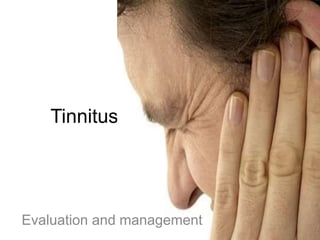
Tinnitus
Evaluation and management
Facts
• ‘Bewitched ear’,
‘ worm in the ear’
‘acoustic hallucination’
• Treatment remedies
for tinnitus date back to the era
of Aristotle who proposed masking tinnitus with an
external stimulus as a remedy
Definition
• Tinnitus is the description of a noise inside
a person’s head in the absence of auditory
stimulation.
• Tinnitus is not a disease, but a condition
that can result from a wide range of
underlying causes.
Types of tinnitus
Causes
• Ear problems
• Neurological disorders
• Psychiatric disorders
• Metabolic disorders
• Miscellaneous
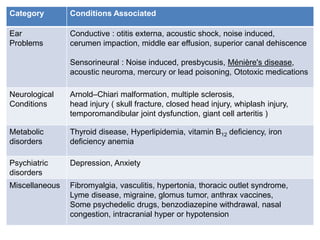
Category Conditions Associated
Ear
Problems
Conductive : otitis externa, acoustic shock, noise induced,
cerumen impaction, middle ear effusion, superior canal dehiscence
Sensorineural : Noise induced, presbycusis, Ménière's disease,
acoustic neuroma, mercury or lead poisoning, Ototoxic medications
Neurological
Conditions
Arnold–Chiari malformation, multiple sclerosis,
head injury ( skull fracture, closed head injury, whiplash injury,
temporomandibular joint dysfunction, giant cell arteritis )
Metabolic
disorders
Thyroid disease, Hyperlipidemia, vitamin B12 deficiency, iron
deficiency anemia
Psychiatric
disorders
Depression, Anxiety
Miscellaneous Fibromyalgia, vasculitis, hypertonia, thoracic outlet syndrome,
Lyme disease, migraine, glomus tumor, anthrax vaccines,
Some psychedelic drugs, benzodiazepine withdrawal, nasal
congestion, intracranial hyper or hypotension
Evaluation
• Diagnosis
• Severity
• Auditory Evoked Responses
• Diagnosis
– Subjective vs Objective ??
• Severity
– Validated self report
questionnaires
• AERs
Management
• Modes
– Psychotherapy and Reassurance
– Relaxation and biofeedback techniques
– Sedation and pharmacotherapy
– Masking manouvers and devices
• Psychotherapy and reassurance
First line therapy for patients with subjective form.
Psychological counselling may help.
• Biofeedback techniques
Biofeedback is a relaxation technique that teaches people to
control certain autonomic body functions, such as pulse,
muscle tension, and skin temperature. The goal of biofeedback
is to help people manage stress in their lives not by reducing
the stress but by changing the body’s reaction to it.
• Pharmacotherapy
– Acute tinnitus
• Systemic Delivery
– Corticosteroids
– Rheological therapy
– Nootropics
– Lidocaine
• Local Therapy
– Topical Corticosteroids
– Chronic tinnitus
• Antidepressants
• Anticonvulsants
• Glutamate receptor antagonists (Caroverine)
• Others
– Misoprostol
– Betahistine
– Nimlodipine
– Furosemide
– Pramipexole
– Zinc
– Vitamin tablets
– Antihistamines
– Antioxidants ( Ginkgo biloba )
– Botulinum toxin and so on…….
Other modalities of treatment
• HBO therapy
• Sound therapy devices
• Tinnitus retraining therapy
– Maskers
– Noise Generators
– Hearing Aids
– Tinnitus instruments
• Cognitive Behavior therapy
• Music Therapy
Recent Advances
• Acoustic Coordinated Reset
Neuromodulation
• Magnetic and Electrical Brain stimulation
Thank You

Tinnitus

  • 1.
  • 2.
    Facts • ‘Bewitched ear’, ‘worm in the ear’ ‘acoustic hallucination’ • Treatment remedies for tinnitus date back to the era of Aristotle who proposed masking tinnitus with an external stimulus as a remedy
  • 3.
    Definition • Tinnitus isthe description of a noise inside a person’s head in the absence of auditory stimulation. • Tinnitus is not a disease, but a condition that can result from a wide range of underlying causes.
  • 4.
  • 5.
    Causes • Ear problems •Neurological disorders • Psychiatric disorders • Metabolic disorders • Miscellaneous
  • 6.
    Category Conditions Associated Ear Problems Conductive: otitis externa, acoustic shock, noise induced, cerumen impaction, middle ear effusion, superior canal dehiscence Sensorineural : Noise induced, presbycusis, Ménière's disease, acoustic neuroma, mercury or lead poisoning, Ototoxic medications Neurological Conditions Arnold–Chiari malformation, multiple sclerosis, head injury ( skull fracture, closed head injury, whiplash injury, temporomandibular joint dysfunction, giant cell arteritis ) Metabolic disorders Thyroid disease, Hyperlipidemia, vitamin B12 deficiency, iron deficiency anemia Psychiatric disorders Depression, Anxiety Miscellaneous Fibromyalgia, vasculitis, hypertonia, thoracic outlet syndrome, Lyme disease, migraine, glomus tumor, anthrax vaccines, Some psychedelic drugs, benzodiazepine withdrawal, nasal congestion, intracranial hyper or hypotension
  • 7.
  • 8.
    • Diagnosis – Subjectivevs Objective ?? • Severity – Validated self report questionnaires • AERs
  • 9.
    Management • Modes – Psychotherapyand Reassurance – Relaxation and biofeedback techniques – Sedation and pharmacotherapy – Masking manouvers and devices
  • 10.
    • Psychotherapy andreassurance First line therapy for patients with subjective form. Psychological counselling may help. • Biofeedback techniques Biofeedback is a relaxation technique that teaches people to control certain autonomic body functions, such as pulse, muscle tension, and skin temperature. The goal of biofeedback is to help people manage stress in their lives not by reducing the stress but by changing the body’s reaction to it.
  • 11.
    • Pharmacotherapy – Acutetinnitus • Systemic Delivery – Corticosteroids – Rheological therapy – Nootropics – Lidocaine • Local Therapy – Topical Corticosteroids – Chronic tinnitus • Antidepressants • Anticonvulsants • Glutamate receptor antagonists (Caroverine)
  • 12.
    • Others – Misoprostol –Betahistine – Nimlodipine – Furosemide – Pramipexole – Zinc – Vitamin tablets – Antihistamines – Antioxidants ( Ginkgo biloba ) – Botulinum toxin and so on…….
  • 13.
    Other modalities oftreatment • HBO therapy • Sound therapy devices • Tinnitus retraining therapy – Maskers – Noise Generators – Hearing Aids – Tinnitus instruments • Cognitive Behavior therapy • Music Therapy
  • 14.
    Recent Advances • AcousticCoordinated Reset Neuromodulation • Magnetic and Electrical Brain stimulation
  • 15.