5
Sorting Revisited
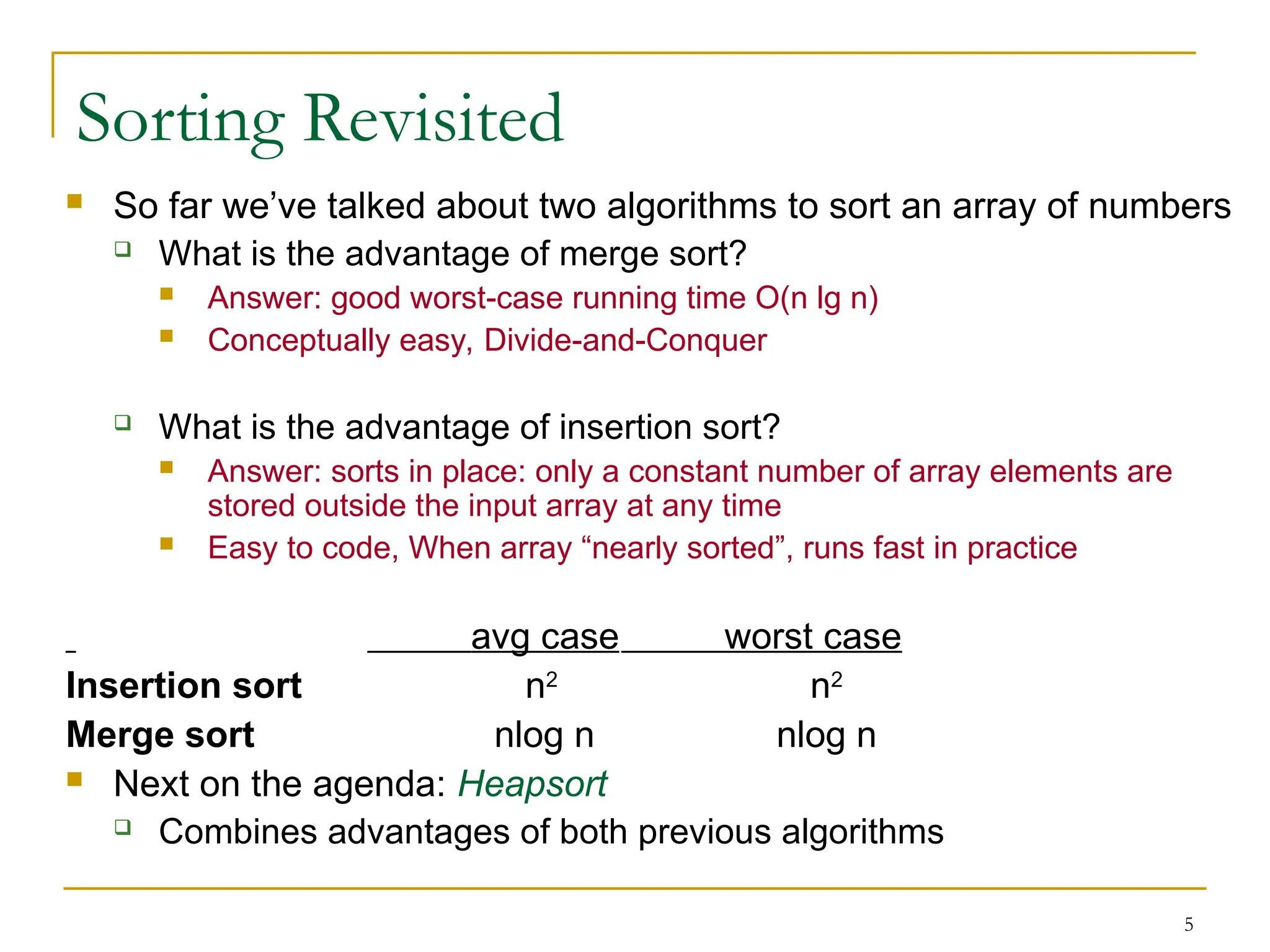
Sofar we’ve talked about two algorithms to sort an array of numbers
What is the advantage of merge sort?
Answer: good worst-case running time O(n lg n)
Conceptually easy, Divide-and-Conquer
What is the advantage of insertion sort?
Answer: sorts in place: only a constant number of array elements are
stored outside the input array at any time
Easy to code, When array “nearly sorted”, runs fast in practice
avg case worst case
Insertion sort n2
n2
Merge sort nlog n nlog n
Next on the agenda: Heapsort
Combines advantages of both previous algorithms
3.
6
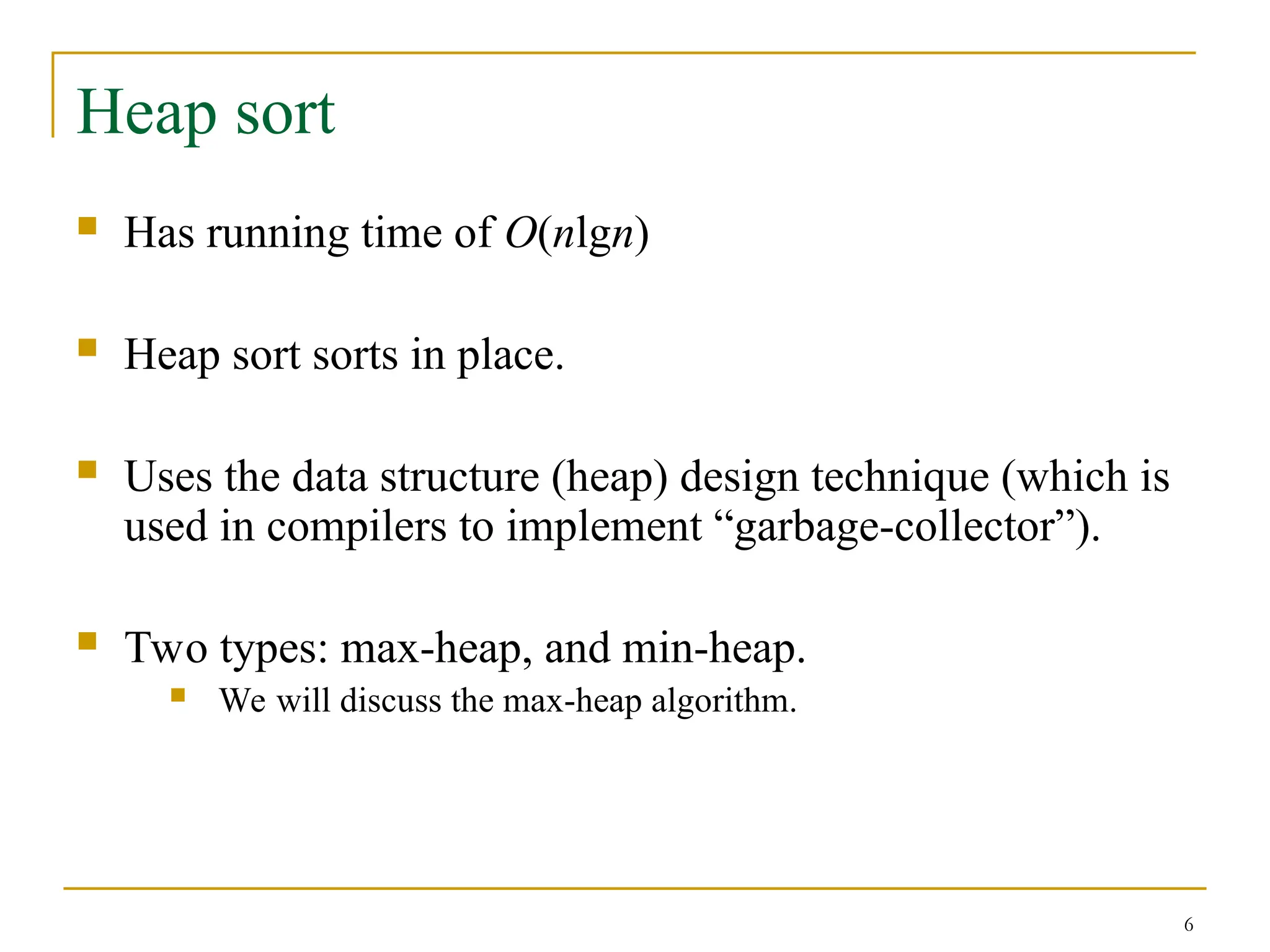
Heap sort
Hasrunning time of O(nlgn)
Heap sort sorts in place.
Uses the data structure (heap) design technique (which is
used in compilers to implement “garbage-collector”).
Two types: max-heap, and min-heap.
We will discuss the max-heap algorithm.
4.
7
Heaps
A heapcan be seen as a complete binary tree
The tree is completely filled on all levels except possibly the lowest.
In practice, heaps are usually implemented as arrays
An array A that represent a heap is an object with two attributes:
A[1 .. length[A]]
length[A]: # of elements in the array
heap-size[A]: # of elements in the heap stored within array A, where
heap-size[A] ≤ length[A]
No element past A[heap-size[A]] is an element of the heap
16 14 10 8 7 9 3 2 4 1
A =
9
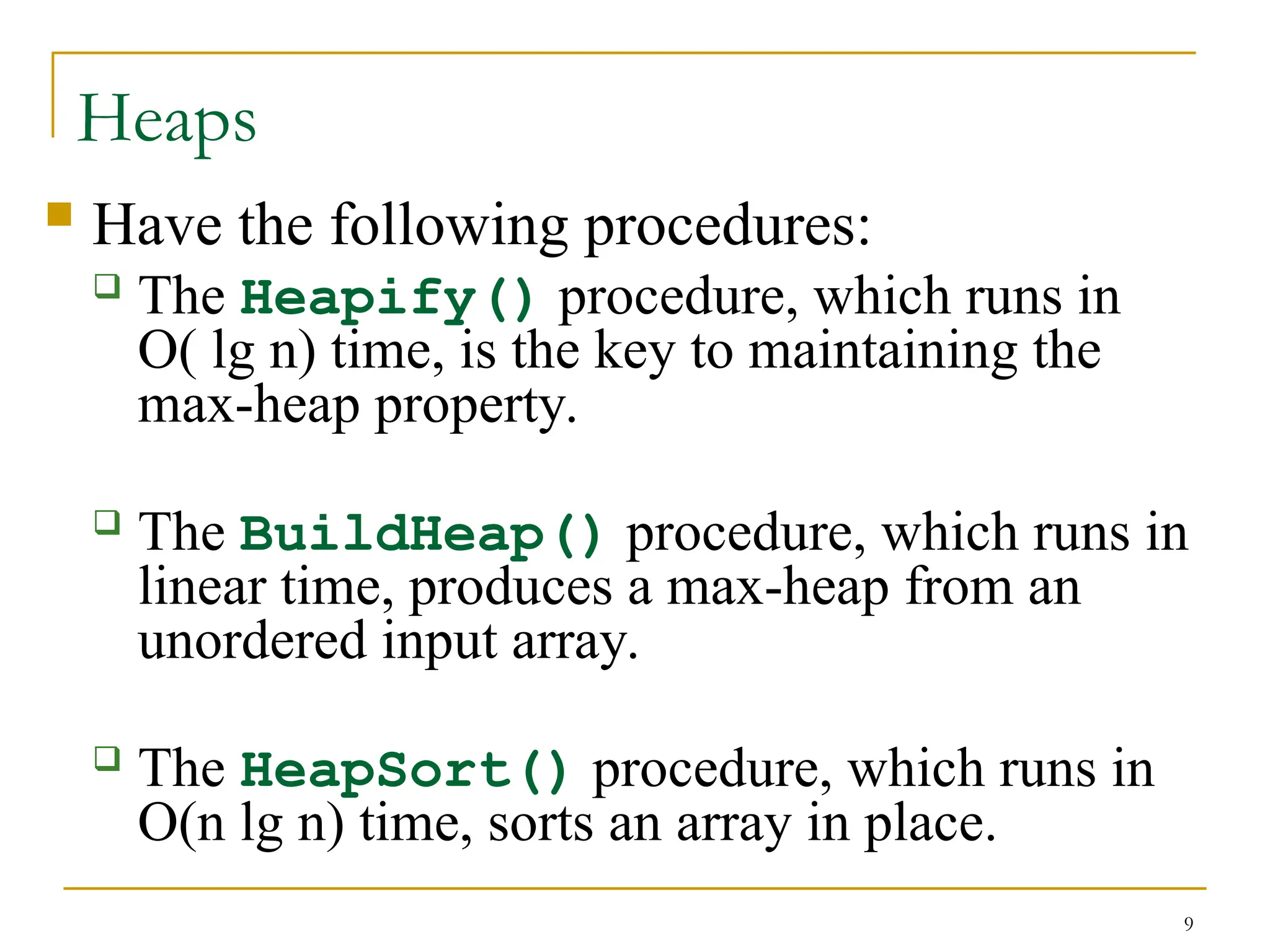
Heaps
Have thefollowing procedures:
The Heapify() procedure, which runs in
O( lg n) time, is the key to maintaining the
max-heap property.
The BuildHeap() procedure, which runs in
linear time, produces a max-heap from an
unordered input array.
The HeapSort() procedure, which runs in
O(n lg n) time, sorts an array in place.
7.
10
The Heap Property
Heaps also satisfy the heap property (max-
heap):
A[Parent(i)] A[i] for all nodes i > 1
In other words, the value of a node is at most the
value of its parent
The largest value in a heap is at its root (A[1])
and subtrees rooted at a specific node contain
values no larger than that node’s value
8.
11
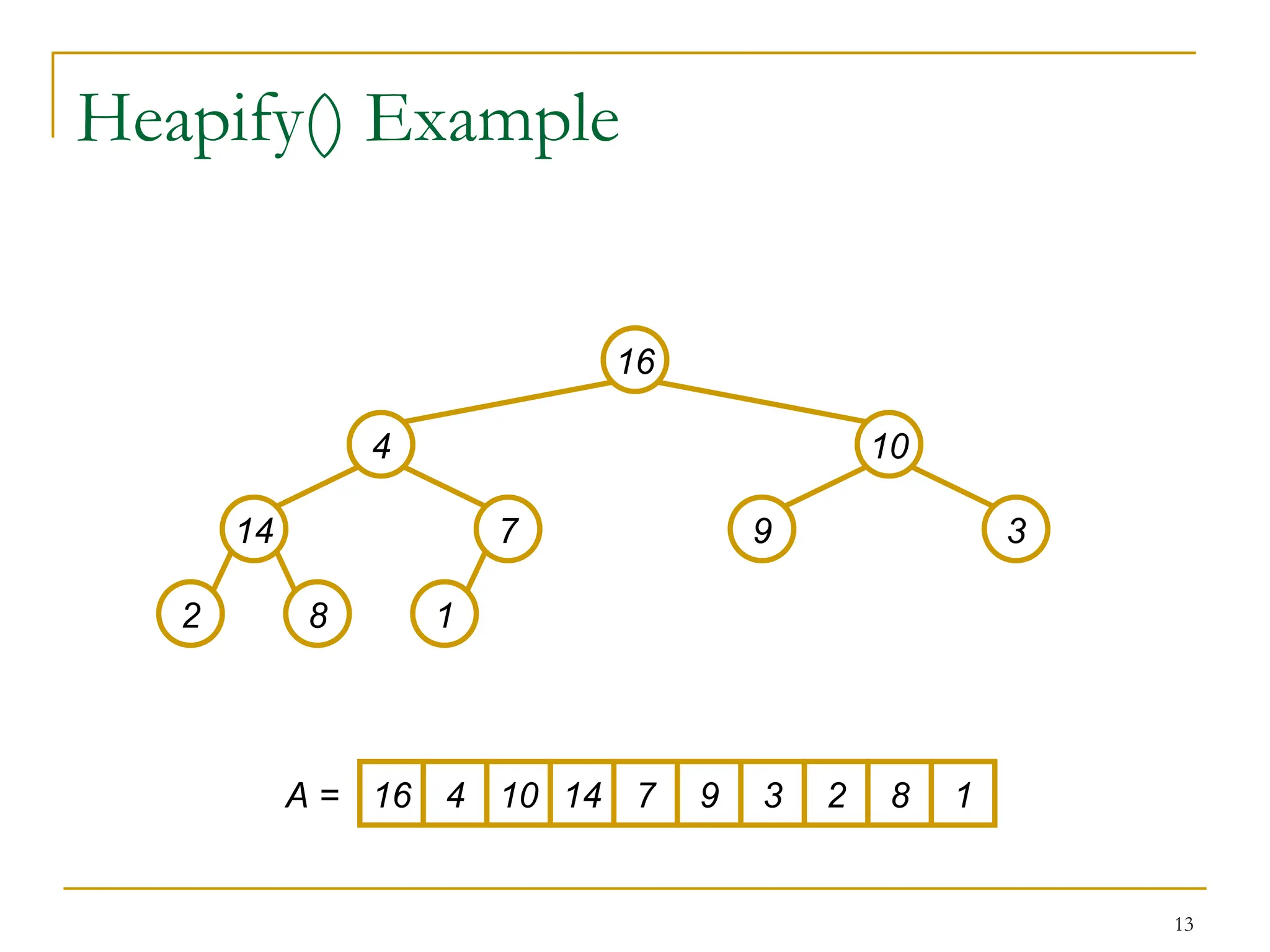
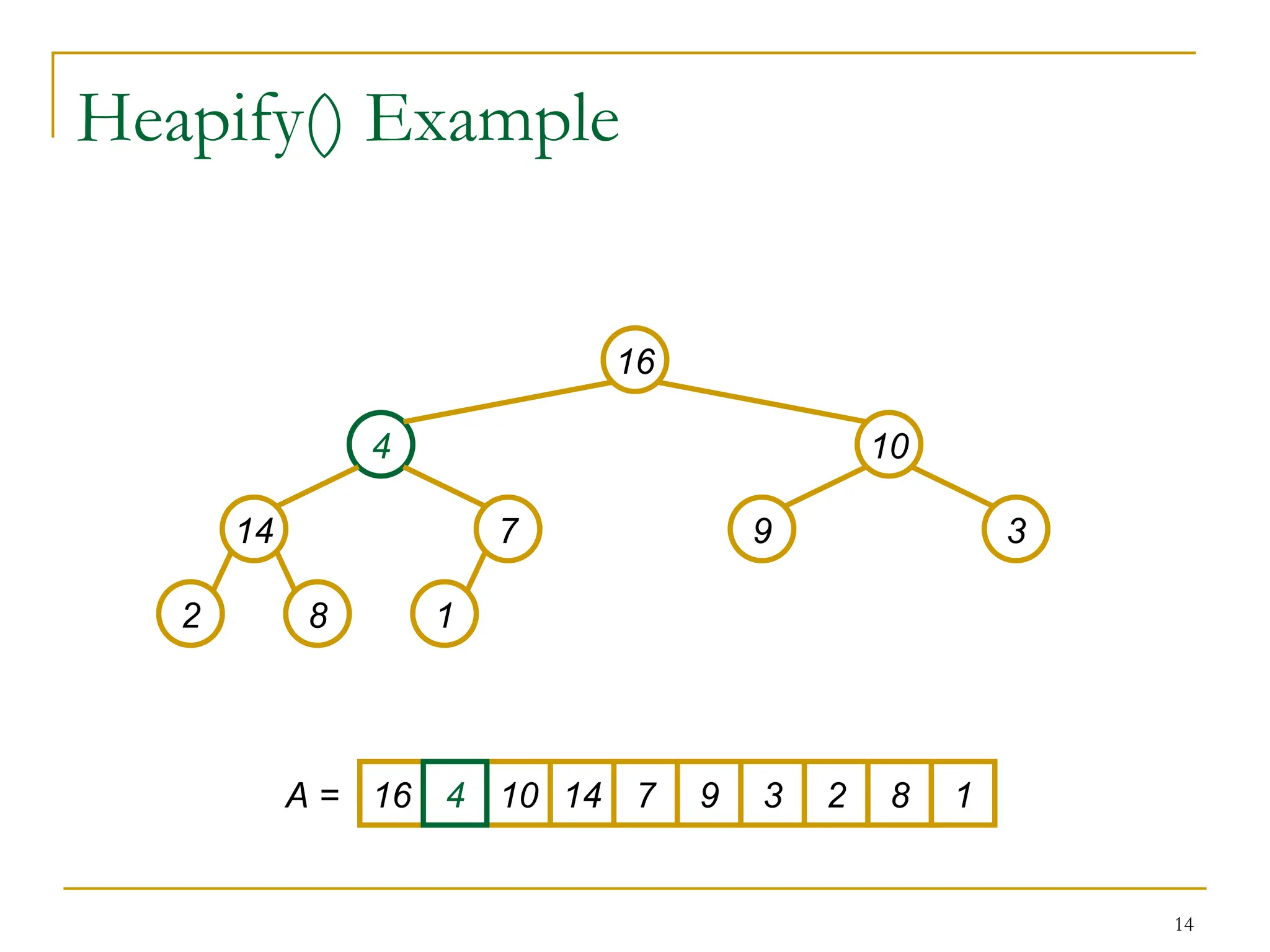
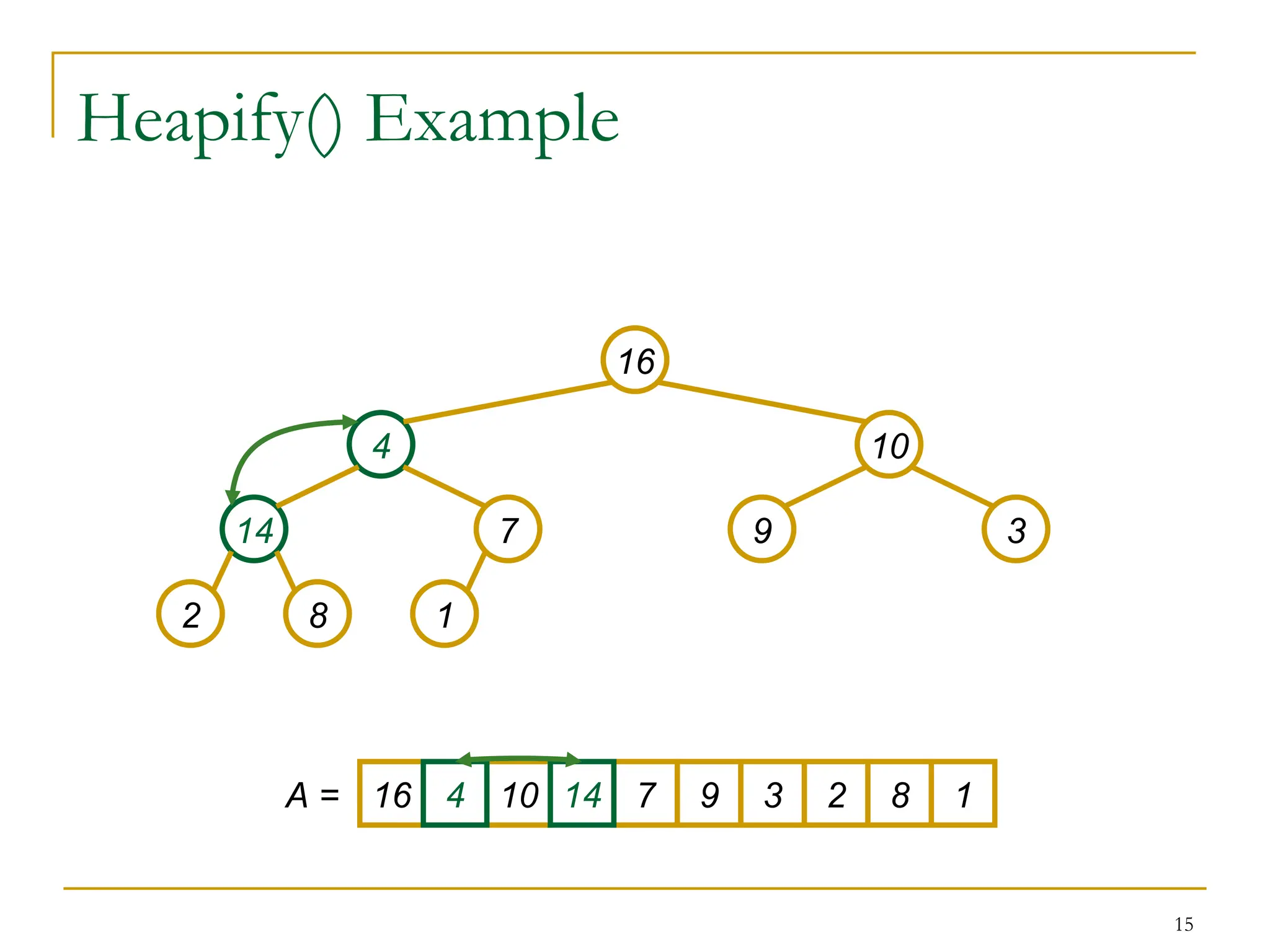
Heap Operations: Heapify
)(
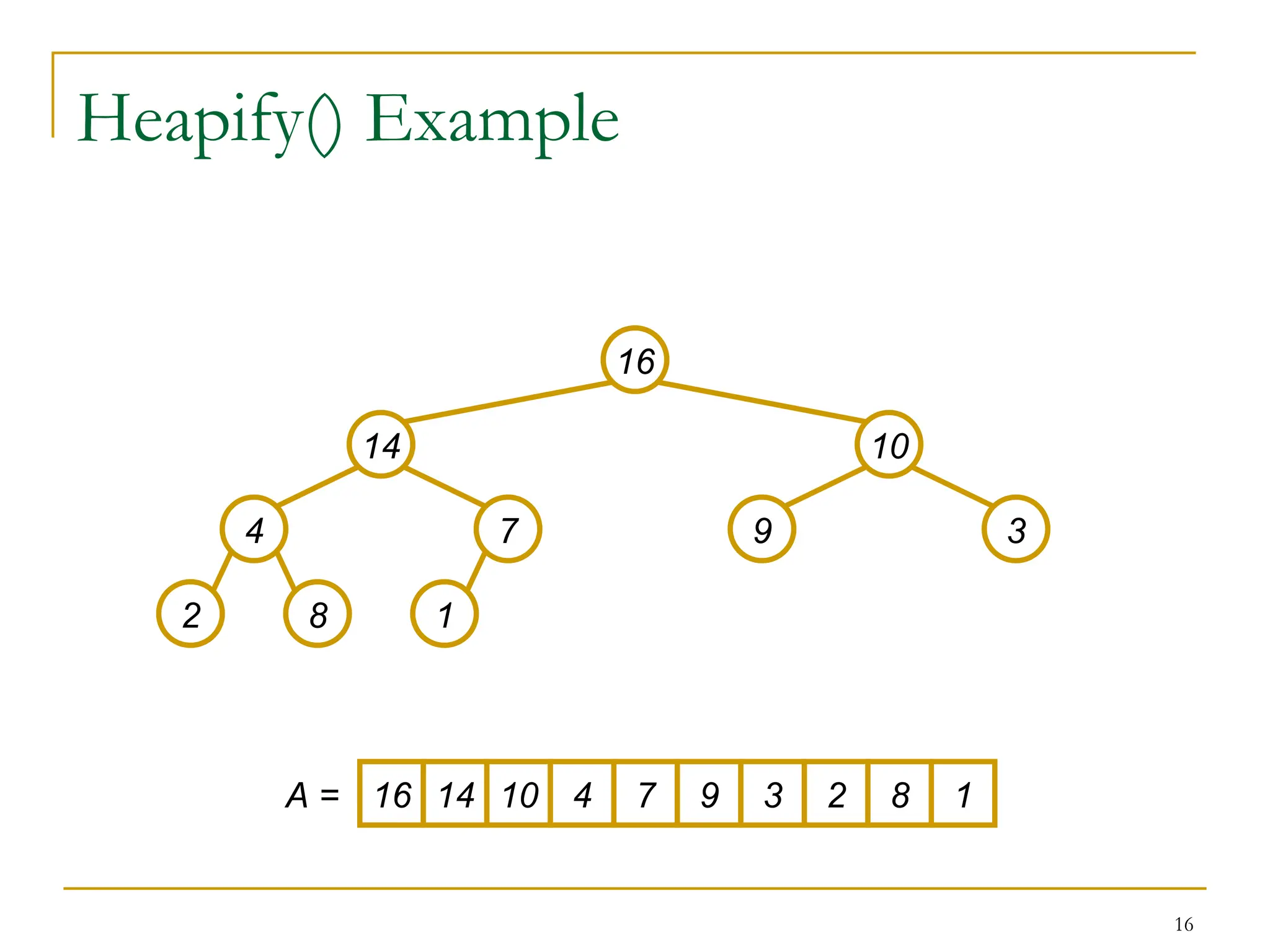
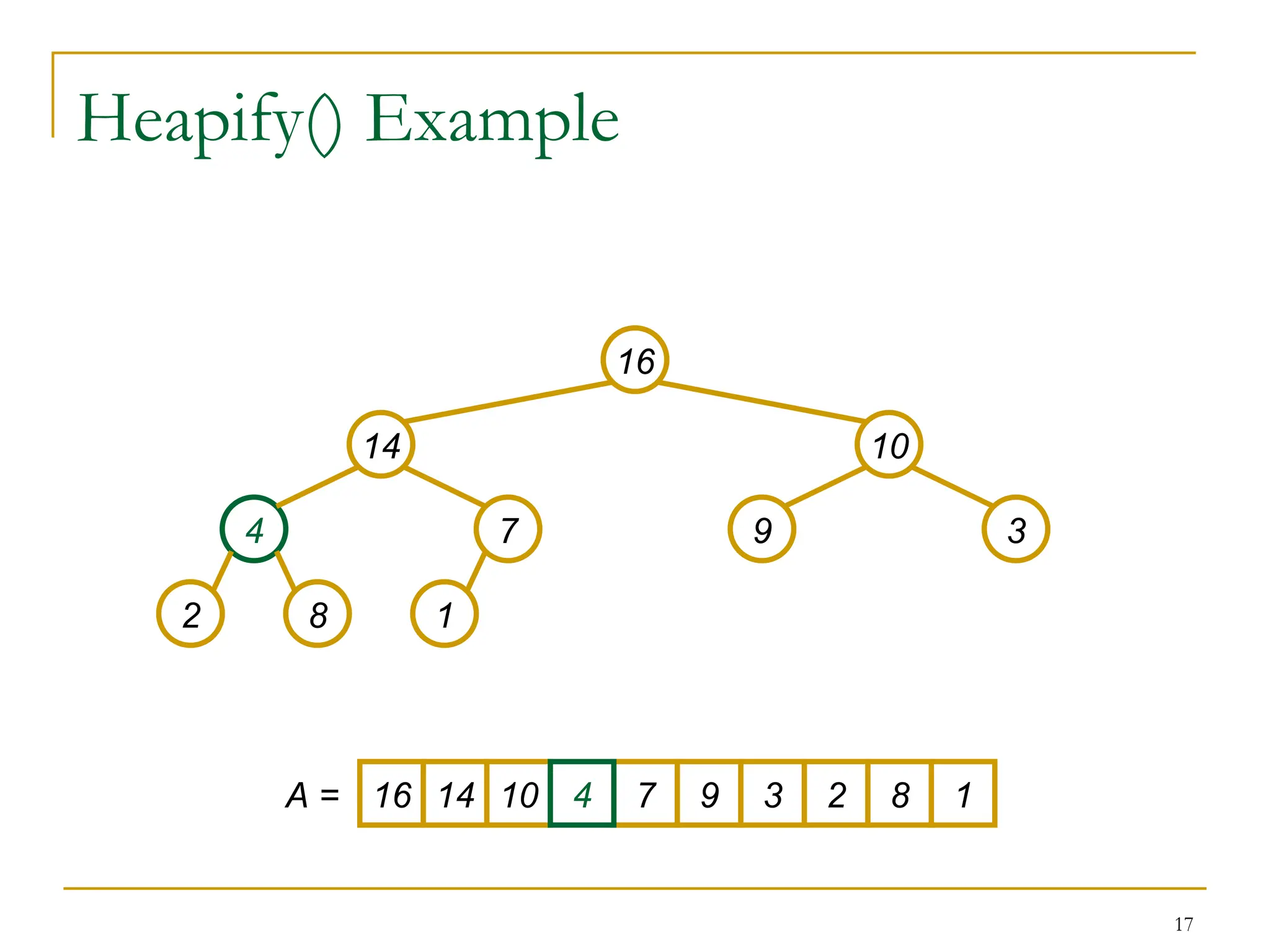
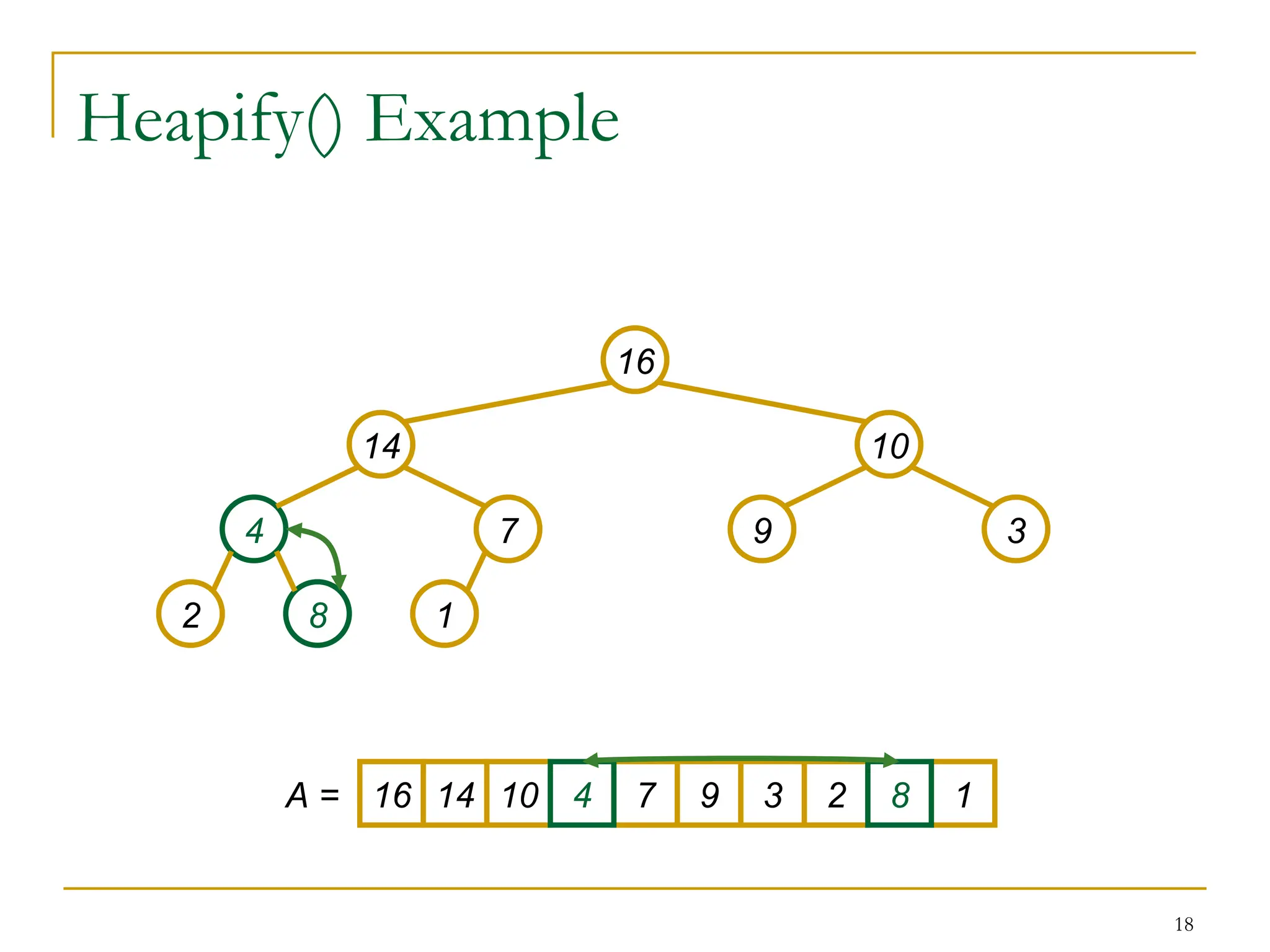
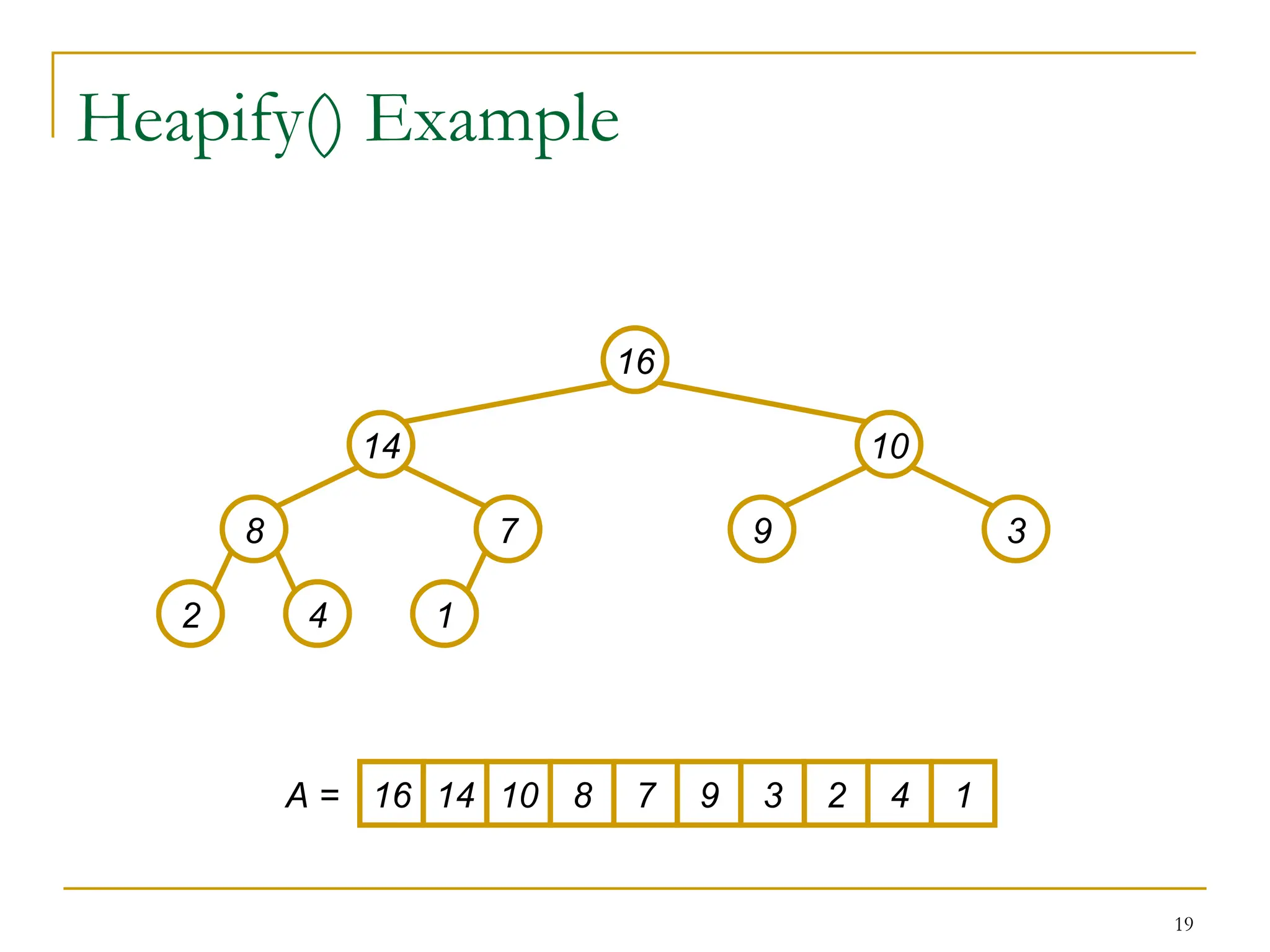
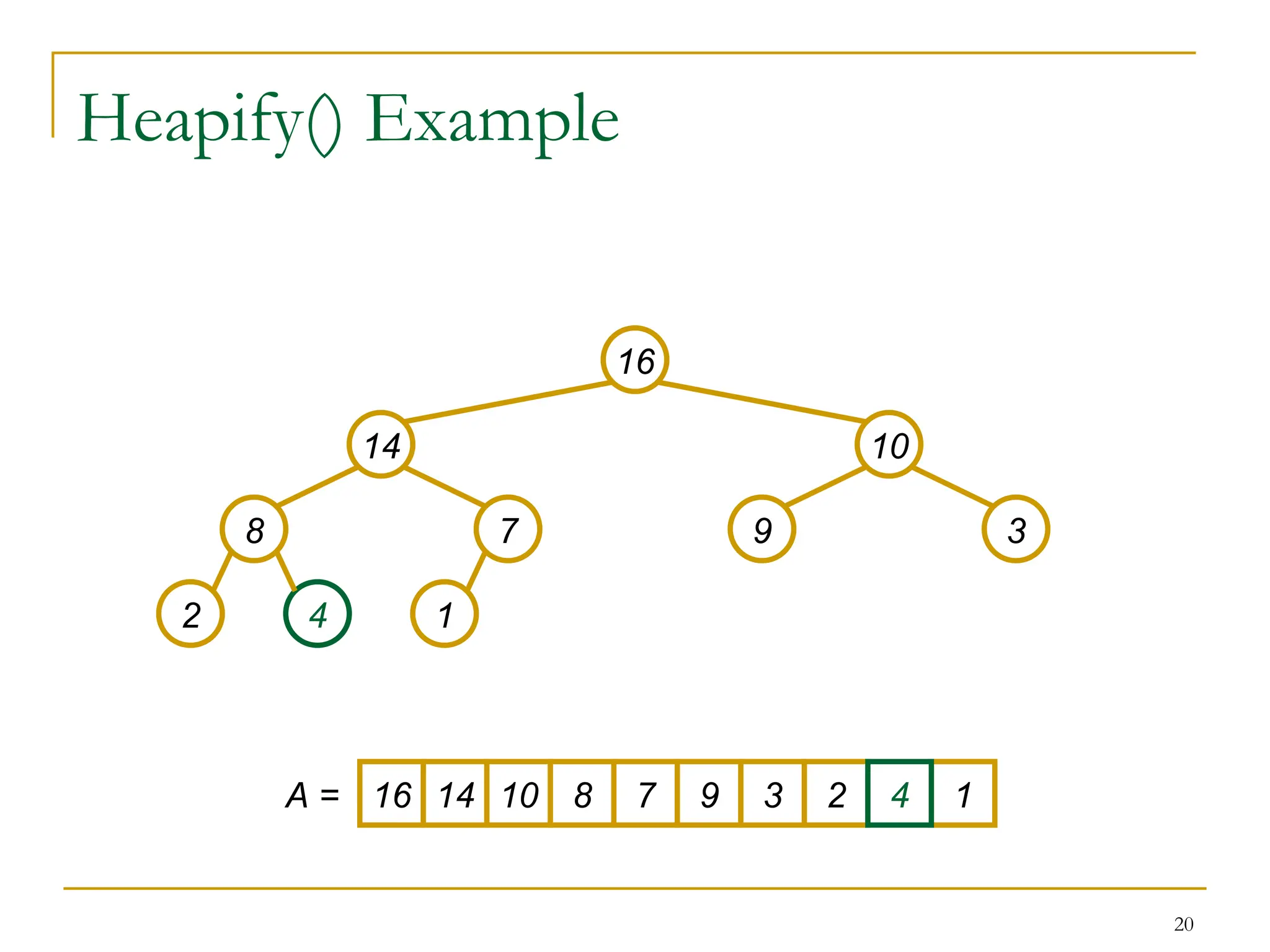
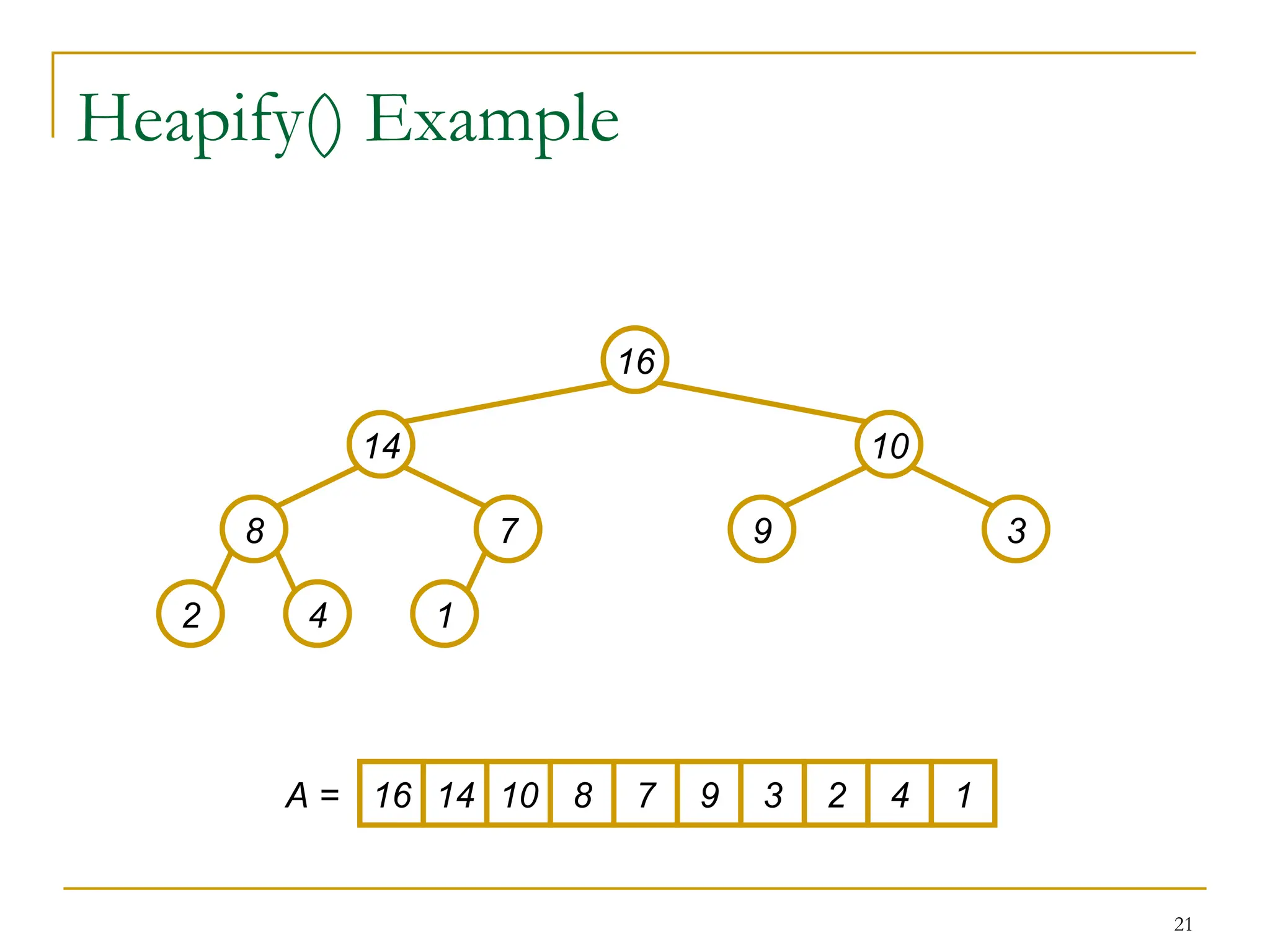
Heapify(): maintain the heap property
Given: a node i in the heap with children L and R
two subtrees rooted at L and R, assumed to be
heaps
Problem: The subtree rooted at i may violate the heap
property (How?)
A[i] may be smaller than its children value
Action: let the value of the parent node “float down” so
subtree at i satisfies the heap property
If A[i] < A[L] or A[i] < A[R], swap A[i] with the
largest of A[L] and A[R]
Recurs on that subtree
9.
12
Heap Operations: Heapify
)(
Heapify(A,i)
{
1. L left(i)
2. R right(i)
3. if L heap-size[A] and A[L] > A[i]
4. then largest L
5. else largest i
6. if R heap-size[A] and A[R] > A[largest]
7. then largest R
8. if largest i
9. then exchange A[i] A[largest]
10. Heapify(A, largest)
}
22
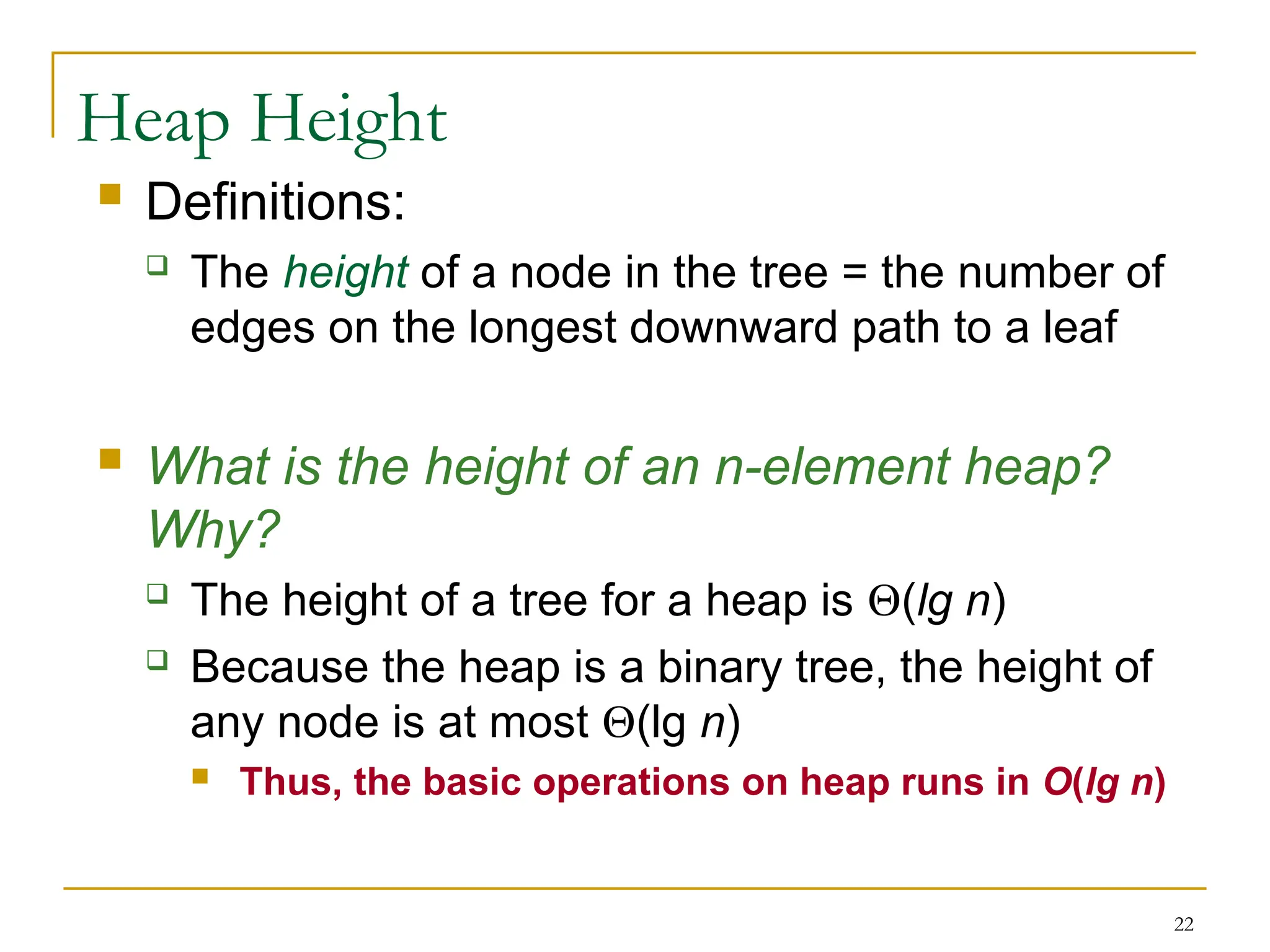
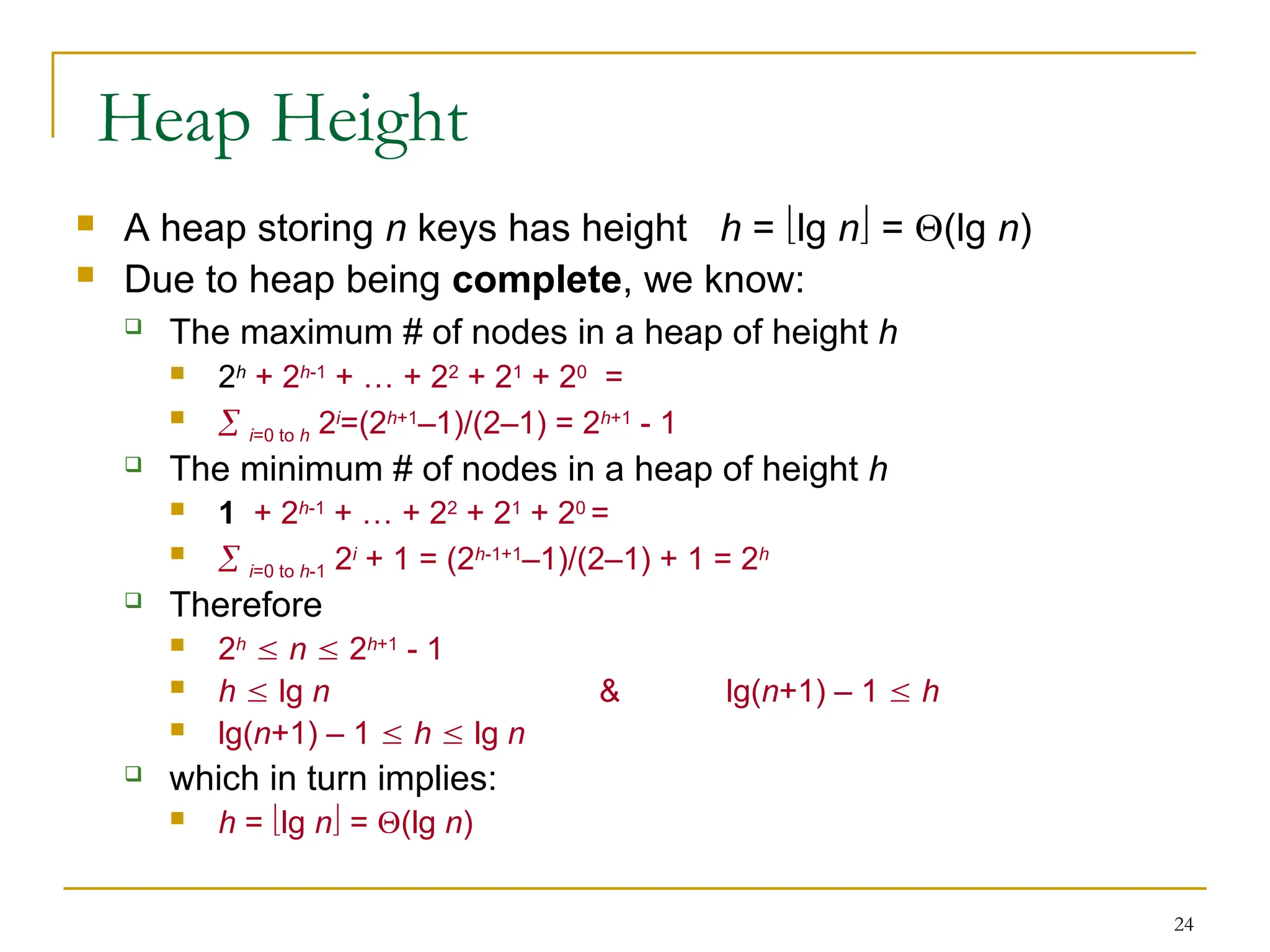
Heap Height
Definitions:
The height of a node in the tree = the number of
edges on the longest downward path to a leaf
What is the height of an n-element heap?
Why?
The height of a tree for a heap is (lg n)
Because the heap is a binary tree, the height of
any node is at most (lg n)
Thus, the basic operations on heap runs in O(lg n)
20.
23
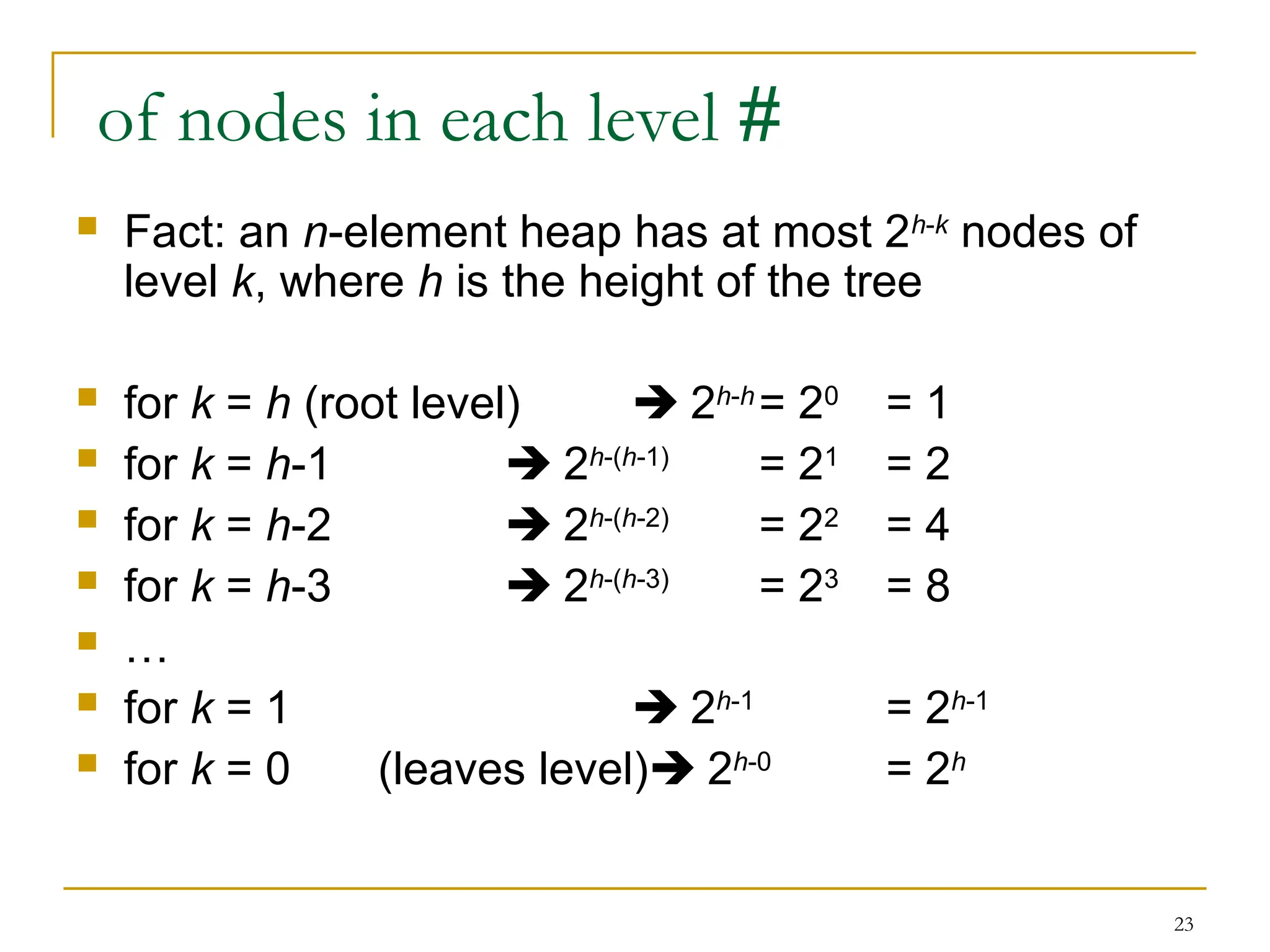
#
of nodes ineach level
Fact: an n-element heap has at most 2h-k
nodes of
level k, where h is the height of the tree
for k = h (root level) 2h-h
= 20
= 1
for k = h-1 2h-(h-1)
= 21
= 2
for k = h-2 2h-(h-2)
= 22
= 4
for k = h-3 2h-(h-3)
= 23
= 8
…
for k = 1 2h-1
= 2h-1
for k = 0 (leaves level) 2h-0
= 2h
21.
24
Heap Height
Aheap storing n keys has height h = lg n = (lg n)
Due to heap being complete, we know:
The maximum # of nodes in a heap of height h
2h
+ 2h-1
+ … + 22
+ 21
+ 20
=
i=0 to h 2i
=(2h+1
–1)/(2–1) = 2h+1
- 1
The minimum # of nodes in a heap of height h
1 + 2h-1
+ … + 22
+ 21
+ 20
=
i=0 to h-1 2i
+ 1 = (2h-1+1
–1)/(2–1) + 1 = 2h
Therefore
2h
n 2h+1
- 1
h lg n & lg(n+1) – 1 h
lg(n+1) – 1 h lg n
which in turn implies:
h = lg n = (lg n)
22.
26
Analyzing Heapify
)(
Therunning time at any given node i is
(1) time to fix up the relationships among A[i],
A[Left(i)] and A[Right(i)]
plus the time to call Heapify recursively on a sub-
tree rooted at one of the children of node I
And, the children’s subtrees each have size
at most 2n/3
23.
27
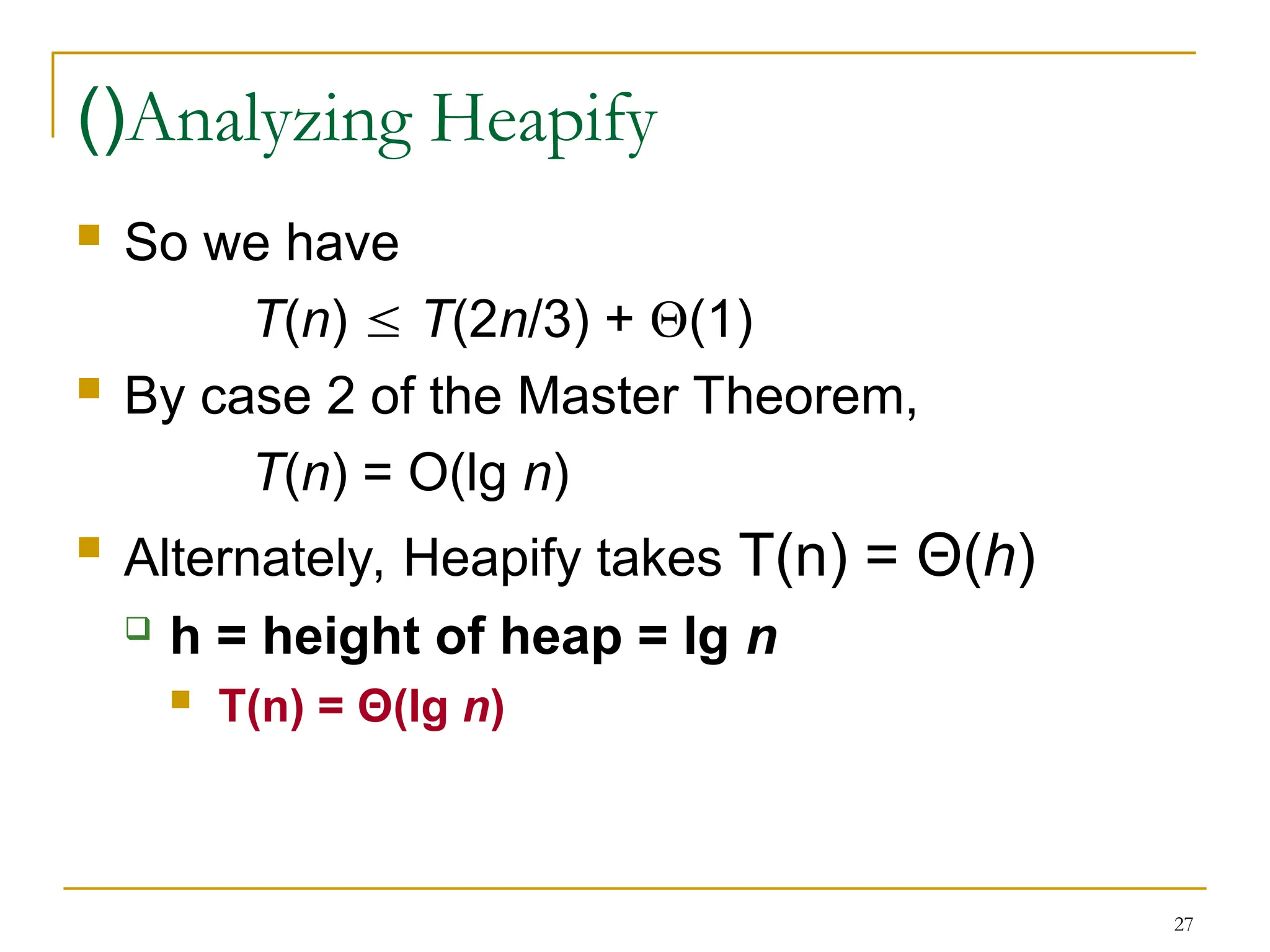
Analyzing Heapify
)(
Sowe have
T(n) T(2n/3) + (1)
By case 2 of the Master Theorem,
T(n) = O(lg n)
Alternately, Heapify takes T(n) = Θ(h)
h = height of heap = lg n
T(n) = Θ(lg n)
24.
28
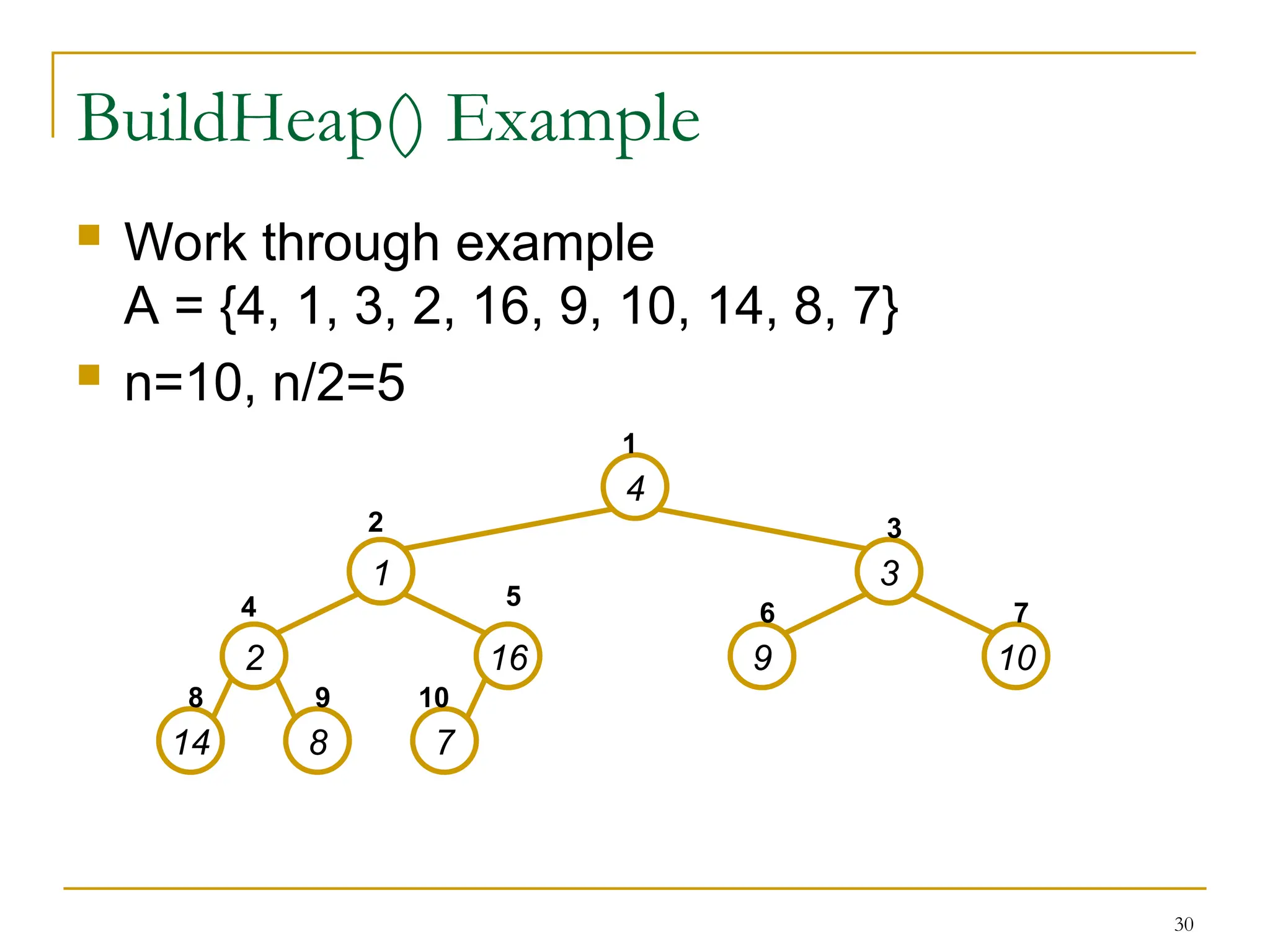
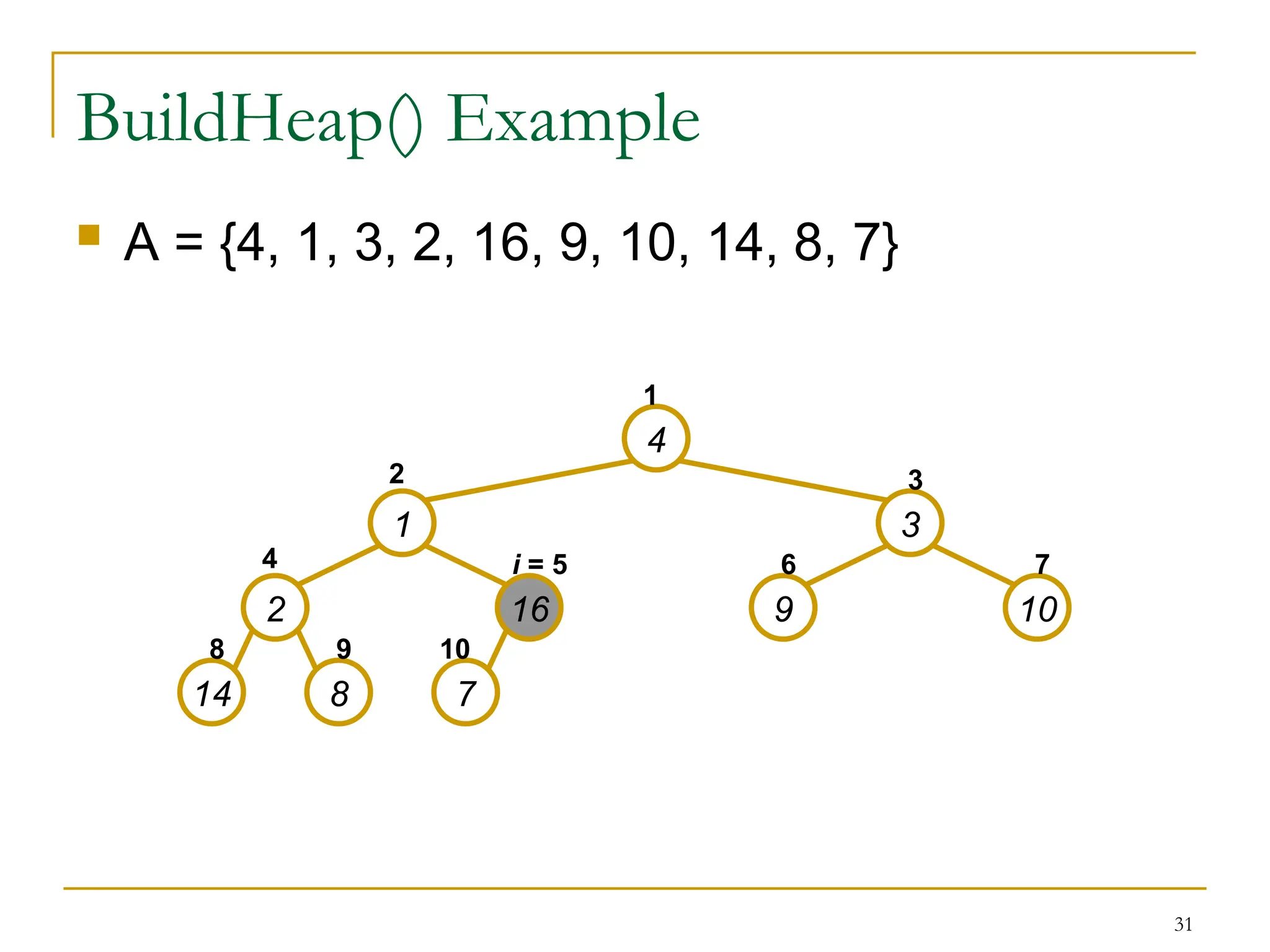
Heap Operations: BuildHeap
)(
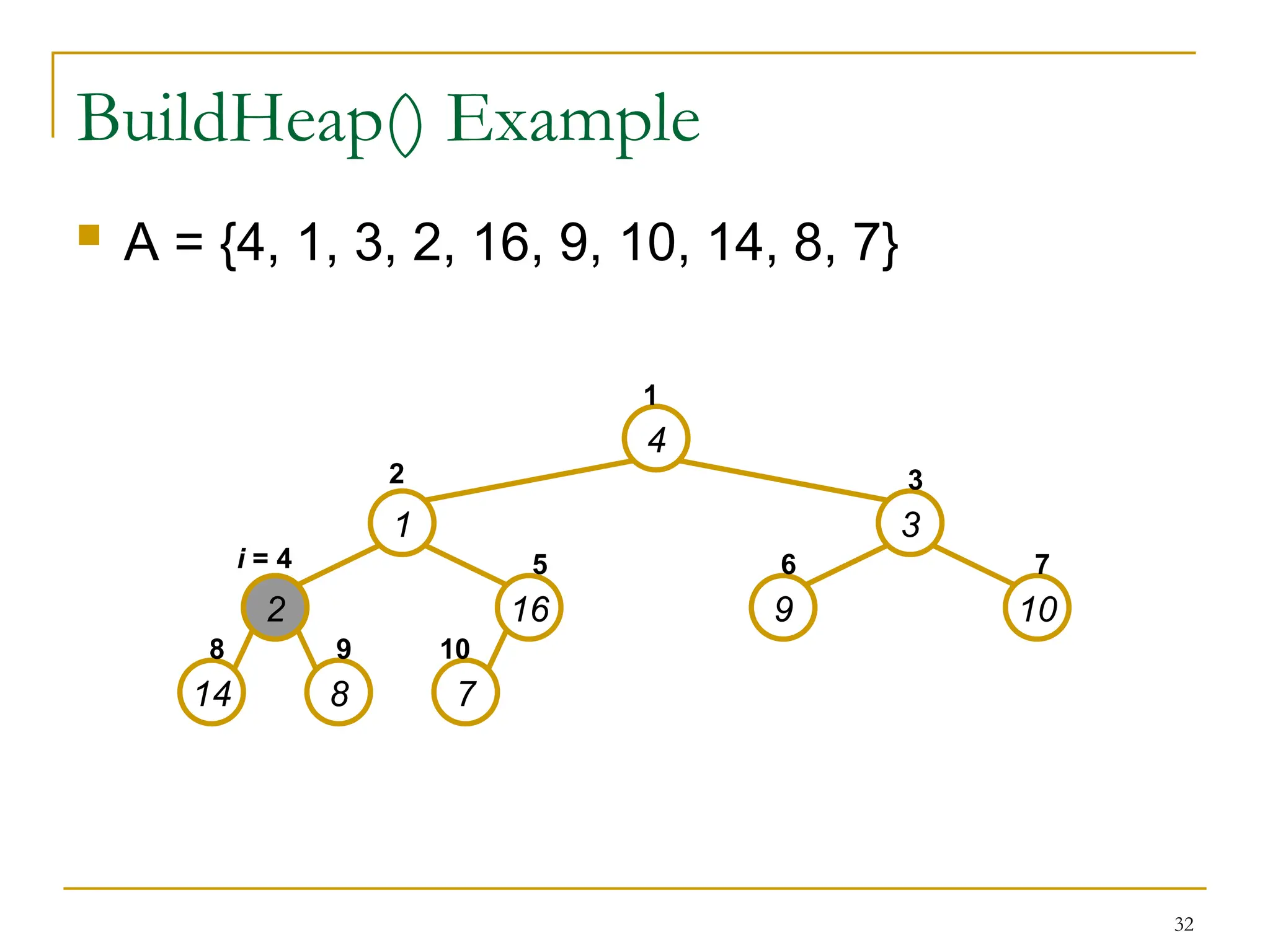
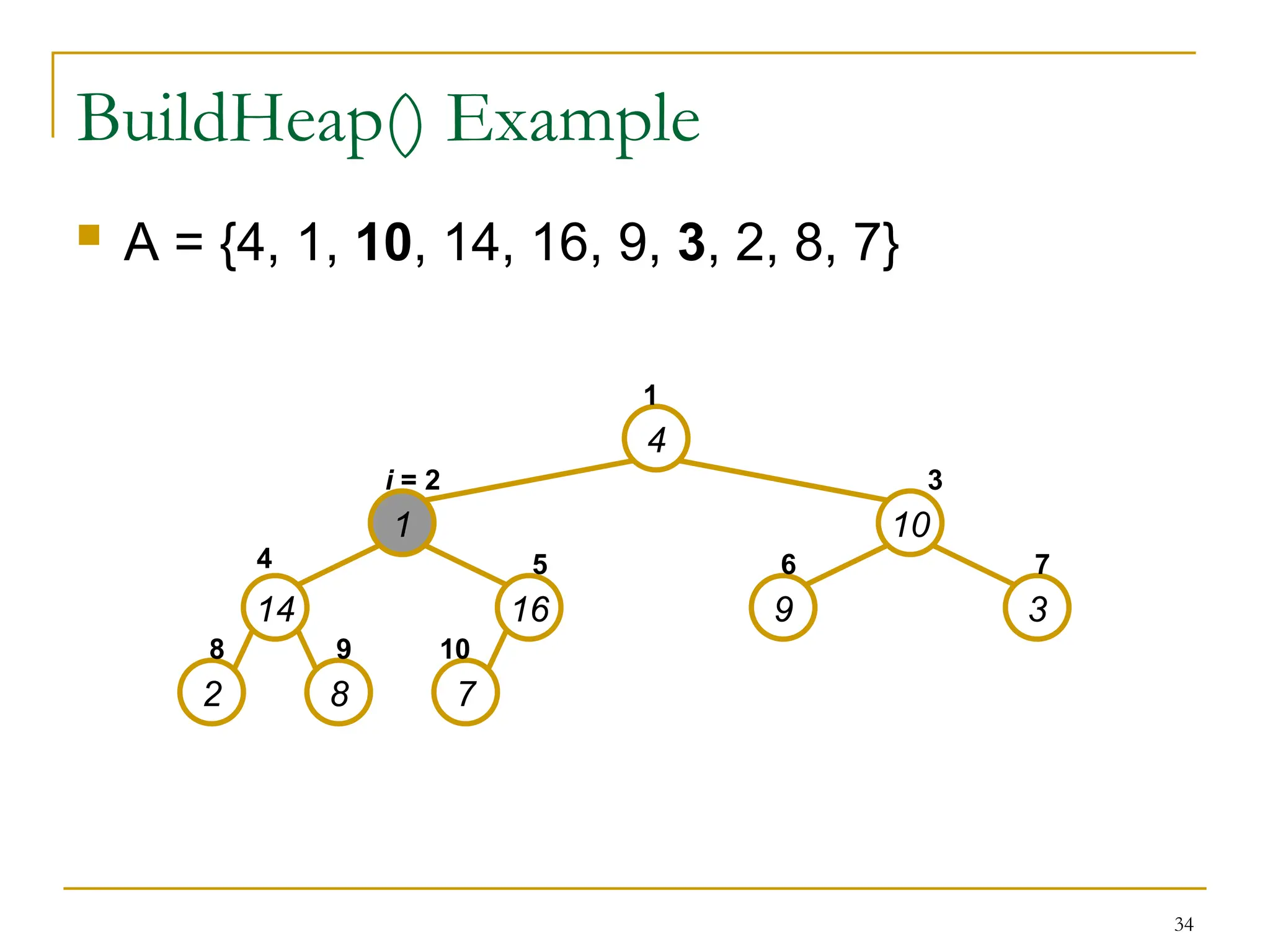
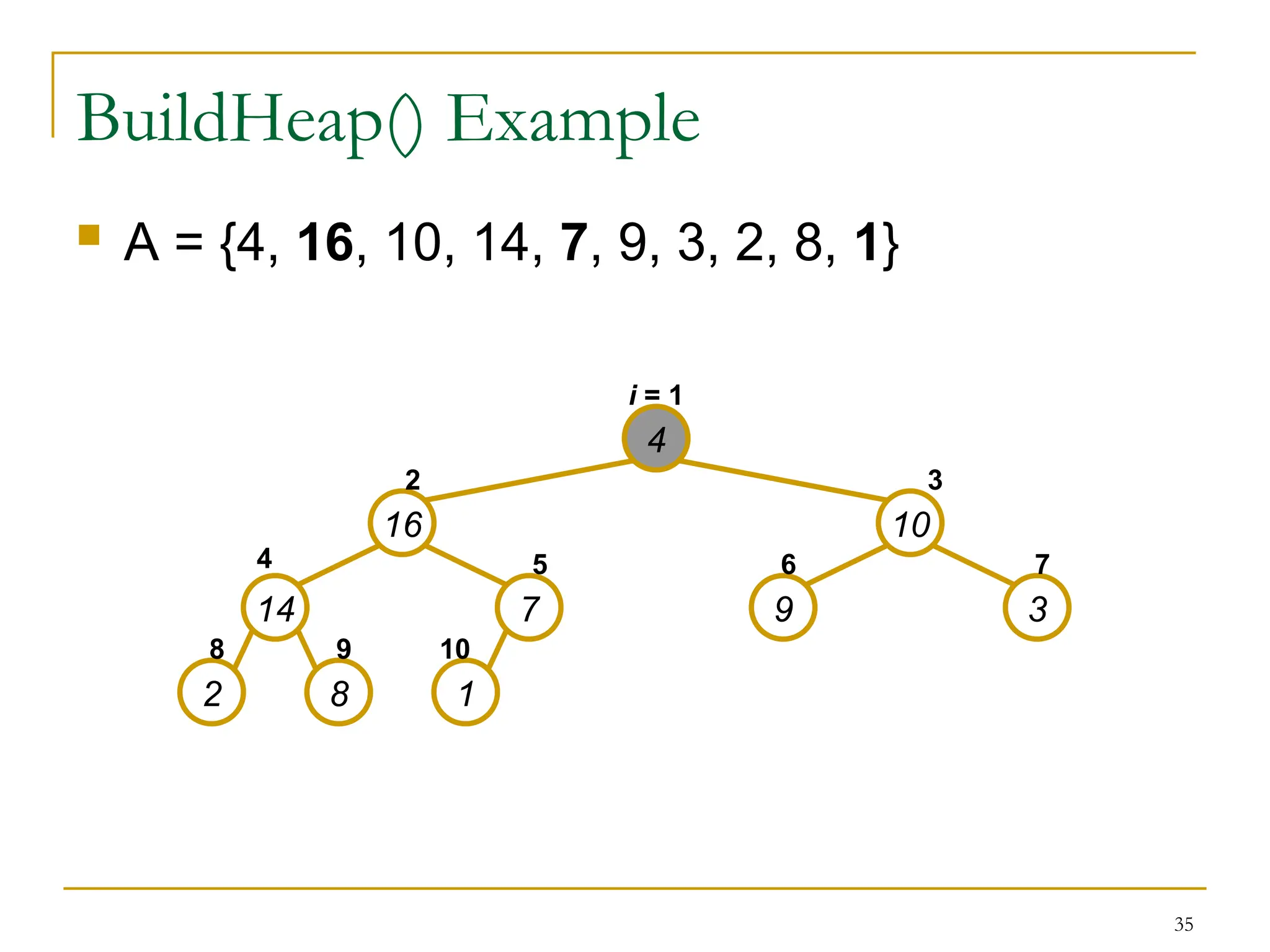
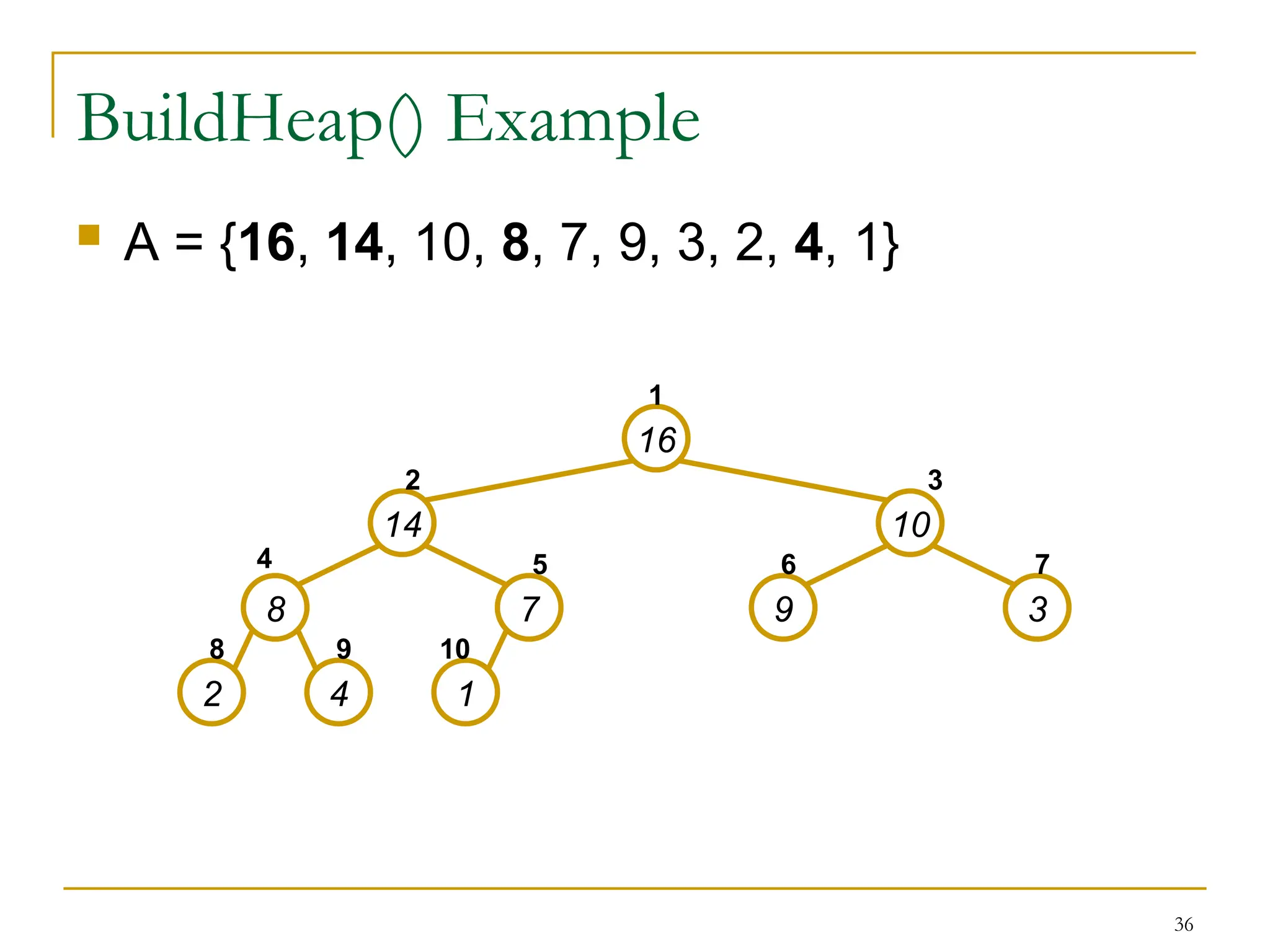
We can build a heap in a bottom-up manner by
running Heapify() on successive subarrays
Fact: for array of length n, all elements in range
A[n/2 + 1, n/2 + 2 .. n] are heaps (Why?)
These elements are leaves, they do not have children
We also know that the leave-level has at most 2h
nodes = n/2 nodes
and other levels have a total of n/2 nodes
Walk backwards through the array from n/2 to
1, calling Heapify() on each node.
25.
29
BuildHeap
)(
// given anunsorted array A, make A a heap
BuildHeap(A)
{
1. heap-size[A] length[A]
2. for i length[A]/2 downto 1
3. do Heapify(A, i)
}
The Build Heap procedure, which runs in linear time,
produces a max-heap from an unsorted input array.
However, the Heapify procedure, which runs in
O(lg n) time, is the key to maintaining the heap property.
37
Analyzing BuildHeap
)(
Eachcall to Heapify() takes O(lg n) time
There are O(n) such calls (specifically, n/2)
Thus the running time is O(n lg n)
Is this a correct asymptotic upper bound?
YES
Is this an asymptotically tight bound?
NO
A tighter bound is O(n)
How can this be? Is there a flaw in the above reasoning?
We can derive a tighter bound by observing that the time for
Heapify to run at a node varies with the height of the node in
the tree, and the heights of most nodes are small.
Fact: an n-element heap has at most 2h-k
nodes of
level k, where h is the height of the tree.
34.
38
Analyzing BuildHeap(): Tight
The time required by Heapify on a node of height k is O(k). So
we can express the total cost of BuildHeap as
k=0 to h 2h-k
O(k) = O(2h
k=0 to h k/2k
)
= O(n k=0 to h k(½)k
)
From: k=0 to ∞ k xk
= x/(1-x)2
where x =1/2
So, k=0 to k/2k
= (1/2)/(1 - 1/2)2
= 2
Therefore, O(n k=0 to h k/2k
) = O(n)
So, we can bound the running time for building a heap from
an unordered array in linear time
35.
39
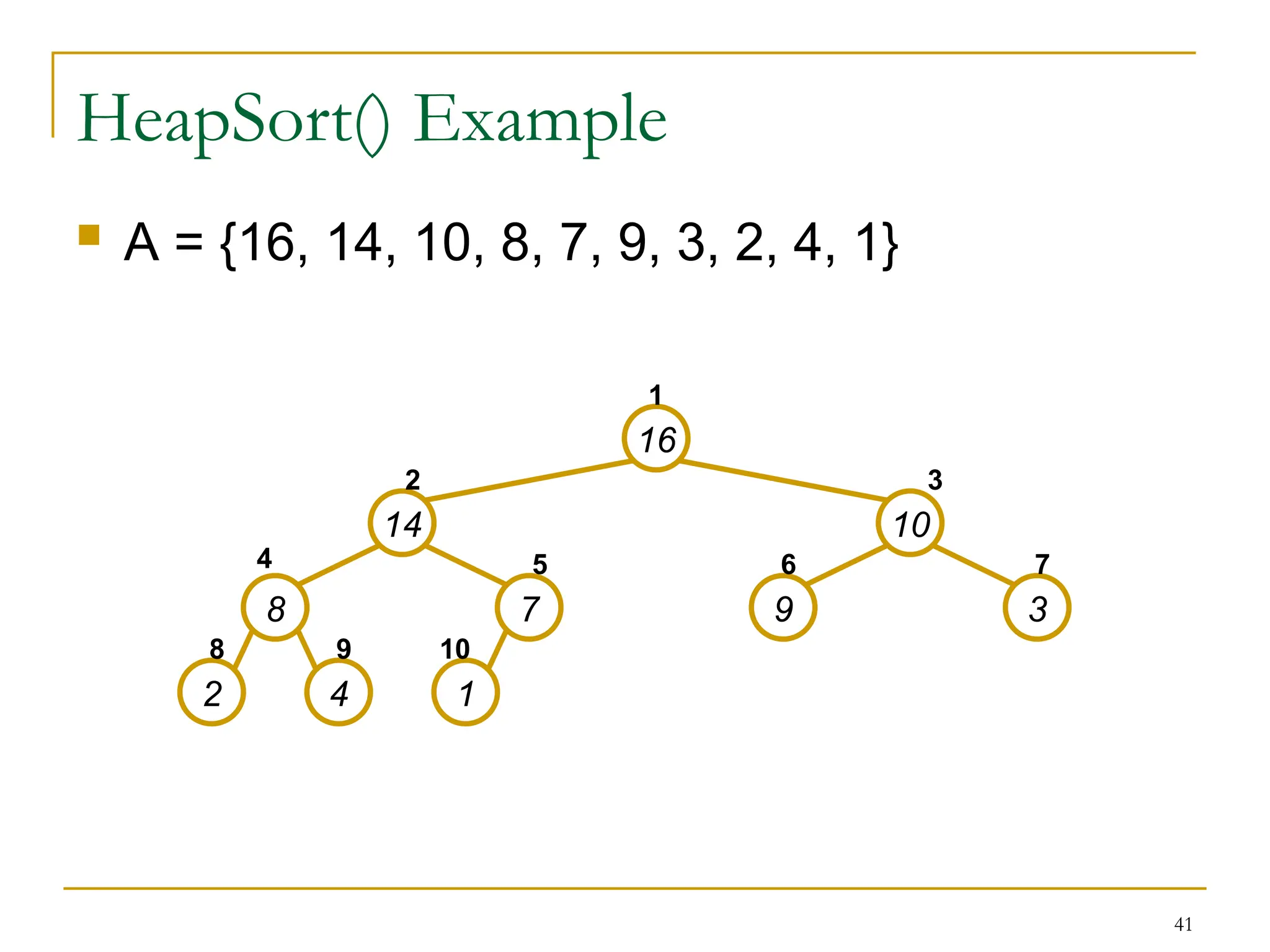
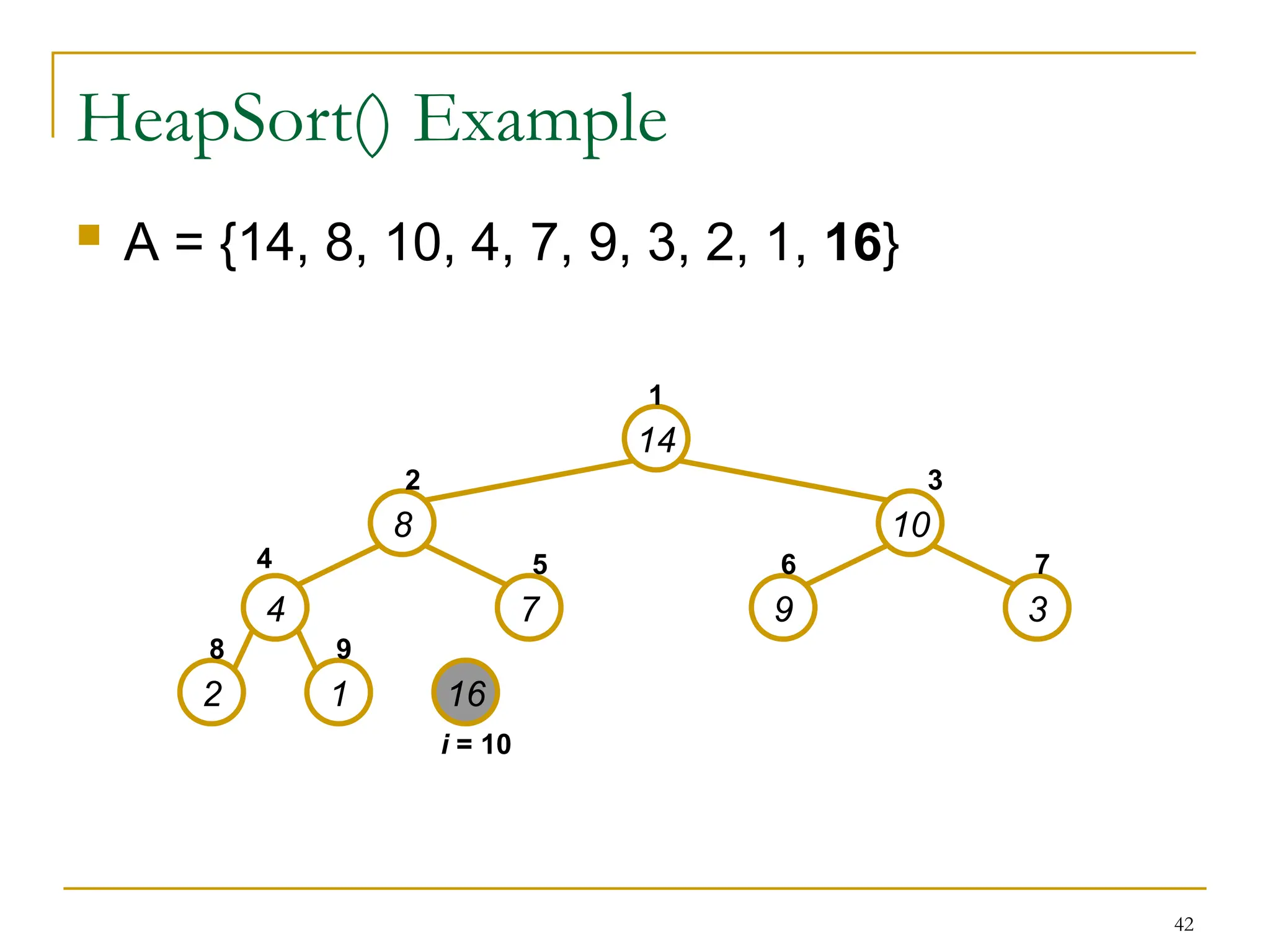
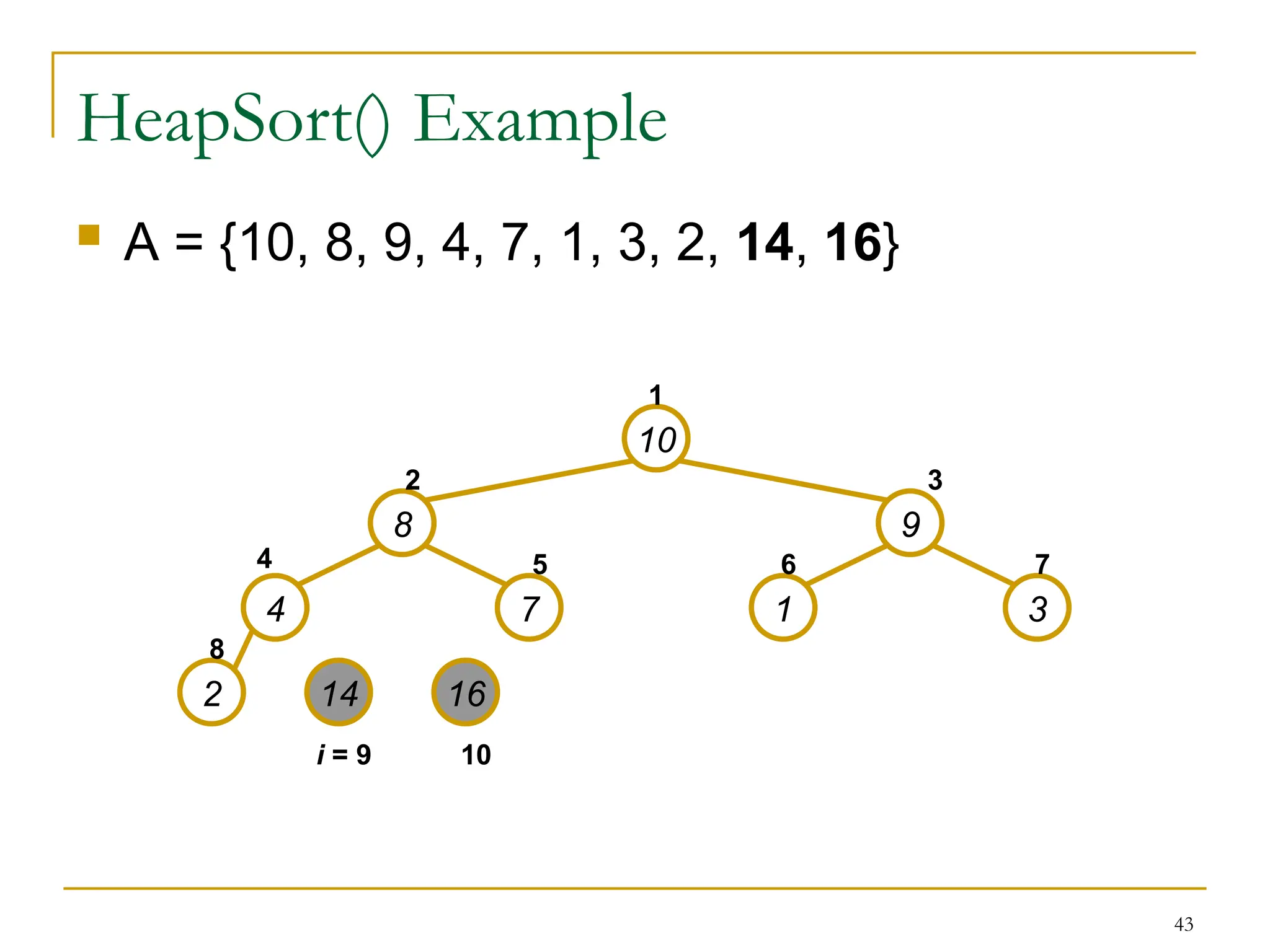
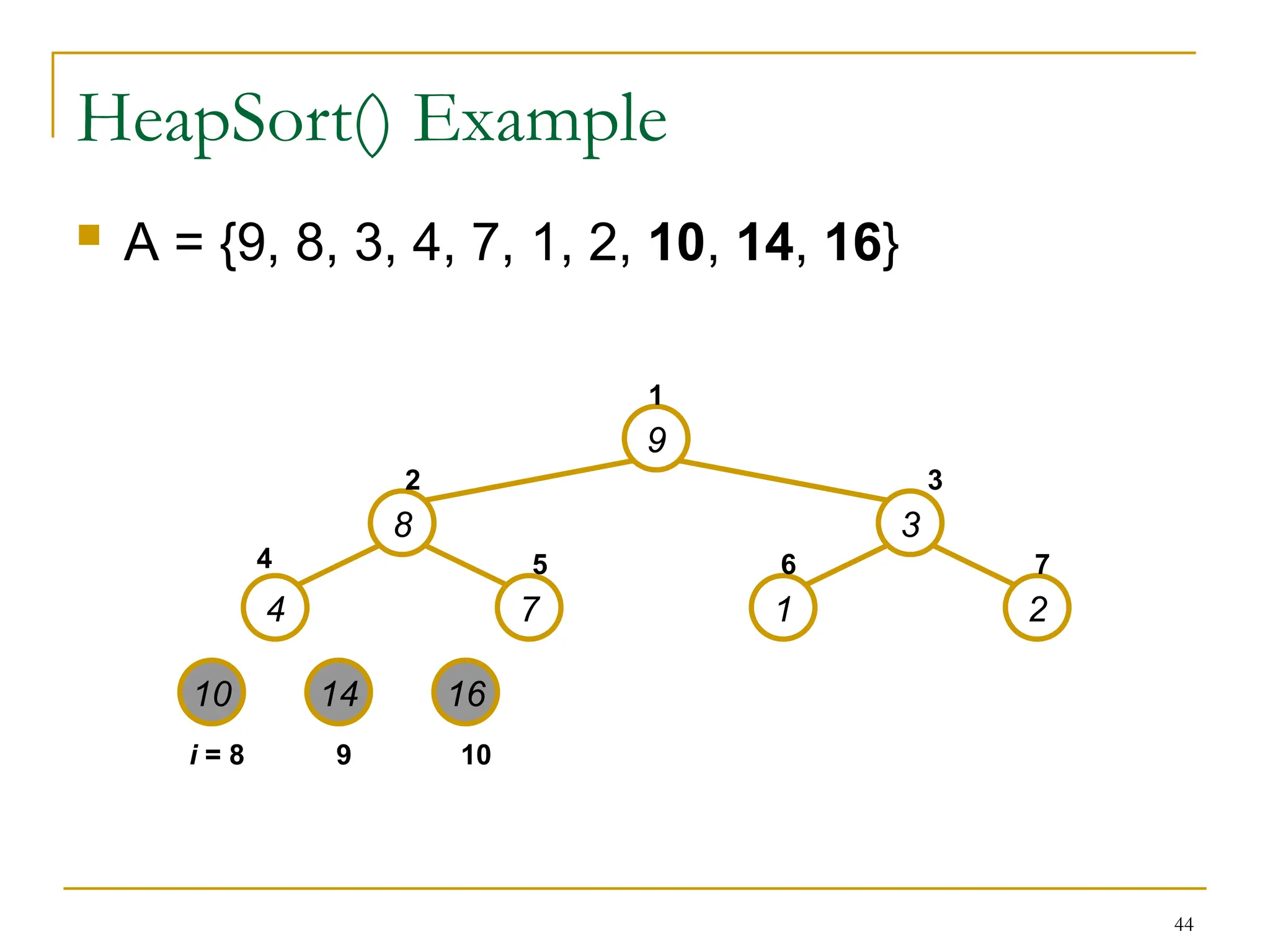
Heapsort
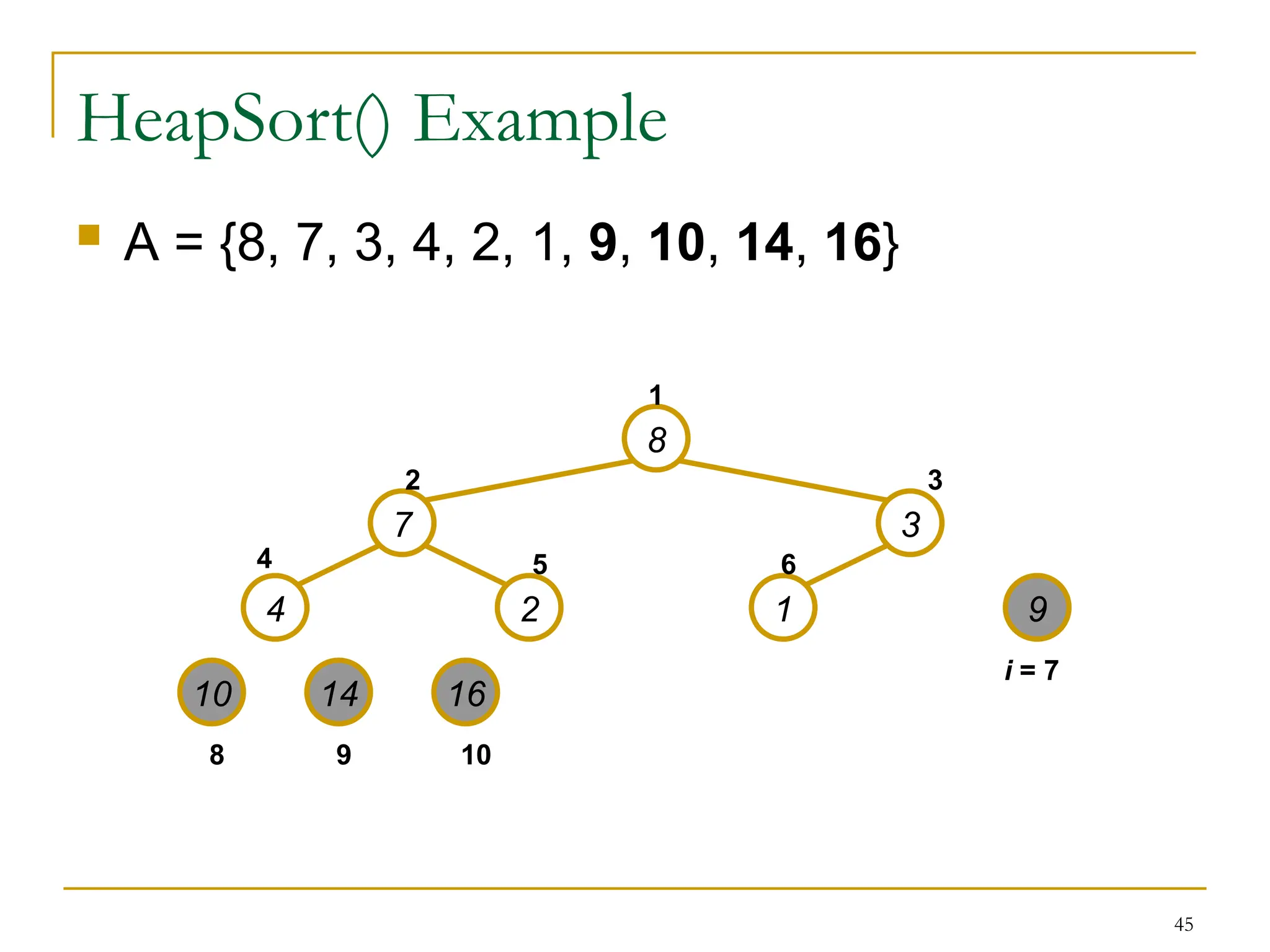
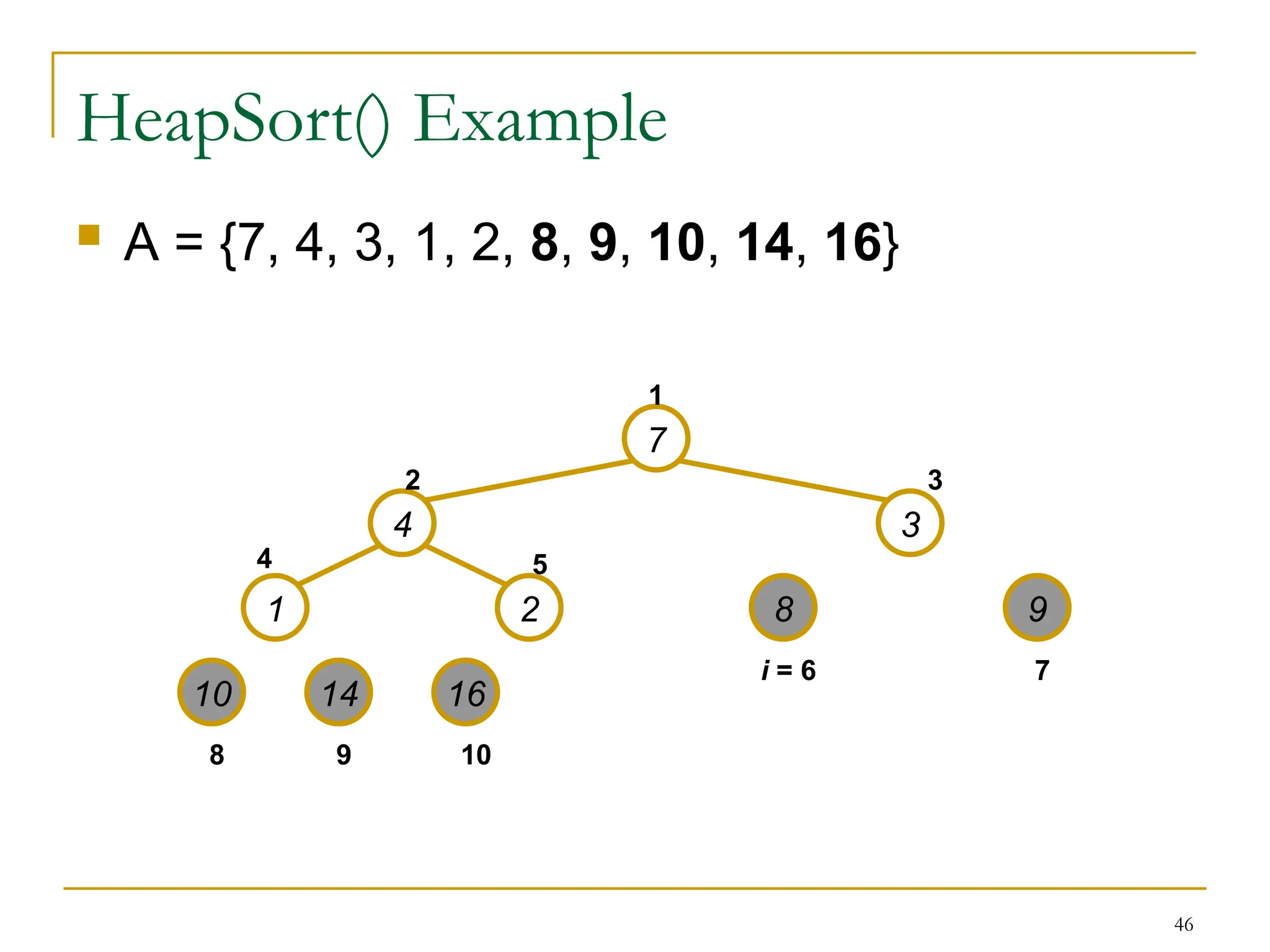
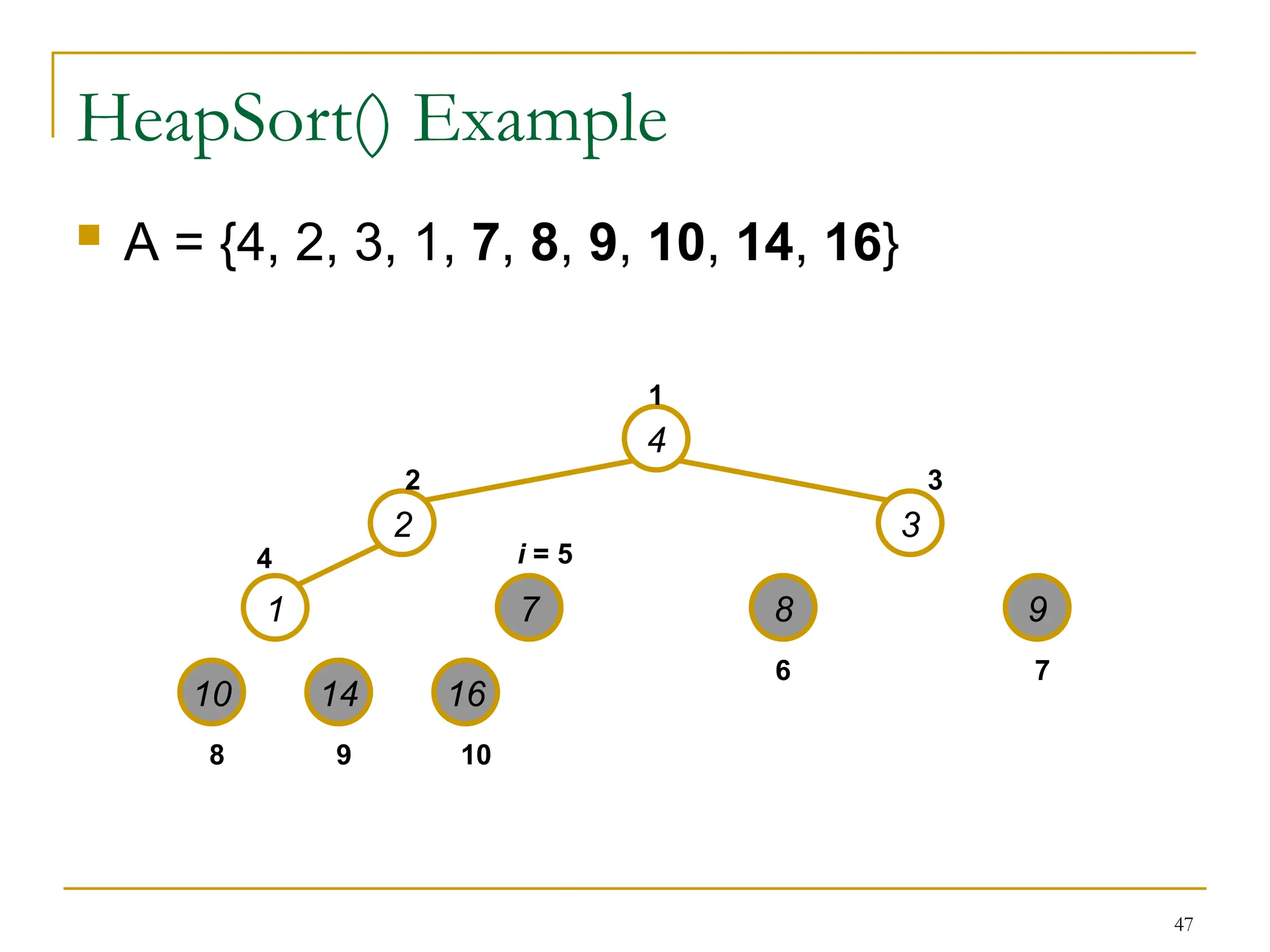
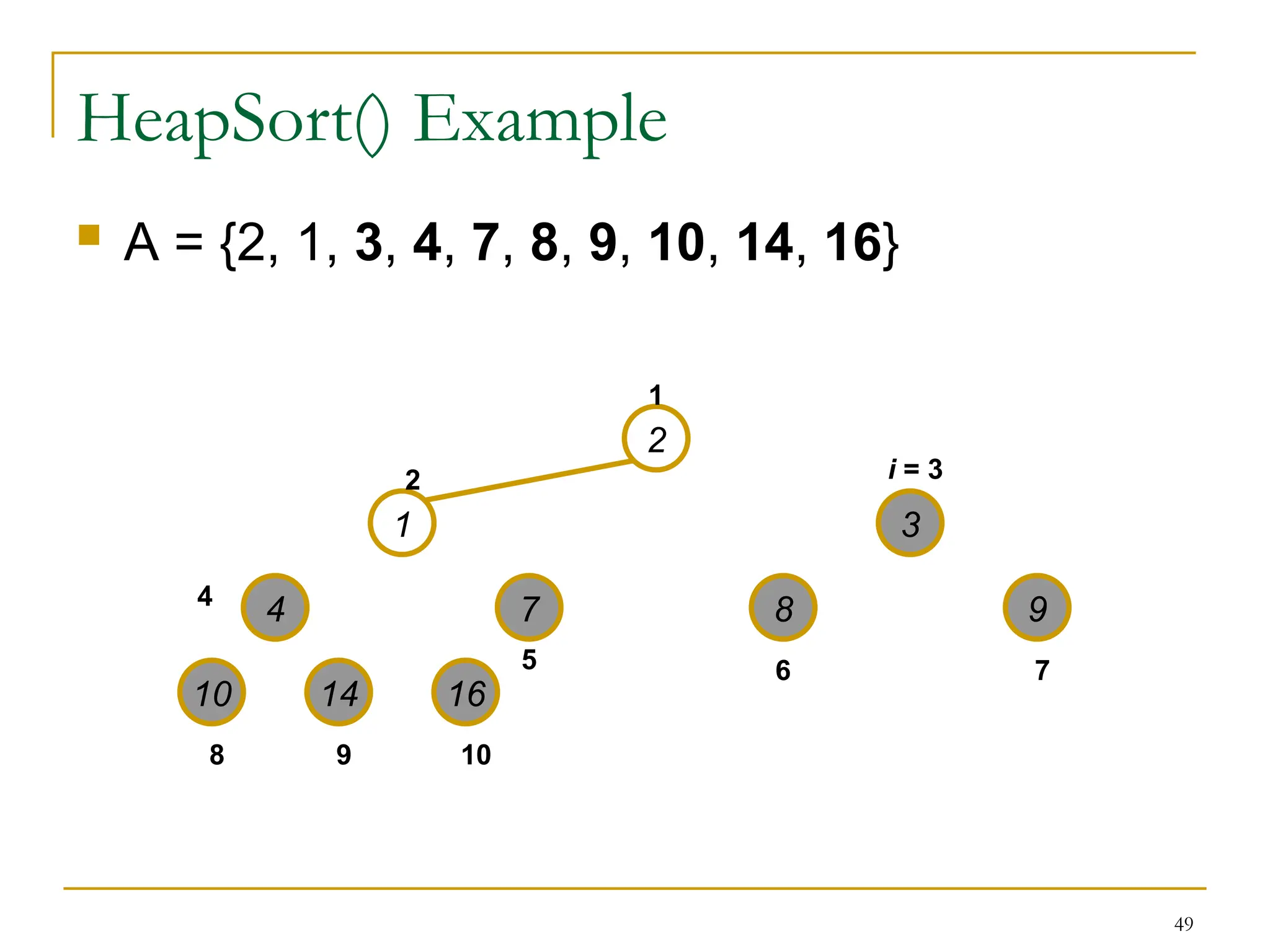
Given BuildHeap(),an in-place sorting
algorithm is easily constructed:
Maximum element is at A[1]
Discard by swapping with element at A[n]
Decrement heap_size[A]
A[n] now contains correct value
Restore heap property at A[1] by calling
Heapify()
Repeat, always swapping A[1] for
A[heap_size(A)]
51
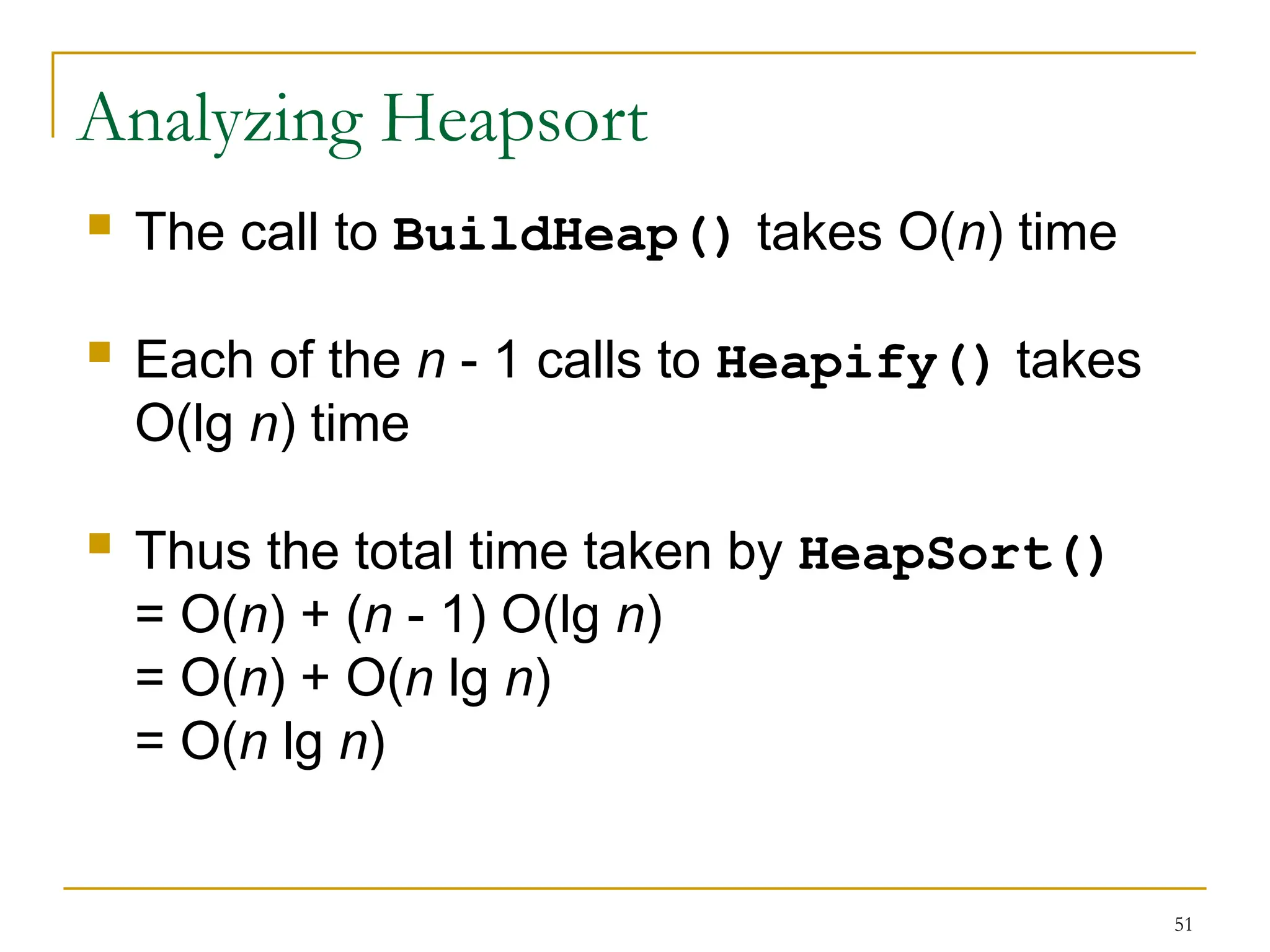
Analyzing Heapsort
Thecall to BuildHeap() takes O(n) time
Each of the n - 1 calls to Heapify() takes
O(lg n) time
Thus the total time taken by HeapSort()
= O(n) + (n - 1) O(lg n)
= O(n) + O(n lg n)
= O(n lg n)
48.
52
Analyzing Heapsort
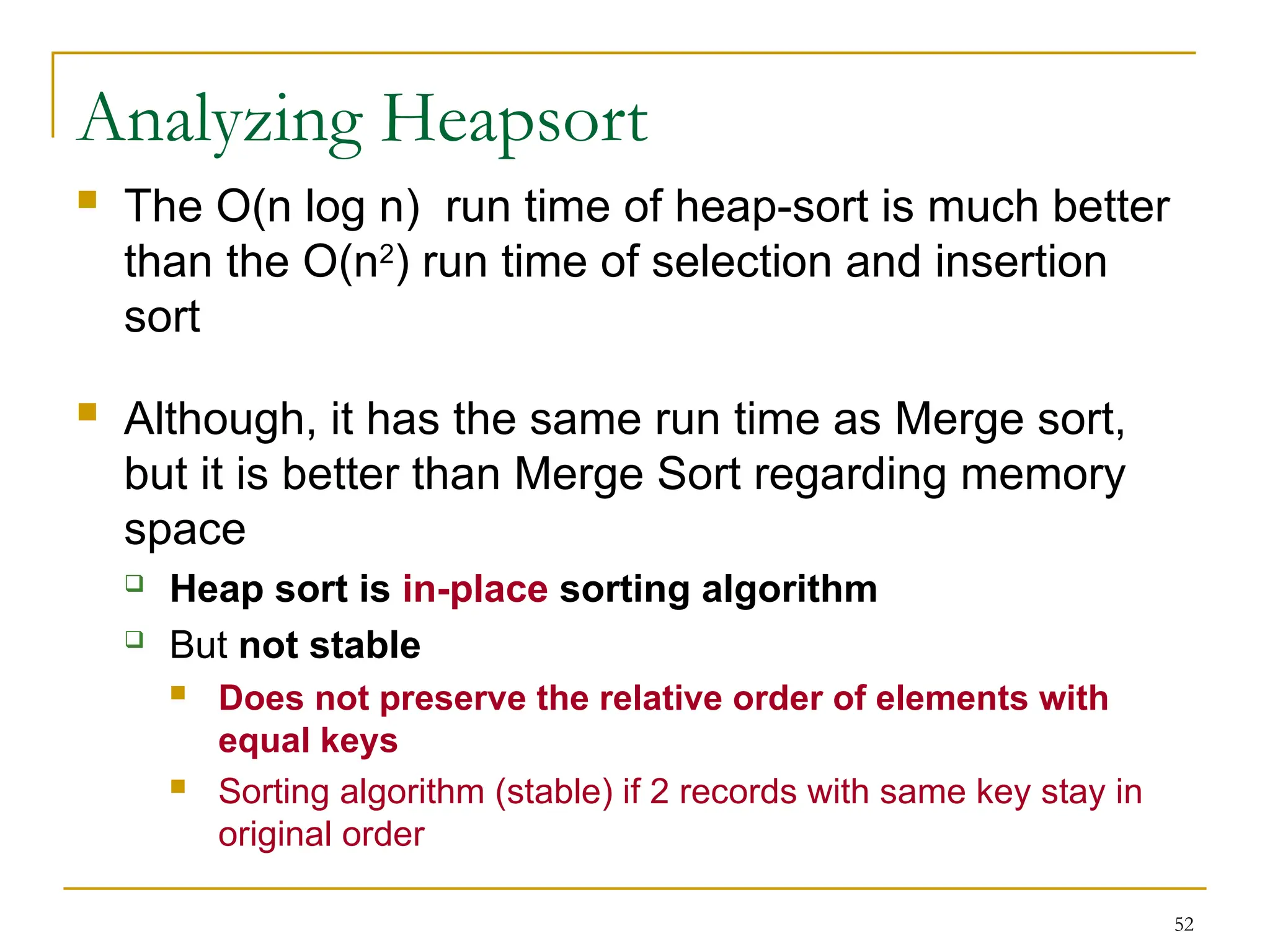
TheO(n log n) run time of heap-sort is much better
than the O(n2
) run time of selection and insertion
sort
Although, it has the same run time as Merge sort,
but it is better than Merge Sort regarding memory
space
Heap sort is in-place sorting algorithm
But not stable
Does not preserve the relative order of elements with
equal keys
Sorting algorithm (stable) if 2 records with same key stay in
original order
49.
53
Max-Priority Queues
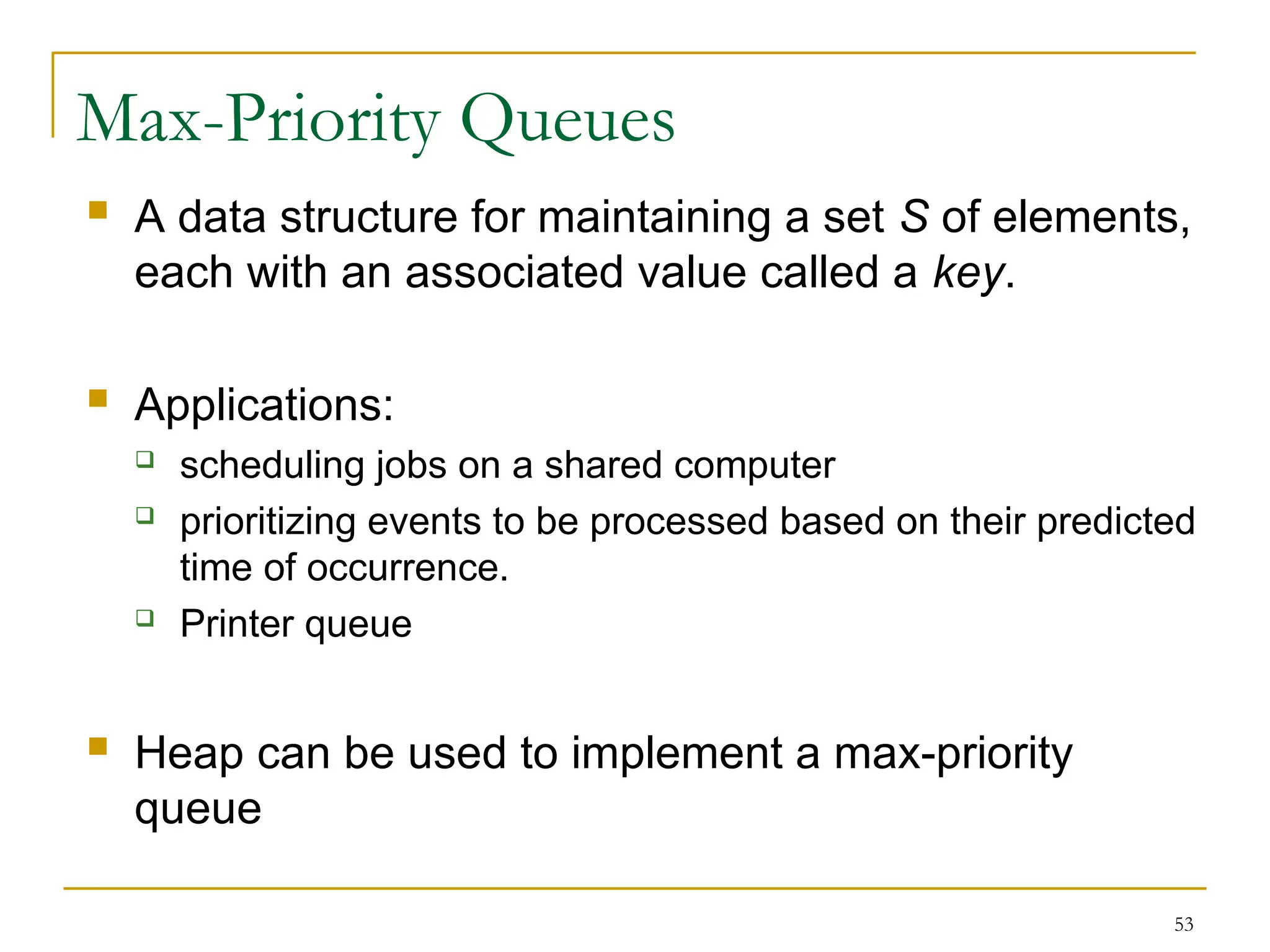
Adata structure for maintaining a set S of elements,
each with an associated value called a key.
Applications:
scheduling jobs on a shared computer
prioritizing events to be processed based on their predicted
time of occurrence.
Printer queue
Heap can be used to implement a max-priority
queue
50.
54
Max-Priority Queue: BasicOperations
Maximum(S): return A[1]
returns the element of S with the largest key (value)
Extract-Max(S):
removes and returns the element of S with the largest key
Increase-Key(S, x, k):
increases the value of element x’s key to the new value k,
x.value k
Insert(S, x):
inserts the element x into the set S, i.e. S S {x}
51.
55
Extract-Max(A)
1. if heap-size[A]< 1 // zero elements
2. then error “heap underflow”
3. max A[1]// max element in first position
4. A[1] A[heap-size[A]]
// value of last position assigned to first position
5. heap-size[A] heap-size[A] – 1
6. Heapify(A, 1)
7. return max
Note lines 3-5 are similar to the for loop
body of Heapsort procedure
52.
56
Increase-Key(A, i, key)
//increase a value (key) in the array
1. if key < A[i]
2. then error “new key is smaller than current key”
3. A[i] key
4. while i > 1 and A[Parent(i)] < A[i]
5. do exchange A[i] A[Parent(i)]
6. i Parent(i) // move index up to parent
58
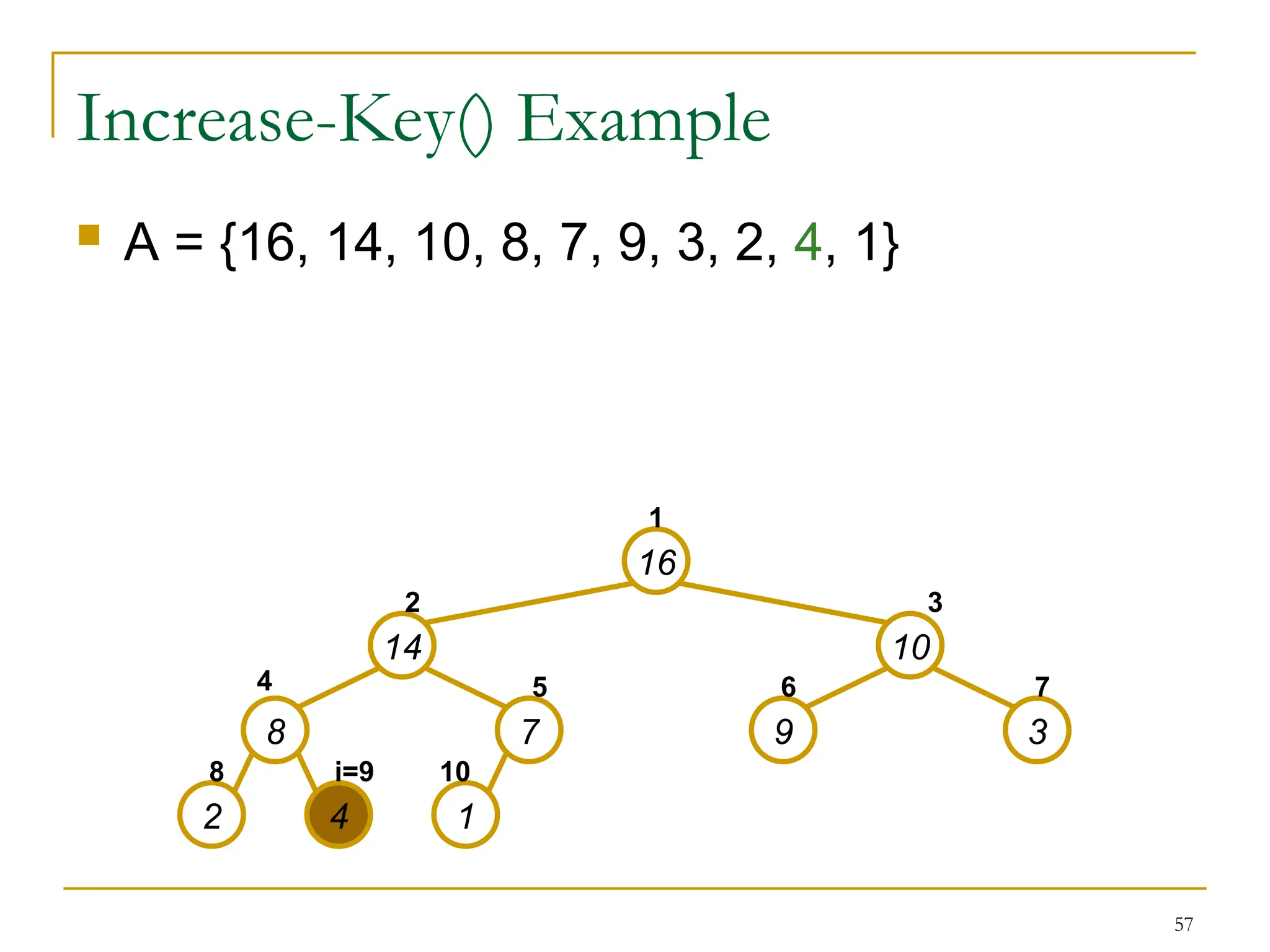
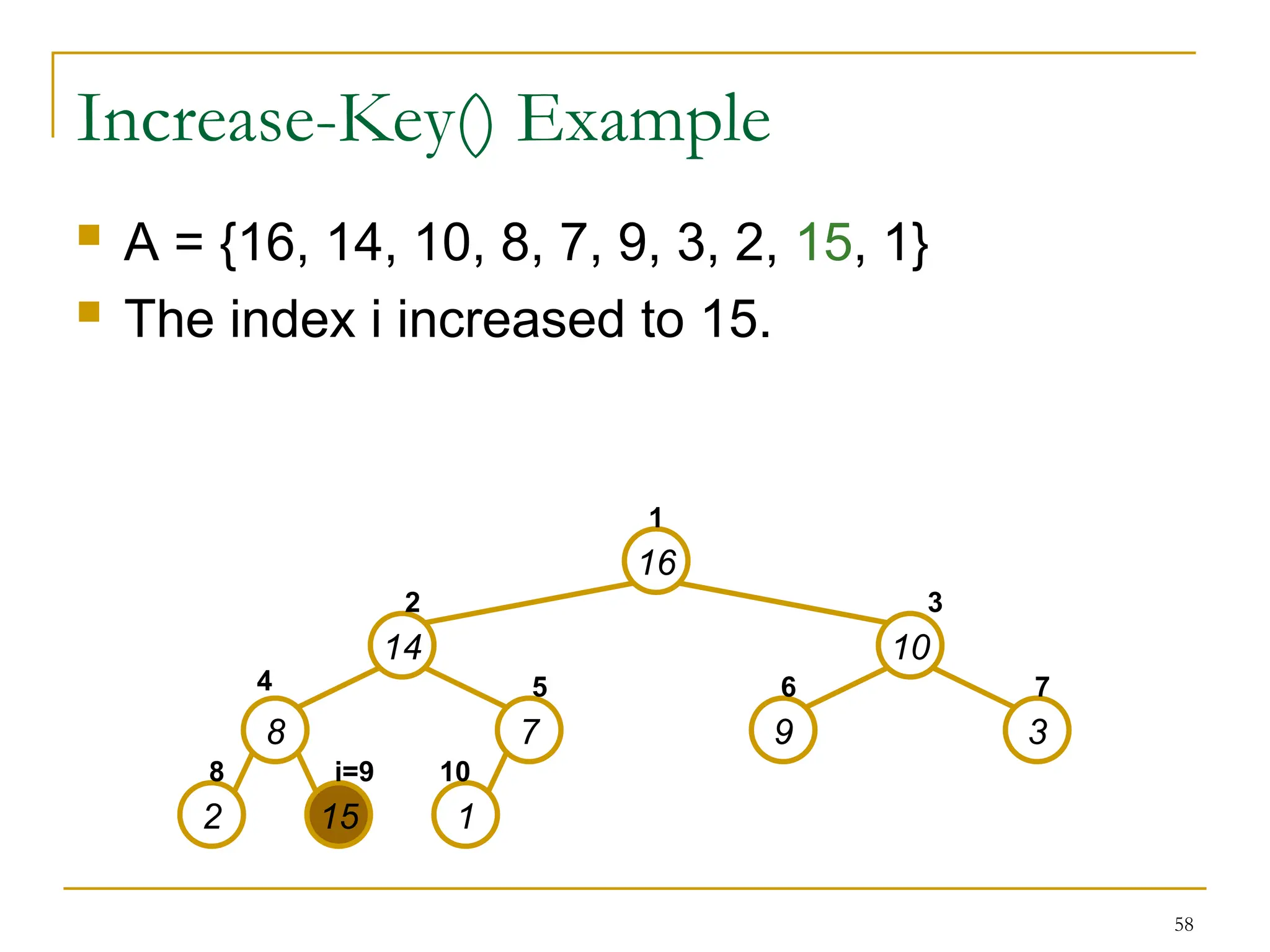
Increase-Key() Example
A= {16, 14, 10, 8, 7, 9, 3, 2, 15, 1}
The index i increased to 15.
16
14 10
8 7 9 3
2 15 1
1
2 3
4 5 6 7
8 i=9 10
55.
59
Increase-Key() Example
A= {16, 14, 10, 15, 7, 9, 3, 2, 8, 1}
After one iteration of the while loop of lines 4-
6, the node and its parent have exchanged
keys (values), and the index i moves up to
the parent.
16
14 10
15 7 9 3
2 8 1
1
2 3
i=4 5 6 7
8 9 10
56.
60
Increase-Key() Example
A= {16, 15, 10, 14, 7, 9, 3, 2, 8, 1}
After one more iteration of the while loop.
The max-heap property now holds and the
procedure terminates.
16
15 10
14 7 9 3
2 8 1
1
2 3
i=4 5 6 7
8 9 10
57.
61
Insert(A, key)
// inserta value at the end of the binary tree
then move it in the right position
1. heap-size[A] heap-size[A] + 1
2. A[heap-size[A]] -
3. Increase-Key(A, heap-size[A], key)
63
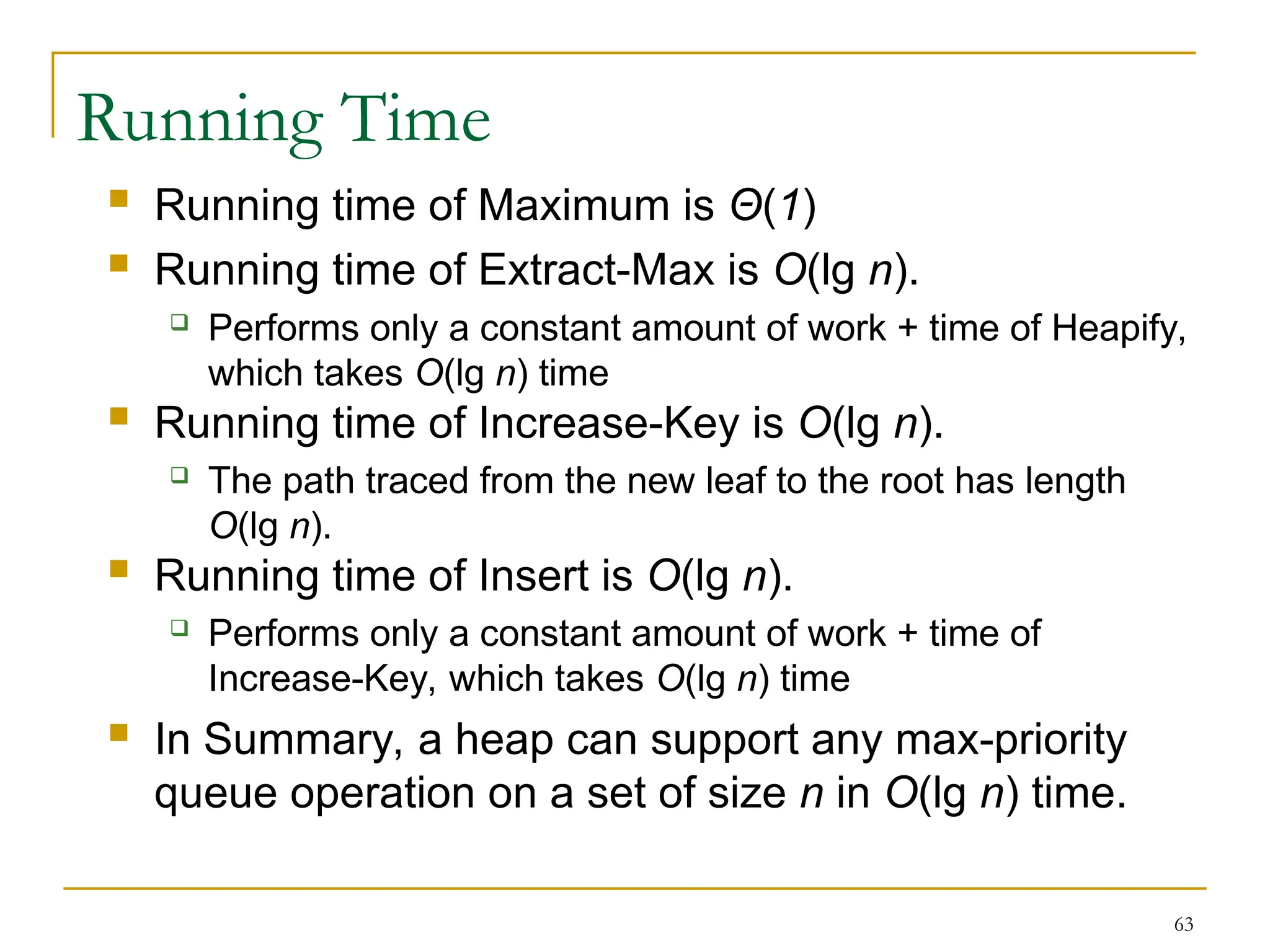
Running Time
Runningtime of Maximum is Θ(1)
Running time of Extract-Max is O(lg n).
Performs only a constant amount of work + time of Heapify,
which takes O(lg n) time
Running time of Increase-Key is O(lg n).
The path traced from the new leaf to the root has length
O(lg n).
Running time of Insert is O(lg n).
Performs only a constant amount of work + time of
Increase-Key, which takes O(lg n) time
In Summary, a heap can support any max-priority
queue operation on a set of size n in O(lg n) time.
![7
Heaps
A heap can be seen as a complete binary tree
The tree is completely filled on all levels except possibly the lowest.
In practice, heaps are usually implemented as arrays
An array A that represent a heap is an object with two attributes:
A[1 .. length[A]]
length[A]: # of elements in the array
heap-size[A]: # of elements in the heap stored within array A, where
heap-size[A] ≤ length[A]
No element past A[heap-size[A]] is an element of the heap
16 14 10 8 7 9 3 2 4 1
A =](https://image.slidesharecdn.com/06heapsort-250427140313-d0fa0577/75/thisisheapsortpptfilewhichyoucanuseanywhereanytim-4-2048.jpg)
![8
Referencing Heap Elements
The root node is A[1]
Node i is A[i]
Parent(i)
return i/2
Left(i)
return 2*i
Right(i)
return 2*i + 1
1
2
3
4
5
6
7
8
9
10
16
15
10
8
7
9
3
2
4
1
Level: 3 2 1 0](https://image.slidesharecdn.com/06heapsort-250427140313-d0fa0577/75/thisisheapsortpptfilewhichyoucanuseanywhereanytim-5-2048.jpg)
![10
The Heap Property
Heaps also satisfy the heap property (max-
heap):
A[Parent(i)] A[i] for all nodes i > 1
In other words, the value of a node is at most the
value of its parent
The largest value in a heap is at its root (A[1])
and subtrees rooted at a specific node contain
values no larger than that node’s value](https://image.slidesharecdn.com/06heapsort-250427140313-d0fa0577/75/thisisheapsortpptfilewhichyoucanuseanywhereanytim-7-2048.jpg)
![11
Heap Operations: Heapify
)(
Heapify(): maintain the heap property
Given: a node i in the heap with children L and R
two subtrees rooted at L and R, assumed to be
heaps
Problem: The subtree rooted at i may violate the heap
property (How?)
A[i] may be smaller than its children value
Action: let the value of the parent node “float down” so
subtree at i satisfies the heap property
If A[i] < A[L] or A[i] < A[R], swap A[i] with the
largest of A[L] and A[R]
Recurs on that subtree](https://image.slidesharecdn.com/06heapsort-250427140313-d0fa0577/75/thisisheapsortpptfilewhichyoucanuseanywhereanytim-8-2048.jpg)
![12
Heap Operations: Heapify
)(
Heapify(A, i)
{
1. L left(i)
2. R right(i)
3. if L heap-size[A] and A[L] > A[i]
4. then largest L
5. else largest i
6. if R heap-size[A] and A[R] > A[largest]
7. then largest R
8. if largest i
9. then exchange A[i] A[largest]
10. Heapify(A, largest)
}](https://image.slidesharecdn.com/06heapsort-250427140313-d0fa0577/75/thisisheapsortpptfilewhichyoucanuseanywhereanytim-9-2048.jpg)
![26
Analyzing Heapify
)(
The running time at any given node i is
(1) time to fix up the relationships among A[i],
A[Left(i)] and A[Right(i)]
plus the time to call Heapify recursively on a sub-
tree rooted at one of the children of node I
And, the children’s subtrees each have size
at most 2n/3](https://image.slidesharecdn.com/06heapsort-250427140313-d0fa0577/75/thisisheapsortpptfilewhichyoucanuseanywhereanytim-22-2048.jpg)
![28
Heap Operations: BuildHeap
)(
We can build a heap in a bottom-up manner by
running Heapify() on successive subarrays
Fact: for array of length n, all elements in range
A[n/2 + 1, n/2 + 2 .. n] are heaps (Why?)
These elements are leaves, they do not have children
We also know that the leave-level has at most 2h
nodes = n/2 nodes
and other levels have a total of n/2 nodes
Walk backwards through the array from n/2 to
1, calling Heapify() on each node.](https://image.slidesharecdn.com/06heapsort-250427140313-d0fa0577/75/thisisheapsortpptfilewhichyoucanuseanywhereanytim-24-2048.jpg)
![29
BuildHeap
)(
// given an unsorted array A, make A a heap
BuildHeap(A)
{
1. heap-size[A] length[A]
2. for i length[A]/2 downto 1
3. do Heapify(A, i)
}
The Build Heap procedure, which runs in linear time,
produces a max-heap from an unsorted input array.
However, the Heapify procedure, which runs in
O(lg n) time, is the key to maintaining the heap property.](https://image.slidesharecdn.com/06heapsort-250427140313-d0fa0577/75/thisisheapsortpptfilewhichyoucanuseanywhereanytim-25-2048.jpg)



![39
Heapsort
Given BuildHeap(), an in-place sorting
algorithm is easily constructed:
Maximum element is at A[1]
Discard by swapping with element at A[n]
Decrement heap_size[A]
A[n] now contains correct value
Restore heap property at A[1] by calling
Heapify()
Repeat, always swapping A[1] for
A[heap_size(A)]](https://image.slidesharecdn.com/06heapsort-250427140313-d0fa0577/75/thisisheapsortpptfilewhichyoucanuseanywhereanytim-35-2048.jpg)
![40
Heapsort
Heapsort(A)
{
1. Build-Heap(A)
2. for i length[A] downto 2
3. do exchange A[1] A[i]
4. heap-size[A] heap-size[A] - 1
5. Heapify(A, 1)
}](https://image.slidesharecdn.com/06heapsort-250427140313-d0fa0577/75/thisisheapsortpptfilewhichyoucanuseanywhereanytim-36-2048.jpg)


![54
Max-Priority Queue: Basic Operations
Maximum(S): return A[1]
returns the element of S with the largest key (value)
Extract-Max(S):
removes and returns the element of S with the largest key
Increase-Key(S, x, k):
increases the value of element x’s key to the new value k,
x.value k
Insert(S, x):
inserts the element x into the set S, i.e. S S {x}](https://image.slidesharecdn.com/06heapsort-250427140313-d0fa0577/75/thisisheapsortpptfilewhichyoucanuseanywhereanytim-50-2048.jpg)
![55
Extract-Max(A)
1. if heap-size[A] < 1 // zero elements
2. then error “heap underflow”
3. max A[1]// max element in first position
4. A[1] A[heap-size[A]]
// value of last position assigned to first position
5. heap-size[A] heap-size[A] – 1
6. Heapify(A, 1)
7. return max
Note lines 3-5 are similar to the for loop
body of Heapsort procedure](https://image.slidesharecdn.com/06heapsort-250427140313-d0fa0577/75/thisisheapsortpptfilewhichyoucanuseanywhereanytim-51-2048.jpg)
![56
Increase-Key(A, i, key)
// increase a value (key) in the array
1. if key < A[i]
2. then error “new key is smaller than current key”
3. A[i] key
4. while i > 1 and A[Parent(i)] < A[i]
5. do exchange A[i] A[Parent(i)]
6. i Parent(i) // move index up to parent](https://image.slidesharecdn.com/06heapsort-250427140313-d0fa0577/75/thisisheapsortpptfilewhichyoucanuseanywhereanytim-52-2048.jpg)


![61
Insert(A, key)
// insert a value at the end of the binary tree
then move it in the right position
1. heap-size[A] heap-size[A] + 1
2. A[heap-size[A]] -
3. Increase-Key(A, heap-size[A], key)](https://image.slidesharecdn.com/06heapsort-250427140313-d0fa0577/75/thisisheapsortpptfilewhichyoucanuseanywhereanytim-57-2048.jpg)