Unit 5:
DNA & Protein Synthesis
Section 2: DNA Replication
Biology
Mrs. DeFord
DNA Replication
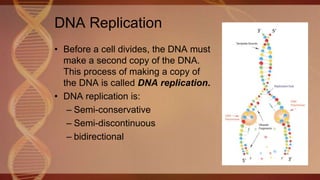
• Before a cell divides, the DNA must
make a second copy of the DNA.
This process of making a copy of
the DNA is called DNA replication.
• DNA replication is:
– Semi-conservative
– Semi-discontinuous
– bidirectional
DNA Replication
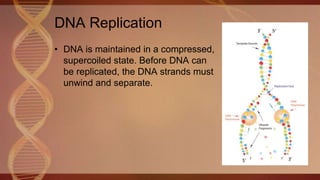
• DNA is maintained in a compressed,
supercoiled state. Before DNA can
be replicated, the DNA strands must
unwind and separate.
DNA Replication
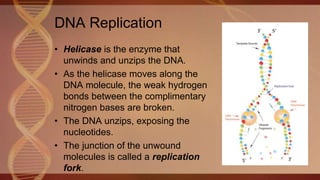
• Helicase is the enzyme that
unwinds and unzips the DNA.
• As the helicase moves along the
DNA molecule, the weak hydrogen
bonds between the complimentary
nitrogen bases are broken.
• The DNA unzips, exposing the
nucleotides.
• The junction of the unwound
molecules is called a replication
fork.
DNA Replication
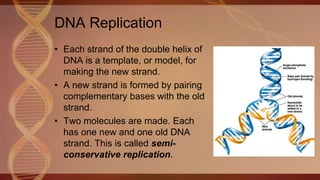
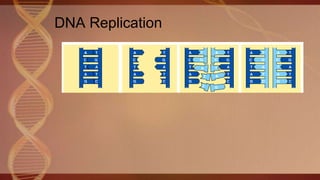
• Each strand of the double helix of
DNA is a template, or model, for
making the new strand.
• A new strand is formed by pairing
complementary bases with the old
strand.
• Two molecules are made. Each
has one new and one old DNA
strand. This is called semi-
conservative replication.
DNA Replication
DNA Replication
DNA Replication
• All known DNA polymerases work in a 5` to 3` direction,
so DNA replication is semi-discontinuous because one
strand is copied continuously and one strand is copied
discontinuously.
– The continuous strand is called the leading strand.
The 5’ carbon is located at the top of the leading
strand.
– The other strand, called the lagging strand, must
start replication in the replication fork and is made in
segments called Okazaki fragments. The 3’ carbon
is located at the lower section of the lagging strand.
• RNA primers are required for initiation of DNA synthesis
• Leading strand requires only one RNA primer
• Lagging strand requires one RNA primer for every
Okazaki fragment
• RNA primers are removed by specific enzymes and
replaced with DNA nucleotides
• Gaps are sealed with DNA ligases.
DNA Replication
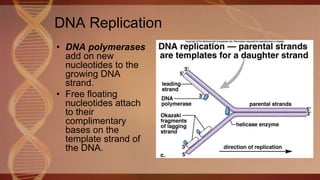
• DNA polymerases
add on new
nucleotides to the
growing DNA
strand.
• Free floating
nucleotides attach
to their
complimentary
bases on the
template strand of
the DNA.
DNA Replication
The Telomere Problem
• When the DNA polymerase reaches the 5' end of the
leading template, synthesis of the leading daughter strand
is almost complete. When the RNA primer, which
occupied the daughter strand's 5' end is removed, the
overlapping single strand cannot be replicated. This
primer was located at the beginning of the leading strand
and at the end of the lagging strand. Thus, the 5' end of
each of these antiparallel daughter strands is one primer-
length shorter. With each succeeding replication, the
chromosome grows shorter and shorter.
DNA Replication
The Telomere Problem
• Fortunately, our chromosomes contains protective ends
called telomeres. Telomeres are highly repeated
sequences that cap both ends of our chromosomes like
the wax tips on shoelaces. Because telomeres are
nonsense DNA (i.e., they do not encode proteins), there is
no immediate consequences when telomeric sequence is
lost. Given enough replication events, telomere shortening
is correlated with triggering a natural cell death called
apoptosis. Cellular aging occurs when the cells are no
longer able to divide.
DNA Replication
The Telomere Problem
• Cells use a special enzyme called telomerase to fix this
problem. Telomerase makes it less likely that genes will be
damaged or lost during replication of rapidly dividing cells
by adding nonsense DNA to the ends of the lagging
strands.
• Telomerase is often switched off in normal adult cells. But
in cancer cells, telomerase may be switched on, resulting
in their ability to grow and divide rapidly.
DNA Replication

HBU5.2 DNA Replication

  • 1.
    Unit 5: DNA &Protein Synthesis Section 2: DNA Replication Biology Mrs. DeFord
  • 3.
    DNA Replication • Beforea cell divides, the DNA must make a second copy of the DNA. This process of making a copy of the DNA is called DNA replication. • DNA replication is: – Semi-conservative – Semi-discontinuous – bidirectional
  • 4.
    DNA Replication • DNAis maintained in a compressed, supercoiled state. Before DNA can be replicated, the DNA strands must unwind and separate.
  • 5.
    DNA Replication • Helicaseis the enzyme that unwinds and unzips the DNA. • As the helicase moves along the DNA molecule, the weak hydrogen bonds between the complimentary nitrogen bases are broken. • The DNA unzips, exposing the nucleotides. • The junction of the unwound molecules is called a replication fork.
  • 6.
    DNA Replication • Eachstrand of the double helix of DNA is a template, or model, for making the new strand. • A new strand is formed by pairing complementary bases with the old strand. • Two molecules are made. Each has one new and one old DNA strand. This is called semi- conservative replication.
  • 7.
  • 8.
  • 9.
    DNA Replication • Allknown DNA polymerases work in a 5` to 3` direction, so DNA replication is semi-discontinuous because one strand is copied continuously and one strand is copied discontinuously. – The continuous strand is called the leading strand. The 5’ carbon is located at the top of the leading strand. – The other strand, called the lagging strand, must start replication in the replication fork and is made in segments called Okazaki fragments. The 3’ carbon is located at the lower section of the lagging strand.
  • 10.
    • RNA primersare required for initiation of DNA synthesis • Leading strand requires only one RNA primer • Lagging strand requires one RNA primer for every Okazaki fragment • RNA primers are removed by specific enzymes and replaced with DNA nucleotides • Gaps are sealed with DNA ligases. DNA Replication
  • 11.
    • DNA polymerases addon new nucleotides to the growing DNA strand. • Free floating nucleotides attach to their complimentary bases on the template strand of the DNA. DNA Replication
  • 12.
    The Telomere Problem •When the DNA polymerase reaches the 5' end of the leading template, synthesis of the leading daughter strand is almost complete. When the RNA primer, which occupied the daughter strand's 5' end is removed, the overlapping single strand cannot be replicated. This primer was located at the beginning of the leading strand and at the end of the lagging strand. Thus, the 5' end of each of these antiparallel daughter strands is one primer- length shorter. With each succeeding replication, the chromosome grows shorter and shorter. DNA Replication
  • 13.
    The Telomere Problem •Fortunately, our chromosomes contains protective ends called telomeres. Telomeres are highly repeated sequences that cap both ends of our chromosomes like the wax tips on shoelaces. Because telomeres are nonsense DNA (i.e., they do not encode proteins), there is no immediate consequences when telomeric sequence is lost. Given enough replication events, telomere shortening is correlated with triggering a natural cell death called apoptosis. Cellular aging occurs when the cells are no longer able to divide. DNA Replication
  • 14.
    The Telomere Problem •Cells use a special enzyme called telomerase to fix this problem. Telomerase makes it less likely that genes will be damaged or lost during replication of rapidly dividing cells by adding nonsense DNA to the ends of the lagging strands. • Telomerase is often switched off in normal adult cells. But in cancer cells, telomerase may be switched on, resulting in their ability to grow and divide rapidly. DNA Replication