Hazard Identification OHS3020A In this section you will develop skills and knowledge in: Identifying work place hazards
What is a hazard? Something with the potential to cause harm, injury or illness .
Examples of hazards include Manual handling-objects/people physical hazards-wet slippery floors, steps work practices- repetitive tasks workplace design , cluttered rooms, doorways to narrow chemical hazards- cleaning agents psychological hazards, stress aggression etc
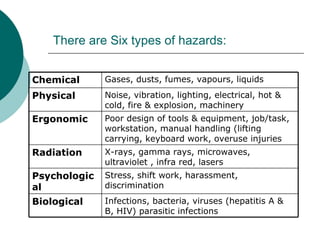
There are Six types of hazards: Infections, bacteria, viruses (hepatitis A & B, HIV) parasitic infections Biological Stress, shift work, harassment, discrimination Psychological X-rays, gamma rays, microwaves, ultraviolet , infra red, lasers Radiation Poor design of tools & equipment, job/task, workstation, manual handling (lifting carrying, keyboard work, overuse injuries Ergonomic Noise, vibration, lighting, electrical, hot & cold, fire & explosion, machinery Physical Gases, dusts, fumes, vapours, liquids Chemical
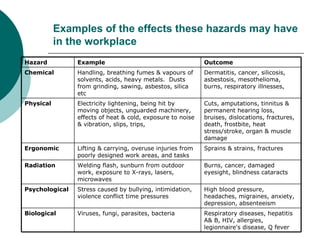
Examples of the effects these hazards may have in the workplace High blood pressure, headaches, migraines, anxiety, depression, absenteeism  Stress caused by bullying, intimidation, violence conflict time pressures Psychological   Respiratory diseases, hepatitis A& B, HIV, allergies, legionnaire's disease, Q fever  Viruses, fungi, parasites, bacteria  Biological   Burns, cancer, damaged eyesight, blindness cataracts Welding flash, sunburn from outdoor work, exposure to X-rays, lasers, microwaves  Radiation   Sprains & strains, fractures Lifting & carrying, overuse injuries from poorly designed work areas, and tasks Ergonomic   Cuts, amputations, tinnitus & permanent hearing loss, bruises, dislocations, fractures, death, frostbite, heat stress/stroke, organ & muscle damage Electricity lightening, being hit by moving objects, unguarded machinery, effects of heat & cold, exposure to noise & vibration, slips, trips, Physical Dermatitis, cancer, silicosis, asbestosis, mesothelioma, burns, respiratory illnesses, Handling, breathing fumes & vapours of solvents, acids, heavy metals.  Dusts from grinding, sawing, asbestos, silica etc  Chemical   Outcome   Example   Hazard
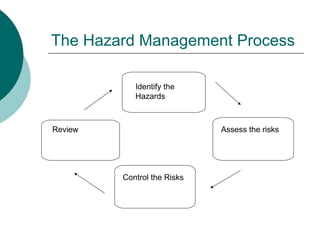
The Hazard Management Process Identify the Hazards Assess the risks Control the Risks Review
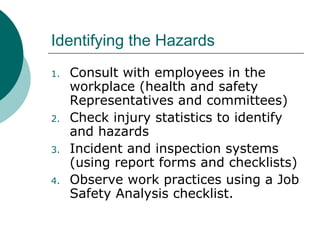
Identifying the Hazards Consult with employees in the workplace (health and safety Representatives and committees) Check injury statistics to identify and hazards Incident and inspection systems (using report forms and checklists) Observe work practices using a Job Safety Analysis checklist.
Consultation Consultation involves the sharing of information and the exchange of view between employers and the persons or bodies that must be consulted, and the genuine opportunity for them to contribute effectively to any decision-making process to eliminate or control risks to health and safety. OHSW Regulations, 1995 1.3.1(3)
Consultation Involves Health and safety reps Health and safety committees Workers carrying out the task The union Consultation requires Access to information Time Commitment on both sides No disadvantage through involvement Acknowledgment of language needs. Work cover corporation hazard management resource guide
Injury Statistics These are useful as they help to identify patterns of injury and how they occurred. To review injury statistics for Aged Care Workers follow this  link   , click on  WorkCover  SA Statistical Review Part 1: 2005-06  [739KB]  and refer to page 37. You may note that amongst the highest injuries for females over all industries is personal care assistant!!! Close behind is Registered Nurse, enrolled nurse and Aged persons carer!!!!
Incident and Near Miss Reports All injuries and near misses are  reported to the supervisor on an  incident form used by the facility/organisation you work for.
Incident and Near Miss Reports Incident reports should include: Time and date of incident Location Exact description of incident Extent of injuries Immediate treatment given to the client
Incident and Near Miss Investigation Who was involved? Time and place the incident occurred What was being done (task) How did it happen? Events leading up to the incident You should also consider the broader picture and investigate work routines and staff/client interactions
Incident and Near Miss Investigation What is the value of an incident  or near miss report?
Incident and inspection systems (using report forms and checklists) Formal inspections Informal inspections
Formal Inspections When undertaking a work place inspection or when developing a formal  Hazard Identification Checklist , the following lists serve as useful starting points for framing questions  Could people be injured or made sick by things such as: Noise Light Radiation High or low temperatures Electricity Moving or falling things (or people) Flammable materials Things under tension or pressure Any other energy source
Thinking Prompts for Observers 2. What could go wrong? What if the equipment is being misused? What might people do that they shouldn’t? How could someone be killed? How could people be injured? What may make people ill? 3.  How might these injuries happen to people? Broken bones Eye damage Hearing problems Strains or sprains Cuts or abrasions Bruises Burns Lung problems Poisoning
Thinking Prompts for Observers Imagine that a ten year old child were brought into the workplace. What would you warn them to be extra careful of? What are the special hazards which may occur only occasionally – for example during maintenance and other irregular work?
Looking for hazards When looking for hazards you should consider: How suitable the things you use are for the task, and how well they are located How people might be hurt directly by equipment, machinery or tools How people might be hurt indirectly through noise, fumes etc How people might be hurt by chemicals and other materials used in the workplace How people use equipment and materials Here is a link to a sample checklist  http://www.safework.sa.gov.au/contentPages/docs/resInspectChecklistPlant.pdf
Job Safety Analysis To effectively undertake a  JSA of a particular hob, the supervisor and health and safety representative needs to: Identify the job for which the analysis is to be conducted Use their existing knowledge of the tasks involved ina  particular job Consult with employees who ac tually do the job Observe the job being done Record the tasks carried out by the person, how often and how long Record the interaction between the person and equipment Identify the skills, knowledge and attitudes required to perform the task Work cover corporation hazard management resource guide
After hazards have been identified they should be: Listed in the Hazard ID Action Plan ( the Action Plan must be reviewed on a regular basis updated or added to if further hazards are identified) Assessed for and prioritised according to risk severity (use Risk Assessment -DIAS)  Once a risk assessment has been conducted, it is important to: Identify the person responsible for actioning the control measures Give a time frame for implementing control measures (use Hazpak)

Hazard Manv1

  • 1.
    Hazard Identification OHS3020AIn this section you will develop skills and knowledge in: Identifying work place hazards
  • 2.
    What is ahazard? Something with the potential to cause harm, injury or illness .
  • 3.
    Examples of hazardsinclude Manual handling-objects/people physical hazards-wet slippery floors, steps work practices- repetitive tasks workplace design , cluttered rooms, doorways to narrow chemical hazards- cleaning agents psychological hazards, stress aggression etc
  • 4.
    There are Sixtypes of hazards: Infections, bacteria, viruses (hepatitis A & B, HIV) parasitic infections Biological Stress, shift work, harassment, discrimination Psychological X-rays, gamma rays, microwaves, ultraviolet , infra red, lasers Radiation Poor design of tools & equipment, job/task, workstation, manual handling (lifting carrying, keyboard work, overuse injuries Ergonomic Noise, vibration, lighting, electrical, hot & cold, fire & explosion, machinery Physical Gases, dusts, fumes, vapours, liquids Chemical
  • 5.
    Examples of theeffects these hazards may have in the workplace High blood pressure, headaches, migraines, anxiety, depression, absenteeism Stress caused by bullying, intimidation, violence conflict time pressures Psychological Respiratory diseases, hepatitis A& B, HIV, allergies, legionnaire's disease, Q fever Viruses, fungi, parasites, bacteria Biological Burns, cancer, damaged eyesight, blindness cataracts Welding flash, sunburn from outdoor work, exposure to X-rays, lasers, microwaves Radiation Sprains & strains, fractures Lifting & carrying, overuse injuries from poorly designed work areas, and tasks Ergonomic Cuts, amputations, tinnitus & permanent hearing loss, bruises, dislocations, fractures, death, frostbite, heat stress/stroke, organ & muscle damage Electricity lightening, being hit by moving objects, unguarded machinery, effects of heat & cold, exposure to noise & vibration, slips, trips, Physical Dermatitis, cancer, silicosis, asbestosis, mesothelioma, burns, respiratory illnesses, Handling, breathing fumes & vapours of solvents, acids, heavy metals. Dusts from grinding, sawing, asbestos, silica etc Chemical Outcome Example Hazard
  • 6.
    The Hazard ManagementProcess Identify the Hazards Assess the risks Control the Risks Review
  • 7.
    Identifying the HazardsConsult with employees in the workplace (health and safety Representatives and committees) Check injury statistics to identify and hazards Incident and inspection systems (using report forms and checklists) Observe work practices using a Job Safety Analysis checklist.
  • 8.
    Consultation Consultation involvesthe sharing of information and the exchange of view between employers and the persons or bodies that must be consulted, and the genuine opportunity for them to contribute effectively to any decision-making process to eliminate or control risks to health and safety. OHSW Regulations, 1995 1.3.1(3)
  • 9.
    Consultation Involves Healthand safety reps Health and safety committees Workers carrying out the task The union Consultation requires Access to information Time Commitment on both sides No disadvantage through involvement Acknowledgment of language needs. Work cover corporation hazard management resource guide
  • 10.
    Injury Statistics Theseare useful as they help to identify patterns of injury and how they occurred. To review injury statistics for Aged Care Workers follow this link , click on WorkCover  SA Statistical Review Part 1: 2005-06 [739KB] and refer to page 37. You may note that amongst the highest injuries for females over all industries is personal care assistant!!! Close behind is Registered Nurse, enrolled nurse and Aged persons carer!!!!
  • 11.
    Incident and NearMiss Reports All injuries and near misses are reported to the supervisor on an incident form used by the facility/organisation you work for.
  • 12.
    Incident and NearMiss Reports Incident reports should include: Time and date of incident Location Exact description of incident Extent of injuries Immediate treatment given to the client
  • 13.
    Incident and NearMiss Investigation Who was involved? Time and place the incident occurred What was being done (task) How did it happen? Events leading up to the incident You should also consider the broader picture and investigate work routines and staff/client interactions
  • 14.
    Incident and NearMiss Investigation What is the value of an incident or near miss report?
  • 15.
    Incident and inspectionsystems (using report forms and checklists) Formal inspections Informal inspections
  • 16.
    Formal Inspections Whenundertaking a work place inspection or when developing a formal Hazard Identification Checklist , the following lists serve as useful starting points for framing questions Could people be injured or made sick by things such as: Noise Light Radiation High or low temperatures Electricity Moving or falling things (or people) Flammable materials Things under tension or pressure Any other energy source
  • 17.
    Thinking Prompts forObservers 2. What could go wrong? What if the equipment is being misused? What might people do that they shouldn’t? How could someone be killed? How could people be injured? What may make people ill? 3. How might these injuries happen to people? Broken bones Eye damage Hearing problems Strains or sprains Cuts or abrasions Bruises Burns Lung problems Poisoning
  • 18.
    Thinking Prompts forObservers Imagine that a ten year old child were brought into the workplace. What would you warn them to be extra careful of? What are the special hazards which may occur only occasionally – for example during maintenance and other irregular work?
  • 19.
    Looking for hazardsWhen looking for hazards you should consider: How suitable the things you use are for the task, and how well they are located How people might be hurt directly by equipment, machinery or tools How people might be hurt indirectly through noise, fumes etc How people might be hurt by chemicals and other materials used in the workplace How people use equipment and materials Here is a link to a sample checklist http://www.safework.sa.gov.au/contentPages/docs/resInspectChecklistPlant.pdf
  • 20.
    Job Safety AnalysisTo effectively undertake a JSA of a particular hob, the supervisor and health and safety representative needs to: Identify the job for which the analysis is to be conducted Use their existing knowledge of the tasks involved ina particular job Consult with employees who ac tually do the job Observe the job being done Record the tasks carried out by the person, how often and how long Record the interaction between the person and equipment Identify the skills, knowledge and attitudes required to perform the task Work cover corporation hazard management resource guide
  • 21.
    After hazards havebeen identified they should be: Listed in the Hazard ID Action Plan ( the Action Plan must be reviewed on a regular basis updated or added to if further hazards are identified) Assessed for and prioritised according to risk severity (use Risk Assessment -DIAS) Once a risk assessment has been conducted, it is important to: Identify the person responsible for actioning the control measures Give a time frame for implementing control measures (use Hazpak)