Graphic Design Studio OH&S
HOW TO IDENTIFY HAZARDS

Identifying hazards in the workplace involves
finding things and situations that could
potentially cause harm to people. Hazards
generally arise from the following aspects of
work and their interaction:
• physical work environment
• equipment, materials and substances used
• work tasks and how they are performed
• work design and management
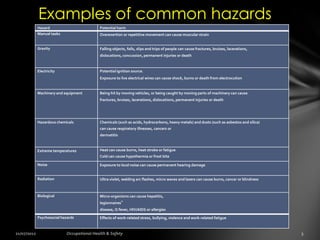
Examples of common hazards
Hazard                    Potential harm
Manual tasks              Overexertion or repetitive movement can cause muscular strain


Gravity                   Falling objects, falls, slips and trips of people can cause fractures, bruises, lacerations,
                          dislocations, concussion, permanent injuries or death


Electricity               Potential ignition source.
                          Exposure to live electrical wires can cause shock, burns or death from electrocution


Machinery and equipment   Being hit by moving vehicles, or being caught by moving parts of machinery can cause
                          fractures, bruises, lacerations, dislocations, permanent injuries or death


Hazardous chemicals       Chemicals (such as acids, hydrocarbons, heavy metals) and dusts (such as asbestos and silica)
                          can cause respiratory illnesses, cancers or
                          dermatitis


Extreme temperatures      Heat can cause burns, heat stroke or fatigue
                          Cold can cause hypothermia or frost bite

Noise                     Exposure to loud noise can cause permanent hearing damage


Radiation                 Ultra violet, welding arc flashes, micro waves and lasers can cause burns, cancer or blindness


Biological                Micro-organisms can cause hepatitis,
                          legionnaires‟
                          disease, Q fever, HIV/AIDS or allergies

Psychosocial hazards      Effects of work-related stress, bullying, violence and work-related fatigue
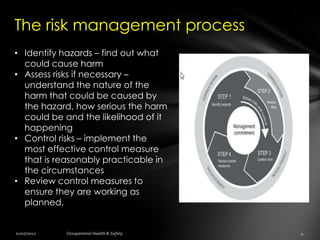
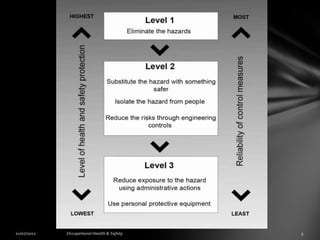
The risk management process
• Identify hazards – find out what
  could cause harm
• Assess risks if necessary –
  understand the nature of the
  harm that could be caused by
  the hazard, how serious the harm
  could be and the likelihood of it
  happening
• Control risks – implement the
  most effective control measure
  that is reasonably practicable in
  the circumstances
• Review control measures to
  ensure they are working as
  planned.
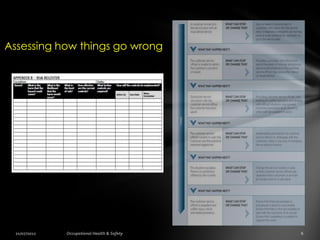
Assessing how things go wrong
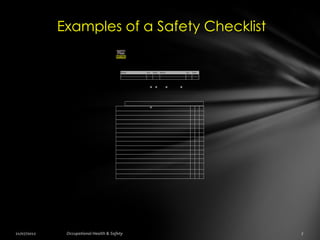
Examples of a Safety Checklist
                     SAFETY AUDIT CHECK LIST – EQUIPMENT

        1. Safety Auditor’s Name ………………....……… Signature……………………........ /....../.....

        2. Safety Auditor’s Name …………………....…… Signature……………………..... /......./......

        3. Other parties
              Name                            Init      Date   Name                             Init    Date


        This checklist is to create awareness of what to look for in equipment, product and facilities. Anyone can
        take this list and complete a safety audit for assessment. This ensures we view all safety issues through
        different eyes. It’s an easy to use … Yes      No Remarks Not Applicable type layout which
        encourages the safety auditor to look for general safety issues, but doesn’t limit the safety auditor to add
        "other" issues, comments or relevant information.
        It’s in two (2) parts – Equipment and Facilities. Always consider and read each part and tick the
        appropriate section and comment where necessary.

         EQUIPMENT:
                Name of Equipment:

        ITEM This is the item you are auditing    appropriate column                                   YES N/A NO
        REMARKS The blank space allows you to write a remark
        Extension cords in good condition and properly placed when in use (where allowed)

        Fuse boxes in good working condition and protected properly

        Lighting – adequate safe level, bulbs okay

        Electric motors clean and in proper alignment

        Safety devices all working on all equipment

        Electric cords properly located and in good repair

        Electrical equipment tested regularly and tagged? If applicable.

        Working area clean and space suitable for equipment use

        Pressure washer hoses in good conditions with no fraying or bulges

        Electrical safety checks current? and tagged

        Air lines to equipment in good safe condition

        Are electric motors well maintained and lubricated and free from dust and fluff?

        Are machine mountings, fittings and other attachments securely mounted to avoid or
        reduce noise and vibration?

        Are intake and exhaust mufflers in good condition?

        Are controllers and switches maintained to prevent current carrying contacts becoming
        badly worn, dirty or corroded?
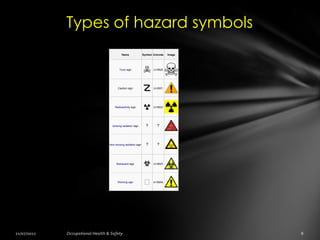
Types of hazard symbols
               Name                Symbol Unicode   Image


             Toxic sign
                                   ☠      U+2620


            Caution sign
                                   ☡      U+2621


         Radioactivity sign
                                   ☢      U+2622


       Ionizing radiation sign       ?      ?


     Non-ionizing radiation sign     ?      ?


          Biohazard sign
                                   ☣      U+2623


           Warning sign
                                    ⚠     U+26A0
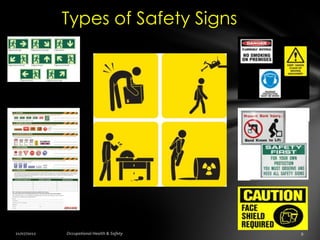
Types of Safety Signs
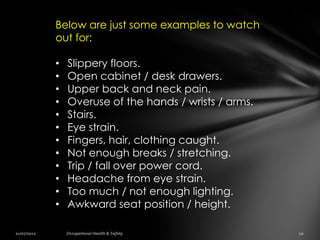
Below are just some examples to watch
out for:

•   Slippery floors.
•   Open cabinet / desk drawers.
•   Upper back and neck pain.
•   Overuse of the hands / wrists / arms.
•   Stairs.
•   Eye strain.
•   Fingers, hair, clothing caught.
•   Not enough breaks / stretching.
•   Trip / fall over power cord.
•   Headache from eye strain.
•   Too much / not enough lighting.
•   Awkward seat position / height.
OH&S Safety Representative


Sarah Marshall has worked in the Occupational Health
and Safety area for more than 15 years and has an
extensive range of experience that shows through her
work.
If there are any concerns or suggestions that you may
have, you can contact Sarah on 0400123456 or email
her at: sarah@resumejourney.com
Under the workplace health and safety act, we have
an obligation to let our employees know about the
OH&S policies and procedures in the company.
Employees also have an obligation to abide by these
rules and procedures in the correct way. As a new
employee for our graphic design studio, here is a list of
OH&S requirements that need to be addressed and
marked off:
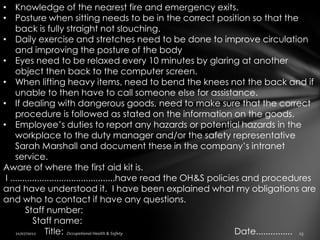
• Knowledge of the nearest fire and emergency exits.
• Posture when sitting needs to be in the correct position so that the
     back is fully straight not slouching.
• Daily exercise and stretches need to be done to improve circulation
     and improving the posture of the body
• Eyes need to be relaxed every 10 minutes by glaring at another
     object then back to the computer screen.
• When lifting heavy items, need to bend the knees not the back and if
     unable to then have to call someone else for assistance.
• If dealing with dangerous goods, need to make sure that the correct
     procedure is followed as stated on the information on the goods.
• Employee’s duties to report any hazards or potential hazards in the
     workplace to the duty manager and/or the safety representative
     Sarah Marshall and document these in the company’s intranet
     service.
Aware of where the first aid kit is.
 I ...........................................have read the OH&S policies and procedures
and have understood it. I have been explained what my obligations are
and who to contact if have any questions.
         Staff number:
            Staff name:
                 Title:                                                 Date...............
Equipment Safety Checks
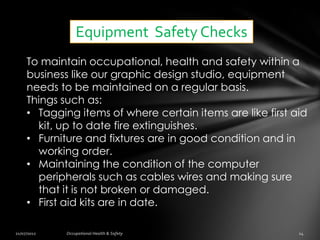
To maintain occupational, health and safety within a
business like our graphic design studio, equipment
needs to be maintained on a regular basis.
Things such as:
• Tagging items of where certain items are like first aid
  kit, up to date fire extinguishes.
• Furniture and fixtures are in good condition and in
  working order.
• Maintaining the condition of the computer
  peripherals such as cables wires and making sure
  that it is not broken or damaged.
• First aid kits are in date.
Resources
http://www.comcare.gov.au/
http://en.wikipedia.org/wiki/Hazard_symbol
http://www.means-of-escape.com/articles/529/the-common-language-for-safety-
communication-that-can-bring-world-harmony/
http://www.hazmark.com/safety.html
http://www.artisansigns.com.au/oh-s/
http://westone.wa.gov.au/toolbox8/furniture/toolbox/drawing_room/803d01/step1.htm
http://www.signsgoldcoast.com.au/Default.aspx?ContentPageName=Safety%20Signs
http://schoolsignsonline.com.au/contents/en-us/d13.html
http://campbellcontractors.co.nz/health-safety/
http://toolkit.smallbiz.nsw.gov.au/part/4/21/101
Further Information
http://www.workcover.nsw.gov.au/Pages/default.aspx

http://www.business.gov.au/businesstopics/occupationalhealthandsafety/pages/default.aspx

http://australia.gov.au/topics/health-and-safety/occupational-health-and-safety

http://www.deir.qld.gov.au/workplace/

http://www.safeworkaustralia.gov.au/sites/SWA/Pages/default.aspx

http://www.worksafe.vic.gov.au/wps/wcm/connect/wsinternet/worksafe/home/laws+and+regulati
ons/occupational+health+and+safety

http://www.assaohs.com.au/

http://regnet.anu.edu.au/nrcohsr/home

http://www.ohs.net.au/

http://www.safework.sa.gov.au/

http://www.weblaw.edu.au/display_page.phtml?WebLaw_Page=Occupational+Health+%26+Safety+
Law

http://www.safetyline.wa.gov.au/index.html

http://www.commerce.wa.gov.au/worksafe/

http://australia.gov.au/topics/employment-and-workplace/ohs-workplace-health-and-safety

http://www.legislation.nsw.gov.au/fullhtml/inforce/subordleg+648+2001+FIRST+0+N

http://www.ausport.gov.au/supporting/clubs/resource_library/managing_risks/occupational_health
_and_safety

http://www.service.tas.gov.au/browse/Employment+and+workplace/Occupational+health+and+saf
ety/
Occupational Health
        &             Spin

      Safety
Graphic Design OH&S

Graphic Design OH&S

Editor's Notes

  • #19 Directions:Delete the letters from this slide. Copy letter boxes from Slide #4 to create your own phrase, place, event, etc. Align the Letters. Change the hint.To play game:Click on Spin button and click on Start/Stop button to spin wheel. Click Start/Stop button to stop wheel. Click to return to game board. Allow player to guess letters. Click on appropriate box to display letters.