REMEDIAL MEASURES OF 
HEALTH AND SAFTY IN 
TEXTILE INDUSTRY 
SUBMITTED TO: MADAM SHUGUFTA 
PREPARED BY: AELYA SHAH 
University of Karachi
INTRODUCTION 
OBJECTIVE: 
To identify hazards in textile industry and provide with 
appropriate remedial measures. 
OUTCOME: 
• To make working environment more safer and healthier. 
Immediate action must be taken to control this hazard to save 
workers health and promote safety.
DEFINE HEALTH AND SAFETY? 
• Regulations and procedures intended to 
prevent accident or injury in workplaces or 
public environments. 
REMEDIAL MEASURES: 
Remedial Measures means taking steps 
to alleviate something we don't desire to 
experience.
AGENDA: 
• The study of Occupational Health and Safety in Textile 
industry examines to promote Health and safety to the 
workers in Pakistan. The Hazards and risk involved in the 
textile industry is high compared with other industries and 
least importance is given to textile industries. Most of accident 
does not come to the legal formalities. The People are not 
aware of Health & safety is due to the workers are 
uneducated and management not given importance due to 
promote OHS in Textile industry becomes a barriers in 
implementing OHS. The major hazards happen are physical, 
chemical, ergonomically & physiologically hazards along with 
these some of things which can create hazards are more 
working hours, improper ventilation. The RPN (Risk priority 
number) has been find out for all the hazards in the textile 
industry and FEA is done for the hazard with highest RPN no.
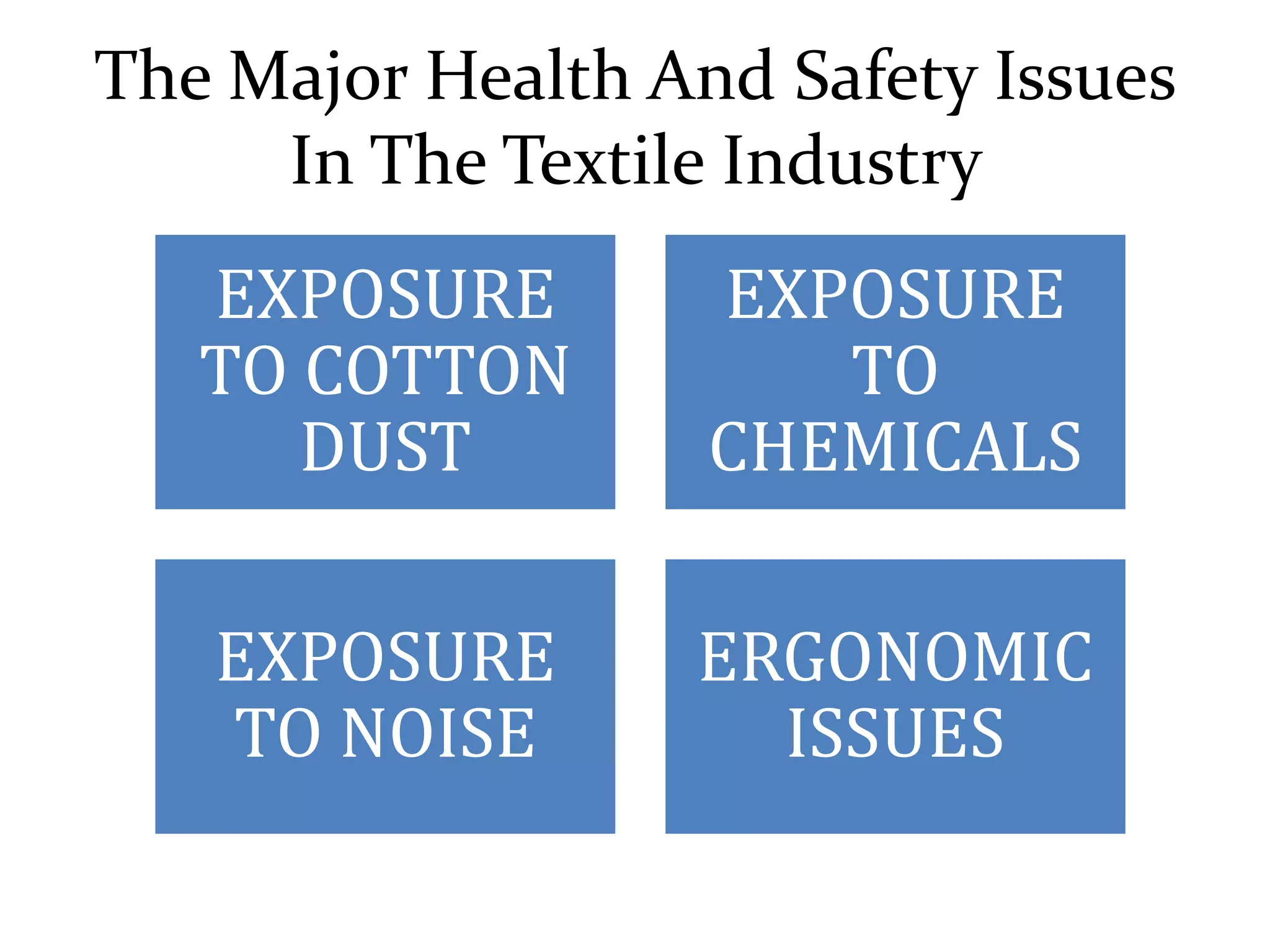
The Major Health And Safety Issues 
In The Textile Industry 
EXPOSURE 
TO COTTON 
DUST 
EXPOSURE 
TO 
CHEMICALS 
EXPOSURE 
TO NOISE 
ERGONOMIC 
ISSUES
METHODOLOGY 
GINNING INDUSTRY: 
• The cotton in a machine which is used to separate the 
cotton fiber from the seeds and the cotton send to the 
textile for making yarn. The one of main Hazard in 
ginning industry is fire, the causes of fire happens in 
the Ginning Industry are Electrical, Manmade 
Behavior, spark from the Machine and stored Raw 
cotton in sunlight and other causes
METHODOLOGY 
• SPINNING INDUSTRY: 
The textiles are fabricated into clothes. Noise is the 
main hazard in textile industry. The noise pollution 
(Regulation and control) rule 2000 in industrial area 
was 75db at Day Time [6 AM to 10 AM] and Night 
time [10 PM to 6 AM].The fire accidents occur in 
textile mills are often. The Hazards in the spinning 
mills are more compare to other sectors of textile 
industry because the Raw material cotton exposed to 
the fire easily.
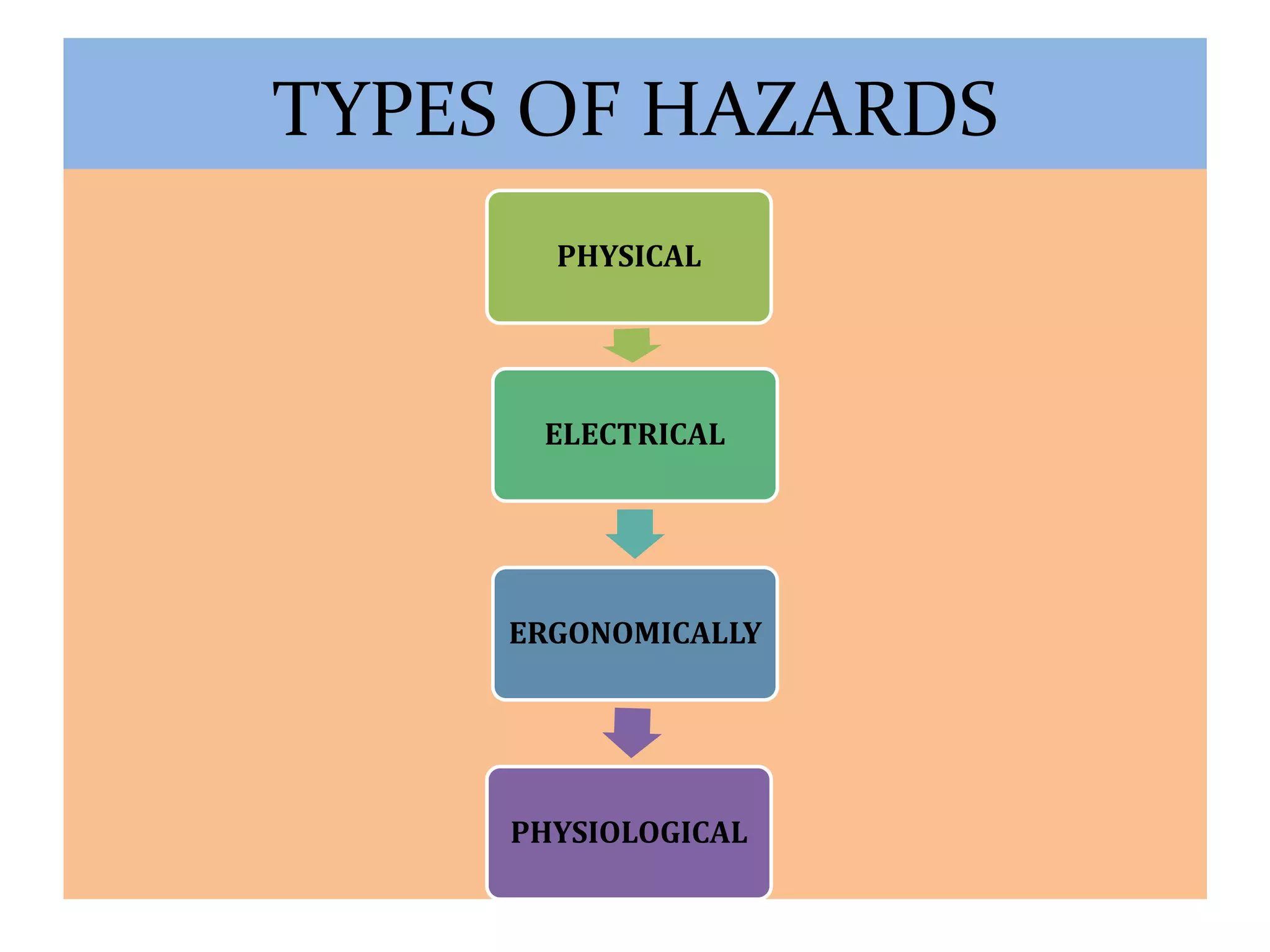
TYPES OF HAZARDS 
PHYSICAL 
ELECTRICAL 
ERGONOMICALLY 
PHYSIOLOGICAL
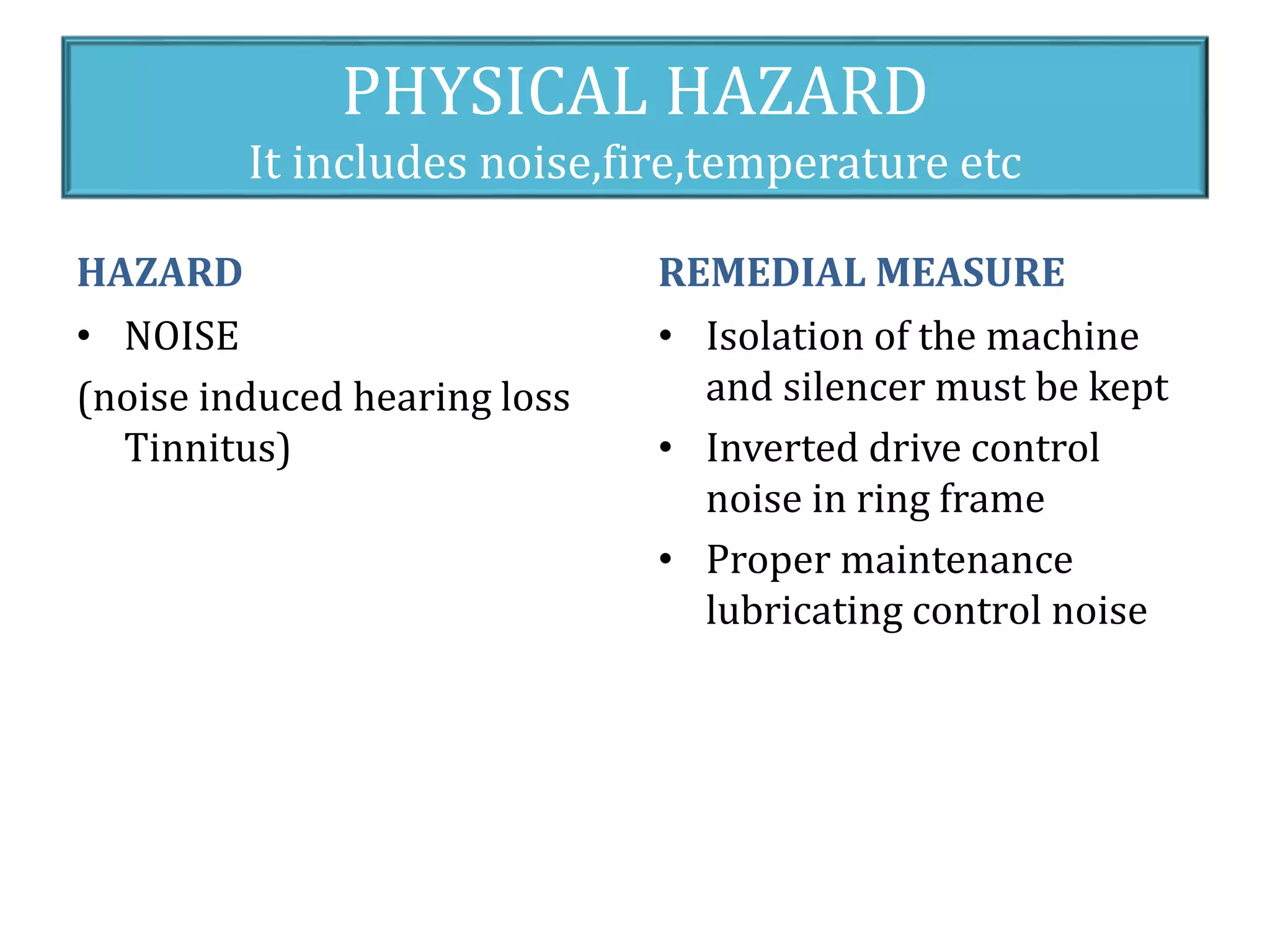
PHYSICAL HAZARD 
It includes noise,fire,temperature etc 
HAZARD 
• NOISE 
(noise induced hearing loss 
Tinnitus) 
REMEDIAL MEASURE 
• Isolation of the machine 
and silencer must be kept 
• Inverted drive control 
noise in ring frame 
• Proper maintenance 
lubricating control noise
PHYSICAL HAZARD 
HAZARD 
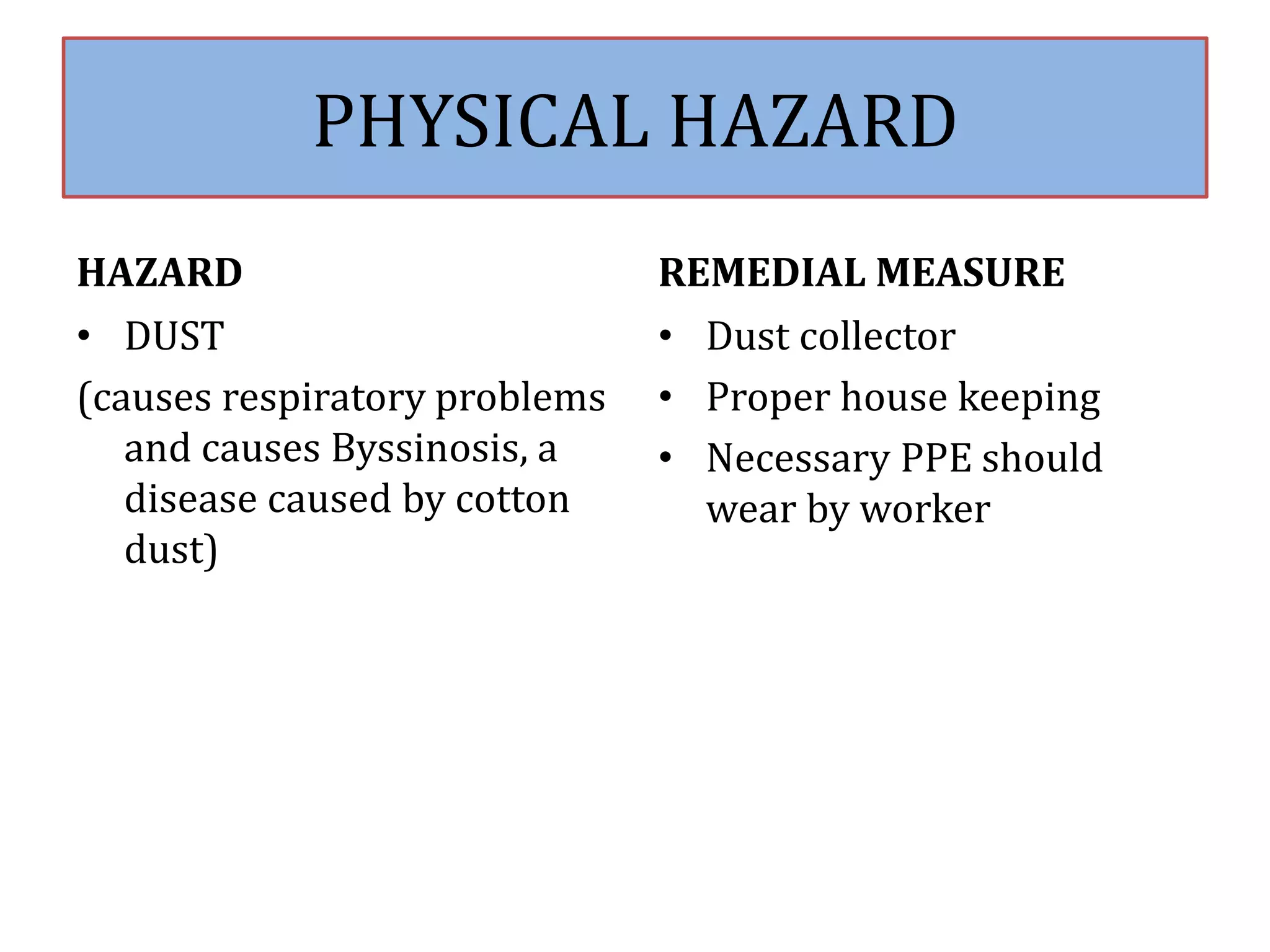
• DUST 
(causes respiratory problems 
and causes Byssinosis, a 
disease caused by cotton 
dust) 
REMEDIAL MEASURE 
• Dust collector 
• Proper house keeping 
• Necessary PPE should 
wear by worker
PHYSICAL HAZARD 
HAZARD 
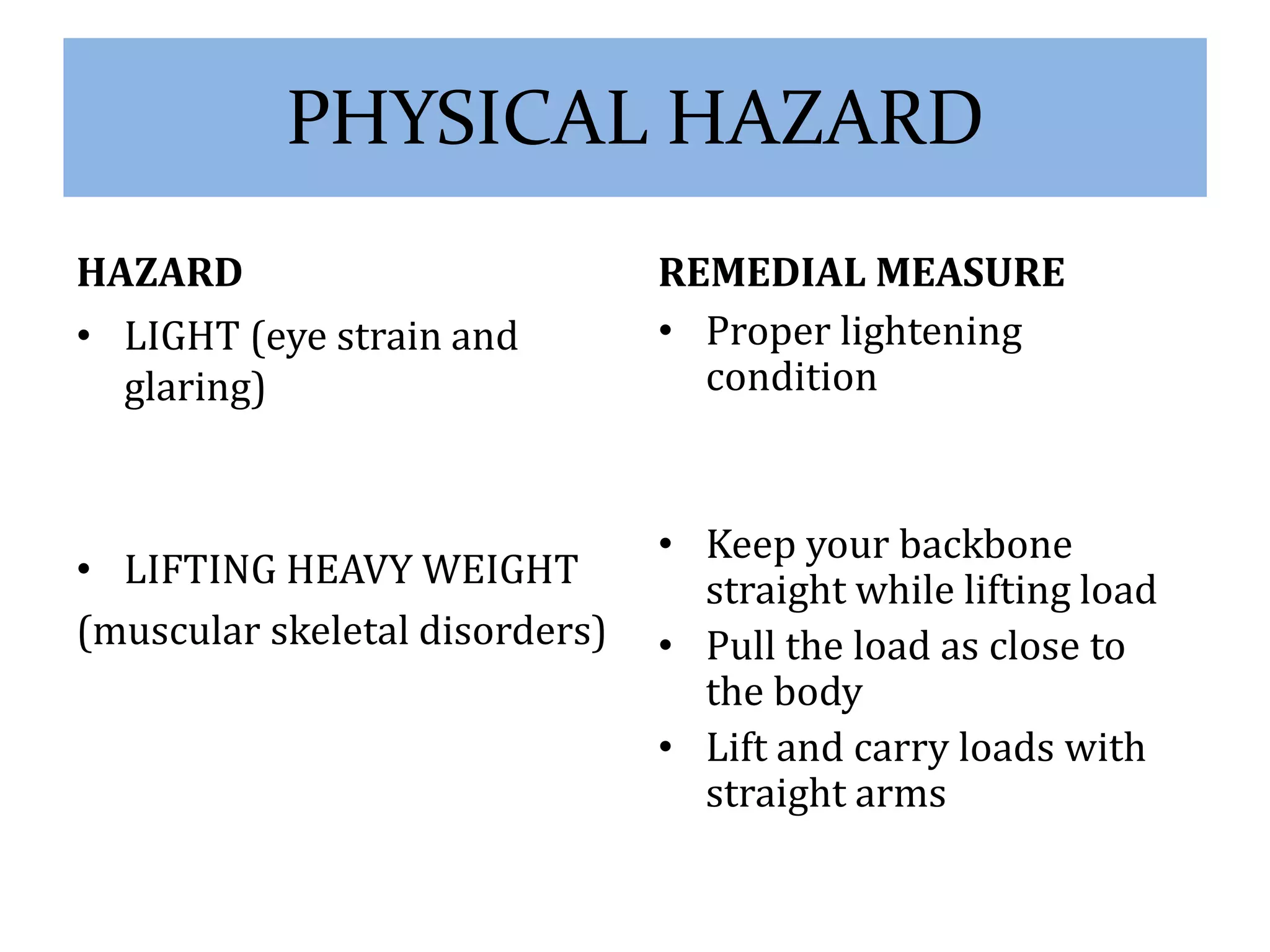
• LIGHT (eye strain and 
glaring) 
• LIFTING HEAVY WEIGHT 
(muscular skeletal disorders) 
REMEDIAL MEASURE 
• Proper lightening 
condition 
• Keep your backbone 
straight while lifting load 
• Pull the load as close to 
the body 
• Lift and carry loads with 
straight arms
PHYSICAL HAZARD 
HAZARD 
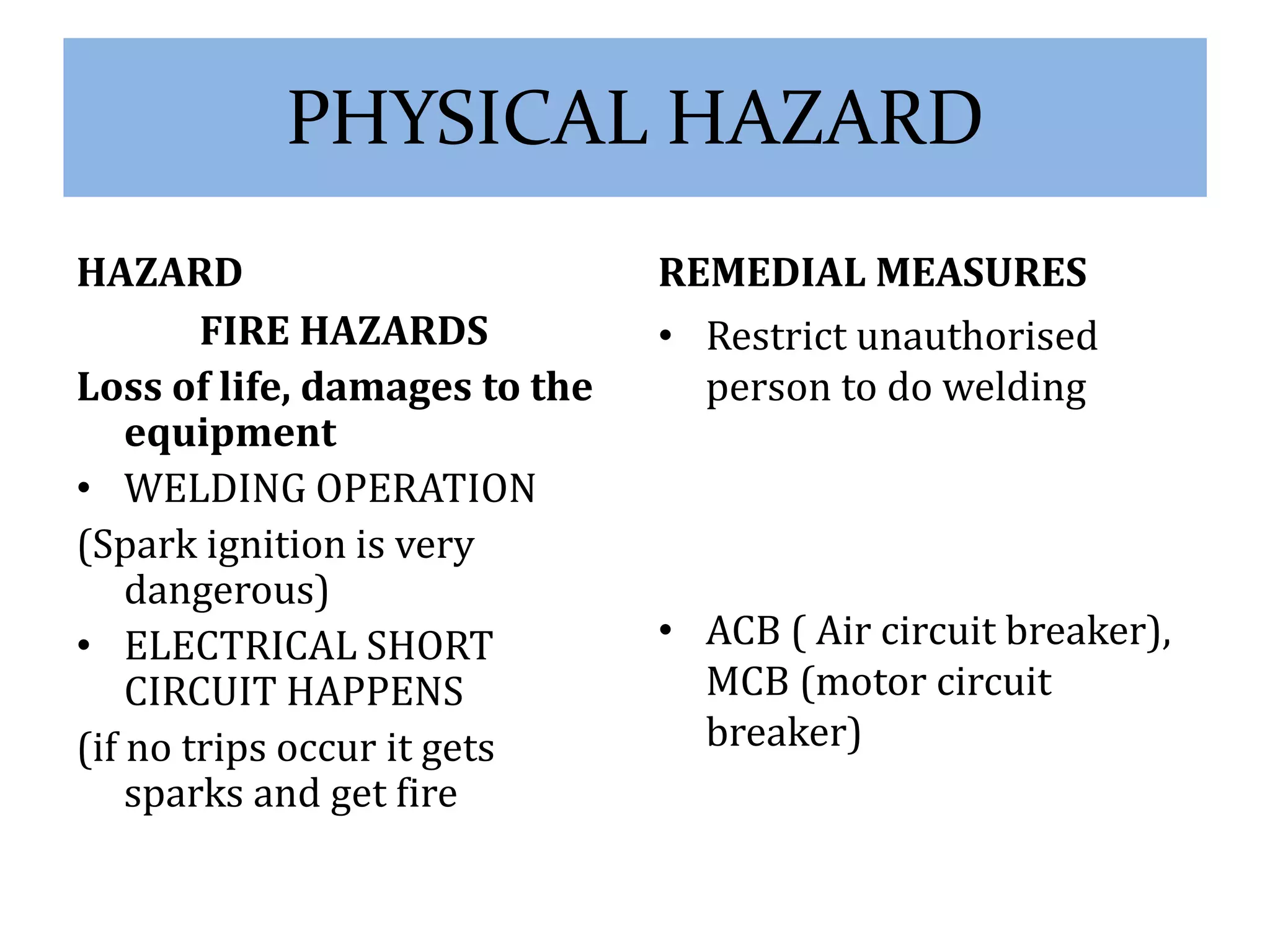
FIRE HAZARDS 
Loss of life, damages to the 
equipment 
• WELDING OPERATION 
(Spark ignition is very 
dangerous) 
• ELECTRICAL SHORT 
CIRCUIT HAPPENS 
(if no trips occur it gets 
sparks and get fire 
REMEDIAL MEASURES 
• Restrict unauthorised 
person to do welding 
• ACB ( Air circuit breaker), 
MCB (motor circuit 
breaker)
PHYSICAL HAZARDS 
HAZARD 
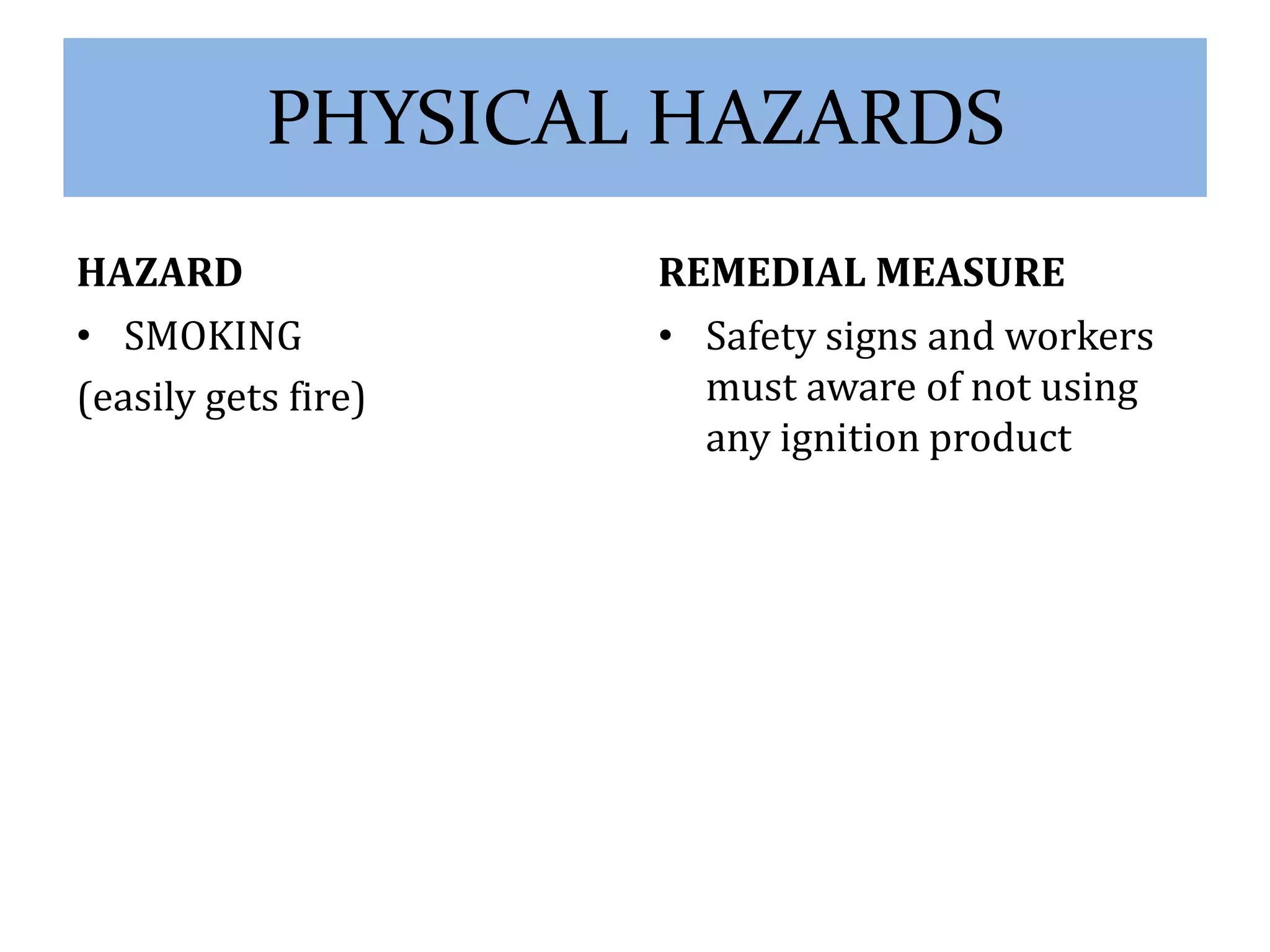
• SMOKING 
(easily gets fire) 
REMEDIAL MEASURE 
• Safety signs and workers 
must aware of not using 
any ignition product
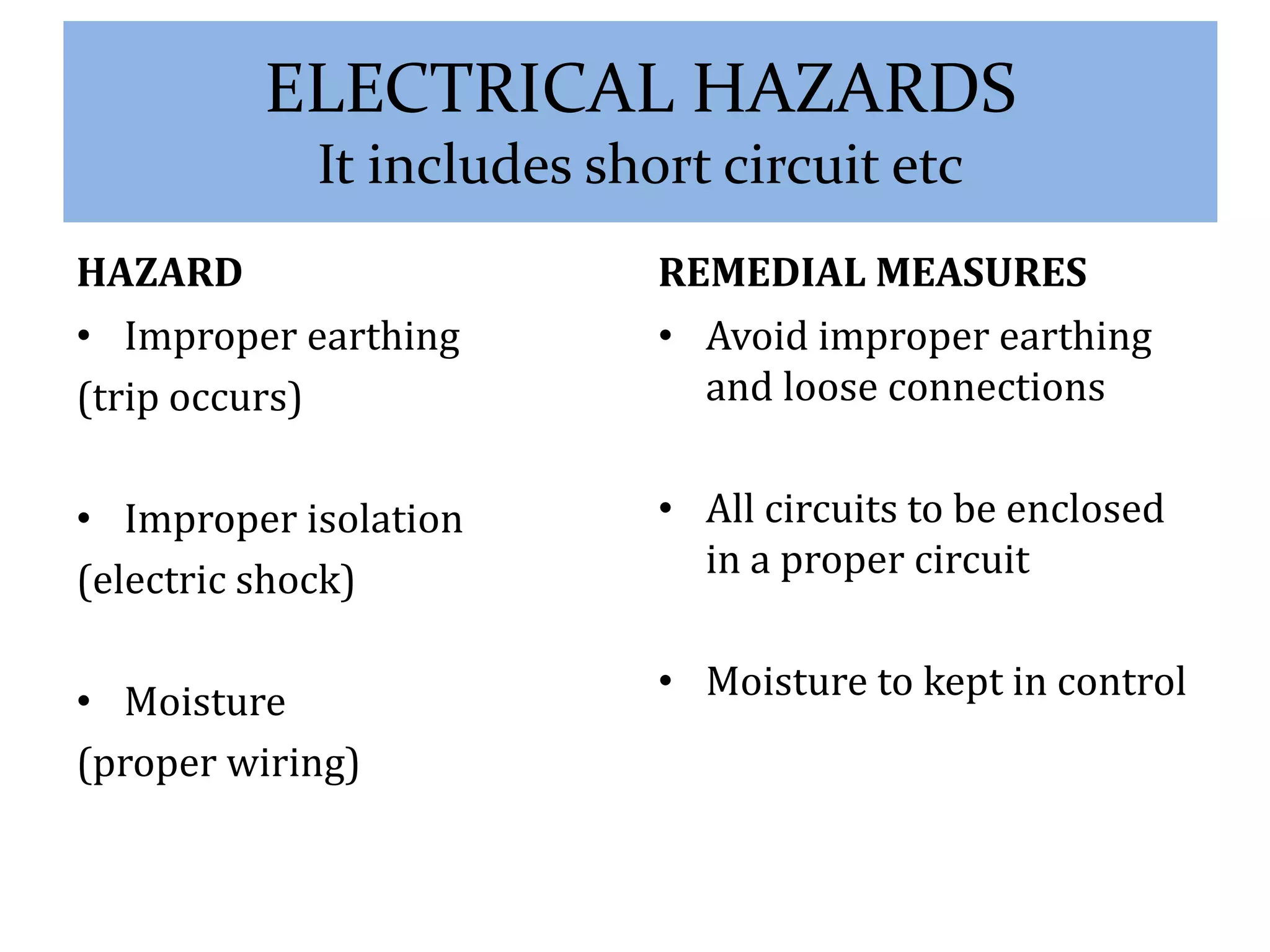
ELECTRICAL HAZARDS 
It includes short circuit etc 
HAZARD 
• Improper earthing 
(trip occurs) 
• Improper isolation 
(electric shock) 
• Moisture 
(proper wiring) 
REMEDIAL MEASURES 
• Avoid improper earthing 
and loose connections 
• All circuits to be enclosed 
in a proper circuit 
• Moisture to kept in control
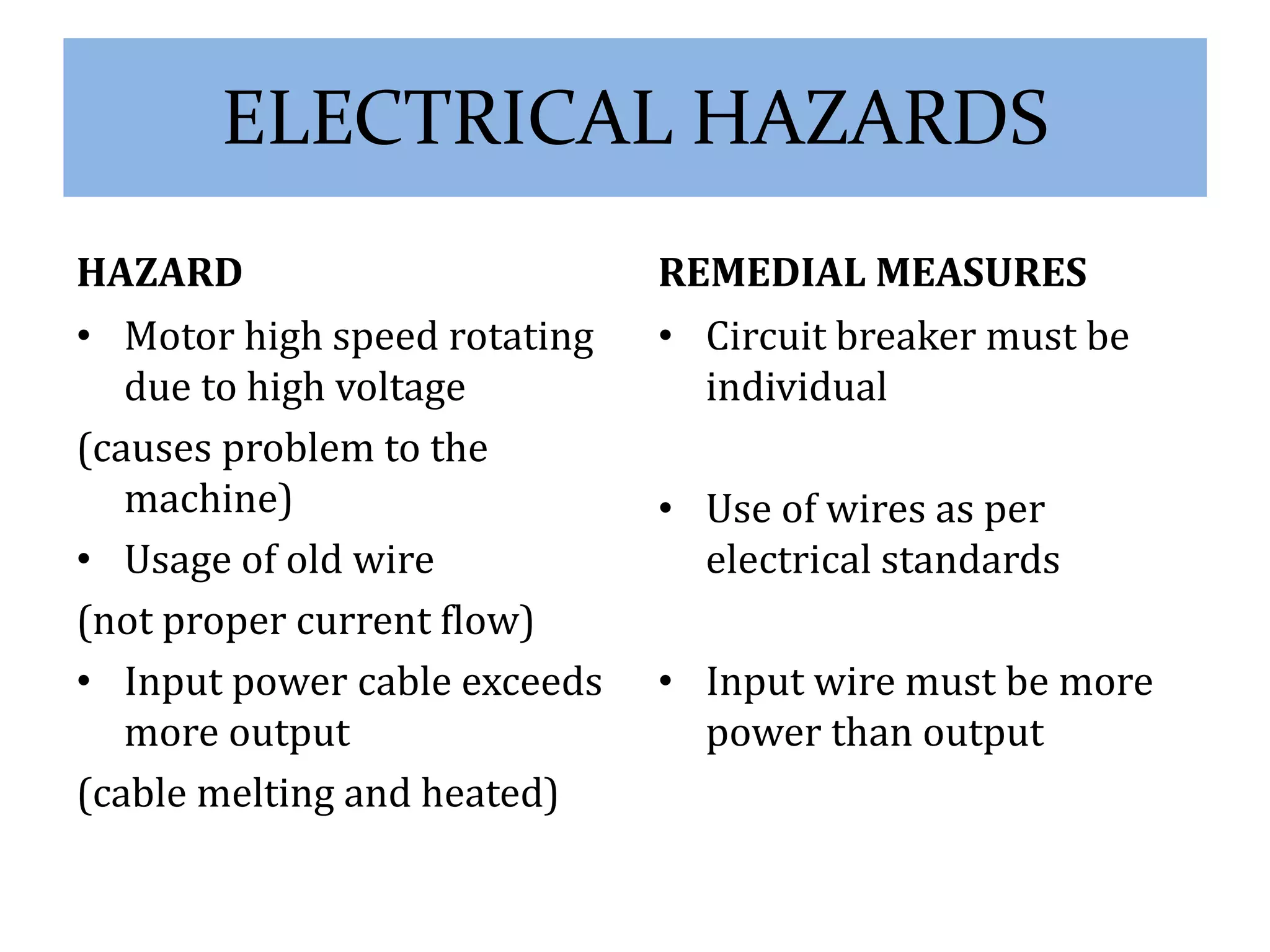
ELECTRICAL HAZARDS 
HAZARD 
• Motor high speed rotating 
due to high voltage 
(causes problem to the 
machine) 
• Usage of old wire 
(not proper current flow) 
• Input power cable exceeds 
more output 
(cable melting and heated) 
REMEDIAL MEASURES 
• Circuit breaker must be 
individual 
• Use of wires as per 
electrical standards 
• Input wire must be more 
power than output
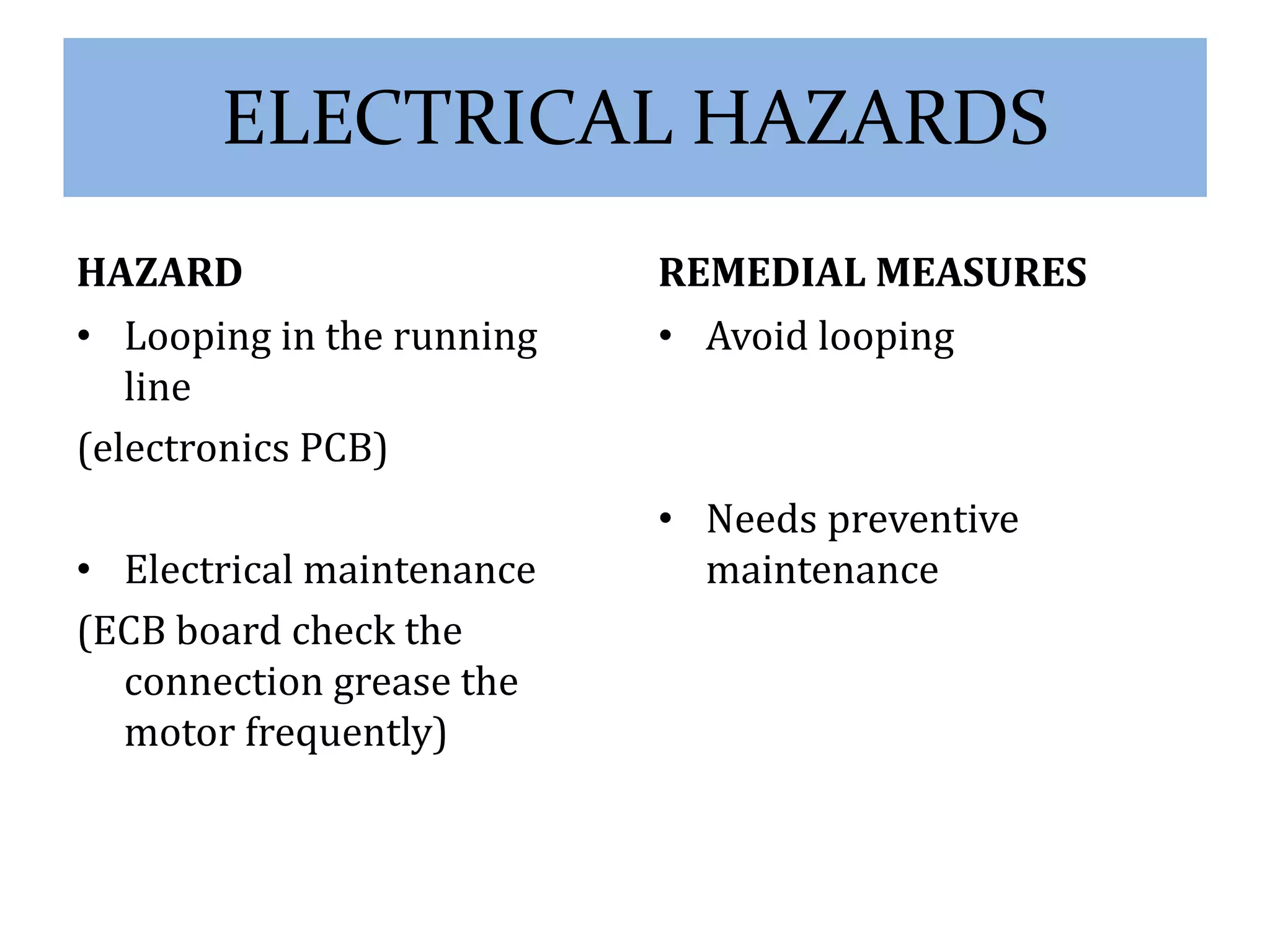
ELECTRICAL HAZARDS 
HAZARD 
• Looping in the running 
line 
(electronics PCB) 
• Electrical maintenance 
(ECB board check the 
connection grease the 
motor frequently) 
REMEDIAL MEASURES 
• Avoid looping 
• Needs preventive 
maintenance
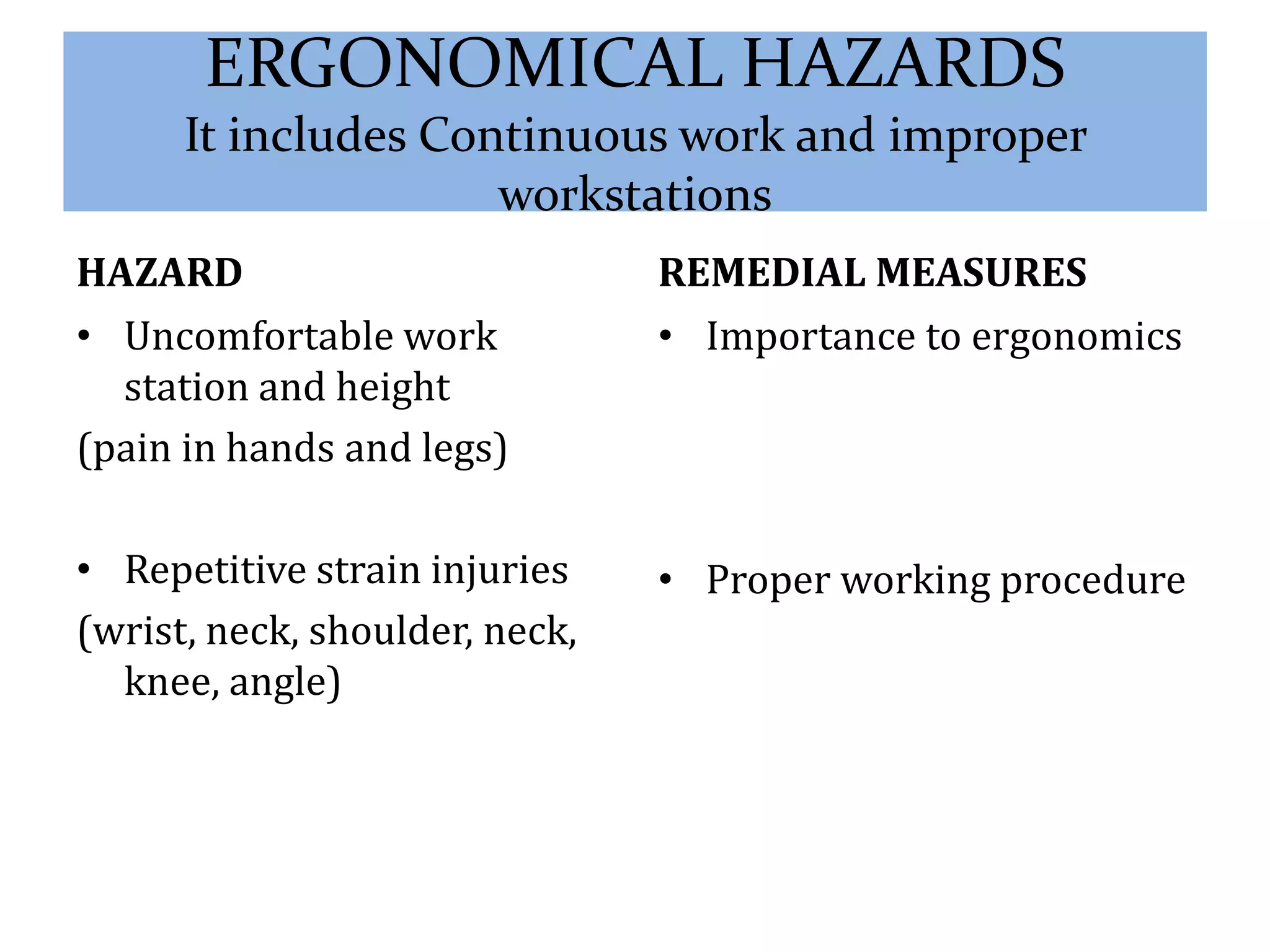
ERGONOMICAL HAZARDS 
It includes Continuous work and improper 
workstations 
HAZARD 
• Uncomfortable work 
station and height 
(pain in hands and legs) 
• Repetitive strain injuries 
(wrist, neck, shoulder, neck, 
knee, angle) 
REMEDIAL MEASURES 
• Importance to ergonomics 
• Proper working procedure
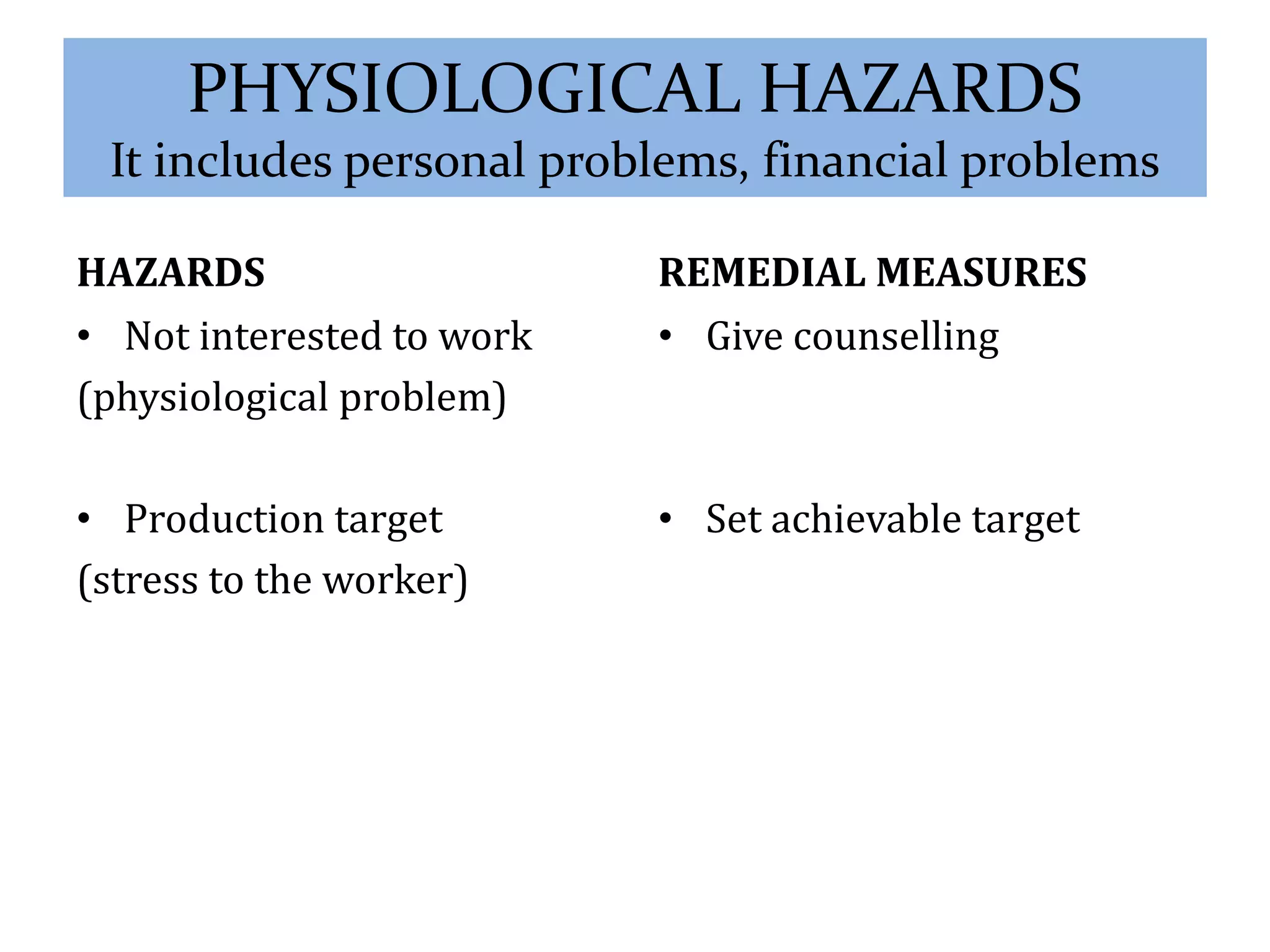
PHYSIOLOGICAL HAZARDS 
It includes personal problems, financial problems 
HAZARDS 
• Not interested to work 
(physiological problem) 
• Production target 
(stress to the worker) 
REMEDIAL MEASURES 
• Give counselling 
• Set achievable target
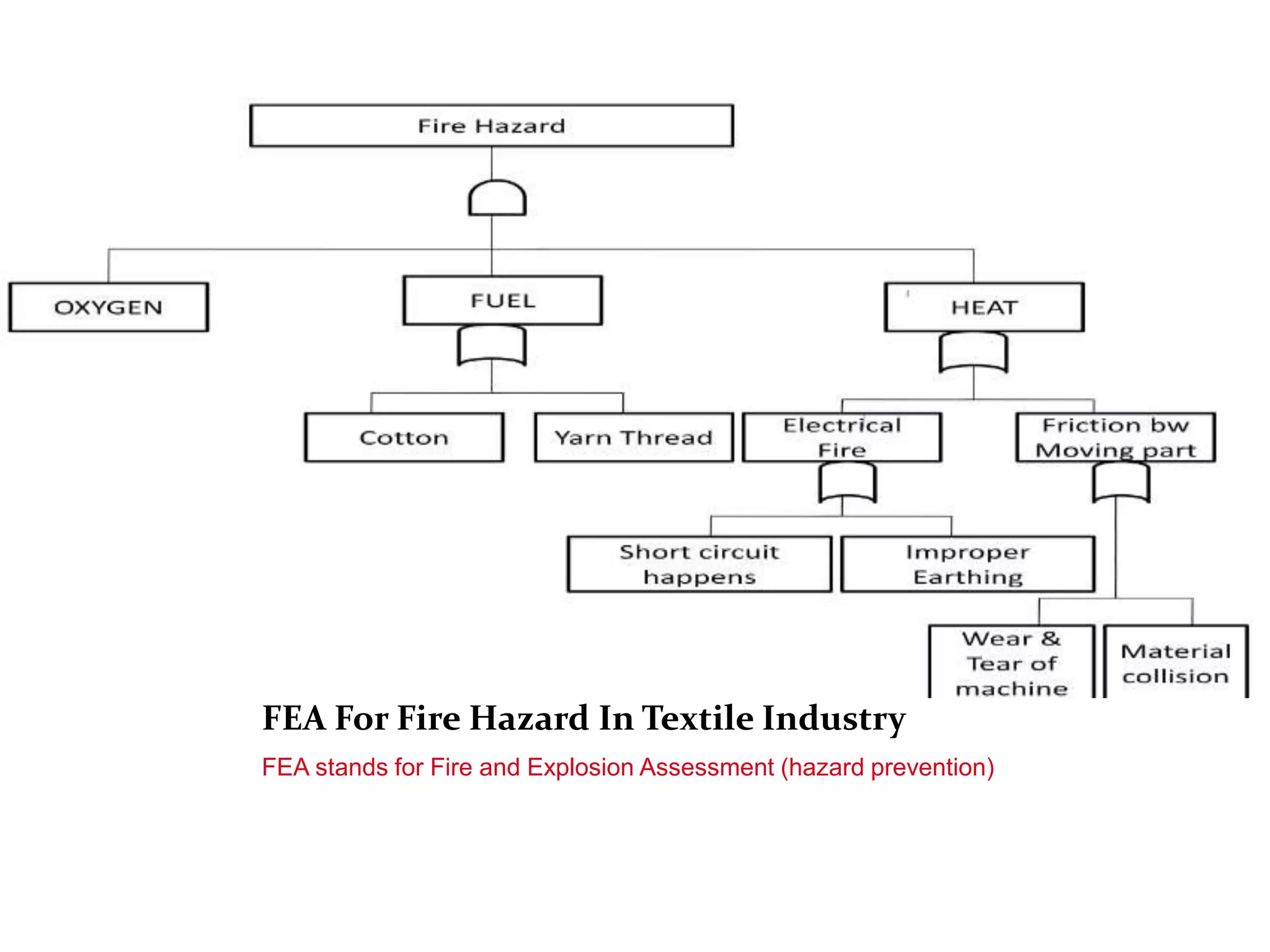
FEA For Fire Hazard In Textile Industry 
FEA stands for Fire and Explosion Assessment (hazard prevention)
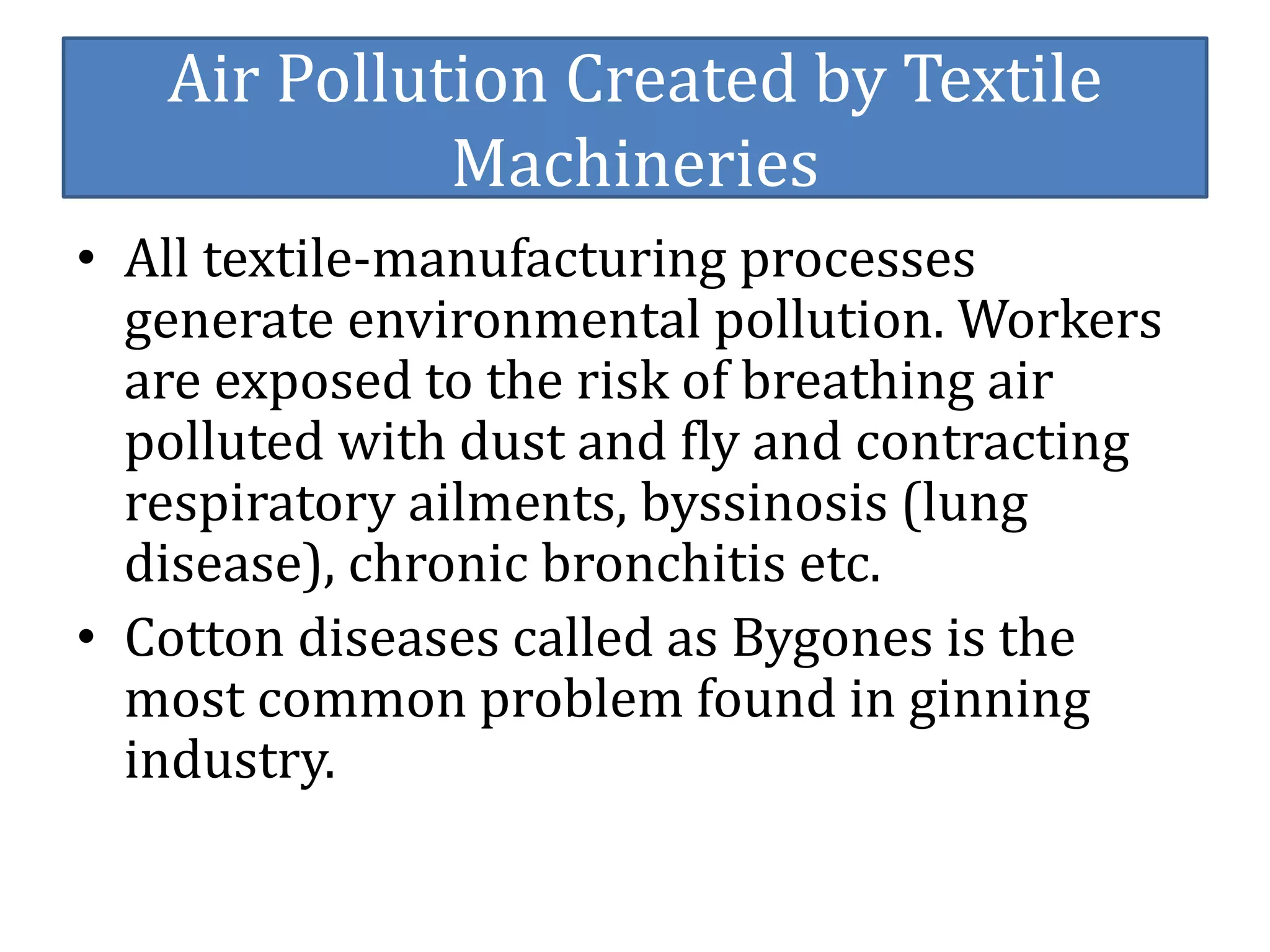
Air Pollution Created by Textile 
Machineries 
• All textile-manufacturing processes 
generate environmental pollution. Workers 
are exposed to the risk of breathing air 
polluted with dust and fly and contracting 
respiratory ailments, byssinosis (lung 
disease), chronic bronchitis etc. 
• Cotton diseases called as Bygones is the 
most common problem found in ginning 
industry.
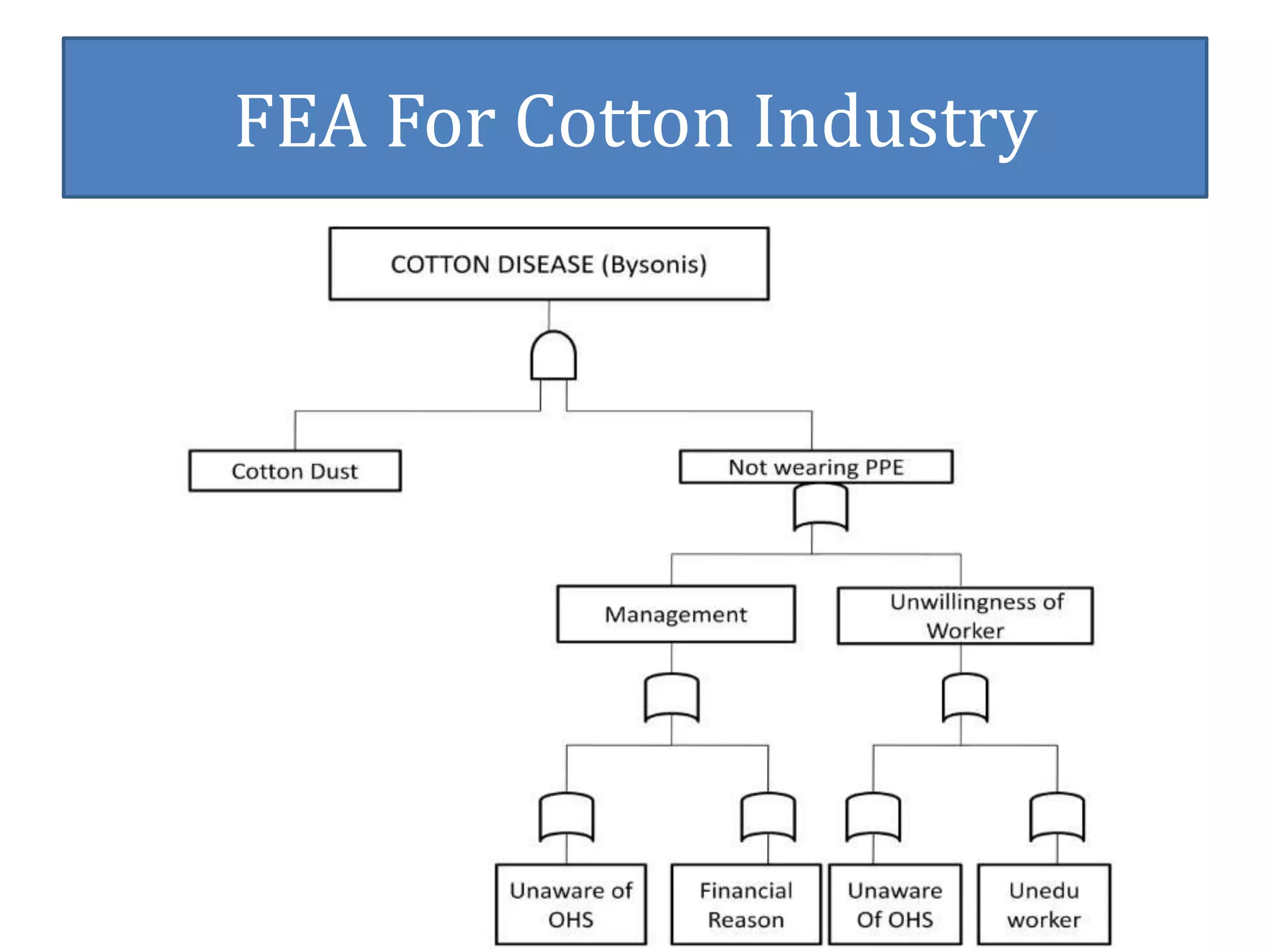
FEA For Cotton Industry
REMEDIAL MEASURES 
• To minimize the effect of these floating fibers or 
impurities, the humidified air which is circulated 
in the spinning and weaving department is filtered 
so as to separate these floating impurities from the 
air. 
• The workroom should not be more than 
0.2mgm3 and controlled by some specific task. 
• The cotton dust should be dumped with proper 
care and avoid storing in open container. 
• Excessive drying should be avoided, if it dry the 
cotton dust will fly fast.
NOISE LEVEL 
• Because of high spindle speeds reached on new 
machines (ring spindles up to 20000 rpm, rotor up 
to 110000 rpm) spinning mills can generally be 
assumed to generate a great deal of noise. Noise 
levels of 70 to 100 dB are commonly recorded in 
workrooms. 
• However, permissible limit set up at 90 dB by 
Federal Standards of USA for maximum exposure 
duration of 8 hours per day.
REMEDIAL MEASURES 
• Noise level can be lowered by the use of noise 
control enclosures, absorbers, silencers and 
baffles and by the use of personal protective 
equipment (PPE), such as earmuffs. 
• Where technical methods are insufficient, noise 
exposure may be reduced by the use of hearing 
protection 
• By administrative controls such as limiting the 
time spent in noisy environment . 
• Scheduling noisy operation outside normal 
shifts or at distant location.
SUMMARY 
• The above presentation has demonstrated the hazards and risk 
involved and their remedial measures in the five main sector of 
textile industries Ginning Industry Spinning Industry Weaving 
Industry Dyeing Industry and Garment Industry but the 
spinning and ginning industries are highlighted more due to 
their immense impact on workers regarding health and safety. 
• The hazards involved in textile industries are mainly noise, dust, 
fire and electrical hazards are found by calculated RPN number, 
• The RPN number is calculated by the multiplication of severity, 
probability and detect ability. RPN = Severity x probability x 
Delectability, comparing to other hazards the maximum RPN is 
found to be harmful to the workers. 
• Immediate action must be taken to control this hazard to save 
workers health and promote safety.
SUGGESTION 
• Upgrade the existing technology or apply PAK-EPA act. It 
is an act to provide for the protection, conservation, 
rehabilitation and improvement of environment, for the 
prevention and control of pollution, and promotion of 
sustainable development. 
• In order to reduce dust emission from machinery it is 
proposed to cover up the moving parts of machines, the 
proper maintenance and correct alignment of the gin 
machinery. 
• Also OSHA standards can be used in textile industry of 
Pakistan in order to improve the health and safety 
aspects of the labor.
REFRENCES 
• [1]. C.W Kan..,”Occupational safety and health management system in 
textile industry” , international lconference textile & fashion 2012 july 
3-4-12 bangok Thailand. 
• [2]. D.S Padmini..,” Unsafe work environment in garments 
industries”,journal of environment research and development, volume 
7 no.1A 2012. 
• [3]. Nazia malik..,” Role of hazard control measure in occupational 
health and safety in the textile industry of Pakistan, pak j.agri sci vol 
47(1), 72-76,2010. 
• [4]. Hafiz Danish asraf.,”frequency of hearing loss among textile 
workers of wearing units in Karachi, Pakistan. 
• [5]. Jamro K. (2013), Remedial measures of health and safety in ginning 
industry of Pakistan, BE Thesis. 
• [6]. Tiwari meenaxi..,” Causes of musco- skeletal disorders in textile 
industry”, Issn 2329-3563.vol 1(4),48-50,December 2012.

REMEDIAL MEASURES OF HEALTH AND SAFETY IN TEXTILE INDUSTRY

  • 1.
    REMEDIAL MEASURES OF HEALTH AND SAFTY IN TEXTILE INDUSTRY SUBMITTED TO: MADAM SHUGUFTA PREPARED BY: AELYA SHAH University of Karachi
  • 2.
    INTRODUCTION OBJECTIVE: Toidentify hazards in textile industry and provide with appropriate remedial measures. OUTCOME: • To make working environment more safer and healthier. Immediate action must be taken to control this hazard to save workers health and promote safety.
  • 3.
    DEFINE HEALTH ANDSAFETY? • Regulations and procedures intended to prevent accident or injury in workplaces or public environments. REMEDIAL MEASURES: Remedial Measures means taking steps to alleviate something we don't desire to experience.
  • 4.
    AGENDA: • Thestudy of Occupational Health and Safety in Textile industry examines to promote Health and safety to the workers in Pakistan. The Hazards and risk involved in the textile industry is high compared with other industries and least importance is given to textile industries. Most of accident does not come to the legal formalities. The People are not aware of Health & safety is due to the workers are uneducated and management not given importance due to promote OHS in Textile industry becomes a barriers in implementing OHS. The major hazards happen are physical, chemical, ergonomically & physiologically hazards along with these some of things which can create hazards are more working hours, improper ventilation. The RPN (Risk priority number) has been find out for all the hazards in the textile industry and FEA is done for the hazard with highest RPN no.
  • 5.
    The Major HealthAnd Safety Issues In The Textile Industry EXPOSURE TO COTTON DUST EXPOSURE TO CHEMICALS EXPOSURE TO NOISE ERGONOMIC ISSUES
  • 6.
    METHODOLOGY GINNING INDUSTRY: • The cotton in a machine which is used to separate the cotton fiber from the seeds and the cotton send to the textile for making yarn. The one of main Hazard in ginning industry is fire, the causes of fire happens in the Ginning Industry are Electrical, Manmade Behavior, spark from the Machine and stored Raw cotton in sunlight and other causes
  • 7.
    METHODOLOGY • SPINNINGINDUSTRY: The textiles are fabricated into clothes. Noise is the main hazard in textile industry. The noise pollution (Regulation and control) rule 2000 in industrial area was 75db at Day Time [6 AM to 10 AM] and Night time [10 PM to 6 AM].The fire accidents occur in textile mills are often. The Hazards in the spinning mills are more compare to other sectors of textile industry because the Raw material cotton exposed to the fire easily.
  • 8.
    TYPES OF HAZARDS PHYSICAL ELECTRICAL ERGONOMICALLY PHYSIOLOGICAL
  • 9.
    PHYSICAL HAZARD Itincludes noise,fire,temperature etc HAZARD • NOISE (noise induced hearing loss Tinnitus) REMEDIAL MEASURE • Isolation of the machine and silencer must be kept • Inverted drive control noise in ring frame • Proper maintenance lubricating control noise
  • 10.
    PHYSICAL HAZARD HAZARD • DUST (causes respiratory problems and causes Byssinosis, a disease caused by cotton dust) REMEDIAL MEASURE • Dust collector • Proper house keeping • Necessary PPE should wear by worker
  • 11.
    PHYSICAL HAZARD HAZARD • LIGHT (eye strain and glaring) • LIFTING HEAVY WEIGHT (muscular skeletal disorders) REMEDIAL MEASURE • Proper lightening condition • Keep your backbone straight while lifting load • Pull the load as close to the body • Lift and carry loads with straight arms
  • 12.
    PHYSICAL HAZARD HAZARD FIRE HAZARDS Loss of life, damages to the equipment • WELDING OPERATION (Spark ignition is very dangerous) • ELECTRICAL SHORT CIRCUIT HAPPENS (if no trips occur it gets sparks and get fire REMEDIAL MEASURES • Restrict unauthorised person to do welding • ACB ( Air circuit breaker), MCB (motor circuit breaker)
  • 13.
    PHYSICAL HAZARDS HAZARD • SMOKING (easily gets fire) REMEDIAL MEASURE • Safety signs and workers must aware of not using any ignition product
  • 14.
    ELECTRICAL HAZARDS Itincludes short circuit etc HAZARD • Improper earthing (trip occurs) • Improper isolation (electric shock) • Moisture (proper wiring) REMEDIAL MEASURES • Avoid improper earthing and loose connections • All circuits to be enclosed in a proper circuit • Moisture to kept in control
  • 15.
    ELECTRICAL HAZARDS HAZARD • Motor high speed rotating due to high voltage (causes problem to the machine) • Usage of old wire (not proper current flow) • Input power cable exceeds more output (cable melting and heated) REMEDIAL MEASURES • Circuit breaker must be individual • Use of wires as per electrical standards • Input wire must be more power than output
  • 16.
    ELECTRICAL HAZARDS HAZARD • Looping in the running line (electronics PCB) • Electrical maintenance (ECB board check the connection grease the motor frequently) REMEDIAL MEASURES • Avoid looping • Needs preventive maintenance
  • 17.
    ERGONOMICAL HAZARDS Itincludes Continuous work and improper workstations HAZARD • Uncomfortable work station and height (pain in hands and legs) • Repetitive strain injuries (wrist, neck, shoulder, neck, knee, angle) REMEDIAL MEASURES • Importance to ergonomics • Proper working procedure
  • 18.
    PHYSIOLOGICAL HAZARDS Itincludes personal problems, financial problems HAZARDS • Not interested to work (physiological problem) • Production target (stress to the worker) REMEDIAL MEASURES • Give counselling • Set achievable target
  • 19.
    FEA For FireHazard In Textile Industry FEA stands for Fire and Explosion Assessment (hazard prevention)
  • 20.
    Air Pollution Createdby Textile Machineries • All textile-manufacturing processes generate environmental pollution. Workers are exposed to the risk of breathing air polluted with dust and fly and contracting respiratory ailments, byssinosis (lung disease), chronic bronchitis etc. • Cotton diseases called as Bygones is the most common problem found in ginning industry.
  • 21.
  • 22.
    REMEDIAL MEASURES •To minimize the effect of these floating fibers or impurities, the humidified air which is circulated in the spinning and weaving department is filtered so as to separate these floating impurities from the air. • The workroom should not be more than 0.2mgm3 and controlled by some specific task. • The cotton dust should be dumped with proper care and avoid storing in open container. • Excessive drying should be avoided, if it dry the cotton dust will fly fast.
  • 23.
    NOISE LEVEL •Because of high spindle speeds reached on new machines (ring spindles up to 20000 rpm, rotor up to 110000 rpm) spinning mills can generally be assumed to generate a great deal of noise. Noise levels of 70 to 100 dB are commonly recorded in workrooms. • However, permissible limit set up at 90 dB by Federal Standards of USA for maximum exposure duration of 8 hours per day.
  • 24.
    REMEDIAL MEASURES •Noise level can be lowered by the use of noise control enclosures, absorbers, silencers and baffles and by the use of personal protective equipment (PPE), such as earmuffs. • Where technical methods are insufficient, noise exposure may be reduced by the use of hearing protection • By administrative controls such as limiting the time spent in noisy environment . • Scheduling noisy operation outside normal shifts or at distant location.
  • 25.
    SUMMARY • Theabove presentation has demonstrated the hazards and risk involved and their remedial measures in the five main sector of textile industries Ginning Industry Spinning Industry Weaving Industry Dyeing Industry and Garment Industry but the spinning and ginning industries are highlighted more due to their immense impact on workers regarding health and safety. • The hazards involved in textile industries are mainly noise, dust, fire and electrical hazards are found by calculated RPN number, • The RPN number is calculated by the multiplication of severity, probability and detect ability. RPN = Severity x probability x Delectability, comparing to other hazards the maximum RPN is found to be harmful to the workers. • Immediate action must be taken to control this hazard to save workers health and promote safety.
  • 26.
    SUGGESTION • Upgradethe existing technology or apply PAK-EPA act. It is an act to provide for the protection, conservation, rehabilitation and improvement of environment, for the prevention and control of pollution, and promotion of sustainable development. • In order to reduce dust emission from machinery it is proposed to cover up the moving parts of machines, the proper maintenance and correct alignment of the gin machinery. • Also OSHA standards can be used in textile industry of Pakistan in order to improve the health and safety aspects of the labor.
  • 27.
    REFRENCES • [1].C.W Kan..,”Occupational safety and health management system in textile industry” , international lconference textile & fashion 2012 july 3-4-12 bangok Thailand. • [2]. D.S Padmini..,” Unsafe work environment in garments industries”,journal of environment research and development, volume 7 no.1A 2012. • [3]. Nazia malik..,” Role of hazard control measure in occupational health and safety in the textile industry of Pakistan, pak j.agri sci vol 47(1), 72-76,2010. • [4]. Hafiz Danish asraf.,”frequency of hearing loss among textile workers of wearing units in Karachi, Pakistan. • [5]. Jamro K. (2013), Remedial measures of health and safety in ginning industry of Pakistan, BE Thesis. • [6]. Tiwari meenaxi..,” Causes of musco- skeletal disorders in textile industry”, Issn 2329-3563.vol 1(4),48-50,December 2012.