Awareness about the
Varies Hazards present in Workplace
A.Ragavendar
Safety - the absence of risk.
Risk - the likelihood that a hazard will cause harm,
in combination with the severity of injury, damage
or loss that might occur.
Safety
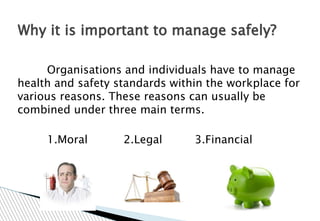
Organisations and individuals have to manage
health and safety standards within the workplace for
various reasons. These reasons can usually be
combined under three main terms.
1.Moral 2.Legal 3.Financial
Why it is important to manage safely?
• Globally, approximately 23L people die every year
from work related accidents and disease.
• Worker safety programmes can reduce 20 to 40%
injury and illness cost at workplace.
1
• Enhance our reputation
• Increase our profits
• Reduce insurance premium
• Maintain a happy & healthy team
Well HSE management can:
• Think about HSE when planning work
• Talk about HSE with our team
• Demonstrate safe and healthy behaviour.
What we should do?
A hazard is anything that has the potential to cause
harm. This could be something as specialised as a
piece of complicated machinery, or as
commonplace as a hot drink. If it could be harmful
in any way. In this PPT we will see the common
hazards in workplace and it influences.
Hazard
Hazards can exist in every workplace. We need to able
recognise them and also should know how to control them.
The followings are some common hazards in workplace.
❖ Mechanical
❖ Physical
❖ Chemical
❖ Biological
❖ Environmental
❖ Organisational
Some common hazards
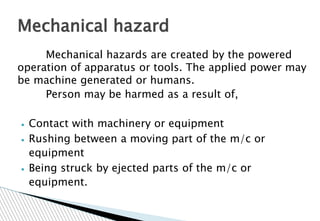
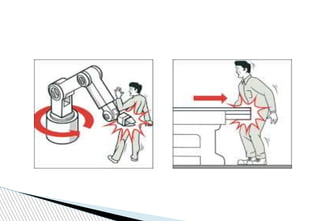
Mechanical hazards are created by the powered
operation of apparatus or tools. The applied power may
be machine generated or humans.
Person may be harmed as a result of,
▪ Contact with machinery or equipment
▪ Rushing between a moving part of the m/c or
equipment
▪ Being struck by ejected parts of the m/c or
equipment.
Mechanical hazard
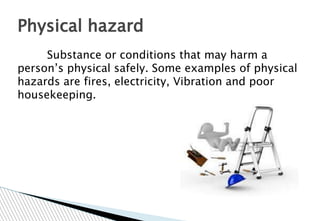
Substance or conditions that may harm a
person’s physical safely. Some examples of physical
hazards are fires, electricity, Vibration and poor
housekeeping.
Physical hazard
Physical hazards are the most common type of
hazards in the workplaces and include unsafe
conditions that can cause injury, illness and death.
• Tripping
• Slipping
• Falling from a height
• Being struck by a falling object
Slips and trips are the most common cause of major
injuries at work. It occur in almost all workplaces
and 95% major slips result in broken bones.
Importantly it can also be the initial cause of a range
of accident, such as fall from height.
Slips and Trips
2
There are several factors that can contribute to slip
or trip:
• Flooring
• Cleaning
• People
• Environment
• Footwear
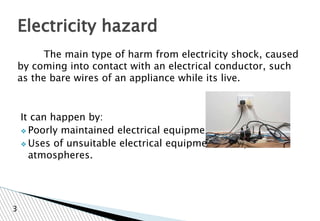
The main type of harm from electricity shock, caused
by coming into contact with an electrical conductor, such
as the bare wires of an appliance while its live.
It can happen by:
❖ Poorly maintained electrical equipment
❖ Uses of unsuitable electrical equipment in explosive
atmospheres.
Electricity hazard
3
Workplace fires cause many people to suffer from
burns each year, and some prove fatal. For a fire to start or
an explosion to occur, three things have to be present.
1.Oxygen 2.Fuel 3.Heat
Removing any one of these components will prevent or
put out a fire.
Fire
Once a fire has started, the best way to reduce
injury or death is to get people away from it and out
of reach of the smoke.
However the best approach is to prevent fires starting
in the first place. A fire will only go out when there’s
no oxygen, the fuel runs out or the heat is removed by
cooling with water or another fire fighting measure.
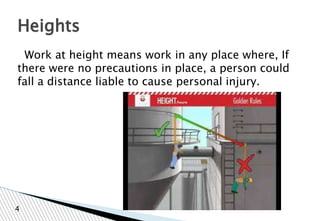
Work at height means work in any place where, If
there were no precautions in place, a person could
fall a distance liable to cause personal injury.
Heights
4
Poor housekeeping can result in dirty, untidy,
overcrowded and obstructed workplaces. This often
leads to a variety of hazardous situations.
Ex: If you don’t clean up oil spillages and tidy away
tools after use, there’ll be a slip and trip hazard. Poor
storage of materials may also present a fire hazard
“Right things at right place”
Housekeeping
5,6
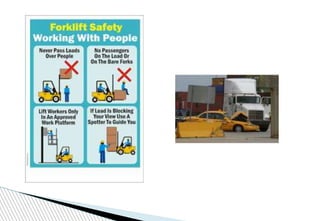
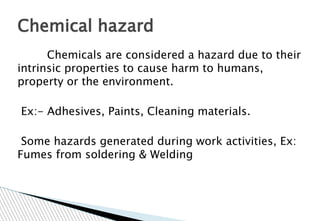
When people and vehicles operate together, there is
the potential for serious accidents.
Most transport-related accidents involve people being
injured as a result of:
❖ Being hit or run over by moving vehicles
❖ Being struck by object falling from vehicles
❖ Falling from vehicles while loading or unloading
❖ Vehicles overturning
Vehicles and transport safety
Chemicals are considered a hazard due to their
intrinsic properties to cause harm to humans,
property or the environment.
Ex:- Adhesives, Paints, Cleaning materials.
Some hazards generated during work activities, Ex:
Fumes from soldering & Welding
Chemical hazard
Chemicals can harm a person’s health by entering the
body by the following way,
▪ Absorption through the skin
▪ Ingestion through the mouth
▪ Inhalation to the lungs.
The harmful effects are: Skin diseases, Respiratory
diseases, Asphyxiation, Damage to nerve system, Blood
poisoning, Cancer etc..
Biological hazards are organic substances or
micro-organisms. They also include toxins that are
produced by organisms (Pathogenic bacteria,
Viruses, Fungi & Parasites).
Examples of common occupational infectious that
can arise from biological hazard include..
Anthrax, Common cold, Needle stick and Sharps
Injuries, Rabies etc..
Biological hazards
▪ Working with animals
▪ Working with people who might be infectious
▪ Handling waste materials
▪ Working in an environment or with equipment that
could be contaminated.
Above will lead to biological hazards.
Environmental hazards are conditions or events, that
have the potential to affect the environment and adversely
affect people’s health. These hazards come in various forms
and are often unnoticed until an accident occurs. These
includes,
▪ Noise
▪ Poor lighting
▪ Unreasonable temperature
▪ Dust
Environmental hazards
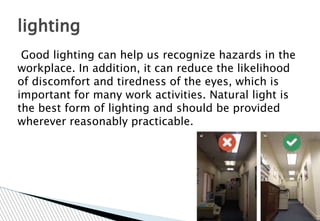
Good lighting can help us recognize hazards in the
workplace. In addition, it can reduce the likelihood
of discomfort and tiredness of the eyes, which is
important for many work activities. Natural light is
the best form of lighting and should be provided
wherever reasonably practicable.
lighting
The key safety issues with lightings are:
• Too little or too much light
• Glare and reflections- ( Can lead to misperception
and mistakes)
• Shadows in safety-critical places
• Providing extra lighting to do the job safely- (
People are more productive when they can see
properly)
Noise is unwanted sound judged to be unpleasant, loud or
disruptive to hearing.
Long-term- Cumulative effect of exposure to loud noise.
(Slow effect)
Ex: machinery or music
Extreme noise- Temporary or permanent deterioration in
your hearing or may even deafen you.
Ex: Quarry workers, Mine workers etc..
Noise
Organisational hazards are a associated with
behaviour Workload, Time constraints and Deadlines.
Studies have shown that the following work
dimensions may have the potential to be stressful:
▪ Temporal aspects of work
▪ Work content
▪ Interpersonal issue with team
▪ Interpersonal issue with supervisors
▪ Organisational structures.
Organisational hazard
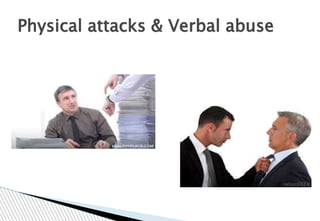
Work related violence occurs when someone is
abused, threatened or assaulted in circumstances
relating to their work.
Violence (Verbal abuse , threats or physical attacks)
can come from people you know, as well as
strangers.
Aggression and violence
If your work brings you into contact with public ,
You’re at a higher risk of attack, especially if you;
• Handle money– Security & Protective services
• Work with violent people- Prison officers
• Deal with complaints----Receptionist
• Work alone– Bus drivers, ticket collectors.
etc..
Physical attacks & Verbal abuse
If a worker feels they’re being out for unfair
treatment by a boss or colleague, they are probably
being bullied.
Ex: Constantly criticising competent staff, Shouting
at staff, Blocking promotion, Putting more load on
him and voluntarily making him fail and Regularly
making jokes about the same person etc..
Bullying
Psychological symptoms:
• Insomnia
• Loss of confidence
• Stress
• Agoraphobia
• Anxiety
• Thoughts of Self-harm
• Irritability
• Guilt High BP
The main injuries associated with workstations
occur after working with them for long periods.
• Upper limb disorder(ULDs):
• Back injuries
• Eye strain
Computer Workstations
9
◦ The use of drugs and alcohol can be a serious workplace
issue. Not only can their use lead to significant health
problems, but also worker under the influence of drugs
or alcohol can be a hazard to themselves and others.
◦ Employers who knowingly allow workers to work under
the influence of alcohol or drugs, where this affects the
safety of themselves and others, could be prosecuted
under safety and health law.
◦ Workers affected by alcohol and drugs are likely to have
increased sickness and poorer performance.
Drugs and Alcoholism
10
The causes of substance misuse may include the
following;
Workload, Staff shortage, Shift work, Bullying and
harassment
Culture in the existing workplace
Long working hours and working away from home.
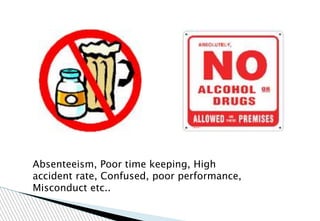
Absenteeism, Poor time keeping, High
accident rate, Confused, poor performance,
Misconduct etc..
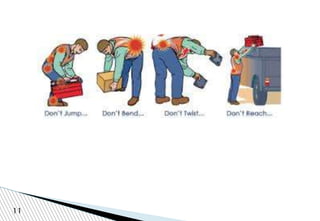
• Manual handling relates to the moving of items
either by lifting, lowering, carrying, pushing or
pulling. The weight of the item is an important
factor, but many other factors can create a risk of
injury. These activities are a major cause of
musculoskeletal disorders(MSDs) – such as lower
back pain, joint injuries and repetitive strain
injuries.
Important factors:
Weight of the load, Size & shape, Posture, Distance,
Movement, Environment and Person ability
Manual handling
11
Awareness about common hazards in work place

Awareness about common hazards in work place

  • 1.
    Awareness about the VariesHazards present in Workplace A.Ragavendar
  • 2.
    Safety - theabsence of risk. Risk - the likelihood that a hazard will cause harm, in combination with the severity of injury, damage or loss that might occur. Safety
  • 3.
    Organisations and individualshave to manage health and safety standards within the workplace for various reasons. These reasons can usually be combined under three main terms. 1.Moral 2.Legal 3.Financial Why it is important to manage safely?
  • 4.
    • Globally, approximately23L people die every year from work related accidents and disease. • Worker safety programmes can reduce 20 to 40% injury and illness cost at workplace. 1
  • 5.
    • Enhance ourreputation • Increase our profits • Reduce insurance premium • Maintain a happy & healthy team Well HSE management can:
  • 6.
    • Think aboutHSE when planning work • Talk about HSE with our team • Demonstrate safe and healthy behaviour. What we should do?
  • 7.
    A hazard isanything that has the potential to cause harm. This could be something as specialised as a piece of complicated machinery, or as commonplace as a hot drink. If it could be harmful in any way. In this PPT we will see the common hazards in workplace and it influences. Hazard
  • 8.
    Hazards can existin every workplace. We need to able recognise them and also should know how to control them. The followings are some common hazards in workplace. ❖ Mechanical ❖ Physical ❖ Chemical ❖ Biological ❖ Environmental ❖ Organisational Some common hazards
  • 9.
    Mechanical hazards arecreated by the powered operation of apparatus or tools. The applied power may be machine generated or humans. Person may be harmed as a result of, ▪ Contact with machinery or equipment ▪ Rushing between a moving part of the m/c or equipment ▪ Being struck by ejected parts of the m/c or equipment. Mechanical hazard
  • 11.
    Substance or conditionsthat may harm a person’s physical safely. Some examples of physical hazards are fires, electricity, Vibration and poor housekeeping. Physical hazard
  • 12.
    Physical hazards arethe most common type of hazards in the workplaces and include unsafe conditions that can cause injury, illness and death. • Tripping • Slipping • Falling from a height • Being struck by a falling object
  • 13.
    Slips and tripsare the most common cause of major injuries at work. It occur in almost all workplaces and 95% major slips result in broken bones. Importantly it can also be the initial cause of a range of accident, such as fall from height. Slips and Trips 2
  • 14.
    There are severalfactors that can contribute to slip or trip: • Flooring • Cleaning • People • Environment • Footwear
  • 15.
    The main typeof harm from electricity shock, caused by coming into contact with an electrical conductor, such as the bare wires of an appliance while its live. It can happen by: ❖ Poorly maintained electrical equipment ❖ Uses of unsuitable electrical equipment in explosive atmospheres. Electricity hazard 3
  • 16.
    Workplace fires causemany people to suffer from burns each year, and some prove fatal. For a fire to start or an explosion to occur, three things have to be present. 1.Oxygen 2.Fuel 3.Heat Removing any one of these components will prevent or put out a fire. Fire
  • 17.
    Once a firehas started, the best way to reduce injury or death is to get people away from it and out of reach of the smoke. However the best approach is to prevent fires starting in the first place. A fire will only go out when there’s no oxygen, the fuel runs out or the heat is removed by cooling with water or another fire fighting measure.
  • 18.
    Work at heightmeans work in any place where, If there were no precautions in place, a person could fall a distance liable to cause personal injury. Heights 4
  • 19.
    Poor housekeeping canresult in dirty, untidy, overcrowded and obstructed workplaces. This often leads to a variety of hazardous situations. Ex: If you don’t clean up oil spillages and tidy away tools after use, there’ll be a slip and trip hazard. Poor storage of materials may also present a fire hazard “Right things at right place” Housekeeping 5,6
  • 20.
    When people andvehicles operate together, there is the potential for serious accidents. Most transport-related accidents involve people being injured as a result of: ❖ Being hit or run over by moving vehicles ❖ Being struck by object falling from vehicles ❖ Falling from vehicles while loading or unloading ❖ Vehicles overturning Vehicles and transport safety
  • 22.
    Chemicals are considereda hazard due to their intrinsic properties to cause harm to humans, property or the environment. Ex:- Adhesives, Paints, Cleaning materials. Some hazards generated during work activities, Ex: Fumes from soldering & Welding Chemical hazard
  • 23.
    Chemicals can harma person’s health by entering the body by the following way, ▪ Absorption through the skin ▪ Ingestion through the mouth ▪ Inhalation to the lungs. The harmful effects are: Skin diseases, Respiratory diseases, Asphyxiation, Damage to nerve system, Blood poisoning, Cancer etc..
  • 24.
    Biological hazards areorganic substances or micro-organisms. They also include toxins that are produced by organisms (Pathogenic bacteria, Viruses, Fungi & Parasites). Examples of common occupational infectious that can arise from biological hazard include.. Anthrax, Common cold, Needle stick and Sharps Injuries, Rabies etc.. Biological hazards
  • 25.
    ▪ Working withanimals ▪ Working with people who might be infectious ▪ Handling waste materials ▪ Working in an environment or with equipment that could be contaminated. Above will lead to biological hazards.
  • 26.
    Environmental hazards areconditions or events, that have the potential to affect the environment and adversely affect people’s health. These hazards come in various forms and are often unnoticed until an accident occurs. These includes, ▪ Noise ▪ Poor lighting ▪ Unreasonable temperature ▪ Dust Environmental hazards
  • 27.
    Good lighting canhelp us recognize hazards in the workplace. In addition, it can reduce the likelihood of discomfort and tiredness of the eyes, which is important for many work activities. Natural light is the best form of lighting and should be provided wherever reasonably practicable. lighting
  • 28.
    The key safetyissues with lightings are: • Too little or too much light • Glare and reflections- ( Can lead to misperception and mistakes) • Shadows in safety-critical places • Providing extra lighting to do the job safely- ( People are more productive when they can see properly)
  • 29.
    Noise is unwantedsound judged to be unpleasant, loud or disruptive to hearing. Long-term- Cumulative effect of exposure to loud noise. (Slow effect) Ex: machinery or music Extreme noise- Temporary or permanent deterioration in your hearing or may even deafen you. Ex: Quarry workers, Mine workers etc.. Noise
  • 30.
    Organisational hazards area associated with behaviour Workload, Time constraints and Deadlines. Studies have shown that the following work dimensions may have the potential to be stressful: ▪ Temporal aspects of work ▪ Work content ▪ Interpersonal issue with team ▪ Interpersonal issue with supervisors ▪ Organisational structures. Organisational hazard
  • 31.
    Work related violenceoccurs when someone is abused, threatened or assaulted in circumstances relating to their work. Violence (Verbal abuse , threats or physical attacks) can come from people you know, as well as strangers. Aggression and violence
  • 32.
    If your workbrings you into contact with public , You’re at a higher risk of attack, especially if you; • Handle money– Security & Protective services • Work with violent people- Prison officers • Deal with complaints----Receptionist • Work alone– Bus drivers, ticket collectors. etc..
  • 33.
    Physical attacks &Verbal abuse
  • 34.
    If a workerfeels they’re being out for unfair treatment by a boss or colleague, they are probably being bullied. Ex: Constantly criticising competent staff, Shouting at staff, Blocking promotion, Putting more load on him and voluntarily making him fail and Regularly making jokes about the same person etc.. Bullying
  • 35.
    Psychological symptoms: • Insomnia •Loss of confidence • Stress • Agoraphobia • Anxiety • Thoughts of Self-harm • Irritability • Guilt High BP
  • 36.
    The main injuriesassociated with workstations occur after working with them for long periods. • Upper limb disorder(ULDs): • Back injuries • Eye strain Computer Workstations 9
  • 37.
    ◦ The useof drugs and alcohol can be a serious workplace issue. Not only can their use lead to significant health problems, but also worker under the influence of drugs or alcohol can be a hazard to themselves and others. ◦ Employers who knowingly allow workers to work under the influence of alcohol or drugs, where this affects the safety of themselves and others, could be prosecuted under safety and health law. ◦ Workers affected by alcohol and drugs are likely to have increased sickness and poorer performance. Drugs and Alcoholism 10
  • 38.
    The causes ofsubstance misuse may include the following; Workload, Staff shortage, Shift work, Bullying and harassment Culture in the existing workplace Long working hours and working away from home.
  • 39.
    Absenteeism, Poor timekeeping, High accident rate, Confused, poor performance, Misconduct etc..
  • 40.
    • Manual handlingrelates to the moving of items either by lifting, lowering, carrying, pushing or pulling. The weight of the item is an important factor, but many other factors can create a risk of injury. These activities are a major cause of musculoskeletal disorders(MSDs) – such as lower back pain, joint injuries and repetitive strain injuries. Important factors: Weight of the load, Size & shape, Posture, Distance, Movement, Environment and Person ability Manual handling
  • 41.

Editor's Notes

  • #3 Tell about safety