Nebosh IG2 – Risk Assessment
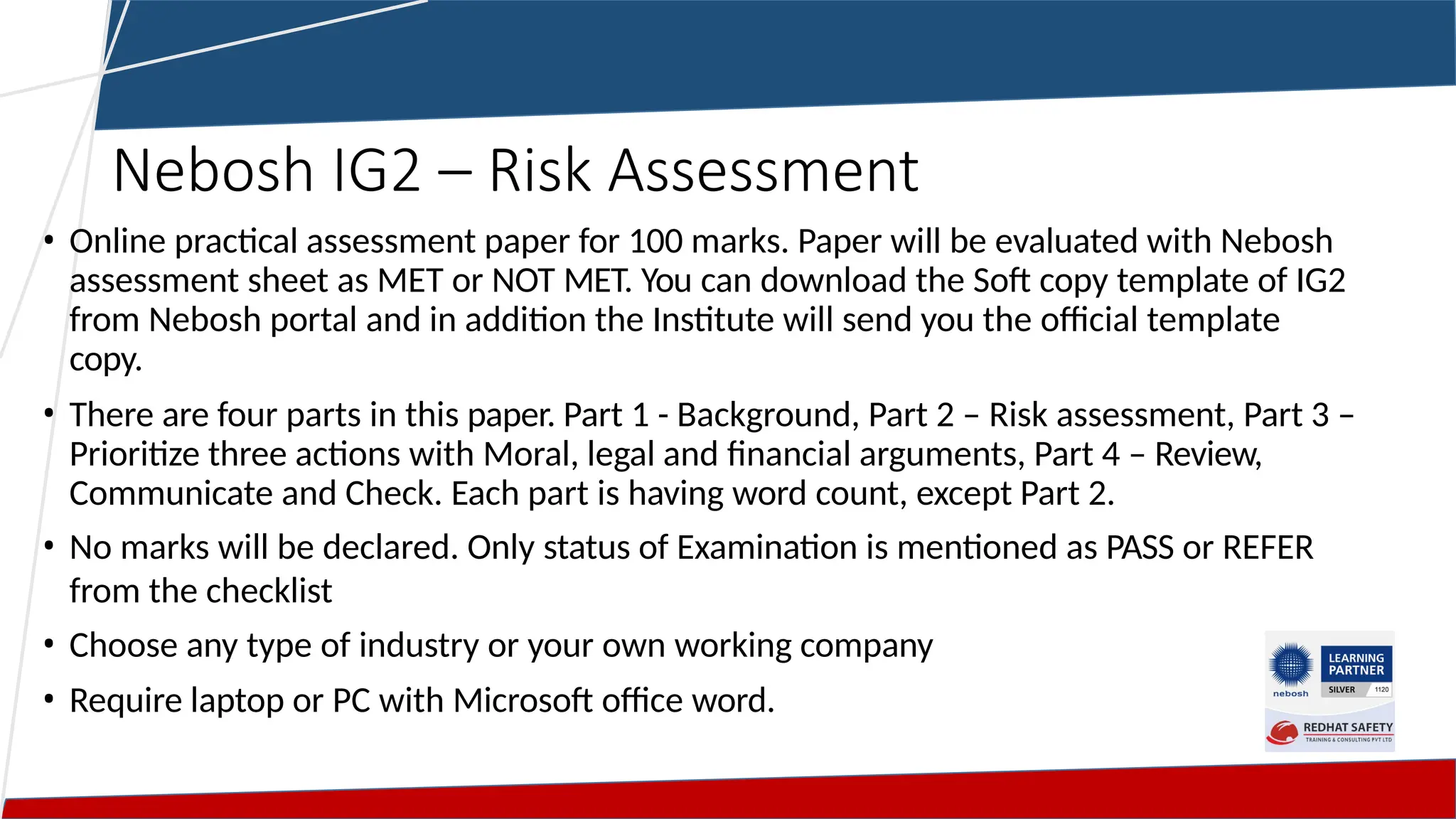
• Online practical assessment paper for 100 marks. Paper will be evaluated with Nebosh
assessment sheet as MET or NOT MET. You can download the Soft copy template of IG2
from Nebosh portal and in addition the Institute will send you the official template
copy.
• There are four parts in this paper. Part 1 - Background, Part 2 – Risk assessment, Part 3 –
Prioritize three actions with Moral, legal and financial arguments, Part 4 – Review,
Communicate and Check. Each part is having word count, except Part 2.
• No marks will be declared. Only status of Examination is mentioned as PASS or REFER
from the checklist
• Choose any type of industry or your own working company
• Require laptop or PC with Microsoft office word.
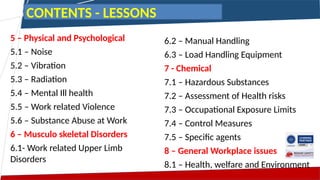
5 – Physical and Psychological
5.1 – Noise
5.2 – Vibration
5.3 – Radiation
5.4 – Mental Ill health
5.5 – Work related Violence
5.6 – Substance Abuse at Work
6 – Musculo skeletal Disorders
6.1- Work related Upper Limb
Disorders
6.2 – Manual Handling
6.3 – Load Handling Equipment
7 - Chemical
7.1 – Hazardous Substances
7.2 – Assessment of Health risks
7.3 – Occupational Exposure Limits
7.4 – Control Measures
7.5 – Specific agents
8 – General Workplace issues
8.1 – Health, welfare and Environment
CONTENTS - LESSONS
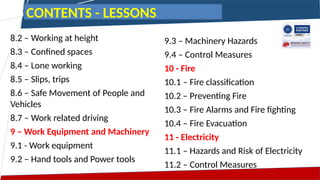
8.2 – Working at height
8.3 – Confined spaces
8.4 – Lone working
8.5 – Slips, trips
8.6 – Safe Movement of People and
Vehicles
8.7 – Work related driving
9 – Work Equipment and Machinery
9.1 - Work equipment
9.2 – Hand tools and Power tools
9.3 – Machinery Hazards
9.4 – Control Measures
10 - Fire
10.1 – Fire classification
10.2 – Preventing Fire
10.3 – Fire Alarms and Fire fighting
10.4 – Fire Evacuation
11 - Electricity
11.1 – Hazards and Risk of Electricity
11.2 – Control Measures
CONTENTS - LESSONS
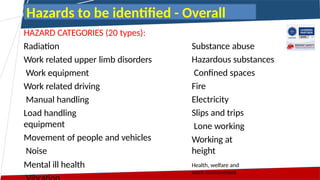
HAZARD CATEGORIES (20 types):
Radiation
Work related upper limb disorders
Work equipment
Work related driving
Manual handling
Load handling
equipment
Movement of people and vehicles
Noise
Mental ill health
Substance abuse
Hazardous substances
Confined spaces
Fire
Electricity
Slips and trips
Lone working
Working at
height
Health, welfare and
work environment
Hazards to be identified - Overall
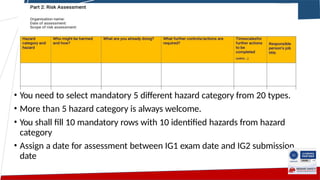
• You need to select mandatory 5 different hazard category from 20 types.
• More than 5 hazard category is always welcome.
• You shall fill 10 mandatory rows with 10 identified hazards from hazard
category
• Assign a date for assessment between IG1 exam date and IG2 submission
date
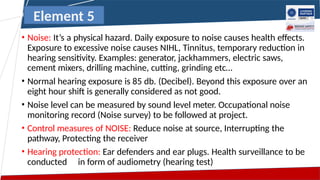
• Noise: It’s a physical hazard. Daily exposure to noise causes health effects.
Exposure to excessive noise causes NIHL, Tinnitus, temporary reduction in
hearing sensitivity. Examples: generator, jackhammers, electric saws,
cement mixers, drilling machine, cutting, grinding etc…
• Normal hearing exposure is 85 db. (Decibel). Beyond this exposure over an
eight hour shift is generally considered as not good.
• Noise level can be measured by sound level meter. Occupational noise
monitoring record (Noise survey) to be followed at project.
• Control measures of NOISE: Reduce noise at source, Interrupting the
pathway, Protecting the receiver
• Hearing protection: Ear defenders and ear plugs. Health surveillance to be
conducted in form of audiometry (hearing test)
Element 5
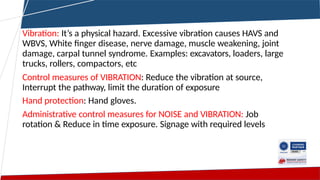
Vibration: It’s a physical hazard. Excessive vibration causes HAVS and
WBVS, White finger disease, nerve damage, muscle weakening, joint
damage, carpal tunnel syndrome. Examples: excavators, loaders, large
trucks, rollers, compactors, etc
Control measures of VIBRATION: Reduce the vibration at source,
Interrupt the pathway, limit the duration of exposure
Hand protection: Hand gloves.
Administrative control measures for NOISE and VIBRATION: Job
rotation & Reduce in time exposure. Signage with required levels
Radiation: It’s a physical hazard. Non – ionizing radiation ( UV, Visible, IR, microwave and
radio waves) and Ionizing radiation (alpha particles, beta particles, x rays, gamma rays,
neutrons. Instrument use to measure this radiation is GEIGER METER. Unit is MILLIREMS.
Radiation more than 0.75 millirem to be controlled.
Health effects of NIR: redness, sun burns, snow blindness, disability glare, internal heating,
internal organ damage,
Health effects of IR: sickness, anemia, hair loss, cancer, genetic mutations, birth defects etc.
Control measure of NIR: use of clothing, PPE, SSOW, permits,
Control measure of IR: Time, Distance and shielding
Basic radiation protection strategies: Competent person, MSRA, PTW, 24hrs notice, log
sheet, flashing amber beacon lights, sealed records, thermo luminescent dosimeter, safe
distance radiation area calculated, evacuated, barricaded with yellow/black tapes, Exposure
shall be eliminated, dose limits, IITS, Health surveillance plastic badge or ring worn by the
worker
Mental ill health: Stress, anxiety, depression due to Psychological, physical
and behavioral symptoms. Work related stress caused by excessive pressure
cause chronic health effects.
Causes: Demands (Work load, deadlines), control (lack of control over work with light
levels, temp), support (Lack of IITS), relationships (poor quality workplace by peer), role
(lack of clarity), change (demotion, reassignment, take over), home work interface
(separation, family illness), staying in work (prolonged absence from work)
Work related violence: abused, threatened, assaulted. Occupations like cash
handling, lone working, wearing a uniform, representing authority, hospitals,
teachers, bus drivers etc
Control: staff survey, interviewing staff, collecting and analyzing, CCTV, panic
alarms, pleasant environment, clear announcement, security doors,
trainings, visit logging with supervisor, GPS, no lone working etc.
Substance abuse at work: Alcohol (local bar), legal (common painkillers) or
illegal drugs (heroin, cocaine), solvents (glue sniffing)
Effects at work: late attendance, increased absenteeism, reduction in quality of work,
reduction in work rate, dishonesty, theft, potentially to found a habit, irritability and
mood swings, deterioration in working relationships, sensory impairment, skewed
perceptions, fatigue, drowsiness, un control driving of vehicle, cirrhosis of the liver
Control measure: clear policy, rule restricting access in workplace, statutory legal
requirements (drink drive laws), non statutory requirements, arrangements for any
random drugs and testing, rehabilitation and treatment programmes, disciplinary
procedures, IITS, awareness campaign
Musculoskeletal disorders (MSD): chronic soft tissue injuries or disorders of muscle,
nerves, joints, cartilage, spinal discs affecting the body movement or system. Ex. Carpel
tunnel syndrome, tendonitis, muscle strain, ligament sprain, neck syndrome, back pain,
trauma, arthritis, bone fractures, painful knee joints etc.
WRULD’s: collective term for a range of disorders of the hand, wrist, arm, shoulder and neck.
Ex. Muscle strains, tears, ligament sprains, joint inflammation, numbness in fingers, arm pain,
discomfort, tingling sensations etc.
Activities causing MSD’s / WRULD’s: High task repetition, standing and sitting for long period,
forceful exertions, repetitive or sustained awkward postures, poor posture, lighting, glare,
environmental parameters, display screen equipment, keyboard operation, bricklaying, use of
keyboard, mouse, call center staff, desktop computers etc
Control measures over DSE: RA, basic work station equipment, ergonomic design, frequent
breaks, plan the work routine, free eye test, IITS, good lumbar support, adjustable seat, foot
support, screen height, space, fore arms, head set, lighting,
Manual handling: lifting, carrying, pushing and pulling of a load by force.
Principles of Manual handling (RA): TILE – Task, Individual, Load and Environment
Hazards in MH: Improper lifting, Improper gripping, poor physique, age factor, Incompetency,
Overload shifting, slip, trip, fall, handling greasy/oily/irregular objects
Element 6
Good Manual handling technique: Before lifting – check the weight, stability, plan the route of
carry, establish a firm grip. The lift – Bend the knees and use leg muscles, keep the back
upright, keep the load close to the body, avoid twisting, overreaching. Setting down – use the
same principles as when lifting, maintain good balance, set the load down and adjust its
position using body weight
Load handling equipment: ex. Crane, forklift, excavator, trucks etc.
Hazards in LHE: Entanglement, drawing in, crushing, Collapse or toppling of equipment, falls
of load from height, falling objects, standing under the suspended load, incompetent
operators, excessive wind speed, poor ground surface, stuck during movement in roads,
striking of load against the structures, failure to use guide rope, damaged lifting gears, fire,
man equipment collision, over turn, contact with live overhead cables, fuel spill, exhaust
fumes, arcing, disposal of battery etc
Control measures: MSRA, PTW, Lifting plan, Operator checklist, operator competency, equipment certificate,
lifting gears certificate, SWL, load chart, safety devices, safety guards, seat belt, securing of load, use of guide
rope or tag line, competent rigger / banksman, use of flags, whistle, health surveillance for operator / rigger etc
Hazardous substances (CHEMICAL): refers to any product (solid, dust, mist, vapor,
liquid, gas) or chemical that has the properties of explosive, flammable, irritant, oxidizing,
toxic, corrosive or toxic to environment. Hazardous to peoples health gives acute and
chronic effects like asphyxiation, carcinogenicity, allergy, rash, burns, breathing difficulty,
eye irritation, skin corrosion, dermatitis, reproductive toxicity, respiratory sensitization,
asbestosis etc
Routes of entry: Inhalation, ingestion, injection, absorption
Control measure: MSDS, PPE, waste management disposal, spill kit, COSHH assessment,
Fire extinguisher, dip tray, training, RA, SSOW, chemical with identified label, safe storage of
chemicals in designated room, appointed ERT contact numbers signage, Fire retardant
room, ventilation, eye wash stations, emergency showers etc
MSDS: Material Safety Data Sheet contains 16 information. Provide sufficient
information, steps to ensure safe use, including transport and disposal. Shall
be communicated to site workforce
Element 7
Occupational exposure limit (OEL): the maximum airborne concentration of a toxic
substance to which a worker can be exposed over a period of time. The purpose of OEL is to
put a limit in place so that workers will not be exposed to high concentrations of air borne
substance.
TWA (Time weighted average) calculated by measuring a persons average exposure. This can
be done from STEL (Short term exposure limit) exposed to 15 min and LTEL (Long term
exposure limit) exposed to 8 hrs.
Controls towards exposure: Eliminate or substitute, change the process, reduce the
exposure time, enclose or segregate, LEV, hoods, periodic testing, Dilution ventilation, RPE,
PPE, personal hygiene, health surveillance, Training on RPE etc.
RPE: two groups – respirators (filters the air taken from the immediate environment) and
BA (breathable air from a separate source). Respirators - Filtering face piece respirator, half
mask or ori nasal respirator, full face respirator, powered respirator etc. BA are of two types –
Compressed air line BA and Self contained BA. RPE must be selected carefully to its suitability
Health, welfare and work environments: Drinking water, sanitary
conveniences, washing facilities, changing rooms, accommodation, resting,
eating facilities, seating, ventilation, lighting etc.
Working at Height: place where if there were no precautions in place,
Hazards: Fall of person, fall of objects, overload, poor load distribution, damaged ladder,
incomplete scaffolding, incompetent scaffolding erector, incompetent scaffolding
inspector, incomplete guard rail, unprotected edges, wide gap between planks, improper
ground surface, adverse weather conditions, inadequate lifeline, inadequate fall
protection system, incompetent equipment certificate etc.
Control: Trained, MSRA, PTW, SSOW, Inspected ladders, Competent
scaffolding inspector, erector, checklist, standard scaffold materials, fall
protection system, weather conditions, safe storage of materials etc
Element 8
Confined space: any chamber, tank, pit, trench, pipe. A space with limited entry and
egress and not suitable for human continuous occupancy.
Hazard: Toxic gas or fumes, fire, flammable gas, oxygen deficiency or enrichment,
inadequate illumination, inadequate ventilation, inappropriate access, Excessive heat, use of
high voltage EE, incompetent persons, no buddy system etc
Control measures: Gas testing, use of calibrated gas tester, Trained, PTW, MSRA, SSOW,
Adequate lighting with 24v, Forced ventilation, safe secured access, use of tripod, SCBA,
Barricade, PPE with signage, Buddy system, “People-in” Tally board, non sparking tools etc
IDLH Immediately dangerous to Life & Health: any condition that provides immediately or
delayed threat to life.
Oxygen – 19.5 to 23.5%, Lower flammable limit (LEL) – less than 10%, CO – less than 35 PPM,
H2S – Less than 10 PPM.
One Parts per million (PPM) – if a million particles of air by volume (ABV) contains one part
of gas
Work equipment: for use at work and including machinery, appliances, tools etc. Hand tools
– hammers, chisel etc, Power tools – Portable electric drills, Machinery – power press, wood
working machine, paper shredder, tractor, abrasive wheels etc, Equipment – MEWP, cherry
picker etc.
Mechanical hazard – crushing (body trapped between two moving parts), shearing (part of the body usually
fingers trapped btw two moving parts), cuts (contact with sharp edged part), lacerations, entanglement (loose
items such as clothing, hairs), drawing in (a part caught and drawn into machine), stabbing (parts of material
ejected from machine, puncture, friction (contact with fast moving surface), abrasion , high pressure fluid
injection, impact (body struck by a powdered part of a machine) etc
Non mechanical Hazard – Electricity (electric shock), noise (hearing damage), vibration (white finger),
chemicals (harmful, irritant), dusts, vibration, radiation, temperature, fire, explosion, slip, trip, fall, ergonomics
etc
Control: IITS, SSOW, Emergency controls, stop controls, machine guarding, fixed enclosed guards, interlocked
guards, adjustable guards, sensitive protection equipment (trip devices), two hand controls, dead mans handle,
pressure mats, photoelectric devices, jigs, holders, push sticks, proper maintenance etc, space considerations,
markings, warnings, lighting considerations etc
Element 9
Fire Triangle: It’s a chemical chain reaction. Heat, Fuel and Oxygen are the three sources of
fire.
Two reasons to use – Fire prevention (keeping these three elements apart) and Fire fighting
(put off, by removing one of the elements)
Fire prevention: Removing of heat is cooling, removing of oxygen is smothering, removing of fuel is
starvation.
Fire transmission/spread: Direct burning, Convection, Conduction, Radiation
Causes of fire: Faulty electrical equipment, deliberate ignition, hot works, smoking, unsafe storage of
flammable liquid & gas, chemical reaction, mechanical heat, cooking appliances, heating appliances
How to extinguish a fire – PASS- Pull the pin, Aim at the base of fire, Squeeze the gas, Sweep to
and fro. Fire blankets, hose reels, sprinkler systems, fire extinguisher, sand bucket.
Fire door – Withstand fire for minimum 30 min, self closing device, intumescent strip, cold
smoke seal, vision panel of fire resistant glass, clearly labeled fire door
Element 10
Classification of fire:
Class A – Combustible solid ex. Paper, wood, coal
Class B – Flammable liquids ex. Petrol, diesel, oil
Class C – Flammable gases ex. propane, methane
Class D – Metals ex. Aluminium, magnesium
Classes of fire extinguishers:
Water – Red body, used for A
Co2 – Red body with black strip, Used for B and electrical fires
DCP – Red body with blue strip, pressure gauge. Used for ABC
Foam – Cream body with pressure gauge, used for B
Fire detection and Alarm systems: Simplest system, Simple with more noise, manually operated fire alarm, interlinked
smoke alarms, automatic fire detection & alarm
Fire alarm – automatic electronic panel which will indicate when the fire occurs connected to the smoke and heat
detector.
Smoke detectors: small smoke particles
usually very sensitive. Ionizing and optical are
the two types of detectors. If used in humid,
wet, dusty can give false alarm
Heat detectors: excess heat generated by fire.
Rate of rise and fixed temperature are the two
main types
FACU – Fire Alarm Control Unit is the
controlling component of FAS
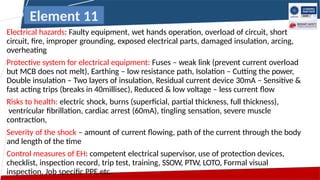
Electrical hazards: Faulty equipment, wet hands operation, overload of circuit, short
circuit, fire, improper grounding, exposed electrical parts, damaged insulation, arcing,
overheating
Protective system for electrical equipment: Fuses – weak link (prevent current overload
but MCB does not melt), Earthing – low resistance path, Isolation – Cutting the power,
Double insulation – Two layers of insulation, Residual current device 30mA – Sensitive &
fast acting trips (breaks in 40millisec), Reduced & low voltage – less current flow
Risks to health: electric shock, burns (superficial, partial thickness, full thickness),
ventricular fibrillation, cardiac arrest (60mA), tingling sensation, severe muscle
contraction,
Severity of the shock – amount of current flowing, path of the current through the body
and length of the time
Control measures of EH: competent electrical supervisor, use of protection devices,
checklist, inspection record, trip test, training, SSOW, PTW, LOTO, Formal visual
inspection, Job specific PPE etc.
Element 11
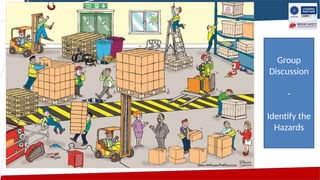
Group
Discussion
-
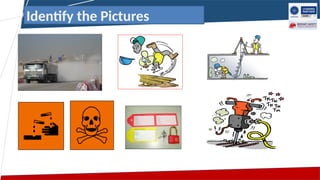
Identify the
Hazards
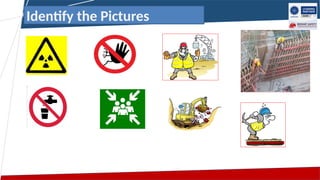
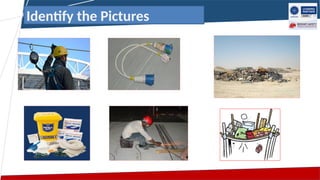
Identify the Pictures
Over All in the IG2 – Learning outcome -
You will Know how to identify the
foreseeable hazards and minimise the risks
with suitable control measures
Thank You

Ig2 - Power Point Presentation - 5 -11 Elements.pptx

  • 1.
    Nebosh IG2 –Risk Assessment • Online practical assessment paper for 100 marks. Paper will be evaluated with Nebosh assessment sheet as MET or NOT MET. You can download the Soft copy template of IG2 from Nebosh portal and in addition the Institute will send you the official template copy. • There are four parts in this paper. Part 1 - Background, Part 2 – Risk assessment, Part 3 – Prioritize three actions with Moral, legal and financial arguments, Part 4 – Review, Communicate and Check. Each part is having word count, except Part 2. • No marks will be declared. Only status of Examination is mentioned as PASS or REFER from the checklist • Choose any type of industry or your own working company • Require laptop or PC with Microsoft office word.
  • 3.
    5 – Physicaland Psychological 5.1 – Noise 5.2 – Vibration 5.3 – Radiation 5.4 – Mental Ill health 5.5 – Work related Violence 5.6 – Substance Abuse at Work 6 – Musculo skeletal Disorders 6.1- Work related Upper Limb Disorders 6.2 – Manual Handling 6.3 – Load Handling Equipment 7 - Chemical 7.1 – Hazardous Substances 7.2 – Assessment of Health risks 7.3 – Occupational Exposure Limits 7.4 – Control Measures 7.5 – Specific agents 8 – General Workplace issues 8.1 – Health, welfare and Environment CONTENTS - LESSONS
  • 4.
    8.2 – Workingat height 8.3 – Confined spaces 8.4 – Lone working 8.5 – Slips, trips 8.6 – Safe Movement of People and Vehicles 8.7 – Work related driving 9 – Work Equipment and Machinery 9.1 - Work equipment 9.2 – Hand tools and Power tools 9.3 – Machinery Hazards 9.4 – Control Measures 10 - Fire 10.1 – Fire classification 10.2 – Preventing Fire 10.3 – Fire Alarms and Fire fighting 10.4 – Fire Evacuation 11 - Electricity 11.1 – Hazards and Risk of Electricity 11.2 – Control Measures CONTENTS - LESSONS
  • 5.
    HAZARD CATEGORIES (20types): Radiation Work related upper limb disorders Work equipment Work related driving Manual handling Load handling equipment Movement of people and vehicles Noise Mental ill health Substance abuse Hazardous substances Confined spaces Fire Electricity Slips and trips Lone working Working at height Health, welfare and work environment Hazards to be identified - Overall
  • 6.
    • You needto select mandatory 5 different hazard category from 20 types. • More than 5 hazard category is always welcome. • You shall fill 10 mandatory rows with 10 identified hazards from hazard category • Assign a date for assessment between IG1 exam date and IG2 submission date
  • 7.
    • Noise: It’sa physical hazard. Daily exposure to noise causes health effects. Exposure to excessive noise causes NIHL, Tinnitus, temporary reduction in hearing sensitivity. Examples: generator, jackhammers, electric saws, cement mixers, drilling machine, cutting, grinding etc… • Normal hearing exposure is 85 db. (Decibel). Beyond this exposure over an eight hour shift is generally considered as not good. • Noise level can be measured by sound level meter. Occupational noise monitoring record (Noise survey) to be followed at project. • Control measures of NOISE: Reduce noise at source, Interrupting the pathway, Protecting the receiver • Hearing protection: Ear defenders and ear plugs. Health surveillance to be conducted in form of audiometry (hearing test) Element 5
  • 8.
    Vibration: It’s aphysical hazard. Excessive vibration causes HAVS and WBVS, White finger disease, nerve damage, muscle weakening, joint damage, carpal tunnel syndrome. Examples: excavators, loaders, large trucks, rollers, compactors, etc Control measures of VIBRATION: Reduce the vibration at source, Interrupt the pathway, limit the duration of exposure Hand protection: Hand gloves. Administrative control measures for NOISE and VIBRATION: Job rotation & Reduce in time exposure. Signage with required levels
  • 9.
    Radiation: It’s aphysical hazard. Non – ionizing radiation ( UV, Visible, IR, microwave and radio waves) and Ionizing radiation (alpha particles, beta particles, x rays, gamma rays, neutrons. Instrument use to measure this radiation is GEIGER METER. Unit is MILLIREMS. Radiation more than 0.75 millirem to be controlled. Health effects of NIR: redness, sun burns, snow blindness, disability glare, internal heating, internal organ damage, Health effects of IR: sickness, anemia, hair loss, cancer, genetic mutations, birth defects etc. Control measure of NIR: use of clothing, PPE, SSOW, permits, Control measure of IR: Time, Distance and shielding Basic radiation protection strategies: Competent person, MSRA, PTW, 24hrs notice, log sheet, flashing amber beacon lights, sealed records, thermo luminescent dosimeter, safe distance radiation area calculated, evacuated, barricaded with yellow/black tapes, Exposure shall be eliminated, dose limits, IITS, Health surveillance plastic badge or ring worn by the worker
  • 10.
    Mental ill health:Stress, anxiety, depression due to Psychological, physical and behavioral symptoms. Work related stress caused by excessive pressure cause chronic health effects. Causes: Demands (Work load, deadlines), control (lack of control over work with light levels, temp), support (Lack of IITS), relationships (poor quality workplace by peer), role (lack of clarity), change (demotion, reassignment, take over), home work interface (separation, family illness), staying in work (prolonged absence from work) Work related violence: abused, threatened, assaulted. Occupations like cash handling, lone working, wearing a uniform, representing authority, hospitals, teachers, bus drivers etc Control: staff survey, interviewing staff, collecting and analyzing, CCTV, panic alarms, pleasant environment, clear announcement, security doors, trainings, visit logging with supervisor, GPS, no lone working etc.
  • 11.
    Substance abuse atwork: Alcohol (local bar), legal (common painkillers) or illegal drugs (heroin, cocaine), solvents (glue sniffing) Effects at work: late attendance, increased absenteeism, reduction in quality of work, reduction in work rate, dishonesty, theft, potentially to found a habit, irritability and mood swings, deterioration in working relationships, sensory impairment, skewed perceptions, fatigue, drowsiness, un control driving of vehicle, cirrhosis of the liver Control measure: clear policy, rule restricting access in workplace, statutory legal requirements (drink drive laws), non statutory requirements, arrangements for any random drugs and testing, rehabilitation and treatment programmes, disciplinary procedures, IITS, awareness campaign Musculoskeletal disorders (MSD): chronic soft tissue injuries or disorders of muscle, nerves, joints, cartilage, spinal discs affecting the body movement or system. Ex. Carpel tunnel syndrome, tendonitis, muscle strain, ligament sprain, neck syndrome, back pain, trauma, arthritis, bone fractures, painful knee joints etc.
  • 12.
    WRULD’s: collective termfor a range of disorders of the hand, wrist, arm, shoulder and neck. Ex. Muscle strains, tears, ligament sprains, joint inflammation, numbness in fingers, arm pain, discomfort, tingling sensations etc. Activities causing MSD’s / WRULD’s: High task repetition, standing and sitting for long period, forceful exertions, repetitive or sustained awkward postures, poor posture, lighting, glare, environmental parameters, display screen equipment, keyboard operation, bricklaying, use of keyboard, mouse, call center staff, desktop computers etc Control measures over DSE: RA, basic work station equipment, ergonomic design, frequent breaks, plan the work routine, free eye test, IITS, good lumbar support, adjustable seat, foot support, screen height, space, fore arms, head set, lighting, Manual handling: lifting, carrying, pushing and pulling of a load by force. Principles of Manual handling (RA): TILE – Task, Individual, Load and Environment Hazards in MH: Improper lifting, Improper gripping, poor physique, age factor, Incompetency, Overload shifting, slip, trip, fall, handling greasy/oily/irregular objects Element 6
  • 13.
    Good Manual handlingtechnique: Before lifting – check the weight, stability, plan the route of carry, establish a firm grip. The lift – Bend the knees and use leg muscles, keep the back upright, keep the load close to the body, avoid twisting, overreaching. Setting down – use the same principles as when lifting, maintain good balance, set the load down and adjust its position using body weight Load handling equipment: ex. Crane, forklift, excavator, trucks etc. Hazards in LHE: Entanglement, drawing in, crushing, Collapse or toppling of equipment, falls of load from height, falling objects, standing under the suspended load, incompetent operators, excessive wind speed, poor ground surface, stuck during movement in roads, striking of load against the structures, failure to use guide rope, damaged lifting gears, fire, man equipment collision, over turn, contact with live overhead cables, fuel spill, exhaust fumes, arcing, disposal of battery etc Control measures: MSRA, PTW, Lifting plan, Operator checklist, operator competency, equipment certificate, lifting gears certificate, SWL, load chart, safety devices, safety guards, seat belt, securing of load, use of guide rope or tag line, competent rigger / banksman, use of flags, whistle, health surveillance for operator / rigger etc
  • 14.
    Hazardous substances (CHEMICAL):refers to any product (solid, dust, mist, vapor, liquid, gas) or chemical that has the properties of explosive, flammable, irritant, oxidizing, toxic, corrosive or toxic to environment. Hazardous to peoples health gives acute and chronic effects like asphyxiation, carcinogenicity, allergy, rash, burns, breathing difficulty, eye irritation, skin corrosion, dermatitis, reproductive toxicity, respiratory sensitization, asbestosis etc Routes of entry: Inhalation, ingestion, injection, absorption Control measure: MSDS, PPE, waste management disposal, spill kit, COSHH assessment, Fire extinguisher, dip tray, training, RA, SSOW, chemical with identified label, safe storage of chemicals in designated room, appointed ERT contact numbers signage, Fire retardant room, ventilation, eye wash stations, emergency showers etc MSDS: Material Safety Data Sheet contains 16 information. Provide sufficient information, steps to ensure safe use, including transport and disposal. Shall be communicated to site workforce Element 7
  • 15.
    Occupational exposure limit(OEL): the maximum airborne concentration of a toxic substance to which a worker can be exposed over a period of time. The purpose of OEL is to put a limit in place so that workers will not be exposed to high concentrations of air borne substance. TWA (Time weighted average) calculated by measuring a persons average exposure. This can be done from STEL (Short term exposure limit) exposed to 15 min and LTEL (Long term exposure limit) exposed to 8 hrs. Controls towards exposure: Eliminate or substitute, change the process, reduce the exposure time, enclose or segregate, LEV, hoods, periodic testing, Dilution ventilation, RPE, PPE, personal hygiene, health surveillance, Training on RPE etc. RPE: two groups – respirators (filters the air taken from the immediate environment) and BA (breathable air from a separate source). Respirators - Filtering face piece respirator, half mask or ori nasal respirator, full face respirator, powered respirator etc. BA are of two types – Compressed air line BA and Self contained BA. RPE must be selected carefully to its suitability
  • 16.
    Health, welfare andwork environments: Drinking water, sanitary conveniences, washing facilities, changing rooms, accommodation, resting, eating facilities, seating, ventilation, lighting etc. Working at Height: place where if there were no precautions in place, Hazards: Fall of person, fall of objects, overload, poor load distribution, damaged ladder, incomplete scaffolding, incompetent scaffolding erector, incompetent scaffolding inspector, incomplete guard rail, unprotected edges, wide gap between planks, improper ground surface, adverse weather conditions, inadequate lifeline, inadequate fall protection system, incompetent equipment certificate etc. Control: Trained, MSRA, PTW, SSOW, Inspected ladders, Competent scaffolding inspector, erector, checklist, standard scaffold materials, fall protection system, weather conditions, safe storage of materials etc Element 8
  • 17.
    Confined space: anychamber, tank, pit, trench, pipe. A space with limited entry and egress and not suitable for human continuous occupancy. Hazard: Toxic gas or fumes, fire, flammable gas, oxygen deficiency or enrichment, inadequate illumination, inadequate ventilation, inappropriate access, Excessive heat, use of high voltage EE, incompetent persons, no buddy system etc Control measures: Gas testing, use of calibrated gas tester, Trained, PTW, MSRA, SSOW, Adequate lighting with 24v, Forced ventilation, safe secured access, use of tripod, SCBA, Barricade, PPE with signage, Buddy system, “People-in” Tally board, non sparking tools etc IDLH Immediately dangerous to Life & Health: any condition that provides immediately or delayed threat to life. Oxygen – 19.5 to 23.5%, Lower flammable limit (LEL) – less than 10%, CO – less than 35 PPM, H2S – Less than 10 PPM. One Parts per million (PPM) – if a million particles of air by volume (ABV) contains one part of gas
  • 18.
    Work equipment: foruse at work and including machinery, appliances, tools etc. Hand tools – hammers, chisel etc, Power tools – Portable electric drills, Machinery – power press, wood working machine, paper shredder, tractor, abrasive wheels etc, Equipment – MEWP, cherry picker etc. Mechanical hazard – crushing (body trapped between two moving parts), shearing (part of the body usually fingers trapped btw two moving parts), cuts (contact with sharp edged part), lacerations, entanglement (loose items such as clothing, hairs), drawing in (a part caught and drawn into machine), stabbing (parts of material ejected from machine, puncture, friction (contact with fast moving surface), abrasion , high pressure fluid injection, impact (body struck by a powdered part of a machine) etc Non mechanical Hazard – Electricity (electric shock), noise (hearing damage), vibration (white finger), chemicals (harmful, irritant), dusts, vibration, radiation, temperature, fire, explosion, slip, trip, fall, ergonomics etc Control: IITS, SSOW, Emergency controls, stop controls, machine guarding, fixed enclosed guards, interlocked guards, adjustable guards, sensitive protection equipment (trip devices), two hand controls, dead mans handle, pressure mats, photoelectric devices, jigs, holders, push sticks, proper maintenance etc, space considerations, markings, warnings, lighting considerations etc Element 9
  • 19.
    Fire Triangle: It’sa chemical chain reaction. Heat, Fuel and Oxygen are the three sources of fire. Two reasons to use – Fire prevention (keeping these three elements apart) and Fire fighting (put off, by removing one of the elements) Fire prevention: Removing of heat is cooling, removing of oxygen is smothering, removing of fuel is starvation. Fire transmission/spread: Direct burning, Convection, Conduction, Radiation Causes of fire: Faulty electrical equipment, deliberate ignition, hot works, smoking, unsafe storage of flammable liquid & gas, chemical reaction, mechanical heat, cooking appliances, heating appliances How to extinguish a fire – PASS- Pull the pin, Aim at the base of fire, Squeeze the gas, Sweep to and fro. Fire blankets, hose reels, sprinkler systems, fire extinguisher, sand bucket. Fire door – Withstand fire for minimum 30 min, self closing device, intumescent strip, cold smoke seal, vision panel of fire resistant glass, clearly labeled fire door Element 10
  • 20.
    Classification of fire: ClassA – Combustible solid ex. Paper, wood, coal Class B – Flammable liquids ex. Petrol, diesel, oil Class C – Flammable gases ex. propane, methane Class D – Metals ex. Aluminium, magnesium Classes of fire extinguishers: Water – Red body, used for A Co2 – Red body with black strip, Used for B and electrical fires DCP – Red body with blue strip, pressure gauge. Used for ABC Foam – Cream body with pressure gauge, used for B Fire detection and Alarm systems: Simplest system, Simple with more noise, manually operated fire alarm, interlinked smoke alarms, automatic fire detection & alarm Fire alarm – automatic electronic panel which will indicate when the fire occurs connected to the smoke and heat detector. Smoke detectors: small smoke particles usually very sensitive. Ionizing and optical are the two types of detectors. If used in humid, wet, dusty can give false alarm Heat detectors: excess heat generated by fire. Rate of rise and fixed temperature are the two main types FACU – Fire Alarm Control Unit is the controlling component of FAS
  • 21.
    Electrical hazards: Faultyequipment, wet hands operation, overload of circuit, short circuit, fire, improper grounding, exposed electrical parts, damaged insulation, arcing, overheating Protective system for electrical equipment: Fuses – weak link (prevent current overload but MCB does not melt), Earthing – low resistance path, Isolation – Cutting the power, Double insulation – Two layers of insulation, Residual current device 30mA – Sensitive & fast acting trips (breaks in 40millisec), Reduced & low voltage – less current flow Risks to health: electric shock, burns (superficial, partial thickness, full thickness), ventricular fibrillation, cardiac arrest (60mA), tingling sensation, severe muscle contraction, Severity of the shock – amount of current flowing, path of the current through the body and length of the time Control measures of EH: competent electrical supervisor, use of protection devices, checklist, inspection record, trip test, training, SSOW, PTW, LOTO, Formal visual inspection, Job specific PPE etc. Element 11
  • 22.
  • 23.
  • 24.
  • 25.
  • 26.
    Over All inthe IG2 – Learning outcome - You will Know how to identify the foreseeable hazards and minimise the risks with suitable control measures Thank You