MODULE FOUR: EFFECTIVE
COMMUNICATIONS
• Effective communications is extremely
important to the goal of increasing employee
involvement in safety and health.
• Skilled safety communications will support
leadership, at all levels, from the CEO to the
employee. So, let's get started with a review
of some basic communications concepts and
principles.
Return to sender...
• The most basic communication theory talks
about the requirement for both a sender and
receiver in the communication process.
• The sender initiates the communication and
the receiver receives, interprets, and responds
to the communication
It's not what you say...it's how you say it!
• Another important concept in communications
is the Two-Level Theory which states that in
any communications process messages are
sent and received on two levels.
• The first level is called the content level and
describes only what is sent. The only
information transferred at this level is data,
usually in the form of spoken words.
• The second level of communication exists on a
higher, more abstract plane.
• It's called the relationship level which
describes the communication that establishes
the relationship between the sender and the
receiver.
• It is how the message is sent that sets up the
relationship
I'm Okay...You are Okay...
• Every time a supervisor recognizes an
employee for safe work behaviors, it
reinforces and makes that behavior more
likely to occur in the future.
• If a supervisor yells at you for "complaining," a
very negative message is sent
A most important responsibility!
• If you are a safety committee representative,
think about the relationship set up between
you and your co-workers.
• Make sure that you get back with your co-
workers as soon as possible to let them know
the status of their concerns or suggestions.
This is probably your most important job as a
safety committee representative.
A rusty latch on the suggestion box...
• How do you know your safety suggestion
program is working?
• If your suggestion program results in only a
few suggestions each month, that's a
symptom of failure
• If the program is failing, it means that those
managing the program are not communicating
well on the relationship level
Imagine, workers competing to be on the
safety committee...
• How do we increase employee involvement in
the safety committee?
MODULE 4 QUIZ
• 1. The words we speak when talking with another person
is the __________ of the message. The tone of voice we
use is likely to establish a ____________ between the
sender and receiver.
•
• a. information, distance b. content, relationship
• c. relationship, content
• d. transmission, reception
• 2. Which communication level has the greatest
impact on the receiver?
• a. Content Level
• b. Interpersonal Level c. Personal Level
• d. Relationship Level
• 3. According to the text, this behavior probably sends
the most negative message to another person:
•
• a. debating b. yelling c. ignoring d. arguing
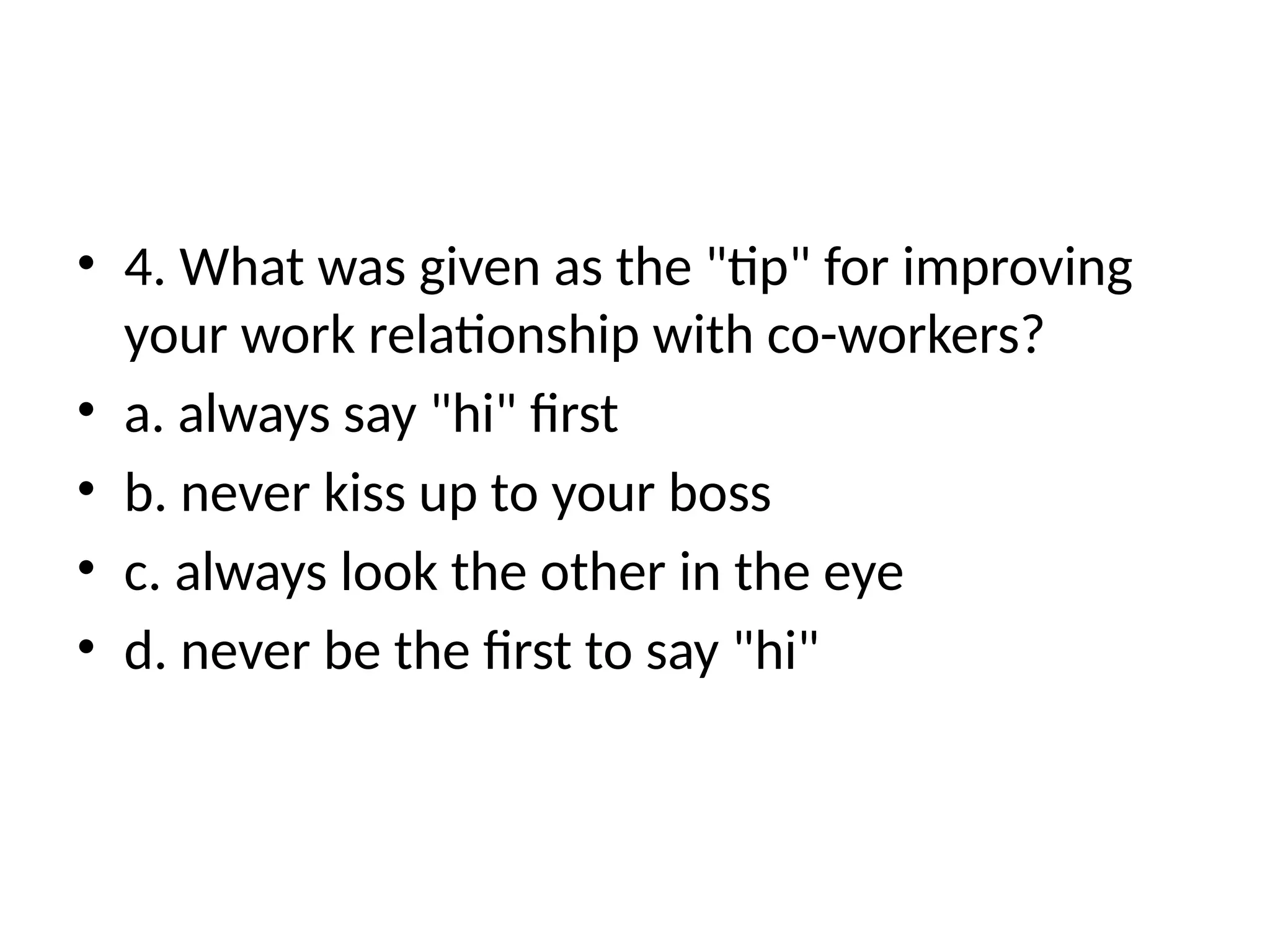
• 4. What was given as the "tip" for improving
your work relationship with co-workers?
• a. always say "hi" first
• b. never kiss up to your boss
• c. always look the other in the eye
• d. never be the first to say "hi"
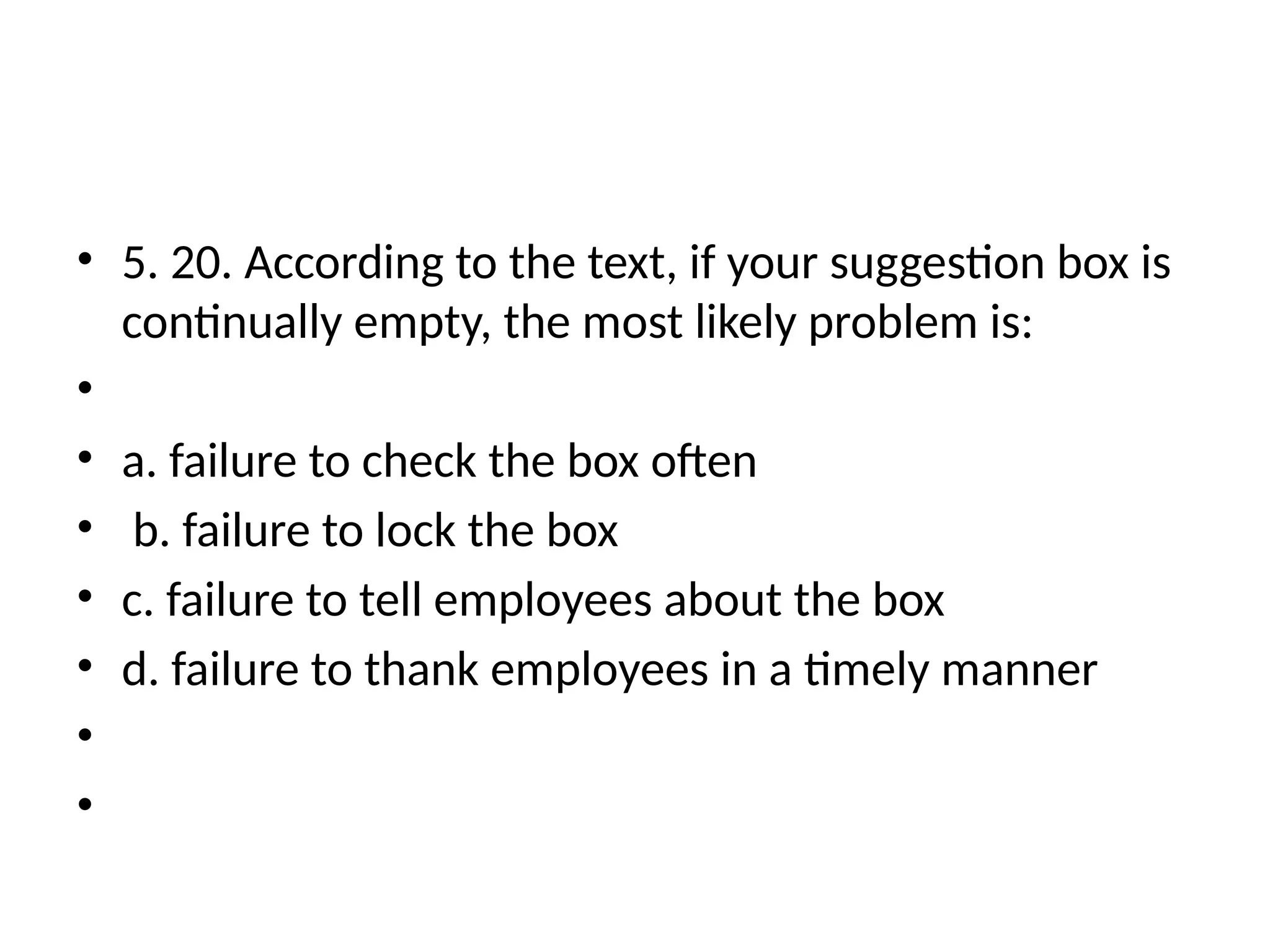
• 5. 20. According to the text, if your suggestion box is
continually empty, the most likely problem is:
•
• a. failure to check the box often
• b. failure to lock the box
• c. failure to tell employees about the box
• d. failure to thank employees in a timely manner
•
•
MODULE FIVE: HAZARD IDENTIFICATION AND CONTROL
• What is a hazard?
• Any workplace condition or a person's "state
of being" that could cause an injury or illness
to an employee.
Controlling Exposure to hazards - The
Hierarchy of Controls
• Controlling exposures to occupational hazards
is the fundamental method of protecting
workers.
• Traditionally, a hierarchy of controls has been
used as a means of determining how to
implement feasible and effective controls.
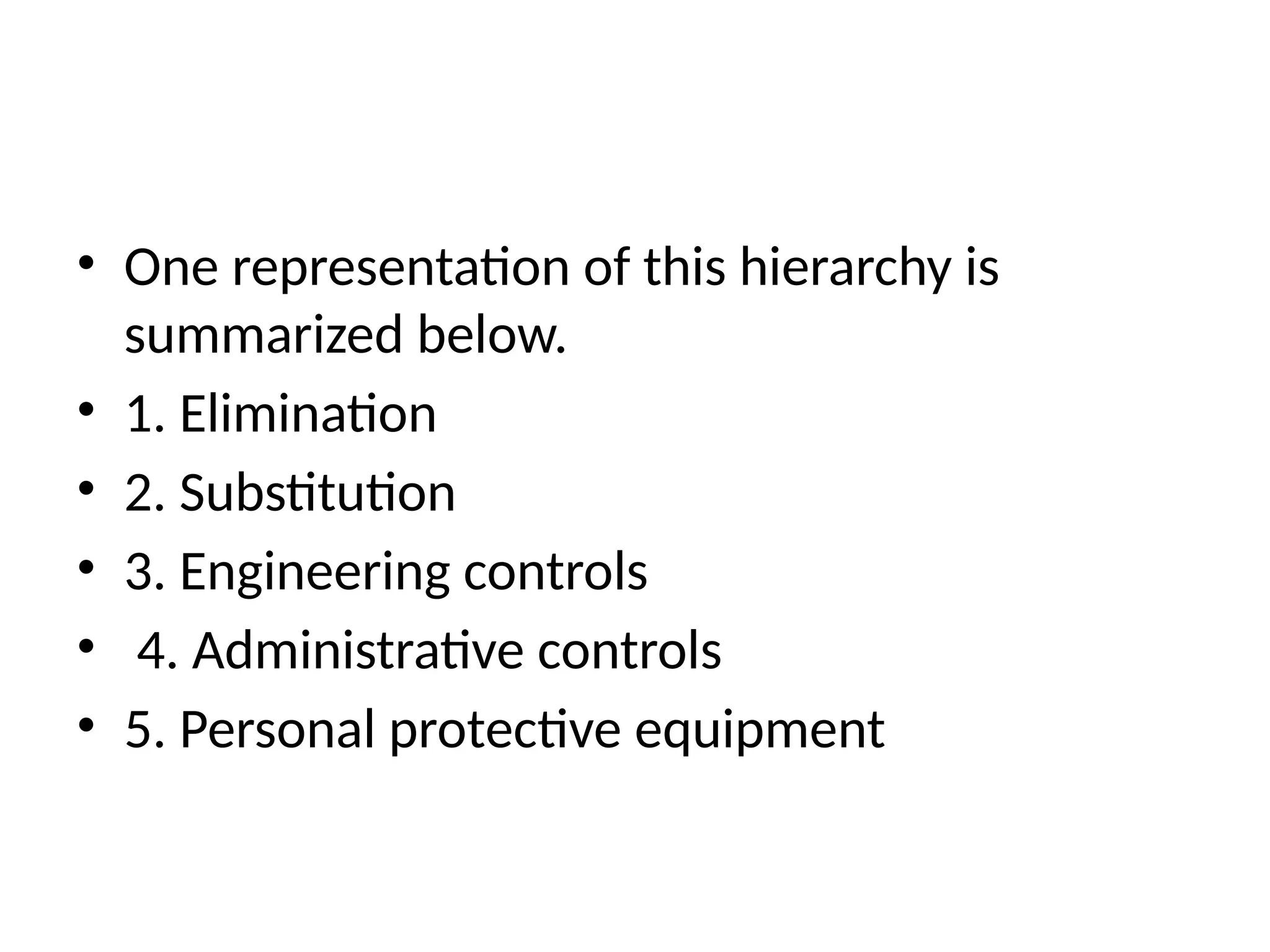
• One representation of this hierarchy is
summarized below.
• 1. Elimination
• 2. Substitution
• 3. Engineering controls
• 4. Administrative controls
• 5. Personal protective equipment
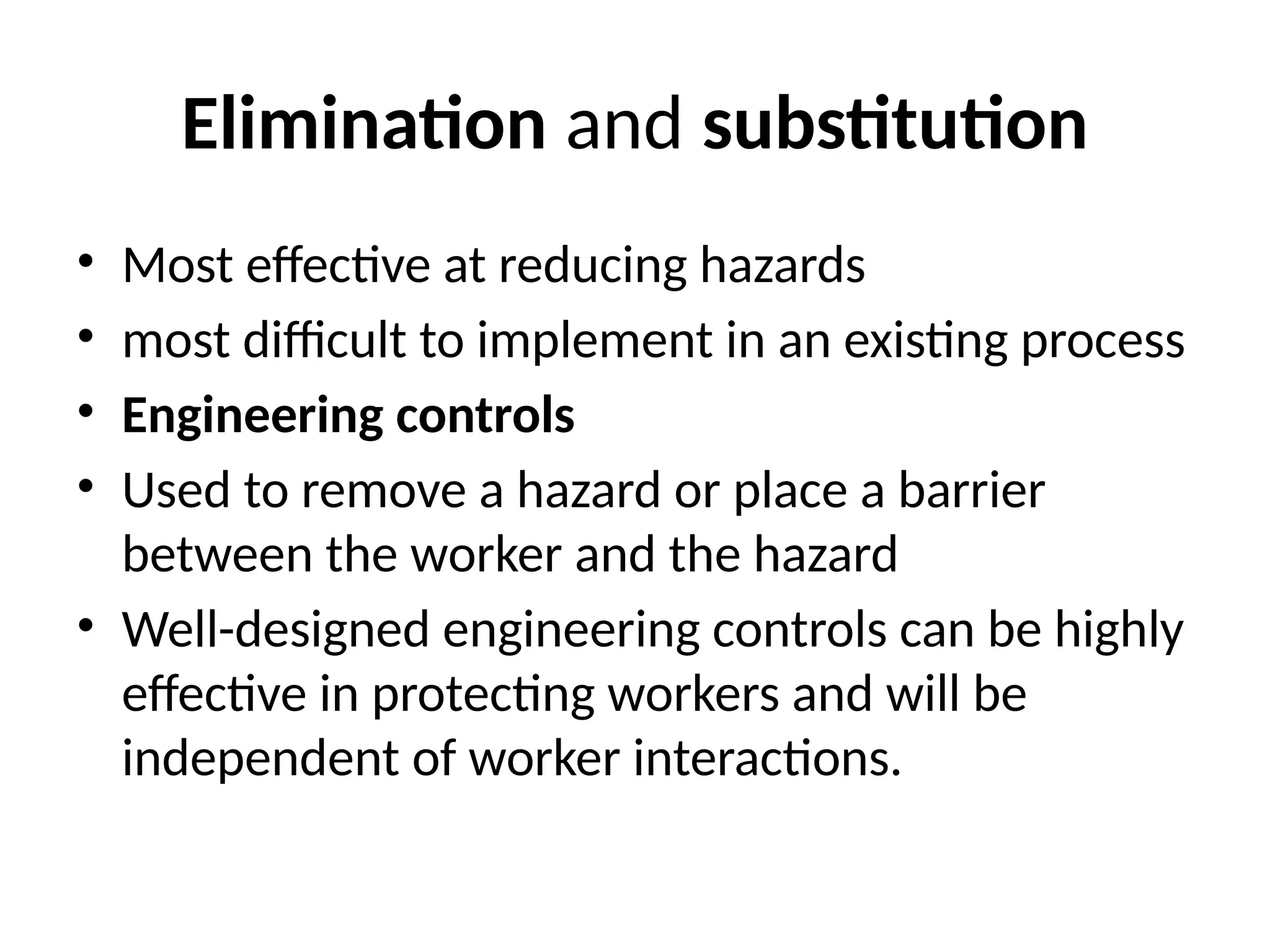
Elimination and substitution
• Most effective at reducing hazards
• most difficult to implement in an existing process
• Engineering controls
• Used to remove a hazard or place a barrier
between the worker and the hazard
• Well-designed engineering controls can be highly
effective in protecting workers and will be
independent of worker interactions.
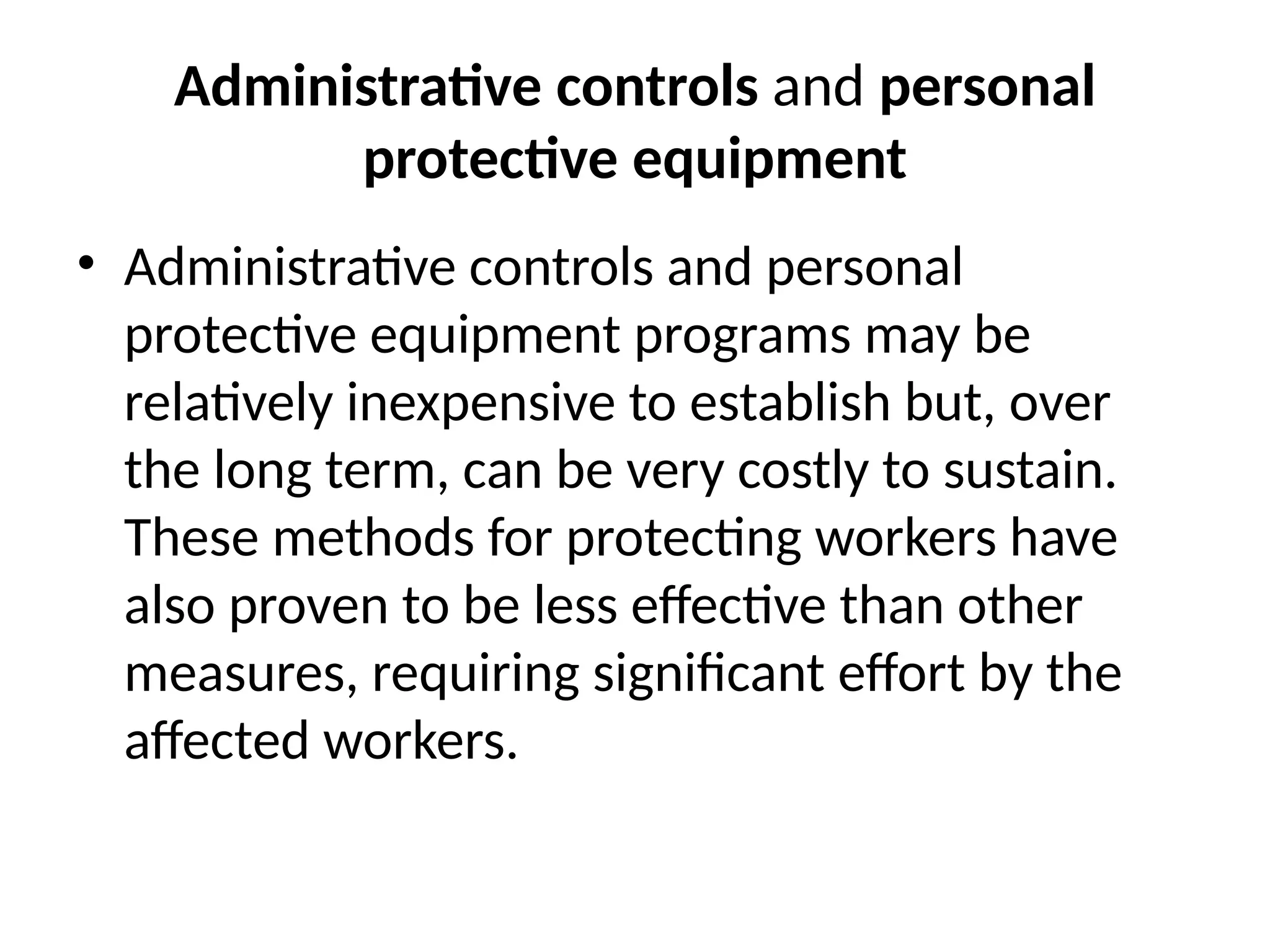
Administrative controls and personal
protective equipment
• Administrative controls and personal
protective equipment programs may be
relatively inexpensive to establish but, over
the long term, can be very costly to sustain.
These methods for protecting workers have
also proven to be less effective than other
measures, requiring significant effort by the
affected workers.
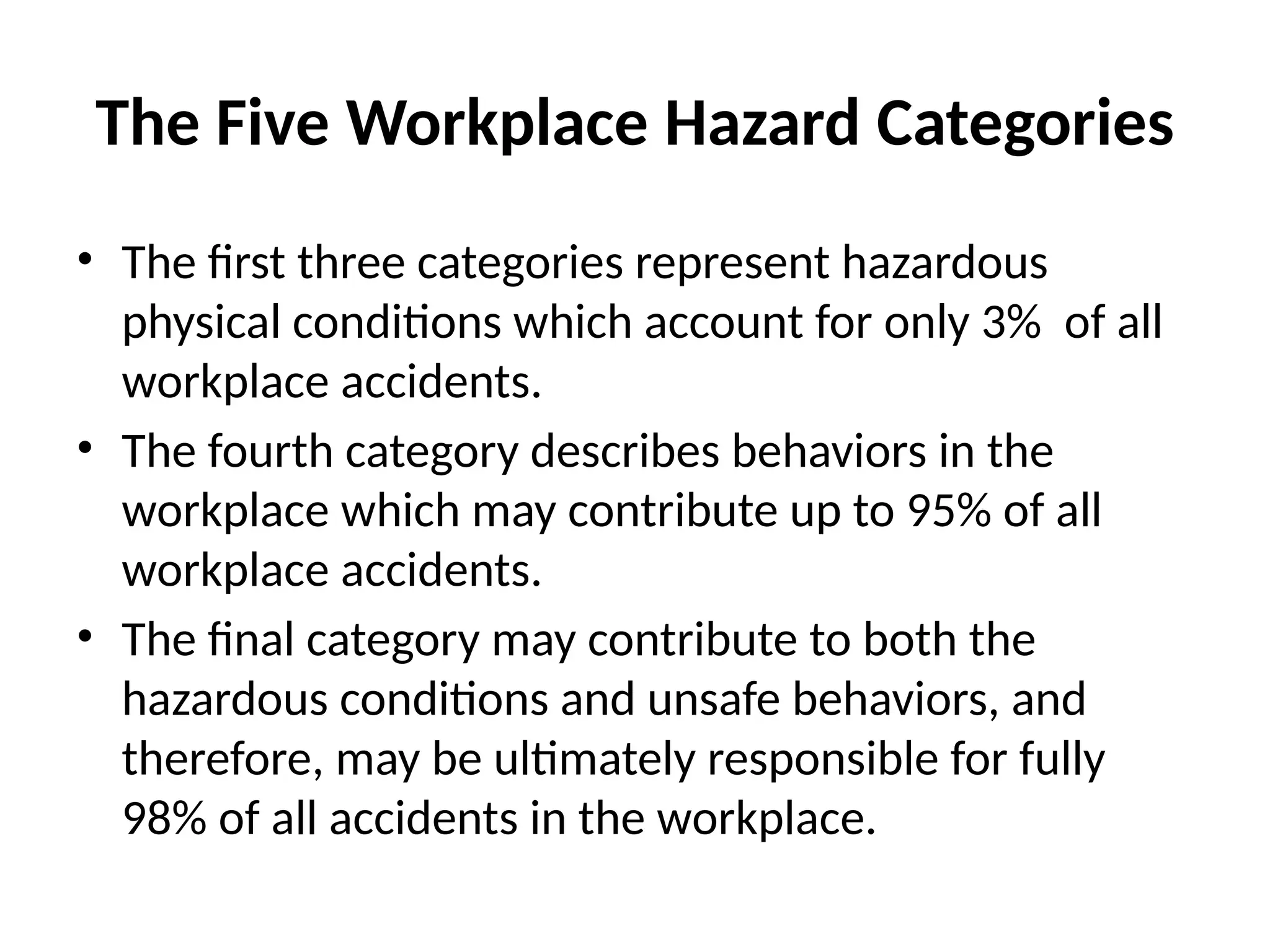
The Five Workplace Hazard Categories
• The first three categories represent hazardous
physical conditions which account for only 3% of all
workplace accidents.
• The fourth category describes behaviors in the
workplace which may contribute up to 95% of all
workplace accidents.
• The final category may contribute to both the
hazardous conditions and unsafe behaviors, and
therefore, may be ultimately responsible for fully
98% of all accidents in the workplace.
Materials
• Hazardous materials include hazardous:
• Liquid and solid chemicals such as acids,
bases, solvents, explosives, etc
• Solids like metal, wood, plastics
• Gases like hydrogen sulfide, methane, etc
Equipment
• This area includes machinery and tools used to
produce or process goods.
• Environment
• This area includes facility design, hazardous
atmospheres, temperature, noise, factors that cause
stress, etc.
• People
• This area includes unsafe employee behaviors at all
levels in the organization such as taking short cuts, not
using PPE, and otherwise ignoring safety rules.
System
• Every company has, to some degree, a safety
and health management system (SHMS).
• It's good to think of the "state" of the SHMS as
a condition
• For instance, management may develop and
implement ineffective policies, procedures
and safety rules.
Two strategies
• Walkaround inspection
• To identify and control hazards in the workplace,
two basic strategies are used. First, and most
common is the walkaround inspection
• Employees should inspect the materials,
equipment, and tools they use, and their
immediate workstation for hazardous conditions
at the start of each workday.
What's the major weakness of the safety inspection?
• By its very nature, the walkaround inspection
is ineffective in uncovering unsafe work
practices because most inspectors look
primarily at hazardous conditions and do not
take enough time to effectively analyze
individual task procedures.
Job Hazard Analysis (JHA)
• The Job Hazard Analysis (JHA) can be the
answer to this weakness.
• It uncovers unsafe work practices as well as
hazardous conditions because sufficient time
is given to closely analysis of one unique task
at a time.
• While the employee accomplishes several cycles of the task,
the supervisor observes and takes notes about what's being
done.
• Once the observation is completed, he divides the task into
a number of unique steps which are listed sequentially.
• Each step is analyzed to uncover hazardous materials,
equipment, tools, and unsafe exposures are involved.
• Next, the hazards and exposures of each step are analyzed
to determine the safety precautions required to eliminate or
at least reduce any hazards or exposures present.
• Lastly, a written safe work procedure (SJP) is
developed for the entire task. The SJP is
reviewed prior to accomplishing the task and it
can also be used as a lesson plan to conduct
training.
• Employee involvement in the JHA process
helps ensure they will use the safe job
procedure developed by the JHA when not
being directly supervised.
Dig up the roots!
• When investigating hazards discovered in a
walkaround inspection or JHA, it's important
that you uncover the root causes that have
allowed those hazards to exist in the
workplace.
• Taking this approach to hazard investigation is
called root cause analysis.
•
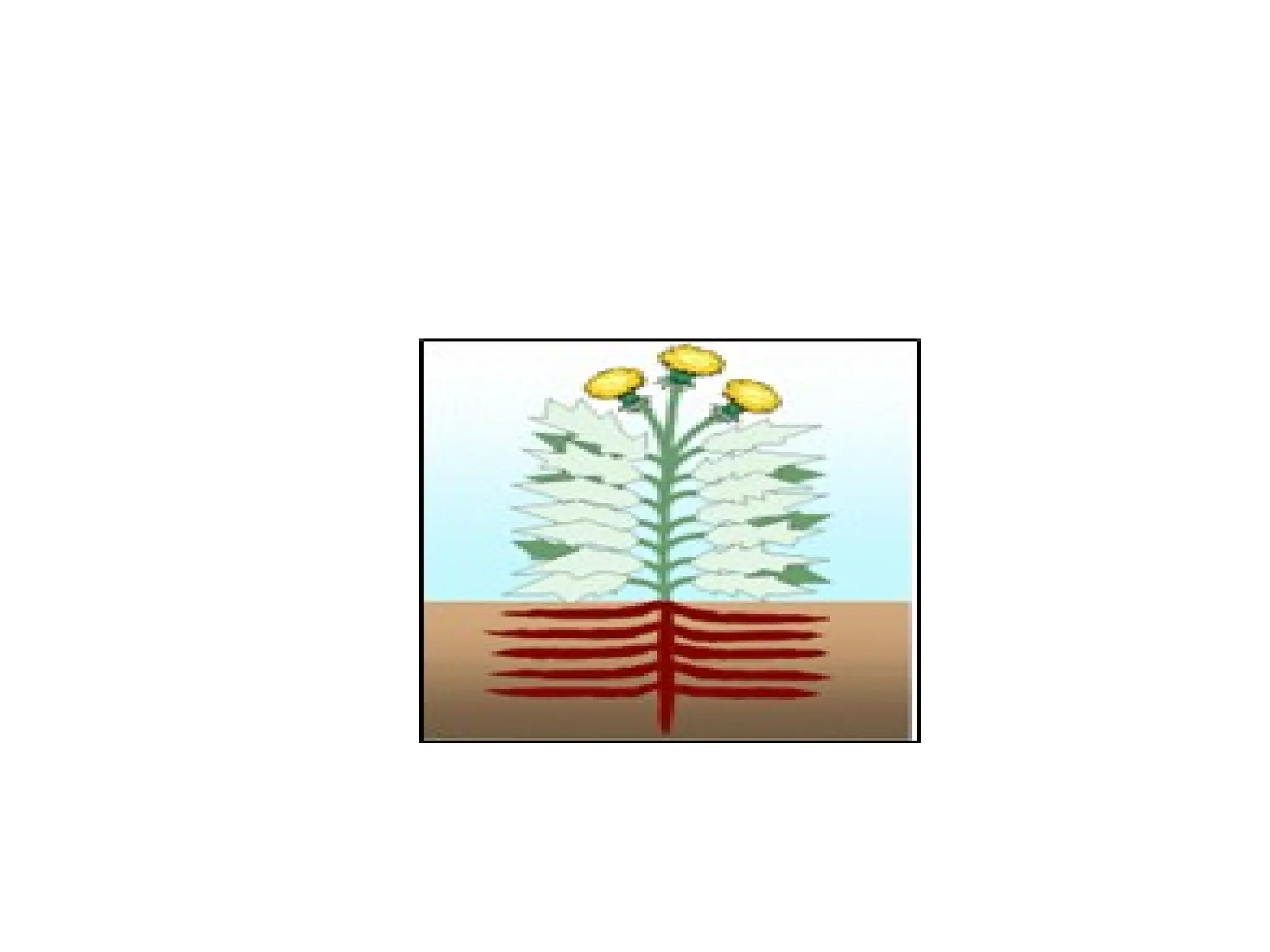
• The flower represents the injury. It's the result
of the transfer of an excessive amount of
energy from an outside source to the body.
This is called the direct cause of the accident.
• The leaves of the weed represent hazardous
conditions and unsafe work practices in the
workplace. Conditions and/or practices are
typically called the surface or indirect causes
of an accident
• The roots of the weed represent
management's effort to maintain a safe and
healthful workplace, safety policies, safety
supervision, safety training, and enforcement
of safety rules
• Inadequate or missing system components
represent the root causes for accidents in the
workplace
• Root causes may feed and actually promote or nurture
hazardous conditions and unsafe work practices.
• Research findings indicate hazardous conditions, alone,
represent only about 3% of the causes for accidents in the
workplace, while unsafe behaviors make up about 95% of
the causes for accidents.
• Consequently, about 98% of all workplace accidents are
ultimately caused by a combination of inadequate safety
management system components, under the control of
management, that result in hazardous conditions and/or
unsafe work practices.
MODULE 5 QUIZ
• 1. Unsafe ________ account for only about 3
percent of all workplace accidents.
• a. behaviors b. conditions
• c. situations d. people
• 2. Which cause category is ultimately most
responsible for accidents in the workplace?
• a. hazardous conditions b. unsafe behaviors
• c. management system weaknesses d. lack of
common sense
• 4. Which of the following is not one of the four areas within which all
workplace hazards exist? (Hint: MEEP)
• a. materials b. employees
• c. energy d. people
• 5. What is a major weakness of the walkaround inspection?
• a. it takes too much time
• b. it looks only at conditions
• c. it isn't conducted often enough
• d. it requires experts
•
• 6. What system weaknesses might explain an
unsafe behavior?
• a. inadequate supervision b. lack of training
• c. inconsistent enforcement
• d. any of the above
•
MODULE SIX: INCIDENT AND ACCIDENT INVESTIGATION
• The process of analysis is extremely important
in identifying and eliminating those
conditions, behaviors and system weaknesses
that result in workplace accidents.
Fix the system not the blame!
• If your safety program fails to eliminate
workplace hazards, chances are very likely an
accident will result.
• When it does, it's important to conduct an
effective accident investigation.
• Or proper analysis of the accident
• You've got to conduct this activity for the express
purpose of improving your safety management
system.
• The only way to receive any long-term benefit from
accident analysis is to make sure system weaknesses
are uncovered and permanently corrected.
• Although accident investigation is a valuable and
necessary tool to help reduce accident losses, it is
always considerably more expensive to rely on
accident investigation than hazard investigation as a
strategy to reduce losses and eliminate hazards in
the workplace.
Accidents just happen...don't they?
• Do they? Are they really unexpected or
unplanned? If a company has 20 disabling injuries
one year, and sets an objective to reduce the
accident rate by 50% by the end of the next year,
aren't they planning 10 accidents for that year?
• If they reach that goal, won't they be happy about
it...content? Is that really acceptable?
• You can't ever afford to relax, or be content in
safety.
Incident and Accident defined
•
• An incident is an unexpected event that may
result in property damage, but does not result
in an injury or illness. Incidents are also called,
"near misses," or "near hits."
• An accident is an unexpected event that may
result in property damage, and does result in
an injury or illness to an employee.
Plan the work...work the plan!
• When a serious accident occurs in the
workplace, everyone will be too busy dealing
with the emergency at hand to worry about
putting together an investigation plan, so the
best time to develop effective accident
investigation procedures is before the accident
occurs.
• The plan should include as a minimum
procedures that determine:
• Who should be notified of accident.
• Who is authorized to notify outside agencies.
(fire, police, etc.)
• Who is assigned to conduct investigations.
• Training required for accident investigators:
• Who receives and acts on investigation
reports.
• Timetables for conducting hazard correction.
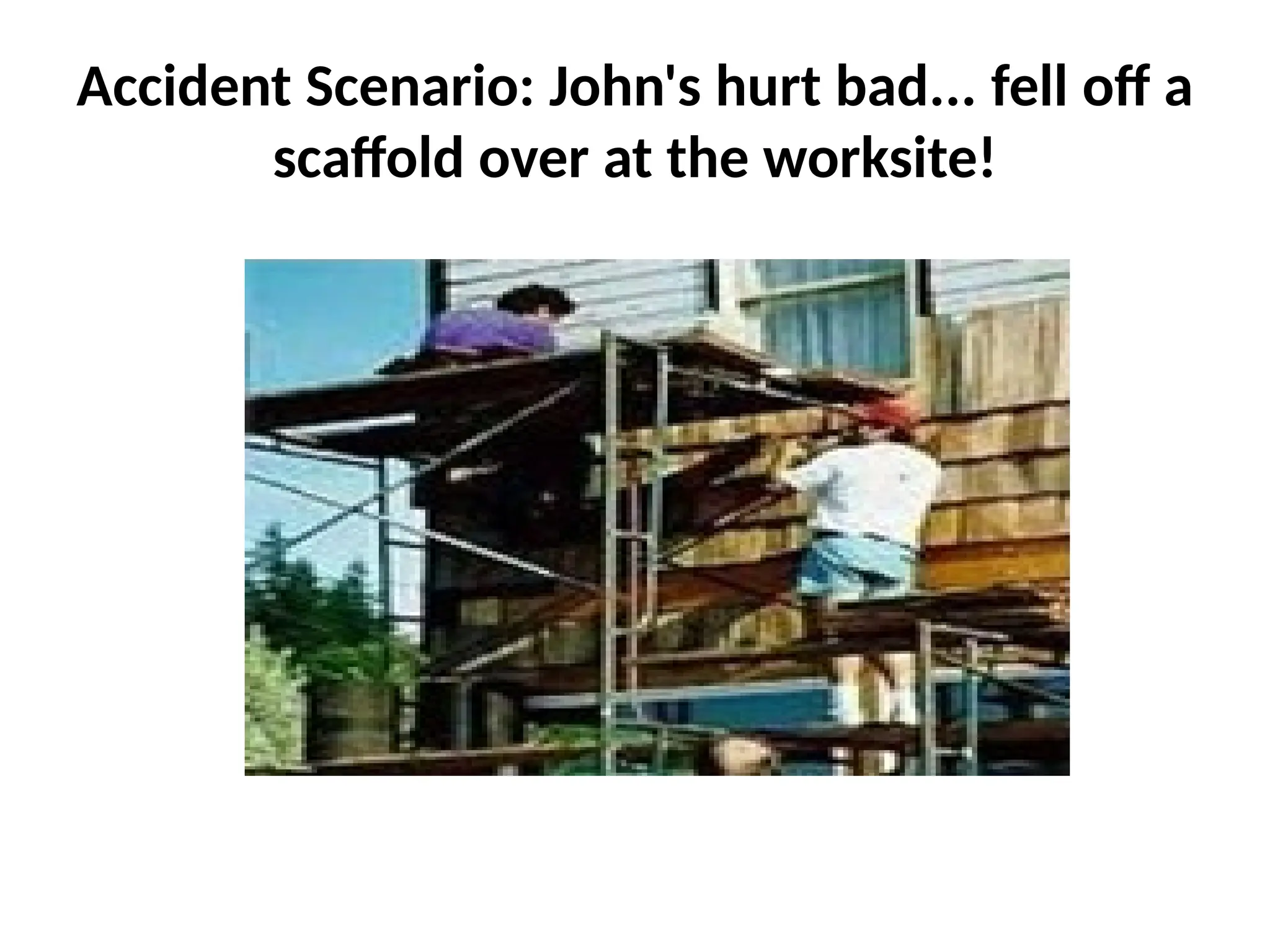
Accident Scenario: John's hurt bad... fell off a
scaffold over at the worksite!
• You've just been notified of an injury in the
workplace and immediately swing into action.
You grab your investigator's kit and hurry to the
accident scene.
• By the time you get there, the Emergency
Medical Team (EMT) is administering first aid.
It's a serious accident so the victim is
transported to the hospital.
• Now it's safe to investigate.
• The first task is to secure the accident scene.
The easiest way to do this is to place yellow
warning tape around the area.
• If tape is not available, warning signs or guards
may be required
Just the facts
• The next step in the procedure is to gather
useful information about what directly and
indirectly contributed to the accident.
• Interviewing eyewitnesses to the accident is
probably one of the most important
techniques in gathering information, but there
are many other tools and techniques too
Gathering background information about the accident
may be accomplished in many ways.
• You want to get initial statements through
interviews with eyewitnesses.
• You should tell those who you initially
interview that you may conduct follow-up
interviews if more questions surface.
• Interview other interested persons such as
supervisors, co-workers, etc.
• You should also review any records associated with the
accident, including:
• Training records , Disciplinary records , Medical records (as
allowed) Maintenance records, EMT reports, Police reports
(rare)
Coroner's report (fatalities), OSHA 300 Log (past similar
injuries) and Safety Committee records
•
• More methods include:
• Take photographs of the scene. Videotape the scene.
• Make sketches of the scene.
• Make observations about the scene. § Include
measurements.
What happened next?
• Read through the information initially to
develop an accurate sequence of events that
led up to and included the actual injury event
What caused the accident?
• Surface causes. The conditions and behaviors directly
or indirectly producing the accident.
• A long-lasting corrective action does not come from a
surface cause. A surface cause leads to a root cause.
• Primary surface causes directly cause the accident and
usually involve the victim and some object or behavior.
Secondary surface cause are unique conditions or
behaviors that indirectly contribute to the accident.
Secondary surface causes can occur anytime, by any
person in the organization, and at any location.
Conditions are objects or "states of being." Behaviors
describe some sort of action, activity. Examples:
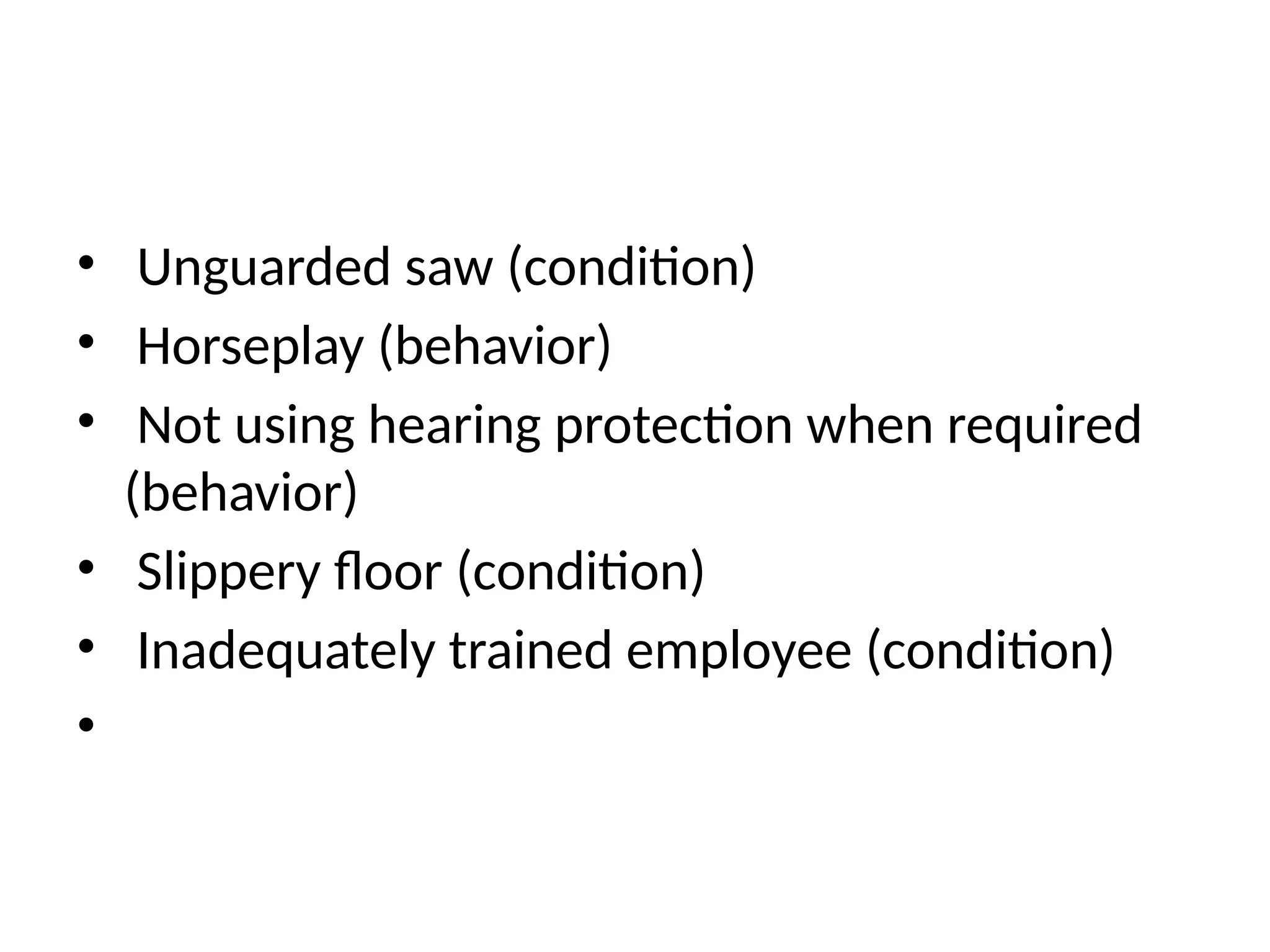
• Unguarded saw (condition)
• Horseplay (behavior)
• Not using hearing protection when required
(behavior)
• Slippery floor (condition)
• Inadequately trained employee (condition)
•
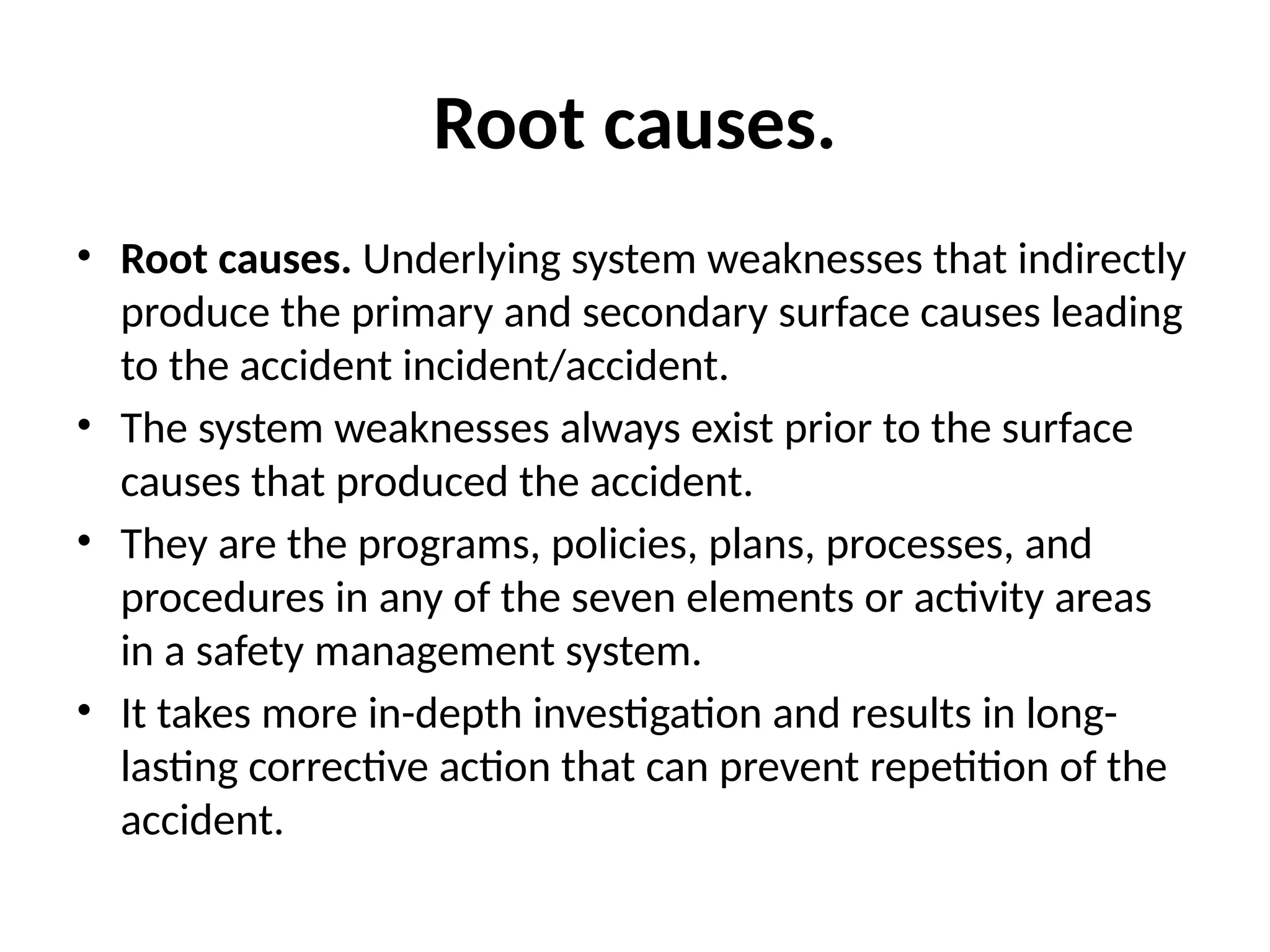
Root causes.
• Root causes. Underlying system weaknesses that indirectly
produce the primary and secondary surface causes leading
to the accident incident/accident.
• The system weaknesses always exist prior to the surface
causes that produced the accident.
• They are the programs, policies, plans, processes, and
procedures in any of the seven elements or activity areas
in a safety management system.
• It takes more in-depth investigation and results in long-
lasting corrective action that can prevent repetition of the
accident.
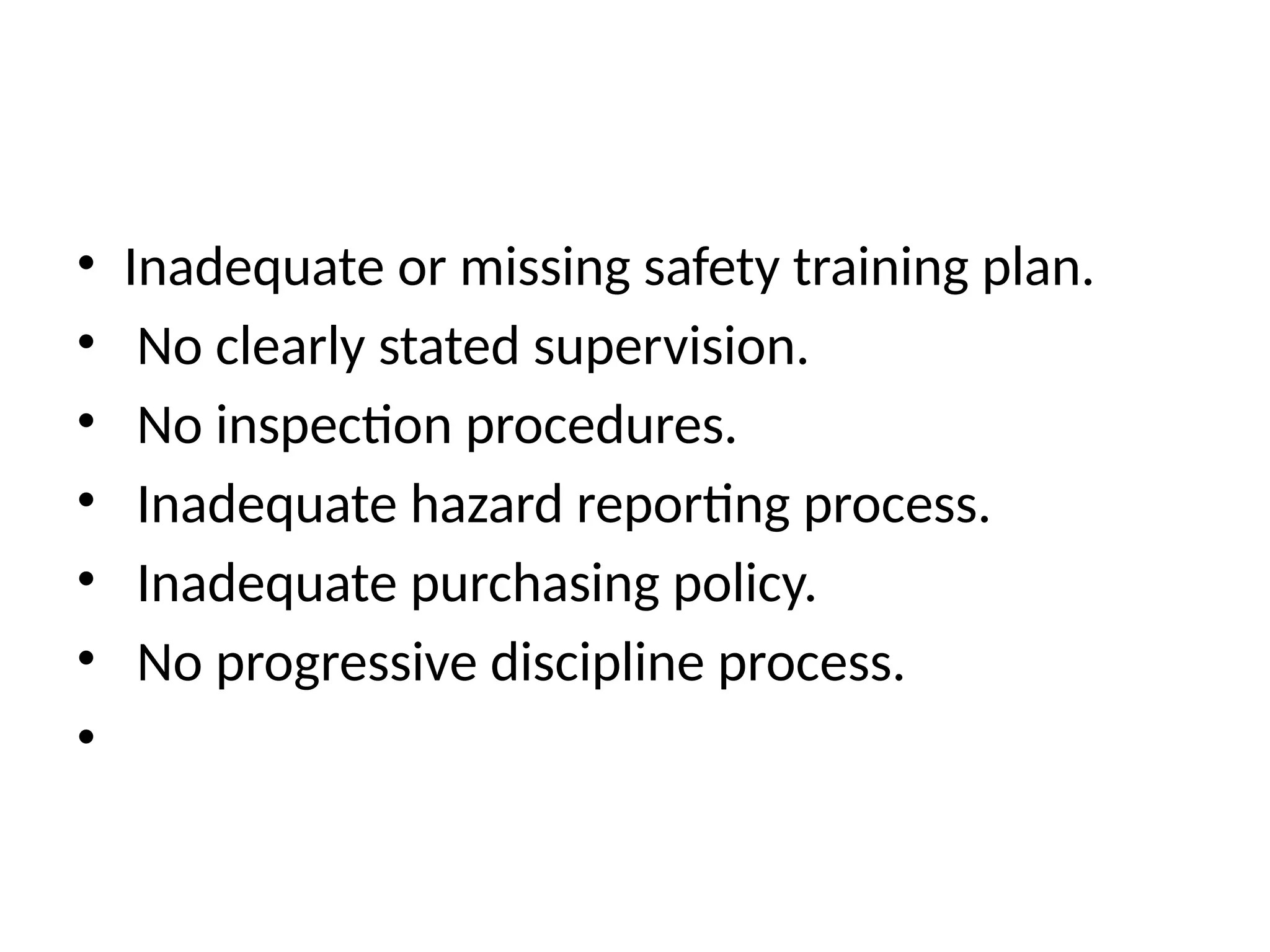
• Inadequate or missing safety training plan.
• No clearly stated supervision.
• No inspection procedures.
• Inadequate hazard reporting process.
• Inadequate purchasing policy.
• No progressive discipline process.
•
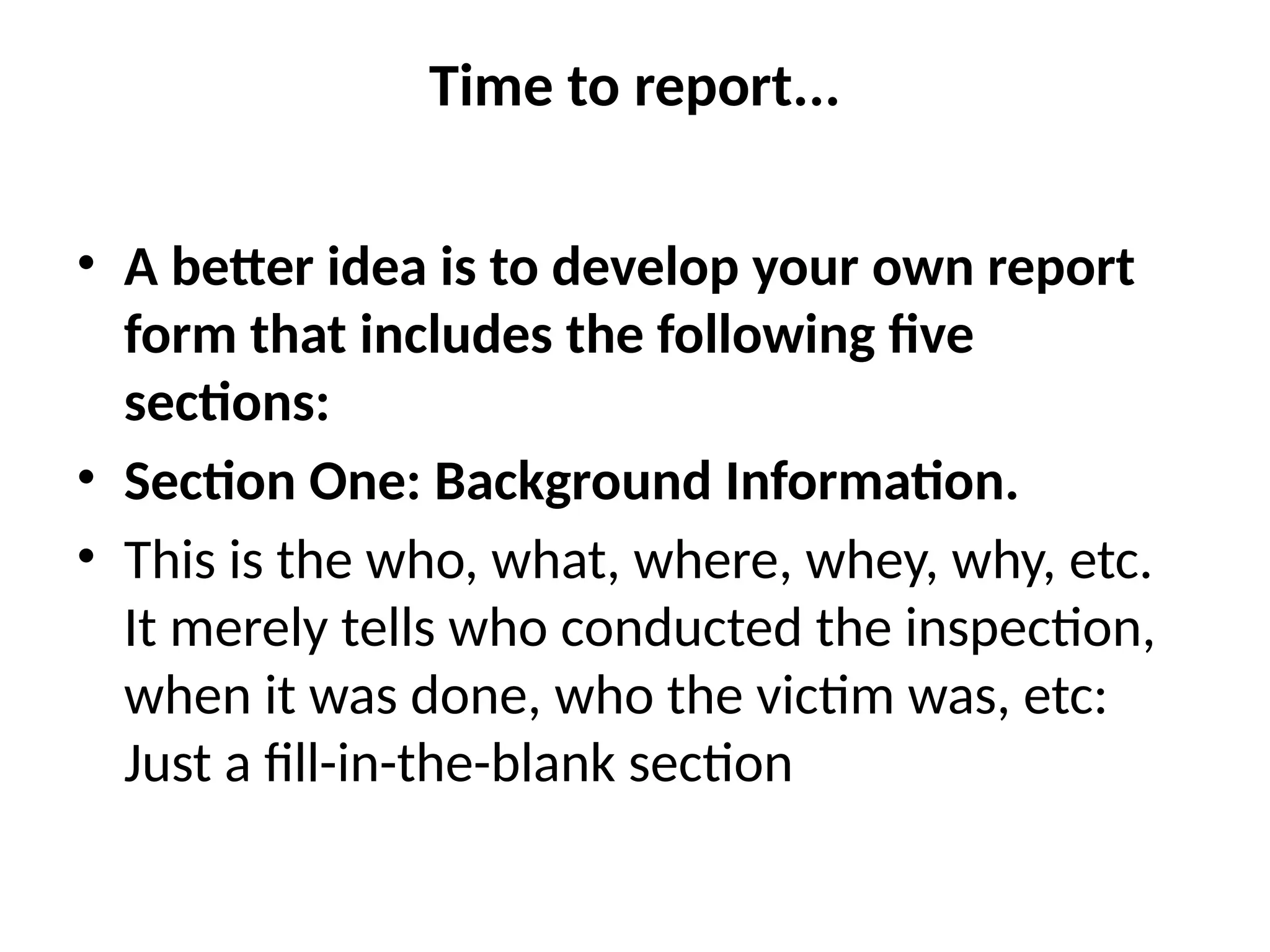
Time to report...
• A better idea is to develop your own report
form that includes the following five
sections:
• Section One: Background Information.
• This is the who, what, where, whey, why, etc.
It merely tells who conducted the inspection,
when it was done, who the victim was, etc:
Just a fill-in-the-blank section
• Section Two: Description of the Accident. This
section includes the sequence of events you
developed to determine cause. Just take the
numbers off, and make a nice concise
paragraph that describes the events leading
up to, and including the accident.
• Section Three: Findings. This section includes
a description of the surface and root causes
associated with the accident. List the surface
causes first, and then their associated root
causes. Remember, your investigation is to
determine cause, not blame. It's virtually
impossible to blame any one individual for a
workplace accident. Don't let anyone pressure
you into placing blame
• Section Four: Recommendations. This section
may be part of your report if requested by
your employer. Recommendations should
relate directly to the surface and root causes
for the accident. For instance, if one of the
surface causes for an accident was a slippery
floor, the related recommendation should
address eliminating that hazard through:
• Engineering controls
• Work Practice controls
• Administrative controls
• Personal protective equipment
• It's crucial that, after making recommendations to eliminate
or reduce the surface causes, you use the same procedure
to recommend actions to correct the root causes.
• If you fail to do this, it's a sure bet that similar accidents will
continue to occur
• Section Five: Summary. In this final section,
it's important to present a cost-benefit
analysis. What are the estimated direct and
indirect costs of the accident being
investigated? These represent potential future
costs if a similar accident were to occur.
Compare this figure with the costs associated
with taking corrective action? You may want
to address return on investment also.
MODULE 6 QUIZ
• 1. According to the text, OSHA investigates to
fix the _______ but to be most effective we
need to analyze accidents to fix the ______.
• a. surface causes, root causes
• b. blame, system
• c. penalties, blame
• d. conditions, behaviors
• 2. Methods for gathering information for an
accident investigation include all of the
following, except:
• a. photos
• b. witness statements
• c. determining level of discipline
• d. event analysis
• 3. Once the sequence of events has been
developed, what is the next step in the
accident analysis process?
• a. surface cause analysis
• b. root cause analysis
• c. determine appropriate discipline
• d. write the report
•
• 4. Which cause category has the greatest
impact on eliminating future accidents?
• a. special causes b. root causes
• c. surface causes d. common causes
• 5. Which of the following control strategies
eliminates or reduces the hazard, itself?
• a. engineering controls b. work practice
controls c. administrative controls
• d. personal protective equipment
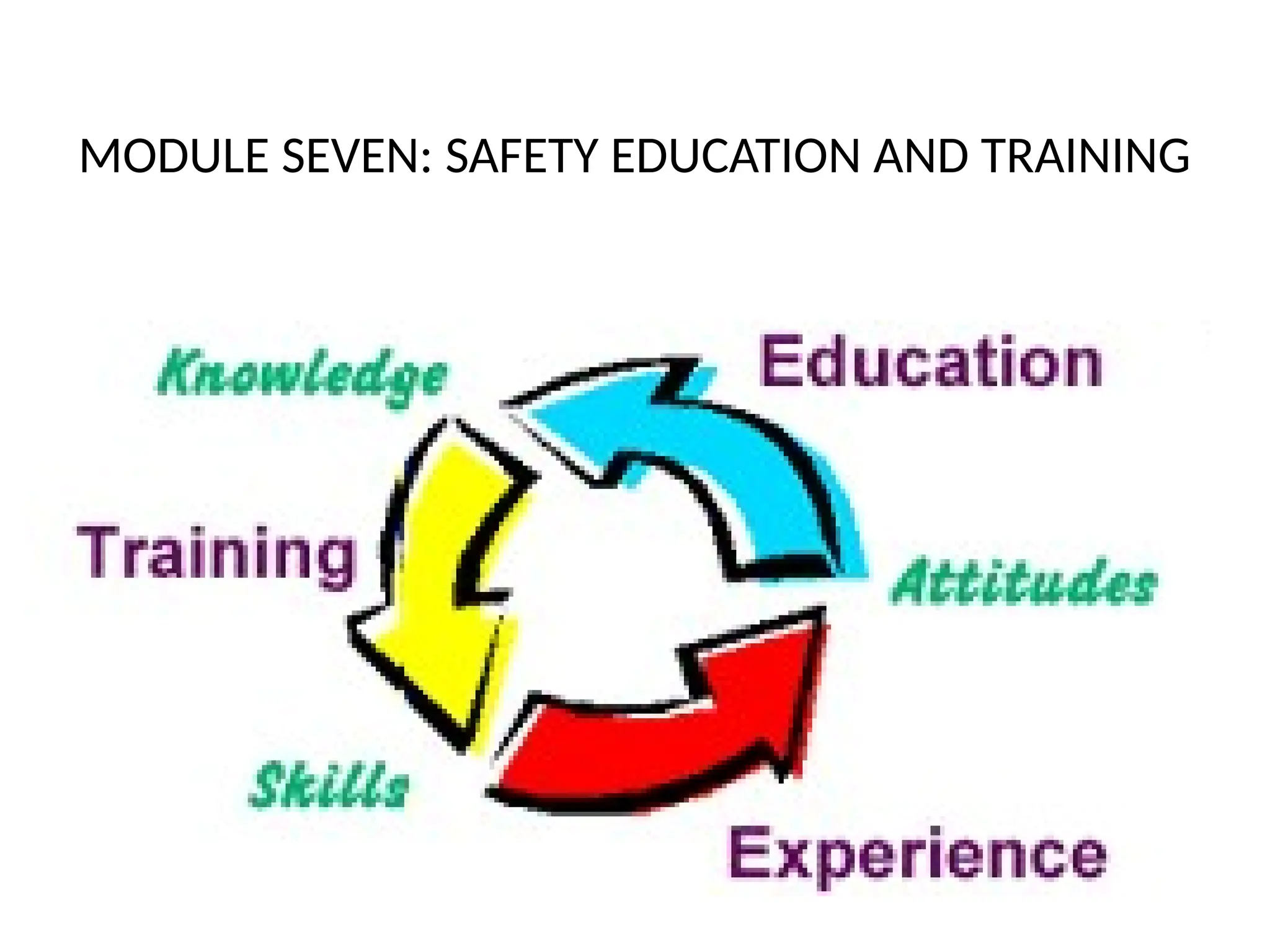
MODULE SEVEN: SAFETY EDUCATION AND TRAINING
• Safety education and training is extremely
important to ensure all processes in your
company's safety and health management
system are effective.
• If this critical element is missing, none of the
other system elements can, or will be
effective
The big picture
• But, this element is often neglected or managed
• ineffectively because the benefits may not be
immediate, tangible, and directly related to profits.
• Managers may find it difficult to see the long-term
improvements in process and product quality that
result from an effective safety education and
training program.
• It's hard to see the big picture: to see the accidents
that don't happen.
Education and Training: What's the
difference?
• We educate to show why.
• Within the context of occupational safety and
health, education describes who, what,
where, when, and most importantly, why
safety procedure and practice are necessary.
• Education informs, persuades, and motivates
to affect attitude.
• To make sure safety education and training is
effective, it's necessary to tie it to
accountability.
• One of the most effective ways to do this is to
emphasize the natural and system
consequences that result from the
appropriate application of what's being
learned
• Natural consequences describe the type of
injury/illness that might result if we don't follow
procedures.
• The system consequences describe the
disciplinary process if we fail to comply, and the
recognition and possible reward we will receive
if we meet or exceed expectations.
• Remember, we do what we do in the workplace
because of consequences.
• Safety education and training must make
consequences clear.
• Safety education is effective in saving lives by
primarily increasing our knowledge.
• Increased knowledge will improve attitudes
and skills.
Training
• We train to show how.
• Training, as a form of education, has a slightly different
definition.
• Safety training is primarily concerned with affecting attitude
through improving skills.
• This is generally accomplished through demonstration --
showing how to safely accomplish the steps of a particular
task or procedure.
• For instance, I might train someone how to accomplish the
procedures for lockout/tagout, or clean up an incidental
chemical spill.
• The number one reason employees don't
follow safety rules is that they don't know why
they are important!
•
• To make sure safety education and training is
effective, it's necessary to tie the training to
accountability.
• One of the most effective ways to do this is to
emphasize the natural and system
consequences that result from the
appropriate application of what's being
learned
Natural consequences
• Natural consequences describe the type of
injury/illness that might result if we don't follow
procedures. For instance...
• An employee breaks an arm or leg as a result of
a fall.
•
• An employee escapes injury by properly using a
personal fall arrest system.
•
System consequences
• System consequences describe the
organizational response to performance. For
instance...
•
• An employee would be subject to a disciplinary
process for failing to comply with safety rules.
• An employee might be recognized for meeting
goals or exceeding expectations
• Remember, we do what we do in the
workplace because of consequences.
• Safety education and training must make
consequences clear.
We train to show how.
• Safety training is primarily concerned with
affecting attitude through improving skills.
• This is generally accomplished through
demonstration -- showing how to safely
accomplish the steps of a particular task or
procedure.
• For instance, I might train someone how to
accomplish the procedures for lockout/tagout,
or clean up an incidental chemical spill.
Why is education so important?
• Education tells the "why" in a learning process.
• In safety and health, the why can save a
person's life.
• By far the most common reason workers do
not follow safety rules (or any rule) is that they
don't understand why doing so is important.
• They don't understand the consequences.
•
It's all about "Show and Tell"
• Safety education and training doesn't have to
be difficult or expensive: it's not rocket
science.
• So, what is probably the best and most
common method to train specific safety
procedures?
• On-the-job show and tell.
A Simple Seven-Step On-The-Job (OJT) Training Process
• Safety training should be simple training.
• Hopefully, it's done where the task is performed.
• Hopefully the supervisor - the person responsible
for the worker's safety - is conducting the training.
• Why...? Well, if a supervisor isn't knowledgeable
enough to train safe procedures, how can he or
she properly supervise, discipline, or recognize
safety behaviors adequately?
Step 1. Introduction
• State and discuss the learning objectives and answer any questions
the employee may have.
• Discuss the acceptable standards of knowledge and performance.
• Tell the trainee what you're going to train.
• Emphasize the importance of the procedure to the success of the
production/service goals.
• Invite questions.
• Emphasize the natural and system consequences of their
performance.
• The natural consequences describe the hurt or health that
automatically results.
• The system consequences are those consequences the organization
applies as a result of an employee's performance; discipline or
positive recognition.
Step 2. Trainer shows and tells.
• In this step the trainee becomes familiar with
each work practice and why it is important.
• Review the initial conditions for the procedure.
• Demonstrate the process, carefully explaining
each step as you go.
• Answer questions and continue to demonstrate
and explain until the employee understands
what to do, when and why to do it, and how to
do it.
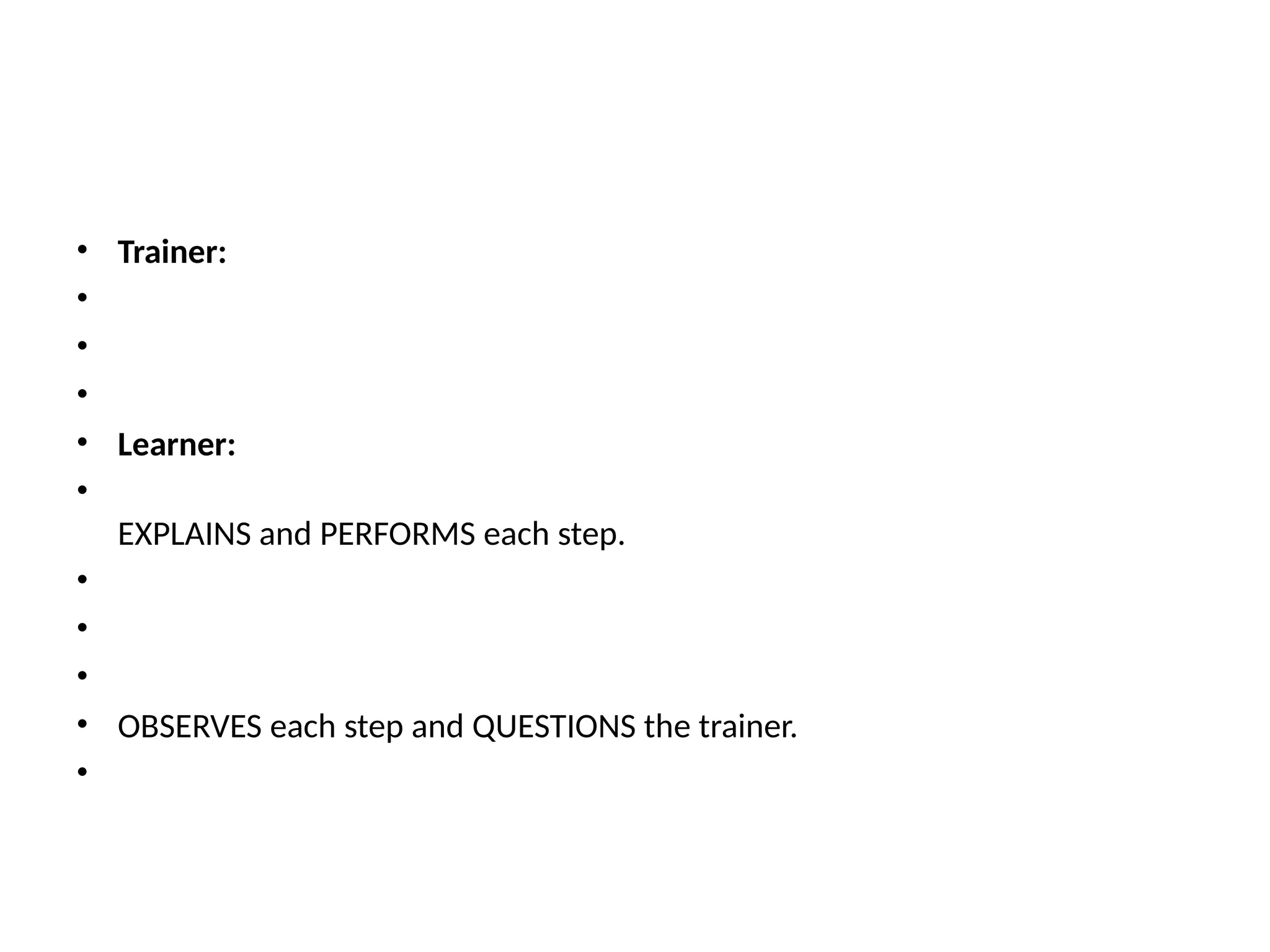
• Trainer:
•
•
•
• Learner:
•
EXPLAINS and PERFORMS each step.
•
•
•
• OBSERVES each step and QUESTIONS the trainer.
•
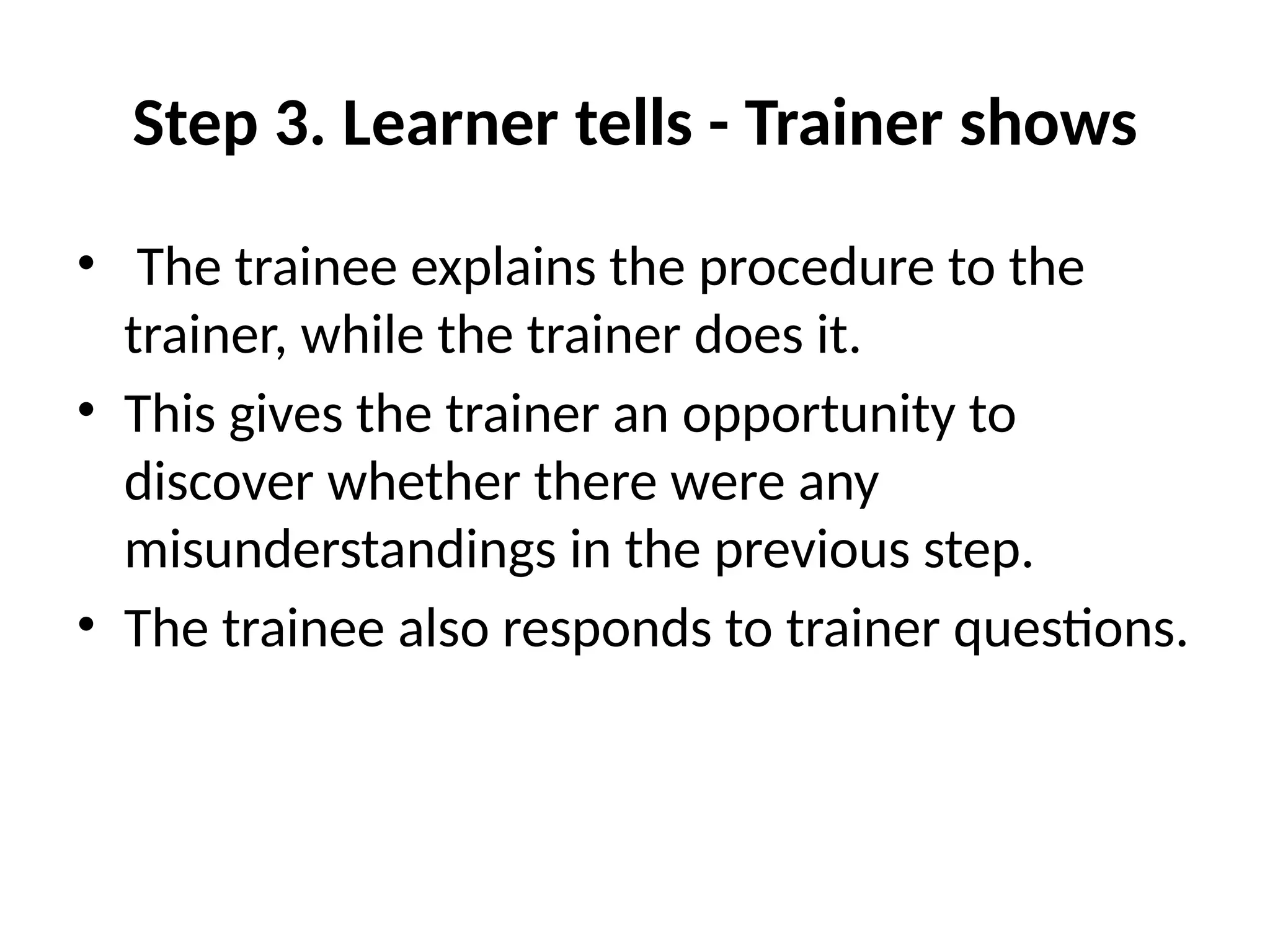
Step 3. Learner tells - Trainer shows
• The trainee explains the procedure to the
trainer, while the trainer does it.
• This gives the trainer an opportunity to
discover whether there were any
misunderstandings in the previous step.
• The trainee also responds to trainer questions.
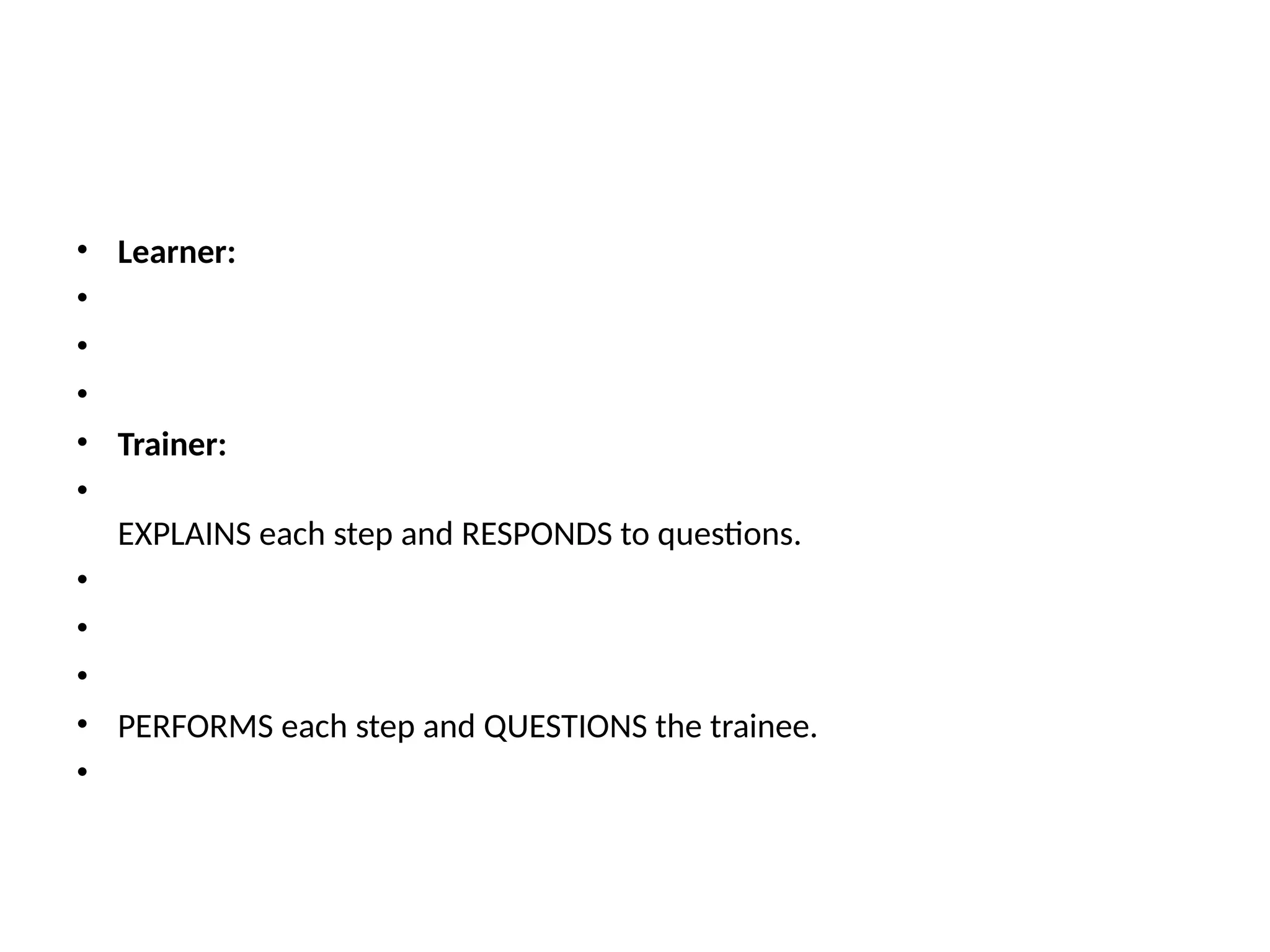
• Learner:
•
•
•
• Trainer:
•
EXPLAINS each step and RESPONDS to questions.
•
•
•
• PERFORMS each step and QUESTIONS the trainee.
•
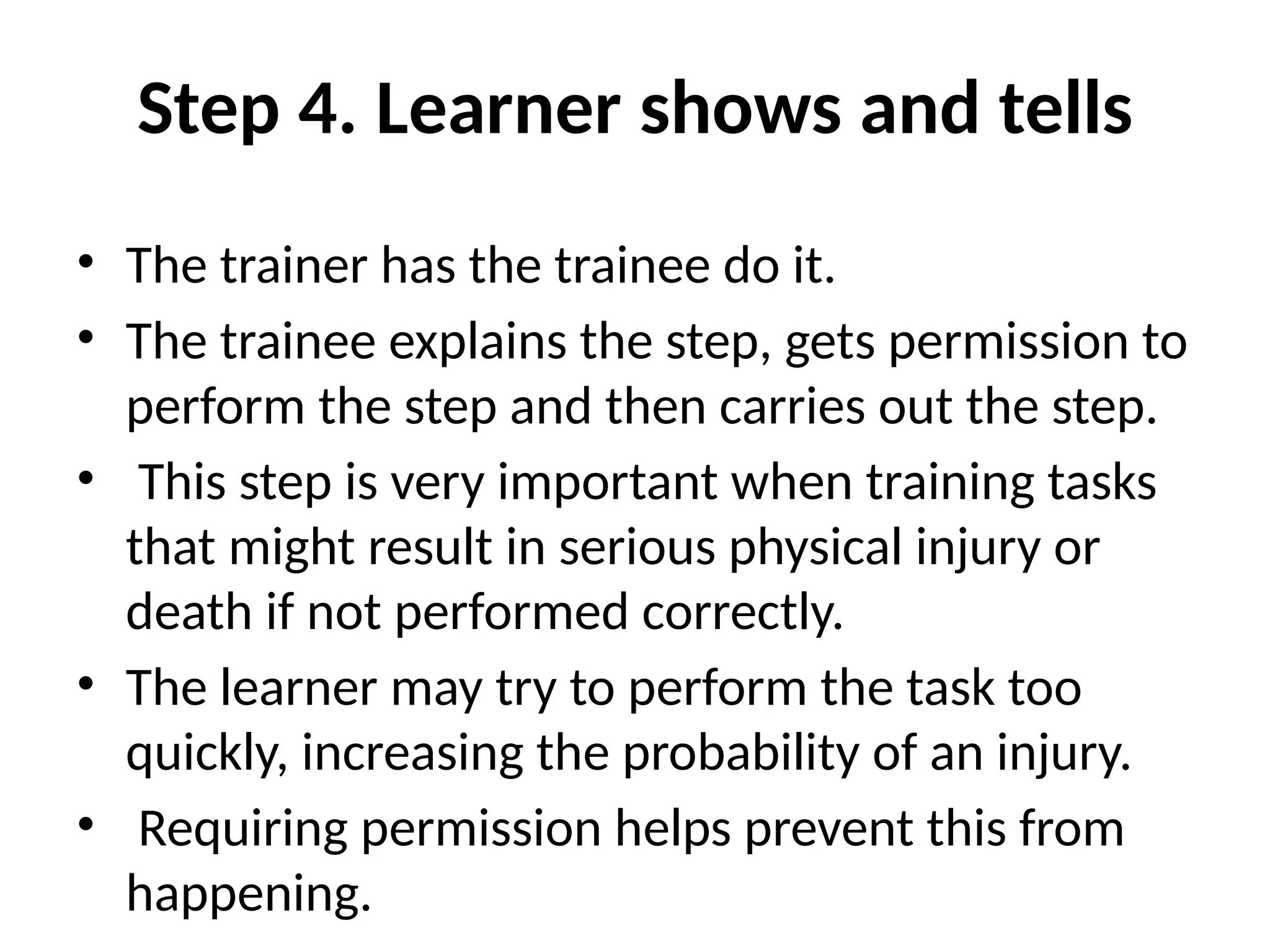
Step 4. Learner shows and tells
• The trainer has the trainee do it.
• The trainee explains the step, gets permission to
perform the step and then carries out the step.
• This step is very important when training tasks
that might result in serious physical injury or
death if not performed correctly.
• The learner may try to perform the task too
quickly, increasing the probability of an injury.
• Requiring permission helps prevent this from
happening.
• Learner: EXPLAINS the step, gets PERMISSION and then
PERFORMS each step.
•
•
•
•
• Trainer:
•
Give PERMISSION and OBSERVES each step, ask QUESTIONS as
the trainee performs
Step 5. Conclusion.
• Recognize accomplishment – “Good job”
• Reemphasize the importance of the procedure
and how it fits into the overall process.
• Tie the training again to accountability by
discussing the natural and system
consequences of performance.
•
Step 6. Document
• Training documentation should be more than an
attendance sheet.
• It represents one possible way to document training.
• Strong documentation includes:
•
• · Trainee's and trainer's name. ·
• Date of training.
• Subject(s) being trained - procedures, practices,
related policies, rules, etc. · Certification - trainee and
trainer signatures.
• Trainee statement of understanding and intent to
comply.
•
• Trainee statement that he/she was provided
opportunity to practice.
• Trainer statement that testing of knowledge and skills
was conducted.
• Trainer statement that student demonstrated adequate
knowledge and skill.
•
Step 7. Validate
• At some point in time after the conclusion of
the OJT session, observe and question the
employee to validate that the training has
been successful and that the employee has
developed a proper attitude related to the
work.
• You've received a few of the technical
concepts and ideas for training in this module,
but in reality there is an art as well as a
science to training.
• Like any artistic endeavor, only practice and
long-suffering will produce excellent work.
• So, go forth and train!
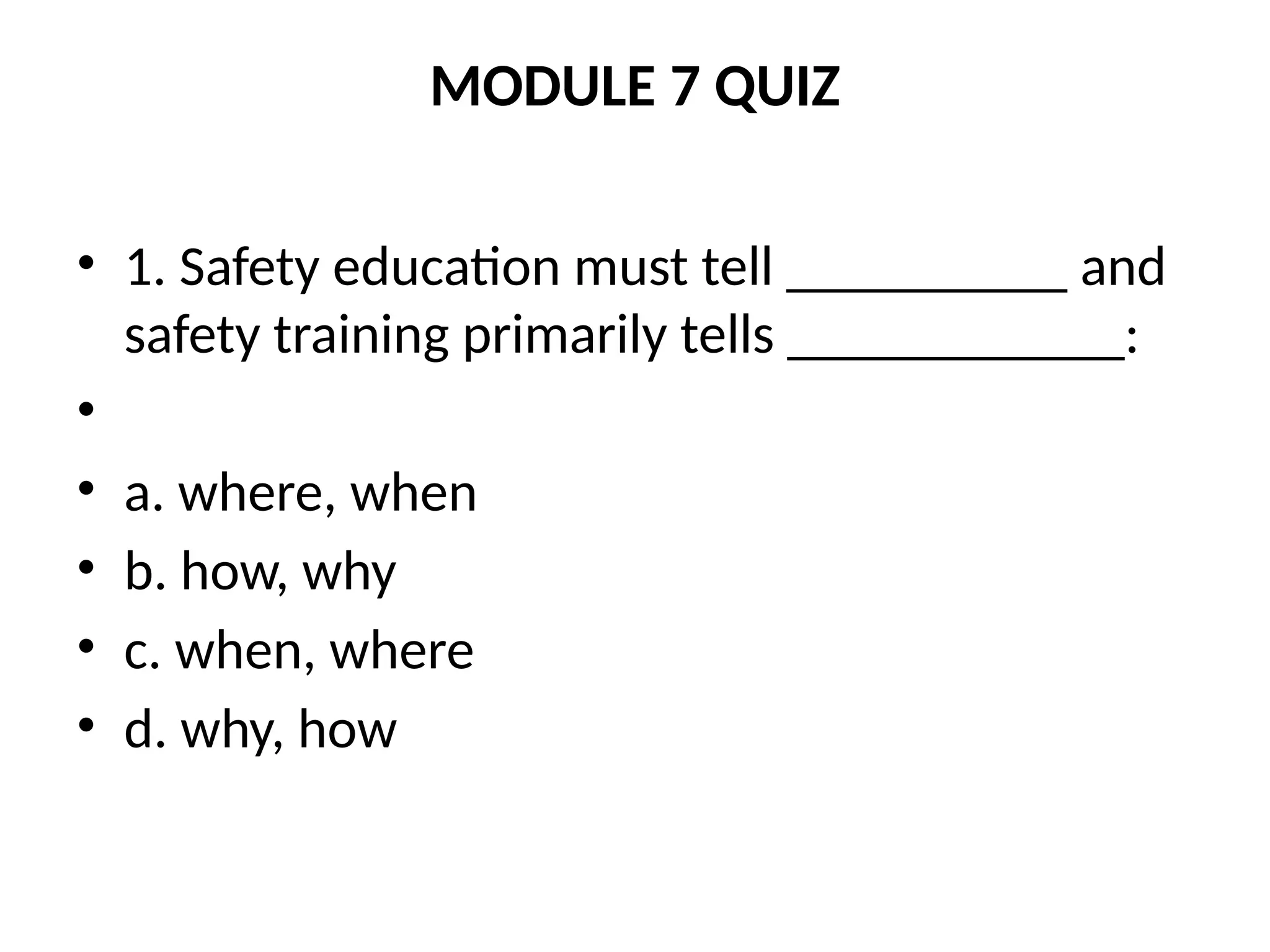
MODULE 7 QUIZ
• 1. Safety education must tell __________ and
safety training primarily tells ____________:
•
• a. where, when
• b. how, why
• c. when, where
• d. why, how
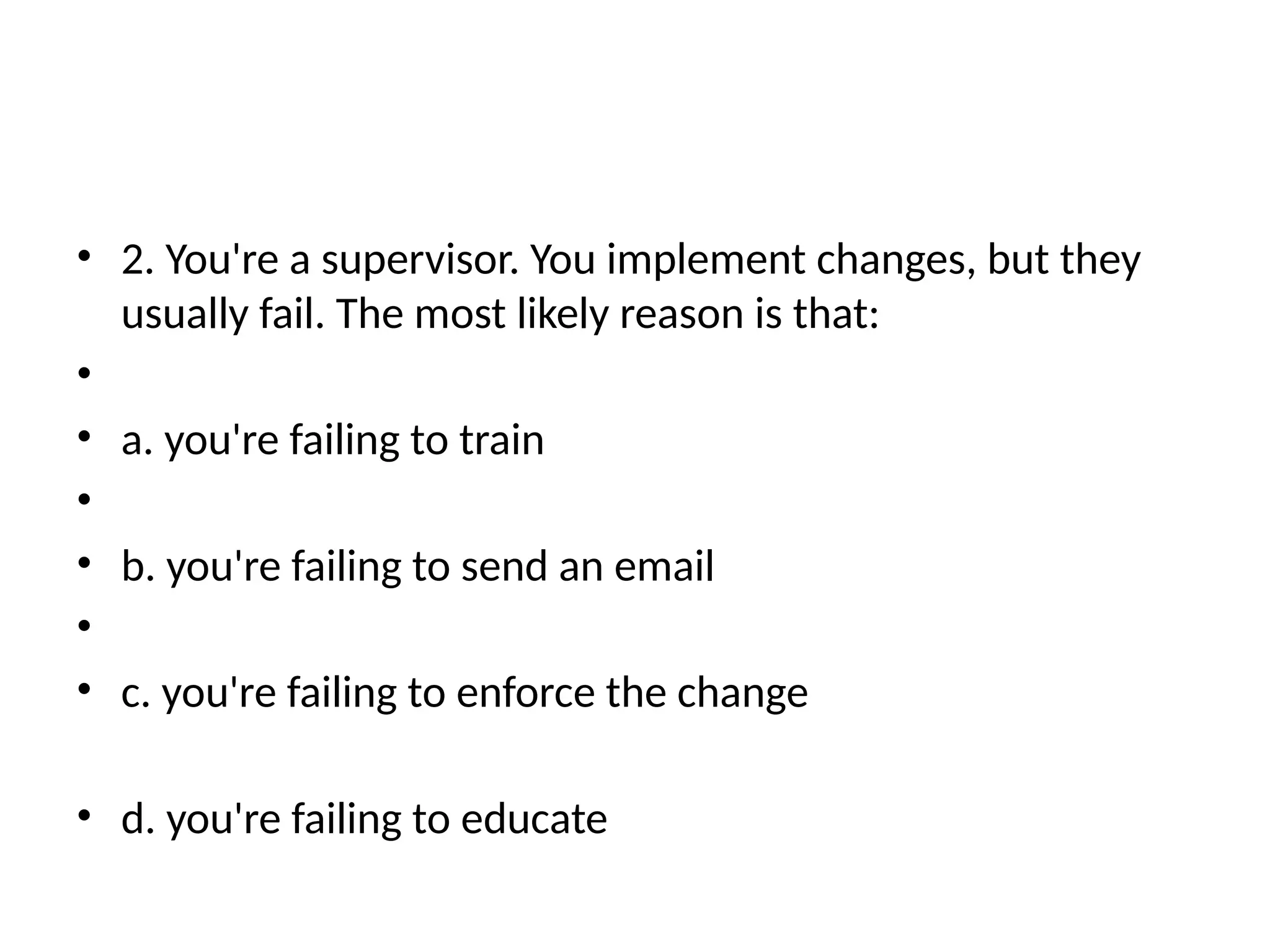
• 2. You're a supervisor. You implement changes, but they
usually fail. The most likely reason is that:
•
• a. you're failing to train
•
• b. you're failing to send an email
•
• c. you're failing to enforce the change
• d. you're failing to educate
• 3. According to the text, what is probably the
best and most common method to train
specific safety procedures?
•
• a. lecture
• b. show and tell
• c. online training
• d. classroom discussion
• 4. In the six-step OJT procedure, this component
helps make sure the new employee does not get
injured performing a step in the task being
learned:
•
• a. explain the step
• b. do the step
• c. get permission
• d. ask questions
• 5. All of the following are necessary to
adequately document training, except:
•
• a. intent to comply
• b. certification of knowledge and skills
• c. worker name, date, subject
• d. test scores
MODULE FOUR.pptxtggcdfjccsccjvffvcfddcbju

  • 1.
    MODULE FOUR: EFFECTIVE COMMUNICATIONS •Effective communications is extremely important to the goal of increasing employee involvement in safety and health. • Skilled safety communications will support leadership, at all levels, from the CEO to the employee. So, let's get started with a review of some basic communications concepts and principles.
  • 2.
    Return to sender... •The most basic communication theory talks about the requirement for both a sender and receiver in the communication process. • The sender initiates the communication and the receiver receives, interprets, and responds to the communication
  • 3.
    It's not whatyou say...it's how you say it! • Another important concept in communications is the Two-Level Theory which states that in any communications process messages are sent and received on two levels. • The first level is called the content level and describes only what is sent. The only information transferred at this level is data, usually in the form of spoken words.
  • 4.
    • The secondlevel of communication exists on a higher, more abstract plane. • It's called the relationship level which describes the communication that establishes the relationship between the sender and the receiver. • It is how the message is sent that sets up the relationship
  • 5.
    I'm Okay...You areOkay... • Every time a supervisor recognizes an employee for safe work behaviors, it reinforces and makes that behavior more likely to occur in the future. • If a supervisor yells at you for "complaining," a very negative message is sent
  • 6.
    A most importantresponsibility! • If you are a safety committee representative, think about the relationship set up between you and your co-workers. • Make sure that you get back with your co- workers as soon as possible to let them know the status of their concerns or suggestions. This is probably your most important job as a safety committee representative.
  • 7.
    A rusty latchon the suggestion box... • How do you know your safety suggestion program is working? • If your suggestion program results in only a few suggestions each month, that's a symptom of failure • If the program is failing, it means that those managing the program are not communicating well on the relationship level
  • 8.
    Imagine, workers competingto be on the safety committee... • How do we increase employee involvement in the safety committee?
  • 9.
    MODULE 4 QUIZ •1. The words we speak when talking with another person is the __________ of the message. The tone of voice we use is likely to establish a ____________ between the sender and receiver. • • a. information, distance b. content, relationship • c. relationship, content • d. transmission, reception
  • 10.
    • 2. Whichcommunication level has the greatest impact on the receiver? • a. Content Level • b. Interpersonal Level c. Personal Level • d. Relationship Level • 3. According to the text, this behavior probably sends the most negative message to another person: • • a. debating b. yelling c. ignoring d. arguing
  • 11.
    • 4. Whatwas given as the "tip" for improving your work relationship with co-workers? • a. always say "hi" first • b. never kiss up to your boss • c. always look the other in the eye • d. never be the first to say "hi"
  • 12.
    • 5. 20.According to the text, if your suggestion box is continually empty, the most likely problem is: • • a. failure to check the box often • b. failure to lock the box • c. failure to tell employees about the box • d. failure to thank employees in a timely manner • •
  • 13.
    MODULE FIVE: HAZARDIDENTIFICATION AND CONTROL • What is a hazard? • Any workplace condition or a person's "state of being" that could cause an injury or illness to an employee.
  • 14.
    Controlling Exposure tohazards - The Hierarchy of Controls • Controlling exposures to occupational hazards is the fundamental method of protecting workers. • Traditionally, a hierarchy of controls has been used as a means of determining how to implement feasible and effective controls.
  • 15.
    • One representationof this hierarchy is summarized below. • 1. Elimination • 2. Substitution • 3. Engineering controls • 4. Administrative controls • 5. Personal protective equipment
  • 16.
    Elimination and substitution •Most effective at reducing hazards • most difficult to implement in an existing process • Engineering controls • Used to remove a hazard or place a barrier between the worker and the hazard • Well-designed engineering controls can be highly effective in protecting workers and will be independent of worker interactions.
  • 17.
    Administrative controls andpersonal protective equipment • Administrative controls and personal protective equipment programs may be relatively inexpensive to establish but, over the long term, can be very costly to sustain. These methods for protecting workers have also proven to be less effective than other measures, requiring significant effort by the affected workers.
  • 18.
    The Five WorkplaceHazard Categories • The first three categories represent hazardous physical conditions which account for only 3% of all workplace accidents. • The fourth category describes behaviors in the workplace which may contribute up to 95% of all workplace accidents. • The final category may contribute to both the hazardous conditions and unsafe behaviors, and therefore, may be ultimately responsible for fully 98% of all accidents in the workplace.
  • 19.
    Materials • Hazardous materialsinclude hazardous: • Liquid and solid chemicals such as acids, bases, solvents, explosives, etc • Solids like metal, wood, plastics • Gases like hydrogen sulfide, methane, etc
  • 20.
    Equipment • This areaincludes machinery and tools used to produce or process goods. • Environment • This area includes facility design, hazardous atmospheres, temperature, noise, factors that cause stress, etc. • People • This area includes unsafe employee behaviors at all levels in the organization such as taking short cuts, not using PPE, and otherwise ignoring safety rules.
  • 21.
    System • Every companyhas, to some degree, a safety and health management system (SHMS). • It's good to think of the "state" of the SHMS as a condition • For instance, management may develop and implement ineffective policies, procedures and safety rules.
  • 22.
    Two strategies • Walkaroundinspection • To identify and control hazards in the workplace, two basic strategies are used. First, and most common is the walkaround inspection • Employees should inspect the materials, equipment, and tools they use, and their immediate workstation for hazardous conditions at the start of each workday.
  • 23.
    What's the majorweakness of the safety inspection? • By its very nature, the walkaround inspection is ineffective in uncovering unsafe work practices because most inspectors look primarily at hazardous conditions and do not take enough time to effectively analyze individual task procedures.
  • 24.
    Job Hazard Analysis(JHA) • The Job Hazard Analysis (JHA) can be the answer to this weakness. • It uncovers unsafe work practices as well as hazardous conditions because sufficient time is given to closely analysis of one unique task at a time.
  • 25.
    • While theemployee accomplishes several cycles of the task, the supervisor observes and takes notes about what's being done. • Once the observation is completed, he divides the task into a number of unique steps which are listed sequentially. • Each step is analyzed to uncover hazardous materials, equipment, tools, and unsafe exposures are involved. • Next, the hazards and exposures of each step are analyzed to determine the safety precautions required to eliminate or at least reduce any hazards or exposures present.
  • 26.
    • Lastly, awritten safe work procedure (SJP) is developed for the entire task. The SJP is reviewed prior to accomplishing the task and it can also be used as a lesson plan to conduct training. • Employee involvement in the JHA process helps ensure they will use the safe job procedure developed by the JHA when not being directly supervised.
  • 27.
    Dig up theroots! • When investigating hazards discovered in a walkaround inspection or JHA, it's important that you uncover the root causes that have allowed those hazards to exist in the workplace. • Taking this approach to hazard investigation is called root cause analysis. •
  • 29.
    • The flowerrepresents the injury. It's the result of the transfer of an excessive amount of energy from an outside source to the body. This is called the direct cause of the accident. • The leaves of the weed represent hazardous conditions and unsafe work practices in the workplace. Conditions and/or practices are typically called the surface or indirect causes of an accident
  • 30.
    • The rootsof the weed represent management's effort to maintain a safe and healthful workplace, safety policies, safety supervision, safety training, and enforcement of safety rules • Inadequate or missing system components represent the root causes for accidents in the workplace
  • 31.
    • Root causesmay feed and actually promote or nurture hazardous conditions and unsafe work practices. • Research findings indicate hazardous conditions, alone, represent only about 3% of the causes for accidents in the workplace, while unsafe behaviors make up about 95% of the causes for accidents. • Consequently, about 98% of all workplace accidents are ultimately caused by a combination of inadequate safety management system components, under the control of management, that result in hazardous conditions and/or unsafe work practices.
  • 32.
    MODULE 5 QUIZ •1. Unsafe ________ account for only about 3 percent of all workplace accidents. • a. behaviors b. conditions • c. situations d. people • 2. Which cause category is ultimately most responsible for accidents in the workplace? • a. hazardous conditions b. unsafe behaviors • c. management system weaknesses d. lack of common sense
  • 33.
    • 4. Whichof the following is not one of the four areas within which all workplace hazards exist? (Hint: MEEP) • a. materials b. employees • c. energy d. people • 5. What is a major weakness of the walkaround inspection? • a. it takes too much time • b. it looks only at conditions • c. it isn't conducted often enough • d. it requires experts •
  • 34.
    • 6. Whatsystem weaknesses might explain an unsafe behavior? • a. inadequate supervision b. lack of training • c. inconsistent enforcement • d. any of the above •
  • 35.
    MODULE SIX: INCIDENTAND ACCIDENT INVESTIGATION • The process of analysis is extremely important in identifying and eliminating those conditions, behaviors and system weaknesses that result in workplace accidents.
  • 36.
    Fix the systemnot the blame! • If your safety program fails to eliminate workplace hazards, chances are very likely an accident will result. • When it does, it's important to conduct an effective accident investigation. • Or proper analysis of the accident • You've got to conduct this activity for the express purpose of improving your safety management system.
  • 37.
    • The onlyway to receive any long-term benefit from accident analysis is to make sure system weaknesses are uncovered and permanently corrected. • Although accident investigation is a valuable and necessary tool to help reduce accident losses, it is always considerably more expensive to rely on accident investigation than hazard investigation as a strategy to reduce losses and eliminate hazards in the workplace.
  • 38.
    Accidents just happen...don'tthey? • Do they? Are they really unexpected or unplanned? If a company has 20 disabling injuries one year, and sets an objective to reduce the accident rate by 50% by the end of the next year, aren't they planning 10 accidents for that year? • If they reach that goal, won't they be happy about it...content? Is that really acceptable? • You can't ever afford to relax, or be content in safety.
  • 39.
    Incident and Accidentdefined • • An incident is an unexpected event that may result in property damage, but does not result in an injury or illness. Incidents are also called, "near misses," or "near hits." • An accident is an unexpected event that may result in property damage, and does result in an injury or illness to an employee.
  • 40.
    Plan the work...workthe plan! • When a serious accident occurs in the workplace, everyone will be too busy dealing with the emergency at hand to worry about putting together an investigation plan, so the best time to develop effective accident investigation procedures is before the accident occurs. • The plan should include as a minimum procedures that determine:
  • 41.
    • Who shouldbe notified of accident. • Who is authorized to notify outside agencies. (fire, police, etc.) • Who is assigned to conduct investigations. • Training required for accident investigators: • Who receives and acts on investigation reports. • Timetables for conducting hazard correction.
  • 42.
    Accident Scenario: John'shurt bad... fell off a scaffold over at the worksite!
  • 43.
    • You've justbeen notified of an injury in the workplace and immediately swing into action. You grab your investigator's kit and hurry to the accident scene. • By the time you get there, the Emergency Medical Team (EMT) is administering first aid. It's a serious accident so the victim is transported to the hospital. • Now it's safe to investigate.
  • 44.
    • The firsttask is to secure the accident scene. The easiest way to do this is to place yellow warning tape around the area. • If tape is not available, warning signs or guards may be required
  • 45.
    Just the facts •The next step in the procedure is to gather useful information about what directly and indirectly contributed to the accident. • Interviewing eyewitnesses to the accident is probably one of the most important techniques in gathering information, but there are many other tools and techniques too
  • 46.
    Gathering background informationabout the accident may be accomplished in many ways. • You want to get initial statements through interviews with eyewitnesses. • You should tell those who you initially interview that you may conduct follow-up interviews if more questions surface. • Interview other interested persons such as supervisors, co-workers, etc.
  • 47.
    • You shouldalso review any records associated with the accident, including: • Training records , Disciplinary records , Medical records (as allowed) Maintenance records, EMT reports, Police reports (rare) Coroner's report (fatalities), OSHA 300 Log (past similar injuries) and Safety Committee records • • More methods include: • Take photographs of the scene. Videotape the scene. • Make sketches of the scene. • Make observations about the scene. § Include measurements.
  • 48.
    What happened next? •Read through the information initially to develop an accurate sequence of events that led up to and included the actual injury event
  • 49.
    What caused theaccident? • Surface causes. The conditions and behaviors directly or indirectly producing the accident. • A long-lasting corrective action does not come from a surface cause. A surface cause leads to a root cause. • Primary surface causes directly cause the accident and usually involve the victim and some object or behavior. Secondary surface cause are unique conditions or behaviors that indirectly contribute to the accident. Secondary surface causes can occur anytime, by any person in the organization, and at any location. Conditions are objects or "states of being." Behaviors describe some sort of action, activity. Examples:
  • 50.
    • Unguarded saw(condition) • Horseplay (behavior) • Not using hearing protection when required (behavior) • Slippery floor (condition) • Inadequately trained employee (condition) •
  • 51.
    Root causes. • Rootcauses. Underlying system weaknesses that indirectly produce the primary and secondary surface causes leading to the accident incident/accident. • The system weaknesses always exist prior to the surface causes that produced the accident. • They are the programs, policies, plans, processes, and procedures in any of the seven elements or activity areas in a safety management system. • It takes more in-depth investigation and results in long- lasting corrective action that can prevent repetition of the accident.
  • 52.
    • Inadequate ormissing safety training plan. • No clearly stated supervision. • No inspection procedures. • Inadequate hazard reporting process. • Inadequate purchasing policy. • No progressive discipline process. •
  • 53.
    Time to report... •A better idea is to develop your own report form that includes the following five sections: • Section One: Background Information. • This is the who, what, where, whey, why, etc. It merely tells who conducted the inspection, when it was done, who the victim was, etc: Just a fill-in-the-blank section
  • 54.
    • Section Two:Description of the Accident. This section includes the sequence of events you developed to determine cause. Just take the numbers off, and make a nice concise paragraph that describes the events leading up to, and including the accident.
  • 55.
    • Section Three:Findings. This section includes a description of the surface and root causes associated with the accident. List the surface causes first, and then their associated root causes. Remember, your investigation is to determine cause, not blame. It's virtually impossible to blame any one individual for a workplace accident. Don't let anyone pressure you into placing blame
  • 56.
    • Section Four:Recommendations. This section may be part of your report if requested by your employer. Recommendations should relate directly to the surface and root causes for the accident. For instance, if one of the surface causes for an accident was a slippery floor, the related recommendation should address eliminating that hazard through:
  • 57.
    • Engineering controls •Work Practice controls • Administrative controls • Personal protective equipment • It's crucial that, after making recommendations to eliminate or reduce the surface causes, you use the same procedure to recommend actions to correct the root causes. • If you fail to do this, it's a sure bet that similar accidents will continue to occur
  • 58.
    • Section Five:Summary. In this final section, it's important to present a cost-benefit analysis. What are the estimated direct and indirect costs of the accident being investigated? These represent potential future costs if a similar accident were to occur. Compare this figure with the costs associated with taking corrective action? You may want to address return on investment also.
  • 59.
    MODULE 6 QUIZ •1. According to the text, OSHA investigates to fix the _______ but to be most effective we need to analyze accidents to fix the ______. • a. surface causes, root causes • b. blame, system • c. penalties, blame • d. conditions, behaviors
  • 60.
    • 2. Methodsfor gathering information for an accident investigation include all of the following, except: • a. photos • b. witness statements • c. determining level of discipline • d. event analysis
  • 61.
    • 3. Oncethe sequence of events has been developed, what is the next step in the accident analysis process? • a. surface cause analysis • b. root cause analysis • c. determine appropriate discipline • d. write the report •
  • 62.
    • 4. Whichcause category has the greatest impact on eliminating future accidents? • a. special causes b. root causes • c. surface causes d. common causes • 5. Which of the following control strategies eliminates or reduces the hazard, itself? • a. engineering controls b. work practice controls c. administrative controls • d. personal protective equipment
  • 63.
    MODULE SEVEN: SAFETYEDUCATION AND TRAINING
  • 64.
    • Safety educationand training is extremely important to ensure all processes in your company's safety and health management system are effective. • If this critical element is missing, none of the other system elements can, or will be effective
  • 65.
    The big picture •But, this element is often neglected or managed • ineffectively because the benefits may not be immediate, tangible, and directly related to profits. • Managers may find it difficult to see the long-term improvements in process and product quality that result from an effective safety education and training program. • It's hard to see the big picture: to see the accidents that don't happen.
  • 66.
    Education and Training:What's the difference? • We educate to show why. • Within the context of occupational safety and health, education describes who, what, where, when, and most importantly, why safety procedure and practice are necessary. • Education informs, persuades, and motivates to affect attitude.
  • 67.
    • To makesure safety education and training is effective, it's necessary to tie it to accountability. • One of the most effective ways to do this is to emphasize the natural and system consequences that result from the appropriate application of what's being learned
  • 68.
    • Natural consequencesdescribe the type of injury/illness that might result if we don't follow procedures. • The system consequences describe the disciplinary process if we fail to comply, and the recognition and possible reward we will receive if we meet or exceed expectations. • Remember, we do what we do in the workplace because of consequences. • Safety education and training must make consequences clear.
  • 69.
    • Safety educationis effective in saving lives by primarily increasing our knowledge. • Increased knowledge will improve attitudes and skills.
  • 70.
    Training • We trainto show how. • Training, as a form of education, has a slightly different definition. • Safety training is primarily concerned with affecting attitude through improving skills. • This is generally accomplished through demonstration -- showing how to safely accomplish the steps of a particular task or procedure. • For instance, I might train someone how to accomplish the procedures for lockout/tagout, or clean up an incidental chemical spill.
  • 71.
    • The numberone reason employees don't follow safety rules is that they don't know why they are important! • • To make sure safety education and training is effective, it's necessary to tie the training to accountability.
  • 72.
    • One ofthe most effective ways to do this is to emphasize the natural and system consequences that result from the appropriate application of what's being learned
  • 73.
    Natural consequences • Naturalconsequences describe the type of injury/illness that might result if we don't follow procedures. For instance... • An employee breaks an arm or leg as a result of a fall. • • An employee escapes injury by properly using a personal fall arrest system. •
  • 74.
    System consequences • Systemconsequences describe the organizational response to performance. For instance... • • An employee would be subject to a disciplinary process for failing to comply with safety rules. • An employee might be recognized for meeting goals or exceeding expectations
  • 75.
    • Remember, wedo what we do in the workplace because of consequences. • Safety education and training must make consequences clear.
  • 76.
    We train toshow how. • Safety training is primarily concerned with affecting attitude through improving skills. • This is generally accomplished through demonstration -- showing how to safely accomplish the steps of a particular task or procedure. • For instance, I might train someone how to accomplish the procedures for lockout/tagout, or clean up an incidental chemical spill.
  • 77.
    Why is educationso important? • Education tells the "why" in a learning process. • In safety and health, the why can save a person's life. • By far the most common reason workers do not follow safety rules (or any rule) is that they don't understand why doing so is important. • They don't understand the consequences. •
  • 78.
    It's all about"Show and Tell" • Safety education and training doesn't have to be difficult or expensive: it's not rocket science. • So, what is probably the best and most common method to train specific safety procedures? • On-the-job show and tell.
  • 79.
    A Simple Seven-StepOn-The-Job (OJT) Training Process • Safety training should be simple training. • Hopefully, it's done where the task is performed. • Hopefully the supervisor - the person responsible for the worker's safety - is conducting the training. • Why...? Well, if a supervisor isn't knowledgeable enough to train safe procedures, how can he or she properly supervise, discipline, or recognize safety behaviors adequately?
  • 80.
    Step 1. Introduction •State and discuss the learning objectives and answer any questions the employee may have. • Discuss the acceptable standards of knowledge and performance. • Tell the trainee what you're going to train. • Emphasize the importance of the procedure to the success of the production/service goals. • Invite questions. • Emphasize the natural and system consequences of their performance. • The natural consequences describe the hurt or health that automatically results. • The system consequences are those consequences the organization applies as a result of an employee's performance; discipline or positive recognition.
  • 81.
    Step 2. Trainershows and tells. • In this step the trainee becomes familiar with each work practice and why it is important. • Review the initial conditions for the procedure. • Demonstrate the process, carefully explaining each step as you go. • Answer questions and continue to demonstrate and explain until the employee understands what to do, when and why to do it, and how to do it.
  • 82.
    • Trainer: • • • • Learner: • EXPLAINSand PERFORMS each step. • • • • OBSERVES each step and QUESTIONS the trainer. •
  • 83.
    Step 3. Learnertells - Trainer shows • The trainee explains the procedure to the trainer, while the trainer does it. • This gives the trainer an opportunity to discover whether there were any misunderstandings in the previous step. • The trainee also responds to trainer questions.
  • 84.
    • Learner: • • • • Trainer: • EXPLAINSeach step and RESPONDS to questions. • • • • PERFORMS each step and QUESTIONS the trainee. •
  • 85.
    Step 4. Learnershows and tells • The trainer has the trainee do it. • The trainee explains the step, gets permission to perform the step and then carries out the step. • This step is very important when training tasks that might result in serious physical injury or death if not performed correctly. • The learner may try to perform the task too quickly, increasing the probability of an injury. • Requiring permission helps prevent this from happening.
  • 86.
    • Learner: EXPLAINSthe step, gets PERMISSION and then PERFORMS each step. • • • • • Trainer: • Give PERMISSION and OBSERVES each step, ask QUESTIONS as the trainee performs
  • 87.
    Step 5. Conclusion. •Recognize accomplishment – “Good job” • Reemphasize the importance of the procedure and how it fits into the overall process. • Tie the training again to accountability by discussing the natural and system consequences of performance. •
  • 88.
    Step 6. Document •Training documentation should be more than an attendance sheet. • It represents one possible way to document training. • Strong documentation includes: • • · Trainee's and trainer's name. · • Date of training. • Subject(s) being trained - procedures, practices, related policies, rules, etc. · Certification - trainee and trainer signatures.
  • 89.
    • Trainee statementof understanding and intent to comply. • • Trainee statement that he/she was provided opportunity to practice. • Trainer statement that testing of knowledge and skills was conducted. • Trainer statement that student demonstrated adequate knowledge and skill. •
  • 90.
    Step 7. Validate •At some point in time after the conclusion of the OJT session, observe and question the employee to validate that the training has been successful and that the employee has developed a proper attitude related to the work.
  • 91.
    • You've receiveda few of the technical concepts and ideas for training in this module, but in reality there is an art as well as a science to training. • Like any artistic endeavor, only practice and long-suffering will produce excellent work. • So, go forth and train!
  • 92.
    MODULE 7 QUIZ •1. Safety education must tell __________ and safety training primarily tells ____________: • • a. where, when • b. how, why • c. when, where • d. why, how
  • 93.
    • 2. You'rea supervisor. You implement changes, but they usually fail. The most likely reason is that: • • a. you're failing to train • • b. you're failing to send an email • • c. you're failing to enforce the change • d. you're failing to educate
  • 94.
    • 3. Accordingto the text, what is probably the best and most common method to train specific safety procedures? • • a. lecture • b. show and tell • c. online training • d. classroom discussion
  • 95.
    • 4. Inthe six-step OJT procedure, this component helps make sure the new employee does not get injured performing a step in the task being learned: • • a. explain the step • b. do the step • c. get permission • d. ask questions
  • 96.
    • 5. Allof the following are necessary to adequately document training, except: • • a. intent to comply • b. certification of knowledge and skills • c. worker name, date, subject • d. test scores