HAZARD CHECKLIST
DTS-EQA
OUTLINES
• INTRODUTION
• HAZARD DEFININATION
• TYPES OF HAZARD
• SAFETY HAZARD
• HEALTH HAZARDS
• ENVIRONMENTAL HAZARDS
• HAZARD CHECKLIST QUESTIONS
• METHODS OF INDENTIFYING
AND ANALYING HAZARD
• HAZARD CHECKLISTS
CONSIDERATION
• HAZID
• HAZOP
• FAILURE MODES AND EFFECTS
ANALYSIS (FMEA)
OUTLINES
• SWIFT
• ADVANTAGES OF HAZARD CHECKLIST
• DISADVANTAGES OF HAZARD CHECKLIST
• EXAMPLES OF LABORATORY SAFETY AUDIT
• REFERENCE
INTRODUTION
A Hazard Checklist Contains Questions Or Topics Intended To Prompt
Consideration Of A Range Of Safety Issues. It Can Also Be Used In
Combination With Structured Hazard Identification (HAZID) Techniques
Such As SWIFT And HAZOP
Checklists Can Be Created From Previous Risk Assessments,And Provide
An Efficient Means Of Generating A List Of Standard Hazards Suitable For
HAZID Of Systems At All Phases Of Development.
INTRODUTION CONT’D
• The Checklist Should Be Constructed To Address A Range Of Safety
Issues Including Presence Of Hazardous Materials Or Functions,
Functional Performance, InteractionWith Other Systems,And Personnel
Safety. If Hazard Analysis Or Safety Assessment Has Already Been Carried
Out On A Similar System,Any Available And Relevant Information Should
Be Incorporated Into The Checklist.
HAZARD DEFININATION
TYPES OF HAZARD
• SAFETY HAZARD
• HEALTH HAZARD
• ENVIRONMENTAL HAZARD
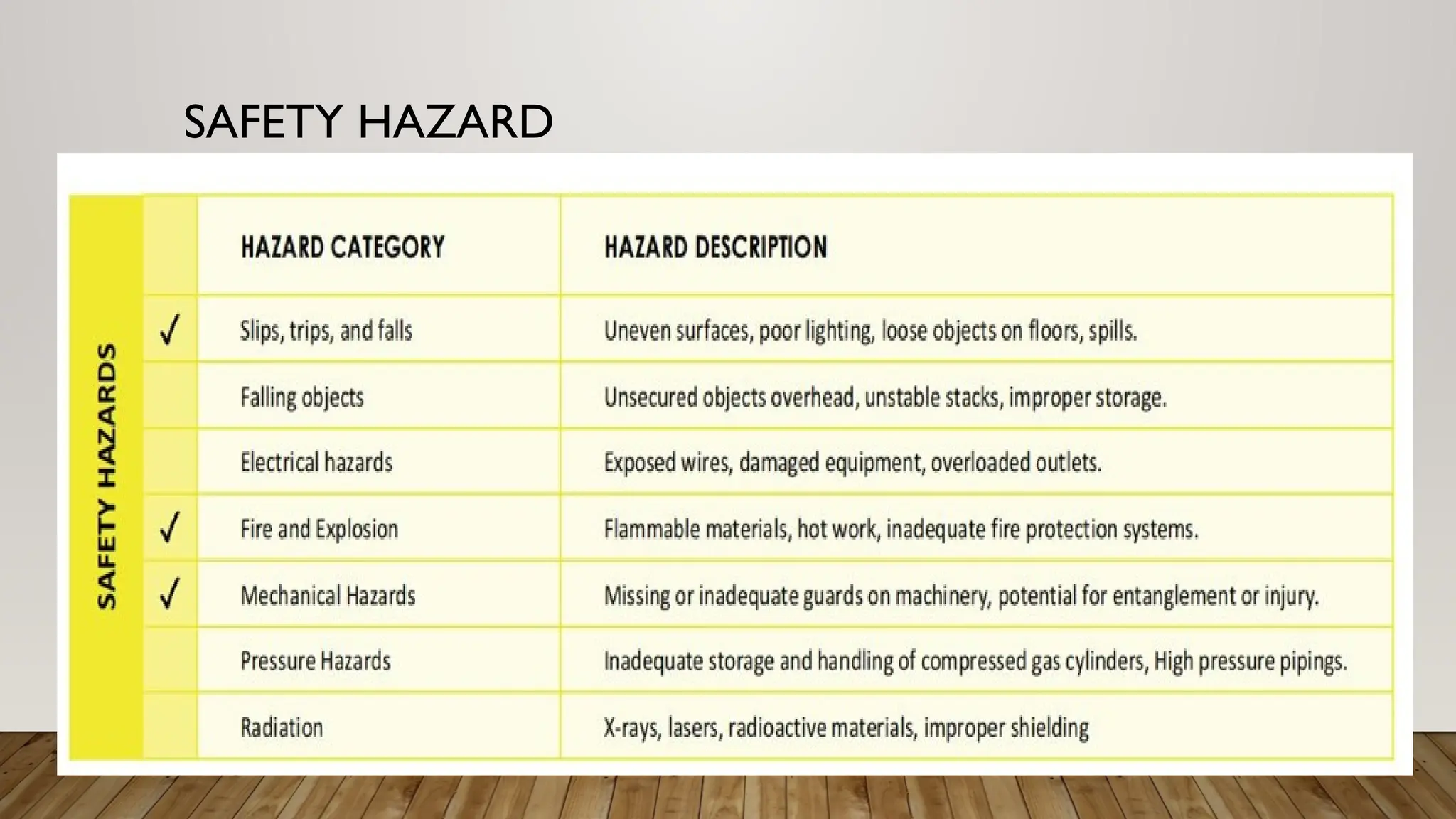
SAFETY HAZARD
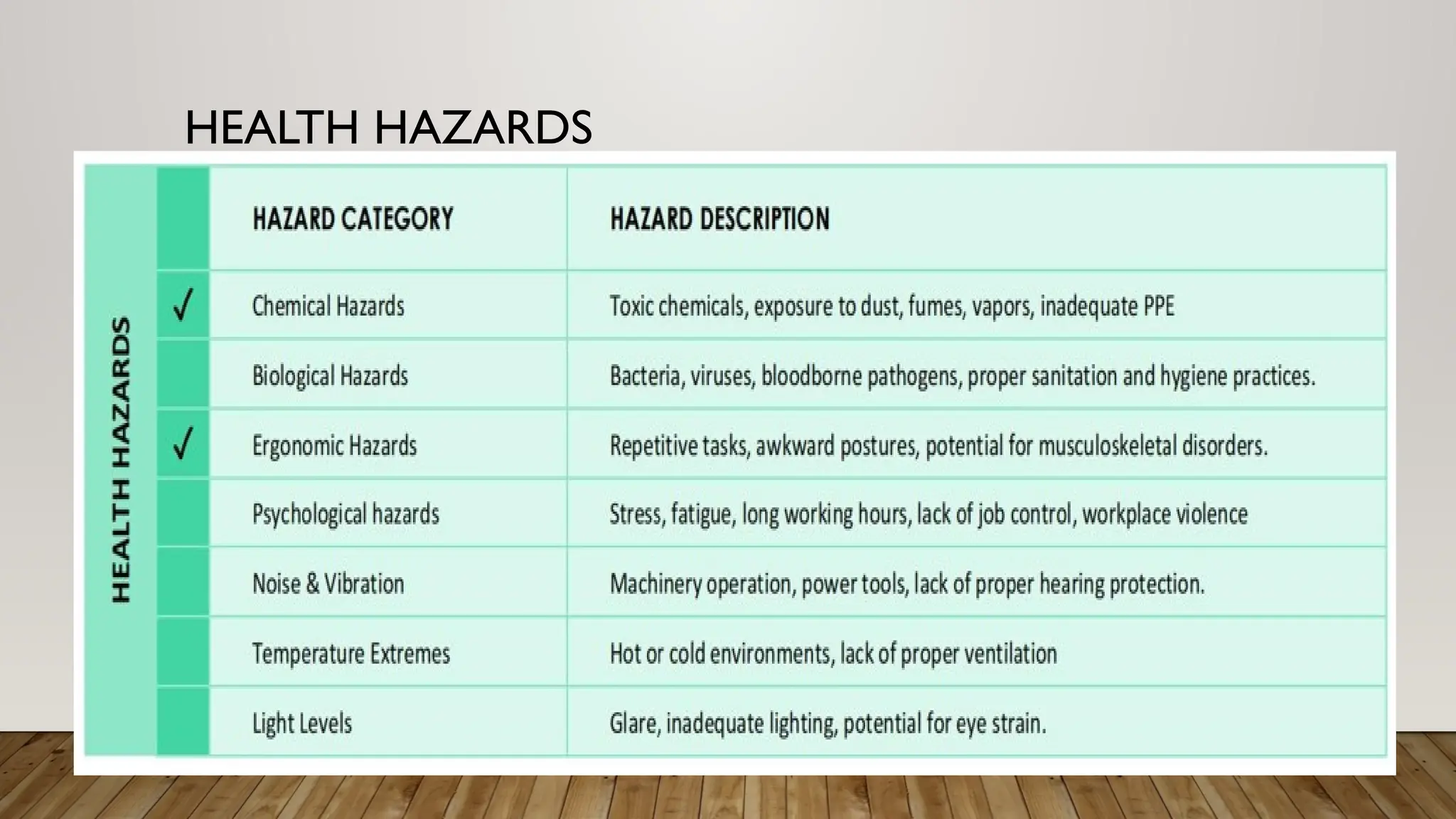
HEALTH HAZARDS
ENVIRONMENTAL HAZARDS
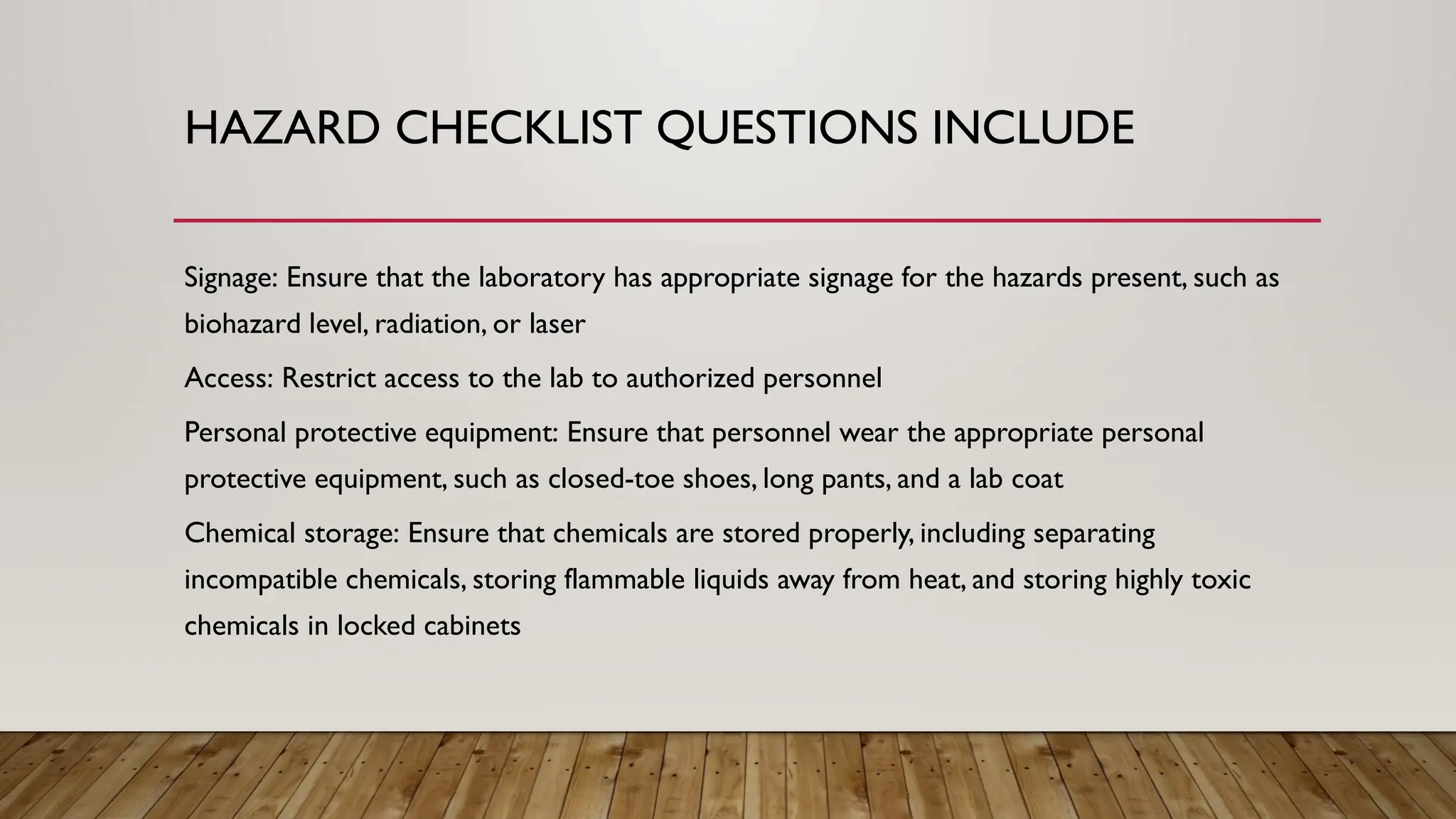
HAZARD CHECKLIST QUESTIONS INCLUDE
Signage: Ensure that the laboratory has appropriate signage for the hazards present, such as
biohazard level, radiation, or laser
Access: Restrict access to the lab to authorized personnel
Personal protective equipment: Ensure that personnel wear the appropriate personal
protective equipment, such as closed-toe shoes, long pants, and a lab coat
Chemical storage: Ensure that chemicals are stored properly, including separating
incompatible chemicals, storing flammable liquids away from heat, and storing highly toxic
chemicals in locked cabinets
HAZARD CHECKLIST QUESTIONS INCLUDE
Safety equipment: Ensure that safety equipment, such as safety showers and eye wash stations, are
available and in good working order
Electrical safety: Ensure that electrical cords are not a tripping hazard, and that damaged cords,
outlets, or plugs are repaired
Housekeeping: Ensure that the lab is clean, orderly, and uncluttered
Emergency procedures: Ensure that emergency notification procedures, contacts, and phone
numbers are posted
First aid: Ensure that a first aid kit is readily accessible and adequately stocked
METHODS OF INDENTIFYING AND ANALYING
HAZARD
HAZARD CHECKLIST
ACCIDENT AND HISTORY REVIEW
FUNCTIONAL FAILURE MODE AND EFFECTS ANALYSIS
(FMEA)
STRUCTUREDWHAT IFTECHNIQUE (SWIFT)
HAZARD AND OPERABILITY STUDY (HAZOP)
HAZARD CHECKLISTS CONSIDERATION
When setting up and using a Hazard Checklist, the following points should be considered:
A Hazard checklist is useful for most risk assessments, but should not be the only HAZID
method, except for standard installations whose hazards have been studied in more detail
elsewhere.
The topics presented in any Hazard Checklist should not be considered to be
comprehensive; they are for guidance, and are the minimum that should be considered.
For greatest benefit, Hazard checklists should be applied in an imaginative way by those with
a good understanding of the system design, operation, location, upkeep and interactions.
HAZID
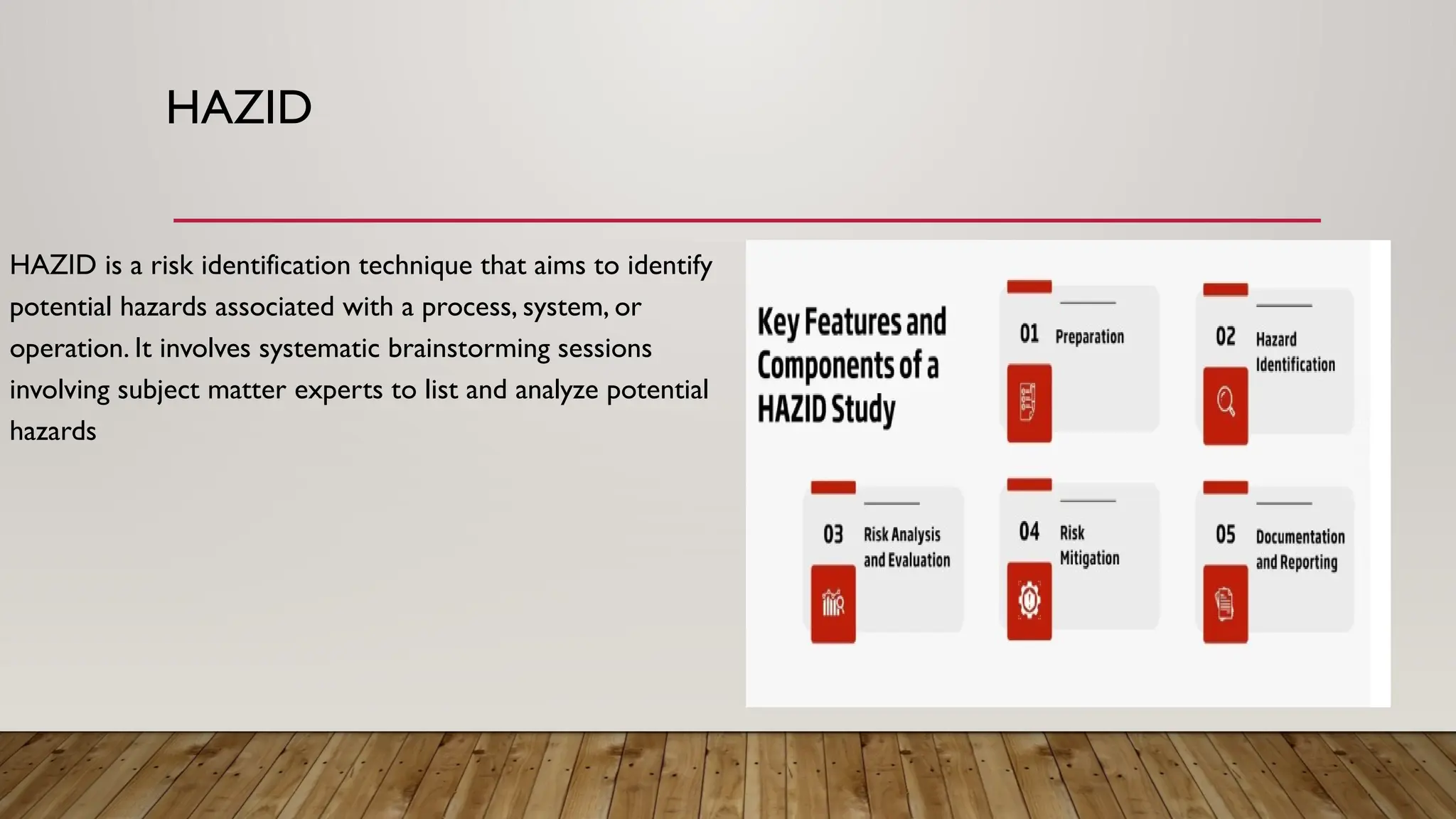
HAZID is a risk identification technique that aims to identify
potential hazards associated with a process, system, or
operation. It involves systematic brainstorming sessions
involving subject matter experts to list and analyze potential
hazards
HAZOP
Hazard and Operability (HAZOP)
study is a structured and systematic
examination of a planned or existing
process or operation in order to
identify and evaluate problems that
may represent risks to personnel or
equipment, or prevent efficient
operation
FAILURE MODES AND EFFECTS ANALYSIS (FMEA)
It was one of the first systematic techniques for failure analysis. It was developed in the United
States military (Military Procedure MIL-P-1629, titled ‘Procedures for Performing a Failure
Modes, Effects and Criticality Analysis’, November 9, 1949) as a reliability evaluation technique to
determine the effect of system and equipment failures.
Failures were classified according to their impact on mission success and personnel, equipment
and safety. In the 1960’s it was used by the aerospace industry and NASA during the Apollo
program. More and more industries - notably the automotive industry - have seen the benefits
to be gained by using FMEAs to complement their design processes.
FMEA
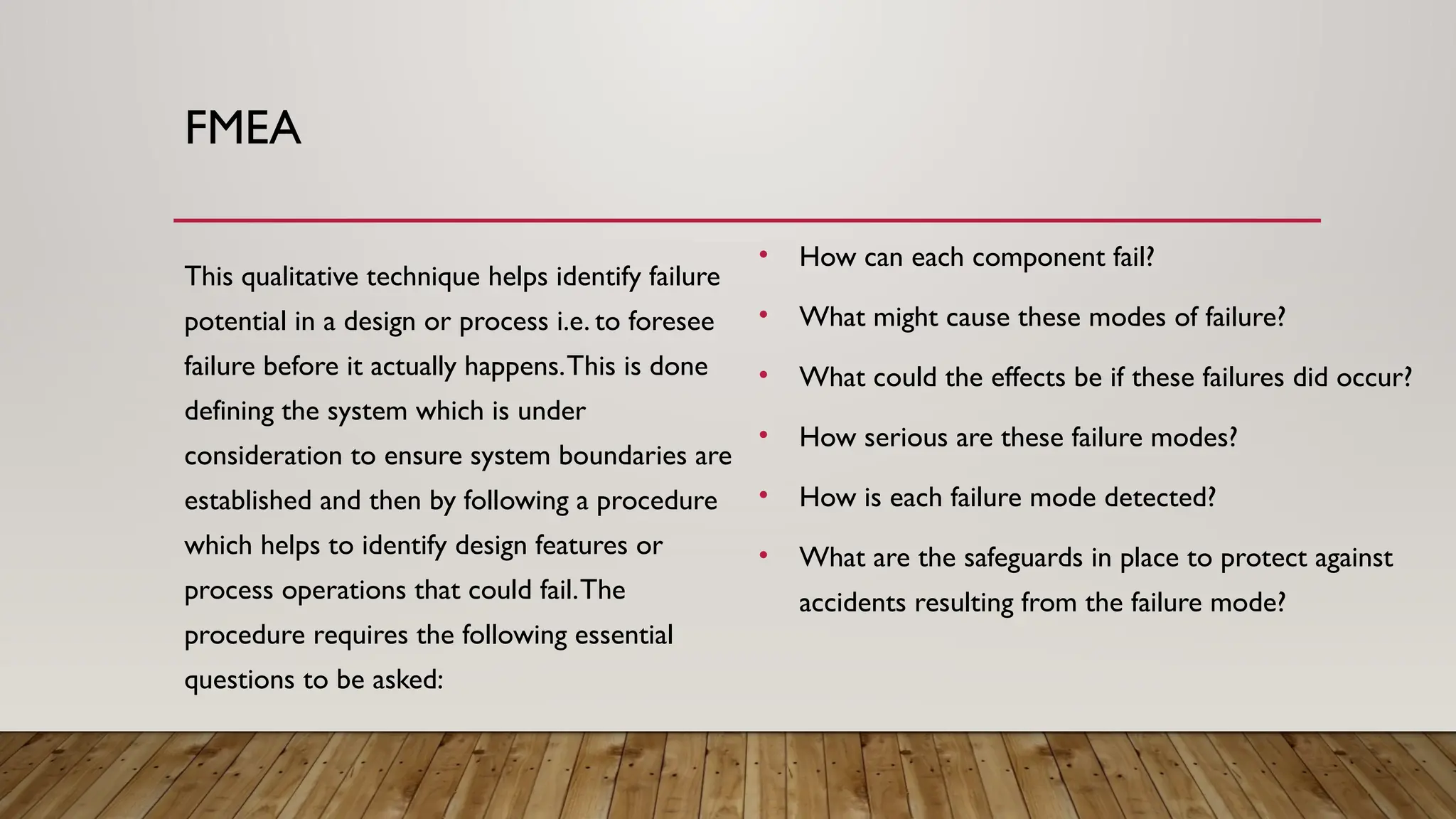
This qualitative technique helps identify failure
potential in a design or process i.e. to foresee
failure before it actually happens.This is done
defining the system which is under
consideration to ensure system boundaries are
established and then by following a procedure
which helps to identify design features or
process operations that could fail.The
procedure requires the following essential
questions to be asked:
• How can each component fail?
• What might cause these modes of failure?
• What could the effects be if these failures did occur?
• How serious are these failure modes?
• How is each failure mode detected?
• What are the safeguards in place to protect against
accidents resulting from the failure mode?
SWIFT
The Structured What-If Checklist Technique (SWIFT) combines the use of
checklists with a brainstorming ‘What if?’ approach. It was initially developed
for hazard identification in the chemical process industry.The technique was
developed as an efficient alternative to HAZOP for providing highly effective
hazard identification in situations and systems where HAZOP is not
appropriate. SWIFT can also be used in conjunction with or complementary
to a HAZOP.
SWIFT
Its effectiveness in identifying hazards comes from asking questions in
a variety of important areas, according to a structured plan.The aim is
to ensure complete coverage of all the various types of failures or
errors which are likely to result in a hazard within the system being
examined.
SWIFT
The “What-if?” questions, which can be posed by any team member (including
the SWIFT leader and Recorder) are structured according to various question
categories.The SWIFT analysis is further strengthened through the use of
category specific checklists at the conclusion of each question category
resulting in an additional level of thoroughness. Information resulting from the
SWIFT meeting is recorded on logsheets in columns as “What If”,
“Consequences”,“Existing Safeguards” and “Recommendations”.
ADVANTAGES OF HAZARD CHECKLIST
• Makes use of experience from previous risk assessments.
• Supports rapid and full Hazard Identification of common systems and technologies.
• Helps to prevent past accidents from recurring.
• Promotes standard hazard categories, and facilitates comparison between HAZIDs.
• Can be prepared and applied by a single analyst at low cost.
• Requires minimal information about the installation, and so is suitable for concept design
DISADVANTAGES OF HAZARD CHECKLIST
• Limited to previous experience, and thus may not anticipate hazards in
novel designs or novel accident scenarios from existing designs.
• Bounded in nature and thus does not encourage imaginative thinking.The
technique is therefore often used only as a prompt if ideas are dwindling
or as a final review/check at the end of the Hazard identification exercise.
Example Laboratory Safety Audit
Laboratory Safety Audit
Date:
Instructions:
1 . Follow these instructions on each page:
 Indicate Y (Yes), N (No), or N/A (not applicable) for each item.
 Answer all questions.
 List, explain, and/or clarify “N/A” responses on a separate sheet.
2 . If there is insufficient space on the form for all of the required information:
 Include the informatio n on a separate page.
 Add it to this document.
 Indicate on the form that there is additional information on the follo wing
page.
3 . Policies and procedures will need to be updated in the following situations:
 When adding new tasks and procedures that affect occupational exposure
 When changing or modifying tasks and procedures that affect occupational
exposure
Ensure compliance with every item checked or dated in this audit.
GENERAL Yes No N/A
Has a designated Safety Officer been appointed to oversee
laboratory safety issues?
Do employees receive safety training at the time of hire and
annually thereafter?
Do you have the required OSHA poster 3 1 6 5 1 displayed where
all employees are likely to see it?
Is there a current listing posted of emergency contacts with
phone numbers?
Are all ladders maintained in good condition?
Are nonslip safety rungs provided on each ladder?
Are portable metal ladders legibly marked with signs reading,
“Caution, do not use around electrical equipment” or
equivalent wording?
Are BSCs certified annually?
Are blood-borne pathogen and chemical spill kits maintained
in accessible locations?
Is there signage indicating the location of these spill kits?
Are noise levels below 7 5 dBA?
Do employees understand what to do if they sustain an
exposure to blood and body fluids?
KEY ELEMENTS FOR CHECKLIST CONSIDERATION:
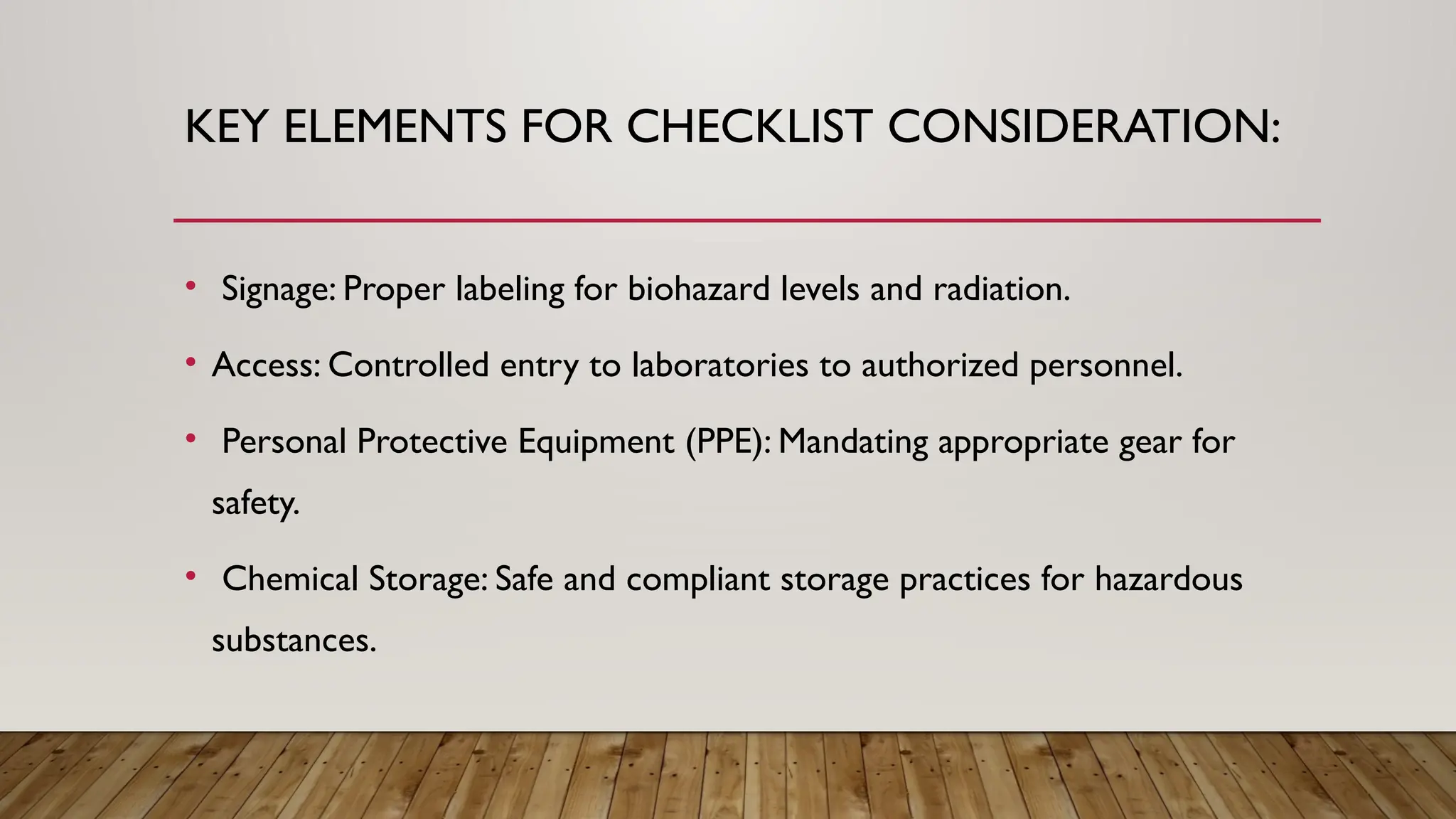
• Signage: Proper labeling for biohazard levels and radiation.
• Access: Controlled entry to laboratories to authorized personnel.
• Personal Protective Equipment (PPE): Mandating appropriate gear for
safety.
• Chemical Storage: Safe and compliant storage practices for hazardous
substances.
KEY ELEMENTS FOR CHECKLIST CONSIDERATION
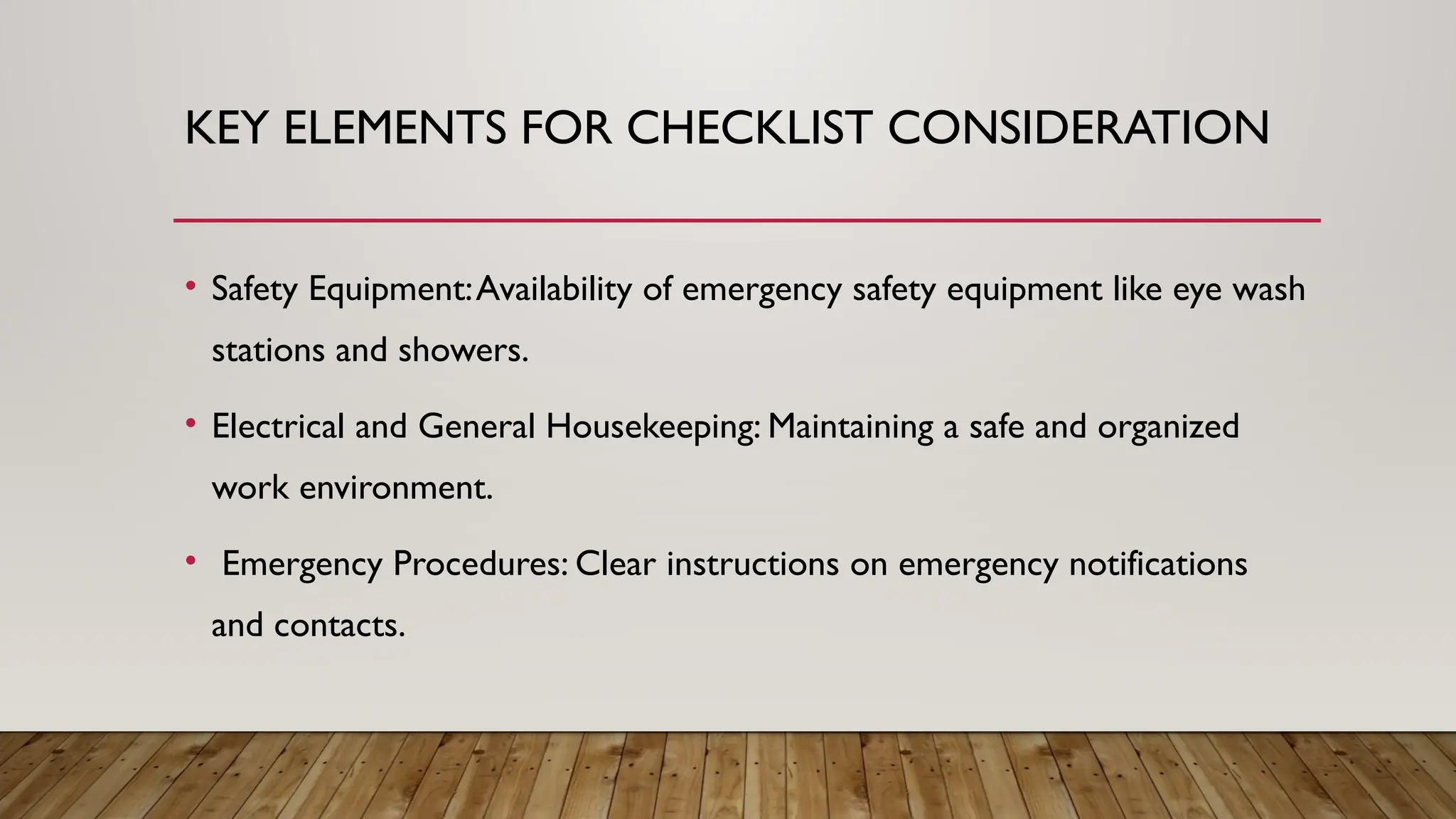
• Safety Equipment:Availability of emergency safety equipment like eye wash
stations and showers.
• Electrical and General Housekeeping: Maintaining a safe and organized
work environment.
• Emergency Procedures: Clear instructions on emergency notifications
and contacts.
REFERENCE
• Synergenog, HAZIDVs. HAZOP: UnderstandingTwo Major Hazard Identification Tools In
Detail Https://Synergenog.Com/Hazid-vs-hazop/
THANKYOU FOR LISTENING

HAZARD CHECKLIST IN THE MEDICAL LABORATORY

  • 1.
  • 2.
    OUTLINES • INTRODUTION • HAZARDDEFININATION • TYPES OF HAZARD • SAFETY HAZARD • HEALTH HAZARDS • ENVIRONMENTAL HAZARDS • HAZARD CHECKLIST QUESTIONS • METHODS OF INDENTIFYING AND ANALYING HAZARD • HAZARD CHECKLISTS CONSIDERATION • HAZID • HAZOP • FAILURE MODES AND EFFECTS ANALYSIS (FMEA)
  • 3.
    OUTLINES • SWIFT • ADVANTAGESOF HAZARD CHECKLIST • DISADVANTAGES OF HAZARD CHECKLIST • EXAMPLES OF LABORATORY SAFETY AUDIT • REFERENCE
  • 4.
    INTRODUTION A Hazard ChecklistContains Questions Or Topics Intended To Prompt Consideration Of A Range Of Safety Issues. It Can Also Be Used In Combination With Structured Hazard Identification (HAZID) Techniques Such As SWIFT And HAZOP Checklists Can Be Created From Previous Risk Assessments,And Provide An Efficient Means Of Generating A List Of Standard Hazards Suitable For HAZID Of Systems At All Phases Of Development.
  • 5.
    INTRODUTION CONT’D • TheChecklist Should Be Constructed To Address A Range Of Safety Issues Including Presence Of Hazardous Materials Or Functions, Functional Performance, InteractionWith Other Systems,And Personnel Safety. If Hazard Analysis Or Safety Assessment Has Already Been Carried Out On A Similar System,Any Available And Relevant Information Should Be Incorporated Into The Checklist.
  • 6.
  • 7.
    TYPES OF HAZARD •SAFETY HAZARD • HEALTH HAZARD • ENVIRONMENTAL HAZARD
  • 8.
  • 9.
  • 10.
  • 11.
    HAZARD CHECKLIST QUESTIONSINCLUDE Signage: Ensure that the laboratory has appropriate signage for the hazards present, such as biohazard level, radiation, or laser Access: Restrict access to the lab to authorized personnel Personal protective equipment: Ensure that personnel wear the appropriate personal protective equipment, such as closed-toe shoes, long pants, and a lab coat Chemical storage: Ensure that chemicals are stored properly, including separating incompatible chemicals, storing flammable liquids away from heat, and storing highly toxic chemicals in locked cabinets
  • 12.
    HAZARD CHECKLIST QUESTIONSINCLUDE Safety equipment: Ensure that safety equipment, such as safety showers and eye wash stations, are available and in good working order Electrical safety: Ensure that electrical cords are not a tripping hazard, and that damaged cords, outlets, or plugs are repaired Housekeeping: Ensure that the lab is clean, orderly, and uncluttered Emergency procedures: Ensure that emergency notification procedures, contacts, and phone numbers are posted First aid: Ensure that a first aid kit is readily accessible and adequately stocked
  • 13.
    METHODS OF INDENTIFYINGAND ANALYING HAZARD HAZARD CHECKLIST ACCIDENT AND HISTORY REVIEW FUNCTIONAL FAILURE MODE AND EFFECTS ANALYSIS (FMEA) STRUCTUREDWHAT IFTECHNIQUE (SWIFT) HAZARD AND OPERABILITY STUDY (HAZOP)
  • 14.
    HAZARD CHECKLISTS CONSIDERATION Whensetting up and using a Hazard Checklist, the following points should be considered: A Hazard checklist is useful for most risk assessments, but should not be the only HAZID method, except for standard installations whose hazards have been studied in more detail elsewhere. The topics presented in any Hazard Checklist should not be considered to be comprehensive; they are for guidance, and are the minimum that should be considered. For greatest benefit, Hazard checklists should be applied in an imaginative way by those with a good understanding of the system design, operation, location, upkeep and interactions.
  • 15.
    HAZID HAZID is arisk identification technique that aims to identify potential hazards associated with a process, system, or operation. It involves systematic brainstorming sessions involving subject matter experts to list and analyze potential hazards
  • 16.
    HAZOP Hazard and Operability(HAZOP) study is a structured and systematic examination of a planned or existing process or operation in order to identify and evaluate problems that may represent risks to personnel or equipment, or prevent efficient operation
  • 17.
    FAILURE MODES ANDEFFECTS ANALYSIS (FMEA) It was one of the first systematic techniques for failure analysis. It was developed in the United States military (Military Procedure MIL-P-1629, titled ‘Procedures for Performing a Failure Modes, Effects and Criticality Analysis’, November 9, 1949) as a reliability evaluation technique to determine the effect of system and equipment failures. Failures were classified according to their impact on mission success and personnel, equipment and safety. In the 1960’s it was used by the aerospace industry and NASA during the Apollo program. More and more industries - notably the automotive industry - have seen the benefits to be gained by using FMEAs to complement their design processes.
  • 18.
    FMEA This qualitative techniquehelps identify failure potential in a design or process i.e. to foresee failure before it actually happens.This is done defining the system which is under consideration to ensure system boundaries are established and then by following a procedure which helps to identify design features or process operations that could fail.The procedure requires the following essential questions to be asked: • How can each component fail? • What might cause these modes of failure? • What could the effects be if these failures did occur? • How serious are these failure modes? • How is each failure mode detected? • What are the safeguards in place to protect against accidents resulting from the failure mode?
  • 19.
    SWIFT The Structured What-IfChecklist Technique (SWIFT) combines the use of checklists with a brainstorming ‘What if?’ approach. It was initially developed for hazard identification in the chemical process industry.The technique was developed as an efficient alternative to HAZOP for providing highly effective hazard identification in situations and systems where HAZOP is not appropriate. SWIFT can also be used in conjunction with or complementary to a HAZOP.
  • 20.
    SWIFT Its effectiveness inidentifying hazards comes from asking questions in a variety of important areas, according to a structured plan.The aim is to ensure complete coverage of all the various types of failures or errors which are likely to result in a hazard within the system being examined.
  • 21.
    SWIFT The “What-if?” questions,which can be posed by any team member (including the SWIFT leader and Recorder) are structured according to various question categories.The SWIFT analysis is further strengthened through the use of category specific checklists at the conclusion of each question category resulting in an additional level of thoroughness. Information resulting from the SWIFT meeting is recorded on logsheets in columns as “What If”, “Consequences”,“Existing Safeguards” and “Recommendations”.
  • 22.
    ADVANTAGES OF HAZARDCHECKLIST • Makes use of experience from previous risk assessments. • Supports rapid and full Hazard Identification of common systems and technologies. • Helps to prevent past accidents from recurring. • Promotes standard hazard categories, and facilitates comparison between HAZIDs. • Can be prepared and applied by a single analyst at low cost. • Requires minimal information about the installation, and so is suitable for concept design
  • 23.
    DISADVANTAGES OF HAZARDCHECKLIST • Limited to previous experience, and thus may not anticipate hazards in novel designs or novel accident scenarios from existing designs. • Bounded in nature and thus does not encourage imaginative thinking.The technique is therefore often used only as a prompt if ideas are dwindling or as a final review/check at the end of the Hazard identification exercise.
  • 24.
    Example Laboratory SafetyAudit Laboratory Safety Audit Date: Instructions: 1 . Follow these instructions on each page:  Indicate Y (Yes), N (No), or N/A (not applicable) for each item.  Answer all questions.  List, explain, and/or clarify “N/A” responses on a separate sheet. 2 . If there is insufficient space on the form for all of the required information:  Include the informatio n on a separate page.  Add it to this document.  Indicate on the form that there is additional information on the follo wing page. 3 . Policies and procedures will need to be updated in the following situations:  When adding new tasks and procedures that affect occupational exposure  When changing or modifying tasks and procedures that affect occupational exposure Ensure compliance with every item checked or dated in this audit. GENERAL Yes No N/A Has a designated Safety Officer been appointed to oversee laboratory safety issues? Do employees receive safety training at the time of hire and annually thereafter? Do you have the required OSHA poster 3 1 6 5 1 displayed where all employees are likely to see it? Is there a current listing posted of emergency contacts with phone numbers? Are all ladders maintained in good condition? Are nonslip safety rungs provided on each ladder? Are portable metal ladders legibly marked with signs reading, “Caution, do not use around electrical equipment” or equivalent wording? Are BSCs certified annually? Are blood-borne pathogen and chemical spill kits maintained in accessible locations? Is there signage indicating the location of these spill kits? Are noise levels below 7 5 dBA? Do employees understand what to do if they sustain an exposure to blood and body fluids?
  • 25.
    KEY ELEMENTS FORCHECKLIST CONSIDERATION: • Signage: Proper labeling for biohazard levels and radiation. • Access: Controlled entry to laboratories to authorized personnel. • Personal Protective Equipment (PPE): Mandating appropriate gear for safety. • Chemical Storage: Safe and compliant storage practices for hazardous substances.
  • 26.
    KEY ELEMENTS FORCHECKLIST CONSIDERATION • Safety Equipment:Availability of emergency safety equipment like eye wash stations and showers. • Electrical and General Housekeeping: Maintaining a safe and organized work environment. • Emergency Procedures: Clear instructions on emergency notifications and contacts.
  • 27.
    REFERENCE • Synergenog, HAZIDVs.HAZOP: UnderstandingTwo Major Hazard Identification Tools In Detail Https://Synergenog.Com/Hazid-vs-hazop/
  • 28.