Hawthorne Experiments

Prepared by:
Arushi bhatnagar
INTRODUCTION
Classical approach led to the more efficient forms of the
organization and management but it failed to recognize the
overwhelming role of people in management.
Jobs became narrow &workers began to resist the formal
& impersonal treatment over looking their social and
psychological needs.
This resistance and need to secure willing cooperation of
workers led to the development of neo classical
approach.
INTRODUCTION
The Hawthorne studies were conducted in
order to find out the role of human resource in
increasing the production of an organization.
The Hawthorne studies included the following
experiments..
Experiments Conducted
Illumination Experiment
Relay Assembly Test room studies
Mass interview programme
Bank Wiring Observation Group
HAWTHORNE EXPERIMENT
Conducted between 1924-1932
Conducted at WESTERN ELECTRIC
COMPANY, Chicago, USA
Conducted by,
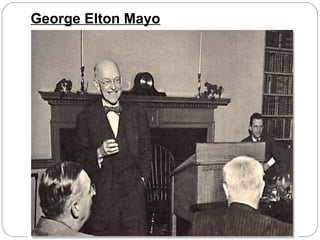
George Elton Mayo(father of neo classical
approach)
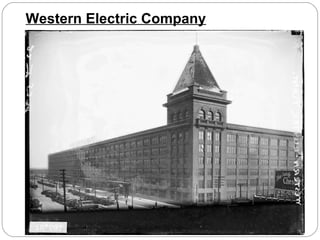
Western Electric Company
George Elton Mayo
He was an Australian Psychologist, Sociologist
and Organization Theorist.
Spent most of his career at Harvard Business
School and was the Professor of Industrial
Research
Known as the founder of Human Relations
Movement
Also known for his research including
Hawthorne Studies
George Elton Mayo
Illumination Experiment
• 1924-1927
• Funded by General Electric
• Conducted by The National Research Council (NRC) of the National

Academy of Sciences with engineers from MIT

• Measured Light Intensity vs. Worker Output
•

Two groups were selected from among employees. One group was placed in the
room where lighting remained constant . Other group was placed in another
room where lighting varies periodically.

• Result :
– Output of both the groups increased steadily.
• Conclusions:
– Lighting was a minor factor influencing on output
Relay Assembly Test Room Studies
 1927-1929
 Experiments were conducted by Elton Mayo
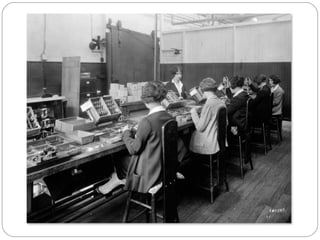
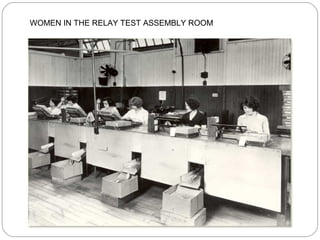
 It was conducted in 3 diff groups .the test group consist of six females

workers.
 Frequent changes were made to measure effect on output:

 Pay Incentives (Each Girls pay was based on the other 5 in the group)
 Length of Work Day & Work Week (5pm, 4:30 pm, 4pm)
 Use of Rest Periods (Two 5 minutes break)
 Company Sponsored Meals (Morning Coffee & soup along with sandwich)

 Results:

 Productivity of the group increased even when the improvements in working

conditions were withdrawn.

 Conclusions:
 Socio-psychological factors such as special attention , sense of group pride and

belonging exercise a greater influence on productivity than working hours.
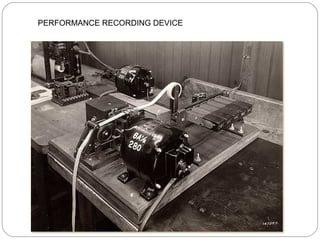
PERFORMANCE RECORDING DEVICE
WOMEN IN THE RELAY TEST ASSEMBLY ROOM
Mass Interview Program
•

Conducted 20,000 interviews.

•

Objective was to explore information, to judge their attitudes and opinions on the factors
influencing productivity.

• Results
- it was found that the opportunity to talk freely about things that are more important to
workers has a positive effect on their moral & productivity
- Complaints were symptoms of deep-rooted disturbances.
-Workers are governed by experience obtained from both inside and outside the
company.
Bank Wiring Observation room
study
 1931-1932
 A group of 14 workers were put under close observation.
 A pay of every member was made dependent on the

performance of the group as a whole .

 Result:
 No appreciable changes in output.
 It was found that the group had its own norms of performance &
various forms of social pressure were exercised to enforce these norms.
CONCLUSION
•A workgroup is not merely a techno-economic unit . it is also a socio
system with a culture of its own.
• workers were not merely rational economic beings motivated
simply by money .they are also socio-psychological beings and
respond to the total work situation
• workers act or react not as individual but as a member of group
.the informal groups have their own norms &beliefs .
•Complaints and criticism of employees were symptoms of

deep-

rooted disturbances.
•Workers respond to the total work situation .Their behavior and
performance are conditioned by factors inside and outside the work
place.
EVALUATION
•Unscientific –there was no systematic basis in the choice of work, worker
and the environment .The investigation were not carried out in scientific
manner.
•Doubtful validity- the reactions of small groups of American women can
hardly taken as sufficiently representative to provide a valid solution in
different countries.
•Too obvious- social psychologists argue that the finding of Hawthorne
studies are not new but were all known long ago.
•True but irrelevant- the conclusions of Hawthorne experiments are true bt
irrelevant. some industrialists argue that the main object of a business is tp
make profits rather than to keep workers happy.
•No mention of trade unions-in more than twenty thousand interviewers
upon which so much of the findings were based there was an articulation on
unions among the workers. Mayo is also criticised for ignoring other relevant
factors such as changes in the class and occupational structure of America.
Thank You.

Hawthorne experiment

  • 1.
  • 2.
    INTRODUCTION Classical approach ledto the more efficient forms of the organization and management but it failed to recognize the overwhelming role of people in management. Jobs became narrow &workers began to resist the formal & impersonal treatment over looking their social and psychological needs. This resistance and need to secure willing cooperation of workers led to the development of neo classical approach.
  • 3.
    INTRODUCTION The Hawthorne studieswere conducted in order to find out the role of human resource in increasing the production of an organization. The Hawthorne studies included the following experiments..
  • 4.
    Experiments Conducted Illumination Experiment RelayAssembly Test room studies Mass interview programme Bank Wiring Observation Group
  • 5.
    HAWTHORNE EXPERIMENT Conducted between1924-1932 Conducted at WESTERN ELECTRIC COMPANY, Chicago, USA Conducted by, George Elton Mayo(father of neo classical approach)
  • 6.
  • 7.
    George Elton Mayo Hewas an Australian Psychologist, Sociologist and Organization Theorist. Spent most of his career at Harvard Business School and was the Professor of Industrial Research Known as the founder of Human Relations Movement Also known for his research including Hawthorne Studies
  • 8.
  • 9.
    Illumination Experiment • 1924-1927 •Funded by General Electric • Conducted by The National Research Council (NRC) of the National Academy of Sciences with engineers from MIT • Measured Light Intensity vs. Worker Output • Two groups were selected from among employees. One group was placed in the room where lighting remained constant . Other group was placed in another room where lighting varies periodically. • Result : – Output of both the groups increased steadily. • Conclusions: – Lighting was a minor factor influencing on output
  • 10.
    Relay Assembly TestRoom Studies  1927-1929  Experiments were conducted by Elton Mayo  It was conducted in 3 diff groups .the test group consist of six females workers.  Frequent changes were made to measure effect on output:  Pay Incentives (Each Girls pay was based on the other 5 in the group)  Length of Work Day & Work Week (5pm, 4:30 pm, 4pm)  Use of Rest Periods (Two 5 minutes break)  Company Sponsored Meals (Morning Coffee & soup along with sandwich)  Results:  Productivity of the group increased even when the improvements in working conditions were withdrawn.  Conclusions:  Socio-psychological factors such as special attention , sense of group pride and belonging exercise a greater influence on productivity than working hours.
  • 11.
  • 13.
    WOMEN IN THERELAY TEST ASSEMBLY ROOM
  • 14.
    Mass Interview Program • Conducted20,000 interviews. • Objective was to explore information, to judge their attitudes and opinions on the factors influencing productivity. • Results - it was found that the opportunity to talk freely about things that are more important to workers has a positive effect on their moral & productivity - Complaints were symptoms of deep-rooted disturbances. -Workers are governed by experience obtained from both inside and outside the company.
  • 16.
    Bank Wiring Observationroom study  1931-1932  A group of 14 workers were put under close observation.  A pay of every member was made dependent on the performance of the group as a whole .  Result:  No appreciable changes in output.  It was found that the group had its own norms of performance & various forms of social pressure were exercised to enforce these norms.
  • 17.
    CONCLUSION •A workgroup isnot merely a techno-economic unit . it is also a socio system with a culture of its own. • workers were not merely rational economic beings motivated simply by money .they are also socio-psychological beings and respond to the total work situation • workers act or react not as individual but as a member of group .the informal groups have their own norms &beliefs . •Complaints and criticism of employees were symptoms of deep- rooted disturbances. •Workers respond to the total work situation .Their behavior and performance are conditioned by factors inside and outside the work place.
  • 18.
    EVALUATION •Unscientific –there wasno systematic basis in the choice of work, worker and the environment .The investigation were not carried out in scientific manner. •Doubtful validity- the reactions of small groups of American women can hardly taken as sufficiently representative to provide a valid solution in different countries. •Too obvious- social psychologists argue that the finding of Hawthorne studies are not new but were all known long ago. •True but irrelevant- the conclusions of Hawthorne experiments are true bt irrelevant. some industrialists argue that the main object of a business is tp make profits rather than to keep workers happy. •No mention of trade unions-in more than twenty thousand interviewers upon which so much of the findings were based there was an articulation on unions among the workers. Mayo is also criticised for ignoring other relevant factors such as changes in the class and occupational structure of America.
  • 19.