AUTHOR: FRITZ J. ROETHLISBERGER (1941)
YUANZE UNIVERSITY- DOCTOR OF PHILOSOPHY PROGRAM
COURSE OF ORGANIZATIONTHEORY
INSTRUCTOR: PROFESSOR SHIH-CHUN HSU
PRESENTED BY: JESSIE PHAM, ID: s1019424
 Introduction
 Research Background
 The Hawthorne Experiments
 Illuminated intensity variation
 RelayAssemblyTest Room
 Mass Interviewing Program
 BankWiring Observation Room
 Results of Class Survey
 Conclusions
HAVE YOU EVER HEARD
THETERM OF
“THE HAWTHORNE EFFECTS”?
WHATARETHE HAWTHORNE
EXPERIMENTS ABOUT ?
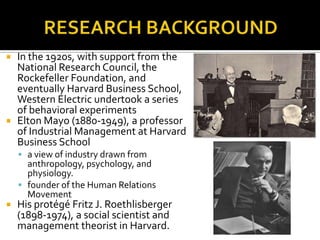
 In the 1920s, with support from the
National Research Council, the
Rockefeller Foundation, and
eventually Harvard Business School,
Western Electric undertook a series
of behavioral experiments
 Elton Mayo (1880-1949), a professor
of Industrial Management at Harvard
Business School
 a view of industry drawn from
anthropology, psychology, and
physiology.
 founder of the Human Relations
Movement
 His protégé Fritz J. Roethlisberger
(1898-1974), a social scientist and
management theorist in Harvard.
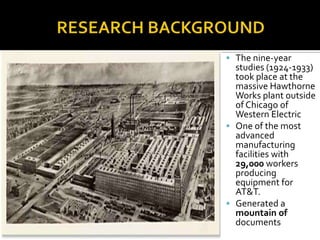
 The nine-year
studies (1924-1933)
took place at the
massive Hawthorne
Works plant outside
of Chicago of
Western Electric
 One of the most
advanced
manufacturing
facilities with
29,000 workers
producing
equipment for
AT&T.
 Generated a
mountain of
documents
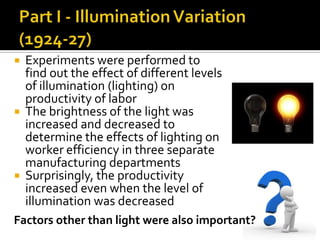
 Experiments were performed to
find out the effect of different levels
of illumination (lighting) on
productivity of labor
 The brightness of the light was
increased and decreased to
determine the effects of lighting on
worker efficiency in three separate
manufacturing departments
 Surprisingly, the productivity
increased even when the level of
illumination was decreased
Factors other than light were also important?
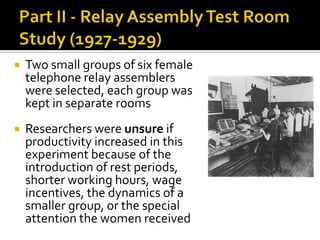
 Two small groups of six female
telephone relay assemblers
were selected, each group was
kept in separate rooms
 Researchers were unsure if
productivity increased in this
experiment because of the
introduction of rest periods,
shorter working hours, wage
incentives, the dynamics of a
smaller group, or the special
attention the women received
 From time to time, changes were made in
working hours, rest periods, lunch breaks, etc
 They were allowed to choose their own rest
periods and to give suggestions
 Output increased in both the control rooms
 “The intimate atmosphere of the test room gave them
a sense of freedom not experienced on the factory
floor”
 “They felt more at ease to talk and over time
developed strong friendships”
 “The six individuals became a team!”
Mental attitudes, proper
supervision, and informal social
relationships experienced in a
group were key to productivity
and job satisfaction.
 21,000 employees were interviewed over a
period of three years to find out reasons for
increased their productivity
 The interview is now defined as a
conversation in which the employee is
encouraged to express himself freely upon
any topic of his own choosing.
 Interviews, which averaged around 30
minutes, grew to 90 minutes or even two
hours in length
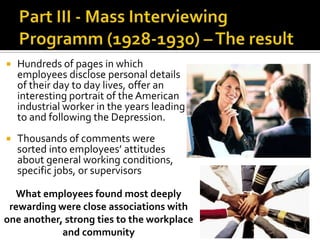
 Hundreds of pages in which
employees disclose personal details
of their day to day lives, offer an
interesting portrait of the American
industrial worker in the years leading
to and following the Depression.
 Thousands of comments were
sorted into employees’ attitudes
about general working conditions,
specific jobs, or supervisors
What employees found most deeply
rewarding were close associations with
one another, strong ties to the workplace
and community
 A group of 14 male workers in the bank wiring
room were placed under observation for six
months
 A worker's pay depended on the performance of
the group as a whole
 It’s thought that the efficient workers would put
pressure on the less efficient workers to complete
the work
 The group established its own standards of
output, and social pressure was used to achieve
the standards of output.
 The questions and theories generated about the
relationship of productivity to the needs and
motivations of the industrial workers.
 “Instead of treating the workers as an appendage
to ‘the machine’,” the Hawthorne experiments
brought to light ideas concerning motivational
influences, job satisfaction, resistance to change,
group norms, worker participation, and effective
leadership.
 These were groundbreaking concepts in the
1930s.
PLEASE
HELPTO
FILL IN
THIS!
 ONLY 18 students went class last week, (where
were the other 8?) 
 14/18 participated in the survey, very high
respondent rate (~78%) 
 Q1- 6/14: professional jobs (managers,
instructor, teacher, visiting doctor, vice president
and CEO vs. the rest (students, sales& marketing
employee, retired)
 Q2-9/14 said they enjoy going to work everyday
(~64%) vs. “Too much work” (Dissatisfied
group)
 Q3-The top 6 reasons to stay in job?
 Interesting work
 Challenging job assignments
 Nice co-workers/followers
 Good boss
 Safe, healthy and comfortable environment
 Salary/benefits stability
 Q4-What employer could do to improve
employee productivity? (open question)
 Training and promotion opportunity
 Trusty, caring and safe working place (vacation)
 Cross-departmental/ highly flexible work designs
 Shared leadership, decentralized structure
 Motivate, praise them
 4 responses of salary (money, payment, bonus)
 Q5- Have you ever heard about “Hawthorne
Effect”? If yes, pls specify?
 100% NEVER HEARD BEFORE 
 The Hawthorne effect is a form of reactivity
whereby subjects improve or modify an aspect of
their behavior being experimentally measured
simply in response to the fact that they know
they are being studied, not in response to any
particular experimental manipulation
 Mayo's findings was the effect that working in
groups had on the individuals
 Hawthorne set the individual in a social context,
establishing that the performance of employees is
influenced by their surroundings and by the people
that they are working with as much as by their own
innate abilities.
“workers were motivated by more than self-
interest” and instead the following applied:
 Psychological Contract
There is an unwritten understanding between
the worker and employer regarding what is
expected from them
 Interest in Workers
A worker’s motivation can be increased by
showing an interest in them.
 Work is a Group Activity
 Social Aspect ofWork
Workers are motivated by the social aspect of
work, as demonstrated by the female workers
socializing during and outside work and the
subsequent increase in motivation.
 RecognizeWorkers
Workers are motivated by recognition,
security and a sense of belonging.
 Communication
Workers are motivated through a good
working relationship with management.
 “A human problem to be brought to a human
solution requires human data and human
tools”
 “The road back to sanity in Management-
employee relations” that “worker is a social
animal and should be treated as such“ and “a
man whose job is without social function is
like a man without a country”
 THANK YOU VERY MUCH FOR
YOUR PARTICIPATIONAND
ATTENTION!
 ANY COMMENTS &
QUESTIONS?
 Under normal conditions with a forty eight hour week, including Saturdays, and no rest pauses.
The girls produced 2,400 relays a week each.
 They were then put on piece-work for eight weeks.
 Output went up
 Two five minute rest pauses, morning and afternoon, were introduced for a period of five
weeks.
 Output went up once more
 The rest pauses were lengthened to ten minutes each.
 Output went up sharply.
 Six five minute pauses were introduced, and the girls complained that their work rhythm
was broken by the frequent pauses.
 Output fell slightly
 Return to the two rest pauses, the first with a hot meal supplied by the Company free of
charge.
 Output went up
 The girls were dismissed at 4.30 p.m. instead of 5.00 p.m.
 Output went up
 They were dismissed at 4.00 p.m.
 Output remained the same
 Finally, all the improvements were taken away, and the girls went back to the physical
conditions of the beginning of the experiment: work on Saturday, 48 hour week, no rest
pauses, no piece work and no free meal.This state of affairs lasted for a period of 12 weeks.
 Output was the highest ever recorded averaging 3000 relays a week

The hawthorne experiments-roethlisberger1941

  • 1.
    AUTHOR: FRITZ J.ROETHLISBERGER (1941) YUANZE UNIVERSITY- DOCTOR OF PHILOSOPHY PROGRAM COURSE OF ORGANIZATIONTHEORY INSTRUCTOR: PROFESSOR SHIH-CHUN HSU PRESENTED BY: JESSIE PHAM, ID: s1019424
  • 2.
     Introduction  ResearchBackground  The Hawthorne Experiments  Illuminated intensity variation  RelayAssemblyTest Room  Mass Interviewing Program  BankWiring Observation Room  Results of Class Survey  Conclusions
  • 3.
    HAVE YOU EVERHEARD THETERM OF “THE HAWTHORNE EFFECTS”? WHATARETHE HAWTHORNE EXPERIMENTS ABOUT ?
  • 4.
     In the1920s, with support from the National Research Council, the Rockefeller Foundation, and eventually Harvard Business School, Western Electric undertook a series of behavioral experiments  Elton Mayo (1880-1949), a professor of Industrial Management at Harvard Business School  a view of industry drawn from anthropology, psychology, and physiology.  founder of the Human Relations Movement  His protégé Fritz J. Roethlisberger (1898-1974), a social scientist and management theorist in Harvard.
  • 5.
     The nine-year studies(1924-1933) took place at the massive Hawthorne Works plant outside of Chicago of Western Electric  One of the most advanced manufacturing facilities with 29,000 workers producing equipment for AT&T.  Generated a mountain of documents
  • 6.
     Experiments wereperformed to find out the effect of different levels of illumination (lighting) on productivity of labor  The brightness of the light was increased and decreased to determine the effects of lighting on worker efficiency in three separate manufacturing departments  Surprisingly, the productivity increased even when the level of illumination was decreased Factors other than light were also important?
  • 7.
     Two smallgroups of six female telephone relay assemblers were selected, each group was kept in separate rooms  Researchers were unsure if productivity increased in this experiment because of the introduction of rest periods, shorter working hours, wage incentives, the dynamics of a smaller group, or the special attention the women received
  • 8.
     From timeto time, changes were made in working hours, rest periods, lunch breaks, etc  They were allowed to choose their own rest periods and to give suggestions  Output increased in both the control rooms  “The intimate atmosphere of the test room gave them a sense of freedom not experienced on the factory floor”  “They felt more at ease to talk and over time developed strong friendships”  “The six individuals became a team!”
  • 9.
    Mental attitudes, proper supervision,and informal social relationships experienced in a group were key to productivity and job satisfaction.
  • 10.
     21,000 employeeswere interviewed over a period of three years to find out reasons for increased their productivity  The interview is now defined as a conversation in which the employee is encouraged to express himself freely upon any topic of his own choosing.  Interviews, which averaged around 30 minutes, grew to 90 minutes or even two hours in length
  • 11.
     Hundreds ofpages in which employees disclose personal details of their day to day lives, offer an interesting portrait of the American industrial worker in the years leading to and following the Depression.  Thousands of comments were sorted into employees’ attitudes about general working conditions, specific jobs, or supervisors What employees found most deeply rewarding were close associations with one another, strong ties to the workplace and community
  • 12.
     A groupof 14 male workers in the bank wiring room were placed under observation for six months  A worker's pay depended on the performance of the group as a whole  It’s thought that the efficient workers would put pressure on the less efficient workers to complete the work  The group established its own standards of output, and social pressure was used to achieve the standards of output.
  • 13.
     The questionsand theories generated about the relationship of productivity to the needs and motivations of the industrial workers.  “Instead of treating the workers as an appendage to ‘the machine’,” the Hawthorne experiments brought to light ideas concerning motivational influences, job satisfaction, resistance to change, group norms, worker participation, and effective leadership.  These were groundbreaking concepts in the 1930s.
  • 14.
  • 15.
     ONLY 18students went class last week, (where were the other 8?)   14/18 participated in the survey, very high respondent rate (~78%)   Q1- 6/14: professional jobs (managers, instructor, teacher, visiting doctor, vice president and CEO vs. the rest (students, sales& marketing employee, retired)  Q2-9/14 said they enjoy going to work everyday (~64%) vs. “Too much work” (Dissatisfied group)
  • 16.
     Q3-The top6 reasons to stay in job?  Interesting work  Challenging job assignments  Nice co-workers/followers  Good boss  Safe, healthy and comfortable environment  Salary/benefits stability
  • 17.
     Q4-What employercould do to improve employee productivity? (open question)  Training and promotion opportunity  Trusty, caring and safe working place (vacation)  Cross-departmental/ highly flexible work designs  Shared leadership, decentralized structure  Motivate, praise them  4 responses of salary (money, payment, bonus)  Q5- Have you ever heard about “Hawthorne Effect”? If yes, pls specify?  100% NEVER HEARD BEFORE 
  • 18.
     The Hawthorneeffect is a form of reactivity whereby subjects improve or modify an aspect of their behavior being experimentally measured simply in response to the fact that they know they are being studied, not in response to any particular experimental manipulation  Mayo's findings was the effect that working in groups had on the individuals  Hawthorne set the individual in a social context, establishing that the performance of employees is influenced by their surroundings and by the people that they are working with as much as by their own innate abilities.
  • 19.
    “workers were motivatedby more than self- interest” and instead the following applied:  Psychological Contract There is an unwritten understanding between the worker and employer regarding what is expected from them  Interest in Workers A worker’s motivation can be increased by showing an interest in them.  Work is a Group Activity
  • 20.
     Social AspectofWork Workers are motivated by the social aspect of work, as demonstrated by the female workers socializing during and outside work and the subsequent increase in motivation.  RecognizeWorkers Workers are motivated by recognition, security and a sense of belonging.  Communication Workers are motivated through a good working relationship with management.
  • 21.
     “A humanproblem to be brought to a human solution requires human data and human tools”  “The road back to sanity in Management- employee relations” that “worker is a social animal and should be treated as such“ and “a man whose job is without social function is like a man without a country”
  • 22.
     THANK YOUVERY MUCH FOR YOUR PARTICIPATIONAND ATTENTION!  ANY COMMENTS & QUESTIONS?
  • 23.
     Under normalconditions with a forty eight hour week, including Saturdays, and no rest pauses. The girls produced 2,400 relays a week each.  They were then put on piece-work for eight weeks.  Output went up  Two five minute rest pauses, morning and afternoon, were introduced for a period of five weeks.  Output went up once more  The rest pauses were lengthened to ten minutes each.  Output went up sharply.  Six five minute pauses were introduced, and the girls complained that their work rhythm was broken by the frequent pauses.  Output fell slightly  Return to the two rest pauses, the first with a hot meal supplied by the Company free of charge.  Output went up  The girls were dismissed at 4.30 p.m. instead of 5.00 p.m.  Output went up  They were dismissed at 4.00 p.m.  Output remained the same  Finally, all the improvements were taken away, and the girls went back to the physical conditions of the beginning of the experiment: work on Saturday, 48 hour week, no rest pauses, no piece work and no free meal.This state of affairs lasted for a period of 12 weeks.  Output was the highest ever recorded averaging 3000 relays a week