 A human problem to be brought to a human
solution requires human data and human tools.
INTRODUCTION
The Hawthorne studies were conducted in
order to find out the role of human resource in
increasing the production of an organization.
A series of experiments in which the output of
the workers was observed to increase as a
result of improved treatment by their
managers.
 Illumination Experiment
 Relay Assembly Test Experiments
 Bank Wiring Observation Group
To find out the relationship of the quality and quantity of
illumination to
the efficiency of industrial workers .
• Result :
– Higher worker productivity and satisfaction at all light levels
– Worker productivity was stopped as the light levels reached
moonlight intensity.
• Conclusions:
– Light intensity has no conclusive effect on output
– Increased productivity was due to workers’ receiving attention
– Too many variables had not been controlled in the experiments
• Concept of “Hawthorne Effect” was created
 Experiment 1 :-
Intensity of illumination increased – increase
productivity for both the groups
 Experiment 2 :-
Intensity of illumination decreased –
productivity increased .
 Experiment 3:-
Intensity of illumination gets to the level of
moonlight – productivity decreased.
• Result :
– Higher worker productivity and satisfaction at all light
levels
– Worker productivity was stopped as the light levels
reached moonlight intensity.
• Conclusions:
– Light intensity has no conclusive effect on output
– Increased productivity was due to workers’ receiving
attention
– Too many variables had not been controlled in the
experiments
• Concept of “Hawthorne Effect” was created
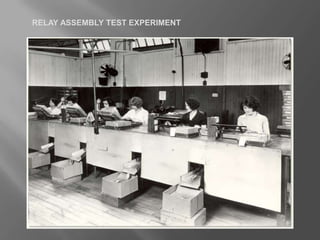
RELAY ASSEMBLY TEST EXPERIMENT
 Experiments were conducted by Elton Mayo
 Manipulated factors of production to measure effect on
output:
 Length of Work Day & Work Week
 Use of Rest Periods
 Company Sponsored Meals
 Results:
 Higher output and greater employee satisfaction
 Conclusions:
 Positive effects even with negative influences – workers’ output will
increase as a response to attention
 Strong social bonds were created within the test group. Workers are
influenced by need for recognition, security and sense of belonging
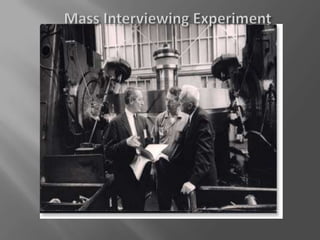
 Conducted many interviews .
 Objective was to explore information, which could be
used to improve supervisory training.
 Initially used the method of Direct Questioning and
changed to Non Directive.
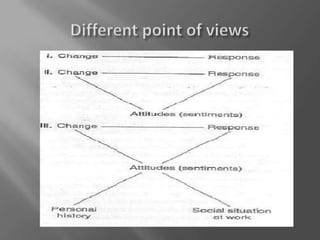
- The worker was satisfied/dissatisfied depending upon how he regarded
his social status in the company.
- Social groups created big impact on work.
- Production was restricted by workers regardless all financial incentives
offered as group pressure are on individual workers.
• Results
- Merely giving an opportunity to talk and express grievances would
increase the morale.
- Complaints were symptoms of deep-rooted disturbances.
-Workers are governed by experience obtained from both inside and
outside the company.
 Analyze the functioning of small group & impact on
individual behavior including wireman , soldermen and
inspectors.
 Hourly wage rate – average output of each worker.
 Bonus – average group output. To earn more –
produce more.
 But To earn bonus – help each other Workers decided
target for themselves – lower than companies.
 Reason for restricted output :-
1.Fear for unemployment.
2.Fear of raising the standard.
3.Protection of slower workers.
Result :- Workers sets certain norms.
Informal relationship – imp. factor
CONCLUSION
•The Hawthorne studies have had a remarkable impact on
management in organizations and how workers react to various
situations.
•The research carried out at the Western Electrics Hawthorne plant
during the 1920’s and early 1930’s helped to initiate a whole new
approach to human behaviour studies.
•Workers are not isolated , unrelated individuals they are social
animals and should be treated as such
•The final result was “the organization of teamwork-that is, of
sustained cooperation leads to success”
Thank You.

Hawthrone experiment

  • 2.
     A humanproblem to be brought to a human solution requires human data and human tools.
  • 3.
    INTRODUCTION The Hawthorne studieswere conducted in order to find out the role of human resource in increasing the production of an organization. A series of experiments in which the output of the workers was observed to increase as a result of improved treatment by their managers.
  • 4.
     Illumination Experiment Relay Assembly Test Experiments  Bank Wiring Observation Group
  • 5.
    To find outthe relationship of the quality and quantity of illumination to the efficiency of industrial workers . • Result : – Higher worker productivity and satisfaction at all light levels – Worker productivity was stopped as the light levels reached moonlight intensity. • Conclusions: – Light intensity has no conclusive effect on output – Increased productivity was due to workers’ receiving attention – Too many variables had not been controlled in the experiments • Concept of “Hawthorne Effect” was created
  • 6.
     Experiment 1:- Intensity of illumination increased – increase productivity for both the groups  Experiment 2 :- Intensity of illumination decreased – productivity increased .  Experiment 3:- Intensity of illumination gets to the level of moonlight – productivity decreased.
  • 7.
    • Result : –Higher worker productivity and satisfaction at all light levels – Worker productivity was stopped as the light levels reached moonlight intensity. • Conclusions: – Light intensity has no conclusive effect on output – Increased productivity was due to workers’ receiving attention – Too many variables had not been controlled in the experiments • Concept of “Hawthorne Effect” was created
  • 8.
  • 9.
     Experiments wereconducted by Elton Mayo  Manipulated factors of production to measure effect on output:  Length of Work Day & Work Week  Use of Rest Periods  Company Sponsored Meals  Results:  Higher output and greater employee satisfaction  Conclusions:  Positive effects even with negative influences – workers’ output will increase as a response to attention  Strong social bonds were created within the test group. Workers are influenced by need for recognition, security and sense of belonging
  • 11.
     Conducted manyinterviews .  Objective was to explore information, which could be used to improve supervisory training.  Initially used the method of Direct Questioning and changed to Non Directive.
  • 13.
    - The workerwas satisfied/dissatisfied depending upon how he regarded his social status in the company. - Social groups created big impact on work. - Production was restricted by workers regardless all financial incentives offered as group pressure are on individual workers. • Results - Merely giving an opportunity to talk and express grievances would increase the morale. - Complaints were symptoms of deep-rooted disturbances. -Workers are governed by experience obtained from both inside and outside the company.
  • 14.
     Analyze thefunctioning of small group & impact on individual behavior including wireman , soldermen and inspectors.  Hourly wage rate – average output of each worker.  Bonus – average group output. To earn more – produce more.  But To earn bonus – help each other Workers decided target for themselves – lower than companies.
  • 15.
     Reason forrestricted output :- 1.Fear for unemployment. 2.Fear of raising the standard. 3.Protection of slower workers. Result :- Workers sets certain norms. Informal relationship – imp. factor
  • 16.
    CONCLUSION •The Hawthorne studieshave had a remarkable impact on management in organizations and how workers react to various situations. •The research carried out at the Western Electrics Hawthorne plant during the 1920’s and early 1930’s helped to initiate a whole new approach to human behaviour studies. •Workers are not isolated , unrelated individuals they are social animals and should be treated as such •The final result was “the organization of teamwork-that is, of sustained cooperation leads to success”
  • 17.

Editor's Notes

  • #4 HUMAN PROBLEM REQUIRES HUMAN SOLUTIONS
  • #15 To be an accepted member of the group man had to be in accordance with these social standards.