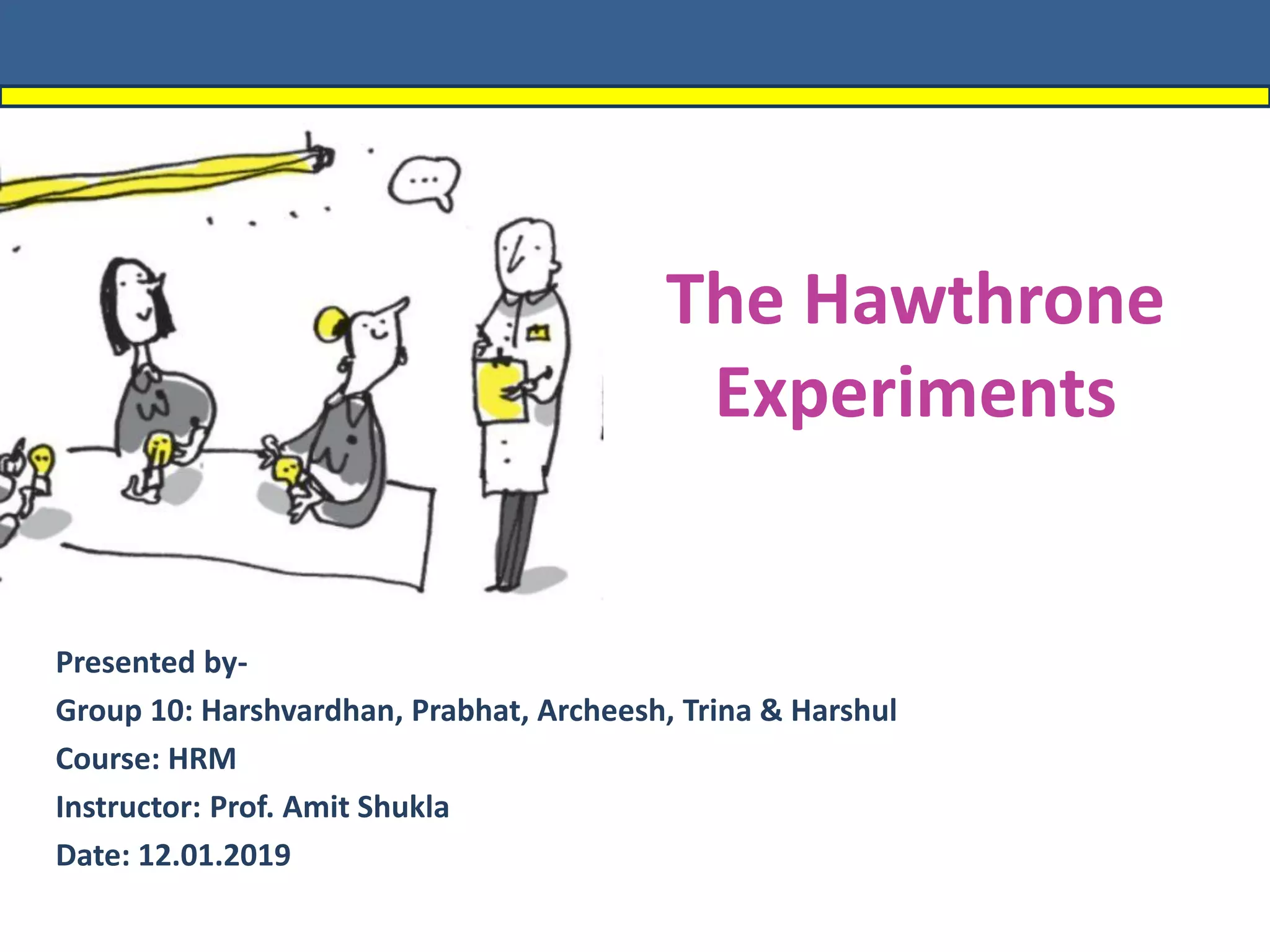
The Hawthrone
Experiments
Presented by-
Group 10: Harshvardhan, Prabhat, Archeesh, Trina & Harshul
Course: HRM
Instructor: Prof. Amit Shukla
Date: 12.01.2019
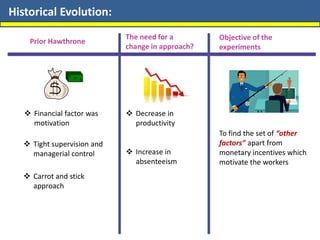
Historical Evolution:
Prior Hawthrone
❖ Financial factor was
motivation
❖ Tight supervision and
managerial control
❖ Carrot and stick
approach
The need for a
change in approach?
❖ Decrease in
productivity
❖ Increase in
absenteeism
Objective of the
experiments
To find the set of “other
factors” apart from
monetary incentives which
motivate the workers
About the Experiment
Hawthorne works, a western electric plant near Philadelphia, was studied for eight
years staring 1924 and 1932.
The reasons for inefficiency were believed to be improper job design, fatigue and
other conditions of work.
This was commissioned to see if workers would become more productive under
different circumstances. This was studied through a set of 4 series of experiments
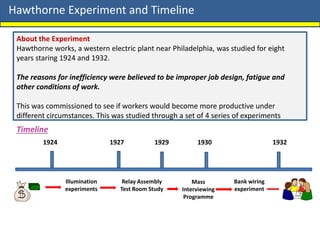
Hawthorne Experiment and Timeline
Timeline
1924 1927 1929 1930 1932
Illumination
experiments
Relay Assembly
Test Room Study
Mass
Interviewing
Programme
Bank wiring
experiment
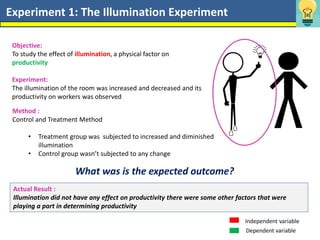
Experiment 1: The Illumination Experiment
Objective:
To study the effect of illumination, a physical factor on
productivity
Experiment:
The illumination of the room was increased and decreased and its
productivity on workers was observed
Method :
Control and Treatment Method
• Treatment group was subjected to increased and diminished
illumination
• Control group wasn’t subjected to any change
What was is the expected outcome?
Actual Result :
Illumination did not have any effect on productivity there were some other factors that were
playing a part in determining productivity
Independent variable
Dependent variable
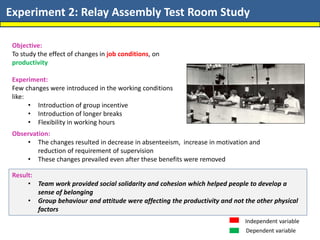
Experiment 2: Relay Assembly Test Room Study
Objective:
To study the effect of changes in job conditions, on
productivity
Experiment:
Few changes were introduced in the working conditions
like:
• Introduction of group incentive
• Introduction of longer breaks
• Flexibility in working hours
Observation:
• The changes resulted in decrease in absenteeism, increase in motivation and
reduction of requirement of supervision
• These changes prevailed even after these benefits were removed
Result:
• Team work provided social solidarity and cohesion which helped people to develop a
sense of belonging
• Group behaviour and attitude were affecting the productivity and not the other physical
factors
Independent variable
Dependent variable
Experiment 3: The Mass Interviewing Programme
Objective:
To study the effect of counselling and indirect interviewing
on human behaviour
Experiment:
• Indirect interview method was adopted where the
employee was given an opportunity to talk
• “Yes or No” type reply system was eliminated
• The interviewer listened and did not argue or cross
questioned
Observation:
The worker behaviour was influenced by group behaviour
Result:
This experiment helped the researchers understand the minds of the workers since through this
experiment the labour was treated more than just a “labour input” as they were given a voice
Independent variable
Dependent variable
Experiment 4: Bank Wiring Observation Room Study
Objective:
To study how small groups effect the functioning of
individual behaviour
Hypothesis:
• In order to earn more the individual would
produce more
• In order to get group bonus they would help
each other to produce more
Observation:
The individuals set low targets for themselves
Result:
• Fear of layoff and unemployment
• Fear of rising standards and expectations
• A desire to project slower workers
• Monetary gain doesn’t only motivate the workers
• Social security measures, autonomy and social bonding also effect productivity
Independent variable
Dependent variable
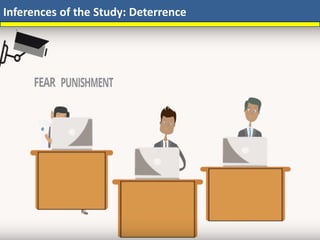
Inferences of the Study: Deterrence
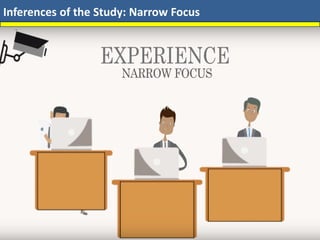
Inferences of the Study: Narrow Focus
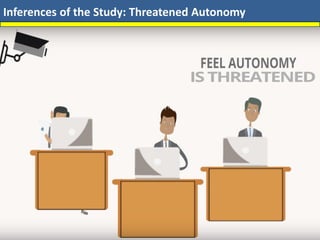
Inferences of the Study: Threatened Autonomy
Lets Test the Hawthorne Effect on different tasks!
Gamification: Made a
game out of the task
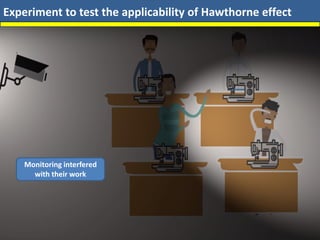
Experiment to test the applicability of Hawthorne effect
Monitoring interfered
with their work
Effect on productivity prior to the controlled setting
Effect of monitoring on productivity
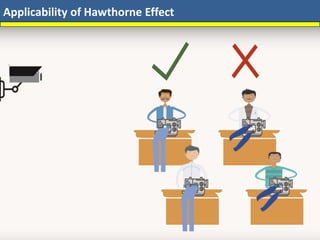
Applicability of Hawthorne Effect
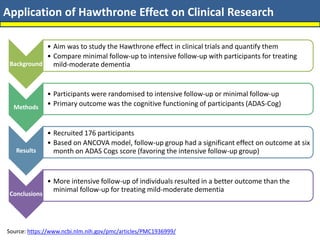
Application of Hawthrone Effect on Clinical Research
Source: https://www.ncbi.nlm.nih.gov/pmc/articles/PMC1936999/
Background
• Aim was to study the Hawthrone effect in clinical trials and quantify them
• Compare minimal follow-up to intensive follow-up with participants for treating
mild-moderate dementia
Methods
• Participants were randomised to intensive follow-up or minimal follow-up
• Primary outcome was the cognitive functioning of participants (ADAS-Cog)
Results
• Recruited 176 participants
• Based on ANCOVA model, follow-up group had a significant effect on outcome at six
month on ADAS Cogs score (favoring the intensive follow-up group)
Conclusions
• More intensive follow-up of individuals resulted in a better outcome than the
minimal follow-up for treating mild-moderate dementia
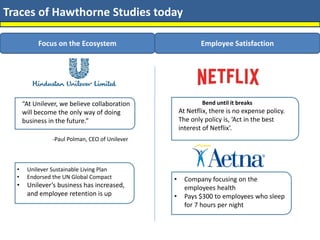
Traces of Hawthorne Studies today
-Paul Polman, CEO of Unilever
“At Unilever, we believe collaboration
will become the only way of doing
business in the future.”
• Unilever Sustainable Living Plan
• Endorsed the UN Global Compact
• Unilever’s business has increased,
and employee retention is up
Focus on the Ecosystem Employee Satisfaction
Bend until it breaks
At Netflix, there is no expense policy.
The only policy is, ‘Act in the best
interest of Netflix’.
• Company focusing on the
employees health
• Pays $300 to employees who sleep
for 7 hours per night
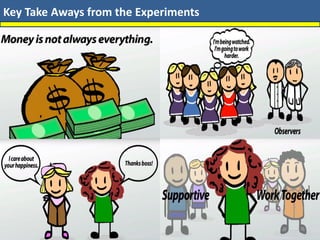
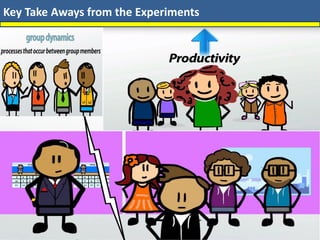
Key Take Aways from the Experiments
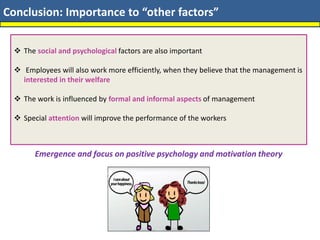
Conclusion: Importance to “other factors”
❖ The social and psychological factors are also important
❖ Employees will also work more efficiently, when they believe that the management is
interested in their welfare
❖ The work is influenced by formal and informal aspects of management
❖ Special attention will improve the performance of the workers
Emergence and focus on positive psychology and motivation theory
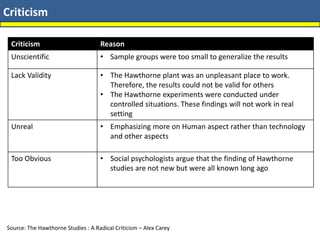
Criticism
Source: The Hawthorne Studies : A Radical Criticism – Alex Carey
Criticism Reason
Unscientific • Sample groups were too small to generalize the results
Lack Validity • The Hawthorne plant was an unpleasant place to work.
Therefore, the results could not be valid for others
• The Hawthorne experiments were conducted under
controlled situations. These findings will not work in real
setting
Unreal • Emphasizing more on Human aspect rather than technology
and other aspects
Too Obvious • Social psychologists argue that the finding of Hawthorne
studies are not new but were all known long ago
Is it Relevant Today ?
In spite of the short comings of Hawthorne experiments, it
initiated a new approach to management (Human Relations
Approach)
Helped to initiate a whole new approach to human behaviour
studies
An organizations are not only structures but also people
References
1. The Hawthorne Studies : A Radical Criticism – Alex Carey
2. https://www.library.hbs.edu/hc/hawthorne/intro.html#i
3. https://www.thefreelibrary.com/Elton+Mayo%3a+the+Hawthorne+experiments.-
a0151189059
4. https://www.youtube.com/watch?v=JPIgh7feCpM
5. http://www.economist.com/node/12510632
6. http://www.elizabethedersheim.com/2012/09/24/history-matters-the-hawthorne-
experiments-legacy-for-today/
7. https://ac.els-cdn.com/S0197245699000549/1-s2.0-S0197245699000549-
main.pdf?_tid=c8de60a4-fd9e-11e7-9e04-
00000aacb35e&acdnat=1516424588_5b0e7b86fd0705b5cbd37f55cb2b9949
Thank You
The floor is now open for discussion

The Hawthorne Experiments

  • 1.
    The Hawthrone Experiments Presented by- Group10: Harshvardhan, Prabhat, Archeesh, Trina & Harshul Course: HRM Instructor: Prof. Amit Shukla Date: 12.01.2019
  • 2.
    Historical Evolution: Prior Hawthrone ❖Financial factor was motivation ❖ Tight supervision and managerial control ❖ Carrot and stick approach The need for a change in approach? ❖ Decrease in productivity ❖ Increase in absenteeism Objective of the experiments To find the set of “other factors” apart from monetary incentives which motivate the workers
  • 3.
    About the Experiment Hawthorneworks, a western electric plant near Philadelphia, was studied for eight years staring 1924 and 1932. The reasons for inefficiency were believed to be improper job design, fatigue and other conditions of work. This was commissioned to see if workers would become more productive under different circumstances. This was studied through a set of 4 series of experiments Hawthorne Experiment and Timeline Timeline 1924 1927 1929 1930 1932 Illumination experiments Relay Assembly Test Room Study Mass Interviewing Programme Bank wiring experiment
  • 4.
    Experiment 1: TheIllumination Experiment Objective: To study the effect of illumination, a physical factor on productivity Experiment: The illumination of the room was increased and decreased and its productivity on workers was observed Method : Control and Treatment Method • Treatment group was subjected to increased and diminished illumination • Control group wasn’t subjected to any change What was is the expected outcome? Actual Result : Illumination did not have any effect on productivity there were some other factors that were playing a part in determining productivity Independent variable Dependent variable
  • 5.
    Experiment 2: RelayAssembly Test Room Study Objective: To study the effect of changes in job conditions, on productivity Experiment: Few changes were introduced in the working conditions like: • Introduction of group incentive • Introduction of longer breaks • Flexibility in working hours Observation: • The changes resulted in decrease in absenteeism, increase in motivation and reduction of requirement of supervision • These changes prevailed even after these benefits were removed Result: • Team work provided social solidarity and cohesion which helped people to develop a sense of belonging • Group behaviour and attitude were affecting the productivity and not the other physical factors Independent variable Dependent variable
  • 6.
    Experiment 3: TheMass Interviewing Programme Objective: To study the effect of counselling and indirect interviewing on human behaviour Experiment: • Indirect interview method was adopted where the employee was given an opportunity to talk • “Yes or No” type reply system was eliminated • The interviewer listened and did not argue or cross questioned Observation: The worker behaviour was influenced by group behaviour Result: This experiment helped the researchers understand the minds of the workers since through this experiment the labour was treated more than just a “labour input” as they were given a voice Independent variable Dependent variable
  • 7.
    Experiment 4: BankWiring Observation Room Study Objective: To study how small groups effect the functioning of individual behaviour Hypothesis: • In order to earn more the individual would produce more • In order to get group bonus they would help each other to produce more Observation: The individuals set low targets for themselves Result: • Fear of layoff and unemployment • Fear of rising standards and expectations • A desire to project slower workers • Monetary gain doesn’t only motivate the workers • Social security measures, autonomy and social bonding also effect productivity Independent variable Dependent variable
  • 8.
    Inferences of theStudy: Deterrence
  • 9.
    Inferences of theStudy: Narrow Focus
  • 10.
    Inferences of theStudy: Threatened Autonomy
  • 11.
    Lets Test theHawthorne Effect on different tasks!
  • 12.
  • 13.
    Experiment to testthe applicability of Hawthorne effect Monitoring interfered with their work
  • 14.
    Effect on productivityprior to the controlled setting
  • 15.
    Effect of monitoringon productivity
  • 16.
  • 17.
    Application of HawthroneEffect on Clinical Research Source: https://www.ncbi.nlm.nih.gov/pmc/articles/PMC1936999/ Background • Aim was to study the Hawthrone effect in clinical trials and quantify them • Compare minimal follow-up to intensive follow-up with participants for treating mild-moderate dementia Methods • Participants were randomised to intensive follow-up or minimal follow-up • Primary outcome was the cognitive functioning of participants (ADAS-Cog) Results • Recruited 176 participants • Based on ANCOVA model, follow-up group had a significant effect on outcome at six month on ADAS Cogs score (favoring the intensive follow-up group) Conclusions • More intensive follow-up of individuals resulted in a better outcome than the minimal follow-up for treating mild-moderate dementia
  • 18.
    Traces of HawthorneStudies today -Paul Polman, CEO of Unilever “At Unilever, we believe collaboration will become the only way of doing business in the future.” • Unilever Sustainable Living Plan • Endorsed the UN Global Compact • Unilever’s business has increased, and employee retention is up Focus on the Ecosystem Employee Satisfaction Bend until it breaks At Netflix, there is no expense policy. The only policy is, ‘Act in the best interest of Netflix’. • Company focusing on the employees health • Pays $300 to employees who sleep for 7 hours per night
  • 19.
    Key Take Awaysfrom the Experiments
  • 20.
    Key Take Awaysfrom the Experiments
  • 21.
    Conclusion: Importance to“other factors” ❖ The social and psychological factors are also important ❖ Employees will also work more efficiently, when they believe that the management is interested in their welfare ❖ The work is influenced by formal and informal aspects of management ❖ Special attention will improve the performance of the workers Emergence and focus on positive psychology and motivation theory
  • 22.
    Criticism Source: The HawthorneStudies : A Radical Criticism – Alex Carey Criticism Reason Unscientific • Sample groups were too small to generalize the results Lack Validity • The Hawthorne plant was an unpleasant place to work. Therefore, the results could not be valid for others • The Hawthorne experiments were conducted under controlled situations. These findings will not work in real setting Unreal • Emphasizing more on Human aspect rather than technology and other aspects Too Obvious • Social psychologists argue that the finding of Hawthorne studies are not new but were all known long ago
  • 23.
    Is it RelevantToday ? In spite of the short comings of Hawthorne experiments, it initiated a new approach to management (Human Relations Approach) Helped to initiate a whole new approach to human behaviour studies An organizations are not only structures but also people
  • 24.
    References 1. The HawthorneStudies : A Radical Criticism – Alex Carey 2. https://www.library.hbs.edu/hc/hawthorne/intro.html#i 3. https://www.thefreelibrary.com/Elton+Mayo%3a+the+Hawthorne+experiments.- a0151189059 4. https://www.youtube.com/watch?v=JPIgh7feCpM 5. http://www.economist.com/node/12510632 6. http://www.elizabethedersheim.com/2012/09/24/history-matters-the-hawthorne- experiments-legacy-for-today/ 7. https://ac.els-cdn.com/S0197245699000549/1-s2.0-S0197245699000549- main.pdf?_tid=c8de60a4-fd9e-11e7-9e04- 00000aacb35e&acdnat=1516424588_5b0e7b86fd0705b5cbd37f55cb2b9949
  • 25.
    Thank You The flooris now open for discussion