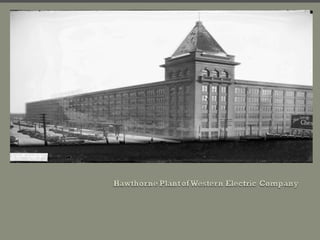
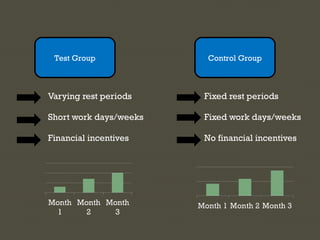
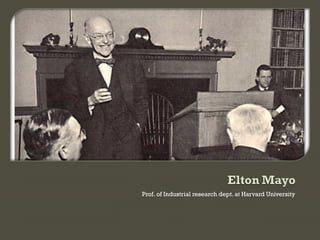
The Hawthorne Studies were a series of experiments conducted from 1927 to 1932 at the Western Electric Company plant in Hawthorne, Illinois by Professor Elton Mayo from Harvard Business School. The purpose was to examine the effects of factors like monotony, fatigue, rest breaks, work hours, and environmental conditions on worker productivity. The studies found that productivity increased for workers who received improved treatment and attention from managers, regardless of the specific changes made, in what became known as the Hawthorne Effect.