The Hawthorne Effect
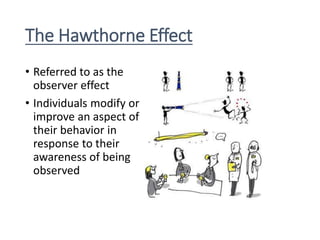
• Referred to as the
observer effect
• Individuals modify or
improve an aspect of
their behavior in
response to their
awareness of being
observed
Hawthorne Effect
• But even the
control group
may experience
changes.
• Just the fact
that you know
you are in an
experiment can
cause change.
Whether the lights were brighter or
dimmer, production went up in the
Hawthorne electric plant.
Experimenter Bias
• Another confounding
variable.
• Not a conscious act.
• Double-Blind
Procedure.
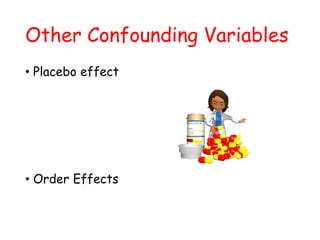
Other Confounding Variables
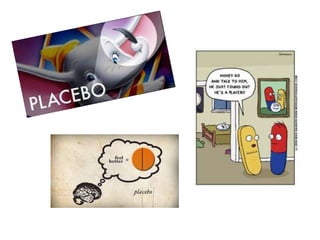
• Placebo effect
• Order Effects
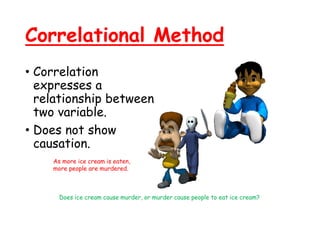
Correlational Method
• Correlation
expresses a
relationship between
two variable.
• Does not show
causation.
As more ice cream is eaten,
more people are murdered.
Does ice cream cause murder, or murder cause people to eat ice cream?
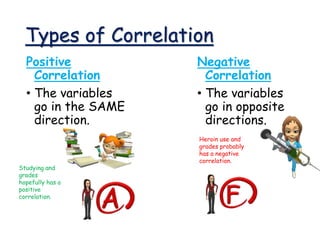
Types of Correlation
Positive
Correlation
• The variables
go in the SAME
direction.
Negative
Correlation
• The variables
go in opposite
directions.
Studying and
grades
hopefully has a
positive
correlation.
Heroin use and
grades probably
has a negative
correlation.
Survey Method
•Most common type of
study in psychology
•Measures correlation
•Cheap and fast
•Need a good random
sample
•Low-response rate
Naturalistic Observation
• Watch subjects in their
natural environment.
• Do not manipulate the
environment.
• The good is that there
is Hawthorne effect.
• The bad is that we can
never really show cause
and effect.
Case Studies
• A detailed picture
of one or a few
subjects.
• Tells us a great
story…but is just
descriptive
research.
• Does not even give
us correlation data.
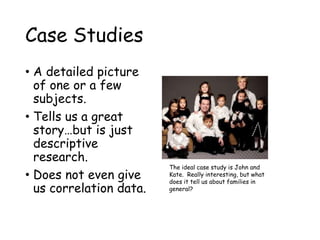
The ideal case study is John and
Kate. Really interesting, but what
does it tell us about families in
general?

Notes 9 22

  • 1.
    The Hawthorne Effect •Referred to as the observer effect • Individuals modify or improve an aspect of their behavior in response to their awareness of being observed
  • 2.
    Hawthorne Effect • Buteven the control group may experience changes. • Just the fact that you know you are in an experiment can cause change. Whether the lights were brighter or dimmer, production went up in the Hawthorne electric plant.
  • 3.
    Experimenter Bias • Anotherconfounding variable. • Not a conscious act. • Double-Blind Procedure.
  • 4.
    Other Confounding Variables •Placebo effect • Order Effects
  • 6.
    Correlational Method • Correlation expressesa relationship between two variable. • Does not show causation. As more ice cream is eaten, more people are murdered. Does ice cream cause murder, or murder cause people to eat ice cream?
  • 7.
    Types of Correlation Positive Correlation •The variables go in the SAME direction. Negative Correlation • The variables go in opposite directions. Studying and grades hopefully has a positive correlation. Heroin use and grades probably has a negative correlation.
  • 8.
    Survey Method •Most commontype of study in psychology •Measures correlation •Cheap and fast •Need a good random sample •Low-response rate
  • 9.
    Naturalistic Observation • Watchsubjects in their natural environment. • Do not manipulate the environment. • The good is that there is Hawthorne effect. • The bad is that we can never really show cause and effect.
  • 10.
    Case Studies • Adetailed picture of one or a few subjects. • Tells us a great story…but is just descriptive research. • Does not even give us correlation data. The ideal case study is John and Kate. Really interesting, but what does it tell us about families in general?