HAWTHORNE
EXPERIMENTS
By : Deepshikha
The Hawthorne experiment were first conducted in November, 1924 at Western
Electric Company’s Hawthorne plant in Chicago
The initial tests were sponsored by The National Research Council (NRC) of the
National Academy of Sciences
In 1927, a research team from Harvard Business School was invited to join the
studies after the illumination test drew unanticipated results
A team of researchers led by George Elton Mayo from the Harvard Business School
carried out the studies
(General Electric originally contributed funding, but they withdrew after the first
trial was completed)
HAWTHORNE EXPERIMENT
INTRODUCTION
The Hawthorne studies were conducted in
order to find out the role of human resource in
increasing the production of an organization.
The Hawthorne studies included the following
experiments.
 Illumination Experiment
 Relay Assembly Test Experiment
 Mass Interview Group
 Bank Wiring Observation Group
EXPERIMENTS CONDUCTED
HAWTHORNE EXPERIMENT
Conducted between 1924-1932
Conducted at WESTERN ELECTRIC
COMPANY, Chicago, USA
Conducted by,
•Elton Mayo
•White Head
•Roethlisberger
George Elton Mayo
 He was an Australian Psychologist,
Sociologist and Organization Theorist.
 Lectured at University of Queensland before
moving to the University of Pennsylvania
 Known as the founder of Human Relations
Movement
 Also known for his research including
Hawthorne Studies
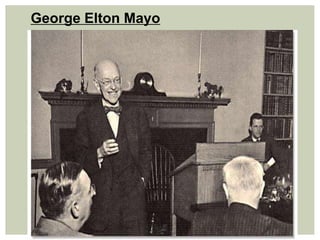
George Elton Mayo
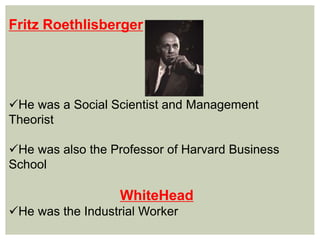
Fritz Roethlisberger
He was a Social Scientist and Management
Theorist
He was also the Professor of Harvard Business
School
WhiteHead
He was the Industrial Worker
Western Electric Company
•Gray and Barton, a telephone industry supply
company founded in 1869 by Elisha Gray and Enos
Barton
•In 1872, the company changed its name to the
Western Electric Manufacturing Company
•In 1881, when the annual sales had already grown
to nearly $1 million, the firm was purchased by the
American Bell Telephone Company, it was renamed
the Western Electric Company and became Bells
manufacturing arm
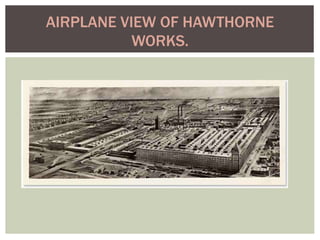
AIRPLANE VIEW OF HAWTHORNE
WORKS.
MAGNETIC WIRE INSULATING DEPARTMENT
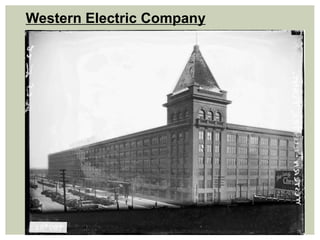
Western Electric Company
Research on productivity at massive manufacturing complexes like
the Hawthorne Works was made possible through partnerships
among industries, universities, and government. In the 1920s, with
support from the National Research Council, the Rockefeller
Foundation, and eventually Harvard Business School, Western
Electric undertook a series of behavioral experiments. The first, a
sequence of illumination tests from 1924 to 1927, set out to
determine the effects of lighting on worker efficiency in three
separate manufacturing departments. Accounts of the study
revealed no significant correlation between productivity and light
levels. The results prompted researchers to investigate other factors
affecting worker output.
• 1924-1927
• Funded by General Electric
• Conducted by The National Research Council (NRC) of the
National Academy of Sciences with engineers from MIT
• Measured Light Intensity vs. Worker Output
• Result :
– Higher worker productivity and satisfaction at all light levels
– Worker productivity was stopped with the light levels reached moonlight
intensity.
• Conclusions:
– Light intensity has no conclusive effect on output
– Productivity has a psychological component
• Concept of “Hawthorne Effect” was created
ILLUMINATION STUDIES
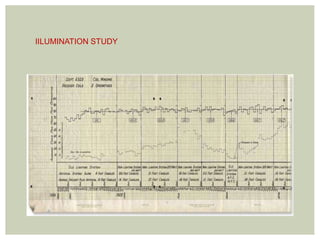
IILUMINATION STUDY
The next experiments beginning in 1927 focused on the
relay assembly department, where the electromagnetic
switches that made telephone connections possible were
produced. The manufacture of relays required the repetitive
assembly of pins, springs, insulators, coils, and screws.
Western Electric produced over 7 million relays annually.
As the speed of individual workers determined overall
production levels, the effects of factors like rest periods and
work hours in this department were of particular interest to
the company.
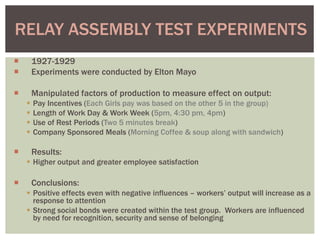
 1927-1929
 Experiments were conducted by Elton Mayo
 Manipulated factors of production to measure effect on output:
 Pay Incentives (Each Girls pay was based on the other 5 in the group)
 Length of Work Day & Work Week (5pm, 4:30 pm, 4pm)
 Use of Rest Periods (Two 5 minutes break)
 Company Sponsored Meals (Morning Coffee & soup along with sandwich)
 Results:
 Higher output and greater employee satisfaction
 Conclusions:
 Positive effects even with negative influences – workers’ output will increase as a
response to attention
 Strong social bonds were created within the test group. Workers are influenced
by need for recognition, security and sense of belonging
RELAY ASSEMBLY TEST EXPERIMENTS
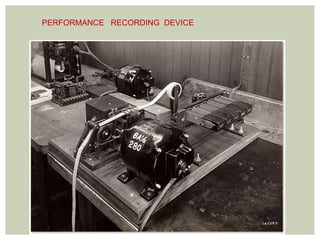
PERFORMANCE RECORDING DEVICE
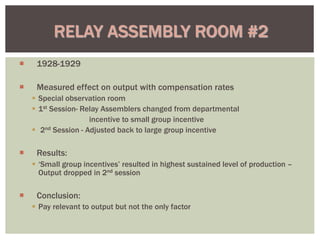
 1928-1929
 Measured effect on output with compensation rates
 Special observation room
 1st Session- Relay Assemblers changed from departmental
incentive to small group incentive
 2nd Session - Adjusted back to large group incentive
 Results:
 ‘Small group incentives’ resulted in highest sustained level of production –
Output dropped in 2nd session
 Conclusion:
 Pay relevant to output but not the only factor
RELAY ASSEMBLY ROOM #2
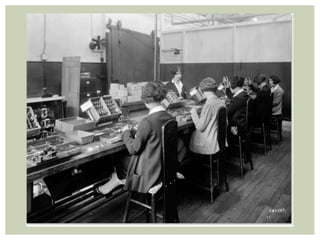
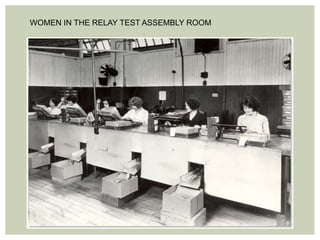
WOMEN IN THE RELAY TEST ASSEMBLY ROOM
 1928-1931
 Measured output with changes to work conditions only:
 Special Observation Room
 Length of Work Day
 Use of Rest Periods
 Workers stayed on established Piece-rate compensation
 Result:
 Productivity increased by 15% over standard output base
 Conclusions:
 Productivity is affected by non-pay considerations
 Social dynamics are a basis of worker performance
MICA SPLITTING TEST GROUP
• Conducted 20,000 interviews.
• Objective was to explore information, which could be used to improve supervisory
training.
• Initially used the method of Direct Questioning and changed to Non Directive.
• Results
- Giving an opportunity to talk and express grievances would increase the morale.
- Complaints were symptoms of deep-rooted disturbances.
-Workers are governed by experience obtained from both inside and outside the
company.
MASS INTERVIEW PROGRAM
- The workers were satisfied or dissatisfied depending upon how they regarded their social
status in the company.
- Social groups created big impact on work.
- Production was restricted by workers regardless all financial incentives offered as group
pressure are on individual workers.
MASS INTERVIEW PROGRAM (CONTD)
 1931-1932
 Limited changes to work conditions
 Segregated work area
 No Management Visits
 Supervision would remain the same
 Observer would record data only – no interaction with workers
 Small group pay incentive
 Result:
 No appreciable changes in output
 Conclusions:
 Preexisting performance norms
 Group dictated production standards –
 Work Group protection from management changes.
BANK WIRING OBSERVATION GROUP
CONCLUSION
•The Hawthorne studies have had a remarkable impact on
management in organizations and how workers react to various
situations.
•The research carried out at the Western Electrics Hawthorne plant
during the 1920’s and early 1930’s helped to initiate a whole new
approach to human behaviour studies.
•The final result was “the organization of teamwork-that is, of
sustained cooperation leads to success”.
Thank
You

lecture hawthorne experiments

  • 1.
  • 2.
    The Hawthorne experimentwere first conducted in November, 1924 at Western Electric Company’s Hawthorne plant in Chicago The initial tests were sponsored by The National Research Council (NRC) of the National Academy of Sciences In 1927, a research team from Harvard Business School was invited to join the studies after the illumination test drew unanticipated results A team of researchers led by George Elton Mayo from the Harvard Business School carried out the studies (General Electric originally contributed funding, but they withdrew after the first trial was completed) HAWTHORNE EXPERIMENT
  • 3.
    INTRODUCTION The Hawthorne studieswere conducted in order to find out the role of human resource in increasing the production of an organization.
  • 4.
    The Hawthorne studiesincluded the following experiments.  Illumination Experiment  Relay Assembly Test Experiment  Mass Interview Group  Bank Wiring Observation Group EXPERIMENTS CONDUCTED
  • 5.
    HAWTHORNE EXPERIMENT Conducted between1924-1932 Conducted at WESTERN ELECTRIC COMPANY, Chicago, USA Conducted by, •Elton Mayo •White Head •Roethlisberger
  • 6.
    George Elton Mayo He was an Australian Psychologist, Sociologist and Organization Theorist.  Lectured at University of Queensland before moving to the University of Pennsylvania  Known as the founder of Human Relations Movement  Also known for his research including Hawthorne Studies
  • 7.
  • 8.
    Fritz Roethlisberger He wasa Social Scientist and Management Theorist He was also the Professor of Harvard Business School WhiteHead He was the Industrial Worker
  • 9.
    Western Electric Company •Grayand Barton, a telephone industry supply company founded in 1869 by Elisha Gray and Enos Barton •In 1872, the company changed its name to the Western Electric Manufacturing Company •In 1881, when the annual sales had already grown to nearly $1 million, the firm was purchased by the American Bell Telephone Company, it was renamed the Western Electric Company and became Bells manufacturing arm
  • 10.
    AIRPLANE VIEW OFHAWTHORNE WORKS.
  • 11.
  • 12.
  • 13.
    Research on productivityat massive manufacturing complexes like the Hawthorne Works was made possible through partnerships among industries, universities, and government. In the 1920s, with support from the National Research Council, the Rockefeller Foundation, and eventually Harvard Business School, Western Electric undertook a series of behavioral experiments. The first, a sequence of illumination tests from 1924 to 1927, set out to determine the effects of lighting on worker efficiency in three separate manufacturing departments. Accounts of the study revealed no significant correlation between productivity and light levels. The results prompted researchers to investigate other factors affecting worker output.
  • 14.
    • 1924-1927 • Fundedby General Electric • Conducted by The National Research Council (NRC) of the National Academy of Sciences with engineers from MIT • Measured Light Intensity vs. Worker Output • Result : – Higher worker productivity and satisfaction at all light levels – Worker productivity was stopped with the light levels reached moonlight intensity. • Conclusions: – Light intensity has no conclusive effect on output – Productivity has a psychological component • Concept of “Hawthorne Effect” was created ILLUMINATION STUDIES
  • 15.
  • 16.
    The next experimentsbeginning in 1927 focused on the relay assembly department, where the electromagnetic switches that made telephone connections possible were produced. The manufacture of relays required the repetitive assembly of pins, springs, insulators, coils, and screws. Western Electric produced over 7 million relays annually. As the speed of individual workers determined overall production levels, the effects of factors like rest periods and work hours in this department were of particular interest to the company.
  • 17.
     1927-1929  Experimentswere conducted by Elton Mayo  Manipulated factors of production to measure effect on output:  Pay Incentives (Each Girls pay was based on the other 5 in the group)  Length of Work Day & Work Week (5pm, 4:30 pm, 4pm)  Use of Rest Periods (Two 5 minutes break)  Company Sponsored Meals (Morning Coffee & soup along with sandwich)  Results:  Higher output and greater employee satisfaction  Conclusions:  Positive effects even with negative influences – workers’ output will increase as a response to attention  Strong social bonds were created within the test group. Workers are influenced by need for recognition, security and sense of belonging RELAY ASSEMBLY TEST EXPERIMENTS
  • 18.
  • 20.
     1928-1929  Measuredeffect on output with compensation rates  Special observation room  1st Session- Relay Assemblers changed from departmental incentive to small group incentive  2nd Session - Adjusted back to large group incentive  Results:  ‘Small group incentives’ resulted in highest sustained level of production – Output dropped in 2nd session  Conclusion:  Pay relevant to output but not the only factor RELAY ASSEMBLY ROOM #2
  • 21.
    WOMEN IN THERELAY TEST ASSEMBLY ROOM
  • 22.
     1928-1931  Measuredoutput with changes to work conditions only:  Special Observation Room  Length of Work Day  Use of Rest Periods  Workers stayed on established Piece-rate compensation  Result:  Productivity increased by 15% over standard output base  Conclusions:  Productivity is affected by non-pay considerations  Social dynamics are a basis of worker performance MICA SPLITTING TEST GROUP
  • 23.
    • Conducted 20,000interviews. • Objective was to explore information, which could be used to improve supervisory training. • Initially used the method of Direct Questioning and changed to Non Directive. • Results - Giving an opportunity to talk and express grievances would increase the morale. - Complaints were symptoms of deep-rooted disturbances. -Workers are governed by experience obtained from both inside and outside the company. MASS INTERVIEW PROGRAM
  • 25.
    - The workerswere satisfied or dissatisfied depending upon how they regarded their social status in the company. - Social groups created big impact on work. - Production was restricted by workers regardless all financial incentives offered as group pressure are on individual workers. MASS INTERVIEW PROGRAM (CONTD)
  • 26.
     1931-1932  Limitedchanges to work conditions  Segregated work area  No Management Visits  Supervision would remain the same  Observer would record data only – no interaction with workers  Small group pay incentive  Result:  No appreciable changes in output  Conclusions:  Preexisting performance norms  Group dictated production standards –  Work Group protection from management changes. BANK WIRING OBSERVATION GROUP
  • 27.
    CONCLUSION •The Hawthorne studieshave had a remarkable impact on management in organizations and how workers react to various situations. •The research carried out at the Western Electrics Hawthorne plant during the 1920’s and early 1930’s helped to initiate a whole new approach to human behaviour studies. •The final result was “the organization of teamwork-that is, of sustained cooperation leads to success”.
  • 28.