A
PRESENTATION
on
Inert Gas Extinguishing System
By: RAMESH KU. SHARMA
MECHANICAL ENGINEER
Fire Protection in Electronics Areas
(CR,CER,… )
• Agent requirements
High efficiency
Non-toxic
Non-damaging to equipment
Non-conductor of electricity
CLEAN AGENTS
The National Fire Protection Association
(NFPA) defines, a “clean agent” as “an
electrically non-conducting, volatile or gaseous
fire extinguishant that does not have a residue
upon evaporation”.
AS per NFPA-2001, Clean Agents can be
classified into two categories:
H A L O C A R B O N S I N E R T G A S E S
C L E A N A G E N T S
Halocarbon agents
This agent Contains one or more organic compound
containing one or more elements like
Fluorine,Chlorine,Bromine or iodine.
These agents extinguish fire by combination of
cooling action, oxygen depletion and chemical
inhibition.
These agent are available with trade name as FM-
200,FE13,CEA-410,NAF-Slll etc.FM-200 and NAF-Slll
are used widely.
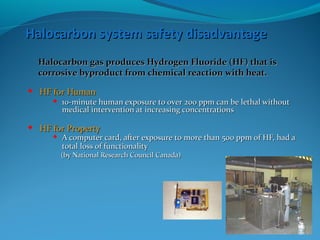
Halocarbon system safety disadvantageHalocarbon system safety disadvantage
 HF for HumanHF for Human
 10-minute human exposure to over 200 ppm can be lethal without10-minute human exposure to over 200 ppm can be lethal without
medical intervention at increasing concentrationsmedical intervention at increasing concentrations
 HF for PropertyHF for Property
 A computer card, after exposure to more than 500 ppm of HF, had aA computer card, after exposure to more than 500 ppm of HF, had a
total loss of functionalitytotal loss of functionality
(by National Research Council Canada)(by National Research Council Canada)
Halocarbon gas produces Hydrogen Fluoride (HF) that isHalocarbon gas produces Hydrogen Fluoride (HF) that is
corrosive byproduct from chemical reaction with heat.corrosive byproduct from chemical reaction with heat.
INERT GAS AGENT
An agent that contains as primary components one
or more of the gases helium, argon, nitrogen. Inert
gas agents that are blends of gases can also contain
CO2 as a secondary component.
INERGEN(IG-541)(N2-52%, ARGON -40%, CO2-8%) -
TYCO USA, ANSUL USA, WORMOLD ASTRALIA.
ARGONITE (IG-55)(N2-50%, ARGON -50%)-
GINGE-KERR, DENMARK.
ARGOTEC (IG-01)( ARGON -100%)- MINIMAX, GERMANY
NITROGEN (IG-100)(N2-100%) - NOHMI BOSAI, JAPAN
OPERATING PRINCIPLE
 Inert gases extinguish fire by dilution of O2 concentration below the level
that does not support combustion.
 Normal atmosphere in the room contains 21% oxygen.
 To extinguish fire oxygen concentration should be less than 15%
 Oxygen concentration less than 12% is not safe for human occupancy.
 Inert gas bring down the O2 concentration in a protected space to around
12.5%, a level that is breathable but will not support flaming combustion.
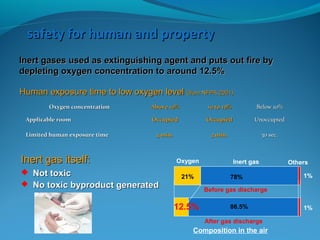
safety for human and propertysafety for human and property
Human exposure time to low oxygen levelHuman exposure time to low oxygen level (from NFPA 2001)(from NFPA 2001)
Oxygen concentrationOxygen concentration Above 12%Above 12% 10 to 12%10 to 12% Below 10%Below 10%
Applicable roomApplicable room OccupiedOccupied OccupiedOccupied UnoccupiedUnoccupied
Limited human exposure timeLimited human exposure time 5 min.5 min. 3 min.3 min. 30 sec.30 sec.
Oxygen Inert gas Others
21% 78% 1%
12.5% 86.5% 1%
Before gas discharge
After gas discharge
Composition in the air
Inert gases used as extinguishing agent and puts out fire byInert gases used as extinguishing agent and puts out fire by
depleting oxygen concentration to around 12.5%depleting oxygen concentration to around 12.5%
Inert gas itself:Inert gas itself:
 Not toxicNot toxic
 No toxic byproduct generatedNo toxic byproduct generated
DESIGN FACTORS
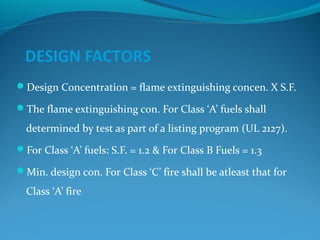
Design Concentration = flame extinguishing concen. X S.F.
The flame extinguishing con. For Class ‘A’ fuels shall
determined by test as part of a listing program (UL 2127).
For Class ‘A’ fuels: S.F. = 1.2 & For Class B Fuels = 1.3
Min. design con. For Class ‘C’ fire shall be atleast that for
Class ‘A’ fire
DESIGN FACTORS
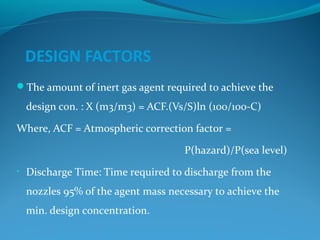
The amount of inert gas agent required to achieve the
design con. : X (m3/m3) = ACF.(Vs/S)ln (100/100-C)
Where, ACF = Atmospheric correction factor =
P(hazard)/P(sea level)
• Discharge Time: Time required to discharge from the
nozzles 95% of the agent mass necessary to achieve the
min. design concentration.
Automatic Operation
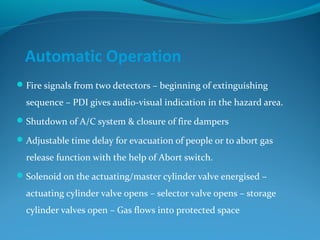
Fire signals from two detectors – beginning of extinguishing
sequence – PDI gives audio-visual indication in the hazard area.
Shutdown of A/C system & closure of fire dampers
Adjustable time delay for evacuation of people or to abort gas
release function with the help of Abort switch.
Solenoid on the actuating/master cylinder valve energised –
actuating cylinder valve opens – selector valve opens – storage
cylinder valves open – Gas flows into protected space
Pressure Relief Damper SizePressure Relief Damper Size
Pressure relief openings
 During the flooding of a extinguishing zone with a gaseous extinguishing agent this
must be protected against positive pressure.
 This is carried out with pressure relief openings. The same mass flow resp. flow rate
(density-dependent), which is brought into the room via the gas extinguishing system,
must to flow off through the opening.
A = 134 x Q / (P )½A = 134 x Q / (P )½
A: Calculated area of Pressure ReliefA: Calculated area of Pressure Relief
Damper [cm2]Damper [cm2]
Q: Maximum flow rate (= 1.6 x designQ: Maximum flow rate (= 1.6 x design
flow rate) [m3/min]flow rate) [m3/min]
P: Allowable strength of enclosureP: Allowable strength of enclosure
[Pa][Pa]
TOTAL FLOODING INERT GAS
EXTINGUISHING SYSTEM
ADVANTAGES
Gases are environment friendly. Not subject to thermal or
chemical decomposition.
Remote location of cylinders is possible.
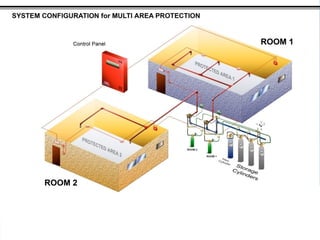
One bank of cylinders can protect more than one hazard
area which are separately located through directional
valves
Cheap agent refill.
Safe in occupied area, if discharged accidentally.
Relatively simpler post-fire clean-up.
TOTAL FLOODING INERT GAS
EXTINGUISHING SYSTEM
DISADVANTAGES
Health and safety aspects should be obtained from
system provider for discharge with and without fire.
Requires much larger space for locating large number
of cylinders.
Since a large volume of gas is introduced at high
pressure, adequate venting has to be designed for
protecting the equipment and room structure,
especially glass.
CONCLUSION
INERT GAS SYSTEM APPEARS TO BE BETTER
CHOICE IN COMPARISON TO HALOCARBONS DUE
TO
FOLLOWING REASONS:
 INERT GAS WOULD BE EASILY AVAILABLE
THROUGH OUT INDIA. REFILLING OF THE GAS
WOULD ALSO BE EASY AND CHEAPER.
 INERT GAS BEING CLOSE TO NATURE, ITS IMPACT
ON ENVIRONMENT IS MINIMUM.
Environmental Health and Safety
THANK YOU

INERT GAS EXTINGUISHING SYSTEM

  • 1.
    A PRESENTATION on Inert Gas ExtinguishingSystem By: RAMESH KU. SHARMA MECHANICAL ENGINEER
  • 2.
    Fire Protection inElectronics Areas (CR,CER,… ) • Agent requirements High efficiency Non-toxic Non-damaging to equipment Non-conductor of electricity
  • 3.
    CLEAN AGENTS The NationalFire Protection Association (NFPA) defines, a “clean agent” as “an electrically non-conducting, volatile or gaseous fire extinguishant that does not have a residue upon evaporation”.
  • 4.
    AS per NFPA-2001,Clean Agents can be classified into two categories: H A L O C A R B O N S I N E R T G A S E S C L E A N A G E N T S
  • 5.
    Halocarbon agents This agentContains one or more organic compound containing one or more elements like Fluorine,Chlorine,Bromine or iodine. These agents extinguish fire by combination of cooling action, oxygen depletion and chemical inhibition. These agent are available with trade name as FM- 200,FE13,CEA-410,NAF-Slll etc.FM-200 and NAF-Slll are used widely.
  • 6.
    Halocarbon system safetydisadvantageHalocarbon system safety disadvantage  HF for HumanHF for Human  10-minute human exposure to over 200 ppm can be lethal without10-minute human exposure to over 200 ppm can be lethal without medical intervention at increasing concentrationsmedical intervention at increasing concentrations  HF for PropertyHF for Property  A computer card, after exposure to more than 500 ppm of HF, had aA computer card, after exposure to more than 500 ppm of HF, had a total loss of functionalitytotal loss of functionality (by National Research Council Canada)(by National Research Council Canada) Halocarbon gas produces Hydrogen Fluoride (HF) that isHalocarbon gas produces Hydrogen Fluoride (HF) that is corrosive byproduct from chemical reaction with heat.corrosive byproduct from chemical reaction with heat.
  • 7.
    INERT GAS AGENT Anagent that contains as primary components one or more of the gases helium, argon, nitrogen. Inert gas agents that are blends of gases can also contain CO2 as a secondary component. INERGEN(IG-541)(N2-52%, ARGON -40%, CO2-8%) - TYCO USA, ANSUL USA, WORMOLD ASTRALIA. ARGONITE (IG-55)(N2-50%, ARGON -50%)- GINGE-KERR, DENMARK. ARGOTEC (IG-01)( ARGON -100%)- MINIMAX, GERMANY NITROGEN (IG-100)(N2-100%) - NOHMI BOSAI, JAPAN
  • 8.
    OPERATING PRINCIPLE  Inertgases extinguish fire by dilution of O2 concentration below the level that does not support combustion.  Normal atmosphere in the room contains 21% oxygen.  To extinguish fire oxygen concentration should be less than 15%  Oxygen concentration less than 12% is not safe for human occupancy.  Inert gas bring down the O2 concentration in a protected space to around 12.5%, a level that is breathable but will not support flaming combustion.
  • 9.
    safety for humanand propertysafety for human and property Human exposure time to low oxygen levelHuman exposure time to low oxygen level (from NFPA 2001)(from NFPA 2001) Oxygen concentrationOxygen concentration Above 12%Above 12% 10 to 12%10 to 12% Below 10%Below 10% Applicable roomApplicable room OccupiedOccupied OccupiedOccupied UnoccupiedUnoccupied Limited human exposure timeLimited human exposure time 5 min.5 min. 3 min.3 min. 30 sec.30 sec. Oxygen Inert gas Others 21% 78% 1% 12.5% 86.5% 1% Before gas discharge After gas discharge Composition in the air Inert gases used as extinguishing agent and puts out fire byInert gases used as extinguishing agent and puts out fire by depleting oxygen concentration to around 12.5%depleting oxygen concentration to around 12.5% Inert gas itself:Inert gas itself:  Not toxicNot toxic  No toxic byproduct generatedNo toxic byproduct generated
  • 11.
    DESIGN FACTORS Design Concentration= flame extinguishing concen. X S.F. The flame extinguishing con. For Class ‘A’ fuels shall determined by test as part of a listing program (UL 2127). For Class ‘A’ fuels: S.F. = 1.2 & For Class B Fuels = 1.3 Min. design con. For Class ‘C’ fire shall be atleast that for Class ‘A’ fire
  • 12.
    DESIGN FACTORS The amountof inert gas agent required to achieve the design con. : X (m3/m3) = ACF.(Vs/S)ln (100/100-C) Where, ACF = Atmospheric correction factor = P(hazard)/P(sea level) • Discharge Time: Time required to discharge from the nozzles 95% of the agent mass necessary to achieve the min. design concentration.
  • 13.
    Automatic Operation Fire signalsfrom two detectors – beginning of extinguishing sequence – PDI gives audio-visual indication in the hazard area. Shutdown of A/C system & closure of fire dampers Adjustable time delay for evacuation of people or to abort gas release function with the help of Abort switch. Solenoid on the actuating/master cylinder valve energised – actuating cylinder valve opens – selector valve opens – storage cylinder valves open – Gas flows into protected space
  • 14.
    Pressure Relief DamperSizePressure Relief Damper Size Pressure relief openings  During the flooding of a extinguishing zone with a gaseous extinguishing agent this must be protected against positive pressure.  This is carried out with pressure relief openings. The same mass flow resp. flow rate (density-dependent), which is brought into the room via the gas extinguishing system, must to flow off through the opening. A = 134 x Q / (P )½A = 134 x Q / (P )½ A: Calculated area of Pressure ReliefA: Calculated area of Pressure Relief Damper [cm2]Damper [cm2] Q: Maximum flow rate (= 1.6 x designQ: Maximum flow rate (= 1.6 x design flow rate) [m3/min]flow rate) [m3/min] P: Allowable strength of enclosureP: Allowable strength of enclosure [Pa][Pa]
  • 15.
    TOTAL FLOODING INERTGAS EXTINGUISHING SYSTEM ADVANTAGES Gases are environment friendly. Not subject to thermal or chemical decomposition. Remote location of cylinders is possible. One bank of cylinders can protect more than one hazard area which are separately located through directional valves Cheap agent refill. Safe in occupied area, if discharged accidentally. Relatively simpler post-fire clean-up.
  • 16.
    TOTAL FLOODING INERTGAS EXTINGUISHING SYSTEM DISADVANTAGES Health and safety aspects should be obtained from system provider for discharge with and without fire. Requires much larger space for locating large number of cylinders. Since a large volume of gas is introduced at high pressure, adequate venting has to be designed for protecting the equipment and room structure, especially glass.
  • 17.
    CONCLUSION INERT GAS SYSTEMAPPEARS TO BE BETTER CHOICE IN COMPARISON TO HALOCARBONS DUE TO FOLLOWING REASONS:  INERT GAS WOULD BE EASILY AVAILABLE THROUGH OUT INDIA. REFILLING OF THE GAS WOULD ALSO BE EASY AND CHEAPER.  INERT GAS BEING CLOSE TO NATURE, ITS IMPACT ON ENVIRONMENT IS MINIMUM.
  • 18.
    Environmental Health andSafety THANK YOU