Hard phone, cell phone, soft phone, what's next?
The Next Generation Communications
June 5, 2014 IT Summit 1:10pm – 2:00pm Science Center A
Agenda
Unified Communications (UC)
Susan DeLellis, UC Strategy and Planning
susan_delellis@harvard.edu
UC Service Demonstrations
Karen Erasmi, Voice Engineering Manager
karen_erasmi@harvard.edu
Mike Cardoza, Video Services Product Manager
mike_cardoza@harvard.edu
Q&A
2
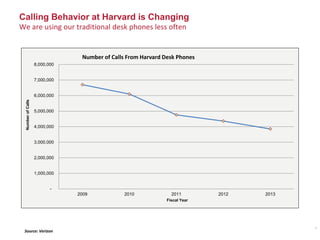
Calling Behavior at Harvard is Changing
We are using our traditional desk phones less often
-
1,000,000
2,000,000
3,000,000
4,000,000
5,000,000
6,000,000
7,000,000
8,000,000
2009 2010 2011 2012 2013
NumberofCalls
Fiscal Year
Number of Calls From Harvard Desk Phones
3
Source: Verizon
-
5,000,000
10,000,000
15,000,000
20,000,000
25,000,000
2009 2010 2011 2012 2013
TotalMinutesUsed
Fiscal Year
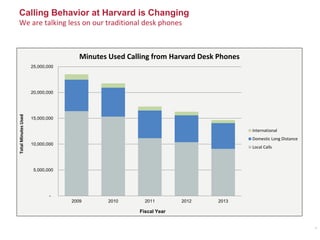
Minutes Used Calling from Harvard Desk Phones
International
Domestic Long Distance
Local Calls
Calling Behavior at Harvard is Changing
We are talking less on our traditional desk phones
4
Our Expectations and Appetite for Communications Tools are Rising
We are becoming more mobile
We are influenced by consumer based options
5
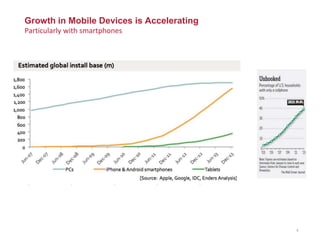
Growth in Mobile Devices is Accelerating
Particularly with smartphones
6
Unified Communications Initiative
What is it? A Transformation and Modernization
Why Now? We’re running out of Time
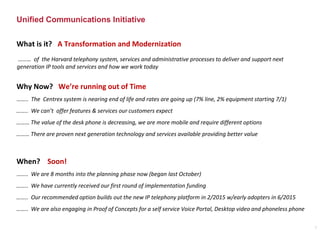
…….. The Centrex system is nearing end of life and rates are going up (7% line, 2% equipment starting 7/1)
…….. We can’t offer features & services our customers expect
……… The value of the desk phone is decreasing, we are more mobile and require different options
……… There are proven next generation technology and services available providing better value
When? Soon!
…….. We are 8 months into the planning phase now (began last October)
…….. We have currently received our first round of implementation funding
…….. Our recommended option builds out the new IP telephony platform in 2/2015 w/early adopters in 6/2015
…….. We are also engaging in Proof of Concepts for a self service Voice Portal, Desktop video and phoneless phone
……… of the Harvard telephony system, services and administrative processes to deliver and support next
generation IP tools and services and how we work today
7
8
IP Telephony Conferencing
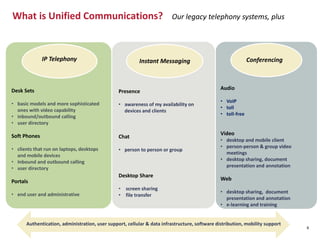
What is Unified Communications? Our legacy telephony systems, plus
Desk Sets
• basic models and more sophisticated
ones with video capability
• inbound/outbound calling
• user directory
Soft Phones
• clients that run on laptops, desktops
and mobile devices
• Inbound and outbound calling
• user directory
Portals
• end user and administrative
Presence
• awareness of my availability on
devices and clients
Chat
• person to person or group
Desktop Share
• screen sharing
• file transfer
Instant Messaging
Audio
• VoIP
• toll
• toll-free
Video
• desktop and mobile client
• person-person & group video
meetings
• desktop sharing, document
presentation and annotation
Web
• desktop sharing, document
presentation and annotation
• e-learning and training
Authentication, administration, user support, cellular & data infrastructure, software distribution, mobility support
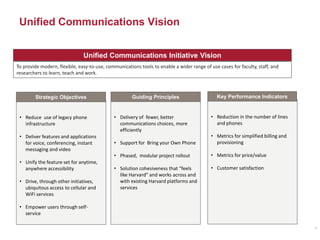
To provide modern, flexible, easy-to-use, communications tools to enable a wider range of use cases for faculty, staff, and
researchers to learn, teach and work.
Unified Communications Initiative Vision
• Reduce use of legacy phone
infrastructure
• Deliver features and applications
for voice, conferencing, instant
messaging and video
• Unify the feature set for anytime,
anywhere accessibility
• Drive, through other initiatives,
ubiquitous access to cellular and
WiFi services
• Empower users through self-
service
Strategic Objectives
• Delivery of fewer, better
communications choices, more
efficiently
• Support for Bring your Own Phone
• Phased, modular project rollout
• Solution cohesiveness that “feels
like Harvard” and works across and
with existing Harvard platforms and
services
Guiding Principles
• Reduction in the number of lines
and phones
• Metrics for simplified billing and
provisioning
• Metrics for price/value
• Customer satisfaction
Key Performance Indicators
Unified Communications Vision
9
Unified Communications Opportunities & Challenges
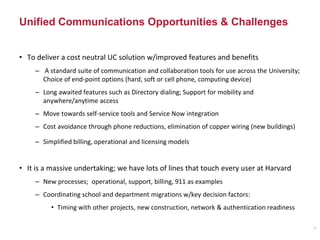
• To deliver a cost neutral UC solution w/improved features and benefits
– A standard suite of communication and collaboration tools for use across the University;
Choice of end-point options (hard, soft or cell phone, computing device)
– Long awaited features such as Directory dialing; Support for mobility and
anywhere/anytime access
– Move towards self-service tools and Service Now integration
– Cost avoidance through phone reductions, elimination of copper wiring (new buildings)
– Simplified billing, operational and licensing models
• It is a massive undertaking; we have lots of lines that touch every user at Harvard
– New processes; operational, support, billing, 911 as examples
– Coordinating school and department migrations w/key decision factors:
• Timing with other projects, new construction, network & authentication readiness
10
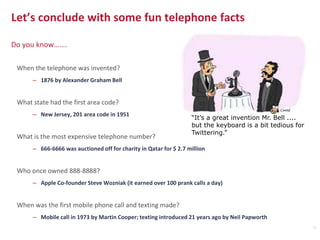
When the telephone was invented?
– 1876 by Alexander Graham Bell
What state had the first area code?
– New Jersey, 201 area code in 1951
What is the most expensive telephone number?
– 666-6666 was auctioned off for charity in Qatar for $ 2.7 million
Who once owned 888-8888?
– Apple Co-founder Steve Wozniak (it earned over 100 prank calls a day)
When was the first mobile phone call and texting made?
– Mobile call in 1973 by Martin Cooper; texting introduced 21 years ago by Neil Papworth
Let’s conclude with some fun telephone facts
Do you know…….
“It’s a great invention Mr. Bell ....
but the keyboard is a bit tedious for
Twittering.”
11
Unified Communications
Application Demonstrations
End User Voice Portal
Phoneless Phone
Jabber Desktop Video
12
Thank you for attending
Questions?
13

Hardphonecellphone

  • 1.
    Hard phone, cellphone, soft phone, what's next? The Next Generation Communications June 5, 2014 IT Summit 1:10pm – 2:00pm Science Center A
  • 2.
    Agenda Unified Communications (UC) SusanDeLellis, UC Strategy and Planning susan_delellis@harvard.edu UC Service Demonstrations Karen Erasmi, Voice Engineering Manager karen_erasmi@harvard.edu Mike Cardoza, Video Services Product Manager mike_cardoza@harvard.edu Q&A 2
  • 3.
    Calling Behavior atHarvard is Changing We are using our traditional desk phones less often - 1,000,000 2,000,000 3,000,000 4,000,000 5,000,000 6,000,000 7,000,000 8,000,000 2009 2010 2011 2012 2013 NumberofCalls Fiscal Year Number of Calls From Harvard Desk Phones 3 Source: Verizon
  • 4.
    - 5,000,000 10,000,000 15,000,000 20,000,000 25,000,000 2009 2010 20112012 2013 TotalMinutesUsed Fiscal Year Minutes Used Calling from Harvard Desk Phones International Domestic Long Distance Local Calls Calling Behavior at Harvard is Changing We are talking less on our traditional desk phones 4
  • 5.
    Our Expectations andAppetite for Communications Tools are Rising We are becoming more mobile We are influenced by consumer based options 5
  • 6.
    Growth in MobileDevices is Accelerating Particularly with smartphones 6
  • 7.
    Unified Communications Initiative Whatis it? A Transformation and Modernization Why Now? We’re running out of Time …….. The Centrex system is nearing end of life and rates are going up (7% line, 2% equipment starting 7/1) …….. We can’t offer features & services our customers expect ……… The value of the desk phone is decreasing, we are more mobile and require different options ……… There are proven next generation technology and services available providing better value When? Soon! …….. We are 8 months into the planning phase now (began last October) …….. We have currently received our first round of implementation funding …….. Our recommended option builds out the new IP telephony platform in 2/2015 w/early adopters in 6/2015 …….. We are also engaging in Proof of Concepts for a self service Voice Portal, Desktop video and phoneless phone ……… of the Harvard telephony system, services and administrative processes to deliver and support next generation IP tools and services and how we work today 7
  • 8.
    8 IP Telephony Conferencing Whatis Unified Communications? Our legacy telephony systems, plus Desk Sets • basic models and more sophisticated ones with video capability • inbound/outbound calling • user directory Soft Phones • clients that run on laptops, desktops and mobile devices • Inbound and outbound calling • user directory Portals • end user and administrative Presence • awareness of my availability on devices and clients Chat • person to person or group Desktop Share • screen sharing • file transfer Instant Messaging Audio • VoIP • toll • toll-free Video • desktop and mobile client • person-person & group video meetings • desktop sharing, document presentation and annotation Web • desktop sharing, document presentation and annotation • e-learning and training Authentication, administration, user support, cellular & data infrastructure, software distribution, mobility support
  • 9.
    To provide modern,flexible, easy-to-use, communications tools to enable a wider range of use cases for faculty, staff, and researchers to learn, teach and work. Unified Communications Initiative Vision • Reduce use of legacy phone infrastructure • Deliver features and applications for voice, conferencing, instant messaging and video • Unify the feature set for anytime, anywhere accessibility • Drive, through other initiatives, ubiquitous access to cellular and WiFi services • Empower users through self- service Strategic Objectives • Delivery of fewer, better communications choices, more efficiently • Support for Bring your Own Phone • Phased, modular project rollout • Solution cohesiveness that “feels like Harvard” and works across and with existing Harvard platforms and services Guiding Principles • Reduction in the number of lines and phones • Metrics for simplified billing and provisioning • Metrics for price/value • Customer satisfaction Key Performance Indicators Unified Communications Vision 9
  • 10.
    Unified Communications Opportunities& Challenges • To deliver a cost neutral UC solution w/improved features and benefits – A standard suite of communication and collaboration tools for use across the University; Choice of end-point options (hard, soft or cell phone, computing device) – Long awaited features such as Directory dialing; Support for mobility and anywhere/anytime access – Move towards self-service tools and Service Now integration – Cost avoidance through phone reductions, elimination of copper wiring (new buildings) – Simplified billing, operational and licensing models • It is a massive undertaking; we have lots of lines that touch every user at Harvard – New processes; operational, support, billing, 911 as examples – Coordinating school and department migrations w/key decision factors: • Timing with other projects, new construction, network & authentication readiness 10
  • 11.
    When the telephonewas invented? – 1876 by Alexander Graham Bell What state had the first area code? – New Jersey, 201 area code in 1951 What is the most expensive telephone number? – 666-6666 was auctioned off for charity in Qatar for $ 2.7 million Who once owned 888-8888? – Apple Co-founder Steve Wozniak (it earned over 100 prank calls a day) When was the first mobile phone call and texting made? – Mobile call in 1973 by Martin Cooper; texting introduced 21 years ago by Neil Papworth Let’s conclude with some fun telephone facts Do you know……. “It’s a great invention Mr. Bell .... but the keyboard is a bit tedious for Twittering.” 11
  • 12.
    Unified Communications Application Demonstrations EndUser Voice Portal Phoneless Phone Jabber Desktop Video 12
  • 13.
    Thank you forattending Questions? 13