
Unified CommunicationsPresented by,Sarah DeoriUtkarsh VermaVandan JoshiVijay Deep ShuklaChineahRowin
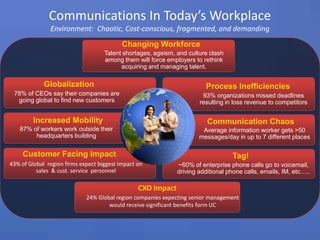
Customer Facing Impact43% of Global  region firms expect biggest impact on sales  & cust. service  personnelCommunications In Today’s WorkplaceEnvironment:  Chaotic, Cost-conscious, fragmented, and demandingChanging WorkforceCommunication ChaosAverage information worker gets >50 messages/day in up to 7 different placesTalent shortages, ageism, and culture clash among them will force employers to rethink acquiring and managing talent.GlobalizationProcess Inefficiencies78% of CEOs say their companies are going global to find new customers93% organizations missed deadlines resulting in loss revenue to competitorsIncreased Mobility87% of workers work outside their headquarters building Tag!~60% of enterprise phone calls go to voicemail, driving additional phone calls, emails, IM, etc….. CXO Impact24% Global region companies expecting senior management would receive significant benefits form UC
What Is Unified Communications?Instant messagingPresence informationIP telephonyVideo conferencingCall control Speech control
How its different from unified messaging.Unified communications refers to both real-time and non-real time delivery of communications based on the preferred method and location of the recipientUnified messaging systems picksmessages from several sources (such as email, voice mail and faxes), but holds those messages only for retrieval at a later time.
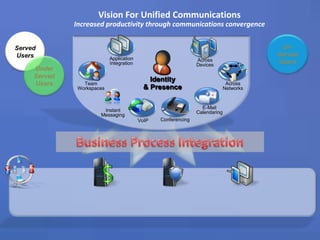
Vision For Unified CommunicationsIncreased productivity through communications convergenceServedUsers Un-ServedUsers Under ServedUsers E-MailCalendaringVoIPAcross DevicesConferencing InstantMessagingAcross NetworksTeam WorkspacesBusiness Process IntegrationIdentity & PresenceApplication Integration
Business process integrationAllows an individual to send a message on one medium and receive on anotherMain focus of Unified Communications is to reduce communication response time
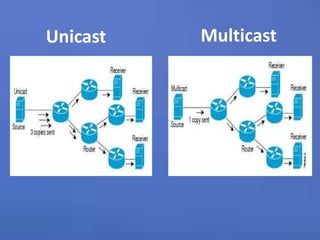
MulticastUnicast
ComponentsMultiple modes of business communications can be seamlessly integratedA solution which consists of various elementscall control Multi mode communicationsPresenceinstant messagingunified messagingspeech access and personal assistantconferencing collaboration toolsMobilitybusiness process integration
Business benefitsStreamline information delivery Ensure ease of useFaster interaction and service-deliveryMore direct collaboration between co-workers and with suppliers and clients
Who is it forUnified communications is very useful for knowledge workersInformation workersService workers Facilitates always-available style of communicationCan be tailored to each person’s specific job or to a particular section of a company
Thank You

Unified Communications

  • 1.
    Unified CommunicationsPresented by,SarahDeoriUtkarsh VermaVandan JoshiVijay Deep ShuklaChineahRowin
  • 2.
    Customer Facing Impact43%of Global region firms expect biggest impact on sales & cust. service personnelCommunications In Today’s WorkplaceEnvironment: Chaotic, Cost-conscious, fragmented, and demandingChanging WorkforceCommunication ChaosAverage information worker gets >50 messages/day in up to 7 different placesTalent shortages, ageism, and culture clash among them will force employers to rethink acquiring and managing talent.GlobalizationProcess Inefficiencies78% of CEOs say their companies are going global to find new customers93% organizations missed deadlines resulting in loss revenue to competitorsIncreased Mobility87% of workers work outside their headquarters building Tag!~60% of enterprise phone calls go to voicemail, driving additional phone calls, emails, IM, etc….. CXO Impact24% Global region companies expecting senior management would receive significant benefits form UC
  • 3.
    What Is UnifiedCommunications?Instant messagingPresence informationIP telephonyVideo conferencingCall control Speech control
  • 4.
    How its differentfrom unified messaging.Unified communications refers to both real-time and non-real time delivery of communications based on the preferred method and location of the recipientUnified messaging systems picksmessages from several sources (such as email, voice mail and faxes), but holds those messages only for retrieval at a later time.
  • 5.
    Vision For UnifiedCommunicationsIncreased productivity through communications convergenceServedUsers Un-ServedUsers Under ServedUsers E-MailCalendaringVoIPAcross DevicesConferencing InstantMessagingAcross NetworksTeam WorkspacesBusiness Process IntegrationIdentity & PresenceApplication Integration
  • 6.
    Business process integrationAllowsan individual to send a message on one medium and receive on anotherMain focus of Unified Communications is to reduce communication response time
  • 7.
  • 8.
    ComponentsMultiple modes ofbusiness communications can be seamlessly integratedA solution which consists of various elementscall control Multi mode communicationsPresenceinstant messagingunified messagingspeech access and personal assistantconferencing collaboration toolsMobilitybusiness process integration
  • 9.
    Business benefitsStreamline informationdelivery Ensure ease of useFaster interaction and service-deliveryMore direct collaboration between co-workers and with suppliers and clients
  • 10.
    Who is itforUnified communications is very useful for knowledge workersInformation workersService workers Facilitates always-available style of communicationCan be tailored to each person’s specific job or to a particular section of a company
  • 11.

Editor's Notes

  • #4 * Unified communications (UC) is the integration of real-time communication services – mentioned above.* UC is not a single product, but a set of products that provides a consistent unified user interface and user experience across multiple devices and media types.[1]
  • #7 to simplify and integrate all forms of communications in view to optimize business processes and reduce the response time, manage flows and eliminate device and media dependencies. It should be possible to easily transfer any activity or message to another medium. For example, one can receive a voice mail message and choose to access it through email or a cell phone. If the sender is online according to the presence information and currently accepts calls, the response can be sent immediately through text chat or video call. Otherwise, it may be sent as a non real-time message that can be accessed through a variety of media.