eXchange Closure and Commencement of the Unified  Communications Program
Linda O’Brien Vice Principal, Information
Scholarly information in a digital age   choices for the University of Melbourne www.informationfutures.unimelb.edu.au Information Futures Commission
The eXchange Story It’s all about collaboration & connectedness
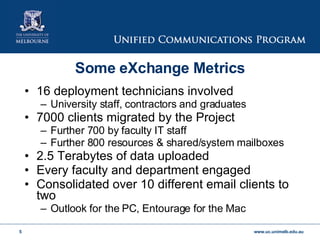
Some eXchange Metrics 16 deployment technicians involved University staff, contractors and graduates 7000 clients migrated by the Project  Further 700 by faculty IT staff Further 800 resources & shared/system mailboxes 2.5 Terabytes of data uploaded Every faculty and department engaged Consolidated over 10 different email clients to two Outlook for the PC, Entourage for the Mac
Thanks to Many eXchange Steering Group Liz Baré  Donald Speagle Dianne Chambers  Alister Air Peter Tregloan Richard Frampton  Peter Jones Andrew Yeoh Ken Knot Richard Phillips Current eXchange Team Members Reuchlin Teo David Marshall  Ché Broekman  Ursula Soulsby Hilary Sissons Michelle Ely Ange Mcharg  Aaron Goldberg Timothy Uhen Hanh Kinh Tran  Dan Su
Thanks to Many Past eXchange Team Members Mark Leech Simon Marsh Elliot B. Gingold Kevin Edwards Guy Edwards Anna Morley Daniel Chan Jessica Deane Long Hoang Nguyen Francis Chan Quan Pham (continued) Andrew Chan Leah Bezant Matt Hurst Operational teams Craig Waller Greg Morgan Drew Poynton  Michael Blair Will Belcher
 
Richard Frampton Faculty General Manager Faculty of Medicine, Dentistry, & Health Sciences
eXchange – a Faculty View   IS – Faculty Partnership One platform - whole of University initiative  Rollout timelines Building bridges throughout
eXchange for MDHS - Benefits   new Spam, Archiving, Redundancy and other capabilities  Engagement What was different/special/useful How the uni can benefit from continuing this type of collaboration Consultative , Results focussed
 
Liz Baré Vice Principal  & Head of University Services
Commencement of Unified Communications From eXchange to Unified Communications A new opportunity to deliver further Progress towards the University vision Real savings Improvements in collaboration New functionality through Voice over IP
Why Unified Communications Supports the University’s vision Take the University to the next level in Telecommunications capability Able to contribute to just about any communication or learning/teaching process A University-wide cooperative effort
Reduce on-going operational and maintenance costs of telephony services Reduce the cost of collaboration and research Facilitate and improve both internal and external communications Particularly for the University’s international connections Why Unified Communications
 
Andrew Wilmore Program Manager Unified Communications
 
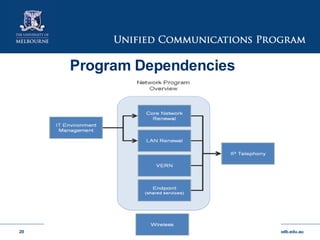
Program Dependencies
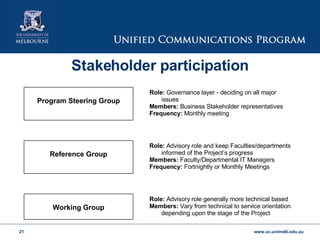
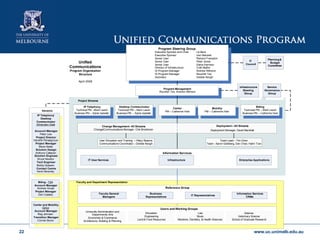
Stakeholder participation Role:  Advisory role generally more technical based Members:  Vary from technical to service orientation depending upon the stage of the Project Working Group Role:  Advisory role and keep Faculties/departments informed of the Project’s progress Members:  Faculty/Departmental IT Managers Frequency:  Fortnightly or Monthly Meetings Reference Group Role:  Governance layer - deciding on all major issues Members:  Business Stakeholder representatives Frequency:  Monthly meeting Program Steering Group
 
 
Colin Blythe Acting Director, Infrastructure Information Services
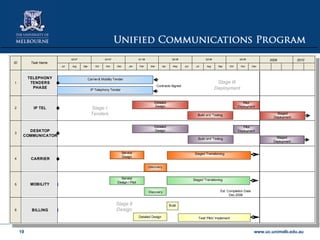
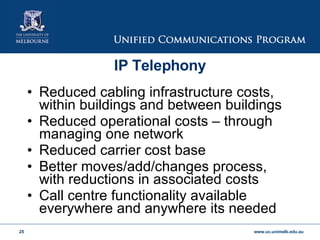
IP Telephony Reduced cabling infrastructure costs, within buildings and between buildings Reduced operational costs – through managing one network Reduced carrier cost base Better moves/add/changes process, with reductions in associated costs Call centre functionality available everywhere and anywhere its needed
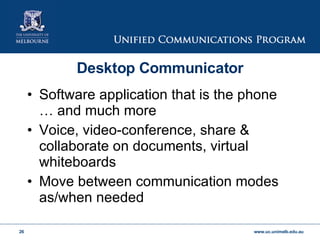
Desktop Communicator Software application that is the phone … and much more Voice, video-conference, share & collaborate on documents, virtual whiteboards Move between communication modes as/when needed
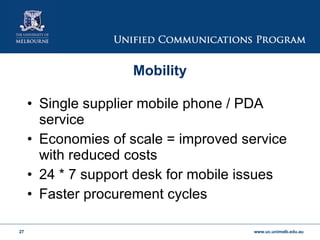
Mobility Single supplier mobile phone / PDA service Economies of scale = improved service with reduced costs 24 * 7 support desk for mobile issues Faster procurement cycles
Billing Centralised process to collate and report on faculty and departmental costs for fixed line and mobile phone services Automated processing of carrier bills, and disbursement to Themis codes Self-service reports
Partners Cisco  – networking, wireless and IP Telephony – the underlying technology supplier Dimension Data  – IP Telephony vendor and integrator NEC  – current telephone supplier Optus  – carrier services, mobile handsets TSA  – Billing system supplier
 
Thank you Please view the various exhibits, and discuss your needs and ideas with the  team members. Program Website and Blog   Website  www.uc.unimelb.edu.au Blog  http:// blogs.unimelb.edu.au /uc/

UC Launch

  • 1.
    eXchange Closure andCommencement of the Unified Communications Program
  • 2.
    Linda O’Brien VicePrincipal, Information
  • 3.
    Scholarly information ina digital age  choices for the University of Melbourne www.informationfutures.unimelb.edu.au Information Futures Commission
  • 4.
    The eXchange StoryIt’s all about collaboration & connectedness
  • 5.
    Some eXchange Metrics16 deployment technicians involved University staff, contractors and graduates 7000 clients migrated by the Project Further 700 by faculty IT staff Further 800 resources & shared/system mailboxes 2.5 Terabytes of data uploaded Every faculty and department engaged Consolidated over 10 different email clients to two Outlook for the PC, Entourage for the Mac
  • 6.
    Thanks to ManyeXchange Steering Group Liz Baré Donald Speagle Dianne Chambers Alister Air Peter Tregloan Richard Frampton Peter Jones Andrew Yeoh Ken Knot Richard Phillips Current eXchange Team Members Reuchlin Teo David Marshall Ché Broekman Ursula Soulsby Hilary Sissons Michelle Ely Ange Mcharg Aaron Goldberg Timothy Uhen Hanh Kinh Tran Dan Su
  • 7.
    Thanks to ManyPast eXchange Team Members Mark Leech Simon Marsh Elliot B. Gingold Kevin Edwards Guy Edwards Anna Morley Daniel Chan Jessica Deane Long Hoang Nguyen Francis Chan Quan Pham (continued) Andrew Chan Leah Bezant Matt Hurst Operational teams Craig Waller Greg Morgan Drew Poynton Michael Blair Will Belcher
  • 8.
  • 9.
    Richard Frampton FacultyGeneral Manager Faculty of Medicine, Dentistry, & Health Sciences
  • 10.
    eXchange – aFaculty View IS – Faculty Partnership One platform - whole of University initiative Rollout timelines Building bridges throughout
  • 11.
    eXchange for MDHS- Benefits new Spam, Archiving, Redundancy and other capabilities Engagement What was different/special/useful How the uni can benefit from continuing this type of collaboration Consultative , Results focussed
  • 12.
  • 13.
    Liz Baré VicePrincipal & Head of University Services
  • 14.
    Commencement of UnifiedCommunications From eXchange to Unified Communications A new opportunity to deliver further Progress towards the University vision Real savings Improvements in collaboration New functionality through Voice over IP
  • 15.
    Why Unified CommunicationsSupports the University’s vision Take the University to the next level in Telecommunications capability Able to contribute to just about any communication or learning/teaching process A University-wide cooperative effort
  • 16.
    Reduce on-going operationaland maintenance costs of telephony services Reduce the cost of collaboration and research Facilitate and improve both internal and external communications Particularly for the University’s international connections Why Unified Communications
  • 17.
  • 18.
    Andrew Wilmore ProgramManager Unified Communications
  • 19.
  • 20.
  • 21.
    Stakeholder participation Role: Advisory role generally more technical based Members: Vary from technical to service orientation depending upon the stage of the Project Working Group Role: Advisory role and keep Faculties/departments informed of the Project’s progress Members: Faculty/Departmental IT Managers Frequency: Fortnightly or Monthly Meetings Reference Group Role: Governance layer - deciding on all major issues Members: Business Stakeholder representatives Frequency: Monthly meeting Program Steering Group
  • 22.
  • 23.
  • 24.
    Colin Blythe ActingDirector, Infrastructure Information Services
  • 25.
    IP Telephony Reducedcabling infrastructure costs, within buildings and between buildings Reduced operational costs – through managing one network Reduced carrier cost base Better moves/add/changes process, with reductions in associated costs Call centre functionality available everywhere and anywhere its needed
  • 26.
    Desktop Communicator Softwareapplication that is the phone … and much more Voice, video-conference, share & collaborate on documents, virtual whiteboards Move between communication modes as/when needed
  • 27.
    Mobility Single suppliermobile phone / PDA service Economies of scale = improved service with reduced costs 24 * 7 support desk for mobile issues Faster procurement cycles
  • 28.
    Billing Centralised processto collate and report on faculty and departmental costs for fixed line and mobile phone services Automated processing of carrier bills, and disbursement to Themis codes Self-service reports
  • 29.
    Partners Cisco – networking, wireless and IP Telephony – the underlying technology supplier Dimension Data – IP Telephony vendor and integrator NEC – current telephone supplier Optus – carrier services, mobile handsets TSA – Billing system supplier
  • 30.
  • 31.
    Thank you Pleaseview the various exhibits, and discuss your needs and ideas with the team members. Program Website and Blog Website www.uc.unimelb.edu.au Blog http:// blogs.unimelb.edu.au /uc/