Aircraft Roll Control
Guided by:
Mr. Anshul Bansal
Submitted by:
Palak Pandya
14/608
INTRODUCTION
• An aileron is a hinged flight control surface usually at
the trailing edge of each wing. Ailerons are used in pairs to
control the aircraft in roll, which normally results in a change in
flight path. Movement around this axis is called 'rolling'.
• Control surfaces of a fixed wing aircraft are attached to the
airframe on the hinges or tracks so that they may move and thus
deflect the air stream passing over them.
• Control surfaces are used to change the motion of aircraft in
respective direction.
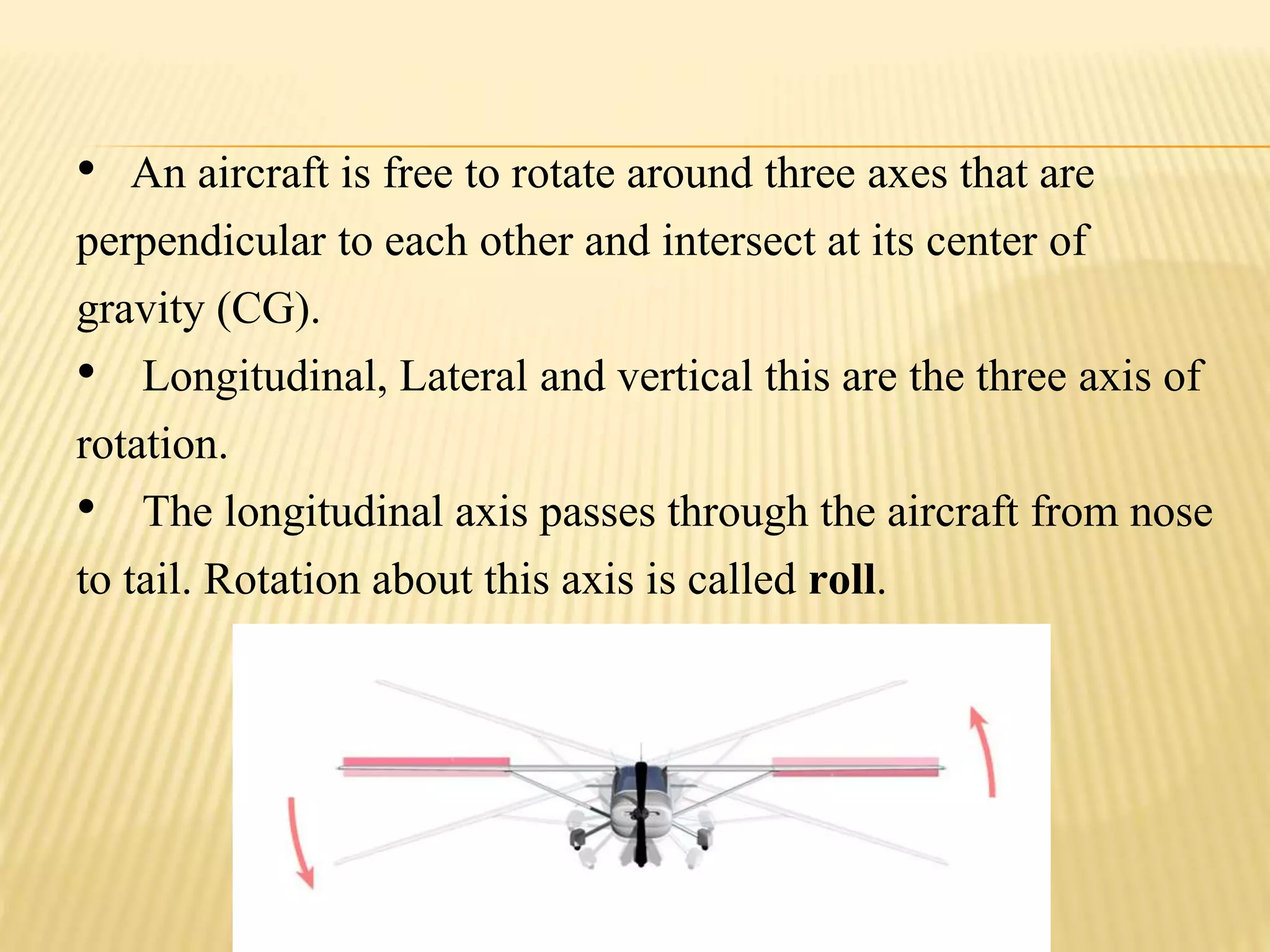
• An aircraft is free to rotate around three axes that are
perpendicular to each other and intersect at its center of
gravity (CG).
• Longitudinal, Lateral and vertical this are the three axis of
rotation.
• The longitudinal axis passes through the aircraft from nose
to tail. Rotation about this axis is called roll.
DEVICES USED:
• Primary control surface : aileron.
• Secondary control surface : spoilers, flaps, trim tabs.
• yoke
AILERON :
• Ailerons control roll.
• Ailerons are mounted on the trailing edge of each wing
near the wingtips and move in opposite directions.
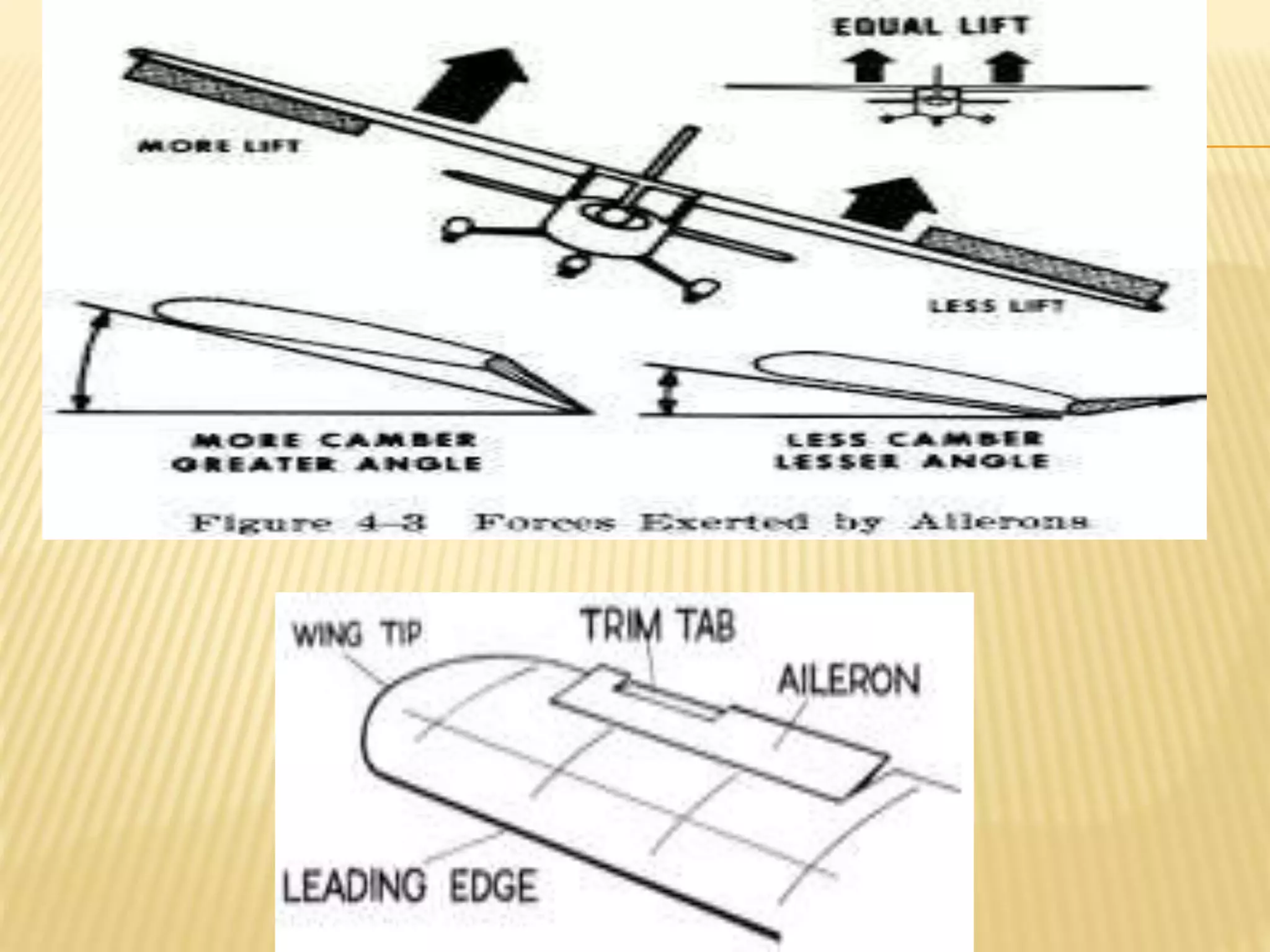
• When the pilot moves the stick left, the left aileron goes up
and the right aileron goes down. A raised aileron reduces lift
on that wing and a lowered one increases lift, so moving the
stick left causes the left wing to drop and the right wing to rise.
This causes the aircraft to roll to the left and begin to turn to
the left.
• Centering the stick returns the ailerons to neutral
maintaining the bank angle. The aircraft will continue to
turn until opposite aileron motion returns the bank angle
to zero to fly straight.
• This motion is about the direction of the motion(X-
axis) of the airplane and is called ROLLINGMOTION.
• Aileron act as a controlling surface for rolling
motion and therefore are called LATERAL
CONTROLS.
• Trim tabs :
Trim tabs are small movable sections
resembling scaled down ailerons located at
or near the trailing edge of the aileron.
• Yokes :
The control yokes also vary greatly
amongst aircraft. There are yokes where
roll is controlled by rotating the yoke
clockwise/counterclockwise (like steering
a car)
ROLL CONTROL WITHOUT AILERONS
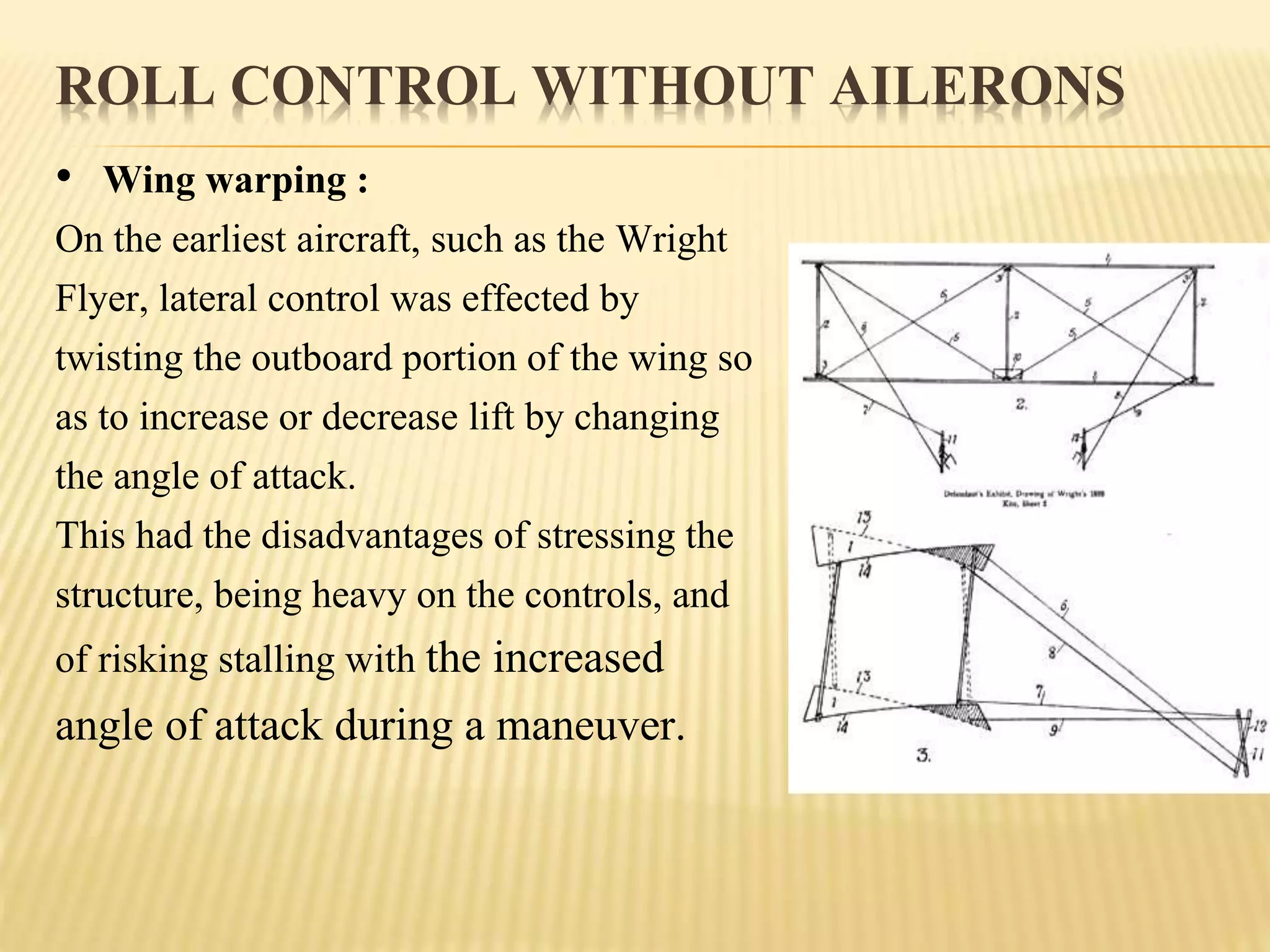
• Wing warping :
On the earliest aircraft, such as the Wright
Flyer, lateral control was effected by
twisting the outboard portion of the wing so
as to increase or decrease lift by changing
the angle of attack.
This had the disadvantages of stressing the
structure, being heavy on the controls, and
of risking stalling with the increased
angle of attack during a maneuver.
• Differential spoilers :
Spoilers are devices that when extended into the airflow over a
wing, disrupt the airflow and reduce the amount of lift generated.
Some aircraft like the MU-2 have most of their wing trailing
edge covered in flaps, leaving little room for ailerons. By spoiling
airflow on one wing, the wing lowers and the aircraft rolls.
• Roll induced by rudder :
Some aircraft such as the Fokker Spin and model gliders lack any
type of lateral control. Deflecting the rudder gives yaw and a lot of
differential wing lift, giving a yaw induced roll moment.
•Weight-Shift:
Here's a technique commonly used in
ultralights and hang gliders. Weight shifting
increases the load on one wing, and twists it.
The wing twist decreases the angle of attack,
and the aircraft begins to roll.
THANK YOU

Hands on experience with aircraft roll control.

  • 1.
    Aircraft Roll Control Guidedby: Mr. Anshul Bansal Submitted by: Palak Pandya 14/608
  • 2.
    INTRODUCTION • An aileronis a hinged flight control surface usually at the trailing edge of each wing. Ailerons are used in pairs to control the aircraft in roll, which normally results in a change in flight path. Movement around this axis is called 'rolling'. • Control surfaces of a fixed wing aircraft are attached to the airframe on the hinges or tracks so that they may move and thus deflect the air stream passing over them. • Control surfaces are used to change the motion of aircraft in respective direction.
  • 3.
    • An aircraftis free to rotate around three axes that are perpendicular to each other and intersect at its center of gravity (CG). • Longitudinal, Lateral and vertical this are the three axis of rotation. • The longitudinal axis passes through the aircraft from nose to tail. Rotation about this axis is called roll.
  • 5.
    DEVICES USED: • Primarycontrol surface : aileron. • Secondary control surface : spoilers, flaps, trim tabs. • yoke
  • 6.
    AILERON : • Aileronscontrol roll. • Ailerons are mounted on the trailing edge of each wing near the wingtips and move in opposite directions. • When the pilot moves the stick left, the left aileron goes up and the right aileron goes down. A raised aileron reduces lift on that wing and a lowered one increases lift, so moving the stick left causes the left wing to drop and the right wing to rise. This causes the aircraft to roll to the left and begin to turn to the left.
  • 7.
    • Centering thestick returns the ailerons to neutral maintaining the bank angle. The aircraft will continue to turn until opposite aileron motion returns the bank angle to zero to fly straight. • This motion is about the direction of the motion(X- axis) of the airplane and is called ROLLINGMOTION. • Aileron act as a controlling surface for rolling motion and therefore are called LATERAL CONTROLS.
  • 10.
    • Trim tabs: Trim tabs are small movable sections resembling scaled down ailerons located at or near the trailing edge of the aileron. • Yokes : The control yokes also vary greatly amongst aircraft. There are yokes where roll is controlled by rotating the yoke clockwise/counterclockwise (like steering a car)
  • 11.
    ROLL CONTROL WITHOUTAILERONS • Wing warping : On the earliest aircraft, such as the Wright Flyer, lateral control was effected by twisting the outboard portion of the wing so as to increase or decrease lift by changing the angle of attack. This had the disadvantages of stressing the structure, being heavy on the controls, and of risking stalling with the increased angle of attack during a maneuver.
  • 12.
    • Differential spoilers: Spoilers are devices that when extended into the airflow over a wing, disrupt the airflow and reduce the amount of lift generated. Some aircraft like the MU-2 have most of their wing trailing edge covered in flaps, leaving little room for ailerons. By spoiling airflow on one wing, the wing lowers and the aircraft rolls. • Roll induced by rudder : Some aircraft such as the Fokker Spin and model gliders lack any type of lateral control. Deflecting the rudder gives yaw and a lot of differential wing lift, giving a yaw induced roll moment.
  • 13.
    •Weight-Shift: Here's a techniquecommonly used in ultralights and hang gliders. Weight shifting increases the load on one wing, and twists it. The wing twist decreases the angle of attack, and the aircraft begins to roll.
  • 15.