Submitted By:-
Vikram Kumar
Submitted To:-
Mr. Anshul Bansal
What is Aircraft Stall?
•A stall is a condition in wherein the angle of attack increases beyond a certain
point such that the lift begins to decrease.
•The angle at which this occurs is called the critical angle of attack.
•As angle of attack increases, the separated regions on the top of the wing
increase in size and hinder the wing’s ability to create lift.
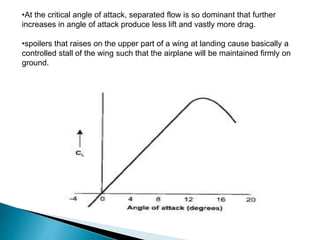
•At the critical angle of attack, separated flow is so dominant that further
increases in angle of attack produce less lift and vastly more drag.
•spoilers that raises on the upper part of a wing at landing cause basically a
controlled stall of the wing such that the airplane will be maintained firmly on
ground.
Aircraft have
• attached flow or unstalled flight regions
• separated flow or stalled flight regions
Different types of flow Region
attached flow or unstalled flight regions
•air flowing over the flight control surfaces behaves in a predictable and expected
manner.
•The stall angle of attack is the angle of attack at which significant separation of
the air occurs over the wing of the aircraft.
• At the stall angle of attack, the wing no longer generates sufficient lift to maintain
level flight and the fluid flowing over control surfaces is no longer sufficient to allow
the control surfaces to generate adequate forces to control the aircraft.
•As a result, the control surfaces are no longer effective in controlling the aircraft's
orientation and flight path.
Principle Of Stall Protection System
•aircraft stall protection systems calculate two different maximum angles of attack
and that limit the aircraft angle of attack to the at least two different maximum
angles of attack at different times.
Difference Between Stall Protection
And Warning System
•Stall warning systems provide visual,
audible, and tactile indications to the pilot
that the aircraft is approaching the stall
angle of attack.
•Stall warning systems do not affect the
pilot control of the aircraft, and as such,
the pilot may elect to ignore the stall
warning system and command the
aircraft into the stall (or uncontrolled)
flight region.
•Stall protection systems, prevent the
aircraft from entering the stalled flight
region by taking control of the flight
control surfaces from the pilot and
actuating the flight control surfaces.
•stall protection systems prevent the
aircraft angle of attack from exceeding
the stall angle of attack so that the wing
retains predictable lift characteristics
STALL PROTECTION SYSTEM
•An aircraft stall protection system and method include calculating a first
angle of attack and a second angle of attack based on aircraft configuration
and environmental conditions.
•The system and method limit the actual aircraft angle of attack to the first
angle of attack for a predetermined period of time and thereafter the system
and method limit the actual aircraft angle of attack to the second angle of
attack.
•The system and method allow the aircraft operator or pilot to extract
maximum performance from the aircraft for any given set of flight
conditions, without the risk of stalling for a prolonged period of time.
•This system and method are suitable for use in conjunction with a stall
warning system.
Hands on experience with stall protection system

Hands on experience with stall protection system

  • 1.
  • 2.
    What is AircraftStall? •A stall is a condition in wherein the angle of attack increases beyond a certain point such that the lift begins to decrease. •The angle at which this occurs is called the critical angle of attack. •As angle of attack increases, the separated regions on the top of the wing increase in size and hinder the wing’s ability to create lift.
  • 3.
    •At the criticalangle of attack, separated flow is so dominant that further increases in angle of attack produce less lift and vastly more drag. •spoilers that raises on the upper part of a wing at landing cause basically a controlled stall of the wing such that the airplane will be maintained firmly on ground.
  • 4.
    Aircraft have • attachedflow or unstalled flight regions • separated flow or stalled flight regions Different types of flow Region
  • 5.
    attached flow orunstalled flight regions •air flowing over the flight control surfaces behaves in a predictable and expected manner. •The stall angle of attack is the angle of attack at which significant separation of the air occurs over the wing of the aircraft. • At the stall angle of attack, the wing no longer generates sufficient lift to maintain level flight and the fluid flowing over control surfaces is no longer sufficient to allow the control surfaces to generate adequate forces to control the aircraft. •As a result, the control surfaces are no longer effective in controlling the aircraft's orientation and flight path.
  • 6.
    Principle Of StallProtection System •aircraft stall protection systems calculate two different maximum angles of attack and that limit the aircraft angle of attack to the at least two different maximum angles of attack at different times.
  • 7.
    Difference Between StallProtection And Warning System •Stall warning systems provide visual, audible, and tactile indications to the pilot that the aircraft is approaching the stall angle of attack. •Stall warning systems do not affect the pilot control of the aircraft, and as such, the pilot may elect to ignore the stall warning system and command the aircraft into the stall (or uncontrolled) flight region. •Stall protection systems, prevent the aircraft from entering the stalled flight region by taking control of the flight control surfaces from the pilot and actuating the flight control surfaces. •stall protection systems prevent the aircraft angle of attack from exceeding the stall angle of attack so that the wing retains predictable lift characteristics
  • 8.
    STALL PROTECTION SYSTEM •Anaircraft stall protection system and method include calculating a first angle of attack and a second angle of attack based on aircraft configuration and environmental conditions. •The system and method limit the actual aircraft angle of attack to the first angle of attack for a predetermined period of time and thereafter the system and method limit the actual aircraft angle of attack to the second angle of attack.
  • 9.
    •The system andmethod allow the aircraft operator or pilot to extract maximum performance from the aircraft for any given set of flight conditions, without the risk of stalling for a prolonged period of time. •This system and method are suitable for use in conjunction with a stall warning system.