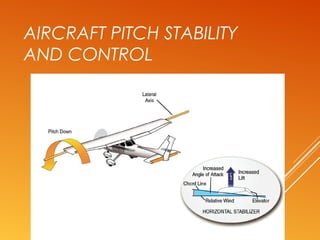
AIRCRAFT PITCH
CONTROL
Submitted To – Mr. Anshul Bansal
Submitted By – Pankaj Aswal (14/609)
INTRODUCTION
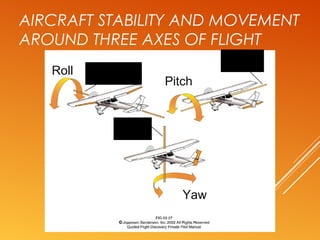
 Aircraft have three axes of flight which intersect
at the center of gravity
 Aircraft must be stable around these three axes
for controlled flight
 Aircraft must be controlled to rotate around
these three axes to change direction
Longitudinal
Axis
Lateral
Axis
Vertical
Axis
AIRCRAFT STABILITY AND MOVEMENT
AROUND THREE AXES OF FLIGHT
Roll
Pitch
Yaw
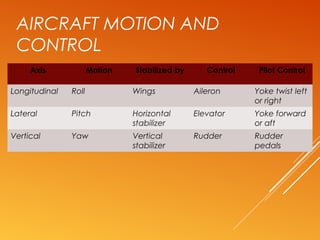
AIRCRAFT MOTION AND
CONTROL
Axis Motion Stabilized by Control Pilot Control
Longitudinal Roll Wings Aileron Yoke twist left
or right
Lateral Pitch Horizontal
stabilizer
Elevator Yoke forward
or aft
Vertical Yaw Vertical
stabilizer
Rudder Rudder
pedals
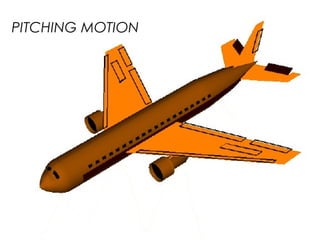
PITCHING MOTION
ELEVATOR
 Moveable part of the horizontal stabilizer, hinged to the back
of the fixes part of the horizontal tail.
 Elevator moves upwards or downwards to create a lift,
resulting in a net moment about the CG of the plane.
 Raised elevator push down the tail and cause the nose to
pitch up resulting in increase in angle of attack and
consequently the altitude.
ELEVATOR
 when the pilot pulls the stick forward the elevators go
down to increase the lift at the front and lift the nose up.
 It result in motion about the direction of wing(Y-axis) of the
airplane and is called PITCHING MOTION.
 Elevator controls the latitudinal motion and are therefore
called LONGITUDINAL CONTROLS.
AIRCRAFT PITCH STABILITY
AND CONTROL
THANK YOU

Hands on experience with aircraft pitch control

  • 1.
    AIRCRAFT PITCH CONTROL Submitted To– Mr. Anshul Bansal Submitted By – Pankaj Aswal (14/609)
  • 2.
    INTRODUCTION  Aircraft havethree axes of flight which intersect at the center of gravity  Aircraft must be stable around these three axes for controlled flight  Aircraft must be controlled to rotate around these three axes to change direction
  • 4.
    Longitudinal Axis Lateral Axis Vertical Axis AIRCRAFT STABILITY ANDMOVEMENT AROUND THREE AXES OF FLIGHT Roll Pitch Yaw
  • 5.
    AIRCRAFT MOTION AND CONTROL AxisMotion Stabilized by Control Pilot Control Longitudinal Roll Wings Aileron Yoke twist left or right Lateral Pitch Horizontal stabilizer Elevator Yoke forward or aft Vertical Yaw Vertical stabilizer Rudder Rudder pedals
  • 6.
  • 7.
    ELEVATOR  Moveable partof the horizontal stabilizer, hinged to the back of the fixes part of the horizontal tail.  Elevator moves upwards or downwards to create a lift, resulting in a net moment about the CG of the plane.  Raised elevator push down the tail and cause the nose to pitch up resulting in increase in angle of attack and consequently the altitude.
  • 8.
    ELEVATOR  when thepilot pulls the stick forward the elevators go down to increase the lift at the front and lift the nose up.  It result in motion about the direction of wing(Y-axis) of the airplane and is called PITCHING MOTION.  Elevator controls the latitudinal motion and are therefore called LONGITUDINAL CONTROLS.
  • 9.
  • 10.

Editor's Notes

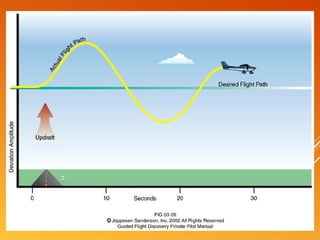
  • #3 Aircraft stability is the characteristic of an airplane in flight that causes it to return to a condition of equilibrium, or steady flight, after it is disturbed.
  • #5 The axis of flight is oriented along the fuselage and along the wings. An aircraft is said to roll about the longitudinal axis. Its stability about the longitudinal axis is known as roll stability. An aircraft moving about its lateral axis is said to adjust its pitch or change its pitch attitude. Its stability about the lateral axis is known as pitch stability. An aircraft is yawing when moving about the vertical axis. Its stability about the vertical axis is known as yaw stability.
  • #10 An aircraft climbs (ascends) when lift and thrust exceed weight and drag. An aircraft descends when the opposite is true. To climb a pilot inputs more thrust and pulls back on the yoke to raises the elevator for a pitch up attitude. To descend a pilot reduces power and pushes forward on the yoke to lower the elevator for a pitch down attitude.