Mr. Sarang A. Khadtare, Mrs. B.S. Dani / International Journal of Engineering Research and
                 Applications (IJERA) ISSN: 2248-9622 www.ijera.com
                      Vol. 3, Issue 2, March -April 2013, pp.524-527
Study of Three Phase Cascaded H-Bridge Multilevel Inverter For
                 Asymmetrical Configuration
                       Mr. Sarang A. Khadtare*, Mrs. B.S. Dani**
                         *(Department of Electrical Engg., Nagpur University, India.
                         ** (Department of Electrical Engg, Nagpur University, India.

ABSTRACT
         We know that, the inverters are broadly           waveform.
classified as two level inverters and multilevel
inverters. This conventional inverters have
many limitations at high power and high voltage
applications. However, the multilevel inverter
becomes popular for high power and high
voltage applications due to their increased
number of levels at the output. As number of
levels increases, the harmonics are reduced and
output voltage tend to become more pure i.e.,
sinusoidal. There are three types of topologies
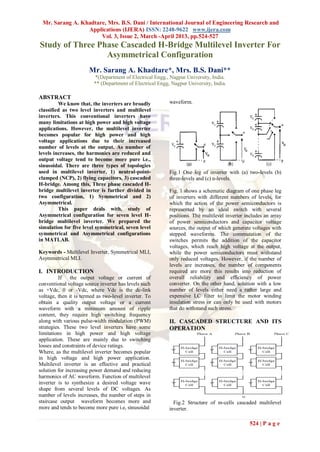
used in multilevel inverter, 1) neutral-point-             Fig.1 One leg of inverter with (a) two-levels (b)
clamped (NCP), 2) flying capacitors, 3) cascaded           three-levels and (c) n-levels.
H-bridge. Among this, Three phase cascaded H-
bridge multilevel inverter is further divided in           Fig. 1 shows a schematic diagram of one phase leg
two configuration, 1) Symmetrical and 2)                   of inverters with different numbers of levels, for
Asymmetrical.                                              which the action of the power semiconductors is
         This paper deals with, study of                   represented by an ideal switch with several
Asymmetrical configuration for seven level H-              positions. The multilevel inverter includes an array
bridge multilevel inverter. We prepared the                of power semiconductors and capacitor voltage
simulation for five level symmetrical, seven level         sources, the output of which generate voltages with
symmetrical and Asymmetrical configurations                stepped waveforms. The commutation of the
in MATLAB.                                                 switches permits the addition of the capacitor
                                                           voltages, which reach high voltage at the output,
Keywords - Multilevel Inverter, Symmetrical MLI,           while the power semiconductors must withstand
Asymmetrical MLI.                                          only reduced voltages. However, if the number of
                                                           levels are increases, the number of components
I. INTRODUCTION                                            required are more this results into reduction of
          If the output voltage or current of              overall reliability and efficiency of power
conventional voltage source inverter has levels such       converter. On the other hand, solution with a low
as +Vdc, 0 or -Vdc, where Vdc is the dc-link               number of levels either need a rather large and
voltage, then it is termed as two-level inverter. To       expensive LC filter to limit the motor winding
obtain a quality output voltage or a current               insulation stress or can only be used with motors
waveform with a minimum amount of ripple                   that do withstand such stress.
content, they require high switching frequency
along with various pulse-width modulation (PWM)            II. CASCADED STRUCTURE AND ITS
strategies. These two level inverters have some            OPERATION
limitations in high power and high voltage
application. These are mainly due to switching
losses and constraints of device ratings.
Where, as the multilevel inverter becomes popular
in high voltage and high power application.
Multilevel inverter is an effective and practical
solution for increasing power demand and reducing
harmonics of AC waveform. Function of multilevel
inverter is to synthesize a desired voltage wave
shape from several levels of DC voltages. As
number of levels increases, the number of steps in
staircase output waveform becomes more and                   Fig.2 Structure of m-cells cascaded multilevel
more and tends to become more pure i.e, sinusoidal         inverter.

                                                                                                524 | P a g e
Mr. Sarang A. Khadtare, Mrs. B.S. Dani / International Journal of Engineering Research and
                 Applications (IJERA) ISSN: 2248-9622 www.ijera.com
                      Vol. 3, Issue 2, March -April 2013, pp.524-527
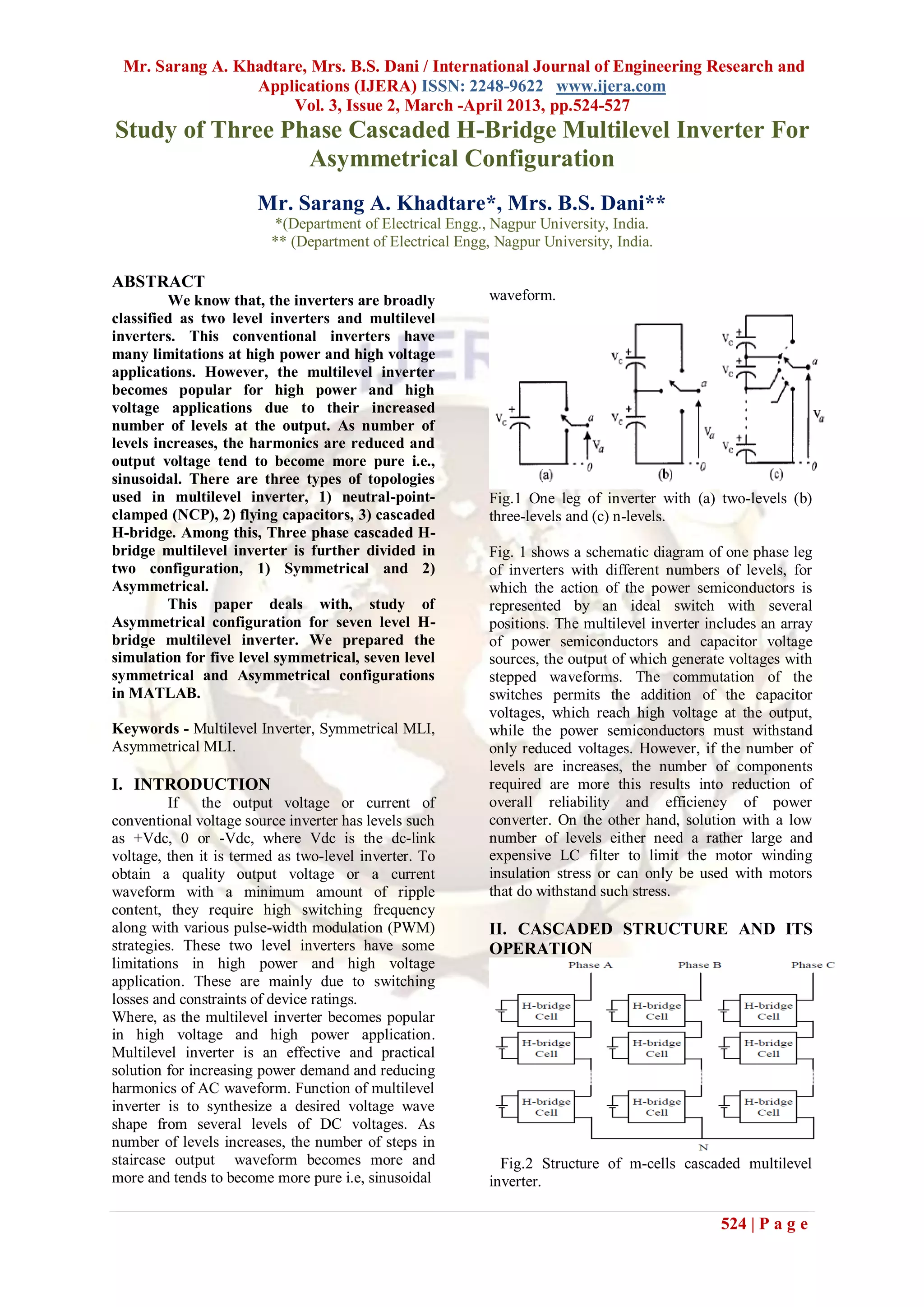
The Fig.2 shows, structure of m-cells cascaded           To provide a large number of output levels without
multilevel inverter. In which, each phase consists of    increasing the number of inverters, asymmetric
H-bridge cell connected in series with other H-          multilevel inverters can be used. It is proposed to
bridge cell. Same is true for all three phases. Such a   chose the dc-voltages sources according to a
structure is known as cascade ding. The structure of     geometric progression with a factor of 2 or 3. For N
single H-bridge cell is shown in Fig.3.                  of such cascade inverters, one can achieve the
                                                         following distinct voltage levels,


                                                         Table 1. Comparison of Multilevel Inverter
                                                                            Symmetri Asymmetrical inverter
                                                                            cal
                                                                                          Binary    Ternary
                                                                            inverter
                                                           N                2N+1
                                                           DC       sources
                                                                            N             N         N
                                                           number
                                                            Switch number      4N             4N             4N
  Fig.3 H-bridge cell structure.
                                                                               N
          As shown in fig., the four IGBT's are
arranged in bridge fashion in order to form single
phase H-bridge. Which is supplied by an isolated         The maximum output voltage of these N cascaded
dc source on dc side, which can be obtained from         multilevel inverters is,
batteries, fuel cell, or ultracapacitors. The            Vo,MAX =                                 (6)
advantage of this topology is that the modulation,
                                                         Equation (6) can be rewritten as,
control, and protection requirements of each bridge
are modular. It should be pointed out that, unlike
the diode-clamped and flying-capacitor topologies,
isolated dc sources are required for each cell in                                                        (7)
each phase.
          In symmetrical multilevel inverter, all H-
bridge cells are fed by equal voltages, and hence all
the arm cells produce similar output voltage steps.      Comparing (3) to (7), it can be seen that
However, if all the cells are not fed by equal           asymmetrical multilevel inverters can generate
voltages, the inverter becomes an asymmetrical           more voltage levels and higher maximum output
one. In this inverter, the arm cells have different      voltage with the same number of bridges.
effect on the output voltage. An output phase-
voltage waveform is obtained by summing the
bridges output voltages,
vo (t) = vo,1 (t) + vo,2 (t) + · · · + vo,N (t)
(1)
where, N is the number of cascaded bridges.

The inverter output voltage vo (t) may be
determined from the individual cells switching
states,
vo (t) =                               μj = 0,
1, . . . . (2)
If all dc-voltage sources in Fig. 1 are equal to Vdc,
the inverter is then known as a symmetric
multilevel one. The effective number of output
voltage levels n in symmetric multilevel inverter is
                                                               Fig.4 Block diagram of five level inverter.
related to the cells number by,
  n = 1+2 N                                 (3)
                                                                  As shown in fig.4, if the each upper H-
The maximum output voltage Vo,Max is then
                                                         bridge cell in each phase is supplied by 2Vdc and if
Vo,MAX = NVdc.                             (4)
                                                         each lower H-bridge cell in each phase is supplied
                                                         by Vdc then we are able to obtained the same value

                                                                                              525 | P a g e
Mr. Sarang A. Khadtare, Mrs. B.S. Dani / International Journal of Engineering Research and
                                                            Applications (IJERA) ISSN: 2248-9622 www.ijera.com
                                                                 Vol. 3, Issue 2, March -April 2013, pp.524-527
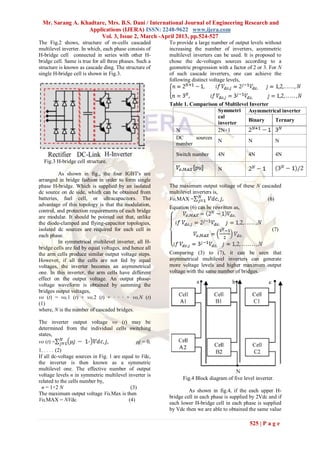
                      of output voltage but with seven levels. Similarly,
                      if the each upper H- bridge cell in each phase is                                                                                    300
                      supplied by 3Vdc and if each lower H-bridge cell in
                      each phase is supplied by Vdc then we are able to
                      obtained the same value of output voltage but with                                                                                   200
                      nine levels.


                                                                                                                                   Phase Voltage (Volts)
                      III. RESULTS                                                                                                                         100

                                                    300                                                                                                        0

                                                    200                                                                                                    -100
                             Phase Voltage(Volts)


                                                    100                                                                                                    -200

                                                      0                                                                                                    -300
                                                                                                                                                               0                            0.16          0.33         0.49           0.66        0.83       1
                                                                                                                                                                                                                    Time(Sec)
                                                    -100
                                                                                                                                                                                                                        (A)

                                                    -200
                                                                                                                                                                                    600

                                                    -300                                                                                                                            400
                                                        0          0.16    0.33      0.49     0.66         0.83          1
                                                                                  Time(Sec)
                                                                                                                                                             Line Voltage (Volts)


                                                                                                     (A)                                                                            200

                      600
                                                                                                                                                                                      0

                      400
                                                                                                                                                                                    -200
Line Voltage(Volts)


                      200
                                                                                                                                                                                    -400
                        0
                                                                                                                                                                                    -600
                                                                                                                                                                                        0          0.16      0.33       0.49           0.66       0.83   1
                      -200                                                                                                                                                                                           Time (Sec)
                                                                                                                                                                  (B)
                      -400                                                                                                       Fig.6 Simulation Results For 7- Level Symmetric
                                                                                                                                 Cascaded H-Bridge Multilevel Inverter, A) Phase
                                                                                                                                 Voltage; B) Line Voltage.
                      -600
                          0                                 0.16          0.33       0.49        0.66             0.83       1
                                                                                  Time(Sec)
                                                            (B)
                      Fig.5 Simulation Results For 5- Level Symmetric
                      Cascaded H-Bridge Multilevel Inverter, A) Phase
                      Voltage; B) Line Voltage.


                                                                                                                                                                                                                                  526 | P a g e
Mr. Sarang A. Khadtare, Mrs. B.S. Dani / International Journal of Engineering Research and
                                                                 Applications (IJERA) ISSN: 2248-9622 www.ijera.com
                                                                      Vol. 3, Issue 2, March -April 2013, pp.524-527
                                                                                                 REFERENCES
                                       300                                                                               [1]   ''Power Electronics'' Circuits, Devices,
                                                                                                                               And Applications, 3rd Edition by
                                                                                                                               Muhammad H. Rashid.
                                       200                                                                               [2]   Bipin Singh, KP Singh and AN Tiwari,
                                                                                                                               ''Modelling      of   5-Level     Inverter
              Phase Voltage (Volts)


                                                                                                                               Controlled With DVR Technique'',
                                       100                                                                                     VSRD-IJEECE, Vol. 2 (1), 2012, 16-21.
                                                                                                                         [3]   F. Khoucha, M. S Lagoun, K. Marouani,
                                                                                                                               A. Kheloui, and M.E.H. Benbouzid,
                                            0                                                                                  “Hybrid cascaded H-bridge multilevel
                                                                                                                               inverter induction motor drive direct
                                                                                                                               torque      control    for     automotive
                                      -100
                                                                                                                               applications,” IEEE Trans. Ind. Electron.,
                                                                                                                               vol. 57, no.3,pp.892–899, Mar. 2010.
                                      -200                                                                               [4]   Farid Khoucha, Mouna Soumia Lagoun,
                                                                                                                               Abdelaziz Kheloui, and Mohamed El
                                                                                                                               Hachemi Benbouzid, Senior Member, "A
                                      -300                                                                                     Comparison of Symmetrical and
                                          0           0.16     0.33         0.49            0.66          0.83       1         Asymmetrical Three-Phase H-Bridge
                                                                         Time(Sec)                                             Multilevel Inverter for DTC Induction
                                                                                                                               Motor Drives'', IEEE TRANSACTIONS
                                                                             (A)                                               ON ENERGY CONVERSION, VOL. 26,
                                                                                                                               NO. 1, MARCH 2011.
                                      600                                                                                [5]     K.Surya Suresh1 and M.Vishnu Prasad,
                                                                                                                               Sri Vasavi Institute of Engineering and
                                                                                                                               Technology,             EEE Department,
                                      400                                                                                      Nandamuru, AP, India "PV Cell Based
                                                                                                                               Five Level Inverter Using Multicarrier
                                                                                                                               PWM" International Journal of Modern
Line Voltage (Volts)


                                      200                                                                                      Engineering Research (IJMER) Vol.1,
                                                                                                                               Issue.2, pp-545-551.
                                                                                                                         [6]    Bindeshwar Singh, Nupur Mittal , Dr.
                                        0                                                                                      K.S. Verma , Dr. Deependra Singh,
                                                                                                                               S.P.Singh, Rahul Dixit, Manvendra Singh,
                                                                                                                               Aanchal Baranwa, "Multi-level inverter:
                                                                                                                               A literature survey on topologies and
                             -200                                                                                              control strategies" International Journal
                                                                                                                               of Reviews in Computing 31st July 2012.
                                                                                                                               Vol. 10.
                             -400                                                                                        [7]   Jannu Ramu1, S.J.V. Prakash, K.Satya
                                                                                                                               Srinivasu1, R.N.D. Pattabhi Ram, M.
                                                                                                                               Vishnu Prasad and Md. Mazhar
                             -600                                                                                              Hussain,''Comparison              between
                                 0                  0.16     0.33        0.49        0.66          0.83          1             Symmetrical and Asymmetrical Single
                                                                      Time (Sec)                                               Phase Seven Level Cascade H-Bridge
                                                                                (B)                                            Multilevel     Inverter     with    PWM
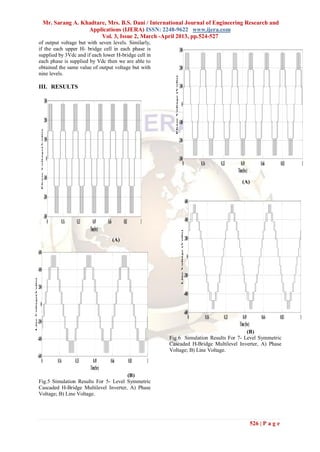
                                                Fig.7 Simulation Results For 7- Level Asymmetric                               Topology." International Journal of
                                                Cascaded H-Bridge Multilevel Inverter, A) Phase                                Multidisciplinary       Sciences        and
                                                Voltage; B) Line Voltage.                                                      Engineering, Vol. 3, No. 4, April 2012.

                                                IV. CONCLUSION
                                                        From above waveforms and table we
                                                concluded that, the Asymmetrical inverter is able to
                                                produce same value of output voltage but with
                                                more number of levels thus the output voltage has
                                                less harmonics and it is more pure than
                                                Symmetrical one. The number of bridges and DC
                                                sources, switching losses are also reduced in
                                                asymmetric MLI as compared to symmetrical.

                                                                                                                                                           527 | P a g e

Ch32524527

  • 1.
    Mr. Sarang A.Khadtare, Mrs. B.S. Dani / International Journal of Engineering Research and Applications (IJERA) ISSN: 2248-9622 www.ijera.com Vol. 3, Issue 2, March -April 2013, pp.524-527 Study of Three Phase Cascaded H-Bridge Multilevel Inverter For Asymmetrical Configuration Mr. Sarang A. Khadtare*, Mrs. B.S. Dani** *(Department of Electrical Engg., Nagpur University, India. ** (Department of Electrical Engg, Nagpur University, India. ABSTRACT We know that, the inverters are broadly waveform. classified as two level inverters and multilevel inverters. This conventional inverters have many limitations at high power and high voltage applications. However, the multilevel inverter becomes popular for high power and high voltage applications due to their increased number of levels at the output. As number of levels increases, the harmonics are reduced and output voltage tend to become more pure i.e., sinusoidal. There are three types of topologies used in multilevel inverter, 1) neutral-point- Fig.1 One leg of inverter with (a) two-levels (b) clamped (NCP), 2) flying capacitors, 3) cascaded three-levels and (c) n-levels. H-bridge. Among this, Three phase cascaded H- bridge multilevel inverter is further divided in Fig. 1 shows a schematic diagram of one phase leg two configuration, 1) Symmetrical and 2) of inverters with different numbers of levels, for Asymmetrical. which the action of the power semiconductors is This paper deals with, study of represented by an ideal switch with several Asymmetrical configuration for seven level H- positions. The multilevel inverter includes an array bridge multilevel inverter. We prepared the of power semiconductors and capacitor voltage simulation for five level symmetrical, seven level sources, the output of which generate voltages with symmetrical and Asymmetrical configurations stepped waveforms. The commutation of the in MATLAB. switches permits the addition of the capacitor voltages, which reach high voltage at the output, Keywords - Multilevel Inverter, Symmetrical MLI, while the power semiconductors must withstand Asymmetrical MLI. only reduced voltages. However, if the number of levels are increases, the number of components I. INTRODUCTION required are more this results into reduction of If the output voltage or current of overall reliability and efficiency of power conventional voltage source inverter has levels such converter. On the other hand, solution with a low as +Vdc, 0 or -Vdc, where Vdc is the dc-link number of levels either need a rather large and voltage, then it is termed as two-level inverter. To expensive LC filter to limit the motor winding obtain a quality output voltage or a current insulation stress or can only be used with motors waveform with a minimum amount of ripple that do withstand such stress. content, they require high switching frequency along with various pulse-width modulation (PWM) II. CASCADED STRUCTURE AND ITS strategies. These two level inverters have some OPERATION limitations in high power and high voltage application. These are mainly due to switching losses and constraints of device ratings. Where, as the multilevel inverter becomes popular in high voltage and high power application. Multilevel inverter is an effective and practical solution for increasing power demand and reducing harmonics of AC waveform. Function of multilevel inverter is to synthesize a desired voltage wave shape from several levels of DC voltages. As number of levels increases, the number of steps in staircase output waveform becomes more and Fig.2 Structure of m-cells cascaded multilevel more and tends to become more pure i.e, sinusoidal inverter. 524 | P a g e
  • 2.
    Mr. Sarang A.Khadtare, Mrs. B.S. Dani / International Journal of Engineering Research and Applications (IJERA) ISSN: 2248-9622 www.ijera.com Vol. 3, Issue 2, March -April 2013, pp.524-527 The Fig.2 shows, structure of m-cells cascaded To provide a large number of output levels without multilevel inverter. In which, each phase consists of increasing the number of inverters, asymmetric H-bridge cell connected in series with other H- multilevel inverters can be used. It is proposed to bridge cell. Same is true for all three phases. Such a chose the dc-voltages sources according to a structure is known as cascade ding. The structure of geometric progression with a factor of 2 or 3. For N single H-bridge cell is shown in Fig.3. of such cascade inverters, one can achieve the following distinct voltage levels, Table 1. Comparison of Multilevel Inverter Symmetri Asymmetrical inverter cal Binary Ternary inverter N 2N+1 DC sources N N N number Switch number 4N 4N 4N Fig.3 H-bridge cell structure. N As shown in fig., the four IGBT's are arranged in bridge fashion in order to form single phase H-bridge. Which is supplied by an isolated The maximum output voltage of these N cascaded dc source on dc side, which can be obtained from multilevel inverters is, batteries, fuel cell, or ultracapacitors. The Vo,MAX = (6) advantage of this topology is that the modulation, Equation (6) can be rewritten as, control, and protection requirements of each bridge are modular. It should be pointed out that, unlike the diode-clamped and flying-capacitor topologies, isolated dc sources are required for each cell in (7) each phase. In symmetrical multilevel inverter, all H- bridge cells are fed by equal voltages, and hence all the arm cells produce similar output voltage steps. Comparing (3) to (7), it can be seen that However, if all the cells are not fed by equal asymmetrical multilevel inverters can generate voltages, the inverter becomes an asymmetrical more voltage levels and higher maximum output one. In this inverter, the arm cells have different voltage with the same number of bridges. effect on the output voltage. An output phase- voltage waveform is obtained by summing the bridges output voltages, vo (t) = vo,1 (t) + vo,2 (t) + · · · + vo,N (t) (1) where, N is the number of cascaded bridges. The inverter output voltage vo (t) may be determined from the individual cells switching states, vo (t) = μj = 0, 1, . . . . (2) If all dc-voltage sources in Fig. 1 are equal to Vdc, the inverter is then known as a symmetric multilevel one. The effective number of output voltage levels n in symmetric multilevel inverter is Fig.4 Block diagram of five level inverter. related to the cells number by, n = 1+2 N (3) As shown in fig.4, if the each upper H- The maximum output voltage Vo,Max is then bridge cell in each phase is supplied by 2Vdc and if Vo,MAX = NVdc. (4) each lower H-bridge cell in each phase is supplied by Vdc then we are able to obtained the same value 525 | P a g e
  • 3.
    Mr. Sarang A.Khadtare, Mrs. B.S. Dani / International Journal of Engineering Research and Applications (IJERA) ISSN: 2248-9622 www.ijera.com Vol. 3, Issue 2, March -April 2013, pp.524-527 of output voltage but with seven levels. Similarly, if the each upper H- bridge cell in each phase is 300 supplied by 3Vdc and if each lower H-bridge cell in each phase is supplied by Vdc then we are able to obtained the same value of output voltage but with 200 nine levels. Phase Voltage (Volts) III. RESULTS 100 300 0 200 -100 Phase Voltage(Volts) 100 -200 0 -300 0 0.16 0.33 0.49 0.66 0.83 1 Time(Sec) -100 (A) -200 600 -300 400 0 0.16 0.33 0.49 0.66 0.83 1 Time(Sec) Line Voltage (Volts) (A) 200 600 0 400 -200 Line Voltage(Volts) 200 -400 0 -600 0 0.16 0.33 0.49 0.66 0.83 1 -200 Time (Sec) (B) -400 Fig.6 Simulation Results For 7- Level Symmetric Cascaded H-Bridge Multilevel Inverter, A) Phase Voltage; B) Line Voltage. -600 0 0.16 0.33 0.49 0.66 0.83 1 Time(Sec) (B) Fig.5 Simulation Results For 5- Level Symmetric Cascaded H-Bridge Multilevel Inverter, A) Phase Voltage; B) Line Voltage. 526 | P a g e
  • 4.
    Mr. Sarang A.Khadtare, Mrs. B.S. Dani / International Journal of Engineering Research and Applications (IJERA) ISSN: 2248-9622 www.ijera.com Vol. 3, Issue 2, March -April 2013, pp.524-527 REFERENCES 300 [1] ''Power Electronics'' Circuits, Devices, And Applications, 3rd Edition by Muhammad H. Rashid. 200 [2] Bipin Singh, KP Singh and AN Tiwari, ''Modelling of 5-Level Inverter Phase Voltage (Volts) Controlled With DVR Technique'', 100 VSRD-IJEECE, Vol. 2 (1), 2012, 16-21. [3] F. Khoucha, M. S Lagoun, K. Marouani, A. Kheloui, and M.E.H. Benbouzid, 0 “Hybrid cascaded H-bridge multilevel inverter induction motor drive direct torque control for automotive -100 applications,” IEEE Trans. Ind. Electron., vol. 57, no.3,pp.892–899, Mar. 2010. -200 [4] Farid Khoucha, Mouna Soumia Lagoun, Abdelaziz Kheloui, and Mohamed El Hachemi Benbouzid, Senior Member, "A -300 Comparison of Symmetrical and 0 0.16 0.33 0.49 0.66 0.83 1 Asymmetrical Three-Phase H-Bridge Time(Sec) Multilevel Inverter for DTC Induction Motor Drives'', IEEE TRANSACTIONS (A) ON ENERGY CONVERSION, VOL. 26, NO. 1, MARCH 2011. 600 [5] K.Surya Suresh1 and M.Vishnu Prasad, Sri Vasavi Institute of Engineering and Technology, EEE Department, 400 Nandamuru, AP, India "PV Cell Based Five Level Inverter Using Multicarrier PWM" International Journal of Modern Line Voltage (Volts) 200 Engineering Research (IJMER) Vol.1, Issue.2, pp-545-551. [6] Bindeshwar Singh, Nupur Mittal , Dr. 0 K.S. Verma , Dr. Deependra Singh, S.P.Singh, Rahul Dixit, Manvendra Singh, Aanchal Baranwa, "Multi-level inverter: A literature survey on topologies and -200 control strategies" International Journal of Reviews in Computing 31st July 2012. Vol. 10. -400 [7] Jannu Ramu1, S.J.V. Prakash, K.Satya Srinivasu1, R.N.D. Pattabhi Ram, M. Vishnu Prasad and Md. Mazhar -600 Hussain,''Comparison between 0 0.16 0.33 0.49 0.66 0.83 1 Symmetrical and Asymmetrical Single Time (Sec) Phase Seven Level Cascade H-Bridge (B) Multilevel Inverter with PWM Fig.7 Simulation Results For 7- Level Asymmetric Topology." International Journal of Cascaded H-Bridge Multilevel Inverter, A) Phase Multidisciplinary Sciences and Voltage; B) Line Voltage. Engineering, Vol. 3, No. 4, April 2012. IV. CONCLUSION From above waveforms and table we concluded that, the Asymmetrical inverter is able to produce same value of output voltage but with more number of levels thus the output voltage has less harmonics and it is more pure than Symmetrical one. The number of bridges and DC sources, switching losses are also reduced in asymmetric MLI as compared to symmetrical. 527 | P a g e