© Cengage Learning 2016© Cengage Learning 2016
An Invitation to Health: Building Your Future, Brief Edition, 9e
Dianne Hales
Personal Stress Management
3
© Cengage Learning 2016
After reading this chapter, the student
should be able to:
• Outline the types of stress and the effects
of stress on people
• Identify stressors commonly reported by
different groups across America
• Examine the most common causes of
stress that individuals face
Objectives
© Cengage Learning 2016
• Summarize the incidence, symptoms, and
treatment of the stress disorders
associated with traumatic life events
• Outline how the body responds to stress
• Describe how stress can affect a person’s
heart, immune system, gastrointestinal
system, and susceptibility to cancer
Objectives (cont’d.)
© Cengage Learning 2016
• Discuss practical techniques of stress
management
• Summarize how time management can
help prevent stress
Objectives (cont’d.)
© Cengage Learning 2016
• Defined as “a non-specific response of the
body to any demand made upon it”
• Stressor
– Anything that triggers a state of arousal
– May be positive or negative
• Eustress: positive stress
• Distress: negative effects of stress
Stress
© Cengage Learning 2016
• Physical stress triggers body changes
– Heart, muscles, immune system, and more
• Chronic stress affects thoughts and
feelings
• Stress can sidetrack spiritual health
• Relationships are affected by life stress
• Stress can interfere with brain function
• External forces can cause or intensify
stress
Stress and the Dimensions of Health
© Cengage Learning 2016
• Acute time-limited stressors
– Examples: timed test or public speaking
• Brief naturalistic stressors
– Example: taking the SAT
• Life change events
– Planned and unpredictable events
• Distant stressors
– Happened in the past
– Continue to impact emotions
Types of Stressors
© Cengage Learning 2016
• Survey results: average stress level 4.9
out of 10
• Symptoms
– Fatigue
– Poor sleep
– Sense of being overwhelmed
• People who say they manage stress well
report a lower stress level
Stress in America
© Cengage Learning 2016
• Common student stressors
– Test pressures
– Financial problems
– Frustrations or delays in reaching goals
– Relationship problems
– Daily hassles
• Reactions to stress vary
– Women more likely to feel stressed about
finances, relationships, and daily hassles
Stress on Campus
© Cengage Learning 2016
• Minority ethnic groups experience various
forms of stress
– Some examples: discrimination stress and
achievement stress
Minority Students
© Cengage Learning 2016
• More common than overt racism
• Microassaults
– Conscious, intentional acts or slurs
• Microinsults
– Rude verbal and nonverbal expressions
• Microinvalidation
– Subtle nullifications of thoughts or feelings of
another
Microaggression Toward Minorities
© Cengage Learning 2016
• Factors influencing anger
– People are working longer hours
• Less patience
– Technology enables 24/7 availability
• Economic stress
– Unemployment
• Job stress or burnout
• Illness and disability
Other Stressors
© Cengage Learning 2016
• About half of all people experience at least
one traumatic life event
– Car accident
– Unexpected death in the family
– Tornado, earthquake
– Violent act
• Vast majority of people able to recover and
continue with their lives
Traumatic Life Events
© Cengage Learning 2016
• Disabling symptoms following a traumatic
event
• Post-traumatic stress disorder (PTSD)
– Can occur following captivity, combat, or
violent incident
• Symptoms of PTSD
– Distressing memories or dreams
– External reminders of the event
– Persistent negative emotions, such as guilt
Acute Stress Disorder
© Cengage Learning 2016
• Cascade of internal changes that mobilize
the body for action
– “Fight-or-flight” response
– Affects heart, muscles, brain
• Once threat passes, body returns to
homeostasis
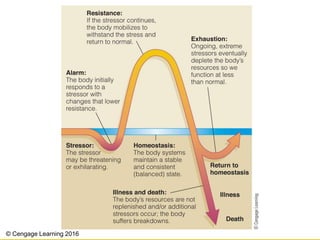
• General adaptation syndrome
– Alarm, resistance, and exhaustion
– See Figure 3.2
The Stress Response
© Cengage Learning 2016
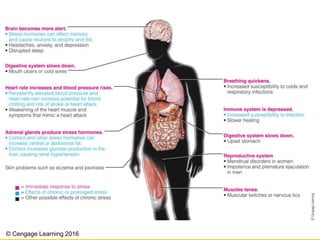
• Heart
– Mulling over stressful events elevates blood
pressure
• Immune system
– Chronic stress breaks down immune system
• Stress influences how much and what we
eat
• Stress-related inflammation can affect
cancer growth
The Impact of Stress
© Cengage Learning 2016
• Techniques
– Journaling: writing down feelings
– Exercise
– Cognitive restructuring
• Get rid of inaccurate or self-defeating thoughts
– Meditation
Managing Stress
© Cengage Learning 2016
• Progressive relaxation
– Intentionally increase and then decrease
tension in the muscles
– Work through the body, focusing on each area
• Visualization
– Create mental picture that helps focus mind
• Biofeedback
– Using measurements of a body process to
adjust that process
• Examples: heart rate or muscle tension
Routes to Relaxation
© Cengage Learning 2016
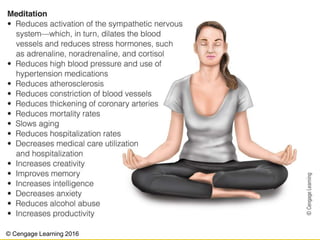
• Meditation
– Brings about changes in various brain regions
• Mindfulness
– Being fully present in the moment
– Focusing on the present time
• Yoga
– May lower harmful compounds associated
with stress that increase inflammation
Routes to Relaxation (cont’d.)
© Cengage Learning 2016
• Symptoms of poor time management
– Rushing
– Consistent lateness
– Fatigue
– Inability to make choices or decisions
– Sense of being overwhelmed by demands
Stress Prevention: Taking Control of
Your Time
© Cengage Learning 2016
• Schedule your time in advance
• Develop a game plan
• Identify time robbers
• Make the most of classes
• Develop an efficient study style
• Cut large problems into smaller pieces
• Focus on the task at hand
• Keep workspace orderly
Time Management Solutions

Chapter 3 power point

  • 1.
    © Cengage Learning2016© Cengage Learning 2016 An Invitation to Health: Building Your Future, Brief Edition, 9e Dianne Hales Personal Stress Management 3
  • 2.
    © Cengage Learning2016 After reading this chapter, the student should be able to: • Outline the types of stress and the effects of stress on people • Identify stressors commonly reported by different groups across America • Examine the most common causes of stress that individuals face Objectives
  • 3.
    © Cengage Learning2016 • Summarize the incidence, symptoms, and treatment of the stress disorders associated with traumatic life events • Outline how the body responds to stress • Describe how stress can affect a person’s heart, immune system, gastrointestinal system, and susceptibility to cancer Objectives (cont’d.)
  • 4.
    © Cengage Learning2016 • Discuss practical techniques of stress management • Summarize how time management can help prevent stress Objectives (cont’d.)
  • 5.
    © Cengage Learning2016 • Defined as “a non-specific response of the body to any demand made upon it” • Stressor – Anything that triggers a state of arousal – May be positive or negative • Eustress: positive stress • Distress: negative effects of stress Stress
  • 6.
    © Cengage Learning2016 • Physical stress triggers body changes – Heart, muscles, immune system, and more • Chronic stress affects thoughts and feelings • Stress can sidetrack spiritual health • Relationships are affected by life stress • Stress can interfere with brain function • External forces can cause or intensify stress Stress and the Dimensions of Health
  • 7.
    © Cengage Learning2016 • Acute time-limited stressors – Examples: timed test or public speaking • Brief naturalistic stressors – Example: taking the SAT • Life change events – Planned and unpredictable events • Distant stressors – Happened in the past – Continue to impact emotions Types of Stressors
  • 8.
    © Cengage Learning2016 • Survey results: average stress level 4.9 out of 10 • Symptoms – Fatigue – Poor sleep – Sense of being overwhelmed • People who say they manage stress well report a lower stress level Stress in America
  • 9.
    © Cengage Learning2016 • Common student stressors – Test pressures – Financial problems – Frustrations or delays in reaching goals – Relationship problems – Daily hassles • Reactions to stress vary – Women more likely to feel stressed about finances, relationships, and daily hassles Stress on Campus
  • 10.
    © Cengage Learning2016 • Minority ethnic groups experience various forms of stress – Some examples: discrimination stress and achievement stress Minority Students
  • 11.
    © Cengage Learning2016 • More common than overt racism • Microassaults – Conscious, intentional acts or slurs • Microinsults – Rude verbal and nonverbal expressions • Microinvalidation – Subtle nullifications of thoughts or feelings of another Microaggression Toward Minorities
  • 12.
    © Cengage Learning2016 • Factors influencing anger – People are working longer hours • Less patience – Technology enables 24/7 availability • Economic stress – Unemployment • Job stress or burnout • Illness and disability Other Stressors
  • 13.
    © Cengage Learning2016 • About half of all people experience at least one traumatic life event – Car accident – Unexpected death in the family – Tornado, earthquake – Violent act • Vast majority of people able to recover and continue with their lives Traumatic Life Events
  • 14.
    © Cengage Learning2016 • Disabling symptoms following a traumatic event • Post-traumatic stress disorder (PTSD) – Can occur following captivity, combat, or violent incident • Symptoms of PTSD – Distressing memories or dreams – External reminders of the event – Persistent negative emotions, such as guilt Acute Stress Disorder
  • 15.
    © Cengage Learning2016 • Cascade of internal changes that mobilize the body for action – “Fight-or-flight” response – Affects heart, muscles, brain • Once threat passes, body returns to homeostasis • General adaptation syndrome – Alarm, resistance, and exhaustion – See Figure 3.2 The Stress Response
  • 16.
  • 17.
  • 18.
    © Cengage Learning2016 • Heart – Mulling over stressful events elevates blood pressure • Immune system – Chronic stress breaks down immune system • Stress influences how much and what we eat • Stress-related inflammation can affect cancer growth The Impact of Stress
  • 19.
    © Cengage Learning2016 • Techniques – Journaling: writing down feelings – Exercise – Cognitive restructuring • Get rid of inaccurate or self-defeating thoughts – Meditation Managing Stress
  • 20.
  • 21.
    © Cengage Learning2016 • Progressive relaxation – Intentionally increase and then decrease tension in the muscles – Work through the body, focusing on each area • Visualization – Create mental picture that helps focus mind • Biofeedback – Using measurements of a body process to adjust that process • Examples: heart rate or muscle tension Routes to Relaxation
  • 22.
    © Cengage Learning2016 • Meditation – Brings about changes in various brain regions • Mindfulness – Being fully present in the moment – Focusing on the present time • Yoga – May lower harmful compounds associated with stress that increase inflammation Routes to Relaxation (cont’d.)
  • 23.
    © Cengage Learning2016 • Symptoms of poor time management – Rushing – Consistent lateness – Fatigue – Inability to make choices or decisions – Sense of being overwhelmed by demands Stress Prevention: Taking Control of Your Time
  • 24.
    © Cengage Learning2016 • Schedule your time in advance • Develop a game plan • Identify time robbers • Make the most of classes • Develop an efficient study style • Cut large problems into smaller pieces • Focus on the task at hand • Keep workspace orderly Time Management Solutions

Editor's Notes

  • #17 Figure 3.1 The effects of stress on the body
  • #18 Figure 3.2 General adaptation syndrome
  • #21 Figure 3.3 Benefits of meditation