1
Eating Disorders
Early Intervention and
Schools Work
May 2017
Jess Griffiths
2
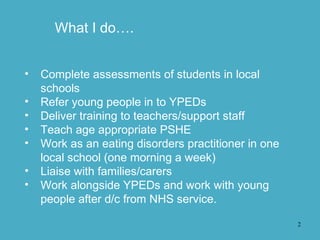
• Complete assessments of students in local
schools
• Refer young people in to YPEDs
• Deliver training to teachers/support staff
• Teach age appropriate PSHE
• Work as an eating disorders practitioner in one
local school (one morning a week)
• Liaise with families/carers
• Work alongside YPEDs and work with young
people after d/c from NHS service.
What I do….
3
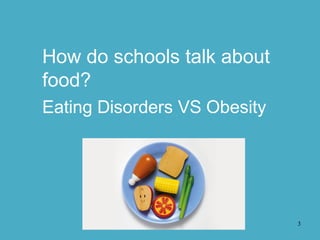
How do schools talk about
food?
Eating Disorders VS Obesity
4
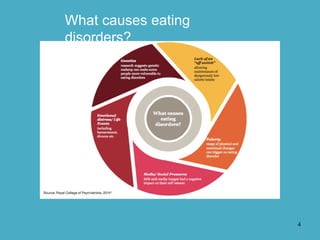
What causes eating
disorders?
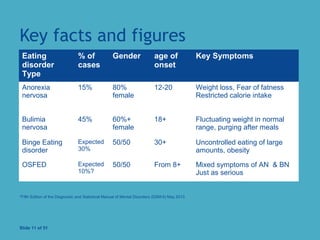
Key facts and figures
Eating
disorder
Type
% of
cases
Gender age of
onset
Key Symptoms
Anorexia
nervosa
15% 80%
female
12-20 Weight loss, Fear of fatness
Restricted calorie intake
Bulimia
nervosa
45% 60%+
female
18+ Fluctuating weight in normal
range, purging after meals
Binge Eating
disorder
Expected
30%
50/50 30+ Uncontrolled eating of large
amounts, obesity
OSFED Expected
10%?
50/50 From 8+ Mixed symptoms of AN & BN
Just as serious
Slide 11 of 51
*Fifth Edition of the Diagnostic and Statistical Manual of Mental Disorders (DSM-5) May 2013
6
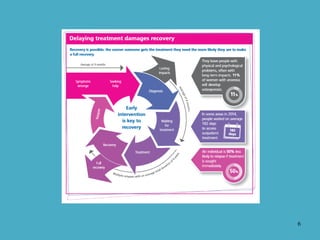
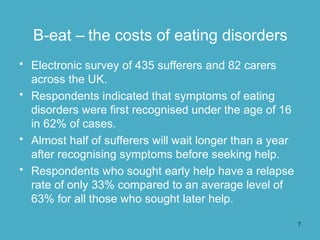
B-eat – the costs of eating disorders
• Electronic survey of 435 sufferers and 82 carers
across the UK.
• Respondents indicated that symptoms of eating
disorders were first recognised under the age of 16
in 62% of cases.
• Almost half of sufferers will wait longer than a year
after recognising symptoms before seeking help.
• Respondents who sought early help have a relapse
rate of only 33% compared to an average level of
63% for all those who sought later help.
7
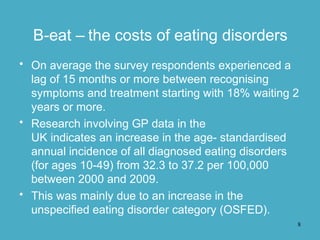
B-eat – the costs of eating disorders
• On average the survey respondents experienced a
lag of 15 months or more between recognising
symptoms and treatment starting with 18% waiting 2
years or more.
• Research involving GP data in the
UK indicates an increase in the age- standardised
annual incidence of all diagnosed eating disorders
(for ages 10-49) from 32.3 to 37.2 per 100,000
between 2000 and 2009.
• This was mainly due to an increase in the
unspecified eating disorder category (OSFED).
8
9
10
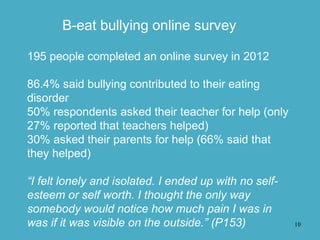
B-eat bullying online survey
195 people completed an online survey in 2012
86.4% said bullying contributed to their eating
disorder
50% respondents asked their teacher for help (only
27% reported that teachers helped)
30% asked their parents for help (66% said that
they helped)
“I felt lonely and isolated. I ended up with no self-
esteem or self worth. I thought the only way
somebody would notice how much pain I was in
was if it was visible on the outside.” (P153)
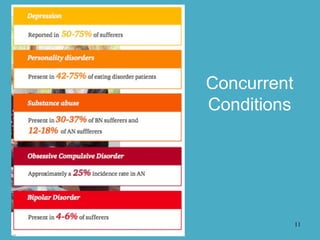
11
Concurrent
Conditions
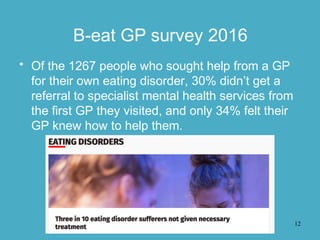
B-eat GP survey 2016
• Of the 1267 people who sought help from a GP
for their own eating disorder, 30% didn’t get a
referral to specialist mental health services from
the first GP they visited, and only 34% felt their
GP knew how to help them.
12
13
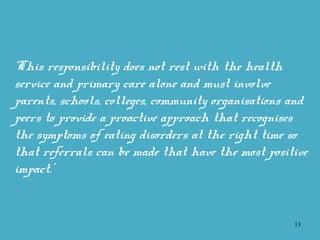
‘This responsibility does not rest with the health
service and primary care alone and must involve
parents, schools, colleges, community organisations and
peers to provide a proactive approach that recognises
the symptoms of eating disorders at the right time so
that referrals can be made that have the most positive
impact.’
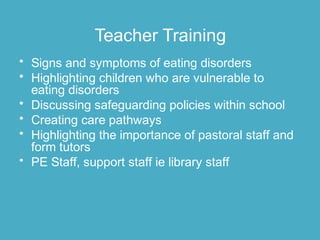
Teacher Training
• Signs and symptoms of eating disorders
• Highlighting children who are vulnerable to
eating disorders
• Discussing safeguarding policies within school
• Creating care pathways
• Highlighting the importance of pastoral staff and
form tutors
• PE Staff, support staff ie library staff
15
16
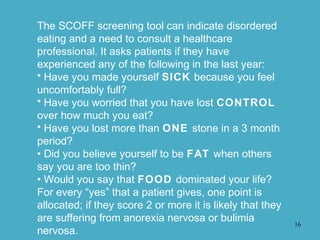
The SCOFF screening tool can indicate disordered
eating and a need to consult a healthcare
professional. It asks patients if they have
experienced any of the following in the last year:
• Have you made yourself SICK because you feel
uncomfortably full?
• Have you worried that you have lost CONTROL
over how much you eat?
• Have you lost more than ONE stone in a 3 month
period?
• Did you believe yourself to be FAT when others
say you are too thin?
• Would you say that FOOD dominated your life?
For every “yes” that a patient gives, one point is
allocated; if they score 2 or more it is likely that they
are suffering from anorexia nervosa or bulimia
nervosa.
NHS Service
• Young Persons Eating Disorders service
01202 492415
• Young people are assessed within three weeks of
referral
• Focus on 8 to 18 but eventually merge with adult
service
• All outpatient treatment for Adolescents
• General hospital if medically unstable
• Inpatient care if ED is too severe to manage in the
community
• Kimmeridge Court ED service 6 Bed inpatient unit, 4
bed day unit (INR), outpatient treatment.
01202 492147
• Multi Family Therapy, 4 intensive days, 4 follow
up days.
• Family takes control of food and Adolescent
weight restores
• Family hands control back over to Adolescent
• Establishing healthy Adolescent Identity when
weight is maintained at 95% or over.
The Maudsley Model
• Treatment focus starts to shift to the impact AN
has had on the individual establishing a healthy
adolescent identity. This entails a review of
central issues of adolescence and includes
supporting increased personal autonomy for
the adolescent, the development of appropriate
parental boundaries, as well as the need for the
parents to reorganize their life together after
their children’s prospective departure
The Maudsley Model
• Studies consistently show that adolescents with
anorexia respond well to family therapy.
• Between 50-75% will be weight restored by the
end of the treatment and at 4-5 year follow up,
60-90% will have fully recovered. (Le Grange &
Eisler 2014)
Outcomes
B-eat Contact Details
  
Helpline: 0345 634 1414
Youthline: 0345 634 7650
Head office: 103 Prince of Wales Road
Norwich
NR1 1DW
Admin: 0870 770 3256
Media: 0870 770 3221
F: 01603 664915
E: info@b-eat.co.uk
W: www.b-eat.co.uk
 
Slide 51 of 51
Useful Resources
• http://www.inourhands.com
Pooky Knightsmith
• Self-Harm and Eating Disorders in Schools: A Guide to
Whole School Support and Practical Strategies
• The Eating Disorders Pocketbook
• Eating difficulties in younger children
http://www.inourhands.com/mental-health/webinar-16/
• https://www.b-eat.co.uk/research/summary-of-
completed-research/913-pwc-2015-the-costs-of-eating-
disorders-report
https://www.b-eat.co.uk/about-eating-disorders/worried-
about-someone/how-to-talk-to-somebody
22
• Jess Griffiths
• office@jessgriffiths.co.uk
• www.jessgriffiths.co.uk
• 07791 551990
23

Early intervention and schools work

  • 1.
    1 Eating Disorders Early Interventionand Schools Work May 2017 Jess Griffiths
  • 2.
    2 • Complete assessmentsof students in local schools • Refer young people in to YPEDs • Deliver training to teachers/support staff • Teach age appropriate PSHE • Work as an eating disorders practitioner in one local school (one morning a week) • Liaise with families/carers • Work alongside YPEDs and work with young people after d/c from NHS service. What I do….
  • 3.
    3 How do schoolstalk about food? Eating Disorders VS Obesity
  • 4.
  • 5.
    Key facts andfigures Eating disorder Type % of cases Gender age of onset Key Symptoms Anorexia nervosa 15% 80% female 12-20 Weight loss, Fear of fatness Restricted calorie intake Bulimia nervosa 45% 60%+ female 18+ Fluctuating weight in normal range, purging after meals Binge Eating disorder Expected 30% 50/50 30+ Uncontrolled eating of large amounts, obesity OSFED Expected 10%? 50/50 From 8+ Mixed symptoms of AN & BN Just as serious Slide 11 of 51 *Fifth Edition of the Diagnostic and Statistical Manual of Mental Disorders (DSM-5) May 2013
  • 6.
  • 7.
    B-eat – thecosts of eating disorders • Electronic survey of 435 sufferers and 82 carers across the UK. • Respondents indicated that symptoms of eating disorders were first recognised under the age of 16 in 62% of cases. • Almost half of sufferers will wait longer than a year after recognising symptoms before seeking help. • Respondents who sought early help have a relapse rate of only 33% compared to an average level of 63% for all those who sought later help. 7
  • 8.
    B-eat – thecosts of eating disorders • On average the survey respondents experienced a lag of 15 months or more between recognising symptoms and treatment starting with 18% waiting 2 years or more. • Research involving GP data in the UK indicates an increase in the age- standardised annual incidence of all diagnosed eating disorders (for ages 10-49) from 32.3 to 37.2 per 100,000 between 2000 and 2009. • This was mainly due to an increase in the unspecified eating disorder category (OSFED). 8
  • 9.
  • 10.
    10 B-eat bullying onlinesurvey 195 people completed an online survey in 2012 86.4% said bullying contributed to their eating disorder 50% respondents asked their teacher for help (only 27% reported that teachers helped) 30% asked their parents for help (66% said that they helped) “I felt lonely and isolated. I ended up with no self- esteem or self worth. I thought the only way somebody would notice how much pain I was in was if it was visible on the outside.” (P153)
  • 11.
  • 12.
    B-eat GP survey2016 • Of the 1267 people who sought help from a GP for their own eating disorder, 30% didn’t get a referral to specialist mental health services from the first GP they visited, and only 34% felt their GP knew how to help them. 12
  • 13.
    13 ‘This responsibility doesnot rest with the health service and primary care alone and must involve parents, schools, colleges, community organisations and peers to provide a proactive approach that recognises the symptoms of eating disorders at the right time so that referrals can be made that have the most positive impact.’
  • 14.
    Teacher Training • Signsand symptoms of eating disorders • Highlighting children who are vulnerable to eating disorders • Discussing safeguarding policies within school • Creating care pathways • Highlighting the importance of pastoral staff and form tutors • PE Staff, support staff ie library staff
  • 15.
  • 16.
    16 The SCOFF screeningtool can indicate disordered eating and a need to consult a healthcare professional. It asks patients if they have experienced any of the following in the last year: • Have you made yourself SICK because you feel uncomfortably full? • Have you worried that you have lost CONTROL over how much you eat? • Have you lost more than ONE stone in a 3 month period? • Did you believe yourself to be FAT when others say you are too thin? • Would you say that FOOD dominated your life? For every “yes” that a patient gives, one point is allocated; if they score 2 or more it is likely that they are suffering from anorexia nervosa or bulimia nervosa.
  • 17.
    NHS Service • YoungPersons Eating Disorders service 01202 492415 • Young people are assessed within three weeks of referral • Focus on 8 to 18 but eventually merge with adult service • All outpatient treatment for Adolescents • General hospital if medically unstable • Inpatient care if ED is too severe to manage in the community • Kimmeridge Court ED service 6 Bed inpatient unit, 4 bed day unit (INR), outpatient treatment. 01202 492147
  • 18.
    • Multi FamilyTherapy, 4 intensive days, 4 follow up days. • Family takes control of food and Adolescent weight restores • Family hands control back over to Adolescent • Establishing healthy Adolescent Identity when weight is maintained at 95% or over. The Maudsley Model
  • 19.
    • Treatment focusstarts to shift to the impact AN has had on the individual establishing a healthy adolescent identity. This entails a review of central issues of adolescence and includes supporting increased personal autonomy for the adolescent, the development of appropriate parental boundaries, as well as the need for the parents to reorganize their life together after their children’s prospective departure The Maudsley Model
  • 20.
    • Studies consistentlyshow that adolescents with anorexia respond well to family therapy. • Between 50-75% will be weight restored by the end of the treatment and at 4-5 year follow up, 60-90% will have fully recovered. (Le Grange & Eisler 2014) Outcomes
  • 21.
    B-eat Contact Details    Helpline:0345 634 1414 Youthline: 0345 634 7650 Head office: 103 Prince of Wales Road Norwich NR1 1DW Admin: 0870 770 3256 Media: 0870 770 3221 F: 01603 664915 E: info@b-eat.co.uk W: www.b-eat.co.uk   Slide 51 of 51
  • 22.
    Useful Resources • http://www.inourhands.com Pooky Knightsmith •Self-Harm and Eating Disorders in Schools: A Guide to Whole School Support and Practical Strategies • The Eating Disorders Pocketbook • Eating difficulties in younger children http://www.inourhands.com/mental-health/webinar-16/ • https://www.b-eat.co.uk/research/summary-of- completed-research/913-pwc-2015-the-costs-of-eating- disorders-report https://www.b-eat.co.uk/about-eating-disorders/worried- about-someone/how-to-talk-to-somebody 22
  • 23.
    • Jess Griffiths •office@jessgriffiths.co.uk • www.jessgriffiths.co.uk • 07791 551990 23