© Cengage Learning 2016© Cengage Learning 2016
An Invitation to Health: Building Your Future, Brief Edition, 9e
Dianne Hales
Your Social Health
4
© Cengage Learning 2016
After reading this chapter, the student
should be able to:
• Explain the meaning of the term social
health, using examples
• Outline various ways of communicating,
including gender specific ones
• Examine how relationships contribute to
the social health of individuals
Objectives
© Cengage Learning 2016
• Evaluate the impact of modern technology
on communicating
• Identify current trends in dating among
young people
• Explain the significance of love to an
individual’s well-being
• Summarize the impact of dysfunctional
relationships
Objectives (cont’d.)
© Cengage Learning 2016
• Describe the trends, factors, and forms of
long-term partnering in America
• Summarize the changes that have taken
place in the American household over time
Objectives (cont’d.)
© Cengage Learning 2016
• Social health includes the ability to:
– Interact effectively with people and with the
social environment
– Develop satisfying personal relationships
– Fulfill social roles
• Social support affects physical health
– People of all ages function best in socially
supportive environment
The Social Dimension of Health
© Cengage Learning 2016
• Learn to listen
– Relationships always involve an emotional
investment
– Opening yourself up to others increases your
own self-knowledge and understanding
• Be agreeable but assertive
– Communicate your wishes calmly and clearly
Communicating
© Cengage Learning 2016
• Communication traits of young boys
– Make less eye contact
– Vocabulary includes fewer “feeling” words
– Faces become less emotional as they grow
• Communication traits of adult men
– Use fewer words than women
– Interrupt more
– Make more eye contact when speaking to
women than to men
Communication Differences Between
Men and Women
© Cengage Learning 2016
• As much as 90 percent of communication
is nonverbal
• Body language
– Includes tone of voice, body position
• Culture differences affect interpretation of
body language
– Example: eye contact interpreted as hostile or
challenging in one culture
• Conveying friendliness in another culture
Nonverbal Communication
© Cengage Learning 2016
• Friendship
– Basic source of happiness
– Source of solace in times of trouble
• Emotional closeness declines 15 percent
per year in the absence of face-to-face
contact
• Loneliness
– Adolescents, the elderly, adults who live
alone, and single parents most affected
Forming Relationships
© Cengage Learning 2016
• 10 to 15 percent of children born with
predisposition to shyness
– Others become shy due to rejection, shame,
or lack of learning proper social responses
• Types of shyness
– Fearfully shy
– Self-consciously shy
• Social anxiety disorder
– Affects about seven percent of the population
Shyness and Social Anxiety Disorder
© Cengage Learning 2016
• Altruism
– Helping or giving to others
– Enhances self-esteem
• Volunteerism
– Helps those who give as well as those who
receive
– May lower risk factors for cardiovascular
disease
Building a Healthy Community
© Cengage Learning 2016
• Almost one-third of the world’s population
uses the Internet
– 77 percent of Americans
• Social networking a growing trend
– Individuals who socialize online show same
psychological sense of community as those
who interact in person
• Facebook provides greater social support than
Twitter
Living in a Wired World
© Cengage Learning 2016
• 94 percent of college students maintain a
social networking profile
• Motivations
– Nurturing or maintaining existing relationships
– Seeking new relationships
– Enhancing reputation
– Avoiding loneliness
– Keeping tabs on others
– Self-esteem
Social Networking on Campus
© Cengage Learning 2016
• What was once shared with one other
person is now often shared publicly
• Negative aspects of social networking
– Sexting
• Can have unintended consequences
– Excessive cell phone and Internet use
– Cyberbullying
– Cyberstalking
Self-Disclosure and Privacy
© Cengage Learning 2016
• Many young people socialize in groups
before venturing into a romantic
relationship
• Hooking up
– Casual sexual encounter
– No expectation of emotional intimacy or
relationship
– Those who participate more likely white,
attractive, outgoing, and nonreligious
Dating on Campus
© Cengage Learning 2016
• Love is a basic need
– Essential to physical and psychological well-
being
• Intimacy
– Open, trusting, sharing of confidential
thoughts and feelings
– Requires time and nurturing
– Does not require sex
Loving and Being Loved
© Cengage Learning 2016
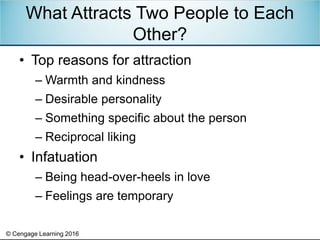
• Top reasons for attraction
– Warmth and kindness
– Desirable personality
– Something specific about the person
– Reciprocal liking
• Infatuation
– Being head-over-heels in love
– Feelings are temporary
What Attracts Two People to Each
Other?
© Cengage Learning 2016
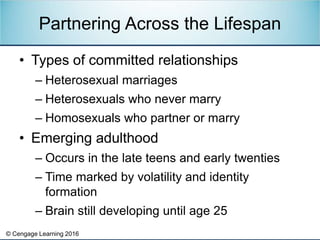
• Types of committed relationships
– Heterosexual marriages
– Heterosexuals who never marry
– Homosexuals who partner or marry
• Emerging adulthood
– Occurs in the late teens and early twenties
– Time marked by volatility and identity
formation
– Brain still developing until age 25
Partnering Across the Lifespan
© Cengage Learning 2016
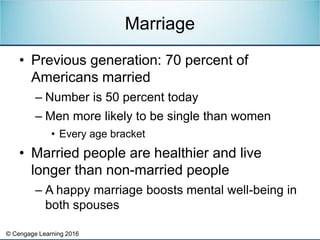
• Previous generation: 70 percent of
Americans married
– Number is 50 percent today
– Men more likely to be single than women
• Every age bracket
• Married people are healthier and live
longer than non-married people
– A happy marriage boosts mental well-being in
both spouses
Marriage
© Cengage Learning 2016
• Families are very diverse
– Gender role reversal more common in African
American families
– Chinese American families often have two
working parents
• Wife may not have equal role in decision-making
– Blended families occur in three of 10
households
• Children of previous relationships
Family Ties

Chapter 4 power point

  • 1.
    © Cengage Learning2016© Cengage Learning 2016 An Invitation to Health: Building Your Future, Brief Edition, 9e Dianne Hales Your Social Health 4
  • 2.
    © Cengage Learning2016 After reading this chapter, the student should be able to: • Explain the meaning of the term social health, using examples • Outline various ways of communicating, including gender specific ones • Examine how relationships contribute to the social health of individuals Objectives
  • 3.
    © Cengage Learning2016 • Evaluate the impact of modern technology on communicating • Identify current trends in dating among young people • Explain the significance of love to an individual’s well-being • Summarize the impact of dysfunctional relationships Objectives (cont’d.)
  • 4.
    © Cengage Learning2016 • Describe the trends, factors, and forms of long-term partnering in America • Summarize the changes that have taken place in the American household over time Objectives (cont’d.)
  • 5.
    © Cengage Learning2016 • Social health includes the ability to: – Interact effectively with people and with the social environment – Develop satisfying personal relationships – Fulfill social roles • Social support affects physical health – People of all ages function best in socially supportive environment The Social Dimension of Health
  • 6.
    © Cengage Learning2016 • Learn to listen – Relationships always involve an emotional investment – Opening yourself up to others increases your own self-knowledge and understanding • Be agreeable but assertive – Communicate your wishes calmly and clearly Communicating
  • 7.
    © Cengage Learning2016 • Communication traits of young boys – Make less eye contact – Vocabulary includes fewer “feeling” words – Faces become less emotional as they grow • Communication traits of adult men – Use fewer words than women – Interrupt more – Make more eye contact when speaking to women than to men Communication Differences Between Men and Women
  • 8.
    © Cengage Learning2016 • As much as 90 percent of communication is nonverbal • Body language – Includes tone of voice, body position • Culture differences affect interpretation of body language – Example: eye contact interpreted as hostile or challenging in one culture • Conveying friendliness in another culture Nonverbal Communication
  • 9.
    © Cengage Learning2016 • Friendship – Basic source of happiness – Source of solace in times of trouble • Emotional closeness declines 15 percent per year in the absence of face-to-face contact • Loneliness – Adolescents, the elderly, adults who live alone, and single parents most affected Forming Relationships
  • 10.
    © Cengage Learning2016 • 10 to 15 percent of children born with predisposition to shyness – Others become shy due to rejection, shame, or lack of learning proper social responses • Types of shyness – Fearfully shy – Self-consciously shy • Social anxiety disorder – Affects about seven percent of the population Shyness and Social Anxiety Disorder
  • 11.
    © Cengage Learning2016 • Altruism – Helping or giving to others – Enhances self-esteem • Volunteerism – Helps those who give as well as those who receive – May lower risk factors for cardiovascular disease Building a Healthy Community
  • 12.
    © Cengage Learning2016 • Almost one-third of the world’s population uses the Internet – 77 percent of Americans • Social networking a growing trend – Individuals who socialize online show same psychological sense of community as those who interact in person • Facebook provides greater social support than Twitter Living in a Wired World
  • 13.
    © Cengage Learning2016 • 94 percent of college students maintain a social networking profile • Motivations – Nurturing or maintaining existing relationships – Seeking new relationships – Enhancing reputation – Avoiding loneliness – Keeping tabs on others – Self-esteem Social Networking on Campus
  • 14.
    © Cengage Learning2016 • What was once shared with one other person is now often shared publicly • Negative aspects of social networking – Sexting • Can have unintended consequences – Excessive cell phone and Internet use – Cyberbullying – Cyberstalking Self-Disclosure and Privacy
  • 15.
    © Cengage Learning2016 • Many young people socialize in groups before venturing into a romantic relationship • Hooking up – Casual sexual encounter – No expectation of emotional intimacy or relationship – Those who participate more likely white, attractive, outgoing, and nonreligious Dating on Campus
  • 16.
    © Cengage Learning2016 • Love is a basic need – Essential to physical and psychological well- being • Intimacy – Open, trusting, sharing of confidential thoughts and feelings – Requires time and nurturing – Does not require sex Loving and Being Loved
  • 17.
    © Cengage Learning2016 • Top reasons for attraction – Warmth and kindness – Desirable personality – Something specific about the person – Reciprocal liking • Infatuation – Being head-over-heels in love – Feelings are temporary What Attracts Two People to Each Other?
  • 18.
  • 19.
    © Cengage Learning2016 • Types of committed relationships – Heterosexual marriages – Heterosexuals who never marry – Homosexuals who partner or marry • Emerging adulthood – Occurs in the late teens and early twenties – Time marked by volatility and identity formation – Brain still developing until age 25 Partnering Across the Lifespan
  • 20.
    © Cengage Learning2016 • Previous generation: 70 percent of Americans married – Number is 50 percent today – Men more likely to be single than women • Every age bracket • Married people are healthier and live longer than non-married people – A happy marriage boosts mental well-being in both spouses Marriage
  • 21.
    © Cengage Learning2016 • Families are very diverse – Gender role reversal more common in African American families – Chinese American families often have two working parents • Wife may not have equal role in decision-making – Blended families occur in three of 10 households • Children of previous relationships Family Ties

Editor's Notes

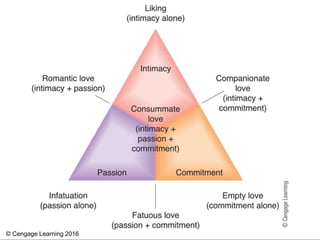
  • #19 Figure 4.1 Sternberg’s love triangle